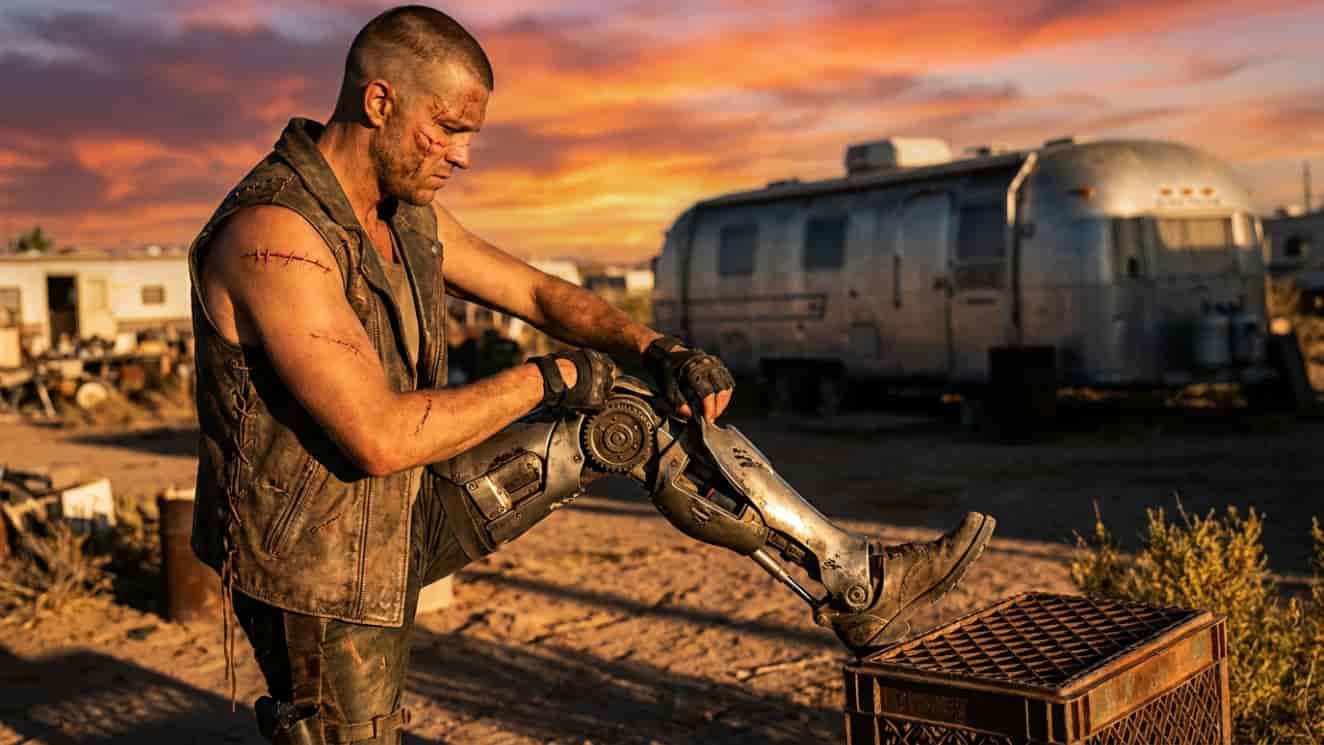
They took his vest. They took his bike. They took the pride he’d spent fifteen years bleeding for on the asphalt of Arizona.
Cody was “out bad”—the worst way a man can leave the 500 MC. No brotherhood. No protection. Just a prosthetic leg and a trailer full of dust.
Everyone in Phoenix knows what happens to a patchless man. You’re supposed to disappear. You’re supposed to crawl into a hole and wait for the heat to finish what the club started.
But Cody has a secret. He didn’t get kicked out for being weak. He got kicked out for being human. And hidden inside the very leg he lost for the club is the one thing they forgot to take.
His mercy is gone. Now, there’s only the debt.
FULL STORY
Chapter 1: The Sound of Tearing
The heat in Phoenix doesn’t just sit on you; it pushes. It’s a physical weight, a heavy, invisible hand pressing your shoulders toward the scorched earth. At four in the afternoon, the asphalt behind the 500 MC clubhouse was soft enough to take an imprint of a boot heel, and the air smelled of ozone, burnt rubber, and the sour, metallic tang of old grease.
Cody felt the sweat stinging the stump of his left leg, right where the liner of his prosthetic met the scarred skin. It was an itch he couldn’t scratch, a dull throb that pulsed in time with the heavy, rhythmic idle of a dozen Harleys lined up like chrome-plated vultures.
He was on his knees. The gravel dug into his right kneecap, but he didn’t shift his weight. To move was to show weakness, and in this circle, weakness was a terminal diagnosis.
“You had one job, Cody,” Big Sam said.
Sam was the President of the Phoenix chapter, a man whose neck was as thick as a utility pole and whose beard was stained yellow by decades of cheap cigarettes. He stood over Cody, the sun at his back, turning him into a massive, dark silhouette.
“The kid wasn’t part of the deal, Sam,” Cody said. His voice was raspy, dry as the Mojave. “He was maybe ten. He didn’t see anything.”
“He saw your face,” a voice called out from the circle. That was Gage. A kid. Twenty-four years old, wearing a vest that looked too new, his skin still unscarred, his ego inflated by the sudden power of a “full patch” he hadn’t earned through anything but blind obedience. “He saw the 500. That’s enough.”
Cody didn’t look at Gage. Looking at Gage was like looking at a mirror of his younger, stupider self, and it made him want to vomit. Instead, he kept his eyes on Sam’s belt buckle—a heavy brass eagle.
“The vote was unanimous,” Sam said, his voice deceptively quiet. “You went soft. And in this life, soft gets people killed. It gets brothers sent to Florence for life. You violated the code. You’re out bad, Cody. No contact. No business. You don’t exist in this city anymore.”
Sam reached out. He didn’t use his hands at first. He used a buck knife with a five-inch blade. He hooked the point under the top seam of Cody’s “500” top rocker—the curved patch that announced his loyalty to the world.
The sound was the worst part. Skritch. The heavy denim of the vest resisted for a second, then gave way. The threads popped like tiny gunshots in the silence of the yard. Cody felt the weight lift off his shoulders—not in a way that felt like freedom, but in a way that felt like being skinned alive.
Sam moved to the bottom rocker: PHOENIX.
Then the center patch. The winged skull. The thing Cody had lost his leg for three years ago, during a high-speed run down the I-10 to deliver a package that should have stayed buried. He’d hit a patch of loose gravel at eighty miles per hour, low-sided, and watched his bike tumble into a bridge abutment while his left leg was crushed into a pulp of bone and gristle. The club had paid for the surgery. They’d paid for the first prosthetic. They’d told him he was a hero.
Now, Sam tossed the severed patches into the dirt at Cody’s feet.
“The bike stays,” Sam said.
“I built that Shovelhead from the frame up,” Cody said, finally looking up. His eyes were watering from the glare, but his face remained a mask of stone. “Every bolt. Every drop of oil.”
“The club’s bike,” Sam corrected. “You’re just the ghost who was riding it.”
Sam turned his back. It was the ultimate insult. He didn’t even consider Cody a threat enough to watch him.
“Gage,” Sam barked. “Get him out of here. Take him to the edge of the lot. He walks from there.”
Gage stepped forward, grinning. He reached down and grabbed Cody by the collar of his now-blank vest, hauling him upward. Cody struggled to get his footing. The prosthetic—a rugged, carbon-fiber model designed for “active lifestyles”—clicked as the knee hinge locked into place. He stumbled, his balance off without the crutches he usually used for long distances.
Gage pushed him toward the gate. The other men, guys Cody had shared beer and blood with for fifteen years, stood like statues. Some looked away. Some stared with a cold, predatory hunger.
“Don’t trip, hop-along,” Gage hissed in his ear.
At the edge of the gravel lot, where the fence met the industrial road, Gage gave Cody one final, violent shove. Cody fell, his hands slapping onto the hot pavement. The heat burned his palms instantly.
Gage stood over him, unzipping his fly. With a smirk, he let a stream of urine hit the pavement inches from Cody’s face, splashing onto his worn leather boots.
“If we see you in a bar, we break the other leg,” Gage said. “If we see you on a bike, we run you over. You’re nothing, Cody. You’re just a gimp with a bad memory.”
Gage turned and walked back toward the clubhouse, his spurs jingling on the asphalt.
Cody sat there for a long time. The sun began to dip, turning the Phoenix sky into a bruised purple and orange. His palms were raw, and his stump was screaming. He reached down and touched the empty space on his chest where the patches used to be. The denim was frayed, the blue fabric underneath darker than the rest of the vest—a ghost image of the life he’d just lost.
He didn’t cry. He didn’t have the moisture to spare. He just waited until his breathing slowed, then he grabbed a discarded piece of rebar from the ditch to use as a makeshift cane and began the three-mile walk to the trailer park.
The trailer was a single-wide in a park called The Palms, though the only palms were two dead, shriveled trunks near the entrance. It was a place for people who were hiding from the law, from debt, or from themselves.
Cody fumbled with his keys, his hands shaking. When the door finally groaned open, the smell hit him—stale air, old coffee, and the lingering scent of Sarah’s perfume. She wasn’t supposed to be there. They’d been divorced for two years, ever since the accident turned Cody into a man who lived for the club and nothing else.
She was sitting at the small laminate table, a first-aid kit open in front of her.
“I heard,” she said. She didn’t look at him. She was looking at a pack of cigarettes on the table, though she didn’t smoke.
“Word travels fast,” Cody said, leaning the rebar against the wall. He collapsed into the recliner, the springs wailing in protest.
“Sam called me,” Sarah said, finally looking up. Her eyes were red-rimmed. She was a nurse at the county hospital, a woman who had seen too much trauma to be easily rattled, but she looked terrified now. “He told me to come get your things. He said you were ‘done.’ Cody, what did you do?”
“I didn’t do something,” Cody said. He reached down and began unstrapping the prosthetic. The relief of the pressure releasing was so intense he almost gasped. He pulled the sleeve off, revealing the red, angry skin of the stump. “That was the problem.”
Sarah stood up and walked over, kneeling beside him. She didn’t ask permission. She took his leg in her hands, her fingers cool and professional. She examined the skin, checking for sores.
“You’re going to get an infection,” she muttered. “You’re pushing it too hard.”
“Doesn’t matter now,” Cody said. “I’m not going anywhere.”
“Sam said if I helped you, there would be trouble for me, too,” she said softly.
Cody froze. He looked at the top of her head, at the gray hairs starting to peek through the brown. He felt a surge of shame so sharp it eclipsed the pain in his leg.
“Then go, Sarah. I didn’t ask you to come.”
“You never do,” she said, looking up at him. “That’s your whole problem. You think being a man means being a desert. Just sand and rocks and nothing else. But look at you. They took your bike, didn’t they?”
“Yeah.”
“And the vest?”
“Yeah.”
She reached out and touched his cheek. Her hand was shaking. “You’re forty-two years old, Cody. You have no money, one leg, and the most dangerous men in the state want you dead. What are you going to do?”
Cody looked past her, toward the corner of the room where his prosthetic sat on the floor. It was a high-end piece of engineering, charcoal gray and sleek.
“I’m going to survive,” he said.
“How?”
He didn’t answer. He couldn’t tell her about the boy. He couldn’t tell her that the boy was currently staying with a cousin in Tucson, and that if the 500 ever found out, the boy wouldn’t be the only one they buried in the desert.
“Go home, Sarah,” he said, his voice hardening. “Please. Before someone sees your car here.”
She stood up, her face setting into a mask of hurt. She packed the first-aid kit with quick, jerky movements.
“You’re a fool,” she said. “You’re still protecting them, even after what they did.”
“I’m not protecting them,” Cody said.
He waited until he heard her car pull away, the gravel crunching under her tires. Then, he leaned forward and grabbed the prosthetic leg.
He didn’t put it back on. Instead, he pulled a small hex key from his pocket. He turned the leg over, revealing a seam near the calf that wasn’t part of the standard manufacturer’s design. A machinist friend in the club—a man who had died in prison last year—had built it for him.
Cody turned the key. A small panel clicked open.
Inside, nestled in custom-molded foam, was a Colt .45. It was clean, oiled, and loaded.
He took the gun out and laid it on his lap. The weight of it felt more honest than the patches ever had. He ran his thumb over the hammer.
He was patchless. He was a gimp. He was a ghost.
But a ghost with a gun could still haunt the living.
Chapter 2: The Ghost of the Road
The following morning brought no relief from the heat. By 8:00 AM, the temperature had already climbed into the nineties, and the air inside the trailer was thick enough to chew. Cody sat by the window, a cup of instant coffee in his hand, watching the entrance to the park.
He wasn’t expecting a social visit. In the world of the 500, “out bad” meant you were radioactive. If a member talked to you, they risked their own patches. If a “hang-around” or a prospect helped you, they were beaten. Cody was a man on an island made of sun-bleached gravel and cheap aluminum siding.
He spent the morning doing what he always did when the world went to hell: maintenance.
He cleaned the prosthetic. He checked the stump for pressure sores. He oiled the Colt. Then, he sat on the floor and tried to figure out his finances. He had three hundred dollars in a coffee can and another four hundred in a checking account the club didn’t know about. Seven hundred dollars wasn’t a life; it was a funeral fund.
Around noon, a truck pulled up. It wasn’t a club bike, which made Cody’s heart skip a beat. It was an old, rusted-out Chevy Silverado with a “Disabled Veteran” plate.
A man climbed out, moving slowly. This was Miller. Miller was sixty, a former Marine who had lost an eye and a chunk of his shoulder in a conflict most people had forgotten. He wasn’t a biker, but he ran the local scrap yard where the club sometimes “processed” things they didn’t want the police to find.
Cody met him at the door, leaning on his crutches.
“You look like hell, Cody,” Miller said, leaning against the railing of the small porch. He didn’t offer a hand. In this neighborhood, even a handshake could be interpreted as an alliance.
“I’ve had better weeks,” Cody said. “What are you doing here, Miller? You know the rules.”
Miller spat a glob of phlegm into the dirt. “I’m too old for rules. And Sam doesn’t own my yard. Not yet, anyway.” He reached into the pocket of his greasy work shirt and pulled out a crumpled envelope. “Found this in the seat of that Shovelhead. Gage brought it in this morning. Said they were gonna chop it for parts just to spite you.”
Cody felt a pang of grief. Chopping that bike was like dismantling a child. He took the envelope. Inside was a Polaroid—a blurry shot of Cody and Sarah at a lake ten years ago. It was the only photo he’d kept on the bike, tucked behind the registration in the tool bag.
“Thanks,” Cody said, his voice thick.
“There’s more,” Miller said, lowering his voice. “Gage was bragging. He’s the one who’s supposed to ‘oversee’ your departure from the city. He’s telling everyone you’re a rat. Says you talked to the Feds about the Tucson run.”
Cody’s grip tightened on the crutch. “I never talked to anyone.”
“Doesn’t matter if it’s true,” Miller said. “It gives them a reason to do more than just strip you. If you’re a rat, they can come for your life, and nobody in the community will say a word. You need to get out, Cody. Take whatever you got and drive until you see snow.”
“I don’t have a car, Miller. They took the bike.”
Miller looked at the Silverado. “I got an old Honda Rebel sitting in the back of the yard. It’s a 250. Small, ugly, and it leaks oil like a sieve. But it runs. If you can get to the yard tonight, it’s yours for the three hundred I know you got in that can.”
Cody looked at the old man. “Why are you helping me?”
Miller’s one good eye went hard. “Because I remember when you stopped Sam from burning down that grocery store on 12th Street because the owner’s kid was inside. You got a memory, Cody. These new kids? They’re just sharks. And I hate sharks.”
Miller turned and walked back to his truck without another word.
Cody spent the rest of the day in a state of vibrating tension. He knew the play. Labeling him a rat was a death sentence. It was Sam’s way of tidying up. If Cody was dead, the secret of the botched hit died with him. The boy in Tucson would be safe, and Sam’s reputation for “unwavering discipline” would remain intact.
As the sun began to set, Cody packed a small duffel bag. A few shirts, socks, the photo Miller had saved, and the Colt.
He didn’t call Sarah. Calling her would put a target on her back. Instead, he wrote a note: Don’t come back here. It’s not yours anymore. I’m sorry about everything. He left it on the laminate table.
The walk to Miller’s scrap yard was four miles. In the daylight, it would have been impossible. In the cooling evening, it was merely agonizing. Every step with the prosthetic felt like a needle being driven into his hip. He avoided the main roads, sticking to the alleys and the dry irrigation ditches that crisscrossed the suburbs.
He was a mile away when he saw the lights.
A pair of headlights turned into the alley behind him. They weren’t moving fast. They were prowling.
Cody didn’t run. He couldn’t. He ducked behind a row of overflowing trash bins and pulled the Colt from his waistband. He felt the cold steel against his palm, the familiar checkering of the grip.
The vehicle crawled past. It was a blacked-out SUV—a club chase vehicle. He recognized the dent in the rear bumper. Gage was inside. He could hear the low thrum of heavy bass vibrating the metal.
They were looking for him.
Cody held his breath, the smell of rotting citrus and sun-heated plastic filling his lungs. The SUV paused at the end of the alley, its brake lights glowing like demon eyes, then turned onto the street.
He waited five minutes before moving.
When he finally reached the scrap yard, Miller was waiting by the gate. The old Honda Rebel was leaning against a stack of flattened cars. It looked pathetic—a small, spindly thing compared to the thundering Shovelhead he’d lost.
“Keys are in it,” Miller said.
Cody handed over the three hundred dollars. It was nearly half of everything he had.
“Good luck, ghost,” Miller said.
Cody climbed onto the bike. His left leg—the fake one—felt awkward on the footpeg. He had to use his hand to lift his leg and place the foot correctly. He kicked the starter. It took four tries before the engine coughed into a weak, sewing-machine hum.
He rode out of the yard, the wind hitting his face. It wasn’t the roar of freedom he was used to. It was a desperate, rattling flight.
He headed south. Tucson was two hours away. He had to make sure the kid was still there. He had to make sure his silence had bought the boy the safety he’d promised.
But as he hit the outskirts of the city, he saw a familiar sight in his vibrating rearview mirror. A single headlight.
It wasn’t a car. It was a bike. And it was gaining fast.
Cody twisted the throttle, but the 250cc engine had nothing more to give. The bike behind him roared—a deep, aggressive V-twin scream.
A moment later, the bike pulled alongside. It was Gage.
He was riding Cody’s Shovelhead.
The sight of it sent a jolt of pure, unadulterated fury through Cody’s chest. Gage was wearing a shit-eating grin, his hair blowing in the wind, his hand resting casually on his thigh as he matched Cody’s speed.
Gage reached out and kicked Cody’s handlebars.
The small Honda wobbled violently. Cody fought to keep it upright, his heart hammering against his ribs.
“Nice ride, rat!” Gage shouted over the wind. “Suits you! A little bike for a little man!”
Gage sped up, then veered sharply in front of Cody, forcing him to slam on the brakes. The Honda skidded, the tires screaming on the asphalt. Cody managed to keep it from going down, but he stalled the engine.
Gage circled back, the Shovelhead idling with a predatory growl. He stopped ten feet away, the chrome reflecting the moon.
“Sam sent me to finish the paperwork,” Gage said, reaching into his vest. He didn’t pull out a pen. He pulled out a brass knuckle duster. “He said a rat shouldn’t have to walk all the way to Tucson.”
Cody sat on the stalled bike, his hands still on the grips. He felt the weight of the Colt in his waistband, hidden by his jacket.
“You shouldn’t be riding that bike, Gage,” Cody said quietly. “You don’t know how to handle it.”
“I’m handling it just fine,” Gage sneered. He hopped off the bike, leaving it idling, and walked toward Cody. “I’m gonna break that other leg, and then I’m gonna see how fast you can crawl.”
Gage lunged. He was fast, but he was arrogant. He swung a wide, looping right hook with the brass knuckles.
Cody didn’t dodge. He leaned back, letting the blow graze his chest, and then he did something Gage didn’t expect.
He swung his left leg.
The carbon-fiber prosthetic wasn’t just a limb; it was a three-pound club of reinforced plastic and steel. It caught Gage squarely in the ribs with a sickening crack.
Gage gasped, the air leaving his lungs in a ragged burst. He stumbled back, clutching his side.
Cody didn’t wait. He rolled off the Honda, landing on his right leg and his crutch. He reached into his waistband and pulled the Colt.
Gage’s eyes went wide. He froze, his hand halfway to the knife on his belt.
“You… you can’t,” Gage stammered, his bravado vanishing like smoke in a gale. “The club… they’ll kill you for this.”
“They already tried,” Cody said. He stepped forward, the barrel of the .45 pointed directly at Gage’s throat. “Get off my bike.”
“It’s not yours anymore!”
Cody thumbed the hammer back. The click was loud in the desert silence.
“Get. Off. My. Bike.”
Gage backed away, his hands raised. He looked small now. Just a kid in a costume he didn’t understand.
Cody reached out and grabbed the handlebars of the Shovelhead. The vibration of the engine traveled up his arm, a familiar, comforting pulse. It was like touching the hand of an old friend.
“Walk back, Gage,” Cody said. “Tell Sam I’m coming for the rest of my things.”
Gage didn’t argue. He turned and started running back toward the city lights, his boots thumping on the pavement.
Cody climbed onto the Shovelhead. He kicked the Honda over into the ditch—a three-hundred-dollar sacrifice. He shifted the heavy bike into gear.
The 500 MC thought they had stripped him. They thought they had taken his identity.
They were wrong. They had just removed the leash.
Chapter 3: The Heat of the Hive
Tucson felt different than Phoenix. It was higher, the air a fraction thinner, but the heat was just as relentless. Cody rolled into the city at 3:00 AM, the Shovelhead’s exhaust echoing off the closed storefronts of South Tucson. He was exhausted, his body a map of pain, but the adrenaline of the encounter with Gage was still humming in his marrow.
He found the house—a small, crumbling stucco box with a chain-link fence and a yard full of dead cactus. This was where the kid, Mateo, was supposed to be.
Cody parked the bike two blocks away and walked the rest of the distance. He didn’t want the roar of the V-twin to wake the neighborhood. He moved through the shadows, his prosthetic clicking rhythmically on the sidewalk.
He sat on the curb across from the house and waited.
As the sun began to bleed over the Rincon Mountains, the front door opened. A woman stepped out, wrapped in a thin cardigan despite the growing warmth. A moment later, a small boy followed her. He was carrying a backpack that looked too big for him.
Mateo.
He looked exactly as he had three weeks ago, standing in that dusty warehouse while Sam screamed at Cody to “do what needed to be done.” The boy’s eyes were still wide, still haunted, but he was alive. He was going to school.
Cody felt a strange, hollow ache in his chest. He had destroyed his life for this child. He had lost his brotherhood, his reputation, and his safety for a boy who didn’t even know his name.
Was it worth it? the voice in his head asked. It sounded like Sam’s voice.
Cody watched them walk to a bus stop at the corner. He waited until they were gone, then he turned and walked back to his bike.
He needed a plan. He couldn’t stay in Tucson, and he couldn’t go back to Phoenix as a marked man. He needed money, and he needed a way to neutralize the threat of the 13—the council that ran the 500.
He rode to a truck stop on the edge of town, a place where the transient nature of the clientele provided a thin layer of anonymity. He went into the diner, ordered a black coffee, and sat in a corner booth with his back to the wall.
He wasn’t alone for long.
A man in a grease-stained jumpsuit sat down opposite him. This was “Sully,” a man Cody had known for a decade. Sully was a ghost of a different kind—a former club treasurer who had “retired” after a mysterious fire destroyed the club’s financial ledgers five years ago.
“You’re a hard man to find, Cody,” Sully said, not looking at him. He was staring at a menu he’d seen a thousand times.
“Not hard enough, apparently,” Cody replied.
“The 13 are pissed. Gage came back crying about his ribs and a stolen bike. Sam put a green light on you. Five thousand to the man who brings back your prosthetic leg with the stump still attached.”
Cody took a slow sip of his coffee. “Sam always was a cheap bastard. I’m worth at least ten.”
Sully chuckled, a dry, rattling sound. “He’s scared, Cody. He knows you saved the kid. And he knows that if the National President finds out Sam ordered a hit on a ten-year-old, Sam’s life expectancy drops to about fifteen minutes. It’s bad for business. It brings the wrong kind of heat.”
“So Sam is cleaning house to protect his own skin.”
“Exactly. You’re the only loose thread.”
Cody leaned forward, his voice dropping an octave. “I need the ledger, Sully.”
Sully froze. He finally looked up, his eyes narrow. “The ledger? The one that supposedly burned?”
“We both know it didn’t burn. You kept a copy. You kept it as insurance in case Sam ever decided you were ‘soft’ too.”
Sully was silent for a long time. The clatter of plates and the low hum of the truckers’ conversations filled the gap between them.
“That ledger is a nuclear bomb, Cody,” Sully said. “It’s got names. Dates. Payoffs to the Sheriff’s department. It’ll bring down the whole chapter. Not just Sam.”
“I don’t care about the chapter,” Cody said. “I care about the kid. And I care about Sarah. If I have that ledger, I have leverage. I can make Sam back off.”
“Or you can make him desperate enough to burn the whole city down to stop you.”
“He’s already trying to kill me, Sully. How much worse can it get?”
Sully sighed, rubbing his face with his hands. “It’s in a locker at the Greyhound station in Phoenix. Box 412. The key is taped to the underside of the third sink in the men’s room.”
Cody nodded. “Why are you giving it to me?”
Sully looked at Cody’s empty sleeve, the place where the patches used to be. “Because I watched you lose that leg for a club that didn’t deserve it. And because I’m tired of seeing the wrong people win.”
Sully stood up and walked away without looking back.
Cody sat there for another hour, thinking. Going back to Phoenix was suicide. The Greyhound station was five miles from the 500 clubhouse. It was their backyard. They’d have scouts at every entrance, every bus stop, every bar.
He left the diner and walked to the Shovelhead. As he reached for the handlebars, he felt a sharp, cold pressure against the back of his neck.
“Don’t move, hop-along.”
It wasn’t Gage. It was a man named Jax, one of the 13. He was older, smarter, and much more dangerous. He was holding a snub-nosed revolver against Cody’s spine.
“Sam figured you’d head for the kid,” Jax said. “He’s got guys at the house in Tucson, too. You’re lucky I found you first. I’d rather just get this over with.”
Cody stood perfectly still. He could feel the heat radiating off the bike’s engine, the smell of hot oil.
“You really want to do this here, Jax? In front of fifty witnesses?”
“Truckers don’t see anything,” Jax said. “They just want to get their loads to Cali. Now, walk toward the SUV. Nice and slow.”
Jax started to lead him away from the bike. Cody’s mind raced. He couldn’t reach the Colt in his waistband—Jax was too close.
As they passed a parked semi-truck, Cody intentionally tripped. He let his prosthetic knee “buckle,” sending him sprawling onto the gravel.
“Get up!” Jax hissed, stepping closer to grab Cody’s arm.
That was the mistake.
Cody rolled onto his back, and as Jax reached down, Cody used his right foot to kick Jax’s knee with everything he had.
Jax screamed, his leg snapping sideways. The revolver went off, the bullet thudding into the dirt inches from Cody’s head.
Cody didn’t hesitate. He lunged upward, grabbing Jax’s wrist and slamming it against the concrete bumper of the parking space. The gun clattered away.
Cody didn’t stop. He pinned Jax against the truck’s tire and delivered a flurry of punches to the man’s face—short, brutal blows fueled by years of repressed anger.
“Where’s Sam?” Cody growled, his hands stained with Jax’s blood.
“Go to hell,” Jax spat, his nose a shattered mess.
Cody reached down and grabbed his own prosthetic leg. He unlatched the quick-release strap, pulling the entire limb off. He held the heavy carbon-fiber foot over Jax’s head like a mace.
“I’ve already lost one leg to this club, Jax. I don’t mind losing a little more. Tell me where Sam is, or I’ll use this to paint the pavement with your brains.”
Jax looked at the prosthetic, then at the cold, dead look in Cody’s eyes. He realized then that he wasn’t looking at a “brother” anymore. He was looking at a man who had nothing left to lose.
“He’s at the clubhouse,” Jax wheezed. “They’re having a meeting tonight. The National President is coming in from Oakland. Sam’s trying to cook the books before he arrives.”
Cody dropped the leg. He scrambled to his feet, hopping on one leg, and grabbed the revolver Jax had dropped.
He hopped back to the Shovelhead, leaned against it, and strapped his leg back on. His hands were shaking, but his mind was clear.
The National President. That changed everything. If Cody could get the ledger and present it to the “Big Boss,” Sam wouldn’t just be out of a job. He’d be out of time.
He kicked the Shovelhead into life. The roar was a declaration of war.
He wasn’t running anymore. He was going home.
Chapter 4: The Weight of the Secret
The ride back to Phoenix was a blur of shimmering heat and internal ghosts. Cody kept the Shovelhead at a steady seventy, the wind whipping his beard, his eyes shielded by dark, scratched lenses. Every mile he covered was a mile closer to a confrontation he knew he might not survive.
He bypassed the city center, taking the long way around through the industrial districts of Glendale. He needed a place to lie low until the meeting began at midnight.
He thought about the kid, Mateo. He thought about the way the boy had looked at him in that warehouse—not with fear of the gun, but with a quiet, devastating confusion. Like he couldn’t understand why the world was suddenly so loud and so dark.
Cody had seen that look before. He’d seen it in the mirror after the accident.
He pulled into a graveyard of old machinery—an abandoned bottling plant where he used to hide stolen bikes back when he was a prospect. The air inside was cool and smelled of damp concrete and rust.
He sat on a crate, the Shovelhead ticking as it cooled. He pulled the Colt out and checked the action. Then he checked Jax’s revolver. Seven rounds total.
He thought about Sarah. He wanted to call her, just to hear her voice, but he knew the 500 would be monitoring her phone. He’d already put her in enough danger.
Why did I stay so long? he wondered.
The club had been everything. When he was twenty, it was a family. When he was thirty, it was a career. By forty, it was a cage. He’d traded his marriage, his health, and his soul for the “winged skull,” only to find out the skull was hollow.
At 10:00 PM, he moved.
The Greyhound station was a neon-lit island of desperation. People with Nowhere-to-Go sat on plastic chairs, clutching bags that contained their entire lives. Cody moved through them like a shadow. He looked like just another drifter—dirty, limping, wearing a blank denim vest.
He found the men’s room. It was foul, the walls covered in layers of graffiti and grime. He went to the third sink and reached underneath.
His fingers brushed against cold metal. Taped to the underside of the basin was a small, brass key.
He went to the locker bay. Box 412.
The lock turned with a satisfying click. Inside was a thick, leather-bound book and a flash drive.
Cody opened the ledger. It wasn’t just numbers. It was a diary of corruption. Lists of “donations” to the local DA. Records of drug shipments from the cartel. And most importantly, the notes for the Tucson hit. Sam had written it down—the target, the price, and the order to “leave no witnesses.”
Cody felt a cold chill that had nothing to do with the air conditioning. This was it. This was the end of Sam.
As he closed the locker, he saw a reflection in the polished metal of the door.
Two men were standing at the entrance to the locker bay. They weren’t travelers. They were wearing “500” patches.
“Going somewhere, Cody?” one of them asked. It was Miller’s nephew, a kid named Leo who had always been too eager to please Sam.
Cody didn’t say a word. He tucked the ledger under his arm and started walking toward the back exit.
“Hey! I’m talking to you!” Leo shouted.
They moved to intercept him. Cody didn’t slow down. As Leo reached out to grab him, Cody swung the heavy ledger like a brick, catching the boy in the temple. Leo went down, his eyes rolling back.
The second man pulled a knife. Cody didn’t even draw his gun. He simply used his prosthetic leg to sweep the man’s feet out from under him, then dropped a heavy knee into his chest.
He was out the back door and onto the Shovelhead before the station security even realized there was a fight.
He rode toward the clubhouse.
The “Church” of the 500 MC was a low, windowless building surrounded by a ten-foot fence topped with concertina wire. Tonight, the parking lot was packed. There were bikes from California, Nevada, and New Mexico. The “Big Boss” was in town.
Cody parked a block away, hidden behind a dumpster. He took off his vest. He didn’t want the blank denim to give him away. He was just a man in a t-shirt and jeans now.
He approached the fence. He knew a spot near the back where the wire was loose—a secret he’d kept since his days as a prospect.
He slipped through, his prosthetic catching for a second on a piece of jagged metal. He bit his lip to keep from crying out as the carbon fiber scraped against the steel.
He reached the back door of the clubhouse. He could hear the low rumble of voices inside—dozens of men, the air thick with smoke and tension.
He waited. He needed the right moment.
Inside, Sam would be giving his report. He’d be lying about the Tucson run. He’d be telling the National President that Cody was a rat who had gone to the Feds.
Cody adjusted the Colt in his waistband. He had the ledger in his left hand.
He felt a sudden, sharp pain in his stump. The skin was blistering, the sweat and the friction of the last forty-eight hours finally taking their toll. He leaned against the cool brick wall, closing his eyes.
Just a little longer, he told himself.
Suddenly, the back door swung open.
Cody flattened himself against the wall. A man stepped out, lighting a cigarette. It was Miller.
The old man saw Cody and froze. He looked at the gun, then at the ledger, then at Cody’s face.
“You’re a dead man if you go in there,” Miller whispered, his voice trembling.
“I’m already dead, Miller,” Cody said. “I’m just here to deliver the mail.”
Miller looked at the clubhouse door, then back at Cody. He reached into his pocket and pulled out a heavy brass key.
“This is for the side entrance. The one that leads directly to the President’s office. Sam is in there now with the National. They’re alone.”
Cody took the key. “Why, Miller?”
“Because my nephew is in there,” Miller said, his eyes tearing up. “And if you don’t stop Sam, Leo is going to end up just like you. Or worse.”
Cody nodded. He moved toward the side door.
He inserted the key. It turned silently.
He stepped into the hallway. The walls were lined with photos of the club’s history—faces of men who were either dead or in prison. At the end of the hall was a heavy oak door.
He could hear Sam’s voice.
“…Cody was always a liability, Mr. President. The accident broke his head as much as his leg. He’s been talking to a guy in the 4th precinct. I had to cut him loose.”
“And the Tucson job?” a deep, gravelly voice asked. That would be the National President, a man they called “The Judge.”
“Handled,” Sam said. “No loose ends.”
Cody pushed the door open.
The room went silent.
Sam was sitting behind his massive desk, a glass of whiskey in his hand. Sitting opposite him was a tall, lean man with graying hair and a suit that cost more than Cody’s trailer.
“Not quite, Sam,” Cody said, stepping into the light.
Sam’s face went from pale to purple in three seconds. He reached for the drawer of his desk.
“Don’t,” Cody said, raising the Colt. “I’ve got seven rounds, and I only need one.”
The Judge didn’t move. He leaned back in his chair, his eyes fixed on Cody.
“You’re Cody,” he said. It wasn’t a question.
“I am.”
“Sam says you’re a rat.”
Cody tossed the ledger onto the desk. It landed with a heavy thud, knocking over Sam’s whiskey.
“Sam says a lot of things. But he doesn’t usually write them down. This is the real book, Judge. Not the one Sam showed you. It’s got the Tucson hit. It’s got the name of the kid Sam told me to kill. And it’s got the bank account where Sam is skimming ten percent of the National’s cut.”
Sam lunged across the desk. He wasn’t going for a gun; he was going for the ledger.
Cody didn’t shoot. He used the butt of the Colt to strike Sam across the jaw. The President collapsed back into his chair, blood blooming on his lip.
The Judge picked up the ledger. He flipped through the pages in silence. The only sound in the room was the ticking of a clock and Sam’s ragged breathing.
After five minutes, the Judge closed the book.
“Sam,” the Judge said softly. “You’ve been a very busy man.”
“He’s lying!” Sam shouted. “He forged it! He’s trying to save his own skin!”
The Judge looked at Cody. “Why did you bring this to me? You could have gone to the police. You could have been safe.”
Cody looked at the winged skull on the wall. “Because I believed in the code once. And because the kid didn’t deserve to die for your business.”
The Judge nodded slowly. He stood up and walked to the door. He opened it and barked an order to the men in the hallway.
“Bring Gage in here. And the rest of the 13.”
Cody stayed in the corner, the gun still in his hand. He watched as the room filled with the men he’d once called brothers. They looked at him with a mix of fear and confusion.
The Judge held up the ledger.
“Sam is out,” the Judge announced. “Effective immediately. He’s ‘out bad.’ No contact. No business. And he’s going to explain to the council exactly where that ten percent went.”
The room was silent. Sam looked around, searching for a friendly face, but he found none. The men who had laughed with him an hour ago were now looking at him like he was a leper.
“What about Cody?” Gage asked, his voice trembling.
The Judge looked at Cody. “Cody is a civilian. He’s leaving Phoenix tonight. And if any member of the 500 so much as breathes in his direction, they’ll answer to me personally.”
Cody lowered the gun. He felt a sudden, overwhelming wave of exhaustion.
“I want my bike,” Cody said.
The Judge nodded. “Take it. And get out of my sight.”
Cody walked out of the room. He passed through the clubhouse, the men parting like the Red Sea. He didn’t look at them. He didn’t want their respect, and he didn’t want their forgiveness.
He walked to the Shovelhead. It was sitting in the middle of the lot, the chrome gleaming under the floodlights.
He climbed on, kicked it into life, and rode out the gate.
He didn’t look back at the clubhouse. He didn’t look back at the city.
He headed north. Toward the mountains. Toward the cool air.
He was patchless. He was a gimp. He was a ghost.
But for the first time in fifteen years, he was a man.
Chapter 5: The Long Road Back
The Mogollon Rim rises up from the desert floor like a jagged spine of limestone and pine. By the time Cody reached the higher elevations, the temperature had dropped forty degrees. The air was crisp, smelling of juniper and damp earth. He pulled over at a scenic turnout and sat on a stone wall, watching the sun rise over the valley he’d just escaped.
Phoenix looked like a shimmering mirage in the distance, a grid of light and heat that seemed small and insignificant from this height.
He took off his boot and his prosthetic. The stump was a mess—blistered, bleeding, and swollen. He used a bottle of water and a clean rag to wash away the grit. He winced, the cold water stinging the raw flesh.
He stayed there for hours, just breathing.
He knew it wasn’t over. Sam was out, but men like Sam didn’t just disappear. They stewed. They plotted. And the 500 MC was still a predator, even if its head had been swapped.
Around noon, he rode into Flagstaff. He found a cheap motel on the edge of town—the kind of place where they don’t ask for ID if you pay in cash. He slept for fourteen hours, a deep, dreamless sleep that felt like a kind of death.
When he woke, he felt different. The weight that had been pressing on his chest for years—the weight of the patches, the weight of the secrets, the weight of the “brotherhood”—was gone.
He walked to a nearby diner, leaning heavily on a new pair of wooden crutches he’d bought at a drugstore. He sat at the counter and ordered a massive breakfast.
He was halfway through his eggs when he saw a familiar face in the window.
It was Sarah.
He froze, his fork halfway to his mouth. She was standing by his bike, her hands on her hips, looking at the Shovelhead like it was a poisonous snake.
Cody pushed his plate away and walked to the door.
“How did you find me?” he asked, stepping onto the sidewalk.
She turned, her face a mix of fury and relief. “You left a note on the table, Cody. You’re a biker, not a spy. I checked every motel in Flagstaff. There are only six that take cash and don’t care about a man with one leg.”
“You shouldn’t be here, Sarah.”
“I’m tired of being told what I should and shouldn’t do,” she said, walking toward him. She stopped inches from his chest. “I heard what happened. Miller called me. He said you’re a hero.”
“I’m not a hero,” Cody said, looking at his boots. “I just stopped being a coward.”
“Whatever you call it, it’s over,” she said. She reached out and took his hand. “Sam is gone. The Judge sent him to a ‘farm’ in Nevada. He won’t be coming back.”
Cody felt a shiver. He knew what the “farm” meant. It was a euphemism for a hole in the desert.
“And the kid?”
“Safe. The National President personally oversaw his relocation. He’s with his mother in California now. They have a new name. New lives.”
Cody nodded. He felt a strange sense of peace. He’d done what he set out to do.
“What now?” Sarah asked.
Cody looked at the Shovelhead. He looked at the long, winding road that led toward the Grand Canyon.
“I’m going to sell the bike,” he said.
Sarah’s eyes went wide. “You… you what? You love that bike more than anything.”
“I used to,” Cody said. “But it’s a part of that life. And I’m done with that life. I want a car. A boring, reliable car with an automatic transmission and air conditioning.”
Sarah smiled, a genuine, warm smile that he hadn’t seen in years. “I think I can help with that.”
They spent the afternoon at a local dealership. Cody traded the Shovelhead for a used Toyota Tacoma. It was white, unassuming, and had plenty of room for his crutches in the back.
As he signed the paperwork, he felt a pang of sadness. He was giving up the one thing he’d built with his own hands. But as he climbed into the driver’s seat and turned on the AC, he realized he wasn’t losing anything. He was just changing gears.
He drove Sarah back to her car. They stood in the parking lot of the motel, the sun setting behind the San Francisco Peaks.
“Are you coming home?” she asked.
Cody looked at her. He saw the woman who had stayed by his side through the accident, through the divorce, and through the madness of the club. He saw the only person who had ever truly known him.
“Not yet,” he said. “I need some time. I need to figure out who Cody is without the vest.”
She nodded, her eyes soft. “I understand. But don’t stay away too long. Phoenix is a lot cooler when you’re not in the middle of a fire.”
She kissed him on the cheek and drove away.
Cody sat on the bumper of his truck, watching her tail lights disappear. He felt a sudden, sharp pain in his stump. He reached down and adjusted the prosthetic.
He thought about the boy, Mateo. He thought about the way the boy had looked at him in the diner.
He’s safe, Cody thought. And so am I.
He climbed into the truck and started the engine. He didn’t head south toward Phoenix. He headed north.
He didn’t know where he was going, and he didn’t care. He had a full tank of gas, a working leg, and a clean conscience.
The ghost was finally at rest.
Chapter 6: The Quiet After
The desert is never truly silent. Even in the dead of night, there is the hum of insects, the rustle of dry brush, and the distant, lonely howl of a coyote. But for Cody, sitting on the porch of a small cabin in Sedona, the silence felt absolute.
It had been six months since he’d left Phoenix.
He’d spent the time working as a dispatcher for a local trucking company. It was quiet work. He sat in an air-conditioned office, talked on the radio, and moved pieces around a map. It didn’t require a vest, a gun, or a brotherhood. It just required a voice and a brain.
His leg had healed. He’d seen a specialist in Flagstaff who had fitted him with a new prosthetic—a “walking” model that didn’t pinch or rub. He could walk a mile now without needing a crutch. He still had a limp, but it was a limp of survival, not a limp of shame.
He’d kept in touch with Miller. The old man was doing well. He’d taken over the scrap yard entirely, and the 500 MC had stayed away. The new Chapter President in Phoenix was a man named “Bones,” a veteran who understood that peace was more profitable than war.
One evening, a car pulled up the long, winding driveway.
Cody didn’t reach for a gun. He just watched.
It was a black SUV. For a second, his heart hammered against his ribs—a ghost of the old fear. But when the door opened, it wasn’t a biker who stepped out.
It was a boy.
He was older now, taller. He was wearing a clean t-shirt and jeans. Behind him, a woman stepped out.
Mateo.
Cody stood up, his heart in his throat.
The boy walked toward the porch, his eyes fixed on Cody. He stopped at the bottom of the steps.
“My mom said I should come see you,” Mateo said. His voice was higher than Cody remembered, but his eyes were the same.
“Hello, Mateo,” Cody said.
“The Judge told us where you were,” the woman said, walking up behind her son. “He said you were the one who saved us.”
Cody looked at the woman. She looked tired, but she looked happy.
“I just did what I had to do,” Cody said.
Mateo stepped up onto the porch. He looked at Cody’s leg.
“Does it hurt?” he asked.
Cody looked down at the carbon-fiber limb. “Sometimes. But it’s a good kind of hurt. It reminds me I’m still here.”
The boy nodded. He reached into his pocket and pulled out a small, smooth stone—a piece of turquoise he’d found in the desert.
“This is for you,” he said, handing it to Cody. “For being my ghost.”
Cody took the stone. It was cool and solid in his hand.
“Thank you, Mateo.”
They stayed for an hour. They talked about California, about school, and about the new life they were building. When they left, Cody felt a sense of closure that he hadn’t known was missing.
He watched their car disappear into the twilight.
He went inside the cabin and sat at his small wooden table. He picked up a pen and a piece of paper.
Dear Sarah, he wrote.
He stopped. He didn’t know what to say. He didn’t know how to explain the way the world looked now.
He looked at the turquoise stone sitting on the table.
I think I’m ready to come home, he wrote.
He folded the paper and put it in an envelope.
He walked outside and sat on the porch again. The sun had set, and the stars were beginning to appear.
He was patchless. He was a gimp. He was a ghost.
But he wasn’t alone.
He looked out over the desert, at the vast, shimmering expanse of the Arizona night. He felt the wind on his face, the cool, mountain air filling his lungs.
He closed his eyes and listened to the silence.
It was the most beautiful thing he’d ever heard.