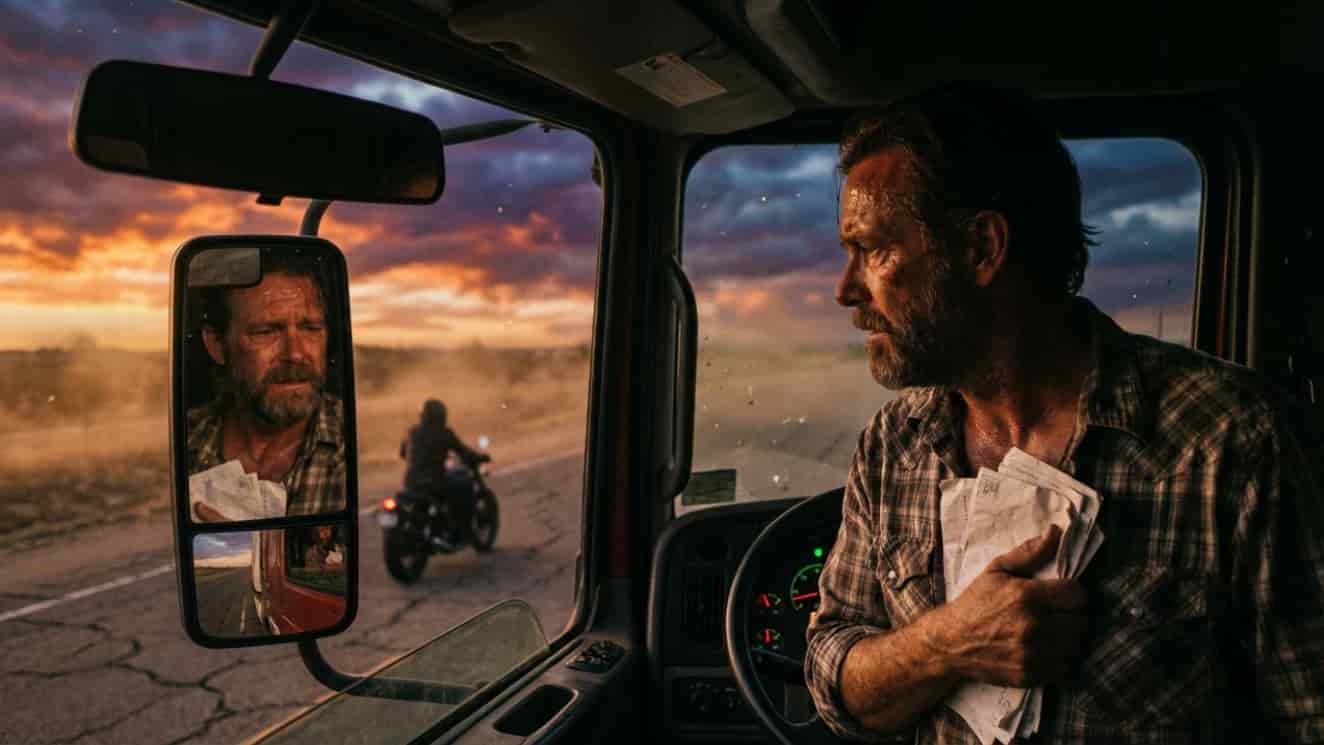
Wyatt knew the smell of the Texas Interstate better than the scent of his own skin—hot asphalt, diesel exhaust, and the dry, metallic tang of an approaching storm. He also knew the weight of the twenty kilos sitting in the hidden compartment behind his seat.
It was supposed to be high-purity methamphetamine, worth more than the truck he was driving. But as he pulled into a derelict rest stop near Abilene, Wyatt knew it was just bleached flour and spite.
He was a dead man driving. He’d known that since he started the swap three states back. Chapter 500 didn’t forgive mistakes, and they certainly didn’t forgive betrayal. But they’d killed his sister with the very poison he’d been hauling for years, and Wyatt decided if he was going to hell, he’d burn the road down behind him.
The problem was the shadow in his mirror. A black bike that had been there for five hundred miles. Caleb. The club’s best cleaner.
Wyatt touched the stack of letters in his pocket—words meant for a girl who’d never read them—and shifted into gear. He wasn’t running anymore. He was just waiting for the crash.
FULL STORY
Chapter 1
The heat in West Texas doesn’t just sit on you; it tries to get inside your bones. Wyatt sat in the cab of a 2004 Ford F-150 that had seen better decades, the air conditioning blowing nothing but a lukewarm suggestion of a breeze. His shirt was stuck to the vinyl seat, and the grit of the road felt like it had been sandblasted into his pores. He looked at the digital clock on the dash. 2:14 PM. He was twenty minutes late for the check-in, and in his line of work, twenty minutes was long enough for people to start checking the cylinders of their revolvers.
He pulled the truck into the “Lone Star Fuel & Wash,” a place that looked like it had been dying since the eighties. The paint on the pumps was peeling like sunburnt skin, and the only other vehicle was a rusted-out combine harvester on a trailer. Wyatt didn’t get out immediately. He checked the side mirror.
The black Harley-Davidson Street Glide was there, idling at the edge of the lot, just far enough away to look like a coincidence to anyone who wasn’t looking. But Wyatt had been looking for six hundred miles. The rider didn’t dismount. He just sat there, a dark silhouette against the shimmering heat waves of the asphalt. Caleb.
Wyatt took a deep breath, the air tasting of stale tobacco and old French fries. He reached under the passenger seat and felt the edge of the heavy, plastic-wrapped bricks. They were supposed to be the “Blue Sky” batch—the pure stuff that the Chapter 500 MC used to fund their entire operation from El Paso to Little Rock.
He climbed out of the cab, his boots crunching on the dry gravel. His knees popped—a reminder of thirty-four years of bad choices and heavy lifting. He walked toward the back of the gas station, past the dumpster that smelled like rotting meat, and into the single-stall bathroom.
The lock didn’t work. He jammed a piece of folded cardboard into the doorframe to keep it shut. The light overhead flickered with a rhythmic hum that made his teeth ache. He reached into his oversized denim jacket and pulled out two bricks of the product. Beside them, he produced a five-pound bag of Gold Medal flour he’d bought at a Kroger in New Mexico.
His hands were shaking. Not a lot, just a fine tremor that made the plastic crinkle too loudly in the small, tiled room.
“Dumb way to die, Wyatt,” he whispered to the cracked mirror.
He used a pocketknife to slit the side of the first brick. The white powder inside was fine, crystalline. It looked like salt. It looked like the stuff that had stopped his sister Casey’s heart in a bathtub in Amarillo three months ago. He didn’t think about the money. He didn’t think about the “brotherhood” he was betraying. He just thought about the way her blue lips had looked in the fluorescent light of the morgue.
He dumped the meth into the toilet. He watched it swirl down, a fortune in misery disappearing into the county sewage line. Then, with a steady hand he didn’t know he still possessed, he began funneling the flour into the plastic sleeve. He packed it tight, smoothing it out until the weight felt right. He used a small handheld heat sealer—the kind people used for leftovers—to close the seam.
He repeated the process with the second brick. When he was done, he tucked the “clean” packages back into his jacket and flushed the toilet one more time to clear the residue.
When he stepped back out into the sun, the biker was closer. Caleb had moved the Harley to a spot right next to Wyatt’s truck. He was leaning against the fender, cleaning his fingernails with a buck knife. He wasn’t wearing his “colors”—the vest with the Chapter 500 patch—but everyone in the life knew who Caleb was. He was the one they sent when the ledger didn’t balance.
“Taking a long time for a piss, Wyatt,” Caleb said. His voice was like low-grade sandpaper. He didn’t look up from his nails.
“Prostate’s shot,” Wyatt lied, walking to the driver’s side door. “Comes with the territory.”
Caleb finally looked up. His eyes were a flat, unreadable gray. He looked Wyatt up and down, lingering on the slight bulge in the denim jacket. “You’re off the pace. Big Boss wants the drop at Mile Marker 500 by midnight. You start lagging, I start wondering why.”
“Road’s hot, Caleb. State troopers are thick near Midland. I’m playing it safe.”
Caleb closed his knife with a sharp clack. “Safe is a funny word for a guy like you. You been acting different since the funeral. Quiet. Distracted.”
Wyatt opened his truck door. “Losing family does that.”
“We’re your family now,” Caleb said, and for the first time, there was a edge of something like a threat in the tone. “Don’t forget who paid for that casket, Wyatt. Don’t forget who keeps the lights on in that shitty apartment of yours.”
Wyatt climbed into the cab and slammed the door. He didn’t look back as he pulled out onto the highway. He could feel Caleb’s eyes on the back of his neck, a physical pressure that didn’t let up even when he hit seventy-five on the straightaway.
In the glove box, tucked under a stack of unpaid bills and a map of the Panhandle, was a bundle of envelopes. They were addressed to Casey. He’d started writing them the day after she died. He told her about the weather. He told her about the way the desert looked at dusk. He told her how sorry he was that he’d been the one to bring the first baggie home six years ago, thinking it was just a party favor.
He reached out and touched the top envelope with the tip of his finger.
“Almost there, Case,” he murmured. “Just a few more miles of flour, and then we’re both out of the business.”
In the distance, the horizon was a jagged line of purple clouds. A storm was coming, the kind that turned the Texas sky green and tore the roofs off trailers. Wyatt pushed the accelerator down. He had five more bricks to swap, three hundred miles to go, and a shadow on two wheels that wasn’t going to let him go without a fight.
Chapter 2
The rain didn’t bring the temperature down; it just turned the world into a humid, gray soup. Wyatt’s windshield wipers were old and brittle, leaving wide streaks of water that blurred the taillights of the semi-trucks ahead of him. He was south of Lubbock now, where the cotton fields stretched out into an endless, flat nothingness.
He needed to swap three more bricks, but Caleb was riding his bumper, the Harley’s single headlight a persistent, blinding eye in his side mirror. The man was a ghost, a mechanical haunting.
Wyatt saw a sign for a “24-Hour Truck Stop & Diner.” He flicked his blinker on. He needed a crowd, or at least the illusion of one.
The diner was called The Rusty Hub. It was filled with the smell of burnt coffee and the low hum of a television mounted in the corner playing weather reports. A few truckers sat in vinyl booths, their faces illuminated by the pale blue glow of their phones.
Wyatt slid into a booth at the far back, near the restrooms. A moment later, the bell above the door jingled. Caleb walked in, water dripping from his black leather jacket. He didn’t sit with Wyatt. He took a stool at the counter, three rows away, and ordered black coffee. He didn’t take off his sunglasses, despite the gloom.
A waitress appeared at Wyatt’s table. She looked like she’d been working the same shift since 1994—tired eyes, hair dyed a shade of red that didn’t exist in nature, and a name tag that said Marnie.
“Coffee,” Wyatt said. “And a slice of whatever pie isn’t older than I am.”
Marnie lingered, her hand on her hip. She looked at Wyatt, then shifted her gaze to Caleb at the counter, then back to Wyatt. “You look like you’re carrying the world on your shoulders, sugar. And that friend of yours looks like he’s looking for a place to bury it.”
Wyatt forced a smile. It felt heavy and fake. “Just a long haul, Marnie. We’re moving some furniture for a friend.”
“Furniture,” she repeated, her voice flat. “Right. I’ve seen enough ‘furniture’ movers come through here to know you all have the same look in your eyes. You’re the one from Amarillo, aren’t you? The one with the sister?”
Wyatt froze. The air in the diner suddenly felt very thin. “How do you know that?”
Marnie sighed, leaning down to wipe a stray crumb off the table. “Casey used to stop here. On her way to see you, she said. She was a sweet girl. Always tipped well, even when she looked like she hadn’t slept in three days. I heard what happened. I’m sorry.”
Wyatt gripped his coffee mug so hard his knuckles turned white. “She shouldn’t have been on the road.”
“None of us should be,” Marnie said softly. She looked at Caleb again. The enforcer was watching them through the mirror behind the counter. “Whatever you’re doing, honey… just make sure it’s worth it. That one over there? He looks like the kind of man who doesn’t believe in second chances.”
She walked away before Wyatt could answer.
He felt a surge of nausea. The reality of what he was doing—the sheer, suicidal scale of it—hit him like a physical blow. He wasn’t just stealing from the Chapter 500; he was mocking them. He was turning their empire of glass into a bakery.
He stood up and walked toward the bathroom, his jacket heavy with the remaining bricks of meth.
Inside the stall, he worked faster this time. The panic was a cold knot in his stomach. He slit the plastic, dumped the white powder into the trash can under a pile of paper towels, and replaced it with the flour.
Clack.
The sound of the bathroom door opening.
Wyatt went perfectly still. He held his breath, the heat sealer still in his hand. He could see a pair of heavy black engineer boots in the gap under the stall door. Caleb.
“You know, Wyatt,” Caleb’s voice boomed in the small, tiled space. “The club is like a clock. Every gear has to turn at the same speed. If one gear starts slipping, the whole thing breaks.”
Wyatt didn’t move. He looked at the brick of flour in his lap. “I’m just taking a dump, Caleb. Give a man some privacy.”
“You’ve been ‘taking a dump’ at every stop for four hundred miles,” Caleb said. His boots didn’t move. “I’m starting to think you’re sick. Or maybe you’re just nervous. You got something to be nervous about?”
“Just the rain,” Wyatt said, his voice steady despite the hammer of his heart. “And your ugly face in my mirror.”
A long silence followed. The only sound was the drip-drip-drip of a leaky faucet.
“Finish up,” Caleb said finally. “We’re losing light. And Wyatt? If I have to come into that stall, you aren’t gonna like what I find.”
The boots turned and walked out.
Wyatt slumped against the plastic partition, a cold sweat breaking out across his forehead. He finished the swap, his fingers fumbling with the heat sealer. He had two bricks left. The most dangerous ones.
He walked back out into the diner. Caleb was already at the door, waiting. Marnie was behind the counter, her eyes fixed on Wyatt with a look of profound, silent pity.
As Wyatt passed her, she whispered, “Drive fast, sugar.”
He stepped back out into the rain. The wind had picked up, howling through the gaps in the truck’s door seals. He climbed in and started the engine.
As he pulled back onto I-20, he saw Caleb’s headlight flare to life behind him.
He reached into his pocket and pulled out one of the letters. He didn’t need to read it; he knew the words by heart.
Dear Casey, I’m doing it. I’m finally doing the thing I should have done years ago. I’m making it right. I don’t know if I’ll see the end of the week, but for the first time in a long time, I don’t mind. I just hope you can see the mess I’m making. I think you’d find it funny.
He tucked the letter back. Ahead of him, the mile markers counted down. 510. 509. 508.
The end of the road was coming, and it was paved with flour and blood.
Chapter 3
Mile Marker 500 wasn’t a town. It wasn’t even a proper exit. It was a sun-bleached stretch of highway where a gravel road veered off into a cluster of rusted oil derricks and an abandoned cattle loading pen. This was the “Dead Zone,” a place where the Chapter 500 did their business because the local sheriff was paid to be elsewhere and the nearest neighbor was ten miles of scrub brush away.
Wyatt’s truck rattled as he turned onto the gravel. The rain had stopped, leaving behind a thick, suffocating fog that clung to the ground. Caleb was right behind him, the Harley’s engine a low, predatory growl.
Waiting in the center of the loading pen was a silver Cadillac Escalade. Two men stood beside it, their silhouettes sharp against the white fog. One was “Big” Sal, a man whose neck was wider than Wyatt’s thigh, and the other was a younger kid Wyatt didn’t recognize—probably a new prospect looking to earn his patch.
Wyatt killed the engine. The silence that followed was heavy, broken only by the tink-tink-tink of his cooling radiator.
Caleb pulled up, kicked his stand down, and dismounted in one fluid motion. He didn’t say a word. He just walked over to the Cadillac and nodded at Sal.
Wyatt stepped out of the truck. He felt like he was walking to the gallows. He reached into the cab and pulled out the duffel bag containing the twenty bricks—two real ones at the bottom, eighteen bags of flour on top.
“You’re late, Wyatt,” Sal said. He didn’t sound angry; he sounded bored, which was worse. Boredom meant he was already thinking about his next meal, and Wyatt was just a checkbox on a list.
“Truck’s acting up,” Wyatt said, dropping the bag onto the hood of the Cadillac. The thud sounded hollow to his ears, though he knew it was just his imagination.
The young prospect stepped forward, a serrated knife in his hand. “Let’s see the harvest.”
Wyatt’s heart skipped a beat. This was the moment. Usually, they just checked the weight and the seal. Testing the product was for when they didn’t trust the source.
“Wait,” Caleb said.
Everyone looked at him. Caleb stepped into the circle of the Cadillac’s headlights. He looked at Wyatt, then at the bag.
“Wyatt’s been real regular with his bathroom breaks today,” Caleb said, his voice light. “Every hundred miles. Like he had a schedule.”
Sal frowned, his heavy brow furrowing. “So? Man’s getting old. Bladders leak.”
“Maybe,” Caleb said. He walked over to Wyatt, stopping just inches away. He was taller than Wyatt, and he smelled like rain and expensive cigarettes. “But Wyatt isn’t just old. He’s grieving. And a grieving man is a dangerous man, Sal. He starts thinking about things like ‘legacy’ and ‘justice.'”
Caleb reached out and patted Wyatt’s denim jacket. He felt the bulge in the inner pocket—the last brick Wyatt hadn’t had time to swap. The real one.
Wyatt didn’t flinch. He couldn’t. He was frozen in a state of pure, crystalline terror.
Caleb reached into Wyatt’s jacket and pulled out the brick. He held it up to the light. It was a “Blue Sky” brick, the real deal.
“See?” Sal grumbled. “It’s right there. Stop being a paranoid prick, Caleb.”
Caleb didn’t look at Sal. He kept his eyes on Wyatt. He took his knife and made a tiny slit in the corner of the brick. He dipped his finger in, took a small pinch of the powder, and rubbed it against his gums.
His eyes widened slightly. “Oh, that’s the real thing, alright. That’s the fire.”
He looked at the bag on the hood. Then back at Wyatt. A slow, terrifying smile spread across Caleb’s face.
“But this one was in his pocket,” Caleb said softly. “Not in the bag. Why would you keep one for yourself, Wyatt? Planning on a little early retirement?”
“It’s for the road,” Wyatt lied, his voice cracking. “A little something to keep me awake.”
“Bullshit,” Caleb said. He turned to the prospect. “Check the bag. All of it.”
The kid stepped up and grabbed the top brick from the duffel. He sliced it open.
Wyatt closed his eyes. He waited for the shout. He waited for the sound of a gun being cocked.
“White,” the kid said. “Looks fine.”
“Taste it,” Caleb commanded.
The kid took a pinch of the flour and put it on his tongue. He made a face. “Tastes… weird. Kinda chalky.”
“Chalky?” Sal stepped forward, his boredom replaced by a sharp, predatory interest. “Let me see that.”
Sal took the bag. He dumped a handful of the white powder into his palm. He sniffed it. He tasted it.
His face went from pale to a deep, bruised purple in three seconds.
“This is flour,” Sal roared. He grabbed Wyatt by the throat and slammed him against the side of the truck. The metal groaned under the impact. “You brought us twenty kilos of fucking Gold Medal?”
Wyatt gasped for air, his feet dangling off the ground. “It’s… it’s a joke, Sal… I…”
“Where is it?” Sal screamed, his spittle hitting Wyatt’s face. “Where’s the product? You sell it? You think you can rip off the 500?”
Caleb didn’t join in the shouting. He just stood there, watching Wyatt with a look of intense, clinical curiosity. He still had the one real brick in his hand.
“He didn’t sell it,” Caleb said, his voice cutting through Sal’s rage. “Look at him. He doesn’t have the stomach for a flip. He didn’t do this for money.”
Caleb walked over and leaned in close to Wyatt’s ear, while Sal continued to choke him.
“You did it for the girl, didn’t you?” Caleb whispered. “You thought you’d starve the beast. You thought if you took this batch off the street, you’d be saving someone.”
Wyatt managed to choke out a single word: “Yeah.”
Sal threw Wyatt to the ground. Wyatt scrambled backward, his back hitting the rear tire of his truck. He was bruised, bleeding from a cut on his lip, and utterly cornered.
“Kill him,” Sal said to the prospect. “Do it slow. I want to see his eyes when he realizes how much this flour cost him.”
The kid pulled a Glock from his waistband.
“Wait,” Caleb said, stepping between the kid and Wyatt.
“What now?” Sal growled. “He’s a rat, Caleb. He’s a dead man.”
“He’s a message,” Caleb corrected. He looked down at Wyatt. “The 500 doesn’t just kill rats. We make them useful. Wyatt knows the route. He knows the hidden stashes. He told me earlier about the dặm số 500—the mile marker stash. He’s got the real stuff buried there, don’t you, Wyatt?”
Wyatt looked up. He hadn’t said a word about a hidden stash. He’d dumped the meth in the toilets of three different gas stations. There was nothing at Mile Marker 500 but dirt and old beer cans.
But Caleb was looking at him with a strange, hard intensity. A signal.
“Yeah,” Wyatt croaked, catching the lifeline. “Under the old oak… at the marker. It’s all there. The real batch.”
Sal paused, his greed warring with his bloodlust. “The whole batch?”
“Every bit,” Wyatt said. “I was gonna come back for it once I was clear. Just kill me and you’ll never find it. The wind’s already covering the tracks.”
Sal looked at Caleb. Caleb shrugged. “He’s telling the truth. I saw him digging near a marker back in New Mexico. I thought he was just taking a leak.”
Sal spat on the ground. “Fine. We go to the marker. If the product isn’t there, Wyatt, I’m gonna peel your skin off while you’re still breathing.”
They threw Wyatt into the back of the Escalade. As Caleb climbed onto his Harley to lead the way, he caught Wyatt’s eye through the window.
It wasn’t a look of mercy. It was the look of a man who was playing a much deeper, much more dangerous game.
Chapter 4
The drive back toward the highway was silent, the interior of the Escalade smelling of expensive leather and the prospect’s nervous sweat. Sal sat in the front, his massive hands gripping the grab bar, his eyes fixed on the Harley’s taillight ahead of them.
Wyatt sat in the middle of the back seat, flanked by the kid with the Glock. His mind was racing. He’d bought himself maybe twenty minutes of life. There was no stash. There was no oak tree. Mile Marker 500 was just a piece of painted metal in the middle of a windswept flatland.
Why did Caleb lie?
The question looped in Wyatt’s head like a broken record. Caleb was the club’s most loyal hound. He’d killed for less than eighteen kilos of flour. Yet, he’d just handed Wyatt a stay of execution.
“You’re a dead man, you know,” the kid whispered next to him. “Even if we find the stuff. Sal doesn’t like being played.”
Wyatt didn’t answer. He looked out the window. The fog was thinning, revealing the vast, empty expanse of the Texas night. He thought about the letters in his truck. They were still there, in the glove box. They’d find them. They’d read his confessions. They’d find out about Marnie at the diner. They’d find out everything.
“I’m already dead,” Wyatt said softly. “I’ve been dead since Amarillo.”
The Escalade slowed. Ahead, Caleb had pulled the Harley onto the shoulder of the highway. He was standing next to the Mile Marker 500 sign.
Sal climbed out of the car before it even stopped moving. “Alright, rat. Where is it?”
They dragged Wyatt out. The wind was whipping across the plains now, cold and sharp. Wyatt looked around. There was nothing but scrub brush and a barbed-wire fence.
“The oak tree,” Sal prompted, his hand moving toward the heavy mag-light on his belt. “I don’t see no fucking tree, Wyatt.”
Wyatt looked at Caleb. The enforcer was leaning against the marker, his face obscured by the darkness. He was holding a flare.
“It’s further back,” Wyatt said, pointing toward a dark silhouette in the distance. “Near the drainage pipe.”
Sal gestured for the prospect to follow Wyatt. “Go. Check it. If he so much as twitches, blow his head off.”
Wyatt started walking, his boots sinking into the soft, muddy earth. The prospect followed him, the Glock leveled at Wyatt’s spine.
As they moved away from the lights of the Cadillac, the darkness swallowed them.
“I don’t see no pipe,” the kid muttered. “You’re lying, aren’t you?”
“It’s there,” Wyatt said. His voice was different now—calm, almost detached. He reached into his pocket and felt the last thing he had left. A heavy brass lighter he’d stolen from his father twenty years ago.
Suddenly, a bright, blinding light erupted behind them.
WHOOSH.
Wyatt spun around. The Harley was on its side, and a river of fire was snaking across the asphalt. Caleb had dropped the flare into the Harley’s fuel tank. The bike exploded in a spectacular ball of orange flame, the shockwave knocking Sal to the ground.
“What the hell?” the prospect shouted, turning his gun toward the explosion.
That was the moment Wyatt moved. He didn’t run away; he ran at the kid. He slammed his shoulder into the boy’s chest, the air leaving the prospect’s lungs in a sharp wheeze. They hit the ground together, rolling in the dirt.
Wyatt wasn’t a fighter, but he was a man who had nothing left to lose, which made him a monster. He gouged at the kid’s eyes, bit down on his hand until he felt the Glock slip free.
He didn’t shoot. He didn’t know how to use the thing. He just threw the gun as far into the scrub brush as he could.
Across the road, the scene was chaos. Sal was screaming, his clothes partially on fire, stumbling away from the burning bike. Caleb was nowhere to be seen.
Then, a voice came from the shadows behind Wyatt.
“Over here, Wyatt.”
Caleb emerged from the darkness near the drainage pipe. He wasn’t holding a weapon. He was holding a heavy canvas bag—the one from Wyatt’s truck.
“You took my bag?” Wyatt panted, standing up. The prospect was curled in a ball on the ground, clutching his throat.
“I took the letters,” Caleb said. He held up the bundle of envelopes addressed to Casey. “And I took the real brick. The one I found in your pocket.”
Wyatt stared at him. “Why? Why the hell are you doing this?”
Caleb looked at the burning wreckage of his bike. He looked at Sal, who was now stumbling toward them, a tire iron in his hand.
“Because I knew her too,” Caleb said.
The words hit Wyatt harder than Sal’s fist ever could.
“Casey?”
“She was in El Paso two years ago,” Caleb said, his voice flat, devoid of emotion. “She didn’t know who I was. I didn’t tell her. I just… I watched her. I saw what the club was doing to her. I saw what you were doing to her, Wyatt. Moving the weight while she was drowning in it.”
Caleb stepped closer. The light from the burning Harley cast long, dancing shadows across his face.
“I wanted to kill you a dozen times,” Caleb continued. “But then I saw you at the funeral. I saw you crying over that cheap plywood box. And I thought, maybe he’ll do it. Maybe he’ll finally grow a spine and burn it down.”
“Caleb!” Sal’s voice roared from the road. “You traitorous piece of shit! I’m gonna kill you both!”
Caleb ignored him. He handed the canvas bag to Wyatt.
“There’s ten thousand in cash in there. Club money I ‘requisitioned’ from the last drop. And the letters. Get in the Cadillac. The keys are in the ignition.”
“What about you?” Wyatt asked.
Caleb pulled a second flare from his pocket. He looked at Sal, who was closing the distance, the tire iron raised.
“I’m a gear that’s slipping, Wyatt,” Caleb said with a ghost of a smile. “I’ve been waiting to break for a long time.”
Caleb turned and walked toward Sal. He didn’t run. He didn’t hide. He just walked into the light of the fire.
Wyatt didn’t wait to see the rest. He ran for the Cadillac. He jumped into the driver’s seat, jammed the car into gear, and floored it.
As he sped away, he looked in the rearview mirror. He saw two shadows collide in the middle of the highway, silhouetted against the dying orange glow of the motorcycle.
He didn’t look back again.