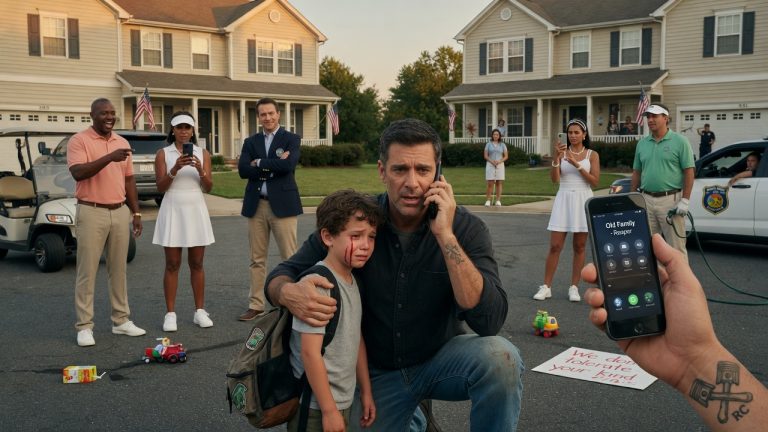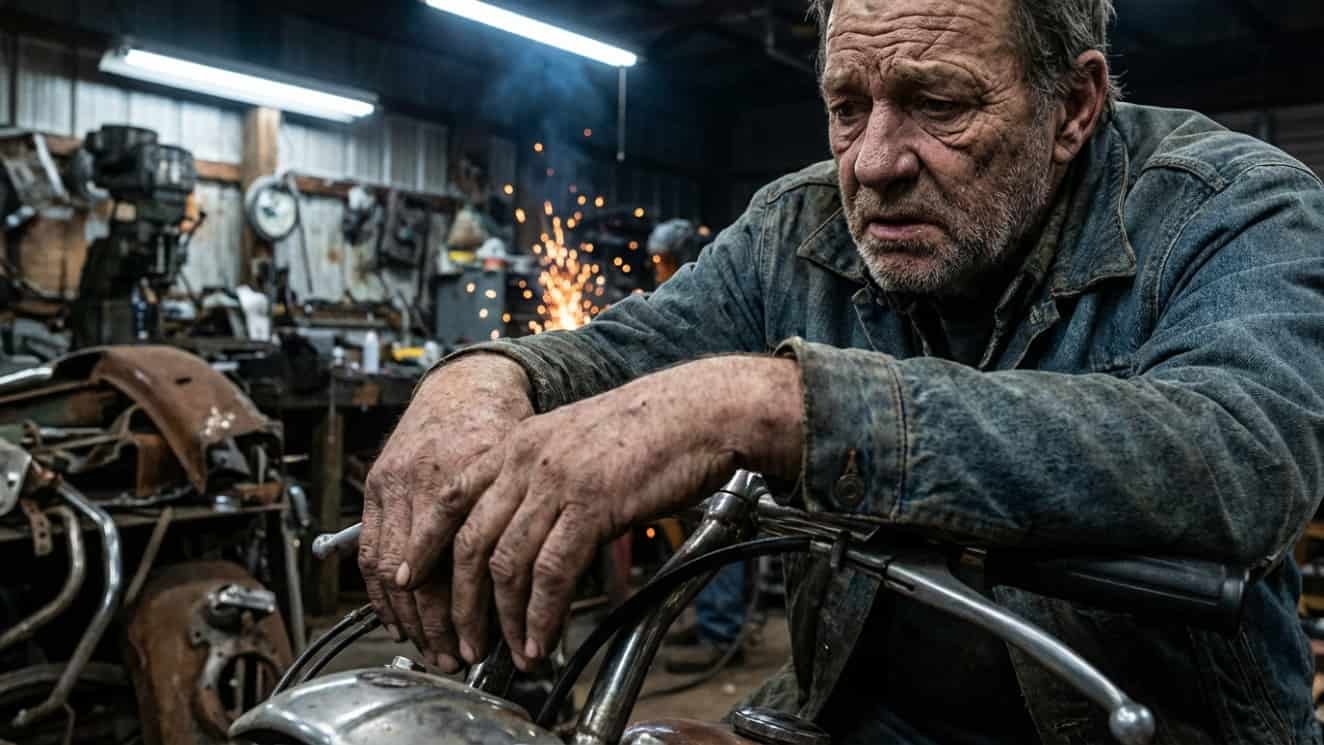
Hank’s hands didn’t work the way they used to. In the damp Ohio cold, his knuckles felt like they’d been stuffed with broken glass, and the simple act of holding a wrench was a daily negotiation with pain. He was seventy-one, living in a trailer behind a scrapyard, surrounded by the rusted skeletons of the machines he used to master.
He was a legend in the Iron Saints—the man who built the first five hundred bikes that put the club on the map. But legends don’t pay the rent, and they don’t fix the tremors in a man’s grip.
When Gabe, the new president of the Saints, rolled a vintage 1978 Shovelhead into the shop, Hank felt a coldness that had nothing to do with the weather. He knew that bike. He knew the weight of its frame, the specific whine of its primary drive, and the secret buried in the steel—a secret that killed a man thirty years ago.
Gabe didn’t want a restoration. He wanted more speed. He wanted “the legendary Hank touch.”
But as Hank looked at his shaking hands and then at the man who represented everything the club had become—cruel, greedy, and hollow—he realized he had a choice. He could fix the flaw he’d hidden in that bike decades ago. Or he could let the iron do what he’d designed it to do.
FULL STORY
Chapter 1: The Weight of Iron
The morning air in northern Ohio didn’t just feel cold; it felt heavy, like a wet wool blanket left out in the rain. Hank sat on the edge of his cot in the trailer, watching his hands. That was his morning ritual now. He waited for the joints to unlock, for the stiffness of the rheumatoid arthritis to settle into a dull, manageable throb rather than the lightning-strike stabs that had woken him at 4:00 AM.
He squeezed a rubber ball, his knuckles white and oversized, looking like walnuts shoved under his skin. It took twenty minutes before he could make a fist. Twenty minutes of staring at the wood-paneled walls of a twelve-by-sixty-foot box that smelled like old coffee and WD-40.
Outside, the scrapyard was waking up. The sound of a front-end loader moving crushed cars echoed across the lot—a rhythmic, metallic crashing that was the soundtrack to his life. Hank stood up, his knees popping, and reached for his denim vest. The patches were faded, the “Iron Saints” rocker across the back cracked and peeling, but the leather was soft as butter, molded to his frame over forty years of riding.
He walked across the muddy yard to the “Shop”—a corrugated metal shed that leaked when the wind blew from the North. Inside, Leo was already there. Leo was twenty-two, with a neck tattoo of a weeping willow and a way of moving that suggested he thought the world owed him a favor it hadn’t delivered yet. He was fast with a wrench, but he treated the machines like they were just scrap metal. He didn’t listen to them.
“Pot’s fresh,” Leo said without looking up. He was stripping the paint off a gas tank, the chemical smell thick in the air.
Hank poured a mug of black coffee, his hand shaking just enough to splash a few drops onto the workbench. He wiped them away with a rag, his movements slow and deliberate. “You’re taking too much off the edges, Leo. You hit that metal too hard, the primer won’t sit right.”
Leo shrugged, the abrasive pad whirring. “It’s a Honda, Hank. The guy just wants it black. He ain’t gonna notice the feathering.”
“I’ll notice,” Hank said. His voice was like gravel being turned in a drum.
He sat down at his primary bench, the one with the specialized jigs he’d built himself. On it sat a carburetor from a ’65 Panhead. It was a delicate piece of machinery, a clockwork heart of brass and steel. He picked up a screwdriver, but his thumb wouldn’t find the purchase. It just slid off. He tried again, his jaw tightening.
The sound of motorcycles cutting through the yard silenced the shop. It wasn’t the polite hum of the bikes Leo worked on. It was the guttural, chest-thumping roar of big-bore American V-twins. Hank knew that sound. It was the sound of a storm coming.
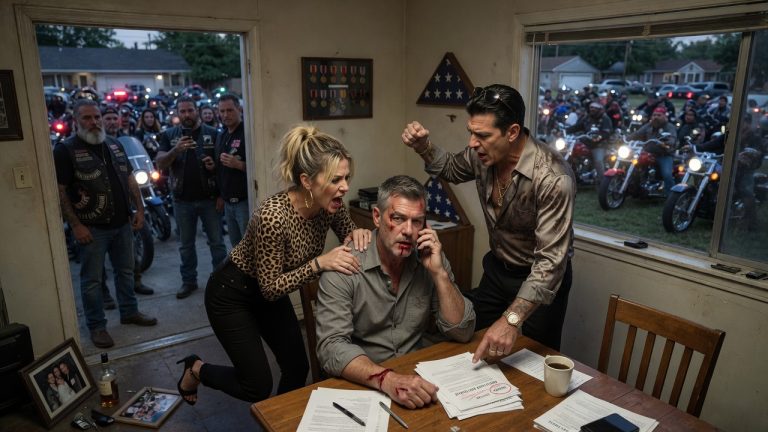
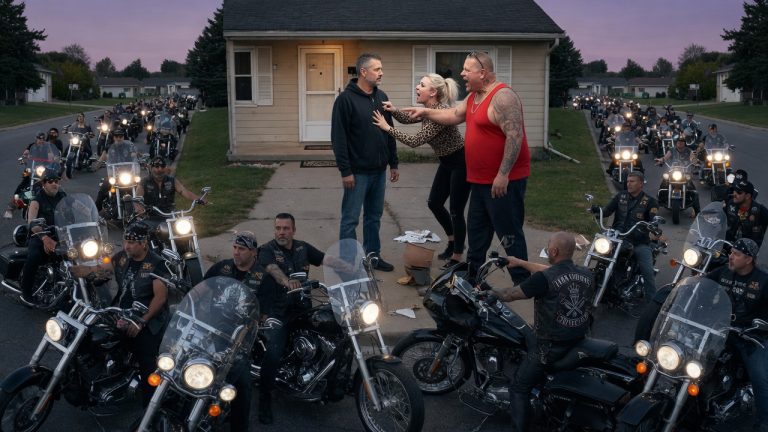
Three bikes pulled up, kicking up plumes of grey Ohio mud. The men on them didn’t turn off the engines immediately; they let them idle, a deliberate display of noise and power. The leader was Gabe. He was forty, maybe a little less, with a beard trimmed into a sharp point and eyes that always seemed to be looking for a fight he knew he’d win. He was the President of the Iron Saints now, a role he’d taken by being louder and meaner than anyone else after the old guard died off or ended up in Lexington.
Gabe hopped off his bike, leaving it running. He walked into the shop like he owned the air inside it. He didn’t look at Leo. He looked at Hank.
“Hank,” Gabe said, his voice a practiced drawl. “You look like hell.”
“I’m seventy-one, Gabe. I’m allowed,” Hank replied, finally setting the screwdriver down. He couldn’t hide the tremor, so he sat on his hands. “What brings the Saints out to the scrap heap?”
Gabe signaled to the two men behind him. They were rolling a bike off a trailer—a vintage Shovelhead, draped in a tattered tarp. They pushed it into the center of the shop, the tires flat and rotting.
Gabe pulled the tarp back.
Hank felt the breath leave his lungs. He knew that bike. He’d built it in 1978 for a man named Miller, the co-founder of the Saints. It was the “Black Widow”—a custom-framed, long-reach chopper that had been the pride of the club until the night Miller took a turn too fast on Highway 6 and ended up as a collection of broken bones in a drainage ditch.
“Found it in a barn out near Sandusky,” Gabe said, running a hand over the rusted chrome of the handlebars. “Miller’s kid was selling his estate. Didn’t know what he had. But I know. This is the bike that started it all. This is the bike the President of the Saints should be riding.”
Hank didn’t move. He stared at the frame. He looked at the specific rake of the front end, the way the down-tubes met the crankcase. He remembered the night he’d welded those tubes. He remembered the anger he’d felt—the way Miller had been skimming off the club’s top, the way he’d treated Hank like a common grease monkey.
“It’s a curse, Gabe,” Hank said softly. “That bike killed the man who owned it.”
Gabe laughed, a short, sharp sound. “Miller was a drunk. He missed a turn because he was half a bottle deep into Jack. The bike’s a masterpiece. And I want it running. Better than new. I want it faster, meaner, and I want it done by the spring rally.”
Hank looked at his hands. “I can’t do it, Gabe. My hands… they don’t do that kind of work anymore.”
Gabe stepped closer, the smell of expensive leather and cheap cologne hitting Hank. He leaned over the workbench, his shadow falling over the carburetor. “Listen to me, old man. You’re living on Saints land. This scrapyard? The club owns the deed. You’re here because we let you be here. You’re a ‘legend’ because we tell people you are. You fix this bike, or I find someone who can—and then I find someone else to move into this trailer.”
He looked over at Leo, who was watching with wide, hungry eyes.
“The kid looks like he wants a shot,” Gabe said, a cruel smile spreading across his face. “Maybe he can do it while you sit in a rocking chair and watch. But it gets done. Or you’re out.”
Gabe turned and walked out, his men following. The roar of their engines faded, leaving a silence in the shop that felt heavier than the Ohio winter.
Leo walked over to the Black Widow, his hand hovering over the seat. “Is it true? You built this whole thing from scratch?”
Hank didn’t answer. He was looking at the neck of the frame, where a small, almost invisible bead of weld sat. Underneath that weld was a notch—a deliberate, half-inch cut in the structural steel he’d made thirty years ago. He’d hidden it with lead and paint. It was designed to hold under normal stress, but to snap like a dry twig if the bike hit eighty miles an hour and hit a bump.
He had meant to kill Miller. And he had.
Now, the ghost he’d built was back, and it was asking for more blood.
Chapter 2: The Ghost in the Chrome
For three days, Hank didn’t touch the Black Widow. He sat in his chair and watched Leo work on other things, the rusted chopper sitting in the center of the floor like an unexploded bomb. Leo kept glancing at it, his ambition radiating off him like heat.
“Why you scared of it?” Leo asked on the fourth morning, his voice echoing in the tin-walled shop. “It’s just metal, Hank. Rusted, shitty metal.”
“It’s not just metal,” Hank said. He stood up, the pain in his hips making him winced. “Go get the degreaser and the brass brushes. If we’re going to do this, we do it right. Strip it down to the bones. Every bolt, every washer.”
As Leo began the messy work of breaking the bike down, Hank retreated into the memories he’d spent decades trying to drown in cheap beer. 1978. The Saints weren’t a business then; they were a brotherhood of men who’d come home from a war they didn’t understand to a country that didn’t want them. Hank had been the quiet one, the one who could make a machine sing. Miller had been the voice.
But Miller had been a parasite. Hank remembered the day he found out Miller had been taking the “funeral fund” money—money meant for the widows of club members—and spending it on cocaine and high-stakes poker in Cleveland. When Hank confronted him, Miller had laughed.
“What are you gonna do, Hank? You’re a mechanic. You’re the help. Without me, you’re just a guy in a dirty shirt.”
Hank’s hands hadn’t shaken then. They had been steady as stone. He had spent three nights in this very shop—before it was a scrapyard, back when it was a thriving garage—modifying the frame of Miller’s new custom build. He’d calculated the physics. He’d known exactly where the stress would peak.
He’d watched Miller ride away on it that Friday night. He’d even waved.
“Hey, look at this,” Leo said, snapping Hank back to the present.
Leo was pointing at the engine block. The grease was gone, revealing a series of fine, hand-etched numbers.
“That’s my signature,” Hank said, his voice trailing off. “Every engine I built for the first five hundred had a number. This is 001. The first one.”
“It’s beautiful,” Leo whispered. For the first time, there was real respect in the boy’s voice. “The way the cooling fins are shaved… nobody does that anymore. It’s too much work.”
“It was a different time,” Hank said. He reached out, his trembling fingers brushing the cold iron of the cylinder head. The metal felt like an old friend who knew all his darkest secrets.
As the weeks passed, the work became a grueling marathon. Hank couldn’t do the heavy lifting anymore. He had to direct Leo, his voice becoming the tool. “A quarter-turn more, Leo. Feel the tension. Don’t force it. Listen to the threads.”
Leo was a fast learner, but he was impatient. He wanted to skip steps. He wanted to use power tools where a hand-touch was required.
“You’re rushing,” Hank barked one afternoon when Leo tried to force a gasket into place. “You rush this, and it leaks. A leak leads to a seize. A seize leads to a funeral. You want to be responsible for Gabe hitting the pavement?”
Leo looked up, a strange glint in his eyes. “Gabe’s a prick, Hank. You know it, I know it. If he hits the pavement, maybe the club gets someone better.”
Hank felt a chill. He saw himself in Leo—that same cold calculation, that same feeling of being undervalued and over-pressured. “Don’t talk like that. A mechanic’s job is to keep the rider alive. That’s the code. It’s the only thing that separates us from the junk we work on.”
“Is that what you did for Miller?” Leo asked.
The shop went dead quiet. Even the loader outside seemed to stop.
“What did you say?” Hank asked, his voice low and dangerous.
Leo stood up, wiping his hands on a greasy rag. “I hear things, Hank. I go to the bars. The old-timers… they talk when they’re drunk. They say Miller’s bike didn’t just fail. They say it was the only bike Hank ever built that broke in half.”
Hank felt the room spin. He gripped the edge of the workbench, his knuckles screaming in protest. “People talk a lot of shit when they’ve got a glass in their hand. Miller was a drunk. He hit a pothole at ninety.”
“Maybe,” Leo said, his voice casual, but his eyes never leaving Hank’s face. “But I’ve been looking at this frame, Hank. I’ve been cleaning the paint off the neck. There’s a lot of lead filler in those joints. More than you’d need for a clean weld.”
Leo walked closer, his voice dropping to a whisper. “Gabe told me to keep an eye on you. He thinks you’re too old. He thinks you might try to ‘forget’ something important. He’s paying me an extra five hundred a week to make sure this bike is perfect. But I think I found something better than perfect.”
Hank looked at the boy. This wasn’t just an apprentice anymore. This was a predator.
“What do you want, Leo?”
“I want that ‘Perfect Bike’ blueprint you keep in the safe,” Leo said. “The one they say has the secret to the infinite-ratio transmission. And I want you to tell me exactly what happened to Miller.”
Hank looked at the Black Widow. The engine was back in the frame now, the chrome gleaming under the shop’s fluorescent lights. It looked like a weapon.
“The blueprints aren’t for you, Leo,” Hank said. “You don’t have the soul for them.”
“We’ll see,” Leo said, turning back to the bike. “Gabe’s coming by tomorrow for a progress report. I’d hate to have to tell him the frame has a… structural integrity issue.”
Hank walked out of the shop and into the biting Ohio wind. He walked until his legs gave out, ending up at the edge of the scrapyard where the oldest cars were kept. They were just cubes of crushed metal now, stacked high against the grey sky. He sat on the bumper of a rusted-out ’62 Chevy and cried—not for the man he’d killed, but for the man he had become. A man who was being blackmailed by a boy who didn’t even know how to properly seat a gasket.
Chapter 3: The Apprentice’s Edge
The next morning, the diner in town was thick with the smell of burnt toast and diesel exhaust. Hank sat in a corner booth, his hands wrapped around a mug of coffee he couldn’t quite feel. He was waiting for Martha.
Martha owned the scrapyard. She was seventy, a widow who had inherited the land and the business from a husband who had been one of Hank’s few real friends. She was the only person who still called him “Henry.”
She slid into the booth across from him, her face a map of hard-earned wrinkles. “You look like you’re preparing for your own wake, Henry.”
“Maybe I am,” Hank said. “Gabe is pushing me on the Shovelhead. And the kid… Leo… he’s found something.”
Martha sighed, reaching across the table to pat his hand. Her touch was the only thing that didn’t hurt. “The Saints have always been trouble, Henry. My Bill knew it, and you know it. They’re not the men they used to be. They’re just a gang now, wearing the clothes of a club.”
“I did something a long time ago, Martha,” Hank whispered, his voice cracking. “Something bad. I thought it was buried. But the bike is back. It’s like it crawled out of the grave.”
Martha looked at him for a long time. She didn’t ask for details. She knew enough. “We all have things in the ground, Henry. The trick is keeping them there. What does the boy want?”
“The blueprints. And the truth.”
“Don’t give him either,” Martha said, her voice turning sharp. “He’s a scavenger. He’ll take what you give him and then he’ll throw you to the wolves anyway. You need to finish that bike and get it out of your shop.”
“If I finish it the way Gabe wants, it’s a death trap,” Hank said. “The frame is compromised. I built it that way. If I fix it, I’m protecting a man who’s worse than Miller ever was. If I don’t… I’m a murderer again.”
“You’re a mechanic, Henry,” Martha said, standing up. “Fix the machine. Let God worry about the man riding it.”
Hank went back to the shop. Gabe was already there, leaning against the Black Widow, talking to Leo. They stopped talking when Hank entered. The atmosphere was thick with a new kind of tension—a shared secret between the young man and the leader.
“Leo tells me you’re making great progress,” Gabe said, his eyes mocking. “He also tells me you’ve been a little… distracted. Thinking about the past.”
Gabe walked over to Hank, pulling a heavy silver ring from his pocket. It was Miller’s old club ring—the one they’d taken off his body before the ambulance arrived. He set it on the workbench.
“I want this embedded in the top triple-tree,” Gabe said. “A tribute to the founder. So every time I look down at the road, I see the man who started it all.”
Hank looked at the ring. It was dented and scarred, just like his conscience.
“The triple-tree isn’t deep enough for an inlay like that,” Hank said, his voice flat. “It’ll weaken the steering.”
“Make it work,” Gabe snapped. “And Hank? Leo showed me the frame. He showed me the lead filler. He thinks it needs a reinforcement sleeve. I told him no. I want it looking exactly like it did in ’78. No sleeves. No extra welds. Just paint and polish.”
Hank looked at Leo. The boy was smiling. He’d told Gabe about the flaw, but he’d framed it in a way that made it sound like a design choice Gabe could reject. He was testing Hank, seeing if he’d fight for the safety of the rider or if he’d cave to the pressure.
“If I don’t sleeve that neck, it’s not safe for high speeds,” Hank said, his voice rising.
“I didn’t ask for a safety lecture,” Gabe said. “I asked for the Black Widow. You’ve got two weeks, old man. After that, I stop being patient.”
When Gabe left, Hank turned to Leo. He didn’t say anything. He just walked over to the safe in the back of the shop—the one Leo had been eyeing for months. He spun the dial, his stiff fingers fumbling twice before the heavy door clicked open.
He pulled out a roll of vellum, yellowed with age and smelling of cedar. He laid it out on the table. It was the blueprint for the “Perfect Bike”—a machine with lines so clean they looked like they’d been drawn by the wind itself. It was a masterpiece of engineering, a design that solved the vibration issues of the V-twin and used a revolutionary hub-center steering system.
Leo gasped. He reached out to touch it, but Hank slapped his hand away.
“You want to know the truth, Leo?” Hank asked. “The truth is that I spent my whole life trying to build something perfect so I could forget the things I built that were broken. This bike… this design… it’s the only good thing I have left.”
Hank picked up a marker and drew a heavy ‘X’ across the neck of the steering assembly on the blueprint.
“This is where the flaw is,” Hank said, pointing to the Black Widow. “I put it there on purpose. I killed Miller because he was a thief and a liar. And now, I’m going to kill Gabe because he’s a bully and a fool.”
Leo’s eyes went wide. “You’re… you’re really gonna do it?”
“No,” Hank said, his voice suddenly tired. “I’m going to let you do it. You’re the one who told him not to sleeve it. You’re the one who wants to be the new legend. So, you finish the assembly. You do the final welds. Your name will be on the paperwork. Your hands will be on the wrench.”
Hank shoved the blueprints toward the boy. “They’re yours. The price is the ghost. Can you live with that, Leo? Can you wake up every morning for the next thirty years and wonder if today is the day the metal finally gives up?”
Leo looked at the blueprints, then at the bike, then at Hank. The hunger in his face was battling with a sudden, cold fear. For the first time, he looked like a child who had wandered into a room he wasn’t supposed to be in.
Chapter 4: The Sound of the Engine
The following week was a blur of high-tension silence. Leo worked on the bike with a frantic, nervous energy. He didn’t brag anymore. He didn’t make jokes. He followed every instruction Hank gave him, but he avoided Hank’s eyes.
Hank sat in his chair, his hands resting on his knees. He felt like a spectator at his own execution. He watched as Leo installed the engine, as he wired the ignition, as he meticulously polished the chrome until it hurt to look at.
On Thursday, the bike was ready for its first fire-up.
“Do it,” Hank said.
Leo thumbed the starter. The engine groaned, a heavy, mechanical labor, and then it roared to life. It wasn’t the smooth, rhythmic thrum of a modern bike. It was a violent, uneven snarl. The whole shop shook. Tools rattled on the benches. The smell of unburnt gasoline and hot oil filled the air.
It was the sound of 1978. It was the sound of a mistake.
“It sounds… angry,” Leo said, his voice barely audible over the engine.
“It’s a Shovelhead,” Hank replied. “They’re all angry. They hate being contained.”
Hank walked over to the bike. He reached out and touched the fuel tank. The vibration was intense, a high-frequency buzz that travelled up his arms and settled in his teeth. He looked at the neck of the frame. Under the fresh black paint, the metal was under incredible stress. Every pulse of the pistons was a hammer blow to that hidden notch.
“You didn’t sleeve it,” Hank said. It wasn’t a question.
“Gabe told me not to,” Leo said, his voice defensive. “He said he’d know if I did. He said he wanted it pure.”
“Pure,” Hank repeated. “That’s a funny word for it.”
That evening, Martha came by the shop. She brought a flask of bourbon and two plastic cups. They sat in the dark, the only light coming from the moon reflecting off the scrap piles.
“It’s finished, isn’t it?” she asked.
“Tomorrow’s the rally,” Hank said. “Gabe’s picking it up at noon. He’s going to lead the pack out to the interstate. He wants to show everyone that the Saints are back in the hands of a ‘real’ rider.”
Martha took a long pull of the bourbon. “You could still fix it, Henry. A few hours with the welder. You could hide the sleeve under a gusset. He’d never know.”
“He’d know,” Hank said. “Gabe isn’t a mechanic, but he’s a predator. He can smell a change in the wind. Besides… I think I’ve reached the end of my fixing, Martha. My hands… they’re done. I can’t even hold the torch steady enough to weld a gate, let alone a frame.”
He held up his hands. In the moonlight, they looked like gnarled roots. “I spent forty years being the man who fixed things. I fixed the bikes, I fixed the club’s problems, I fixed the mistakes other men made. But nobody ever fixed me.”
“What about the boy?” Martha asked. “He looks like he’s seen a ghost.”
“He has,” Hank said. “He’s seen his future. He’s realized that the things you build define you. If he lets Gabe ride that bike out of here, he’s a Saint. If he stops him, he’s nothing. He’s just a kid with a neck tattoo and no job.”
“And what are you, Henry?”
Hank leaned his head back against the cold metal of the shop wall. “I’m the man who’s waiting for the sound of the snap.”
The night before the rally, Hank couldn’t sleep. He went into the shop at 3:00 AM. The Black Widow sat under a single spotlight, looking like a museum piece. He picked up a wrench—it took him three tries to get his fingers around it—and walked over to the bike.
He didn’t fix the frame. He didn’t reinforce the neck.
Instead, he went to the carburetor. He adjusted the idle screw, just a hair. He leaned the mixture out, making the engine run hotter, faster, more responsive. He made it the fastest bike Gabe would ever ride. He made it irresistible.
As he worked, his hands stopped shaking for a few minutes. The muscle memory took over, the decades of craft asserting themselves one last time. He felt a strange, cold peace. He wasn’t a murderer anymore. He was an artist, finishing his final work.
He was setting the stage for the machine to judge the man.