“Chapter 5: The Last Ride
The Saturday of the spring rally was bright and cruelly cold. The yard was filled with over a hundred bikes. The air was a thick fog of exhaust and the smell of roasting hogs. It was a celebration of noise, leather, and the myth of freedom.
Gabe arrived in a brand-new leather jacket, his patches gleaming. He looked like a king coming to claim his throne. He walked into the shop, followed by a dozen of his highest-ranking men.
Hank was standing by the Black Widow. Leo was in the corner, his face pale, his hands shoved deep into his pockets.
“”Is she ready?”” Gabe asked, his voice booming.
“”She’s ready,”” Hank said. “”She’s faster than she ever was.””
Gabe walked around the bike, his eyes searching for any sign of betrayal. He looked at the neck, at the smooth, perfect paint. He looked at the triple-tree where Miller’s ring was now embedded in the chrome.
“”You did good, old man,”” Gabe said, slapping Hank on the shoulder. The force of it sent a jolt of pain through Hank’s spine, but he didn’t flinch. “”I might even let you keep the trailer for another year.””
Gabe swung a leg over the bike. He settled into the seat, his hands gripping the bars. He looked down at the ring, a smirk on his face. “”Miller was a legend. But he didn’t have the vision I have. He let this bike break him. I’m going to make it immortal.””
He thumbed the starter. The engine exploded into life, a violent, screaming roar that silenced the crowd outside. Gabe twisted the throttle, and the bike lurched forward, straining at the leash.
“”Open the doors!”” Gabe shouted.
Leo didn’t move. He was staring at the bike, his mouth half-open.
“”Open the damn doors, Leo!”” Hank barked.
Leo jumped, his hands shaking as he pulled the chain for the rolling metal door. The sunlight flooded in, hitting the chrome of the Black Widow like a physical blow.
Gabe looked at Hank. For a second, just one second, their eyes met. Gabe’s eyes were full of triumph. Hank’s eyes were as empty as an abandoned house.
Gabe kicked the bike into gear and roared out of the shop, the back tire spinning, kicking up a cloud of grey mud and gravel. The other Saints followed, a thundering procession of iron that shook the very foundations of the scrapyard.
Hank walked to the edge of the yard, watching them go. They headed for the interstate on-ramp—a long, sweeping curve that led to a five-mile stretch of perfectly flat, open asphalt. It was the place where every biker in the county went to see what their machine could really do.
Leo walked up beside him. “”You didn’t stop him.””
“”He wouldn’t have listened,”” Hank said.
“”We could have told the others. We could have told the Sergeant-at-Arms.””
“”And then what, Leo? We’d be dead by sunset. Is that what you want? To be a martyr for a man who doesn’t even know your last name?””
They stood there for a long time, the sound of the engines fading into a distant hum. The scrapyard felt suddenly, unnervingly quiet.
Ten minutes passed. Then twenty.
Then, the sirens started.
It wasn’t just one. It was the high-pitched wail of the state troopers, followed by the deeper, more urgent scream of an ambulance. They were coming from the direction of the interstate.
Leo started to shake. He sank down onto a pile of old tires, his head in his hands. “”Oh God. Oh my God.””
Hank didn’t move. He felt a strange weight lift from his shoulders. It wasn’t the weight of guilt; it was the weight of the work. He was finally retired.
An hour later, a single bike pulled back into the yard. It was Dutch, the club’s Vice President. He was covered in road grime, his face a mask of shock. He killed the engine and sat there for a moment, staring at the ground.
Hank walked over to him. “”What happened, Dutch?””
Dutch looked up, his eyes bloodshot. “”He was flying, Hank. Must have been doing a hundred. He hit that expansion joint on the overpass… the one that’s been heaving with the frost.””
He swallowed hard, his throat working. “”The whole front end just… it just vanished. The neck snapped clean off. The bike went one way, Gabe went the other. He didn’t even have time to scream.””
“”Is he…?”” Hank started, but he already knew the answer.
“”He’s gone,”” Dutch said. “”Miller’s ring… it was still in the triple-tree when they found it fifty yards down the road. It’s like the bike just decided it was done with him.””
Dutch looked at the shop, then at Hank’s hands. “”Gabe said you were a legend, Hank. I guess he was right. You built a bike that was too much for any man to handle.””
Dutch restarted his bike and rode away, heading toward the clubhouse to start the grim business of picking a new leader.
Hank turned to Leo. The boy was looking at him with a mixture of horror and realization. He saw the truth now—not just the truth of what Hank had done, but the truth of what the “”Perfect Bike”” really meant.
“”Get your things, Leo,”” Hank said.
“”What?””
“”The shop is closed. The club will be looking for someone to blame, and eventually, they’ll look at the welds. You weren’t here. You didn’t see anything. Go find a job in a real shop. A place where they work on Hondas and Yamahas. A place where the machines don’t have memories.””
“”What about you?”” Leo asked, standing up.
“”I’m going to sit in my chair,”” Hank said. “”I’m going to watch the sun go down. And then I’m going to wait for the next storm.””
Chapter 6: Rust and Grace
The aftermath wasn’t as violent as Hank expected. The Saints were too busy fighting over who would take Gabe’s place to worry about an old man in a scrapyard. They took the remains of the Black Widow—what was left of it—and threw it into a lake. They wanted to forget the bad omen.
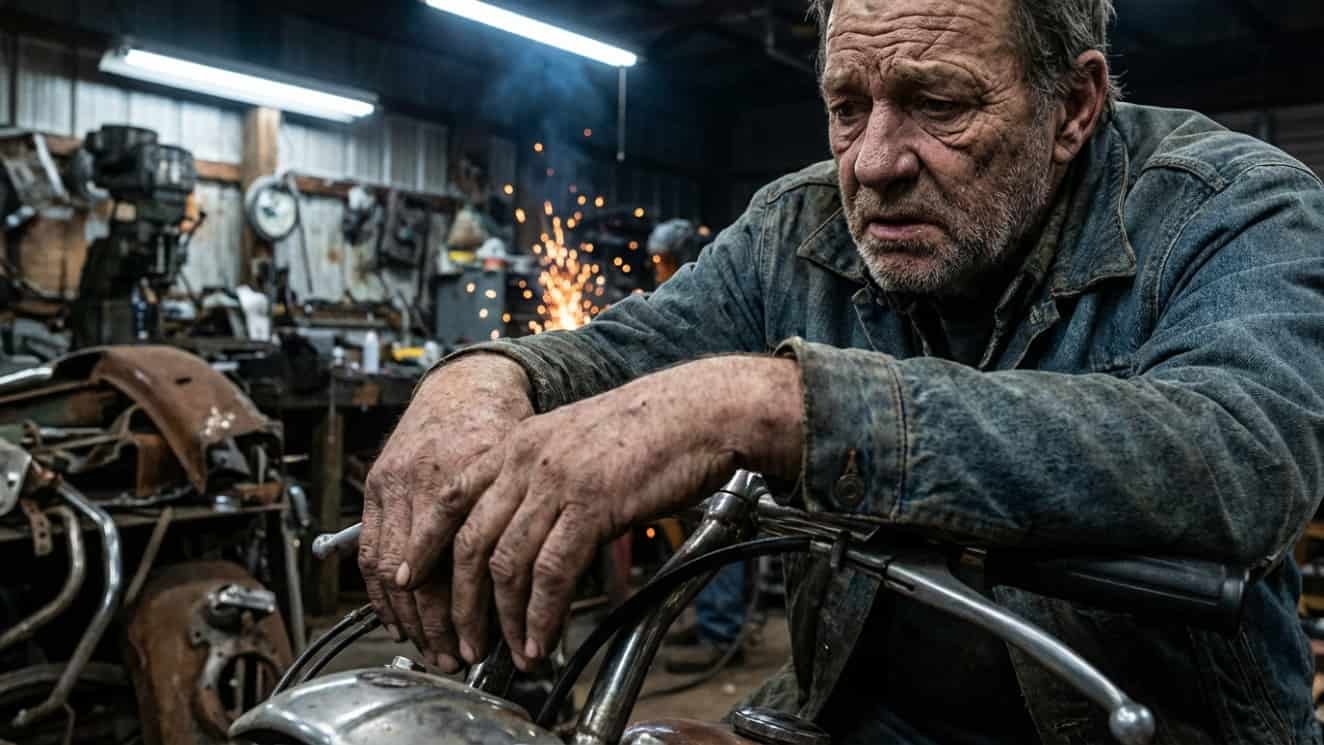
Martha came by a week later. She found Hank sitting on his back porch, a tattered blanket over his legs. His hands were tucked into his sleeves, hidden from the world.
“”Leo’s gone,”” she said, leaning against the railing. “”He took that old truck of his and headed for Columbus.””
“”Good,”” Hank said. “”He was too smart for this place. Too hungry.””
“”He left something for you,”” she said, handing him a small, heavy envelope.
Hank opened it with his teeth and his one semi-functional thumb. Inside was the blueprint for the “”Perfect Bike.”” Leo had erased the ‘X’ Hank had drawn over the neck. In its place, he’d sketched a reinforcement sleeve—a design so elegant and strong it would have held up under a tank.
On the back of the vellum, Leo had written: “You were wrong, Hank. It’s not a curse. It’s just physics. You taught me how to see the flaw. I’ll teach the next one how to fix it.”
Hank felt a lump in his throat. He looked out over the scrapyard. In the fading light, the piles of rusted metal looked like mountain ranges. He saw the beauty in the decay—the way the iron eventually returned to the earth, no matter how much chrome and polish we put on it.
He realized then that he’d spent his whole life fighting the rust. He’d fought the rust in his machines, the rust in his club, and the rust in his own heart. But the rust was just time, and time always won.
He thought about Miller, and he thought about Gabe. He didn’t feel the old anger anymore. He just felt a profound, echoing loneliness. He had survived them all, but the cost was a life spent in the service of ghosts.
“”Are you going to be okay, Henry?”” Martha asked.
“”I’m fine, Martha,”” he said, and for the first time in thirty years, he wasn’t lying. “”I think I’ll just sit here for a while. It’s a quiet night.””
“”It is,”” she agreed. “”The wind’s died down.””
She left him there, a solitary figure in the vast landscape of forgotten things. Hank closed his eyes. He didn’t think about the bikes or the blood. He thought about the sound of a perfectly tuned engine—the way it hums when everything is in balance, when the timing is right and the fuel is clean.
He imagined himself riding that “”Perfect Bike”” down a road that never ended, where his hands didn’t ache and the shadows didn’t follow.
The cold Ohio night settled in, turning the dew on the scrap metal into a fine, silver frost. Hank’s breathing slowed, matching the rhythm of the world around him. He wasn’t a legend, and he wasn’t a murderer. He was just a man, made of the same fragile, rusting iron as the world he’d tried so hard to master.
He reached into his pocket and pulled out a small, brass bolt—the one he’d dropped on the first day Gabe came to the shop. He rolled it between his thumb and forefinger, the movement slow and painful, but steady.
It was a small thing. A simple thing. But it was enough.
The lights of the city flickered in the distance, and the interstate hummed with the sound of thousands of people going somewhere else. Hank stayed where he was, rooted in the rust, a part of the landscape at last.
He didn’t need to fix anything anymore. The world was already broken, and in that brokenness, he had finally found a place to rest.”