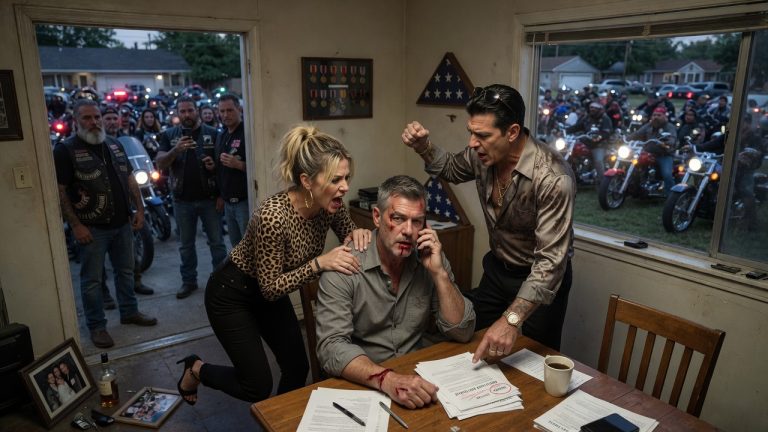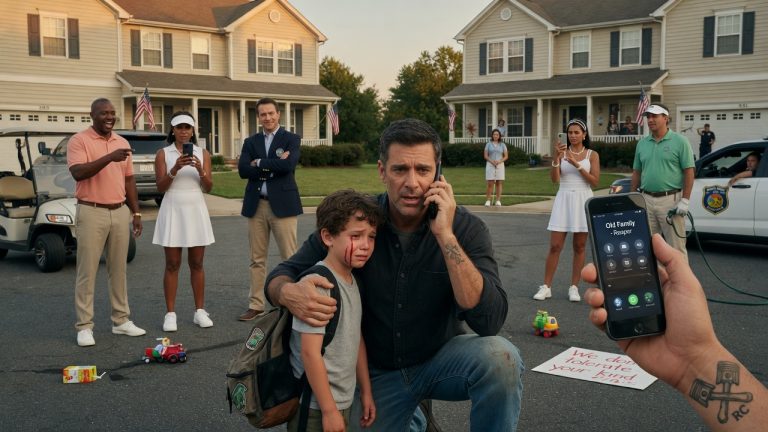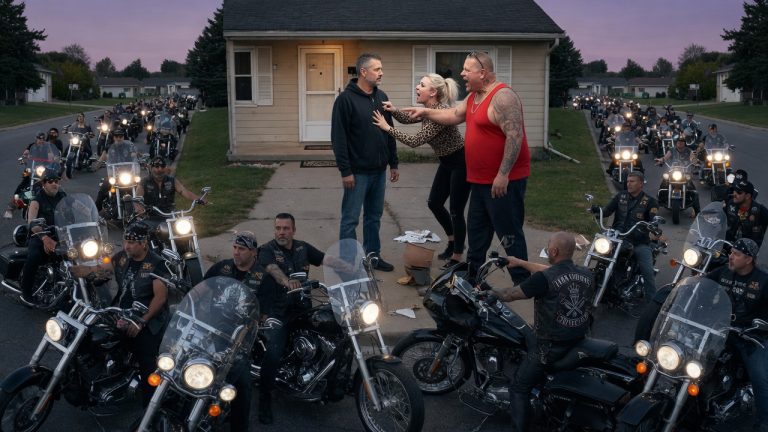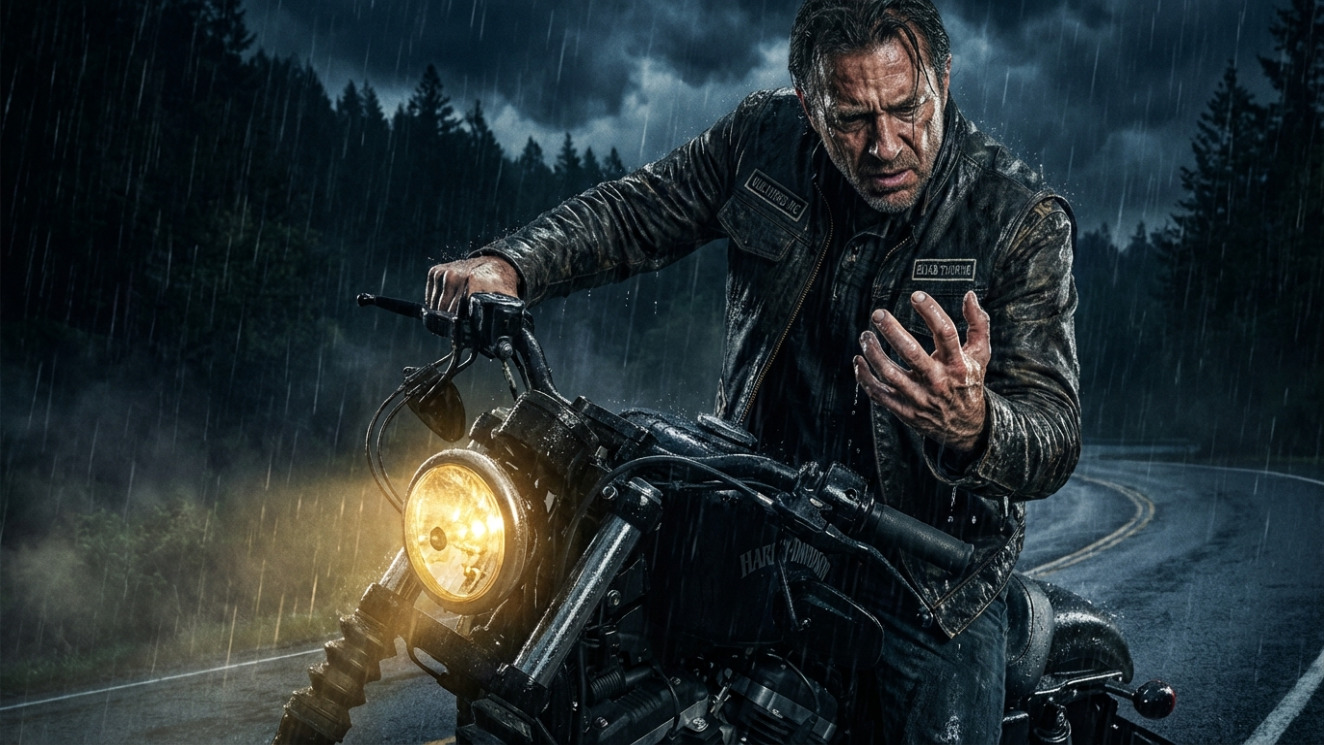
Elias Thorne was the Road Captain. The man who set the pace, the man who never flinched. In the Vultures MC, your word is your bond, and your hands are your life.
But lately, the handlebars have started to feel like they’re made of ice. The tremors start in his right thumb and crawl up his arm until he’s white-knuckling the grip just to stay in his lane.
He thought he could hide it. He thought he could outrun the clock on his own body.
Then he found the messages on Elena’s phone.
While he was out on the coast roads, proving he was still the man his father was, his wife was in a motel room six miles away with someone who didn’t have shaking hands.
Now, Elias is trapped. If he kicks her out, she tells the club he’s a liability. If he stays, he’s living a lie with the woman who broke him.
In the rain-slicked hills of Oregon, a man is only as good as his grip. And Elias Thorne is losing his.
FULL STORY
Chapter 1: The Fault in the Iron
The garage smelled of cold concrete, chain lube, and the specific, metallic tang of an Oregon winter. Elias Thorne sat on a low rolling stool, his knees flanking the engine block of the 1984 Harley-Davidson FLH. It was his father’s bike—a heavy, temperamental beast of chrome and black paint that required more prayer than mechanical skill to keep running.
Elias reached for a 9/16th wrench. His right hand hovered over the tool tray.
It happened again.
A rhythmic, persistent twitch started in the meat of his thumb and pulsed upward, vibrating the tendons in his forearm. He didn’t look at it. He closed his eyes and gripped his thigh, digging his fingers into the heavy denim of his work pants until the muscle went numb.
“Not today,” he muttered. The words felt like a plea to a god he hadn’t spoken to since his father was lowered into the dirt fifteen years ago.
He stayed like that for a full minute, listening to the rain drum against the corrugated tin roof of the shed. Outside, the coastal town of Astoria was waking up in shades of charcoal and slate. The Vultures were supposed to meet at the clubhouse in two hours for the winter solstice run—a cold, miserable loop through the Coast Range that Elias, as Road Captain, had organized.
He stood up, his legs stiff. He was thirty-five, but in the world of the Vultures, thirty-five felt like sixty if you’d spent half your life leaning into the wind. He wiped his hands on a rag, checking the reflection in the polished primary cover. His face looked back, tired and hard, eyes shadowed by a lack of sleep that had nothing to do with the bike.
He walked into the house through the mudroom. The air inside was warm, smelling of burnt toast and the floral perfume Elena had been wearing lately. She was at the kitchen table, scrolling through her phone, a mug of coffee steaming next to her.
“The rain’s not letting up,” she said without looking up. Her voice was flat, the kind of tone that had become the standard frequency of their marriage over the last year.
“Doesn’t matter. We ride,” Elias said. He went to the cupboard to find his own mug. His hand was steady now, but the ghost of the tremor remained, a dull humming deep in his bone marrow.
“You’re going to get pneumonia or slide off a cliff,” Elena said. She finally looked at him, her eyes flicking to his hands and then back to his face. She knew. She didn’t know the medical name for it—neither did he, yet—but she had seen him struggle with a fork three nights ago. She’d seen him drop a glass of water.
“I’ve ridden in worse,” he said.
“You were younger in worse,” she retorted. She stood up, her phone still clutched in her palm. “Jax called. He’s outside.”
Elias looked through the window. A younger man, barely twenty-four, was sitting in a beat-up Ford F-150 in the driveway. Jax was a prospect Elias had taken under his wing—a kid with more heart than sense, who looked at Elias like he was some kind of highway prophet.
“He’s early,” Elias said.
“He’s eager. Unlike some people in this house,” Elena said, her voice sharpening. She moved past him, her shoulder brushing his. It wasn’t an accidental touch; it was a nudge, a small act of friction meant to remind him that she was restless.
Elias watched her go into the bedroom. He looked at the phone she’d left face-down on the table for a split second while she went to grab her sweater. It buzzed.
He shouldn’t have looked. In the club, you don’t touch a man’s bike, and you don’t touch his privacy. But the air in the house had been thick with something sour for months, and Elias was a man trained to spot a threat before it hit the front tire.
He flipped the phone over.
The notification was from a contact saved only as ‘C.’
Tonight was incredible. He still has no idea?
The tremor returned, more violent than before. Elias didn’t drop the phone. He set it back down, exactly where it had been, his heart hammering against his ribs like a piston in a dry cylinder. He felt a sudden, cold clarity. The world didn’t end with a crash; it ended with a text message on a Tuesday morning.
Elena came back into the room, wearing a heavy cardigan. She saw him standing by the table, his face pale under the tan of a thousand road miles.
“What?” she asked, her voice defensive.
“Nothing,” Elias said. He grabbed his leather vest—the one with the ‘Road Captain’ patch over the heart—and pulled it on. The weight of the leather usually felt like armor. Today, it felt like lead. “I’ll be back late. Don’t wait up.”
“I never do,” she said.
He walked out the door without looking back. Jax was leaning against the truck, grinning, the rain soaking into his cheap nylon jacket.
“Cap! Ready for the soak?” Jax called out.
Elias didn’t answer. He walked to the garage, rolled the 1984 Harley out into the wet gravel, and kicked the starter. The bike roared to life, a guttural, uneven throb that vibrated through his boots. He gripped the bars, his right hand shaking so hard the brake lever rattled. He squeezed until the metal bit into his palm.
He looked at Jax, who was watching him with wide, admiring eyes. Jax didn’t see the tremor. He saw the legend. He saw the man who had led the Vultures through three states and ten years of turf wars.
“Mount up,” Elias barked over the engine. “We’ve got miles to cover.”
As they pulled out of the driveway, Elias saw the curtain in the bedroom window move. Elena was watching. He wondered if ‘C’ was watching, too. He wondered if they were laughing at the man who couldn’t even hold a wrench straight, riding off into the rain to lead a pack of men who would tear him apart if they knew he was broken.
The highway was a ribbon of wet black silk. Elias pushed the Harley to seventy, the wind screaming past his helmet. He focused on the taillight of the bike in front of him once they joined the pack at the clubhouse. There were twenty of them, a column of noise and steel cutting through the Oregon mist.
Big Mike, the President, was at the front, his massive frame blocking the wind. Elias rode at his shoulder, the position of honor. Every time the road curved, Elias felt the fear. If his hand seized, if the tremor turned into a spasm, he would drift. He would clip Big Mike’s rear tire. He would send twenty men into the guardrail at seventy miles per hour.
The responsibility was a physical weight, pressing down on his shoulders. He was the Road Captain. He was the one who saw the gravel before it became a slide. He was the one who managed the pace.
And for the first time in his life, he was terrified of the machine between his legs.
They stopped at a roadside diner in Elsie, a place where the coffee was thick as oil and the waitress didn’t mind the puddles of rainwater forming under their boots. The Vultures took over the back corner, a sea of black leather and loud voices.
“Good pace, Elias,” Big Mike said, clapping him on the back. Mike’s hand felt like a sledgehammer. “Though you were leaning a bit hard on that last sweeper. You okay?”
Elias felt the eyes of the table turn toward him. These were men who lived by instinct. They could smell weakness like blood in the water.
“Just the wind, Mike,” Elias said, his voice steady. He kept his right hand tucked into his armpit, hidden by his vest. “Bike’s running a little heavy.”
“That old FLH of your old man’s?” a biker named Dutch laughed. “Thing belongs in a museum, Thorne. Or a scrap heap. Get yourself a new Glide.”
“She’s got more soul than anything on the floor today,” Elias snapped. The anger felt good. It was sharper than the fear.
Jax sat next to him, beaming. “It’s the best-looking bike in the line, Cap. I’m gonna get one just like it when I get my patches.”
Elias looked at the kid. Jax’s face was clean, his eyes full of the romantic bullshit that drew boys to clubs. He didn’t know about the grit in the oil. He didn’t know about the way your joints screamed in the cold, or the way the brotherhood could turn into a cage the second you stopped being useful.
“Focus on keeping your current bike upright, kid,” Elias said.
He got up to go to the bathroom. He needed a moment of silence away from the smell of wet leather and the performative masculinity of the room. He stood in front of the cracked mirror, watching his hand. It was vibrating again, a low-frequency hum that made his fingers look blurred.
He took a deep breath and shoved his hand under the cold water tap. The shock of the ice-cold water did nothing.
He thought about the text. Tonight was incredible.
He had spent fifteen years building a life based on two things: the Vultures and Elena. One was a family he’d earned with blood and miles; the other was the woman who had been there when he buried his father. She had held his hand when he cried. Now, she was holding someone else’s, and his own hand was failing him.
He was losing everything at once.
When they got back on the road, the rain turned into a downpour. The visibility dropped to twenty feet. Elias led the pack through the winding turns of Highway 26, his teeth clenched so hard his jaw ached. He didn’t think about the road. He thought about the motel rooms Elena must have visited. He thought about the man ‘C.’ Was it someone he knew? A civilian? Or worse—another Vulture?
The thought hit him like a physical blow. The club was a small world. If it was a brother, the betrayal wasn’t just personal; it was a violation of the code. It would mean blood.
He pushed the Harley faster, the engine screaming. He wanted to outrun the tremor. He wanted to outrun the image of Elena in another man’s arms. He leaned the heavy bike into a sharp left-hand turn, the floorboard scraping against the asphalt, throwing a shower of sparks into the grey afternoon.
For a second, the bike wobbled. The tremor in his hand surged, and he felt the front tire lose its bite.
His heart stopped. He wrestled the bars, his muscles screaming, forcing the heavy machine back into the line. He felt the wind of a semi-truck passing in the opposite direction, a wall of air that nearly knocked him over.
He straightened out, his breath coming in ragged gasps. Behind him, he saw Jax swerve slightly, startled by Elias’s sudden movement.
Elias didn’t slow down. He couldn’t. If he slowed down, he was done.
They made it back to the clubhouse by dusk. The men dispersed, heading to their various homes or the bar inside. Elias stayed by his bike, wiping the grime off the chrome with a trembling hand.
“Elias.”
He looked up. Big Mike was standing there, lit by the flickering neon sign of the clubhouse. The President’s face was unreadable.
“You’re off your game, Thorne,” Mike said quietly. “That turn back there? You almost took Jax out. You almost took me out.”
“I told you, Mike. The wind—”
“Don’t lie to me,” Mike stepped closer. He was a head taller than Elias, a mountain of a man who had survived three stabbings and a prison stint. “If it’s the bike, fix it. Nếu nó là cái đầu của mày, hãy sửa nó đi. We’re going to the valley next week. High speed. I need my Road Captain sharp.”
“I’ll be sharp,” Elias said.
“See that you are,” Mike said, his voice dropping an octave. “I’d hate to have to put someone else at the front. It’d be a shame for your father’s son to end up in the sweep van.”
Mike walked away, the gravel crunching under his heavy boots.
Elias stood in the dark, the rain turning to mist. He looked at his hand. It was still. For now.
He didn’t go into the clubhouse for a beer. He didn’t talk to Jax. He got back on the Harley and rode home, the cold air biting through his gloves.
When he pulled into the driveway, the house was dark except for the light in the kitchen. He walked in, the floorboards creaking under his weight. Elena was sitting at the table, a glass of red wine in front of her.
“How was the ride?” she asked.
Elias walked over to her. He didn’t take off his vest. He didn’t wash the road grime from his face. He stood over her, the smell of gasoline and rain filling the small kitchen.
He reached out and grabbed her phone from the table. This time, his hand didn’t shake. It was as steady as a rock, fueled by a cold, concentrated rage.
“Who is C?” he asked.
The color drained from Elena’s face. She didn’t move. She didn’t try to grab the phone. She just looked at him, and in her eyes, Elias saw something worse than guilt. He saw pity.
“Elias,” she whispered.
“Who is he, Elena?”
“It doesn’t matter,” she said, her voice trembling now. “Look at you. Look at your life. You’re obsessed with a club that doesn’t care if you live or die. You’re obsessed with a dead man’s bike. And you’re falling apart. I can see it. Everyone can see it.”
She reached out and touched his right hand—the hand that had been shaking all day.
“You can’t even hold a glass of water, Elias. How are you going to hold onto me?”
Elias felt the tremor start deep in his palm, triggered by her touch. He ripped his hand away, the phone clattering onto the floor.
The secret was out. The wound was open. And as the rain continued to fall on the Oregon coast, Elias Thorne realized that the road ahead wasn’t just uncertain—it was a goddamn cliff.
Chapter 2: The Tail Light’s Ghost
The morning after the solstice run felt like a hangover without the benefit of the booze. Elias woke up at 5:00 AM, the grey light of Astoria filtering through the blinds like woodsmoke. Beside him, Elena was a motionless ridge under the heavy duvet. They hadn’t spoken another word after the confrontation in the kitchen. He’d slept on the couch, or tried to, his mind looping the image of the text message and the sensation of his own failing nerves.
He dressed in the dark—heavy denim, thick socks, the boots that felt like anchors. He didn’t go to the kitchen. He went straight to the garage.
He needed to see if the tremor was a fluke. He needed it to be the cold, the exhaustion, the stress of the run. He sat on the Harley and reached for a screwdriver, intending to adjust the idle.
His hand was a traitor.
The moment he tried to coordinate the fine motor movement of fitting the tip into the screw head, his wrist began to dance. It was a rhythmic, mocking vibration. He growled, a low, animal sound in the back of his throat, and slammed the screwdriver onto the workbench.
“Damn it!”
The sound echoed in the small space. He leaned his forehead against the cold leather of the seat. The bike—his father’s 1984 FLH—felt like a witness to his humiliation. His father had ridden until the day his heart stopped, a sudden, clean end on a straight stretch of road. He hadn’t withered. He hadn’t been betrayed by his own skin.
Elias heard the back door of the house open and close. He froze.
Through the salt-crusted window of the garage, he watched Elena walk to her car. She was dressed for work—a dental clinic in town—but she was carrying a small overnight bag. She didn’t look toward the garage. She looked at her watch, her movements hurried and nervous.
She climbed into her silver Honda and backed out of the driveway.
Elias didn’t think. He didn’t weigh the consequences or the dignity of the act. He climbed into his old Chevy Silverado, a rusted-out work truck he rarely used, and followed her.
He kept three cars back, his hands gripping the steering wheel of the truck. Driving the Chevy was easier; the power steering and the heavy wheel masked the tremor. He felt like a ghost, haunting the tail lights of his own life.
She didn’t go to the clinic.
She drove through the center of Astoria, past the maritime museum and the fishing docks, and headed south on Highway 101. The road hugged the coastline, the Pacific Ocean a churning cauldron of white foam and iron-grey water to the right.
Elias’s heart was a dull thud in his chest. He knew this road. This was the way to the cheap motels that lined the coast between Astoria and Seaside. Places with names like The Driftwood and The Sea-Breeze, where the carpet smelled of damp and the curtains didn’t quite meet in the middle.
She pulled into the parking lot of The Tides, a U-shaped motor lodge that looked like it hadn’t been painted since the Reagan administration. She parked near the back, away from the road.
Elias drove past, pulled into a turnout half a mile down, and turned around. He parked on the shoulder, hidden by a stand of wind-bent sitka spruces. He watched through the rearview mirror.
A man stepped out of Room 14.
He wasn’t a biker. He was younger, maybe late twenties, wearing a clean North Face jacket and expensive-looking boots. He looked like the kind of man who worked in an office in Portland, someone who had never had grease under his fingernails.
Elena met him at the door. They didn’t kiss. They didn’t hug. She just handed him the bag, and they both went inside.
Elias sat in the truck, the engine ticking as it cooled. The rain started again, a soft, persistent drizzle that blurred the windshield. He felt a strange, hollow sensation in his gut. It wasn’t the white-hot rage he’d expected. It was a profound, crushing sense of displacement.
He was the Road Captain of the Vultures. He was a man people feared, or at least respected. And here he was, sitting in a rusted truck, watching his wife enter a ten-dollar-an-hour room with a man who probably couldn’t change a tire.
His hand started to shake on the steering wheel. He watched it, detached, as if it belonged to someone else.
If I walk in there, he thought, what happens?
In the club’s world, the answer was simple. You kicked the door down. You broke the man’s jaw. You took the woman home and dealt with the betrayal with a cold, hard finality. But Elias wasn’t just a Vulture. He was a man who was losing his grip on the physical world. If he fought, would his hand fail him? Would he miss the punch? Would he look pathetic in front of the man who was replacing him?
The humiliation of the possibility was stronger than the urge for revenge.
He put the truck in gear and drove back to town.
He went to the clubhouse. It was early, and the bar was empty except for Dutch, who was mopping the floors. The air smelled of stale beer and cigarettes.
“Thorne,” Dutch nodded. “You look like hell. Mike was asking about you. Said you missed the morning meeting.”
“I had things to do,” Elias said. He went behind the bar and poured himself a cup of the sludge-like coffee.
“The kid was looking for you, too,” Dutch said, leaning on his mop. “Jax. He’s obsessed, Elias. Spent the whole morning cleaning his chain because you told him it looked gritty. You’re turning him into a neurotic.”
“Better neurotic than dead,” Elias said.
He sat at a booth in the back, the one beneath the framed photograph of the club’s founders. His father was in that photo—a younger, leaner version of the man Elias remembered, standing next to a bike that looked brand new. They looked invincible. They looked like they owned the road because they did.
Jax walked in twenty minutes later, his face lighting up when he saw Elias.
“Cap! I didn’t think you’d be in today.”
“Sit down, Jax,” Elias said.
The kid sat, his energy jarring in the quiet room. “I did the chain. And I checked the tire pressure. Ready for the valley run next week.”
Elias looked at him. Jax was the foil to his own decay. He was all potential, no history. He didn’t have a father’s ghost on his shoulder or a wife in a motel room.
“Why do you want this, Jax?” Elias asked suddenly.
Jax blinked, confused. “What? The club?”
“The life. The noise. The constant threat of some cop or some rival club deciding today’s the day you die. Why?”
Jax leaned back, his expression turning serious. “Because it’s real, Cap. My old man worked at the paper mill for forty years. He came home every night smelling like chemicals, sat in front of the TV, and didn’t say a word. He was a ghost before he even died. Here? When we’re on the road? I feel like I’m actually standing on the earth. And having guys like you to look up to… it means something.”
Elias felt a pang of guilt. He was a lie. He was the ghost Jax was trying to avoid.
“Don’t look up too high, kid,” Elias said. “The view gets shaky.”
“You okay, Elias?” Jax asked, his voice lowering. “You seem… thin. Like you’re not all there.”
“I’m fine,” Elias said, his voice sharpening. “Go check the fluid levels on the support van. If we’re going to the valley, we need everything tight.”
Jax hesitated, then nodded and left.
Elias stayed in the booth for hours. He watched the club members drift in and out. He saw the politics, the small power plays, the way the younger guys tested the older ones. He saw the world as a predator sees it—constantly looking for a crack in the armor.
Around 4:00 PM, Big Mike came in. He didn’t go to the bar. He walked straight to Elias’s booth and sat down across from him. Mike didn’t say anything for a long time. He just looked at Elias with those heavy, tired eyes.
“I heard you were following Elena this morning,” Mike said.
Elias felt the air leave his lungs. “Who told you that?”
“Doesn’t matter. In this town, a Vulture truck is a lighthouse. You were seen.”
Elias clenched his fist under the table. The tremor was there, a dull thrumming. “It’s personal, Mike. Not club business.”
“Everything is club business when the Road Captain is acting like a jilted teenager,” Mike said. His voice wasn’t angry; it was disappointed. “If she’s stepping out, you handle it. If you can’t handle it, you tell me. What you don’t do is spend the day lurking in a truck while the club is preparing for a major run.”
“I’m handling it,” Elias said.
“Are you?” Mike leaned forward. “Because word is, you didn’t even get out of the truck. You just watched her go into The Tides and then you drove away. That’s not the Elias Thorne I know. The Elias I know would have burnt that motel to the ground.”
Elias looked down at the table. He couldn’t tell Mike the truth. He couldn’t say, I’m afraid I can’t hit him because my hand won’t close. He couldn’t say, I’m afraid I’m losing my mind along with my motor skills.
“She knows something, Mike,” Elias said quietly.
Mike frowned. “What does she know?”
“Something about me. Something that… if it gets out, I’m done.”
The silence that followed was heavy. Mike studied him, his eyes narrowing. He was looking for the weakness. He was a leader first and a friend second.
“Is it legal?” Mike asked.
“No.”
“Is it the club?”
“No.”
“Then what?”
Elias looked up, his eyes burning. “It’s my father’s son, Mike. It’s the legacy. I’m not who I was.”
Mike sighed and stood up. “We all get old, Elias. But we don’t get weak. Not in this patch. You have until the valley run to get your house in order. If you’re still shaking in your boots by then, I’m stripping the patch. I won’t have a liability at the head of the line.”
Mike walked away, leaving Elias alone in the darkening booth.
Elias drove home as the sun set behind the clouds, a bruised purple light bleeding over the ocean. When he walked into the house, Elena was already there. She was cooking dinner—chicken and potatoes. The smell was domestic and normal, a jarring contrast to the reality of the morning.
She didn’t look at him when he entered.
“I saw you,” he said.
She stopped stirring the pot. She didn’t turn around. “I figured you would. You were never subtle, Elias.”
“Who is he?”
“His name is Connor. He’s a physical therapist,” she said. She turned around then, her face defiant. “I met him six months ago. At first, it was just… talking. Someone who didn’t talk about bikes or patches or who owed who money. Someone who saw me.”
“And now?”
“And now he’s the one who tells me I don’t have to live in a house that feels like a tomb,” she said. “He’s the one who knows what’s wrong with you, Elias. I showed him the video I took of you sleeping. The way your hand moves even when you’re unconscious.”
Elias felt a surge of cold horror. “You recorded me?”
“I had to know!” she shouted, her voice cracking. “I had to know if you were dying or just losing your mind. He says it’s neurological. He says you need a specialist. A real one, not that hack doctor you see for the club’s patch-ups.”
“You told a stranger?” Elias stepped toward her, his hand seizing. He gripped the back of a kitchen chair to steady himself. “You told a civilian about my health? Do you have any idea what that does to me? If the club finds out I’m a ‘neurological case,’ they’ll put me out to pasture. I’ll be nothing.”
“You’re already nothing!” she spat back. “You’re a man hiding in a garage, clinging to a piece of iron that doesn’t love you back. You’re terrified of your own body, and you’re taking it out on me.”
She walked toward him, her eyes fierce. She took his shaking hand and held it against her chest. He could feel her heart beating, fast and panicked.
“I won’t tell them,” she whispered. “I won’t tell Big Mike. I won’t tell anyone. But only if you stay.”
Elias stared at her. “What?”
“I’m not leaving him, Elias. I can’t. He’s the only thing that makes me feel like I’m still alive. But I won’t leave you, either. I’ll stay here. I’ll be the wife the Vultures expect. I’ll keep your secret. I’ll help you hide the tremors. I’ll be your hands when you can’t use them.”
“You’re asking me to let you… to let you stay with him?”
“It’s a trade, Elias,” she said, her voice cold and pragmatic. “My silence for your pride. You keep the patch. You keep the legacy. And I keep my sanity. Otherwise… I walk into that clubhouse tomorrow and I tell Big Mike exactly why his Road Captain is so hesitant on the turns.”
Elias felt like he was drowning. The room felt smaller, the walls closing in. He looked at his hand, held tight against her heart. It was still shaking. It was always shaking.
He looked at Elena—the woman he had loved, the woman who was now a stranger holding him hostage.
“I’m the Road Captain,” he whispered, though it sounded like a question.
“Only as long as I say you are,” she replied.
She let go of his hand and went back to the stove. Elias stood in the center of the kitchen, the smell of dinner filling the air, feeling the weight of the invisible chains she had just wrapped around his neck.
He had the patch. He had the secret. But as he looked at the 1984 Harley through the window, he realized he had never been more alone on the road.
Chapter 3: The Off-Book Debt
The office was located in a strip mall on the outskirts of Long Beach, tucked between a laundromat and a defunct tax-prep service. The windows were tinted so dark they looked like ink. There was no sign, only a gold-lettered suite number: 302.
Elias sat in the waiting room, which consisted of two plastic chairs and a stack of three-year-old hunting magazines. His right hand was shoved deep into his pocket, his fingers curled into a ball.
“Mr. Thorne?”
A woman in scrubs appeared. She didn’t look like a nurse. She looked like someone who had seen too much and cared too little. She led him back to a small exam room that smelled of ozone and industrial cleaner.
Dr. Aris was a man in his sixties with skin the color of old parchment and eyes that didn’t miss a detail. He was the club’s “quiet” doctor—the one who handled gunshot wounds that didn’t need police reports and broken bones that happened during “accidents” at the docks.
“Sit,” Aris said, gesturing to the table. He didn’t ask how Elias was. He didn’t offer small talk. He just looked at Elias’s pocket. “Show me.”
Elias pulled his hand out. The tremor was a low, steady vibration now, a constant hum that felt like a motor idling in his wrist.
Aris took his hand. His touch was cold and clinical. He moved Elias’s arm, checking the resistance in the elbow and the shoulder. He asked Elias to tap his fingers together, to follow a pen with his eyes, to walk across the room.
“Is it Parkinson’s?” Elias asked, the word tasting like ash in his mouth.
Aris sat back on his stool, clicking his pen. “Maybe. Or Essential Tremor. Or something else entirely. Without a full workup at a real hospital—an MRI, a neurologist—I’m just guessing, Elias.”
“You know I can’t go to a real hospital. It goes on the record. The club finds out.”
“The Vultures are going to find out anyway,” Aris said. “You’re a Road Captain. You live on two wheels. This isn’t like being a bookkeeper. You can’t hide a failing nervous system from a motorcycle.”
“I’m hiding it fine,” Elias lied.
Aris let out a dry, rattling laugh. “You’re hiding it with fear. That only makes the tremors worse. Stress is the fuel for this fire, Elias. And from what I hear, you’re under plenty of it.”
Elias looked at the floor. “Elena’s keeping it quiet. She… she’s helping me.”
Aris raised an eyebrow. “Is she? Or is she just holding the leash? I’ve known Elena a long time, Elias. She’s a survivor. She’s not doing this out of the goodness of her heart.”
The truth of the statement stung. Elias thought of the ‘trade’ they had made. He had spent the last three days living in a house with a woman who was a stranger. She would leave in the afternoons, presumably to see Connor, and return in time to play the dutiful wife for the club members who dropped by. She would help him button his shirts. She would cut his meat.
She was his nurse and his betrayer, and he couldn’t breathe in her presence.
“Can you give me something?” Elias asked. “Just to steady it. For the valley run.”
“I can give you propranolol,” Aris said, turning to a cabinet. “It’s a beta-blocker. It’ll slow your heart rate, dampen the physical manifestation of the tremor. But it won’t fix the underlying cause. And it might make you dizzy. Not a great side effect when you’re doing ninety on a highway.”
“I’ll take the risk,” Elias said.
Aris handed him a small orange bottle. “Don’t take more than prescribed. And Elias?”
“Yeah?”
“You’re thirty-five. You have a whole life ahead of you that doesn’t involve a leather vest and a club that will discard you the second you’re a liability. Think about that before you kill yourself trying to prove you’re still your father.”
Elias took the pills and left without a word.
He didn’t go home. He went to a dive bar called The Anchor, a place where the Vultures didn’t hang out. He sat in a corner booth, the bottle of pills on the table in front of him. He ordered a double whiskey.
He was staring at the label when the door opened and Jax walked in.
The kid looked out of place in the dark, grimy bar. He saw Elias and hesitated, then walked over.
“Cap? I saw the truck outside.”
Elias sighed. “Can’t a man have a drink in peace, Jax?”
“Sorry. I just… I was worried. You’ve been dodging the clubhouse.” Jax sat down across from him, his eyes flicking to the pill bottle and then back to Elias’s face. “Is everything okay?”
“Everything’s fine,” Elias said, sliding the bottle into his pocket. “Just a headache.”
Jax didn’t look convinced. He leaned forward, his voice low. “People are talking, Elias. Big Mike, Dutch… they’re saying you’re losing your nerve. That the wreck at the solstice run wasn’t the wind.”
“They can say whatever they want,” Elias growled.
“I defended you,” Jax said, his voice earnest. “I told them you’re the best rider in the club. That you just need some time. But Elias… you have to show them. At the valley run. If you don’t lead like the old Elias, Mike’s gonna make a move. I’ve seen him talking to Silas from the Portland chapter. Silas wants your spot.”
Elias felt a cold spike of adrenaline. Silas was a younger guy, aggressive and ambitious. He didn’t have the history Elias had, but he had the physical strength and a hunger for the Road Captain patch.
“Mike’s talking to Silas?”
“I heard them in the back office,” Jax nodded. “Mike said he needs a captain who doesn’t ‘hesitate in the shadows.’ You gotta show up, Elias. You gotta be the man I know you are.”
Elias looked at Jax. The kid’s faith was a mirror he didn’t want to look into. He saw himself ten years ago—the certainty, the loyalty, the belief that the club was a brotherhood that transcended the weaknesses of the individual.
“Why do you care so much, Jax?” Elias asked.
Jax looked away, his jaw tightening. “Because if you’re not who I think you are… then this whole thing is just a bunch of old men playing dress-up. I need you to be real, Elias. I need the club to be what you said it was.”
Elias felt the weight of the kid’s expectations pressing down on him. He was a pillar of a temple that was already crumbling.
“Go home, Jax,” Elias said. “I’ll be at the clubhouse tomorrow. And I’ll be leading the valley run.”
Jax nodded, a look of relief on his face, and left.
Elias finished his whiskey. The alcohol didn’t dull the fear; it only made it more sluggish. He thought about Silas. He thought about Big Mike. He thought about the 1984 Harley waiting in his garage—a machine that required a firm, steady hand to master.
He took one of the pills Aris had given him.
The drive home was quiet. The rain had stopped, leaving the roads damp and reflective under the streetlights. When he walked into the house, the light in the kitchen was on, but the room was empty.
He went into the bedroom. Elena was sitting on the edge of the bed, her back to him. She was wearing a silk robe he hadn’t seen before.
“Where were you?” she asked.
“Seeing Aris.”
She turned around. Her eyes were red-rimmed. “What did he say?”
“He gave me pills. Beta-blockers.”
She laughed, a sharp, bitter sound. “Pills. Like that’s going to fix anything. You’re trying to patch a sinking ship with duct tape, Elias.”
“It’s all I’ve got,” he said.
He sat down on the bed next to her. For a moment, they were just two people in a room, the history of their life together a palpable presence between them. He remembered when they were twenty, riding down the coast on a stolen bike, the world feeling like it belonged to them.
“Why him, Elena?” he asked quietly. “Why a physical therapist from Portland?”
She looked at him, and for the first time in months, the anger was gone, replaced by a weary honesty.
“Because he’s gentle, Elias. Because when he looks at me, he doesn’t see a ‘Vulture’s woman.’ He sees a woman who’s tired of being afraid. He doesn’t have a patch. He doesn’t have a ‘legacy.’ He just has a life. A normal, quiet life where we talk about movies and books and what we’re going to have for breakfast.”
“I could have given you that,” Elias said, though he knew it was a lie.
“No, you couldn’t,” she said. “You’re your father’s son. You were never going to leave the road. And now the road is leaving you, and you’re terrified of what’s left.”
She reached out and touched his hand. It was steady—the pill was working.
“He wants me to move to Portland with him,” she said.
Elias felt a coldness settle in his chest. “Are you?”
“I haven’t decided yet,” she said. “But Elias… if you fail this run, if Big Mike takes your patch… what do you have left? Why should I stay in a house with a man who has no identity beyond a vest he can’t wear?”
The threat was clear. She wasn’t just holding his secret; she was holding the last thread of his world. If he lost the club, he lost her. If he lost her, he lost the person who helped him hide his weakness.
It was a circle of mutual destruction.
“I won’t fail,” Elias said.
He stood up and went to the garage. He didn’t sleep. He spent the night working on the Harley, his hands steady under the influence of the medication. He cleaned every inch of the chrome. He adjusted the clutch. He listened to the rhythm of the engine, trying to find a harmony in the machine that he couldn’t find in himself.
As the sun began to rise over the Astoria hills, Elias Thorne sat on the bike, his hands gripped tight on the bars. He was ready for the valley. He was ready for the high speeds and the sharp turns.
But as he looked at the reflection of his own tired face in the headlight, he knew that the pills were only a temporary shield. The truth was coming for him, as inevitable as the tide, and when it hit, he didn’t know if he’d be able to stay upright.
Chapter 4: The Hollow Brotherhood
The clubhouse was a hive of controlled chaos. The Vultures were prepping for the valley run—a hundred-mile dash through the Willamette Valley’s winding secondary roads, ending at a massive bonfire at a sympathetic farmer’s property. It was the club’s way of asserting dominance over the territory, a show of force that involved thirty bikes and a support van.
Elias stood by the 1984 FLH, checking his gear. The beta-blockers made him feel strangely detached, as if he were watching himself from a distance. His heart rate was slow, his hands eerily still.
“Thorne.”
He turned. Big Mike was walking toward him, flanked by a man Elias didn’t recognize at first. Then it clicked.
Silas.
He was younger than Elias by five years, with a shaved head and a jawline that looked like it had been carved from granite. He wore a ‘Portland’ rocker on his vest and carried himself with the cocky assurance of a man who hadn’t yet learned that the road always wins.
“Elias, you remember Silas,” Mike said. His tone was neutral, but his eyes were scanning Elias’s face for any sign of the ‘thinness’ he’d mentioned before.
“Silas,” Elias nodded.
“Road Captain,” Silas said, the title sounding like a challenge in his mouth. “I heard the coastal roads have been chewing you up lately. Mike asked me to ride drag today. Just in case the old iron needs a hand.”
The insult was thinly veiled. In the hierarchy of the club, the Road Captain led, and the strongest riders usually occupied the front or the rear to manage the pack. Putting Silas at the back was Mike’s way of saying he had a replacement ready if Elias faltered.
“The old iron will be fine,” Elias said. “Just make sure you can keep up, Silas. The valley isn’t the city. There’s no stoplights to save you if you miss a line.”
Silas smirked. “I’ll be right on your tail, Thorne. Don’t you worry about me.”
They moved out at 10:00 AM.
The roar of thirty V-twins was a physical force, a wall of sound that vibrated the very air. Elias took his place at the front, next to Big Mike. He felt the weight of the pack behind him—a long, shimmering snake of chrome and leather.
As they hit the open road, Elias pushed the Harley. The wind was a solid pressure against his chest. He focused on the rhythm of the road, the way the asphalt changed color as they moved inland, away from the salt air and into the damp, green heart of the valley.
The pills were working, but they had a cost. His reaction time felt slightly sluggish. The world seemed to move in slow motion, a dreamlike sequence of trees and farmhouses. He had to concentrate harder than ever to hit his marks.
Every time he checked his mirror, he saw Silas. The younger man was riding tight, his front tire nearly overlapping Elias’s rear. It was a classic intimidation tactic, a way of saying, I’m here, and I’m faster.
They hit a series of long, sweeping curves near Mist. This was Elias’s territory. He knew every dip, every patch of moss that grew in the shadows of the Douglas firs. He leaned the heavy FLH into the first turn, his hands steady on the bars. He felt the familiar thrill of the lean, the way the bike became an extension of his own body.
For a moment, the fear was gone. He was the Road Captain. He was the man his father had been.
But as they transitioned into a sharp right-hander, a deer bolted from the brush.
It was a flash of brown and white, a sudden obstacle in the center of the lane.
Elias’s brain screamed to react. He swerved, his muscles tensing. But the sluggishness of the beta-blockers betrayed him. He was a fraction of a second too slow.
The bike wobbled. He over-corrected, the heavy machine bucking under him. He felt the tremor surge, breaking through the chemical wall of the medication. His right hand seized, the fingers locking onto the throttle.
The engine screamed as the bike surged forward, headed straight for the ditch.
“No!” Elias roared.
He fought the machine, his boots scraping the pavement, his heart hammered against his ribs. He managed to wrestle the bike back into the lane, missing the deer by inches.
Behind him, he heard the screech of tires and the roar of engines as the pack reacted to his sudden maneuver. Silas had to swerve violently to avoid hitting Elias’s rear, nearly clipping Dutch in the process.
The pack slowed, coming to a ragged halt on the shoulder of the road.
Elias sat on his bike, his chest heaving. His hand was shaking so violently now that he had to hide it by gripping the fuel tank.
Big Mike pulled up next to him, his face a mask of fury. He didn’t say a word. He just looked at Elias, then at the road, then at the shaken bikers behind them.
Silas rode up, his helmet off, his face red. “What the hell was that, Thorne? You almost killed half the pack!”
“A deer,” Elias gasped. “Did you see it?”
“I saw you swerve like a drunk!” Silas shouted. “There was no deer, man. You just lost it.”
Elias looked at the other men. They were watching him, their expressions a mix of confusion and growing suspicion. Jax was there, too, his face pale, his eyes searching Elias’s for an explanation.
“There was a deer,” Jax said tentatively. “I saw a flash of something…”
“Shut up, prospect,” Silas snapped. He turned back to Mike. “He’s a liability, Mike. He’s gonna get someone killed. Let me take the front.”
Mike looked at Elias. The silence was deafening. The wind whistled through the trees, the only sound in the tense standoff.
“Elias,” Mike said, his voice low and dangerous. “Is there something you want to tell me?”
Elias felt the secret burning in his throat. He looked at Silas, then at the men he had led for a decade. He could feel the patch over his heart—the ‘Road Captain’ rocker that defined his entire existence.
If he told the truth, he was done. If he lied, he was a ghost.
“The bike,” Elias said, his voice cracking. “The throttle stuck. The cable must have frayed.”
It was a weak lie. Every man there knew Elias was a meticulous mechanic. A frayed cable on his father’s bike was as likely as a Vulture joining the police force.
Mike studied him for a long moment. He looked at the 1984 Harley, then back at Elias’s hands, which were still buried against the tank.
“Fix it,” Mike said. “Silas, you take the lead. Elias, you ride drag. If that bike acts up again, you’re in the van.”
The humiliation was a physical pain. Being sent to the back of the pack—the ‘drag’ position—was the ultimate demotion. It was where the prospects and the broken bikes rode.
Silas grinned, a predatory flash of teeth. He pulled his bike to the front, revving the engine. The pack followed him, the roar of their departure a mocking chorus.
Elias stayed on the shoulder for a moment, alone. Jax lingered, his engine idling.
“I saw it, Cap,” Jax whispered. “The deer. It was there.”
“Go on, Jax,” Elias said, not looking at him. “Get in line.”
Jax hesitated, then pulled away.
Elias followed them, riding at the very back of the line. He felt like a scavenger, picking up the crumbs of the life he had built. Every time he shifted gears, his hand protested. The tremor was back in full force, the pills unable to cope with the surge of adrenaline and shame.
They reached the farm at dusk. The bonfire was already roaring, a massive pillar of flame that licked the darkening sky. The Vultures gathered around it, drinking beer and boasting about the ride.
Elias stood on the fringes, his hands tucked into his armpits. He watched Silas holding court at the center of the group, Big Mike laughing at one of the younger man’s jokes.
He saw Elena.
She had driven the support van, a task she often performed for the major runs. She was standing near the edge of the light, watching him. She had seen the near-miss. She had seen him being relegated to the back.
She walked over to him, a bottle of beer in her hand.
“You almost died today,” she said.
“I’m still here.”
“For how long?” she asked, her voice low so the others wouldn’t hear. “Silas is already talking about the permanent change. Mike’s listening. You’re losing the only thing you have left, Elias.”
“I have you,” he said, the words feeling hollow even as he spoke them.
Elena looked at him, and her eyes were full of a terrible, cold pity. “No, you don’t. I’m leaving, Elias. Connor’s coming to pick me up tonight. From here.”
Elias felt the world tilt. “Tonight? You said you hadn’t decided.”
“The way you looked on that road today… the way you’re looking now… it’s over. You’re a man who’s already gone, and I’m not going to sit around waiting for the funeral.”
She turned to walk away.
“Elena!” Elias grabbed her arm. His hand was shaking so hard the beer in her hand sloshed over the rim.
She looked down at his hand, then up at his face. She didn’t pull away. She just stood there, letting him see the full extent of his weakness.
“Let go, Elias,” she said quietly.
He let go.
He watched her walk toward the farmhouse. He watched her meet a man in a North Face jacket—Connor—who was waiting in the shadows of the porch. They didn’t look back. They got into a car and drove away, the tail lights disappearing into the dark valley night.
Elias stood by the fire, the heat of the flames burning his face while his heart felt like ice. He was a Road Captain without a road. A husband without a wife. A man without a grip.
He saw Big Mike watching him from across the fire. The President’s face was unreadable in the flickering light, but Elias knew what was coming. The brotherhood was a cold thing when the fire went out.
He walked to his bike, the 1984 Harley sitting alone in the grass. He sat on it, feeling the cold leather. He didn’t cry. He didn’t scream. He just sat there, his hand vibrating against the chrome, listening to the laughter of the men who were already forgetting his name.