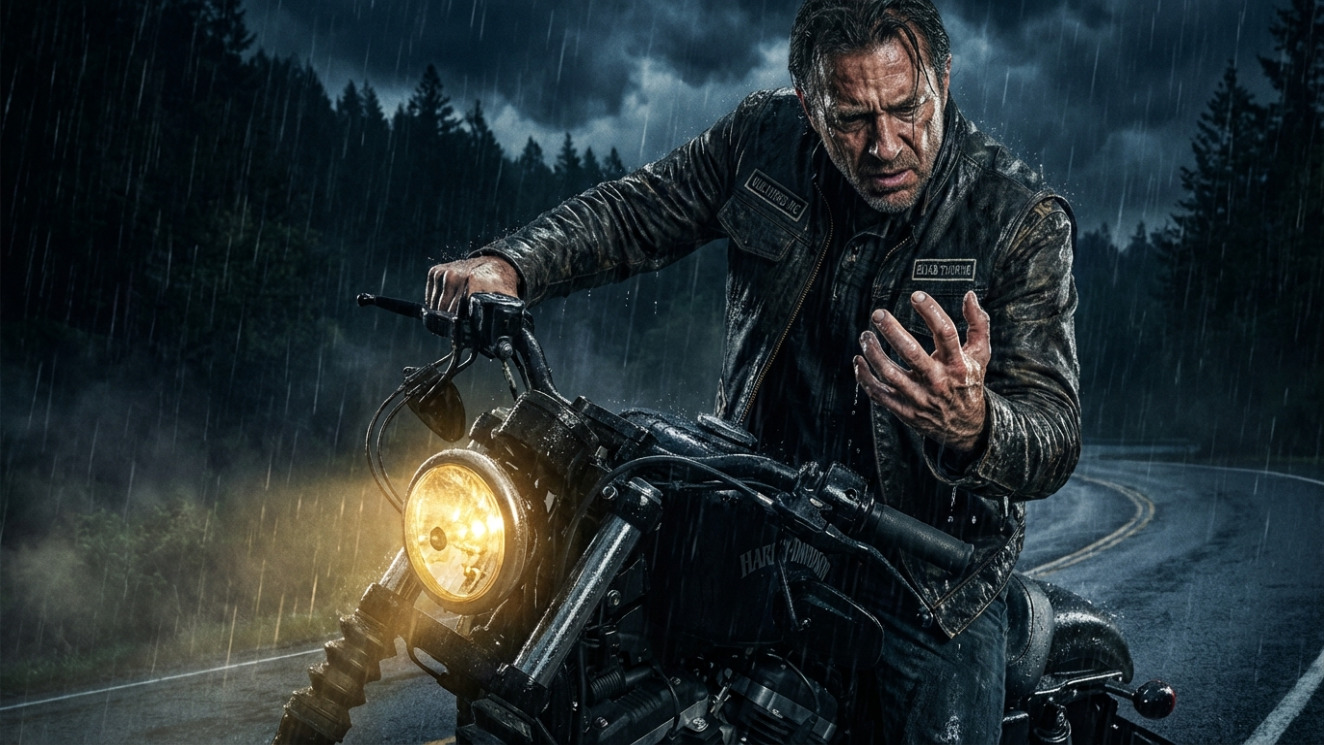
“Chapter 5: The Road Captain’s Ghost
The morning after the bonfire was a grey, hollow thing. The valley was shrouded in a thick, wet fog that clung to the trees like a shroud. Most of the Vultures were still asleep in the farmhouse or in tents, the ground littered with empty beer cans and the charred remains of the fire.
Elias hadn’t slept. He had spent the night in the barn, sitting on the floor next to his bike. The tremors had settled into a dull, persistent ache in his forearm. He felt a strange, cold peace—the kind of peace that comes after everything you’ve been trying to hold onto finally slips through your fingers.
He stood up, his joints popping. He needed to leave. He didn’t want to be there when the pack woke up. He didn’t want to hear Silas’s jokes or see Big Mike’s disappointed gaze.
He rolled the Harley out into the wet grass. He didn’t use the starter. He kicked it. The engine sputtered, coughed, and then settled into its heavy, uneven throb.
“Leaving so soon?”
Elias turned. Big Mike was standing in the doorway of the barn, a cup of steaming coffee in his hand. He looked like he hadn’t slept much either.
“The coastal weather’s coming in,” Elias said. “I want to get ahead of it.”
Mike walked over, his heavy boots sinking into the mud. He leaned against a fence post, watching the bike.
“Elena’s gone,” Mike said. It wasn’t a question.
“Yeah.”
“She told me. Before she left.”
Elias felt a surge of panic. “What did she tell you?”
Mike took a slow sip of his coffee. “She told me you were tired. That you were thinking about retiring the patch. Said you were worried about your health.”
Elias froze. She hadn’t told him the truth. She hadn’t mentioned the tremors or the neurological diagnosis. She had given him an out. A graceful exit.
“She did?” Elias whispered.
“Yeah,” Mike nodded. “She said you were too proud to say it yourself. That you’d ride until you crashed rather than admit you were human.”
Mike looked at Elias, his eyes searching. “Is it true, Elias? Do you want out?”
Elias looked at the patch on his vest. Road Captain. It was more than a title; it was his skin. It was the only thing that kept him standing. If he took it off, what was left? A man with shaking hands and an empty house.
“No,” Elias said, his voice firm. “I’m not done.”
Mike sighed, a long, weary sound. “I want to believe you, Elias. But I can’t ignore what happened yesterday. You’re a hazard. To yourself and to the brothers.”
Mike stepped closer, his voice dropping an octave. “I’m calling a vote when we get back to Astoria. Silas is challenging for the spot. You’ll have to defend it.”
“How?”
“The old way,” Mike said. “A speed run. Astoria to the Cape. First one there takes the patch. The other one… well, the other one finds a new club.”
The ‘old way’ was a brutal tradition the Vultures rarely used anymore. It was a high-speed, high-stakes race through the most dangerous curves of the coast road. It was a test of nerve, skill, and the willingness to die for the patch.
“I’ll be there,” Elias said.
Mike nodded and walked away, back toward the farmhouse.
Elias rode back to Astoria alone. The fog stayed with him, a thick, white wall that made the world feel small and claustrophobic. He didn’t think about the race. He didn’t think about Silas. He thought about his father.
He remembered the day his father had given him the Harley. He was eighteen, and the bike had felt like a god. His father had put a hand on his shoulder and said, “The road doesn’t care if you’re brave, Elias. It only cares if you’re honest. The second you lie to the machine, it’ll kill you.”
He had been lying to the machine for months. He had been lying to himself.
When he got back to the house, it felt like a tomb. Elena’s side of the closet was empty. Her toothbrush was gone. The air still smelled faintly of her perfume, a cruel reminder of what he had lost.
He went to the garage and started working. He stripped the Harley down to its frame. He checked every bolt, every wire, every fluid line. He didn’t use the beta-blockers. He wanted to feel the tremor. He wanted to know exactly how much he had to fight.
The race was set for dusk.
The Vultures gathered at the Astoria Column—a towering monument overlooking the city and the mouth of the Columbia River. The wind was howling, whipping the rain into a frenzy. The ocean was a churning mass of whitecaps below.
Silas was there, his bike a sleek, modern Road Glide with more horsepower than Elias’s old FLH could ever dream of. He was surrounded by the younger bikers, laughing and revving his engine.
Big Mike stood between them, a stopwatch in his hand.
“Astoria to Cape Falcon,” Mike shouted over the wind. “No rules. No stops. First one to the lighthouse takes the patch. The winner is the Road Captain. The loser turns in his vest.”
Elias looked at Silas. The younger man’s eyes were full of a cruel, hungry certainty. He didn’t see a veteran; he saw a corpse.
“Ready to retire, Thorne?” Silas sneered.
Elias didn’t answer. He kicked the starter on the 1984 Harley. The engine roared, a guttural, defiant sound that drowned out the wind. He gripped the bars, his right hand shaking with a violence that made his teeth rattle.
He didn’t hide it. He let Silas see it. He let Big Mike see it.
“Go!” Mike shouted, dropping his arm.
They surged forward, the tires screaming on the wet asphalt. Silas took the lead instantly, his modern bike pulling away with a roar of power. Elias followed, his teeth clenched, his muscles screaming as he fought to keep the heavy Harley in the lane.
The road was a nightmare. The curves were tight and slick, the wind trying to push them off the cliffside at every turn. Silas was fast, leaning his bike until the sparks flew, a trail of fire in the darkening grey.
Elias pushed the FLH. He felt the engine straining, the vibrations traveling through his feet and up into his spine. The tremor in his hand was constant, a mocking rhythm that tried to jerk the throttle open or closed.
He stopped fighting it.
Instead of trying to suppress the tremor, he worked with it. He adjusted his grip, using his palm instead of his fingers. He shifted his weight, using his legs to steer the bike more than his arms. He became a part of the machine’s vibration, a symphony of failing parts and desperate intent.
They hit the Devil’s Punchbowl—a series of hair-pin turns that dropped hundreds of feet toward the ocean. Silas slowed slightly, his confidence wavering in the face of the sheer drop and the slick moss.
Elias didn’t slow down.
He leaned the 1984 Harley into the first turn, the floorboard scraping the pavement with a scream of metal. He was inches from the edge, the spray of the ocean hitting his face. He felt the tremor surge, but he didn’t flinch. He used the vibration to feel the road, to sense the grip of the tires before they lost it.
He passed Silas on the outside of the third turn.
He saw the younger man’s face—a mask of pure, unadulterated terror. Silas wasn’t a rider; he was a racer. He knew speed, but he didn’t know the road. He didn’t know the language of a failing machine.
Elias pulled ahead, the 1984 Harley screaming as he pushed it to its absolute limit. He was flying, a ghost of a man on a ghost of a bike, cutting through the Oregon rain like a blade of steel.
He reached the Cape Falcon lighthouse five minutes before Silas.
He pulled into the gravel lot, the engine ticking as it cooled. He sat on the bike, his chest heaving, his hand shaking so hard it looked like a blur in the moonlight.
The rest of the Vultures arrived ten minutes later, their headlights cutting through the dark. Big Mike stepped out of the lead truck, his face pale. He looked at Elias, then at the lighthouse, then at Silas, who was pulling in with a shattered look on his face.
Mike walked over to Elias. He didn’t say anything for a long time. He just reached out and put a hand on Elias’s shoulder.
“You won,” Mike whispered.
Elias looked up at him. The victory didn’t feel like a victory. It felt like an ending.
“I’m done, Mike,” Elias said, his voice ragged.
Mike frowned. “What? You won. The patch is yours.”
Elias reached up and unzipped his vest. He pulled it off—the heavy leather that had been his identity for fifteen years. He handed it to Big Mike.
“The machine told the truth, Mike,” Elias said. “I can’t do this anymore. Not because I’m afraid. But because I’m broken. And a Road Captain who can’t hold the bars is a lie I’m not willing to tell anymore.”
The silence that followed was absolute. The Vultures watched in shock as their leader, the man who had just outridden death itself, handed over his life.
Elias looked at Silas, who was standing by his bike, his head down.
“The patch is yours, Silas,” Elias said. “But remember what I told you. The road doesn’t care if you’re fast. It only cares if you’re honest. If you lie to it, it’ll kill you.”
Elias got back on the 1984 Harley. He didn’t look at the men. He didn’t look at the lighthouse. He kicked the starter one last time and rode away, back toward Astoria.
He rode slowly this time, feeling the wind and the rain. He felt the tremor in his hand, a constant companion. He didn’t try to hide it. He didn’t take the pills. He just rode.
When he got back to the house, it was dark. He rolled the bike into the garage and sat on the floor, leaning against the engine block.
He was a man with no wife, no club, and a body that was failing him. He was thirty-five years old, and his life was over.
But as he sat in the quiet of the Oregon night, listening to the rain on the tin roof, Elias Thorne felt something he hadn’t felt in a long time.
He felt free.
Chapter 6: The Weight of the Rain
The house in Astoria sold three weeks later. Elias didn’t take much—some clothes, a few tools, and the 1984 Harley-Davidson. Everything else, the furniture and the memories, went to a local auction or the landfill.
Elena hadn’t come back for her things. She’d sent a lawyer’s letter from Portland, a cold, formal document that outlined the division of assets. He’d signed it without reading the fine print. Money didn’t matter anymore.
He was living in a small, one-bedroom apartment in Tillamook, a town that smelled of cows and wet grass. He had a job at a small engine repair shop. The owner, an old man named Walt who was mostly deaf, didn’t care about Elias’s history or the tremors that made his hands jump.
“You’re a good mechanic, Thorne,” Walt had said on his first day. “Just take your time. The world isn’t going anywhere.”
Elias was sitting on his back porch, a small concrete slab overlooking a field of grey-green pasture. The rain was a fine mist, the kind that never quite stopped on the Oregon coast. He was holding a cup of coffee in both hands, trying to keep it from splashing.
He heard the sound of a motorcycle in the distance.
It wasn’t a modern bike. It was a heavy, low-frequency throb that he recognized instantly. He sat still, his heart hammering in his chest.
A bike pulled into the gravel driveway. It was Jax.
The kid looked older. He was wearing the ‘Vultures’ vest, and a new patch—a ‘Full Member’ rocker—shone on his back. He looked tired, the romantic light in his eyes replaced by a weary, hollow look.
Jax hopped off the bike and walked over to the porch. He didn’t say anything at first. He just stood there, looking at Elias.
“You found me,” Elias said.
“Wasn’t hard. A man like you doesn’t just vanish,” Jax said. He sat on the steps, his leather gear creaking. “The club’s gone to hell, Elias.”
“I’m not in the club, Jax.”
“Silas is a disaster,” Jax continued as if Elias hadn’t spoken. “He’s aggressive. He’s taking jobs we shouldn’t be taking. Two guys got picked up by the feds in Portland last week. Mike’s losing control. He just sits in the back office and drinks.”
Elias looked at the mist. He felt a pang of sadness for the Vultures, but it was a distant thing, like mourning a dream you’d had years ago.
“It’s not my problem,” Elias said.
Jax turned to him, his eyes fierce. “You shouldn’t have left, Elias. You won the race. You were the Road Captain.”
“I was a liability, Jax. You saw it. Everyone saw it.” Elias held up his hand. It was vibrating, a rhythmic, mocking dance. “I couldn’t lead you anymore. I would have killed you.”
Jax looked at the hand, then back at Elias’s face. “I would have followed you anyway. At least you were real. Silas is just a suit in leather.”
Jax reached into his vest and pulled out an envelope. He set it on the porch.
“It’s from Elena,” Jax said. “She came by the clubhouse last week. Looking for you. She didn’t have your new address.”
Elias stared at the envelope. It was white, with his name written in her neat, familiar hand.
“She’s in Portland?” Elias asked.
“Yeah. She looked… okay. But she asked about you. Really asked.”
Jax stood up, his mission complete. He looked at the 1984 Harley sitting in the open garage, its chrome dull and covered in dust.
“Are you ever going to ride again, Elias?”
Elias looked at the bike. His father’s legacy. The machine that had defined him and then broken him.
“No,” Elias said. “I think I’m done with the road.”
Jax nodded, a sad, slow movement. He got back on his bike and rode away, the roar of the engine echoing through the quiet valley.
Elias sat on the porch for a long time, the envelope sitting on the concrete next to him. The rain grew heavier, turning the mist into a steady downpour.
He finally picked up the letter and opened it.
Elias,
I heard you left the club. I heard you moved. Connor and I… it didn’t work out. He was gentle, yes. But he didn’t understand why I couldn’t stop looking at the road every time a bike went past. He didn’t understand the silence.
I’m not asking for anything, Elias. I just wanted you to know that I’m sorry. I’m sorry for the trade I made. I was scared, and I was selfish, and I didn’t know how to help you carry the weight of what was happening.
I saw a doctor. A real neurologist. He said there are treatments now. Not just pills. Real things that can help. If you want… I can give you the name.
I hope you’re okay, Elias. I hope you found a way to be yourself without the patch.
Elena.
Elias folded the letter and put it in his pocket. He felt a lump in his throat—a mixture of grief, regret, and a tiny, flickering spark of something he hadn’t felt in years.
Hope.
He stood up and walked to the garage. He pulled the tarp off the 1984 Harley. The bike looked small in the dim light, a relic of a past life.
He reached out and touched the tank. His hand was shaking. He didn’t try to stop it. He just felt the cold metal under his palm.
He wasn’t a Vulture. He wasn’t a Road Captain. He was Elias Thorne, a thirty-five-year-old man with a neurological disorder and a broken heart.
He sat on the bike. He didn’t kick the starter. He just sat there, his hands on the bars, feeling the weight of the machine.
He thought about the road. He thought about the coast curves and the smell of the pine trees after a rain. He thought about the way the wind felt against his face when he wasn’t afraid.
He reached into his pocket and pulled out the orange pill bottle Dr. Aris had given him. He looked at it for a long moment, then he walked to the back of the garage and threw it into the trash.
He wouldn’t hide anymore. If he rode, he would ride as he was. If he fell, he would fall as he was.
He walked back to the house, the rain soaking through his shirt. He went to the phone and dialed the number Elena had included in the letter.
“Elena?” he said when she picked up.
The silence on the other end was long and heavy. He could hear her breathing, a soft, ragged sound.
“Elias?” she whispered.
“I’m in Tillamook,” he said. “I have a job. I have a house. It’s small, and it’s quiet.”
“Elias…”
“I’m still shaking, Elena,” he said, his voice steady even as his hand danced in the air. “But I’m still here.”
“Can I come see you?” she asked.
Elias looked out the window at the rain. He saw the grey hills and the wet asphalt of the road that led away from his house.
“Yeah,” he said. “I’d like that.”
He hung up the phone and went back to the porch. He sat in the chair and watched the rain fall on the Oregon valley.
He was a man who had lost everything. He had lost his identity, his pride, and the woman he loved. He was broken in ways he might never be able to fix.
But as he sat there, his hands trembling in his lap, Elias Thorne realized that he wasn’t a ghost. He was alive. And for the first time in his life, the road ahead didn’t feel like a cliff. It just felt like a road.
He leaned back in his chair and closed his eyes, listening to the sound of the rain. It was the only sound in the world, and it was enough.”