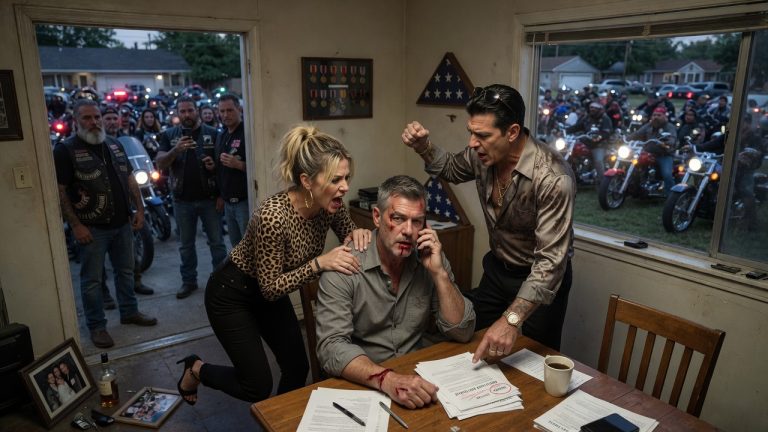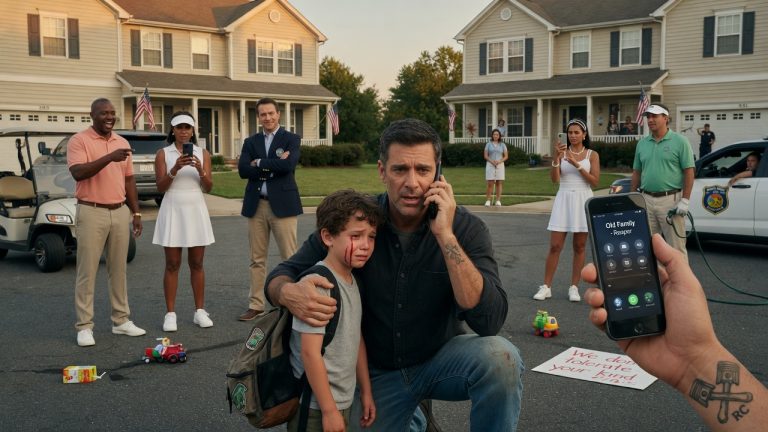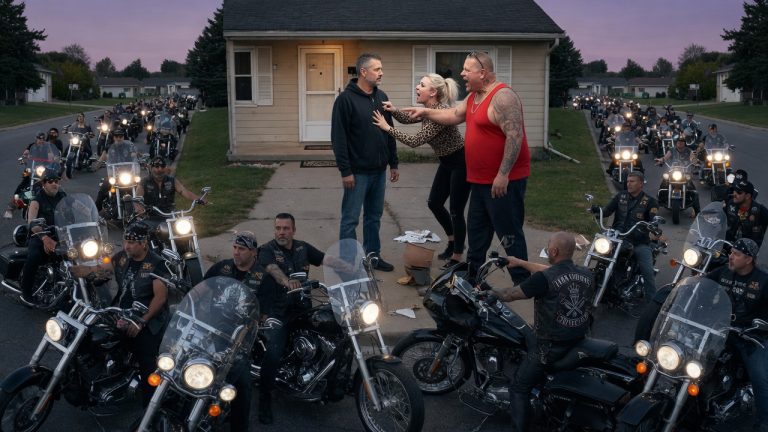
I spent six months rebuilding that ’68 Triumph. Every bolt, every shim, every drop of oil was a promise I was keeping to myself. I wasn’t going to be the guy who let things fall apart. I wasn’t going to be my father, leaving a trail of broken glass and crying women in a rearview mirror.
But then I saw the credit card statement for a hotel I’d never visited.
I didn’t yell. I didn’t throw a wrench through the windshield. I went to the shop, grabbed a magnetic GPS tracker from the “lost and found” bin, and crawled under my wife’s SUV in the middle of a Detroit sleet storm.
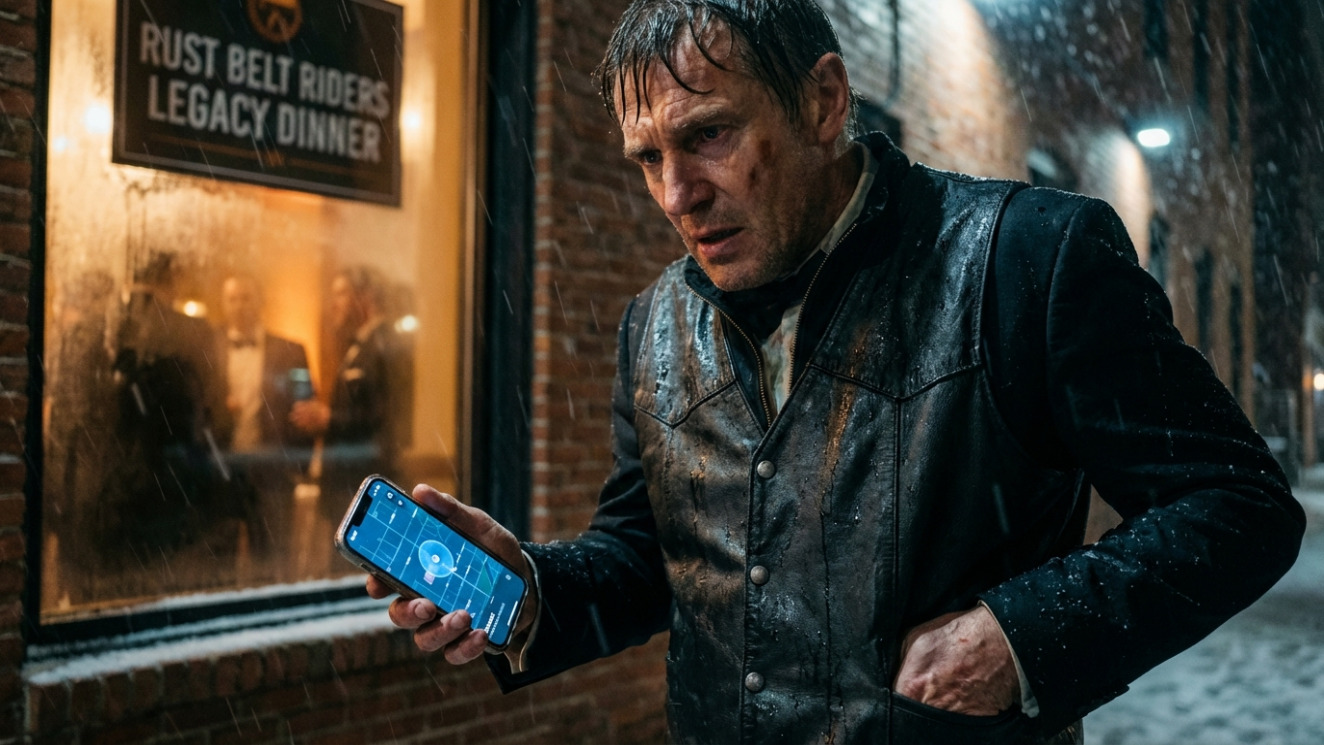
Now, the blue dot on my phone is telling me she’s at the Marriott in Troy. Again.
Tonight is the Rust Belt Riders’ Legacy Dinner. Everyone thinks we’re the “gold standard” couple of the club. They’re waiting for me to give the toast. They’re waiting for Jules to smile and look at me like I’m her hero.
But I have the tracker in my pocket. And I have the phone number of the man she’s with—and his wife’s number, too.
The engine is cold, but the bed she’s in is warm. And I have exactly three hours to decide if I’m going to burn the whole world down or just walk out into the snow.
FULL STORY
Chapter 1
The garage smelled like 1968. It was a thick, permanent soup of evaporated gasoline, burnt oil, and the damp, metallic rot of Detroit winter. I liked it in here. Machines were honest. If a bike didn’t start, it wasn’t because it was mad at you or because it was bored with the relationship. It didn’t start because a gasket was blown or a spark plug was fouled. You could find the fault. You could measure it with a micrometer. You could fix it.
I was hunched over the frame of a Triumph Bonneville, the chrome of the tank reflecting the flickering fluorescent light overhead. My hands were stained black to the knuckles, the kind of grease that takes three days and a gallon of Gojo to truly disappear.
My phone vibrated on the workbench. It rattled against a tray of zinc-plated bolts.
I didn’t look at it. I knew what it was. It was a notification from an app I’d downloaded three days ago—one I’d paid twenty-nine dollars for, feeling like a predator the entire time I entered my credit card info. The app was linked to a small, magnetized black box I’d slapped onto the frame rail of Jules’s Honda Pilot while she was sleeping.
Target has reached Destination: 2000 West Big Beaver Road, Troy, MI.
The Somerset Inn. A nice hotel. Not the kind of place you go for a “late meeting with the school board,” which was the lie Jules had served over coffee this morning. She’d looked me right in the eye when she said it, too. She’d even tucked a stray hair behind her ear—a gesture I’d always found endearing. Now, it felt like a tactical maneuver.
I picked up a 12mm wrench and tightened a nut on the exhaust header. I tightened it until the metal groaned, then I kept going. The bolt snapped. The clean, sharp crack echoed through the warehouse, a tiny gunshot in the silence of the industrial park.
“Dammit,” I breathed.
I sat back on my heels, looking at the sheared-off bolt. It was a stupid mistake. Amateur. I was supposed to be the best restoration guy in the tri-county area. People brought me their baskets of rust because I had “the touch.” But my hands were shaking. Not a lot—just a fine, high-frequency tremor that made the wrench feel like a live wire.
I stood up and walked to the workbench, picking up the phone. The blue dot was stationary. It had been there for forty minutes.
My father used to leave the house at 11:00 PM on Tuesday nights. He told my mother he was checking the security system at the warehouse where he worked as a foreman. He’d come back at 2:00 AM smelling like Newport cigarettes and a perfume that didn’t belong to the woman who was currently folded into a ball on our sofa, waiting for him. I remember the sound of their whispering in the kitchen—the sharp, hissed accusations and the low, rumbling lies he used to flatten her.
I swore I’d never be that guy. I swore I’d never be the one lying, and I swore I’d never be the one being lied to.
I checked the time. 6:45 PM. The “meeting” was supposed to end at 8:00. She’d be home by 8:30, smelling like professional exhaustion. She’d tell me about the budget cuts and the arrogant principal, and I’d listen. I’d be the “good husband.” The anchor.
The heavy steel door of the shop groaned open, letting in a blast of freezing Michigan air.
“Still at it, Miller?”
It was Mack. He was a “Legacy” member of the Rust Belt Riders, which basically meant he’d survived the seventies without dying in a ditch or going to prison. He was sixty, with a beard that looked like steel wool and skin that had the texture of an old saddle. He was riding a pristine Shovelhead he’d finished last summer, the chrome gleaming even in the dull light.
“Just finishing the headers,” I said, putting the phone face-down on the bench.
Mack walked over, his heavy boots clumping on the concrete. He peered at the Triumph. “She’s coming along. Jules still pushing you to sell it? She told my wife at the barbecue that she wants that spare bedroom turned into a sunroom.”
I wiped my hands on a rag, the movement mechanical. “Something like that.”
“Don’t do it,” Mack said, lighting a cigarette. The smoke swirled into the rafters. “A man needs a place where he’s the boss. You start letting them turn your grease-holes into sunrooms, and before you know it, you’re holding her purse at the mall and wondering where your balls went. Look at me—three ex-wives, and I still got every bike I ever loved.”
“Maybe that’s why you have three ex-wives, Mack.”
He laughed, a dry, hacking sound. “Better to have three exes than one lie you’re living every day. Anyway, don’t forget the Legacy Dinner is Friday. You’re the guest of honor. Youngest guy to ever hit Master Builder status in the club. You and Jules are the poster children for the new guard. Clean, professional, solid. The Old Guard likes seeing a couple that actually likes each other for once.”
“We’ll be there,” I said. My voice sounded hollow to my own ears, like I was speaking into a bucket.
“Good. Don’t be late. The President wants to do a whole bit about ‘foundations’ and ‘tradition.’ It’s gonna be a bore, but the steak is usually decent.”
Mack patted my shoulder. His hand felt heavy, an unbearable weight of expectation. To the Riders, I wasn’t just Shane Miller, the mechanic. I was the proof that the club wasn’t just a bunch of aging delinquents. I was the “success story.” I had the business, the beautiful wife, the house in Royal Oak. I was the legacy they wanted to leave behind.
When he left, the silence in the shop felt heavier than before.
I looked at the phone again. The blue dot hadn’t moved.
I walked over to the corner of the shop where I kept a small, locked filing cabinet. I opened the bottom drawer and pulled out a manila folder. Inside weren’t bike titles or tax returns. They were printouts of phone logs.
I’d found the number three weeks ago. A series of long, mid-afternoon calls. Sometimes at 10:00 PM when I was still at the shop. I’d reverse-searched it.
Anthony “Tony” Varrone. 42. Senior Partner at Varrone & Associates. Commercial Real Estate.
I’d seen his face on billboards. A tan that looked expensive, teeth that were too white, and eyes that looked like they’d never seen the inside of a garage in their life. He was everything I wasn’t. He was “clean money.” He was the kind of guy who bought vintage bikes to display in his lobby, not to ride.
I’d also found his address. A sprawling estate in Bloomfield Hills. And I’d found his wife’s name. Elena.
I sat there on the floor of my shop, surrounded by the skeletons of motorcycles, and I felt a strange, cold clarity. The tremor in my hands was gone.
I wasn’t going to be my father. My father was a coward who stayed for the comfort of the lies. He let the rot eat the house from the inside out because he was afraid of the cold.
I got up, grabbed my heavy Carhartt jacket, and headed for the door. I didn’t turn off the lights. I didn’t lock the Triumph in its stand.
I had a GPS coordinate, a sheared-off bolt, and two hours before my wife was supposed to be a “school board member” again. It was time to see if the reality matched the data.
The drive to Troy took twenty minutes. The heater in my old F-150 was struggling against the ten-degree night, blowing lukewarm air that smelled of antifreeze. I watched the suburban sprawl go by—the chain restaurants, the glowing malls, the rows of identical houses with their porch lights on. It all looked so peaceful. So settled.
I pulled into the Marriott parking lot and drove slowly through the rows. My heart was a slow, heavy hammer in my chest. Thump. Thump. Thump.
I found it in the back corner, near the service entrance. The white Honda Pilot. The license plate was “JULES-1.” I’d bought her that plate for her thirtieth birthday. I’d thought it was cute.
I parked three rows away and turned off the engine.
I waited.
The cold began to seep through the truck’s floorboards. I watched the hotel’s side door. Every time it opened, I felt a jolt of electricity go down my spine.
At 7:52 PM, they walked out.
She was laughing. It was that specific laugh—the one she used when she was truly happy, not the polite one she used at club functions. Her head was tilted back, her throat exposed to the freezing air. Tony was next to her, his hand firmly on the small of her back. He said something in her ear, and she leaned into him, her shoulder brushing his expensive wool overcoat.
They stopped at her car. He didn’t just say goodbye. He pulled her in, and she went willingly, her arms wrapping around his neck, her fingers disappearing into his perfectly styled hair.
I watched them for a long time. I watched the way he touched her face. I watched the way she lingered before getting into the driver’s seat.
Then, she pulled away. Tony waited until she’d started the engine before walking toward a silver Lexus parked a few spots over.
I reached into my pocket and pulled out the small black tracker. I’d removed it from her car an hour before I left the shop, knowing I wouldn’t need it anymore. I held it in my palm. It was just a piece of plastic and circuitry. But it had destroyed my world.
I didn’t start my truck until her taillights disappeared around the corner.
I didn’t go home. Not yet. I went back to the shop.
I sat at my workbench and picked up the sheared bolt. I looked at the two pieces of metal—once a single, solid unit, now broken in a way that could never be truly made whole again. You could weld it, sure. You could grind it down and paint over it. But the structural integrity was gone. It would always be a point of failure.
I opened my laptop and looked up the “Legacy Dinner” guest list on the club’s private portal.
Miller, Shane. +1 (Jules).
I looked at the “Platinum Sponsors” list.
Varrone & Associates.
The irony was a physical weight in my gut. Tony was a donor. He liked the “aesthetic” of the biker world. He liked the ruggedness of it, as long as he didn’t have to get his hands dirty. He was probably coming to the dinner. He’d probably sit at a table near us, drinking expensive scotch while I talked about “loyalty” and “tradition.”
I felt a sudden, violent urge to go to his house. To find Elena. To tell her that her husband’s “late meetings” were taking place in Room 412 of the Marriott.
But I stayed in the chair.
I reached for a drill and a tap-and-die set. I had work to do. I had to extract the broken stud from the Triumph. I had to make the engine look perfect again.
Because on Friday night, there was going to be a show. And I wanted to make sure I was ready for my starring role.
The phone rang. It was Jules.
“Hey, honey,” she said. She sounded tired. Perfect. “The meeting ran so late. I’m just pulling into the driveway now. Did you eat?”
“Not yet,” I said. My voice was a flat, dead thing. “I’m still at the shop. The Triumph is giving me some trouble.”
“Oh, Shane. You work too hard. Come home soon? I missed you today.”
“I’ll be there soon, Jules,” I said. “I just have to finish one last thing.”
I hung up and looked at the broken bolt.
“I missed you, too,” I whispered to the empty, oil-scented air.
Chapter 2
The next morning, the world was gray. Not just the Detroit sky, but the very air inside our house. I sat at the kitchen island, a cup of coffee growing cold in my hands, watching Jules move through her morning routine.
She was efficient. She made a green smoothie, packed a sensible lunch, and checked her reflection in the hallway mirror. She looked like a woman with a clean conscience. She looked like a woman who hadn’t been pressed against a Lexus in a Troy parking lot twelve hours ago.
“You’re quiet,” she said, pausing with her hand on the door handle. “Is it the bike? You seemed stressed last night.”
“The bike’s fine,” I said. I didn’t look up from my coffee. “Just thinking about the dinner tomorrow. Mack says I’m the poster boy for ‘The Future of the Club.'”
Jules smiled. It was a bright, supportive smile that didn’t reach her eyes. “You are, Shane. You’ve worked so hard for this. Everyone respects you. I’m so proud to be on your arm for that.”
The word arm felt like a hook. I imagined her arm around Tony’s neck.
“Yeah,” I said. “Proud.”
As soon as her car cleared the driveway, I was out the door. I didn’t go to the shop. I drove to a diner on the edge of Grosse Pointe—a place where the coffee tasted like battery acid and the booths were patched with duct tape.
I was meeting someone.
Elena Varrone arrived ten minutes late. She didn’t look like a woman who lived in a five-million-dollar house in Bloomfield Hills. She looked exhausted. She was wearing a heavy wool coat and a scarf pulled high, but she couldn’t hide the dark circles under her eyes. She sat down across from me, her movements stiff.
“You’re the one who called,” she said. It wasn’t a question.
“Shane Miller,” I said.
“I know who you are. My husband talks about your club. He thinks it’s… ‘authentic.’ He likes being a patron of the arts, even if the art is grease and steel.” She looked at me with a sharp, cynical intensity. “Why are we here, Shane? You didn’t sound like a man looking for a donation on the phone.”
I didn’t lead with the photos I’d taken. I didn’t lead with the GPS logs. I just looked at her.
“Do you know where Tony was last night?”
She flinched. It was subtle—just a tightening of the jaw—but it told me everything. She knew. Or she suspected. And she was tired of knowing.
“He had a closing,” she said, her voice robotic. “Commercial lot in Sterling Heights.”
“He was at the Marriott in Troy,” I said. “With my wife.”
The silence that followed was heavy. The waitress came over, poured two cups of brown water, and left without a word. Elena didn’t touch her cup. She stared at the scratched Formica tabletop as if it held the secrets of the universe.
“How long?” she whispered.
“I found out three weeks ago. I don’t know when it started. Maybe months. Maybe longer.”
Elena let out a breath that sounded like a sob, but her eyes stayed dry. “Tony doesn’t do ‘longer.’ He does ‘new.’ He does ‘exciting.’ He likes things that are hard to get.” She finally looked up at me. “Your wife. Jules, right? She’s the school board type? High heels and a moral compass?”
“She was,” I said. “Or I thought she was.”
“He likes the challenge of a ‘good woman,'” Elena said, her voice dripping with a bitter, practiced venom. “It makes him feel like he’s won something. He’s been doing this for fifteen years, Shane. I stay because of the kids. I stay because of the house. I stay because I’m a coward.”
“I’m not,” I said.
Elena leaned forward. “Then why tell me? Why not just file for divorce and leave her with nothing?”
“Because of the club,” I said. “The Rust Belt Riders… they aren’t just guys I ride with. They’re the only family I have. My father was a cheat, and he died alone. I built my life on the idea that loyalty is the only thing that doesn’t rust. If I just walk away, I’m the guy who failed. I’m the guy whose wife preferred a suit in a Lexus.”
“So you want revenge,” she said.
“I want the truth to be the only thing left standing,” I said. “Tomorrow night is the Legacy Dinner. Tony is a sponsor. He’ll be there. Jules will be there. I’m supposed to give a speech about ‘The Foundation of Brotherhood.'”
Elena’s eyes sharpened. A slow, cold smile spread across her face. It wasn’t a happy look; it was the look of a person who had finally found a weapon.
“What do you need from me?” she asked.
“I need his private phone,” I said. “The one he uses for ‘closings.’ I need the messages. I want to know exactly what he promised her. I want to know if they laughed about me.”
“They did,” Elena said quietly. “They always do. They think we’re the scenery in their movie.”
She reached into her bag and pulled out a small, leather-bound notebook. She tore out a page and pushed it across the table.
“That’s his cloud password,” she said. “He thinks I’m too stupid to use a computer. He keeps it written in his desk drawer. Go ahead, Shane. Take it all. Burn him to the ground. Just… make sure he knows it was you.”
I took the paper. My fingers felt cold.
“He’ll know,” I said.
I left the diner and drove to the shop. I spent the rest of the day in a trance. I didn’t work on the Triumph. I sat at my computer and accessed Tony Varrone’s cloud storage.
It was all there.
The photos. The texts. The “I love you”s that felt like physical blows.
“He’s at the shop again,” Jules had texted last Tuesday. “He’s so obsessed with those machines. He doesn’t even see me anymore. Meet me at the usual spot?”
And Tony’s reply: “I see you, Jules. I see everything he’s too blind to appreciate.”
I felt a roar in my ears. It wasn’t anger—anger is hot. This was something else. This was the sensation of a life being dismantled, piece by piece.
I looked at a photo Jules had sent him. It was a selfie in our bedroom mirror. She was wearing a dress I’d bought her for our anniversary. The caption was: “Wishing you were the one taking this off me.”
I closed my eyes. I remembered buying that dress. I remembered the way I’d felt when I saw her in it—the pride, the sense that I’d finally escaped the wreckage of my childhood and built something beautiful.
I was a fool. I was a man who had spent his life restoring old bikes, thinking that if you polished the outside enough, the inside would eventually become new.
Mack came by late in the afternoon. He saw me sitting in the dark, the blue light of the monitor reflecting in my eyes.
“You okay, kid? You look like you’ve been eating glass.”
“Just tired, Mack,” I said. I shut the laptop. “Big day tomorrow.”
“Listen,” Mack said, leaning against the workbench. “I know I talk a lot of shit about wives and exes. But you and Jules… you’re different. You’re the real deal. When I see you guys together, it makes me think maybe I just picked the wrong ones. Don’t let the pressure get to you tomorrow. Just stand up there, say your piece about the club, and go home to your girl. That’s the dream, Shane. Don’t forget that.”
“I won’t,” I said.
I watched Mack walk out to his bike. I watched the way he handled the machine—with a rough, casual love. He believed in the myth. He believed in the “brotherhood.”
I looked at the laptop.
I had the truth. But the truth wasn’t going to set me free. It was just going to leave me standing in the middle of a very expensive, very public wreck.
I spent the night in the shop. I didn’t want to go home and lie in the bed she’d used to text Tony. I didn’t want to smell her perfume.
I worked on the Triumph until my fingers bled. I polished the chrome until I could see my own reflection—haggard, gray, and unrecognizable.
I wasn’t a Master Builder. I was just a guy with a tracker and a broken heart, waiting for the sun to come up so I could start the fire.
At 3:00 AM, I took the GPS tracker out of my pocket. I walked over to the shop’s hydraulic press. I placed the little black box on the anvil.
I turned the handle.
The press came down slowly. The plastic groaned, then shattered. The circuit board snapped. The battery leaked a tiny, acrid puff of smoke.
I kept turning the handle until the tracker was nothing but a flat, distorted pancake of waste.
I felt a tiny flicker of satisfaction. It was the first thing I’d fixed all week.
Chapter 3
The morning of the Legacy Dinner felt like a funeral.
I went home at 7:00 AM to shower and change. Jules was already up, humming to herself as she ironed a silk dress—the one she planned to wear tonight. It was a deep, midnight blue.
“Where were you?” she asked, her voice light, teasing. “I woke up and the bed was cold.”
“The Triumph had a leak in the primary cover,” I said. I didn’t look at her. I went straight to the bathroom and turned the water on hot. “I had to stay until I found it.”
“You’re such a perfectionist,” she said through the door. “But that’s why everyone loves you. You never leave a job half-done.”
I leaned my forehead against the cold tile of the shower. Never leave a job half-done. After my shower, I didn’t go back to the shop. I went to a small park near the river—the kind of place where the grass is mostly dead and the wind off the water smells like rusted iron.
I sat on a bench and watched the tugboats.
My phone buzzed. A text from Elena.
He’s bringing a gift. A vintage watch for the club’s silent auction. He wants to look like a saint tonight. Do you have the files ready?
I have them, I typed back.
Good. Don’t hesitate, Shane. Men like Tony… they don’t feel guilt. They only feel exposure. Make it hurt.
I put the phone away. I didn’t want to make it hurt. I just wanted it to be over. I wanted to wake up in a world where I didn’t know what Room 412 looked like.
I spent the afternoon wandering through a salvage yard. It’s where I go when I need to think. There’s something comforting about acres of dead cars. They’ve already met their fate. The trauma is over. They’re just waiting to be melted down and turned into something else.
I found an old Ford truck, the same model my father used to drive. I sat in the driver’s seat. The upholstery was torn, and the steering wheel was sticky with decades of grime.
I remembered sitting in this seat when I was eight years old. My father had taken me to the “warehouse.” He’d told me to stay in the truck while he checked the alarms. I’d watched him walk toward a small side door. A woman had met him there. She’d been wearing a red coat. She’d kissed him, and they’d gone inside.
I’d sat in that truck for two hours, freezing, watching the shadows move behind the frosted glass of the warehouse windows.
When he came back, he’d handed me a candy bar.
“Don’t tell your mother we were here,” he’d said. “It’s our secret. A man’s business is his own, Shane. Remember that.”
I’d eaten the candy bar. I’d kept the secret. And I’d watched my mother wither away for ten years, knowing something was wrong but never having the proof to scream about it.
I wouldn’t be him. I wouldn’t hand out candy bars.
I drove back to the house at 5:00 PM. Jules was ready. She looked stunning. The blue dress hugged her curves, and she’d done her hair in a way that made her look like a movie star. She was putting on her earrings—the diamond studs I’d given her for our fifth anniversary.
“Do I look okay?” she asked, turning for me.
“You look perfect,” I said.
“You should get dressed. The President called—he wants you there early for the photos.”
I went to the bedroom and pulled out my suit. It felt like a costume. The Rust Belt Riders usually wore leather and denim, but the Legacy Dinner was the one night a year we pretended to be civilized.
As I tied my tie, I looked at myself in the mirror. I looked like a man who had everything under control.
“Shane?”
Jules was standing in the doorway. She was looking at me with a strange expression—part curiosity, part concern.
“Yeah?”
“You’ve been… different lately. Are you sure you’re okay? If the pressure of the speech is too much, you don’t have to do it. Mack would understand.”
I turned to her. I wanted to scream. I wanted to grab her by the shoulders and ask her how she could stand there, in our bedroom, and act like she cared about my “pressure.”
Instead, I reached out and touched her cheek. My hand was steady.
“I’m fine, Jules. I just want tonight to be memorable.”
“It will be,” she said, leaning into my hand. “It’s your big night.”
The drive to the Detroit Athletic Club was silent. The city lights blurred past the window—a smear of neon and grit. Jules chatted about the school board, about a new curriculum they were debating. I nodded in all the right places. I was becoming an expert at the lie.
The ballroom was filled with the smell of expensive cologne and roasted meat. The Riders were there in force—men I’d known for a decade, men who had helped me move shops, men who had bailed me out when my first business venture went south.
They greeted me with handshakes and slaps on the back.
“Here he is!” Big Pete, the club president, roared. He was a mountain of a man with a silver beard and a voice that could shake walls. “The man of the hour! And the lovely Jules. You guys make the rest of us look like we live in caves.”
Jules laughed, that perfect, melodic sound. “Oh, Pete. You know Shane—he’d rather be in his cave than anywhere else.”
“Tonight, he’s in the light!” Pete said, ushering us toward the head table.
I saw him then.
Tony Varrone was standing near the bar, holding a tumbler of scotch. He was wearing a tailored gray suit that probably cost more than my first three bikes combined. He was talking to a group of local politicians, looking every bit the successful, civic-minded businessman.
Our eyes met across the room.
He didn’t flinch. He didn’t look away. He raised his glass to me in a silent, arrogant toast.
He thought he was untouchable. He thought I was just a “grease monkey” who was lucky to have a woman like Jules.
I felt a cold, hard knot of resolve tighten in my chest.
“I’m going to go check on the AV setup,” I said to Jules.
“Now? Dinner is starting.”
“Just a quick check. I want to make sure the slides for the presentation are in the right order. I don’t want to mess up the history segment.”
“Okay, honey. Don’t be long.”
I walked toward the back of the room, where a young guy in a vest was fiddling with a laptop connected to the giant projector screens.
“Hey,” I said. “I’m Shane Miller. I’ve got a last-minute addition to the slideshow. A few photos of the new Triumph build. Pete wants them included in the ‘Future of the Club’ segment.”
“Sure thing, Mr. Miller,” the kid said. “Just pop the thumb drive in.”
I handed him the drive. The drive that didn’t contain photos of the Triumph.
The drive that contained the hotel logs, the texts, and the photo of Jules in the anniversary dress.
“Set it to play right after my speech,” I said. “During the silent auction. It’s supposed to be a surprise.”
“You got it,” the kid said, dragging the files into the queue. “A surprise it is.”
I walked back to the table. I sat down next to my wife. I picked up my water glass.
I looked at Tony Varrone. He was laughing at something a councilman had said.
I looked at Jules. She was checking her phone under the table. Probably a text from him. “You look beautiful in blue.”
I felt like I was watching a movie. A tragedy I’d written but couldn’t stop.
“Ladies and gentlemen,” Big Pete’s voice boomed over the speakers. “If I could have your attention. Before we start the main course, I’d like to call up a man who represents everything the Rust Belt Riders stand for. A man of integrity. A man of skill. A man who knows that a legacy isn’t something you’re given—it’s something you build, one bolt at a time.”
The room erupted in applause.
“Shane Miller, come on up here!”
I stood up. My legs felt heavy, like I was walking through deep water.
I walked to the podium. The lights were bright, blinding. I looked out at the sea of faces—my “family.”
I saw Mack, nodding at me with pride.
I saw Tony, leaning back in his chair with a smirk.
I saw Jules, her eyes shining, her hands clasped together.
I adjusted the microphone. The feedback squealed—a sharp, piercing needle of sound.
“Thank you, Pete,” I said. My voice was steady. It didn’t sound like mine. It sounded like the voice of a ghost. “Tonight, we’re talking about legacy. We’re talking about what stays when everything else is gone.”
I took a deep breath.
“My father told me once that a man’s business is his own. He told me that some things are meant to be kept in the dark. He thought that if you kept the secrets well enough, you could keep the house standing.”
I looked directly at Jules.
“He was wrong.”
Chapter 4
The room was silent. A hundred pairs of eyes were locked on me, waiting for the inspirational turn. They expected me to talk about the club, about the bikes, about the “brothers” who had my back.
“A legacy isn’t built on secrets,” I continued, my voice gaining a hard, metallic edge. “It’s built on truth. Even when that truth is ugly. Even when it burns down the house you spent ten years building.”
I saw Big Pete frown. He leaned over and whispered something to the Vice President. Jules’s smile faltered. She shifted in her seat, her eyes darting toward Tony.
Tony wasn’t smirking anymore. He was sitting very still, his glass halfway to his mouth.
“I spent six months on the ’68 Triumph,” I said. “I wanted it to be perfect. I wanted it to be the proof that if you care enough about something, it can never really break. But machines are easy. You can see the crack in a frame. You can hear a knock in the engine.”
I paused. I could feel the tension in the room—a physical pressure, like the moments before a storm breaks.
“But people… people are better at hiding the rot. They can sit at your table, sleep in your bed, and tell you they love you while they’re planning their next ‘meeting’ in a hotel room in Troy.”
A low murmur rippled through the ballroom. Jules’s face went white—not the pale of a ghost, but the translucent white of someone who has just felt the floor drop out from under them.
“Shane,” she whispered. It wasn’t loud, but in the silence of the room, it felt like a scream.
I didn’t look at her. I looked at Tony Varrone.
“Tony,” I said, my voice echoing off the high ceilings. “I want to thank you for being a sponsor tonight. I know you value ‘authenticity.’ You like the rugged life. You like taking things that don’t belong to you because you think your money makes you entitled to them.”
Tony stood up. He was fast, smooth. The professional mask was back in place, but his eyes were wide with a flickering panic.
“I don’t know what you’re talking about, Miller. You’ve had too much to drink. Pete, get your boy off the stage.”
Pete stood up, his face a mask of confusion and growing anger. “Shane, sit down. We’ll talk about this in the back.”
“No,” I said. I looked at the AV kid in the back of the room. I gave him a short, sharp nod. “Let’s talk about it here. In the light.”
The giant screens on either side of the podium flickered to life.
The first image wasn’t a motorcycle. It was a screenshot of a text message.
“He’s at the shop again. He’s so obsessed with those machines… Meet me at the usual spot?”
The room gasped. It was a collective intake of breath that sounded like a vacuum.
The next image was the selfie Jules had taken in our bedroom. The blue dress. The anniversary dress.
“Wishing you were the one taking this off me.”
Then came the hotel logs. 2000 West Big Beaver Road. Room 412. Multiple dates over the last three months.
I looked at Jules. She was frozen. Her hand was over her mouth, her eyes fixed on the screen as her private shame was broadcast to every person who mattered in our lives.
The murmurs turned into a roar. The Riders were standing now. These weren’t men who valued “subtlety.” They were men who lived by a code of loyalty that was primal and unforgiving.
Mack was the first to move. He didn’t go for me. He walked toward Tony’s table.
“You son of a bitch,” Mack growled.
“Wait,” Tony said, holding up his hands. “This is a misunderstanding. This is… he’s crazy! He’s a stalker! He tracked her car!”
“Yeah, I tracked her car,” I said into the microphone. My voice was calm, almost conversational. It was the calm of a man who has already lost everything and realized there’s nothing left to fear. “I tracked it to the Marriott. I watched you kiss her, Tony. I watched the way you touched her. You didn’t think a ‘grease monkey’ would notice, did you?”
Jules finally moved. She stood up and ran toward the stage.
“Shane! Stop this! Please!” She was crying now, the mascara running down her cheeks, ruining the “perfect” face she’d spent an hour painting. “We can talk about this! Not like this!”
I looked down at her from the podium. She looked small. For the first time in ten years, I didn’t feel the urge to protect her. I didn’t feel the urge to fix whatever was broken.
“There’s nothing to talk about, Jules. You were right. I’m a perfectionist. I don’t leave jobs half-done.”
The room was chaos. Big Pete had reached the stage. He took the microphone from my hand.
“That’s enough!” he yelled. “Turn those screens off!”
The screens went black, but the damage was permanent. The images were burned into the retinas of everyone in the room.
Pete looked at me, his face a mix of pity and fury. “Shane… why? Why here? Why do this to yourself?”
“Because if I did it at home, I’d be my father,” I said. “I’d be the guy who keeps the secret. I’d be the guy who lets the lie live. I wanted everyone to see it. I wanted there to be no way back.”
I walked off the stage.
The crowd parted for me like I was a leper. I didn’t look at Mack. I didn’t look at the other Riders.
I walked past Tony Varrone. He was surrounded by three of the younger club members—guys who looked like they were waiting for an excuse to take him out to the parking lot.
“Elena has the password, Tony,” I said as I passed him. “She’s probably reading the messages right now.”
Tony’s face collapsed. The arrogance, the wealth, the tailored suit—it all seemed to shrink. He realized that this wasn’t just a “biker problem.” His life in Bloomfield Hills was ending, too.
I walked out of the ballroom.
I heard Jules calling my name, but her voice was drowned out by the noise of the crowd.
I walked out into the cold Detroit night.
The air felt incredible. It was sharp and biting, and it tasted like freedom.
I got into my truck and started the engine. It turned over on the first try. A clean start.
I didn’t go home. I didn’t have a home anymore.
I drove to the shop.
I sat in the dark for a long time, listening to the building groan in the wind.
Around midnight, the door opened.
It was Elena.
She was wearing the same coat from the diner. She looked tired, but there was a strange, grim satisfaction in her eyes.
“He called me,” she said. “He was screaming. He said you ruined him.”
“I just showed the truth,” I said. “The truth did the ruining.”
“He’s at a hotel,” she said. “The locks are changed. The lawyers are already on it.” She walked over and sat on a crate next to me. “What about you, Shane? What about Jules?”
“She’s with her sister, probably. Or maybe she went back to the Marriott. It doesn’t matter.”
“Was it worth it?” she asked. “The scene? The public execution?”
I looked at the Triumph sitting in the middle of the floor. It was a beautiful machine. It was perfect. And I hated the sight of it.
“I don’t know,” I said. “But for the first time in my life, I don’t have any secrets. And I don’t have any candy bars.”
Elena didn’t ask what I meant. She just sat there with me in the cold, oily dark. Two people who had finally stopped trying to fix things that were meant to be broken.