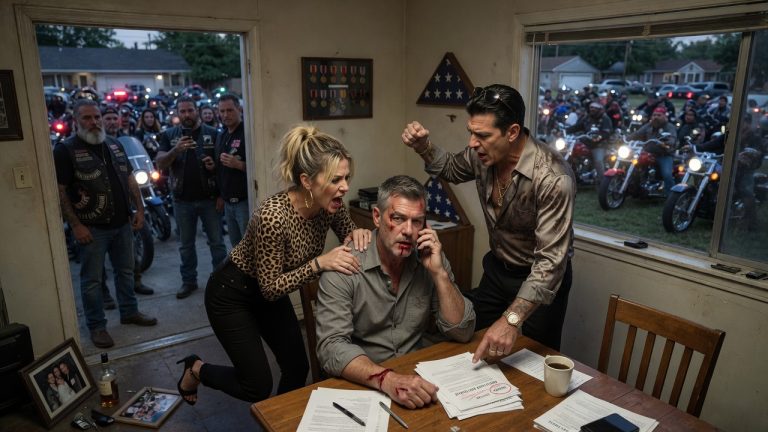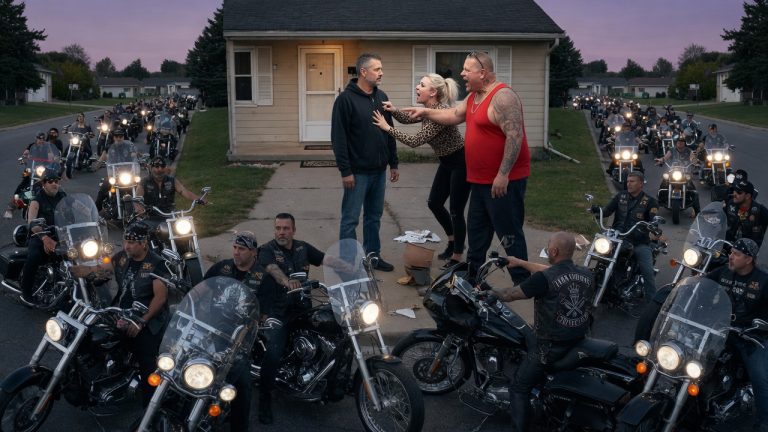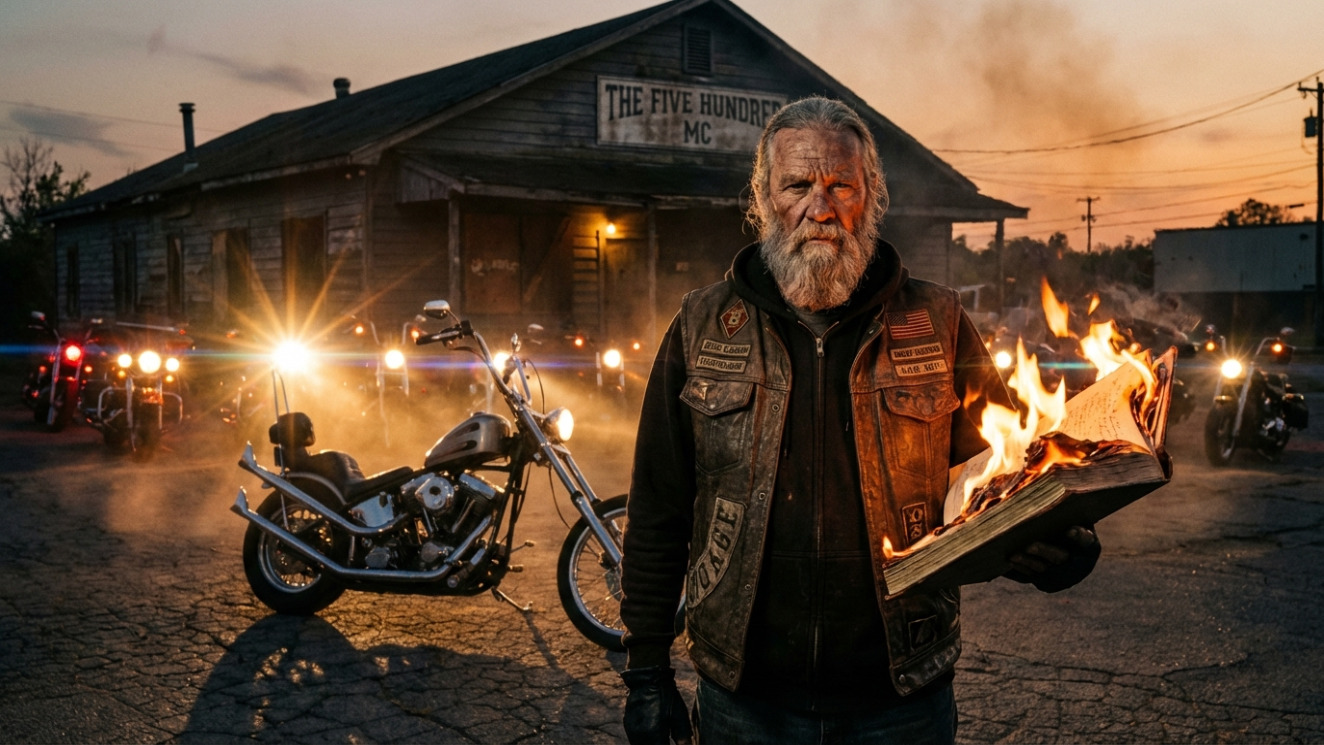
They called it loyalty. I called it ten years of my life.
When I walked out of those prison gates after a decade of silence, I expected to find the brothers I’d bled for. I expected to find the club I’d built with my own two hands. Instead, I found a corporate machine wearing our patches and a Vice President who looked at me like a relic heading for the scrap heap.
But that wasn’t the worst part.
The worst part was the ledger Ma handed me. It turned out the man I went to prison for—the brother I’d protected with every ounce of my honor—was the one who put the target on my back in the first place.
I’m seventy years old. My lungs are failing, and my granddaughter thinks I’m a monster. I’ve got one ride left in me, and five hundred bikers behind me who think they’re honoring a legend.
They don’t know that the legend is a lie. And they don’t know that before I go, I’m going to make sure the truth burns every single one of us to the ground.
FULL STORY
Chapter 1
The air outside the State Correctional Institution didn’t smell like freedom. It smelled like wet asphalt and the diesel exhaust of a SEPTA bus idling half a mile down the road. For Wes Miller, it was the first time in three thousand, six hundred, and fifty-two days that the air didn’t have the metallic, recycled tang of a cell block.
He stood on the gravel shoulder, his boots feeling heavy—too heavy for legs that had grown thin and shaky in the shadows of the yard. He gripped the strap of his nylon duffel. Inside were the remains of a life: a Bible he’d never read, a stack of unanswered letters from a son who had died three years into his sentence, and a portable oxygen concentrator he’d been issued by the prison infirmary two months ago.
“Wes!”
The voice was a jagged tear in the morning quiet.
Wes looked up. Across the two-lane blacktop, the “Five Hundred Shadows” were waiting. That’s what the newspapers used to call the Reapers MC when they rode in force. There weren’t five hundred of them today—maybe sixty—but they were lined up with a precision that felt wrong.
In Wes’s day, a pack of riders was a chaotic, snarling beast. These men sat on bikes that looked like they’d been detailed by a surgical team. Glossy black fairings, matching tactical vests, and helmets with integrated comms. It looked less like a motorcycle club and more like a private security firm.
A man stepped forward from the center of the line. He was young, maybe thirty-five, with a high-and-tight haircut and a beard trimmed with a ruler. He wore the President’s patch. Wes felt a dull ache in his chest that had nothing to do with his lungs. That patch used to be his.
“Jax,” Wes said. His voice was a dry rattle, like gravel in a tin can.
“Welcome home, Iron Wes,” Jax said. He didn’t hug him. He didn’t even shake his hand. He just stood there, thumbs hooked into his vest. “The club’s been waiting.”
“I see you updated the fleet,” Wes said, nodding toward the rows of identical black Baggers.
“Efficiency, Wes. Branding. We don’t ride junk anymore. We’re moving weight, not just making noise.” Jax signaled to a younger kid—a prospect, by the look of his clean vest. “Gears, get the man’s bag.”
The kid, Gears, scurried forward. He looked at Wes with a mix of awe and pity. He’d clearly heard the stories of Iron Wes Miller, the man who’d held his tongue for a decade to save the club’s founders from a racketeering sweep. He probably hadn’t expected the legend to look like a guy who struggled to walk across the street.
“I can carry my own bag, kid,” Wes said.
“It’s okay, sir,” Gears whispered. “Jax wants things done a certain way.”
Wes let the kid take the bag. He climbed into the back of a blacked-out SUV that sat at the rear of the formation. A bike would have killed him today; the vibration alone would have sent him into a coughing fit he wouldn’t come out of.
The ride back to the clubhouse in the Rust Belt town of Oakhaven was a blur of gray Pennsylvania hills and decaying factories. Oakhaven had been a steel town once. Now it was a town of dollar stores and vape shops. The clubhouse, however, had seen an upgrade. What used to be a converted machine shop was now a fortress. High fences, security cameras, and a paved lot that could hold a small army.
Inside, the smell of stale beer and sawdust had been replaced by the scent of expensive floor wax and leather. Jax led Wes to the “Church” room. The long oak table was still there, but there were monitors on the wall showing spreadsheets and logistics maps.
“We’re doing a tribute ride on Saturday,” Jax said, pulling out a chair at the head of the table—Wes’s old chair. “The Five Hundred Shadows. We’ve got chapters coming in from three states. It’s for you, Wes. The man who sacrificed everything for the brotherhood.”
Wes sat down slowly, feeling the wheeze in his chest. “I didn’t sacrifice for a tribute ride, Jax. I did it for the men. Where’s Stitch? Where’s Ma?”
“Stitch is around. Mostly does the clinic work for the guys now. Ma… she’s at the old house. She doesn’t come around the clubhouse much anymore. Says it’s too loud.” Jax leaned forward, his eyes narrowing. “Things are different now, Wes. We’re in the black. We don’t have to worry about the feds because we’ve got friends in the right places. You kept the seat warm, and now you can sit back and enjoy the spoils.”
“The spoils,” Wes repeated. He looked at the monitors. “You’re running pills, aren’t you? Corporate stuff. Not the old-school trade.”
“We’re a logistics company that happens to ride Harleys,” Jax said. “And Saturday is our coming-out party. A five-hundred-bike processional through three counties. The cops will be escorting us. You’ll be in the lead truck. The legend returns.”
Wes wanted to spit, but he didn’t have the moisture. He felt like a ghost haunting his own house.
Later that night, Wes slipped out of the clubhouse. He didn’t take an SUV. He walked. It took him forty minutes to cover a mile, stopping every few hundred yards to lean against a lamp post and catch his breath.
He reached a small, white-sided house with a sagging porch. The paint was peeling, and the yard was overgrown with weeds that the frost hadn’t killed yet. He knocked on the door.
A woman answered. She had gray hair tied back in a messy bun and wore an oversized cardigan. Her eyes were tired, but they sharpened when they saw him.
“Wes,” she said.
“Ma.”
She didn’t invite him in right away. She looked down the street, as if checking to see if he’d been followed. “You look like hell.”
“I feel worse.”
“Come in. I’ll make tea.”
The house smelled like peppermint and old newspapers. It was a sharp contrast to the sterile, cold clubhouse. Ma sat him down at the kitchen table.
“Big Al is gone, Wes,” she said, referring to her husband, the man Wes had gone to prison for. “Died three years ago. Heart gave out.”
“I know. I got the letter,” Wes said. “I’m sorry I wasn’t here.”
Ma looked at him, her lips a thin line. She reached into a drawer and pulled out a thick, yellowed envelope. She didn’t hand it to him. She just let it sit there.
“Jax thinks he’s the king of the world,” she said. “He thinks the club is his personal kingdom. He’s been using your name to recruit all these young kids. Telling them about the ‘code’ of Iron Wes.”
“I didn’t give him permission.”
“He didn’t ask. He’s got them thinking you’re a god because you took that fall for Al.” She paused, her voice dropping to a whisper. “But Al wasn’t who you thought he was, Wes. Toward the end, he got scared. He started talking.”
Wes felt a cold stone drop in his stomach. “Talking to who?”
“The feds. He made a deal. He stayed out of prison by giving them enough to keep the heat on you for the full ten. He sold you out while you were sitting in that cell thinking you were a hero.”
Wes looked at the envelope. He didn’t want to touch it. If he touched it, the last ten years would officially be a waste. If he touched it, the brotherhood he’d died for was a lie.
“He left this for me to give to you when you got out,” Ma said. “He was a coward, Wes. A coward who let his best friend rot.”
Wes reached out. His hand didn’t shake this time. He took the envelope. He didn’t open it. He just felt the weight of it.
“I missed my son’s funeral for a man who ratted me out,” Wes said. It wasn’t a question. It was a realization that felt like a knife in the ribs.
“You have a granddaughter, Wes,” Ma said softly. “Chloe. She’s nineteen. She’s at the community college. She’s the only good thing left of your bloodline. If you’re going to be a ghost, be a ghost for her. Not for that clubhouse.”
Wes stood up. He felt the fluid in his lungs, the rattle of a body that was quitting on him. He had no money, no breath, and no brothers. He only had the truth in a yellow envelope and a granddaughter who didn’t know his face.
“I’m going to see her,” Wes said.
“She won’t want to see you,” Ma warned. “They told her you were a murderer. They told her you chose the club over her father.”
“I did,” Wes said. “That’s the one thing they didn’t lie about.”
He walked out into the cold Pennsylvania night, the envelope tucked under his arm like a weapon.
Chapter 2
The “Blue Note Diner” was the kind of place where the grease on the walls was older than the waitresses. It sat on the edge of the college campus, a stainless-steel relic that served burnt coffee and lukewarm fries to students who couldn’t afford anything better.
Wes sat in a corner booth, his oxygen concentrator humming quietly on the seat beside him. He’d tucked the cannula into his shirt, trying to look less like a patient and more like a man. It didn’t work. He caught his reflection in the sugar shaker—gaunt, gray, and hollowed out.
He watched the girl behind the counter. She had his nose—straight and slightly sharp—and the same dark, stubborn eyes that had looked back at him from the mirror for seventy years. Chloe. She moved with a tired efficiency, wiping down the counter and ignore the flirtatious comments from a group of boys in varsity jackets.
She looked like she was carrying the weight of the world, and Wes knew it was a weight he’d helped build.
When she finally made her way to his booth, her pad was already out. “Coffee’s a dollar-fifty. Refills are free if you’re staying less than an hour.”
She didn’t recognize him. To her, he was just another old man waiting for the clock to run out.
“I’ll take the coffee,” Wes said.
She froze. She looked at him then—really looked at him. The pad in her hand trembled. “I know that voice,” she whispered. “I’ve heard it on the tapes my dad used to keep.”
Wes felt a lump in his throat that no amount of coffee could wash down. “Your father was a good man, Chloe. Better than me.”
“Don’t,” she said, her voice turning sharp as a razor. “Don’t come in here and talk about my father. You weren’t there when he died. You weren’t there for any of it. You were too busy being a ‘brother’ to a bunch of criminals.”
“I made a mistake,” Wes said.
“A ten-year mistake?” She leaned over the table, her voice a low, furious hiss. “My mom had to work three jobs. I grew up with kids calling me ‘biker trash’ because of you. And now you show up with a machine to help you breathe, looking for what? Forgiveness? A place to stay?”
“I don’t want anything from you,” Wes said, though it was a lie. He wanted everything from her. He wanted the years back. He wanted to be the grandfather who taught her how to drive, not the one who showed up in a diner looking like a corpse. “I just wanted to see you.”
“You saw me,” she said. She grabbed a carafe and poured a cup of coffee so fast it splashed onto the table. “That’s a dollar-fifty. Drink it and go.”
She walked away before he could answer. Wes sat there, the heat from the coffee rising into his face. He felt the familiar tickle in his chest. He tried to suppress it, but it was like trying to stop a landslide.
He coughed. It was a deep, racking sound that turned heads across the diner. He pressed a white paper napkin to his mouth, doubling over as his lungs fought for air. When the fit finally passed, he pulled the napkin away.
It was stained with a spray of bright, arterial blood.
He stared at it for a long time. The clock was ticking faster than he’d thought.
“Sir? Are you okay?”
It was Gears. The kid from the clubhouse was standing by the door, looking uncomfortable. He’d clearly been sent to follow Wes.
“I’m fine, kid,” Wes rasped, crumpling the napkin into his pocket. “Help me up.”
Gears came over and offered an arm. He was a big kid, built like a linebacker, but he handled Wes with surprising gentleness. Chloe was watching from the counter, her expression unreadable. For a second, Wes thought he saw a flicker of concern in her eyes, but then she turned away to refill a napkin dispenser.
“Jax wants you back at the house,” Gears said as they walked out into the cold air. “He’s got the regional presidents coming in tonight. They want to hear from you.”
“They want to hear the legend,” Wes said, leaning heavily on the kid. “They don’t want to hear the man.”
“I think you’re cool, Mr. Miller,” Gears said quietly. “My dad used to talk about how you held the line. He said you were the last of the real ones.”
“Your dad was a Reaper?”
“Used to be. He’s in a wheelchair now. Took a spill on the I-80 five years ago. The club… they didn’t really help out much. Jax said he was ‘out of compliance’ because he couldn’t ride anymore.”
Wes stopped walking. He looked at the kid. “And you still want to wear that vest?”
Gears looked down at his boots. “I need the money, sir. And I like the bikes. But… it’s not like the stories. It’s all about quotas now. How many units of this, how many territories for that. It feels like working at a warehouse with more leather.”
Wes patted the kid’s shoulder. “Keep your eyes open, Gears. This isn’t a brotherhood. It’s a funeral procession that hasn’t reached the cemetery yet.”
They got back to the clubhouse just as the sun was dipping below the horizon, casting long, jagged shadows across the asphalt. There were more bikes now. Dozens of them. The air was thick with the smell of exhaust and the low hum of voices.
Inside, the “Church” was packed. Smoke filled the room—real tobacco smoke, the first familiar thing Wes had felt since he got out. Jax was at the head of the table, flanked by two men Wes didn’t recognize. They looked like they belonged in a boardroom, wearing expensive watches and polo shirts under their leather vests.
“Here he is!” Jax shouted, standing up and spreading his arms. “The man of the hour. Iron Wes!”
A roar went up from the men. They began thumping their fists on the table, a rhythmic, tribal sound that used to make Wes’s blood sing. Now, it just made his head ache.
“Tell them, Wes,” Jax said, his eyes glittering with ambition. “Tell these young bloods what it means to be a Reaper. Tell them why you stayed silent for ten years.”
Wes walked to the table. He didn’t sit down. He looked at the faces—some old and weathered, most young and hungry. He looked at the monitors on the wall showing their “logistics” routes. He looked at Jax, who was smiling like a shark.
Wes reached into his pocket and pulled out the yellow envelope Ma had given him. He felt the weight of the betrayal inside it. He could open it now. He could show them that their “founding father” was a rat. He could tear the club apart in five minutes.
But he looked at Gears, standing by the door with a hopeful look on his face. He thought about the five hundred riders coming on Saturday. If he burned it down now, it would be a riot. People would die. The feds would swoop in and pick up the pieces, and kids like Gears would end up in the same cells Wes had just left.
He needed a bigger fire. He needed to do this right.
“I stayed silent,” Wes said, his voice carrying through the room despite its rasp, “because I believed in something. I believed that a man’s word was his bond. I believed that when you put on this patch, you weren’t just joining a club—you were joining a family.”
He paused, catching his breath.
“But family isn’t about profit margins,” he continued, looking directly at Jax. “And loyalty isn’t something you put on a spreadsheet. On Saturday, we ride. Five hundred of us. And on that ride, we’re going to find out who’s really a Reaper and who’s just a ghost in a vest.”
The room erupted again, but Jax’s smile didn’t reach his eyes this time. He leaned back, crossing his arms. “Spoken like a true legend, Wes. I can’t wait for Saturday.”
Wes turned and walked out. He didn’t go to the bunkroom. He went to the garage, where his old bike—a 1974 Shovelhead—was sitting under a tarp in the corner. It was covered in dust, the chrome pitted with rust.
He pulled the tarp off. It looked like he felt. Old, tired, and forgotten.
“You really gonna ride that?”
He turned to see Stitch standing there. The old medic looked like he’d been carved out of a tree trunk, his face a map of scars and wrinkles. He was holding a medical bag.
“I’m gonna try,” Wes said.
“You’re dying, Wes,” Stitch said, not unkindly. “I saw the labs the prison sent over. Your lungs are about sixty percent scar tissue. You ride that bike for a hundred miles, the vibration will shake your heart right out of your chest.”
“Then I’ll die on the road,” Wes said. “Better than dying in a bunkhouse smelling of floor wax.”
Stitch sighed and opened his bag. He pulled out a syringe and a small vial. “This is a steroid cocktail. It’ll give you a few hours of clarity. It’ll stop the coughing, but it’ll put a hell of a strain on your kidneys. You use it, you’re trading weeks for hours.”
“I don’t have weeks, Stitch,” Wes said. “Give it to me.”
Stitch looked at him for a long time, then nodded. “Saturday morning. I’ll be in the van behind you. If you fall, I’ll be the one to pick up the pieces.”
“Thanks, brother.”
“Don’t call me that,” Stitch said, packing his bag. “I’m just a guy with a needle. There aren’t any brothers left in this town, Wes. Just survivors.”
Chapter 3
The morning of the tribute ride broke gray and cold, a typical Pennsylvania spring day where the moisture in the air felt like needles against the skin. Oakhaven was buzzing. The sound of five hundred V-twin engines idling at once wasn’t just a noise; it was a physical force that rattled the windows of the storefronts and vibrated in the marrow of Wes’s bones.
Wes stood in the garage, the Shovelhead purring beneath him. It took three hours of work from Gears and a gallon of fresh oil, but the old girl had roared to life. She smoked a bit, and the idle was uneven, but she sounded like thunder.
Stitch had given Wes the injection twenty minutes ago. The effect was immediate—the tightness in his chest had receded, replaced by a cold, artificial energy. His hands were steady on the grips. For the first time in a decade, he felt like Iron Wes.
Jax pulled up beside him on his custom Bagger. He looked like a poster boy for a modern MC—pristine leather, carbon-fiber helmet, a Bluetooth headset blinking blue on his jaw.
“You sure about this, Wes?” Jax shouted over the din. “The truck is heated. You’d be a lot more comfortable.”
“I’ve had enough of being comfortable, Jax,” Wes said. “Let’s ride.”
The procession moved out of Oakhaven like a black river. The local police had blocked off the intersections, their lights flashing in the gloom. It was a show of power, exactly what Jax wanted. He wanted the world to see that the Reapers owned the road.
Wes rode at the front, just behind Jax. The wind whipped at his face, and for a few miles, he forgot about the blood in his pocket and the betrayal in the envelope. He was just a man on a machine, the world passing by in a blur of gray and brown.
But as they hit the open highway, the reality set in. The “Five Hundred Shadows” weren’t riding together. They were riding in blocks—corporate-style formations. Each chapter kept to itself, eyes forward, no one looking at the man they were supposedly honoring.
They stopped at a roadside rest area fifty miles in. The riders dismounted, stretching their legs and checking their phones. It didn’t feel like a run. It felt like a commute.
Wes sat on a stone bench, his breath already starting to shorten as the steroids began to wear thin. He saw a familiar car parked at the edge of the lot—a battered old Honda. Chloe got out.
She looked out of place among the leather and chrome, her college sweatshirt a bright splash of blue against the black. She walked toward Wes, her face set in a mask of determination.
“What are you doing here, Chloe?” Wes asked.
“I saw the news,” she said. “The ‘Legendary Tribute.’ I wanted to see if you were actually going through with it. If you were really going to lead this circus.”
“It’s not a circus,” Wes said, though he knew it was.
“Isn’t it? Look at them, Wes.” She gestured to the riders. “They don’t care about you. They’re taking pictures for their Instagrams. They’re talking about how this is going to boost their ‘brand.’ You’re a prop.”
“I know what I am,” Wes said. He reached into his vest and pulled out the yellow envelope. “And I know what they are.”
He handed her the envelope.
“What is this?”
“The truth. About why I went away. About who your father really was, and who the men in this club really are.” Wes looked her in the eye. “I can’t change the last ten years, Chloe. But I can make sure the next ten aren’t built on a lie. If anything happens today… you take that to the papers. You take it to the sheriff. You make sure the name Miller isn’t associated with these people anymore.”
Chloe gripped the envelope. Her eyes softened, just for a second. “Why are you doing this now?”
“Because I’m out of time,” Wes said. “And because you’re the only one left worth saving.”
A shadow fell over them. Jax was standing a few feet away, his arms crossed.
“Family reunion, Wes?” Jax asked, his voice smooth but dangerous. “We need to get moving. We’ve got a schedule to keep.”
“She’s leaving,” Wes said.
Chloe looked at Jax, then back at Wes. She didn’t say goodbye. She just turned and walked back to her car. Wes watched her pull away, the red tail lights disappearing into the mist.
“Nice girl,” Jax said. “A bit judgmental, though. That’s the problem with people outside the life. They don’t understand the cost of doing business.”
“The cost is too high, Jax,” Wes said, standing up. “I’m changing the route.”
Jax laughed. “You’re what?”
“The tribute ends at the old quarry,” Wes said. “Not the convention center. We’re going to the place where the club started. We’re going to have a real Church meeting. No cameras. No cops.”
“The quarry is twenty miles out of the way,” Jax said, his voice dropping the friendly veneer. “We have sponsors waiting at the center. We have a press conference.”
“Then you can go to your press conference,” Wes said, his voice raspy but firm. “But the Five Hundred Shadows follow the President. And right now, these guys want to see the legend. They’ll follow me.”
Wes climbed back onto his Shovelhead and kicked it over. He didn’t wait for Jax. He pulled out of the lot, his tires kicking up gravel. Behind him, he heard the roar of engines. One by one, the riders began to pull out.
They weren’t following the corporate plan. They were following the old man on the smoking bike.
Jax stood in the parking lot, his face twisted in fury as his “fleet” abandoned the schedule. He climbed onto his Bagger and took off after them, his eyes fixed on Wes’s back.
The road to the quarry was a winding, narrow strip of asphalt that clung to the side of a mountain. It was dangerous, the kind of road that required total concentration. Wes felt the vibration of the bike deep in his chest. Each bump was a jolt of pain.
He could feel his lungs filling with fluid. Every breath was a wet, shallow struggle. But he didn’t stop. He pushed the old Shovelhead faster, the wind howling in his ears.
He reached the quarry—a massive, hollowed-out pit of gray stone—just as the sun began to break through the clouds. He pulled to the center of the clearing and killed the engine.
One by one, the five hundred riders pulled in behind him, circling the clearing until the sound of their engines was a deafening roar. When they finally shut down, the silence that followed was heavy and expectant.
Wes stood up, leaning against his bike for support. He looked at the sea of leather and chrome.
“Ten years ago,” Wes shouted, his voice cracking, “I went to prison for this club! I thought I was protecting a brotherhood! I thought I was protecting men who would die for me!”
He reached into his vest and pulled out a stack of papers—copies he’d made of the ledger and the federal agreement.
“But I wasn’t!” Wes screamed, the effort sending him into a coughing fit. He spat blood onto the gray dirt. “I was protecting a rat! And now, I see a club that’s traded its soul for a balance sheet! You aren’t Reapers! You’re ghosts!”
He threw the papers into the air. The wind caught them, scattering them among the riders.
Jax pushed his way through the crowd, his hand moving toward his waistband. “That’s enough, Wes! You’re old and you’re sick! You don’t know what you’re saying!”
“I know exactly what I’m saying!” Wes said, facing him down. “I’m saying the Reapers MC is dead! And I’m the one who’s going to bury it!”
A young rider—maybe twenty-one—picked up one of the papers. He read it, then looked at Jax. “Is this true? Did Big Al sell out the founders?”
“It’s ancient history!” Jax shouted. “It doesn’t matter!”
“It matters to me!” the kid shouted back.
The tension in the clearing was a physical thing, like a coiled spring. Wes looked at the riders. He saw the doubt in their eyes. He saw the anger. The “branding” was crumbling. The “business” was falling apart.
Jax pulled a chrome-plated pistol from his vest. “I’m not letting you ruin this, Wes. I worked too hard to build this.”
“Then do it,” Wes said, stepping toward him. “Finish what the prison started. Shoot the legend in front of five hundred of his ‘brothers.’ See what happens then.”
Jax’s hand shook. He looked at the riders around him. Five hundred men were watching him. If he pulled the trigger, he wouldn’t leave that quarry alive. The “corporate” structure wouldn’t save him from five hundred angry men who had just realized they’d been lied to.
Jax lowered the gun. “You’re already dead, Wes. Look at you.”
“Yeah,” Wes said, his voice a whisper. “But I’m dying a Reaper. You’re just a guy with a gun and no one to follow you.”
Wes turned and walked away. He didn’t go back to his bike. He walked toward the edge of the quarry, toward a black SUV that was pulling into the clearing.
It was the Sheriff, Elias Thorne. Behind him were six State Trooper cruisers.
Wes had called them an hour ago.
Chapter 4
Elias Thorne didn’t look like a sheriff. He looked like a retired history teacher who spent too much time in the sun. He stood by his cruiser, his thumbs hooked into his belt, watching the chaos in the quarry with a weary detachment.
“You really did it, Wes,” Thorne said as Wes approached. “You brought the whole nest out into the light.”
“I told you I’d give you the routes, Elias,” Wes rasped. “I told you I’d give you the names. Just leave the kids out of it. The ones like Gears. They don’t know any better.”
Thorne looked at the sea of riders, many of whom were now scattering as the troopers began to move in. “I can’t make any promises, Wes. But I’ll do what I can. You got the ledger?”
“My granddaughter has it,” Wes said. “She’ll give it to you. Along with the federal agreement that proves Big Al was your star witness ten years ago.”
Thorne flinched. “I didn’t have anything to do with that, Wes. That was the feds. I just ran the local end.”
“Doesn’t matter now,” Wes said. He felt a sudden, sharp pain in his chest—a hot needle that seemed to pierce his heart. He stumbled, catching himself on the hood of the cruiser.
“Wes?” Thorne moved forward, concern breaking through his professional mask.
“I’m fine,” Wes gasped, though the world was starting to tilt. “Just… finish it, Elias. Clean this town up.”
The next few hours were a blur of sirens, shouting, and the smell of exhaust. The state troopers were efficient. They didn’t need to make five hundred arrests. They just needed the leadership. Jax was taken away in handcuffs, screaming about his lawyers and his “rights.” The monitors in the clubhouse were being dismantled. The “logistics” company was being dismantled piece by piece.
Wes sat in the back of an ambulance, an oxygen mask pressed to his face. Stitch was there, his face grim as he monitored Wes’s vitals.
“You’re in heart failure, Wes,” Stitch said. “The strain was too much. We need to get you to the hospital.”
“No hospital,” Wes said, pulling the mask away. “Take me to the house. Ma’s house.”
“Wes, you’ll die there.”
“I’m dying anyway, Stitch. I want to see the sun go down from a porch, not a fluorescent light.”
Stitch looked at him for a long time, then nodded. He signaled the driver.
The ride back to Oakhaven was quiet. The town felt different now. The shadow of the Reapers had been lifted, leaving behind a place that was still broken, but at least it was honest.
They reached Ma’s house just as the sky was turning a deep, bruised purple. Ma was waiting on the porch. She didn’t look surprised to see the ambulance. She just held the door open.
They settled Wes into a recliner in the living room, facing the window. Stitch stayed for an hour, checking his IV and making sure he was comfortable, then he left. He didn’t say goodbye. He just patted Wes’s hand and walked out into the night.
“You did it,” Ma said, sitting in the chair beside him. “You burned it all down.”
“It needed burning,” Wes said.
“Chloe’s coming,” Ma said. “She’s got the papers. She’s with the Sheriff now.”
Wes nodded. He felt a strange sense of peace. The debt was paid. The ten years he’d lost were still gone, but they weren’t a waste anymore. They were the price of the truth.
An hour later, a car pulled into the driveway. Chloe walked in, followed by Sheriff Thorne. She looked tired, her eyes red-rimmed, but she wasn’t angry anymore.
She walked over to Wes and took his hand. It was the first time she’d touched him. Her skin was warm, a sharp contrast to his own cold, clammy flesh.
“I gave them everything,” she whispered. “The ledger, the letters. Everything.”
“Good,” Wes said. “That’s my girl.”
“The Sheriff says… he says you’re a hero,” Chloe said, a tear finally escaping and rolling down her cheek. “He said you could have walked away, but you chose to stay and fix it.”
“I’m no hero, Chloe,” Wes said, his voice barely audible. “I’m just an old man who finally figured out which family mattered.”
Thorne stood in the doorway, his hat in his hand. He gave Wes a sharp, respectful nod. “We’ve got enough to put Jax and his crew away for a long time, Wes. Oakhaven’s going to be a different place tomorrow.”
“Make sure it is, Elias,” Wes said.
Thorne nodded and walked out, leaving the three of them in the quiet house.
Wes looked out the window. The “Five Hundred Shadows” were gone. The roar of the engines had faded into the night, replaced by the chirping of crickets and the distant hum of the highway.
He felt the cold creeping up his legs, the darkness pressing in at the edges of his vision. But he didn’t feel afraid. He felt light.
“Chloe,” he whispered.
“I’m here, Grandpa.”
The word “Grandpa” was the most beautiful thing he’d ever heard. It was better than the roar of a thousand bikes. It was better than the legend of Iron Wes.
“Tell your father… tell him I’m coming home,” Wes said.
He closed his eyes. He didn’t struggle for the next breath. He just let it go.