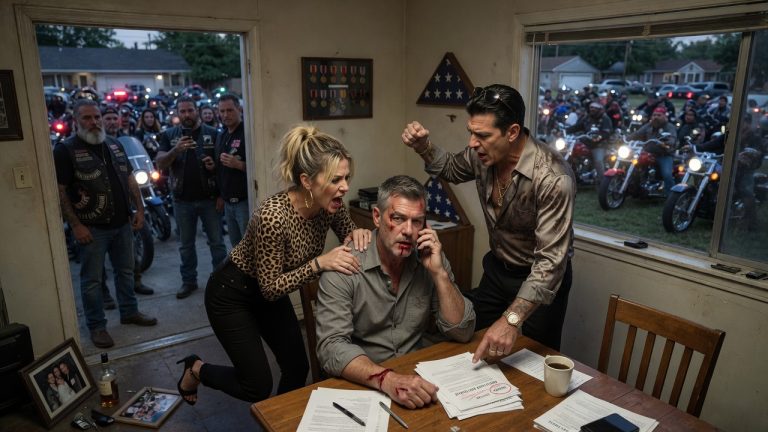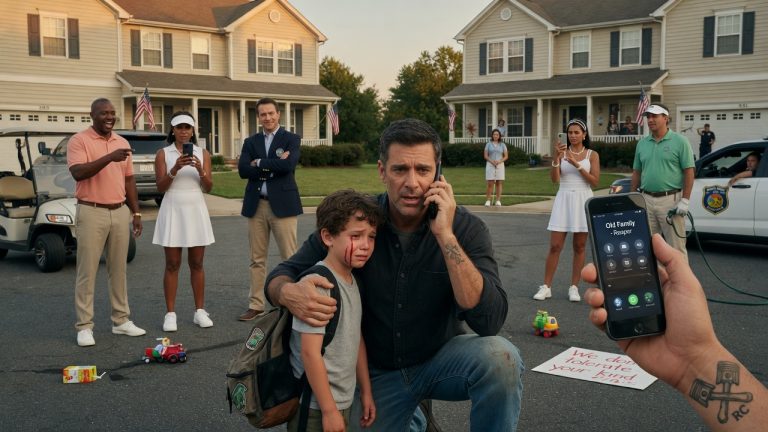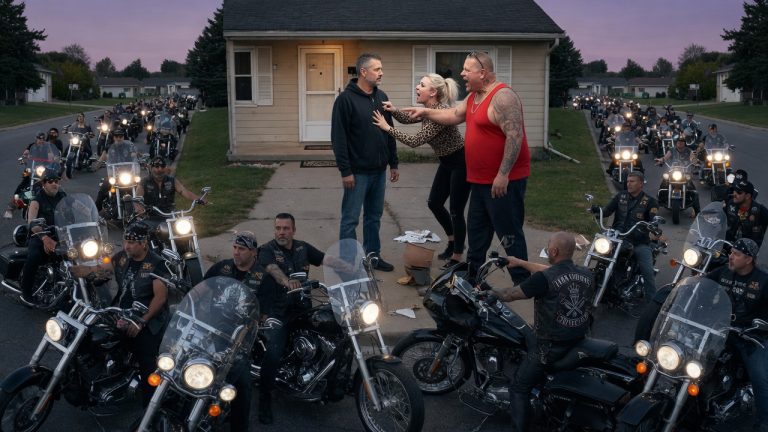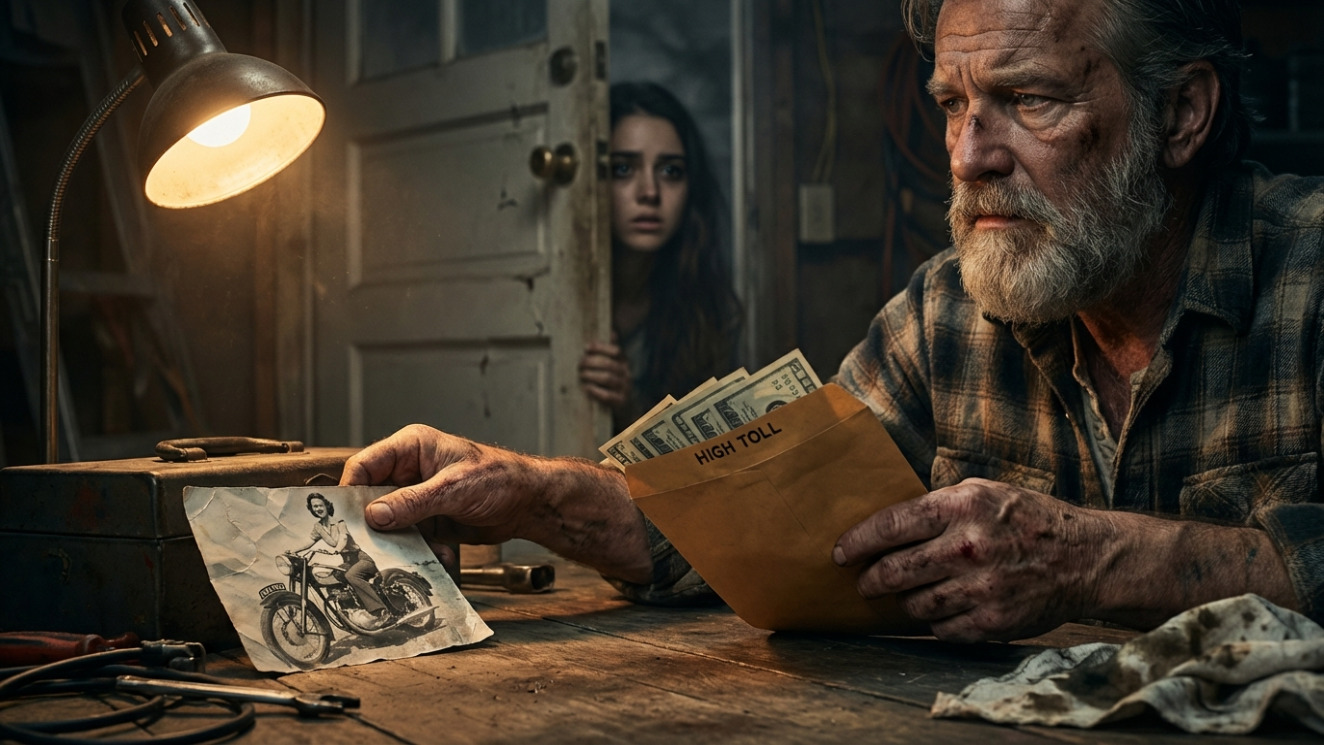
I spent twenty years trying to wash the grease and the blood off these hands. I traded the roar of five hundred brothers for the quiet of a suburban garage, all for one reason: my daughter, Maya. I told her the world was a safe place. I told her that if you worked hard and kept your head down, the ghosts of the past would stay buried.
I lied.
For three years, I’ve been paying a tax on her life. Every month, I hand an envelope of cash to a kid who wasn’t even born when I was the most feared man on the I-5. I sold my wife’s 1947 Knucklehead—the only thing I had left of her—just to get Maya her tuition and a ticket out of this city.
But the Vultures don’t want the money anymore. They want the one thing I promised to protect.
They think I’m just an old man with a wrench and a bad back. They think the “Pope” is dead. They’re about to find out that some ghosts don’t stay in the ground. They just wait for a reason to come back.
FULL STORY
Chapter 1: The Weight of the Wrench
The rain in Seattle doesn’t always fall; sometimes it just hangs in the air like a damp wool blanket, heavy and smelling of wet pavement and old exhaust. Inside the bay of Jackson’s Auto & Cycle, the air was thicker still, laced with the scent of PB Blaster and the metallic tang of grinding steel. Elias “Pope” Jackson wiped a grease-blackened hand across his forehead, leaving a dark smear against his weathered skin. He was fifty-four, but in this light, under the flickering fluorescent tubes of the shop, he looked seventy.
His back ached—a deep, thrumming protest that started in his tailbone and radiated up to his shoulder blades. It was the kind of pain that came from thirty years of leaning over engines and twenty years of carrying a secret that was heavier than any cast-iron block.
“Hey, Pops. You got that alternator swapped yet?”
The voice came from the front office. Maya stepped into the bay, her backpack slung over one shoulder. At eighteen, she was the only clean thing in his world. She had her mother’s wide, observant eyes and a way of standing that suggested she was always ready to run toward something better.
“Ten minutes, Maya,” Pope said, his voice a low rumble. He didn’t look up from the guts of a rusted-out Ford F-150. “Go finish your packing. That scholarship isn’t going to drive itself to the University of Washington.”
Maya leaned against the doorframe, crossing her arms. “The truck can wait until tomorrow. You’ve been here since six. Come home. I made that pasta thing you like. The one with the too-much-garlic.”
Pope managed a ghost of a smile, though it didn’t reach his eyes. “The ‘too-much-garlic’ is the only way to kill the taste of this shop. I’ll be twenty minutes. Promise.”
She lingered for a second, her gaze drifting to the corner of the shop where a heavy canvas tarp draped over a familiar, jagged shape. The 1947 Knucklehead. Her mother’s bike. It was the only piece of the old life Pope had kept, a relic of a time when his name was spoken in whispers and his vest carried the “Pope” patch that meant he answered only to God—and even then, only if he felt like it.
“You haven’t ridden her in a month,” Maya said quietly.
“Tires are dry-rotted,” Pope lied. “Parts are hard to find. Go on, now. Eat. I’ll be there.”
He watched her disappear into the drizzle, her yellow raincoat a bright spark against the grey street. As soon as the door clicked shut, the weight returned. He didn’t go back to the alternator. He sat on a rolling stool and reached into the pocket of his coveralls. He pulled out a crumpled piece of paper—a ledger of sorts. It wasn’t for taxes or inventory. It was a list of dates and amounts.
June: $1,200. July: $1,200. August: $1,500 (Late fee).
The “Vultures” were a different breed than the men Pope had come up with. They weren’t an MC. They didn’t have a clubhouse or a code. They were a pack of street-level predators who used TikTok to coordinate drug drops and intimidation. They didn’t care about the “Old Ways.” They just knew that the old man who ran the shop on 4th Avenue had a daughter who was headed for big things, and they knew he’d pay anything to keep the vultures away from her nest.
The bell above the shop door chimed. It wasn’t the clean, sharp ring of a customer. It was a rhythmic, aggressive rattling.
Pope didn’t stand up. He didn’t have to. He knew the smell of cheap cologne and Newport cigarettes that drifted into the bay.
“Late again, Jackson,” a voice chirped.
He was twenty-one, maybe twenty-two. He went by “Z,” and he wore a North Face puffer jacket even in the humidity. He had a face that had never known a hard day’s work, but his eyes were full of the kind of casual cruelty that only comes from someone who thinks they’re untouchable. Two other boys stood behind him, their hands tucked into their waistbands, their eyes darting around the shop, looking for things to break.
“The alternator took longer than I thought,” Pope said, his voice flat. “I told you I’d have the envelope on Friday.”
“Today is Thursday, old man,” Z said, stepping deeper into the bay. He kicked a bucket of used oil, splashing it across the concrete. “My calendar says today. My boss’s calendar says today. And his calendar says that since we had to drive all the way down here in the rain, there’s a convenience fee.”
Pope stood up then. He was a head taller than Z, and although his hair was grey and his joints were stiff, the sheer mass of the man was still there—the broad shoulders that had once held up the weight of a hundred-man chapter. The boys behind Z shifted, their hands tightening on whatever they were carrying under their jackets.
“I don’t have it,” Pope said. “I spent the last of the liquid cash on Maya’s housing deposit. I’ll have it Friday.”
Z walked over to the tarp-covered bike in the corner. He reached out a hand, his fingers dancing near the edge of the canvas. “Beautiful shape. Very vintage. Very… sentimental.”
“Don’t touch the bike,” Pope said. The air in the room suddenly felt electric, the way it does right before a lightning strike.
Z laughed, a high, thin sound. “Or what? You gonna call your little biker friends? The ones who are all in nursing homes or the ground? You’re a ghost, Jackson. You’re a mechanic who pays rent to stay in business. And right now, the rent is three grand.”
“Three grand? We agreed on fifteen hundred.”
“New month, new rules,” Z said, his face suddenly hardening. He yanked the tarp back. The chrome of the Knucklehead caught the flickering light, gleaming like a polished tooth. “You got twenty-four hours to move this antique, or I’m gonna send some guys over to your house to help Maya pack for college. I hear she’s got a lot of nice stuff. Might be hard to fit it all in her car without… help.”
Pope’s vision tunneled. For a split second, the shop vanished, and he was back in a desert bar in 1994, his hands around the throat of a man who had dared to mention his wife’s name. He felt the familiar, cold itch in his knuckles. The monster he’d spent two decades starvation-dieting was screaming to be let out.
But then he saw Maya’s face in his mind—the way she looked when she got her acceptance letter. The way she believed her father was a “reformed” man, a peaceful man. If he broke Z’s neck right here, her life was over. The Vultures would swarm. They’d burn the shop. They’d find her.
He forced his hands to stay open. He forced his breath to stay slow.
“Tomorrow,” Pope said, the word tasting like bile. “Six p.m.”
“Attaboy,” Z said, patting the tank of the 1947 Knucklehead with a condescending thud. “See? This is why they call you ‘Pope.’ You’re so damn merciful.”
The three of them sauntered out, laughing as they stepped back into the rain. Pope stood in the center of the bay, the silence of the shop rushing back in to fill the space they’d left. He walked over to the bike and pulled the tarp back over it, his hands shaking.
He knew what he had to do. He had one asset left. One thing he’d sworn he’d never part with. He walked to the office, picked up the rotary phone he’d refused to replace, and dialed a number he hadn’t called in ten years.
“It’s Pope,” he said when the line picked up. “I have a ’47 Knucklehead. Original engine. Numbers match. I need thirty thousand. Cash. By noon tomorrow.”
There was a long pause on the other end of the line. “Pope? Man, we thought you went into the witness protection program or something. You sure about the bike? That’s Sarah’s.”
“I’m sure,” Pope said, his voice cracking. “Just bring the money.”
He hung up and sat in the dark. He looked at his hands—the scars from old fights, the deep-set grease that no soap could ever fully remove. He’d spent twenty years trying to be a good man, a safe man. But as he looked at the empty shop, he realized that the world didn’t want him to be good. It just wanted him to be quiet while it took everything he loved.
He didn’t go home to the pasta. He stayed in the shop, listening to the rain, and for the first time in a long time, he didn’t pray for forgiveness. He prayed for the strength to finish what he was about to start.
Chapter 2: The Sacrifice of Steel
The buyer arrived at 11:30 a.m. in a dually truck that looked like it cost more than Pope’s entire shop. A man named “Judge”—though he’d never spent a day in law school—stepped out. He was a collector now, one of those guys who had transitioned from the dirt and grime of the club to the high-gloss world of vintage restoration. He still wore a leather vest, but it was pristine, the patches professionally stitched, the leather smelling of expensive conditioner.
Judge looked at the ’47 Knucklehead with a hunger that made Pope’s stomach turn. He ran a gloved hand over the springier front end, his eyes scanning the frame for the stamped numbers.
“She’s a museum piece, Pope,” Judge said, whistling low. “I heard stories about this bike. Sarah rode it all the way to Sturgis and back with a broken primary, right?”
“She did,” Pope said. He stood by the workbench, his arms crossed, feeling like he was watching someone perform an autopsy on a loved one. “You got the cash?”
Judge pulled a heavy Pelican case from the back of his truck. He set it on the grease-stained floor and flipped the latches. Inside, stacks of hundred-dollar bills were neatly banded. Thirty thousand dollars. It looked like so little when compared to the machine sitting next to it.
“Why now?” Judge asked, looking up. “You’ve turned down six-figure offers for this thing over the years. What changed?”
“Life,” Pope said. “Bills. The price of peace is going up.”
Judge nodded, though he didn’t understand. He couldn’t. To guys like Judge, the bike was an investment. To Pope, the bike was the sound of Sarah’s laugh over the roar of the wind. It was the smell of her leather jacket. It was the last thing Maya had of her mother that still felt alive.
“I need a bill of sale,” Judge said.
Pope signed the paper without reading it. He watched as Judge and two of his hired hands winched the Knucklehead into the back of the dually. As the tailgate slammed shut, Pope felt a hollowed-out sensation in his chest, as if someone had reached in and scooped out his heart with a rusted spoon.
“You ever want to come see her, she’ll be in the climate-controlled garage at the estate,” Judge said, climbing into his truck.
“I won’t,” Pope said.
He watched the truck pull away, the silver chrome of the bike disappearing into the Seattle mist. He was alone in the shop again. He took the money and divided it. Three thousand for Z. Twenty-five thousand for Maya’s tuition and four years of living expenses. Two thousand for… contingencies.
He went to the bank and got a cashier’s check for the tuition. Then he went home.
Maya was in the kitchen, surrounded by cardboard boxes. She looked up and smiled, but the smile faltered when she saw his face.
“Dad? You okay?”
“I’m fine,” he said, handing her a manila envelope. “This is for the university. Tuition, room, board. All of it. For all four years.”
She opened the envelope, her eyes widening as she saw the amount on the check. “Dad… how? You said the shop was struggling. You said we’d have to do loans.”
“I sold some inventory,” he said, walking past her to the sink to wash his hands. He scrubbed until his skin was raw. “Old parts. Things I didn’t need anymore.”
“What parts? You don’t have thirty thousand dollars in parts, Dad.”
She followed him into the bathroom, her voice rising with a mix of suspicion and fear. “Did you take a loan from those people? The ones who come to the shop?”
Pope stopped scrubbing. He looked at himself in the mirror. He saw the “Pope”—the man who had ordered hits, the man who had burned down rival clubhouses, the man who had let Sarah ride that night even though he knew the roads were slick. He saw the monster.
“I sold the bike, Maya,” he said, his voice quiet.
The silence that followed was worse than any shout. Maya leaned against the doorframe, the color draining from her face.
“You sold Mom’s bike?” she whispered. “The only thing left?”
“It’s a machine, Maya. It’s metal and rubber. You’re a person. Your life is more important than a piece of history. I want you out of here. I want you in that school, in a different city, with people who don’t know who I am or what I did.”
“I don’t care about the money!” she yelled, her voice breaking. “You shouldn’t have done that. That bike was hers. It was ours.”
“It was mine to sell,” he snapped, turning on her. “And it’s done. The money is in your name. You’re leaving Monday. No arguments.”
She looked at him with a mix of anger and pity that hurt more than a punch to the jaw. “You think you can just buy my safety? You think you can just pay everyone off and make the world clean? You’re still acting like you’re in the club, Dad. You’re still making decisions for everyone else like you’re the boss. But you’re not. You’re just a man who sold his soul to pay for a lie.”
She turned and slammed her bedroom door.
Pope sat at the small kitchen table, the envelope for Z sitting in front of him. He felt old. He felt small. He realized then that Maya was right. He was trying to buy a future with the currency of the past, and it wasn’t working. The more he tried to protect her, the more he pushed her away into the very shadows he was trying to outrun.
At 5:45 p.m., he drove back to the shop. He sat in his truck and waited. At exactly 6:00, the black SUV with tinted windows pulled up. Z stepped out, looking smug.
Pope got out of his truck and handed him the envelope.
Z opened it, counted the bills, and whistled. “Three thousand. A man of your word. I like that, Jackson. I really do.”
“We’re done,” Pope said. “That’s the last of it. Maya leaves Monday. You stay away from the shop. You stay away from my house.”
Z leaned against the SUV, picking at a fingernail. “See, that’s the thing about ‘done.’ It’s a very subjective word. My boss, he saw the bike was gone. He saw the truck that picked it up. He knows you got a big payday today.”
“I paid the tuition,” Pope said, his voice dropping an octave. “There is no more money.”
“Maybe not in your pocket,” Z said, his eyes turning cold. “But your daughter? She’s a smart girl. She’s going to a big-time school. That’s an investment. And we think we should be partners in that investment. Let’s call it a ‘success tax.’ Fifteen hundred a month, every month she’s in school. To make sure she stays safe on campus. You know how dangerous those colleges can be.”
The world went very, very still. The rain seemed to stop mid-air. Pope felt a familiar coldness spreading through his limbs—the same coldness he’d felt the night he realized Sarah wasn’t coming home.
“You’re breaking the deal,” Pope said.
“There was no deal, old man,” Z spat. “There’s just us taking what we want, and you doing what you’re told. See you next month.”
As the SUV sped away, Pope didn’t feel angry. He didn’t feel scared. He felt a strange, terrifying sense of relief. He had tried to be a father. He had tried to be a civilian. He had tried to be a man who followed the rules of a world that didn’t have any.
He walked back into his shop. He didn’t go to the office. He went to the very back, to a floorboard under a heavy tool chest. He pried it up.
Inside was a heavy, oil-cloth bundle. He unwrapped it slowly. First, the leather vest—dark, heavy, and smelling of old smoke. The “Pope” patch on the back was slightly faded but still legible. Then, a .45 caliber 1911, clean and oiled.
He didn’t put the vest on. Not yet.
He picked up the phone and dialed a number he’d memorized twenty-five years ago. It was a number that was only supposed to be used when the world was ending.
“It’s Pope,” he said when the voice answered. “I need the SAA. I need everyone who’s still upright. I need five hundred bikes in Seattle by Sunday night. No colors. Just steel. We’re going to a graduation party.”
Chapter 3: The Ghost in the Garage
The man who showed up on Saturday morning didn’t look like a warrior. He looked like a retired middle-school teacher. He was wearing a beige windbreaker and New Balance sneakers, and his belly hung slightly over a belt that held a sensible cell-phone holster.
“Roadkill,” Pope said, leaning against the door of the shop.
The man smiled, showing a row of teeth that were mostly porcelain. “Pope. You look like hell. You’re grey as a tombstone.”
“I feel like one,” Pope said. “Come in.”
They sat in the back of the shop, the space where the Knucklehead used to be. Roadkill—whose legal name was Arthur—looked around at the wrenches and the oil pans.
“You really did it, didn’t you? Twenty years of being a grease monkey. I didn’t think you’d last six months without the noise.”
“I had a reason to stay quiet,” Pope said. “Maya.”
“I saw the photos you sent over the years,” Roadkill said. “She’s a ringer for Sarah. Got that same ‘don’t-mess-with-me’ chin.” He paused, his expression shifting from nostalgia to something sharper. “You called the emergency line, Pope. That hasn’t rung since the ’99 war with the Pagans. You said five hundred bikes. You know what that means. You know the attention that brings.”
Pope leaned forward, his hands clasped between his knees. “I’ve been paying protection, Roadkill. To a pack of kids who don’t know who I am. I thought I could buy them off. I sold Sarah’s bike to get Maya out of here. But they’re not letting go. They threatened her at school. They want a cut of her future.”
Roadkill’s eyes went flat. The “retired teacher” look vanished, replaced by the man who had been the club’s Sergeant-at-Arms for two decades. “Vultures? That’s what they call themselves?”
“Yeah. Street gang. No code. No honor. Just greed and social media.”
“They don’t understand the debt,” Roadkill said quietly. “They think because you stopped wearing the patch, you stopped being the man. They think the brotherhood is a story for the History Channel.”
“I don’t want a war,” Pope said. “If we start shooting, Maya never gets out. She’ll be the daughter of a murderer. She’ll be looking over her shoulder for the rest of her life.”
“Then what do you want?”
“I want a wall,” Pope said. “I want them to see what happens when you try to tax a ghost. I want them to understand that the world they live in is only possible because men like us decided to let it be.”
Roadkill nodded slowly. “Sunday night is her ‘going away’ dinner, right? At that place on the waterfront?”
“Yeah. The Vultures said they’d be there to ‘wish her luck.’ They mean to remind me that they can reach her anywhere.”
Roadkill stood up and patted Pope on the shoulder. “I’ll make the calls. We’ve got brothers coming in from Portland, Spokane, even a few from the Oakland chapter. They remember you, Pope. They remember what you did for the club when the feds were at the door. You didn’t just give up the patch. You gave up your life to keep the club alive. We owe you. All of us.”
After Roadkill left, Pope went home. He found Maya in the garage, sitting on a milk crate. She was holding a small silver wrench—the first tool he’d ever given her.
“I’m sorry for what I said,” she whispered without looking up. “About you selling your soul. I know why you did it. I just… I hate that they’re doing this to us.”
Pope sat down on the concrete floor next to her. The cold of the ground seeped into his bones. “They’re not doing it to us, Maya. They’re doing it to me. It’s my past catching up. I thought I could outrun it, but the thing about the past is that it’s got better endurance than any man.”
“Are we going to the dinner tomorrow?” she asked. “Maybe we should just leave tonight. Just drive.”
“No,” Pope said, his voice firm. “If we run, they’ll follow. You can’t start your life as a fugitive. We go to dinner. We eat. We walk out the front door. And then you drive to Seattle, and you don’t look back.”
“Dad, they’ll be there. Z said—”
“I know what he said,” Pope interrupted. He took her hand. His was rough and scarred; hers was smooth and full of potential. “I’ve spent twenty years trying to be the man I thought you needed. But tomorrow, I’m going to be the man I actually am. I need you to trust me. Just one more time.”
She looked at him, searching his face. She saw the “Pope” then—not the mechanic, but the leader. The man who had once commanded a small army with a single nod of his head.
“Okay,” she said softly. “I trust you.”
That night, Pope didn’t sleep. He sat in his darkened living room, cleaning the 1911. He moved with a muscle memory that was terrifyingly precise. He checked the springs, the slide, the barrel. He loaded the magazines with a steady hand.
He wasn’t afraid. For the first time in years, the crushing weight of the “protection” was gone. He had stopped trying to negotiate with the darkness. He had invited it in, and now he was just waiting for the guests to arrive.
He looked at a photo of Sarah on the mantel. She was leaning against the Knucklehead, her hair wild in the wind.
“I’m sorry I sold the bike, Sarah,” he whispered to the empty room. “But I’m going to make sure she never has to sell hers.”
By midnight, the sound began. It was faint at first—a low, rhythmic thrumming in the distance. To anyone else, it might have sounded like a coming storm or a fleet of heavy trucks on the I-5. But Pope knew that sound. It was the heartbeat of his life. One bike, then ten, then fifty. The brothers were moving into position, filtering into the city like shadows, taking over the cheap motels and the back alleys, waiting for the signal.
The Pope was back. And he wasn’t asking for mercy.
Chapter 4: The Sound of the Sea
The restaurant was a place called “The Pier’s End.” It was too expensive for a mechanic, with white tablecloths and windows that looked out over the dark, churning waters of Elliott Bay. It was the kind of place Sarah had always wanted to go to, but they’d never had the clothes or the manners for it. Pope had chosen it because it had one entrance, one exit, and a wide, open parking lot that was visible from every window.
He wore his best suit—a charcoal grey thing that felt tight in the shoulders. Maya wore a blue dress that made her look like a stranger, a woman who belonged in the world of books and lectures, not grease and gravel.
They sat at a corner table. Pope ordered the steak; Maya barely touched her salad.
“They’re here,” she whispered, her eyes darting toward the entrance.
Z and three of his associates strolled in. They didn’t look like they belonged in a place with white tablecloths. They wore their hoodies up, their jewelry clinking as they pushed past the hostess. They didn’t sit at a table. They stood by the bar, leaning against the polished wood, staring directly at Pope and Maya.
Z raised a glass of water in a mocking toast.
“Eat your dinner, Maya,” Pope said, his voice perfectly calm.
“Dad, they’re watching us. Everyone is looking at them.”
“Let them look,” Pope said.
A waiter came by, looking nervous. “Is everything all right, sir? Do you know those gentlemen?”
“They’re just some fans of the shop,” Pope said. “Don’t worry about it.”
For forty-five minutes, the tension in the room was a physical thing. The other diners began to pay their checks and scurry out, sensing the violence that was humming beneath the surface like a live wire. The restaurant grew quiet, the only sound the clinking of silverware and the distant groan of the pier’s pilings.
Z finally grew bored with the silence. He walked over to their table, his boots loud on the hardwood floor. He pulled out a chair and sat down next to Maya, leaning in close.
“Nice dress, Maya,” Z said, his voice oily. “Blue is a good color for you. Makes you look… expensive.”
Maya froze, her fork hovering over her plate.
Pope didn’t look up from his steak. He cut a piece of meat, chewed it slowly, and swallowed. “I told you to stay away, Z.”
“And I told you that the rules changed,” Z said. He reached out to touch a strand of Maya’s hair. “I think maybe we should all take a little ride after this. See the city. Talk about the first payment.”
Pope’s hand moved. It was so fast that the other diners didn’t even see it. He grabbed Z’s wrist, his grease-stained fingers clamping down like a vice. He didn’t pull him away; he just held him there, his grip tightening until Z’s face twisted in pain.
“You’re making a mistake, old man,” Z hissed, his other hand reaching toward his waistband. “My boys are right behind me. We’ll turn this place into a cemetery.”
“Look out the window, Z,” Pope said.
Z frowned, his eyes shifting toward the large glass panes that overlooked the parking lot and the street beyond.
At first, there was nothing but the yellow glow of the streetlights and the falling rain. Then, a single headlight appeared at the end of the block. Then another. And another.
They didn’t come fast. They came at a walking pace—a slow, deliberate procession of steel and chrome. The sound began to vibrate the windows, a low-frequency roar that rattled the wine glasses on the tables.
Z’s boys at the bar turned around, their mouths dropping open.
From the north, the south, and the west, the bikes converged. They filled the parking lot. They filled the street. They lined the sidewalks. Five hundred motorcycles, their engines idling in a synchronized thunder that felt like the earth itself was growling.
The men on the bikes weren’t wearing hoodies. They were wearing leather. They were wearing denim. They were wearing patches that the city of Seattle hadn’t seen in force for twenty years.
Roadkill was at the front, his bike a hulking black beast. He didn’t get off. He just sat there, his arms crossed, his eyes fixed on the front door of the restaurant.
Z pulled his hand back, his face turning a sickly shade of grey. “What… what is this?”
“This is the brotherhood you said was in a nursing home,” Pope said. He stood up slowly, the charcoal suit jacket straining against his frame. “This is the ‘Pope’s’ tax, Z. And it’s a lot higher than yours.”
Pope walked around the table and stood behind Maya, his hands on her shoulders. “You thought I was an old man with a wrench. You forgot that I’m the man who taught these guys how to use one. And how to use a lead pipe. And how to make people disappear into the Cascades.”
Z backed away, his bravado evaporating. He looked at his three friends, but they were already backing toward the kitchen, their eyes wide with the realization that they were surrounded by an army of men who lived by a code they couldn’t even fathom.
“You can’t do anything,” Z stammered. “There are cameras. People see—”
“These men aren’t here to do anything,” Pope said. “They’re just here to watch. They’re here to see you walk out that door. And they’re here to make sure you keep walking until you’re out of this county. If I ever see your face again, or if I hear that you even thought about Maya’s name, I won’t call the police. I’ll just stop being ‘retired.'”
Pope leaned in close to Z’s ear. “I’ve killed men for less than what you’ve done this week. Don’t make me remember how much I enjoyed it.”
Z turned and ran. He didn’t go for his gun. He didn’t look back. He burst through the front doors and was immediately swallowed by the sea of leather and chrome. The brothers didn’t touch him. They didn’t have to. They just parted like a wave, their engines revving as he sprinted through the gauntlet of five hundred staring men. He kept running until he vanished into the dark.
The restaurant was silent now, except for the low, steady thrum of the idling bikes outside.
Maya looked up at her father. She was trembling, but her eyes weren’t full of fear anymore. They were full of a strange, terrifying awe.
“Who are you, Dad?” she whispered.
Pope looked out at the wall of headlights, at the brothers who had come from three states away just because he’d asked. He felt the weight of the .45 in his waistband and the weight of the lives he’d tried to leave behind.
“I’m the man who’s going to make sure you get to school on time,” he said. “Come on. Let’s go.”