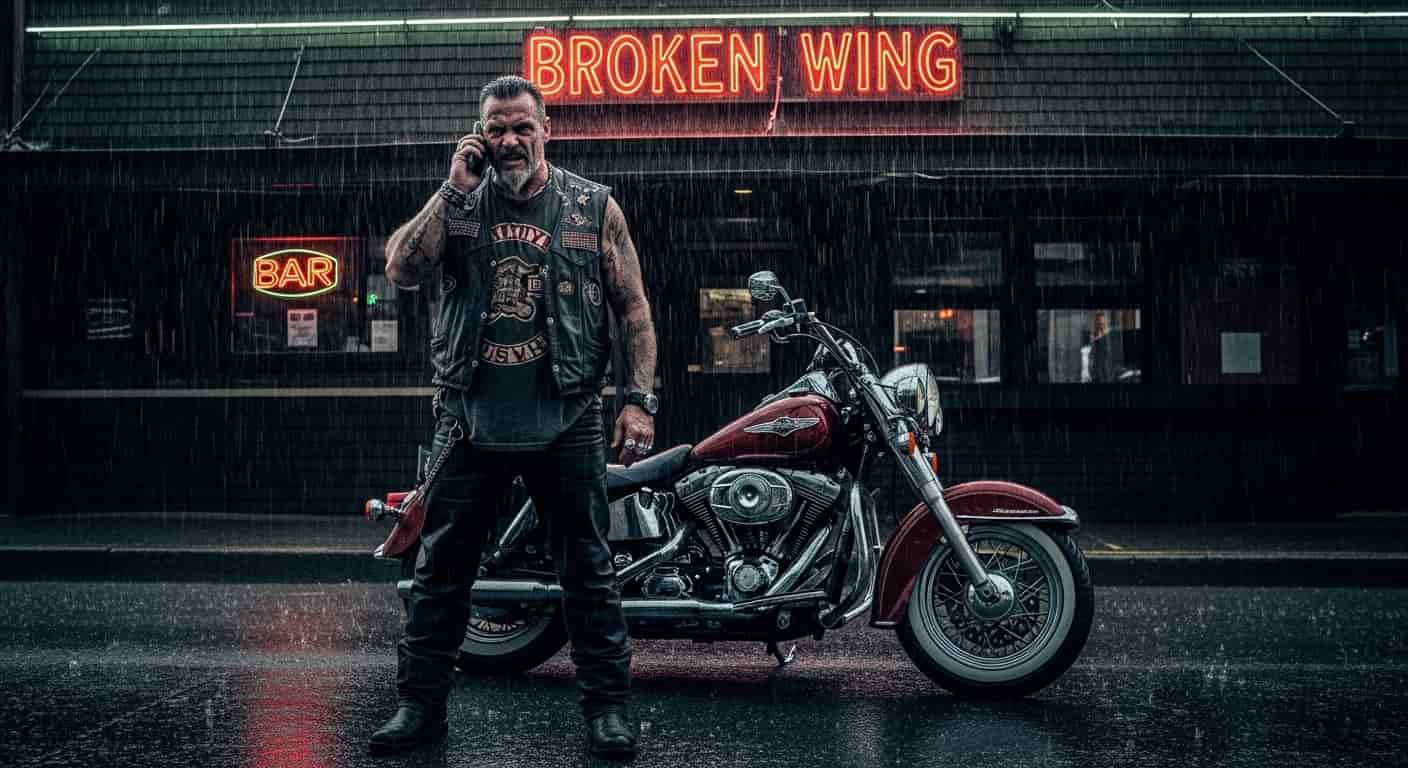
Chapter 1: The Sound of Metal and Memories
The rain in Astoria doesn’t just fall; it heavy-hangs in the air like a wet wool blanket, smelling of salt, pine, and the rot of things left forgotten.
Mack Thorne sat on his 1998 Heritage Softail, the engine’s idle a low, guttural thrum that vibrated through his scarred thighs. He didn’t turn it off. He liked the noise. It drowned out the sound of the wind, which, if he listened too closely, sounded like the whistle of a Hellfire missile cutting through the Iraqi heat.
Ten years. Three thousand six hundred and fifty days since he’d looked through a thermal scope and called in the coordinates that turned a dusty sedan into a scorched skeleton. He’d been told it was a high-value target. It wasn’t. It was a father of three trying to get home before curfew.
Mack checked his watch. It was 4:00 PM. Time for his shift at the Broken Wing, the bar he’d turned into a sanctuary for guys who had too much sand in their souls and not enough peace in their heads.
He walked inside, the smell of stale beer and WD-40 greeting him. Doc, an old VA counselor who’d traded his medical license for a bartender’s rag, looked up.
“You look like hell, Mack,” Doc said, sliding a glass of water across the scarred wood. “The anniversary?”
“The anniversary is every day, Doc,” Mack grunted.
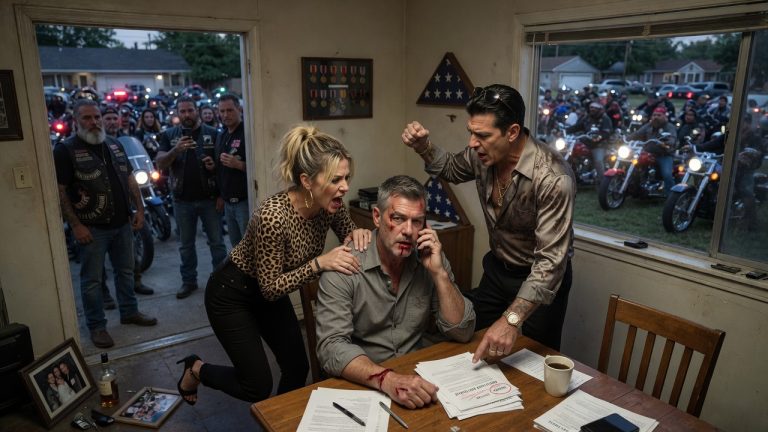
The bell above the door jingled, and the air in the room shifted. Elena walked in. She was wearing a worn raincoat and holding a stack of legal envelopes like they were live grenades. She was the widow of the man in the sedan. She didn’t know that Mack was the reason she was a widow. She only knew him as the quiet biker who sent her half his paycheck every month under the guise of an “Anonymous Veteran’s Fund.”
“Mack,” she whispered, her voice trembling. “He did it. Judge Miller signed the order. They’re seizing the house on Friday.”
Mack felt a familiar heat rise in his chest—not the heat of the desert, but the slow-burn rage of a man who had seen enough bullies to last three lifetimes.
“He wants that coastal land for the resort,” Mack said, his voice dropping an octave.
“I have nowhere to go,” Elena said, a single tear escaping. “He told me if I didn’t leave quietly, he’d make sure I never found work in this county again. He said I’m just a ‘casualty of progress.'”
Mack looked at his hands—the same hands that had typed in the coordinates ten years ago. He couldn’t fix the past. He couldn’t bring back the man in the sedan. But he could damn sure make sure the woman he left behind wasn’t a casualty again.
“He thinks you’re alone, Elena,” Mack said, standing up. His leather vest, the one with the ‘Broken Wing MC’ patch on the back, creaked. “He’s wrong. Go home. Lock your doors. I’m making a phone call.”
Doc watched him walk toward the back office. “Mack, what are you doing? Miller owns the police. He owns the bank.”
Mack paused at the door, the neon sign of the bar reflecting in his hard, grey eyes. “He owns the town, Doc. But he doesn’t own the road. And he definitely doesn’t own the 500 brothers I’ve spent the last decade keeping alive.”
FULL STORY
Chapter 2: The Ghost in the Mailbox
The office of the Broken Wing was cramped, filled with the scent of old paper and gun oil. Mack sat at the desk, staring at an old photo of his platoon. Sarge was there, grinning with a missing front tooth. Doc was younger, thinner. And Mack… Mack looked like a stranger, his eyes bright with a naive sense of purpose that had died in the smoke of that sedan.
He picked up the rotary phone. It was an old-school touch, but Mack didn’t trust digital footprints. He dialed a number he knew by heart.
“Sarge?” Mack said when the line picked up.
“Thorne? You only call me this late when you’re either dying or someone else is about to,” a gravelly voice responded from three states away.
“It’s a widow, Sarge. A good one. Local judge is trying to steamroll her for a paycheck. Using the law like a club.”
There was a pause. “Is this about the one? The secret you carry?”
“It’s about the only thing that matters now,” Mack replied. “I need the brotherhood. All of them. Not for a fight—for a presence. I need 500 bikes in Astoria by Friday morning.”
“You’re asking for a lot of gas money and a lot of favors, Mack.”
“I’m asking for justice. The kind we thought we were fighting for over there.”
“Copy that,” Sarge said. “We’re wheels up at dawn.”
Mack hung up and walked back out to the bar. A young man named Jax, barely twenty-two and wearing a fresh prospect vest, was leaning against the pool table. Jax idolized Mack for the wrong reasons—he saw the scars and the MC patch and thought of “outlaw” glory.
“Is there gonna be a war, Mack?” Jax asked, his eyes gleaming with a dangerous excitement. “I heard you’re calling in the heavy hitters.”
“There isn’t going to be a war, Kid,” Mack said, grabbing his keys. “Wars are messy. People lose things they can’t get back. This is a funeral. We’re just attending the death of a bully’s ego.”
Mack rode out to Elena’s house, a small, salt-scrubbed cottage on the edge of the cliffs. He saw her through the window, packing boxes. His heart ached. Every check he’d sent was a brick in a wall of guilt he’d built around himself. If she knew the truth—that the “Anonymous Fund” was blood money from her husband’s killer—she’d burn the house down before staying another night.
He pulled into the driveway just as a black sedan was leaving. The window rolled down. Judge Miller, a man with teeth too white and a soul too dark, looked out.
“Thorne,” the Judge said. “I’d stay away from this property. It’s a legal minefield now.”
“Laws change, Miller,” Mack said. “Morality doesn’t.”
“Morality is for people who can afford it,” Miller sneered. “Friday at noon. The bulldozers arrive. Tell your little club to stay in their clubhouse unless they want to see how fast I can pull their liquor license.”
Mack watched him drive away. He didn’t tell Elena he was there. He just sat in the dark on his bike, a lone sentinel guarding a ghost he could never outrun.
Chapter 3: The Judge’s Gavel and the Iron Fist
Thursday morning brought a frost that turned the Oregon ferns into glass. Mack was at the bar, cleaning glasses with a rhythmic intensity. Doc was watching the news—a segment on the “unexplained migration” of motorcycle groups moving toward the coast.
“They’re coming, Mack,” Doc said. “State police are starting to sweat. They think it’s a riot.”
“Let them think what they want,” Mack said.
Jax burst through the door, his face bruised. “The Judge’s boys… they caught me down by the docks. Said to tell you that if we show up tomorrow, Elena’s house might just… catch fire tonight.”
Mack’s hand stopped moving. The glass in his hand shattered, the shards drawing blood he didn’t even feel.
“Where are they?” Mack asked.
“The shipyard. Miller’s ‘security’ detail. They’re laughing about it, Mack.”
Mack didn’t say a word. He walked out to his bike. Sarge was already there, having arrived early with a small scout team. Sarge looked at Mack’s bleeding hand, then at the look in his eyes—the same look Mack had right before the drone strike.
“Don’t do it, Mack,” Sarge warned. “If you go down there and break heads, Miller wins. He’ll call it gang violence and bring in the National Guard. Elena loses the house, and we all go to prison.”
“They threatened her life, Sarge,” Mack growled.
“So protect it. Don’t avenge it before it’s gone.”
Mack took a deep breath, the cold air stinging his lungs. He looked at Jax, who was looking at him for a signal to go “full outlaw.”
“Jax,” Mack said. “Go to Elena’s. Sit on the porch. Don’t bring a gun. Bring a thermos of coffee. If anyone shows up, you call the Sheriff—the one in the next county, the one who isn’t on Miller’s payroll. You tell him there’s a peaceful protest happening on private property.”
Jax looked disappointed, but he nodded.
Mack spent the night at the bar, mapping out the arrival. He wasn’t planning a brawl. He was planning a wall. He spent the small hours of the night writing a letter—a confession. He put it in an envelope addressed to Elena. In case tomorrow goes sideways, he thought. In case she needs to know why a man she barely knows would call in 500 bikers to save a house he’s never lived in.
Chapter 4: The Breaking Point
Friday morning was silent. The fog was so thick you couldn’t see the ocean, only hear its roar against the rocks.
At 10:00 AM, the bulldozers arrived. They were massive, yellow beasts that groaned as they were unloaded from flatbeds. Judge Miller was there, wearing a high-visibility vest over his tailored suit, looking like a man who enjoyed the destruction of others.
Elena stood on her porch, her hands shaking. Jax sat on the steps, his arms crossed, a silent witness.
“Move the girl!” Miller shouted to his foreman. “We start at noon sharp.”
The Sheriff, a man named Higgins who had a mortgage Miller had personally subsidized, walked up to the porch. “Elena, honey, don’t make this hard. Just step off the wood.”
“It’s my home,” she said, her voice small but clear. “My husband… he worked three jobs to buy this land. I won’t let you turn his memory into a parking lot.”
“Your husband is a ghost,” Miller shouted from the street. “And ghosts don’t pay taxes. Move her!”
The deputies moved forward. Jax stood up, his hand going to his belt.
VROOOOM.
The sound came from the north. A low, rolling thunder that wasn’t the ocean. It was deep, rhythmic, and it made the windows of the cottage rattle in their frames.
Miller looked toward the bend in the road. One headlight pierced the fog. Then two. Then ten. Then the fog seemed to dissolve as 500 sets of high-beams cut through the grey like the eyes of a thousand wolves.
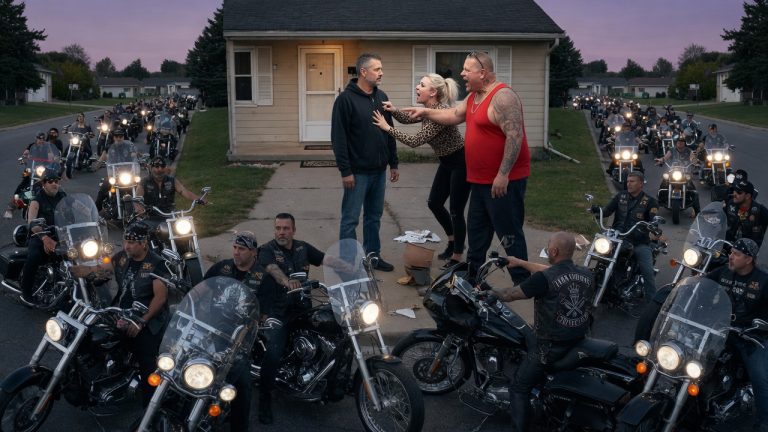
The sound was deafening now—a mechanical symphony of American steel. The bikes didn’t stop at the street. They rode right onto the lawn, forming a perfect, concentric circle around the cottage. They parked, engines still running, the smell of gasoline and hot chrome filling the salt air.
500 men and women in leather. Veterans. Teachers. Mechanics. All of them wearing the ‘Broken Wing’ support patch.
Mack rode his Softail right up to the front of the line, stopping inches from Judge Miller’s shiny black shoes. He turned off the engine. The silence that followed was even louder than the roar.
“You’re trespassing, Thorne,” Miller said, though his voice lacked its usual bite.
“Actually, Miller,” Mack said, pulling a document from his vest. “This land was designated as a ‘Veteran’s Memorial Trust’ two hours ago. I bought the neighboring lot last night and merged the deeds. According to the city charter you wrote yourself, you can’t bulldoze a memorial without a unanimous council vote.”
“You don’t have the money for that!” Miller screamed.
“I didn’t,” Mack said, looking back at the 500 bikers. “But the brotherhood does. We’ve been pooling our ‘dues’ for a long time.”