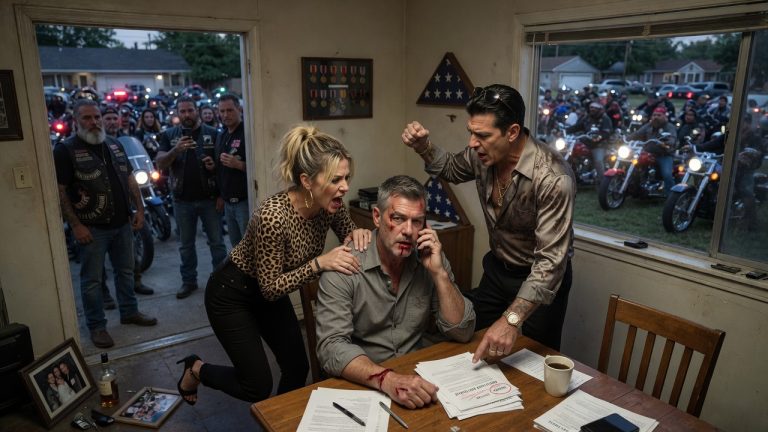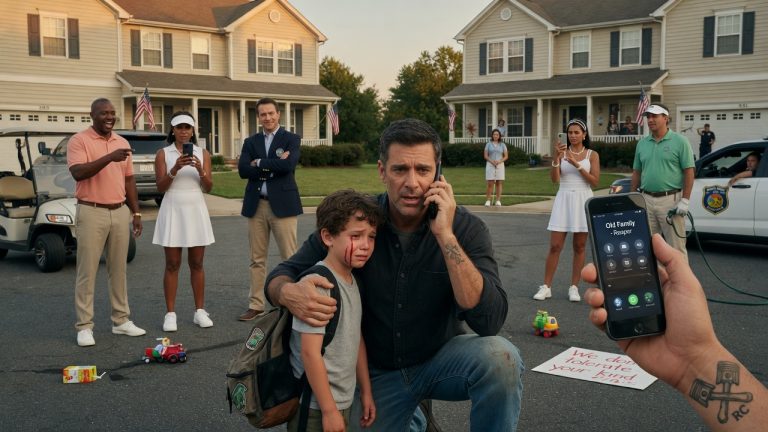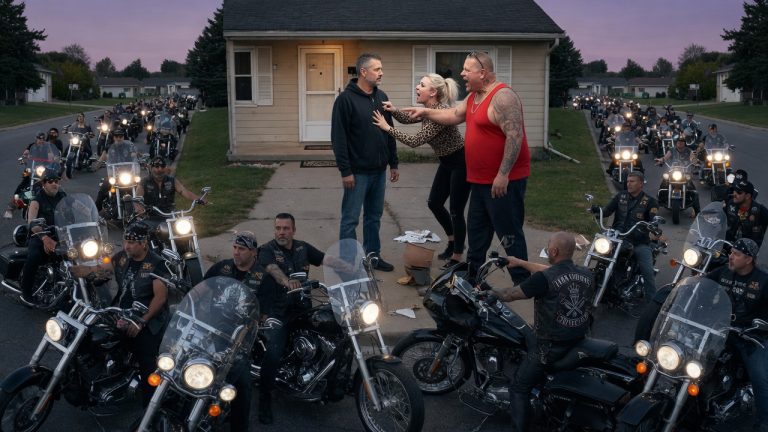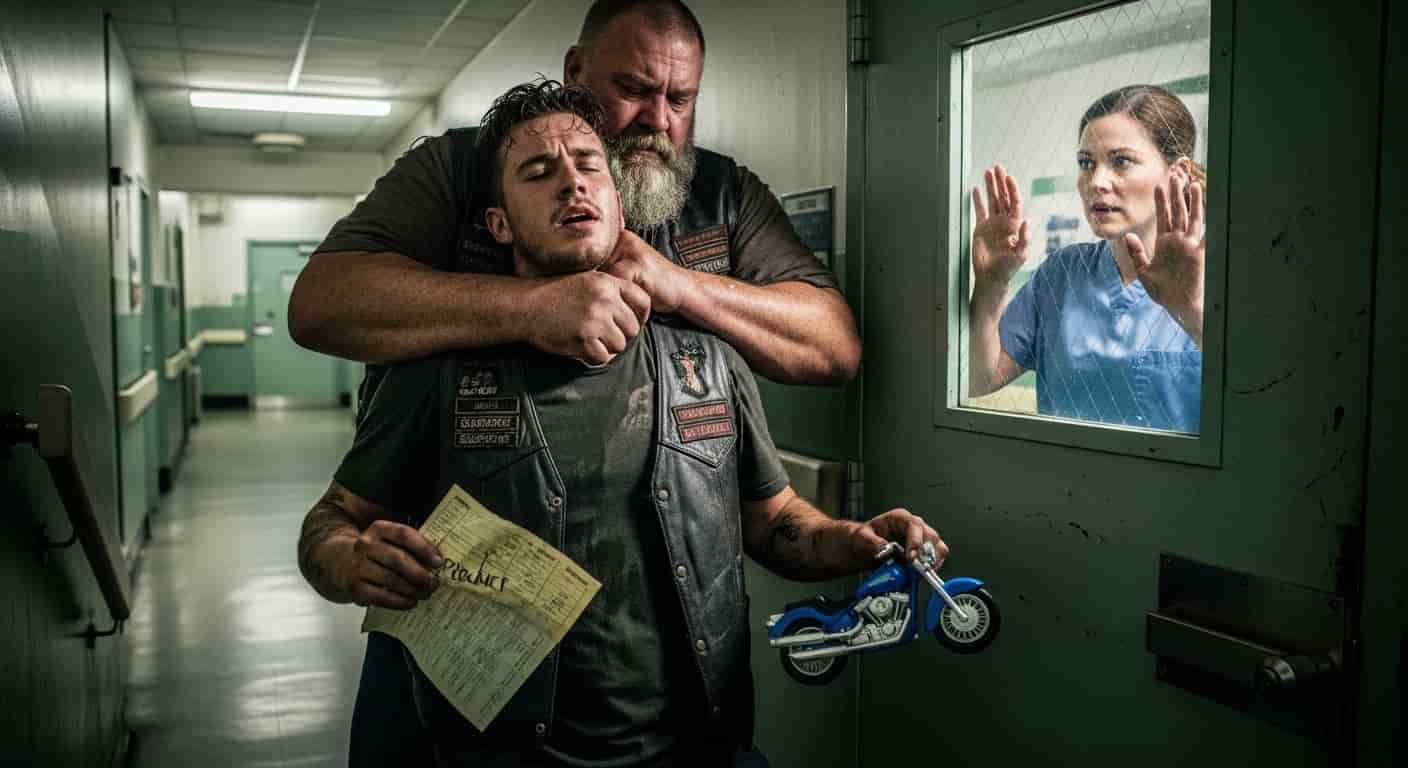
I grew up in foster homes where “family” was just a word social workers used to keep us quiet. When Big Jim gave me my patch, I thought I finally had a father. I thought I had brothers who would bleed for me.
Then I saw the ledger.
The club wasn’t just moving product through the hospital; they were framing the only person who ever gave a damn if I lived or died. Sarah was the nurse who patched my ribs when I was twelve. She gave me a toy bike and told me I was worth more than the bruises on my back.
Now, Big Jim wants her gone. He says it’s “business.” He says a patch is thicker than blood.
But as I stood in that hospital hallway, feeling the weight of the stolen evidence in one hand and my childhood toy in the other, I realized something.
The “family” I found didn’t want a son. They wanted a fall guy. And Big Jim? He’s not a father. He’s a ghost with a leather vest, and he’s about to find out that some debts can’t be paid in cash.
FULL STORY: BLOOD WORK AND BURNOUTS
Chapter 1: The Weight of the Cowhide
The air in the “Iron Sanctuary” smelled like a mix of leaked transmission fluid, stale Marlboro Reds, and the kind of sweat that only comes from men who haven’t known a day of peace since the local steel mill shuttered in ’09. Rook sat on a grease-stained stool at the far end of the bar, his back straight, his shoulders aching. He didn’t look at the other men. You didn’t look at them until they looked at you. That was the first rule Big Jim had taught him when he was still a “hangaround,” sweeping the floors of the garage for ten bucks a day and the privilege of not being kicked out into the Ohio winter.
Today was different. Today, the leather felt heavy.
Rook looked down at the “Prospect” patch on his chest. It was a temporary mark, a brand of servitude, but it was the closest thing to a birth certificate he’d ever owned. In the foster system, his name had been a line on a ledger, a dollar amount for the families who took him in just to use his hands for yard work. Here, he was Rook. He was the one who could fix a carb in twenty minutes and didn’t complain when the runs went into the early morning hours across the West Virginia line.
“Drink up, kid,” a voice boomed.
Big Jim lowered his massive frame onto the stool next to him. Jim was a mountain of a man, his arms covered in tattoos that had faded into blue-grey blurs of eagles and daggers. He smelled of Old Spice and motor oil. He put a hand on Rook’s shoulder—a hand so large it felt like a structural element of the building.
“You did good on that pickup in Steubenville,” Jim said, his voice a low rumble that vibrated in Rook’s chest. “Snake said you kept your head when the cruisers passed. That’s what we need. Discipline. Not like these kids today who think a bike is a fashion statement.”
“Thanks, Jim,” Rook said, his voice tight. He hated how much he craved that approval. He hated that a simple nod from this man felt better than any “A” he’d ever gotten in the school he’d eventually dropped out of.
“We’re family now, Rook. You understand that? Blood is a fluke of nature. This?” Jim tapped the leather vest. “This is a choice. You chose us. We chose you.”
Rook nodded, swallowing hard. “I know.”
“Good. Because family’s about to ask for a favor. A real one.” Jim leaned closer, the smell of beer suddenly sharp. “The hospital. St. Jude’s of the Valley. You still doing those delivery runs for the pharmacy supply house?”
Rook worked a “legit” job three days a week driving a white van for a local medical distributor. It was the club’s way of having a pair of eyes inside the system.
“Yeah. Tuesdays and Thursdays,” Rook said.
“There’s a discrepancy,” Jim said, his eyes narrowing. “Some high-grade stuff is moving out of the back room. The feds are starting to poke around. We need to make sure the trail ends where it’s supposed to end.”
“Where’s it supposed to end?” Rook asked.
Jim smiled, but it didn’t reach his eyes. “With someone who isn’t us. There’s a nurse. Sarah Miller. She’s been there forever. A bit of a bleeding heart. The kind of person who doesn’t keep good records because she’s too busy holding hands. Snake’s already put the paperwork in her locker. I just need you to be the one who ‘discovers’ it if things get loud. Or better yet, make sure she stays quiet if she starts asking where the oxy went.”
Rook felt a cold spike of ice drive straight through his stomach. The name hit him like a physical blow. Sarah Miller.
“Sarah Miller?” he repeated, his voice barely a whisper.
“You know her?” Jim’s grip on his shoulder tightened. Just a fraction. A warning.
“No,” Rook lied. It was the best lie he’d ever told, and it felt like ash in his mouth. “Just sounds like a common name.”
“It’s a name that’s going to save this club a lot of trouble,” Jim said, patting his cheek. “Go get some sleep, kid. You got a long shift tomorrow.”
Rook watched Jim walk away, the back of his vest—the full patch, the reaper and the rockers—looking like a wall he could never climb over. He stayed on the stool until the bar was empty, his fingers tracing the edge of his vest. He thought about the small, blue plastic motorcycle tucked away in a shoebox under his bed. He thought about a woman with tired eyes and a gentle voice who had once looked at a bruised twelve-year-old boy and seen a human being instead of a problem.
The family he chose was asking him to destroy the only family he’d ever known.
Chapter 2: The Ghost of the ER
The hospital smelled of bleach and floor wax—a scent that usually made Rook’s skin crawl. It reminded him of the “clean” foster homes, the ones where they didn’t hit you, but they didn’t talk to you either. They just let you sit in a corner until your time was up.
He pushed the rolling cart through the double doors of the Emergency Department, his white uniform shirt feeling like a costume. Underneath it, his skin felt itchy where the “Prospect” patch would usually rest.
He saw her near the triage desk.
She looked older. Her hair was pulled back in a practical, messy bun, and the lines around her eyes were deeper, carved by twenty more years of night shifts and car-wreck victims. But she still moved the same way—quick, efficient, but with a strange softness, like she was trying not to disturb the air around the people she was helping.
Rook stayed behind his cart, adjusting a box of saline bags. He shouldn’t be here. He should have called in sick. He should have told Jim he couldn’t do it. But Jim didn’t take “no” from prospects. “No” was a fast track to a “red light” beating in the back room.
Sarah turned, her eyes scanning the hallway. She caught his gaze. For a second, nothing happened. He was just another delivery guy. Then, her brow furrowed. She squinted, looking past the beard he’d grown and the hardness in his jaw.
“Bobby?” she whispered.
Rook flinched. Nobody had called him Bobby in a decade.
“It’s Rook now,” he said, his voice cracking.
She stepped toward him, ignoring a ringing phone at the desk. “My god. Bobby. Look at you. You’re… you’re a man.”
“Mostly,” he said, trying to sound tough and failing miserably.
“I wondered what happened to you,” she said, her voice dropping into that low, comforting register he remembered from the night he’d been brought in with three broken ribs and a black eye. “The social worker said you moved to a home in Columbus. I tried to follow up, but…”
“They didn’t like nurses asking questions,” Rook finished for her. “I survived.”
“You did,” she said, her eyes welling up. She reached out, her hand hovering near his arm before she caught herself. “I still have that drawing you made me. Of the steel mill. I kept it in my locker.”
Rook felt his heart hammer against his ribs. Her locker. The place where Snake had planted the evidence.
“Sarah, listen,” he said, stepping closer, his voice urgent. “You need to be careful. The pharmacy records… are you the one in charge of the mid-shift inventory?”
She blinked, confused by the sudden change in tone. “Yes. Why? We’ve had some issues lately. The head pharmacist is a bit of a stickler, and things have been… missing. I’ve been trying to track the signatures, but the computer system is a mess.”
“Don’t track them,” Rook said, his hand gripping the handle of the cart so hard his knuckles turned white. “Just… leave it alone. If you see something wrong, don’t report it. Just walk away.”
“Bobby, what are you talking about? If medicine is missing, people get hurt. I can’t just—”
“Sarah!” A voice cut through the air.
Rook turned. Standing at the end of the hallway was Snake. He wasn’t in his vest; he was wearing a maintenance uniform that looked two sizes too small for his wiry, tattooed frame. He was holding a ladder, but his eyes were locked on Rook.
Snake was ten years older than Rook, a man who enjoyed the “enforcement” side of the club a little too much. He had a thin, jagged scar that ran from his ear to his chin, and eyes that always looked like they were searching for a reason to hit someone.
“Problem with the delivery, Rook?” Snake asked, his voice dripping with false concern.
“No,” Rook said, his blood turning to sludge. “Just confirming the count.”
Snake walked over, the ladder clanking. He looked Sarah up and down with a predatory grin. “Nice to meet you, Nurse Miller. I’m the new guy on the HVAC crew. We’ll be seeing a lot of each other.”
Sarah looked from Snake to Rook, her intuition—the thing that made her a great nurse—flaring. She saw the fear in Rook’s eyes. She saw the way he stood, slightly shielded in front of her.
“I have to get back to work,” she said, her voice trembling slightly.
She turned and walked away, her footsteps echoing on the tile. Rook watched her go, feeling like he was watching a ship sail into a hurricane.
“Big Jim’s gonna be real interested to hear you’re making friends with the target, kid,” Snake hissed, leaning in close. “You better remember which side of the line you live on. She’s just a civilian. You? You’re one of us. And ‘one of us’ doesn’t have friends in scrubs.”
“I was doing my job,” Rook said, trying to find his spine.
“Your job is to shut up and watch the show,” Snake said, patting the ladder. “I already put the gift in her locker. By Friday, the hospital board gets an anonymous tip. By Monday, she’s in handcuffs. And the club stays clean.”
Snake laughed and walked away. Rook stood in the hallway, the smell of bleach and floor wax suddenly unbearable. He looked at the box of saline bags on his cart. They were clear, pure, intended to save lives. He felt like a virus inside a healthy body.
Chapter 3: The Slow Leak
The next three days were a blur of mechanical motion. Rook worked his shifts at the warehouse, fixed Big Jim’s bike, and sat in the bar until his eyes burned. Every time he closed them, he saw Sarah’s locker. He saw the “gift”—a plastic baggie of high-grade fentanyl and a forged logbook with her signature scrawled in Snake’s shaky handwriting.
He knew how it worked. The club had a “cleaner” in the local PD, a sergeant who owed Jim gambling money. Once the hospital found the drugs, the sergeant would make sure the case was airtight. Sarah Miller, the saint of the ER, would become Sarah Miller, the junkie nurse who stole from the dying. She’d lose her license. She’d go to Marysville for five to ten. Her elderly mother, who she cared for in a small house near the river, would be left with nothing.
“You’re quiet, Rook,” Big Jim said. They were in the back office of the garage, the walls covered in calendars from 1994 and polaroids of club runs.
“Just tired, Jim.”
“Tired is for people with nothing to do,” Jim said. He was cleaning a 1911 on his desk, the click-clack of the slide the only other sound in the room. “I heard you had a little reunion at the hospital. Snake says you were talking to the Miller woman like you knew her.”
Rook didn’t blink. He couldn’t afford to blink. “She recognized me from when I was a kid. I was in the ER a lot. I told her I was just a delivery guy. I was keeping her distracted so Snake could do his work.”
Jim looked up, his eyes sharp as flint. He studied Rook for a long time. The silence stretched until Rook could hear his own heartbeat in his ears.
“Distraction,” Jim said slowly. “I like that. Using the past to serve the present. That’s smart. That’s why you’re going to be a full patch soon, Bobby.”
Jim used the name on purpose. It was a claim. A reminder that he owned the boy Bobby and the man Rook.
“The tip goes in tomorrow morning,” Jim continued. “I want you to be there. I want you to see it happen. It’ll be a good lesson in how we handle threats. You see, it’s not always about bullets. Sometimes, you just have to let the world’s own rules crush the people who get in your way.”
“Why her?” Rook asked, the question slipping out before he could stop it. “Why not just move the drugs somewhere else?”
Jim set the gun down. “Because she started asking the pharmacist about the ‘ghost entries’ in the digital log. She’s too smart for her own good. And smart people are dangerous when they have a conscience. We’re doing her a favor, really. Giving her a nice quiet cell where she doesn’t have to worry about the world anymore.”
Jim laughed, a dry, rasping sound.
Rook left the office feeling like he was walking through waist-deep water. He went back to his room—a tiny, wood-paneled box above the garage. He pulled the shoebox out from under his bed.
Inside was the blue toy motorcycle. It was cheap plastic, the chrome paint long since flaked off. He remembered the night she’d given it to him. He’d been crying, not from the pain of his ribs, but because he knew the foster father who’d hit him was waiting in the hallway to take him back.
“Take this,” she’d whispered, tucking it into his small hand. “It’s a fast bike. It can take you anywhere you want to go. When you’re big enough, you just ride away, Bobby. You don’t ever look back.”
He held the toy in his palm. It weighed nothing, yet it felt heavier than the engine blocks he hauled all day.
He had twenty-four hours. He could be the man Big Jim wanted him to be—a “brother,” a biker, a part of something powerful. Or he could be the boy Sarah Miller thought he was.
He couldn’t be both.
Chapter 4: The Father’s Price
Thursday morning broke grey and cold, a typical Ohio dawn where the mist from the river felt like it was made of lead. Rook was at the hospital early. He had a delivery, but he also had a shadow. Snake was in the van with him, humming a tuneless song and tapping his fingers on the dashboard.
“Today’s the day, Rook,” Snake said, grinning. “The fall of the House of Miller. I hear the hospital CEO is already on his way. They’re doing a surprise locker sweep for ‘quality control.'”
Rook pulled the van into the loading dock. His hands were steady, but his mind was a riot. He’d spent the night thinking. If he just took the drugs out of the locker, Snake would know. If he warned Sarah to run, the club would hunt her down. There was only one way to stop it, and it involved a level of betrayal that usually ended in a shallow grave.
“I gotta go inside,” Rook said.
“I’m coming with you,” Snake said, hopping out. “Wouldn’t want you to miss the fireworks.”
They walked through the hospital, two men who clearly didn’t belong. Patients in gowns looked away as they passed. Nurses lowered their voices. They reached the staff breakroom just as three men in suits—the “suits” Jim had mentioned—were walking toward the locker area with the Head of Security.
“Here we go,” Snake whispered, leaning against the wall, a cigarette tucked behind his ear.
Rook saw Sarah. She was coming out of a patient room, looking exhausted. She saw the group heading for the lockers and her face went from tired to confused.
“Is there a problem?” she asked, walking toward them.
“Just a routine check, Nurse Miller,” the Head of Security said, his voice flat. “We’ve had some inventory issues. We’re checking all staff lockers in the high-risk zones.”
“Of course,” Sarah said, reaching for her keys. “I’ve been telling you we need to check the logs anyway.”
Rook watched her. She was so calm. So innocent. It made his stomach turn. He looked at Snake, who was practically vibrating with anticipation.
Rook reached into his pocket and felt the toy motorcycle. He also felt the heavy brass key he’d swiped from the maintenance office the day before—the master key for the lockers.
“I forgot the signature pad in the van,” Rook said suddenly.
“So go get it,” Snake said, not taking his eyes off the lockers.
“I need you to come help me move the heavy crates, Snake. The driver said they’re leaning. If they fall, we lose the whole shipment. Jim will kill us.”
Snake grunted, annoyed. “Fine. Quick. I want to see her face when they find the bag.”
They walked back toward the loading dock. As they passed the pharmacy entrance, Rook saw the pharmacist—a man named Mr. Henderson who looked like he hadn’t slept since the Reagan administration. Henderson was the one who knew. He was the one Jim was paying off to let the “ghost entries” happen.
Rook stopped.
“Snake, go on. I’ll be right there.”
“What now?”
“I gotta use the head. Too much coffee.”
Snake rolled his eyes. “Five minutes, Rook. Or I’m telling Jim you’re losing your edge.”
As soon as Snake disappeared around the corner, Rook didn’t go to the bathroom. He ducked into the pharmacy. Henderson looked up, terrified.
“You’re with the club,” Henderson whispered.
“I’m with me,” Rook said, grabbing Henderson by the collar. “The ledger. The real one. The one you keep in the safe for when Jim inevitably decides to stop paying you and you need leverage. Give it to me.”
“I don’t know what you’re—”
Rook slammed him against the shelf. Vials of insulin rattled. “Listen to me, you old coward. They’re pinning it all on Sarah Miller. Right now. If she goes down, the feds will dig. They’ll find your signatures. Jim won’t protect you. He’ll cut your throat and let you bleed out in this pharmacy. Give me the book, and I’ll make sure it looks like she found it. It’s your only way out.”
Henderson’s eyes went wide. He knew Rook was right. Jim didn’t leave witnesses, he left victims.
With shaking hands, Henderson reached under the counter and pulled out a small, leather-bound notebook. It was a manual backup of every pill that had walked out the door for the last six months.
“This clears her?” Henderson asked.
“This burns the whole club,” Rook said.
He tucked the book into his waistband. He felt a strange lightness. For the first time in his life, he wasn’t a prospect. He wasn’t a foster kid. He was a man with a weapon, and for once, that weapon was the truth.