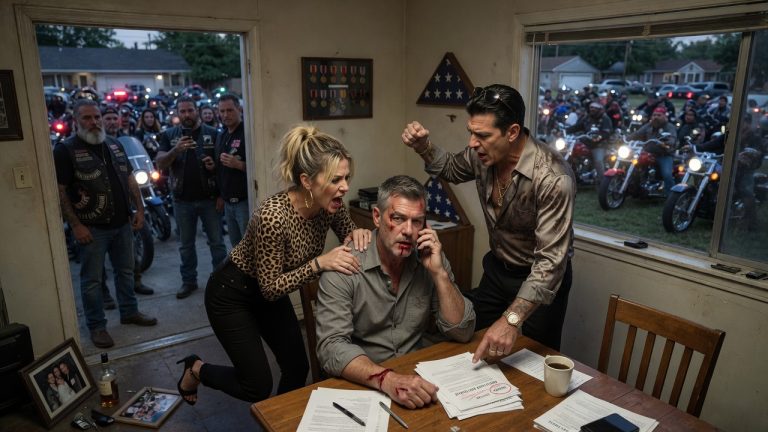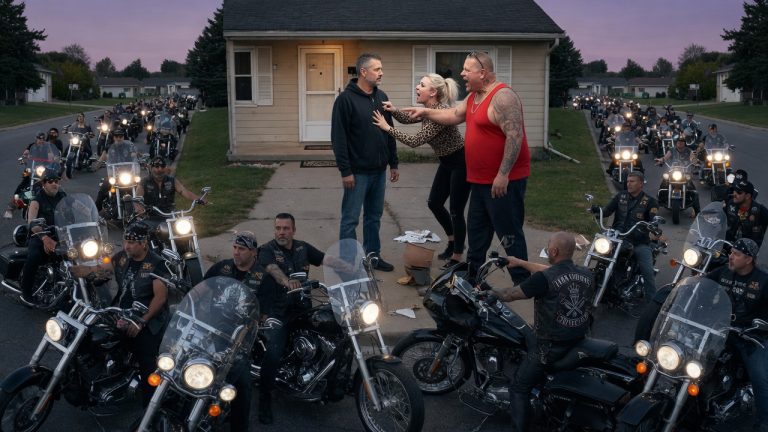
Miller thought Sal was an easy target—a confused veteran with a house he couldn’t afford and a dog that was “in the way.”
He didn’t know about Case. He didn’t know about the six months of safety Sal gave a foster kid thirty years ago.
When Case found out what Miller did to the dog to make the old man sign the papers, the “logic” of the MC went out the window. The club was broke, the debt was mounting, and they were supposed to leave town.
Instead, Case took the last of their survival money and walked into the bank.
Miller isn’t just losing a foreclosure. He’s about to find out what happens when you corner a man who has nothing left to lose but a memory that isn’t even his anymore.
FULL STORY: A WALL OF CHROME AND BONE
Chapter 1: The Rattle of the Ledger
The rain in the Pacific Northwest doesn’t just fall; it colonizes. It gets into the marrow of the cedar trees, the rust of the old Ford trucks, and the seams of a leather vest that hasn’t been oiled in three seasons. Inside the clubhouse of the Iron Remnant, the air smelled of stale coffee, burnt oil, and the slow, metallic rot of a dream dying in real-time.
Case sat at the scarred oak table in the center of the room, a yellow legal pad in front of him. He wasn’t looking at the bikes or the brothers. He was looking at the zeros.
“We’re short, Case,” Tiny said. The big man was leaning against the doorframe, his massive frame casting a shadow that swallowed the pool table. Tiny didn’t look at the ledger. He knew the numbers by heart, the way a man knows the weight of the stone tied to his ankle.
“I can see that,” Case said. His voice was a dry rasp, the sound of tires on gravel. He rubbed a hand over his face, feeling the grit of a twelve-hour ride. “If we sell the parts from the 1970 Shovelhead and the spare frames, we can clear the back taxes on this lot. Maybe have enough for a month of gas and protein.”
“And then?” Tiny asked.
“And then we’re a social club for guys with loud engines and no destination,” Case replied. He stood up, his joints popping like small-caliber fire. The Iron Remnant had once been the apex predator of the county, a wall of chrome and bone that kept the peace and took its cut. Now, they were a ghost story. The digital age had squeezed the life out of their traditional earners, and the local PD had been replaced by a sheriff with a federal grant and a hard-on for RICO cases.
The door to the clubhouse creaked open, letting in a swirl of gray mist. It was Sarah. She didn’t belong here anymore—hadn’t since the divorce three years ago—but she still had the key, and Case had never had the heart to change the lock. She was wearing a nurse’s cardigan over her scrubs, her face pale under the flickering fluorescent lights.
“Case,” she said, her voice tight. “You need to come to the clinic.”
Case didn’t move. “I told you, Sarah. I’m done with the doctors. My back is what it is.”
“It’s not about you,” she said, stepping further into the room. She looked at Tiny, then back to Case. “It’s Sal. The county is moving on the house. And Case… he’s worse.”
The name hit Case harder than a low-side slide at sixty miles per hour. Sal. The man who had taken a shivering, bloodied ten-year-old foster kid into a cabin in the woods for six months when the state had nowhere else to put him. The man who had taught him how to clean a carburetor and how to stand with his shoulders back.
“The bank?” Case asked, the legal pad forgotten.
“A man named Miller,” Sarah said. “He’s been out there three times this week. Sal doesn’t know who he is half the time. He thinks it’s 1994. But Miller… he’s pressuring him to sign a voluntary relocation. He’s using the dog, Case.”
Tiny’s head snapped up. “Buster?”
“Sal can’t take care of him, not really,” Sarah whispered. “Miller told the county the dog was a public health hazard. He threatened to have the animal control officers come out and put him down if Sal didn’t sign the transfer papers for the house. He’s scaring him, Case. He’s scaring a man who can’t even remember his own middle name.”
Case looked down at the zeros on the yellow pad. The money in the club’s “emergency” fund—the ‘get-out-of-town’ stash they’d been building for six months to relocate to a cheaper state—was exactly the amount Sal owed in back taxes and predatory interest. It was their survival. Their exit strategy.
“Tiny,” Case said, his eyes never leaving the paper. “Get the kit. We’re going for a ride.”
“We can’t use that money, Case,” Tiny said, his voice unusually soft. “The guys… they’re expecting to leave on Tuesday. If we spend this, we’re stuck here. We’re sitting ducks for the Sheriff.”
Case looked up. His eyes were cold, flat, and entirely focused. “I spent six months in a house where nobody hit me. I’m not letting that house turn into a parking lot because some suit wants a commission.”
“He won’t even know it’s you,” Sarah said, her voice breaking. “I saw him this morning, Case. He asked me if the mailman was coming back to finish the porch. He doesn’t know you.”
“I know me,” Case said. He grabbed his keys. “That’s enough.”
Chapter 2: The Ghost in the Garden
The ride to Sal’s place was a somber procession through the dripping pines. The road was a series of switchbacks that clung to the side of the mountain, the asphalt crumbling at the edges. Case felt every vibration of the bike, every shudder of the engine. It felt like the machine was as tired as he was.
When they pulled into the gravel driveway of the small, cedar-shingle house, the silence was immediate. The porch light was flickering, a dying amber pulse against the gray afternoon.
Sal was sitting on the porch in a lawn chair that had seen better decades. He was wearing a faded M-65 field jacket, his hands resting on the head of a Golden Retriever whose coat was more white than gold. The dog, Buster, didn’t bark. He just thumped his tail once, a slow, rhythmic sound against the damp wood.
Case dismounted, his boots crunching on the gravel. He walked up the steps, his leather vest creaking. He felt like a giant in a world that had shrunk.
“Afternoon, Sal,” Case said.
The old man looked up. His eyes were a pale, watery blue, searching Case’s face with a desperate, heartbreaking intensity. For a second, a spark of recognition flared—a ghost of a memory—and then it vanished, snuffed out by the fog.
“Help you with something, officer?” Sal asked. His voice was thin, like parchment.
Case felt a sharp, hot needle of grief in his chest. “I’m not a cop, Sal. It’s Case. I stayed here. A long time ago.”
Sal nodded vaguely, his hand continuing to stroke Buster’s ears. “Case. Right. You’re the one who fixed the fence. Thank you for that. The mailman says the fence is real important.”
Case looked at the fence. It was falling over. He hadn’t fixed it in twenty years. “Yeah, Sal. I fixed the fence.”
Buster stood up, his movements stiff and painful. He limped over to Case, sniffing at his chaps. Case noticed the dog’s front paw. It was wrapped in a piece of an old t-shirt, stained with a dark, brownish-red.
“What happened to his foot, Sal?”
Sal’s face crumpled. His bottom lip trembled, a small, rhythmic twitch that made him look like a frightened child. “The man. The man in the shiny car. He… he stepped on it. He said he didn’t mean to, but he did it twice. He said if I didn’t sign the papers, the dog would have to go to the pound because he’s ‘vicious.’ Buster isn’t vicious. He’s just old.”
Tiny, who had been standing at the bottom of the steps, let out a low, guttural growl. It was a sound of pure, unadulterated animal rage. Case felt his own blood go cold—not the cold of the rain, but the cold of a predator scenting its mark.
“The man in the shiny car,” Case said, his voice a whisper. “He coming back today?”
“He said four o’clock,” Sal said, checking a wrist that didn’t have a watch on it. “He says I’m going to a nice place with white walls. He says I won’t have to worry about the roof anymore.”
Case looked up at the roof. It was covered in moss, the shingles curling like dead leaves. He remembered lying in the small bedroom upstairs, listening to the rain hit those shingles and feeling, for the first time in his life, that he wasn’t going to die that night.
“You’re not going anywhere, Sal,” Case said.
“I have to,” Sal whispered. “He has a badge. He said he represents the bank. The bank is the law, isn’t it?”
Case reached out and placed a hand on Sal’s shoulder. The old man flinched at first, then leaned into the touch, his body instinctively seeking the warmth of another human being.
“The bank isn’t the law, Sal,” Case said. “The bank is just a building. And buildings can be torn down.”
A black sedan, polished to a mirror finish that looked obscene in the muddy driveway, rounded the bend. It slowed, the tires kicking up wet gravel, and came to a stop behind Case’s Harley.
A man stepped out. He was in his late thirties, wearing a charcoal suit that cost more than Sal’s house was currently worth. He carried a leather briefcase like a shield. He looked at the bikes, then at Tiny, then at Case. He didn’t look scared yet. He looked annoyed.
“Mr. Salter,” the man said, ignoring Case. “I hope we’re ready to finalize this. I have the notary in the car, and we really should get you moved before the weather turns worse.”
Case turned around slowly. He didn’t step off the porch. He stayed above the man, his silhouette framed by the rotting cedar.
“You Miller?” Case asked.
The man blinked, his eyes scanning Case’s “President” patch. “I am. And you are trespassing on property that is currently in the process of being transferred to the County National Bank. I suggest you take your friends and your… noise… elsewhere.”
Case looked at Miller’s shoes. Black Italian leather. Spotless. Then he looked at the dog’s bandaged paw.
“You stepped on the dog,” Case said.
Miller scoffed, a small, arrogant sound. “The animal was underfoot. It’s a liability. Now, if you’ll excuse me—”
Case didn’t move. He didn’t hit him. He just looked at him. “Tiny. Take Sal and Buster inside. Make him some tea. The kind with the honey in the blue jar.”
“I don’t have any honey,” Sal mumbled, confused.
“It’s in the back of the pantry, Sal,” Case said, his voice never leaving Miller’s face. “I put it there myself. Go on now.”
Tiny gently took Sal’s arm. The old man went willingly, the dog limping beside him. As the screen door slapped shut, the silence returned, heavier than before.
“I’m going to give you a choice, Miller,” Case said. “You can get back in that car and go tell your bosses that this house is no longer for sale. Or you can stay here and we can discuss the veterinary bills for the dog.”
Miller laughed, but it was a nervous, high-pitched sound. “You’re joking. You outlaws are all the same. You think a leather jacket makes you a king. This is a legal foreclosure. You have no standing here. You’re broke, Case. We know the club’s financials. We know you can’t even afford the gas to get out of the county.”
Case felt a strange sense of peace. The secret was out. They were bankrupt. They were losers. But as he looked at the man in the charcoal suit, he realized that Miller had made a fatal mistake. He thought the money was the source of Case’s power.
“You’re right,” Case said, stepping down the first stair. “I don’t have a dime to my name.”
He stepped down the second.
“But I have a lot of memory. And I remember exactly what it feels like to be hurt by someone who thinks they’re better than me.”
Miller took a step back, his heel catching in the mud. “I’ll call the Sheriff.”
“Do it,” Case said. “Tell him there’s a ghost on Salter’s porch. Tell him he’s been waiting thirty years to say hello.”
Chapter 3: The Sterile Room
The bank branch was a fortress of glass and brushed steel in the center of the dying town. It looked like a spaceship that had landed in a junkyard. Case stood across the street, his hands shoved deep into his pockets. The rain was steady now, a rhythmic drumming on his skull.
Tiny was beside him, his breath visible in the cold air. “The guys are pissed, Case. They found out about the money. They say if we don’t leave Tuesday, they’re taking their bikes and hitting the road on their own.”
“Let them,” Case said. “If they don’t understand this, they were never brothers. They were just coworkers with the same hobby.”
“It’s ten thousand dollars, Case. That’s the whole stash. Everything we saved from the last three runs.”
“It’s Sal’s life, Tiny. What’s the exchange rate on that?”
Tiny didn’t answer. He just adjusted his grip on the heavy leather pouch Case had given him. It was the “get-out-of-town” money. Every cent.
Case walked across the street. He didn’t run. He didn’t hide. He walked straight through the double glass doors, the sensors chirping as he entered the climate-controlled silence. The air smelled of carpet cleaner and ozone.
The teller, a young girl with a name tag that said ‘Ashley,’ looked up and froze. Case didn’t look like the usual Saturday morning customer. He looked like the end of the world.
“I need to see Miller,” Case said.
“He… he’s in a meeting,” she stammered.
Case didn’t stop. He walked past the velvet ropes, past the desks where people were signing for car loans and mortgages, and headed straight for the office in the back with the gold lettering on the door: Marcus Miller, Branch Manager.
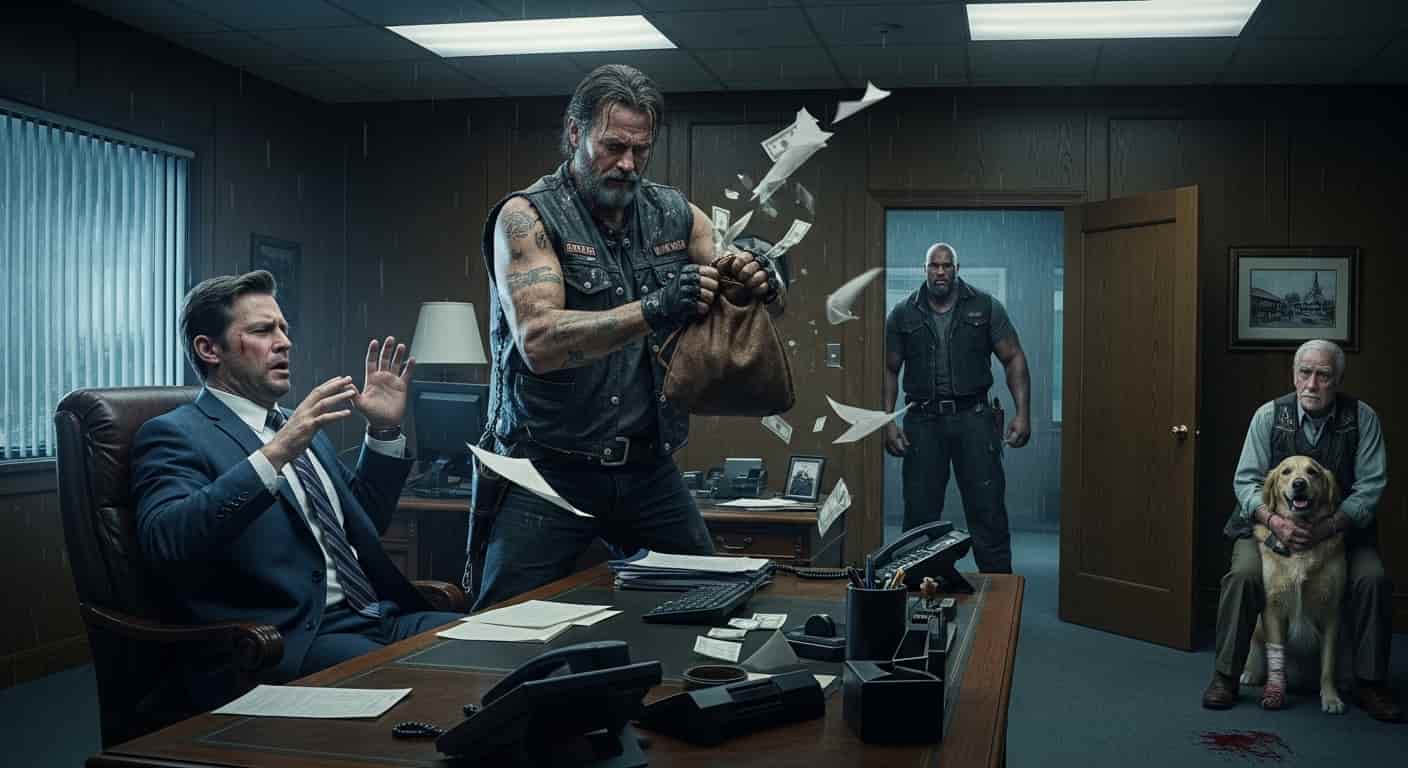
He didn’t knock. He kicked the door.
The sound was an explosion in the quiet office. Miller jumped, his coffee spilling onto his desk. He looked up, his face going from annoyance to pure, unadulterated terror in the span of a heartbeat.
“You!” Miller gasped. “I called the police! They’re on their way!”
“They’re busy,” Case said, his voice flat. “There’s a multi-bike pileup on the county road. Lots of chrome everywhere. It’ll take them a while to sort it out.”
Tiny stepped into the room, closing the door behind him. He didn’t say a word. He just stood there, his arms crossed over his chest, a 300-pound gargoyle in a leather vest.
“What do you want?” Miller asked, his hands shaking as he reached for his phone.
Case leaned over the desk. He didn’t touch Miller. He just entered his space, his shadow falling over the man’s expensive suit.
“I’m here to pay a debt,” Case said.
He reached back and took the leather pouch from Tiny. He held it for a second, feeling the weight of it. This was their freedom. Their new start. Their escape from a life that was slowly strangling them.
He slammed it down on the desk.
The thud was heavy, visceral. It sounded like a body hitting the floor. Papers scattered. A framed photo of Miller’s family tipped over.
“Count it,” Case said.
Miller stared at the pouch. “What is this?”
“It’s the back taxes. It’s the interest. It’s the late fees. It’s everything you said Sal owed.” Case’s eyes were like flint. “And there’s an extra five hundred in there for a vet. For the dog’s paw.”
Miller’s face twisted. “You can’t just… this isn’t a legal tender for—”
“Count the damn money, Miller,” Case said, his voice dropping an octave. He gripped the edge of the mahogany desk, his knuckles turning white. He tilted the desk toward Miller, forcing the man to scramble back in his chair. “Because if I have to take it back out of this room, I’m taking it out of your skin.”
Chapter 4: The Mirror and the Foil
Sarah was waiting at the clinic when Case and Tiny returned. The clinic was a small, overworked building that served as the primary care for the town’s poor and uninsured. It was the kind of place where the magazines in the waiting room were five years old and the paint was the color of a bruise.
“Did you do it?” she asked, leading them into a back room.
“It’s done,” Case said. “The receipt is in my pocket. The house is clear.”
Sarah sat down on a rolling stool, her shoulders sagging. “You’re a fool, Case. You know that, right? You just threw away your only chance to get out of this town. The Sheriff is going to pick you apart piece by piece now.”
“I was never leaving anyway,” Case said. He looked at himself in the small, polished mirror on the wall. He saw the grey in his beard, the lines around his eyes that looked like maps of roads he shouldn’t have taken. “I’m part of the rust here, Sarah. You know that.”
“Sal doesn’t even know what you did,” she said, her voice soft. “He’s in the next room. He thinks the ‘nice man from the bank’ gave him a scholarship for his gardening. He’s forgotten the confrontation already.”
“Good,” Case said.
“Is it?” Sarah stood up and walked over to him. She didn’t touch him, but the air between them was thick with the weight of everything they hadn’t said for three years. “You spent your life’s savings for a man who calls you ‘sir.’ You’re a hero to a man who doesn’t have a hero’s memory. It’s a waste, Case. A beautiful, stupid waste.”
Case looked at her. “You think Miller is a hero? He has a house in the heights. He has a clean record. He pays his taxes. He’s everything the world says a good man should be. But he’s the one who stepped on a dying dog to get a signature.”
“The world doesn’t care about the dog, Case,” Sarah said. “The world cares about the signature.”
“Then the world and I are going to have a problem,” Case said.
The door opened, and a younger man walked in. He was wearing a leather vest, too, but his was clean, the patches bright and new. It was ‘Kid,’ the club’s youngest member. He looked frantic.
“Case! The guys… they’re at the bank. They heard what you did. They’re tearing the place apart. They said if you’re going to waste the money, they’re going to make sure the bank doesn’t get to keep the building.”
Case’s heart sank. “Tiny! Get the bikes!”
“It’s too late, Case,” Kid said, his voice shaking. “The Sheriff is already there. They’ve got three of the brothers in zip ties. They’re looking for you. They’re saying it was an organized hit. A ‘message’.”
Case closed his eyes. The trap had snapped shut. He had saved the house, but he had destroyed the club. The logic he had prided himself on—the cold, hard survivalism that had kept him alive since the foster system—had failed him. Or perhaps, for the first time, he had actually succeeded at being the man Sal had tried to raise.
“Sarah,” Case said, turning to her. “Take the papers. Make sure they’re filed with the county clerk. Not the bank. The clerk.”
“Case, don’t—”
“Go,” he said. He looked at Tiny. “You too. Get out of here. Take Kid. Head south. Don’t look back.”
“I’m staying,” Tiny said. The big man didn’t move. He looked like an oak tree rooted in the linoleum floor. “I like tea with honey. And I like that dog.”
Case felt a lump in his throat he couldn’t swallow. He turned back to the mirror. He didn’t look like a ghost anymore. He looked like a man.