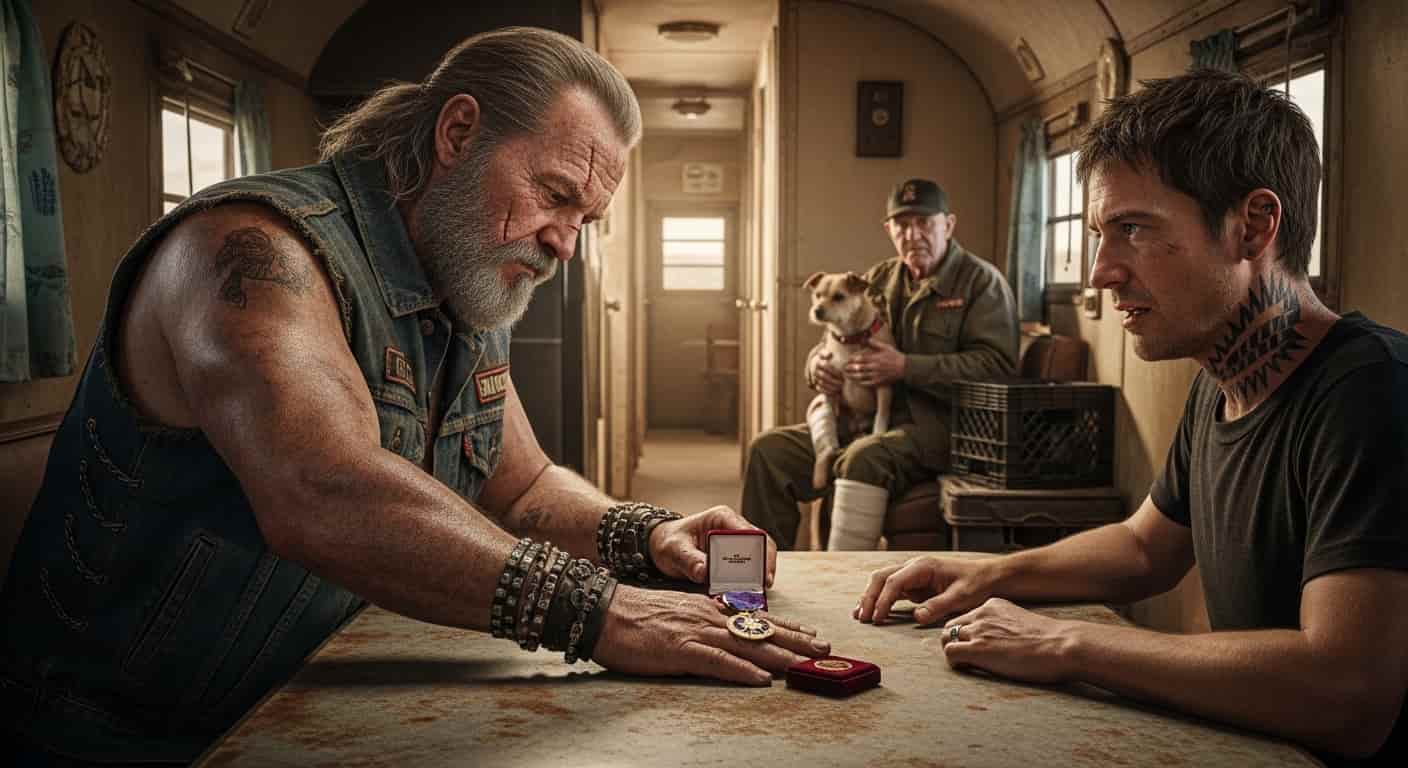
Elias was eighty years old, living on canned soup and memories in a trailer that smelled like hot dust and impending death. When his dog, Barnaby, came home with a crushed hip and a mangled leg, Elias knew he was done. He had exactly one thing left of value: the Purple Heart he’d earned in a valley half a world away.
He put it on the table. He called the only man who dealt in “quick trades” in the county—a twitchy ghost named Cutter.
But when the door kicked open, it wasn’t just the predator who walked in. It was Bear.
Bear hadn’t come for the medal. He hadn’t come for the dog. He came because for three weeks, he’d been seeing that dog’s broken body in his sleep, a direct mirror to the daughter he’d buried years ago because he was too busy riding to hear her scream for help.
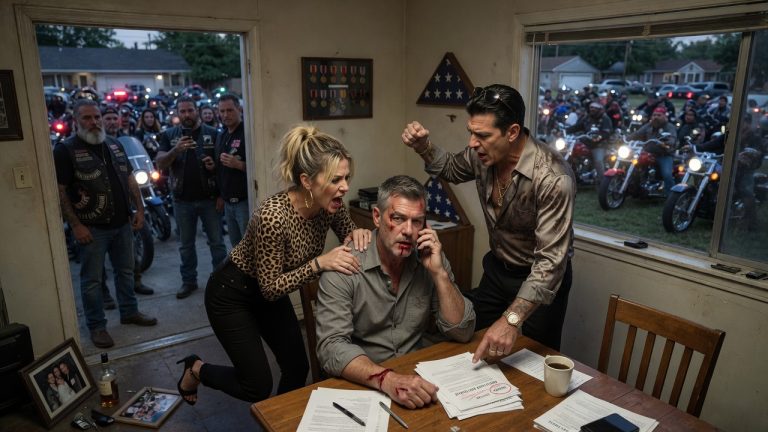
When Bear’s hand slammed down on that table, the air in the trailer changed. It wasn’t just a fight over a piece of metal. It was a confession that was about to turn the dirt red.
“I’m the one who hit him,” Bear said. And that was the moment the lies stopped.
FULL STORY: THE WEIGHT OF THE WAKE
Chapter 1: The Thud in the Dust
The heat in Otero County doesn’t just sit on you; it burrows. It’s a dry, invasive thing that smells like creosote and old rubber. Bear felt it radiating off the chrome of his Heritage Softail, a slow bake that matched the low-simmering ache in his lower back. He was sixty-two, and the bike felt heavier every season.
He shouldn’t have been looking at the photo. It was taped to the inside of his windshield, a faded Polaroid of Sarah when she was twelve, squinting against the sun at a rest stop in Amarillo. He’d reached out a gloved thumb to brush the dust off her face, just a second of drifted focus, and that was all it took.
The dog didn’t bark. It was just a gray blur darting out from behind a rusted-out Ford carcass near the edge of the El Camino trailer park.
There was a sickening, wet thud. A yelp that cut through the rumble of the V-twin engine like a razor through silk. The bike bucked. Bear’s boots hit the asphalt, skidding through the grit as he fought the weight of the machine. He brought it to a halt twenty yards down the road, the kickstand digging into the soft, melting tar.
He didn’t look back immediately. He sat there, chest heaving, the image of Sarah flashing in his mind—not the girl in the photo, but the woman he’d found in a bathroom in Albuquerque three years ago, cold and gray, the needle still rolling across the linoleum.
“Dammit,” he whispered. The word felt small in the desert.
He walked back. The dog was a scruffy terrier mix, the kind of animal that existed on scraps and luck. It was dragging itself toward a patch of shade under a mesquite bush, its hind leg hanging at an angle that made Bear’s stomach turn.
“Hey. Easy, boy,” Bear muttered, kneeling. He reached out, and the dog bared its teeth, a weak, pathetic snarl. There was a collar, frayed and held together by a paperclip. Barnaby. Behind the bush, a trailer sat on cinderblocks. The aluminum siding was peeling like sunburnt skin. A man stepped onto the warped plywood porch. He was thin, wearing an oversized M-65 field jacket despite the hundred-degree heat. His hair was a shock of white, his eyes cloudy with cataracts.
“Barnaby?” the man called. His voice was a thin reed. “That you, Scout?”
Bear looked at the dog. He looked at the old man, whose hand was shaking as it gripped the porch railing. He thought about the three-piece patch on his back, the “Pres” rocker, and the code of the road he’d preached for forty years.
He also thought about the legal trouble a biker with a record didn’t need in a town where the Sheriff looked for excuses.
“Your dog’s hurt, sir,” Bear said, standing up. He didn’t say I hit him. The lie felt like a stone in his throat.
“Hurt?” The man, Elias, scrambled down the steps, nearly falling. He fell to his knees beside the dog. When he saw the leg, a sound came out of him—a high, keening whimper that sounded far too much like the dog’s own cry.
Bear stood over them, his shadow long and dark in the dirt. He could have walked away. He could have reached into his cut, pulled out a hundred-dollar bill, dropped it, and ridden off. That’s what a smart man would do.
“I’ll help you get him inside,” Bear said instead. It was the first mistake in a long line of them.
Chapter 2: The Vulture’s Shadow
The inside of the trailer was a museum of neglect. Stacks of National Geographic from the nineties, a sink full of gray water, and the smell of unwashed laundry and cheap tobacco. Bear cleared a space on the small dinette table while Elias hovered, his hands fluttering like trapped birds.
“He’s all I got left, you see,” Elias kept saying. “My Mary’s gone. My boy… he didn’t come back from the Gulf. It’s just me and Barnaby.”
Bear fashioned a makeshift splint out of a ruler and some duct tape he found under the sink. He worked with the steady hands of a man who’d stitched up road rash in parking lots, but every time the dog flinched, Bear felt a phantom pain in his own hip.
“He needs a vet,” Bear said, tightening the tape. “The real kind. Not a guy with a roll of silver tape.”
Elias went quiet. He sat on the edge of a sagging recliner, looking at his boots. “I know. I know that. But the pension… it don’t stretch. And the truck won’t start.”
Bear looked around the room. On the mantel, among the dust and the dead flies, sat a framed photograph of a young man in desert fatigues. Next to it, a small velvet box, worn at the hinges.
Before Bear could say anything, a shadow darkened the screen door. A sharp, rhythmic knocking followed—not a polite knock, but the rapping of someone who already felt they owned the place.
“Elias! You in there, old man? I heard you got some business to attend to.”
The voice was high, nasal, and vibrating with an artificial energy. Bear knew that voice. It was the sound of a man three days into a five-day bender.
Elias stiffened. “It’s Cutter.”
Bear moved to the window, pulling back a grease-stained curtain. A wiry man in a stained tank top was leaning against a beat-up Honda Civic. Two other men, younger and broader, stood behind him, looking bored and dangerous.
“Who is he?” Bear asked.
“He… he helps me,” Elias whispered, his voice trembling. “He brings me things. Medicines. Food sometimes. But he says I owe him. He says the interest is getting high.”
Bear watched Cutter spit a glob of yellow phlegm into the dirt. He recognized the type. A bottom-feeder. The kind of person who specialized in finding people who were already drowning and holding their heads under for the loose change in their pockets.
“Stay here,” Bear said.
He stepped out onto the plywood porch. The wood groaned under his boots. Cutter looked up, his eyes widening as they raked over Bear’s size, the black leather, and the heavy silver rings on his fingers.
“Whoa,” Cutter said, holding up his hands. “Didn’t know the circus was in town. You lost, Big Rig?”
“Move on,” Bear said. His voice was low, a rumble like a distant storm. “The old man doesn’t want you here.”
Cutter’s grin didn’t reach his eyes. His pupils were pinpricks. “Is that what he said? Because Elias and me, we got a contract. A verbal one. He’s behind on his ‘protection’ fees. Trailer parks can be dangerous, man. Fires start. Dogs get hurt.”
Bear’s blood went cold. Dogs get hurt. He looked at the Civic, then back at Cutter. He felt a sudden, violent urge to wrap his hands around the man’s neck. But he couldn’t. Not yet. He was an outsider here, and he was carrying a secret that made him just as much a villain as the twitchy kid in the yard.
“How much?” Bear asked.
“Two thousand,” Cutter said, his eyes dancing. “Plus a little extra for the disrespect you’re showing me right now.”
Bear reached into his pocket. He had five hundred in his clip. Not enough. Not even close.
“Get out of here,” Bear said, his voice dropping an octave. “Before I decide to see how many of your teeth I can pick up out of this gravel.”
Cutter didn’t flinch. He just nodded to his friends. “We’ll be back, Elias! Don’t let your new boyfriend get you into more trouble than you can handle!”
As the Civic roared away, spewing blue smoke, Bear turned back to the door. Elias was standing there, holding the small velvet box.
“I have this,” Elias said, his voice breaking. “It’s my boy’s. Maybe… maybe it’s enough to make them stop.”
Bear looked at the Purple Heart. It felt heavier than the bike.
Chapter 3: The Mirror of the Patch
That night, Bear sat in the back room of The Iron Sled, the clubhouse for the Black Mountain MC. The air was thick with the smell of stale beer and primary oil. Preacher, the club’s chaplain—a man with a beard down to his belt and a Bible verse tattooed on his knuckles—was cleaning a carburetor at the bar.
“You’re quiet, Bear,” Preacher said without looking up. “Usually when you’re this quiet, someone’s about to get a hospital bill.”
Bear stared at his hands. “I hit a dog today, Preacher.”
Preacher stopped scrubbing. He looked up, his eyes sharp. “An accident?”
“I was looking at Sarah’s picture. I drifted. The dog belongs to an old vet. A guy living on nothing in a trailer that’s rotting out from under him.” Bear took a long pull of his beer. “Then some local tweaker named Cutter showed up. He’s squeezing the old man for ‘protection.’ Two grand.”
“And you want to pay it,” Preacher said. It wasn’t a question.
“I want to kill him,” Bear corrected. “But if I kill him, the old man’s still got a broken dog and no money. And I’m still the guy who broke the dog.”
“Guilt is a heavy passenger, brother,” Preacher said, setting the carb down. “But you can’t outrun it on a bike. You know that better than anyone. You’re trying to save this old man because you couldn’t save Sarah. But Elias isn’t your daughter. And that dog isn’t the soul you lost.”
“It feels the same,” Bear said. “The way he looked at that dog… it’s the way I looked at her when the paramedics pushed me out of the room. Like the last light in the world just went out.”
Bear stood up. “Cutter’s coming back tomorrow. He wants the boy’s Purple Heart. Elias is going to give it to him to pay for dog medicine.”
“And what are we going to do?” Preacher asked, his hand moving toward the heavy maglite he kept under the bar.
“We’re going to show him what a real brotherhood looks like,” Bear said. “And then I’m going to tell the truth. Even if the old man hates me for it.”
Bear walked out to the garage. He looked at his bike, then at the “President” patch hanging on a hook by the door. He’d worn it for twenty years. It had been his identity, his shield, his excuse for never being home.
He took it down. He touched the leather, feeling the weight of it.
Something has to give, he thought. Before I’m the one living in a trailer with nothing but a dog and a box of medals.
Chapter 4: The Trade
The next afternoon, the heat was even worse. It felt like the sky was pressing down on the El Camino trailer park.
Bear was already inside when the Civic pulled up. He was sitting at the table, his back to the door. Elias was in his recliner, clutching Barnaby. The dog was sedated on some aspirin Bear had brought, its breathing shallow but steady.
The Purple Heart sat in the center of the table.
Cutter walked in alone this time, his two goons standing guard at the door. He was vibrating, his hands dancing a frantic jig at his sides.
“There it is,” Cutter said, his eyes locking onto the medal. “The hero’s prize. Beautiful, ain’t it? Worth a lot to the right collector.”
He reached for it.
SLAM.
Bear’s hand came down like a falling hammer. The metal table groaned. Cutter shrieked, pulling his hand back just before his fingers were pinned.
“It’s not for sale, Cutter,” Bear said.
Cutter’s face contorted into a mask of rage. “We had a deal! The old man called me! He said he’d trade!”
“He’s desperate,” Bear said. “Desperate people make bad deals with pieces of trash like you.”
“You think you’re tough because you got a vest and a big bike?” Cutter reached into his waistband. He pulled out a small, snub-nosed revolver. It shook in his hand, the barrel wavering between Bear’s chest and Elias. “Give me the medal, or the old man gets a hole in him.”
Elias let out a choked sob. “Bear, please… let him take it. Barnaby needs the medicine. I don’t care about the medal anymore.”
Bear didn’t move. He looked past the gun, straight into Cutter’s blown-out eyes.
“Look at the dog, Cutter,” Bear said.
“Shut up! Give me the box!”
“Look at the dog’s leg,” Bear commanded, his voice a low, terrifying vibration. “See that splint? See how he’s hurting?”
Cutter glanced at the dog, then back at Bear. “So what? Things get hurt.”
“I’m the one who did it,” Bear said.
The room went silent. Even the wind seemed to stop. Elias looked up, his clouded eyes widening.
“What?” Elias whispered.
“I hit him,” Bear said, never taking his eyes off Cutter. “I was distracted. I was looking at a ghost, and I hit your dog. I lied to you, Elias. I let you think it was just bad luck. I let you feel like the world was just cruel, when it was really just me being a careless old man.”
Bear stood up slowly. The gun followed his chest, but he didn’t stop until the barrel was inches from his leather vest.
“I owe him two thousand dollars for the vet,” Bear said to Cutter. “But I don’t owe you a damn thing. And if you pull that trigger, you better make sure it kills me. Because if it doesn’t, I’m going to feed you that gun piece by piece.”
Cutter’s finger tightened on the trigger. His face was slick with sweat. He looked at Bear—a wall of black leather and righteous fury—and then he looked at the door.
He didn’t see his friends anymore.
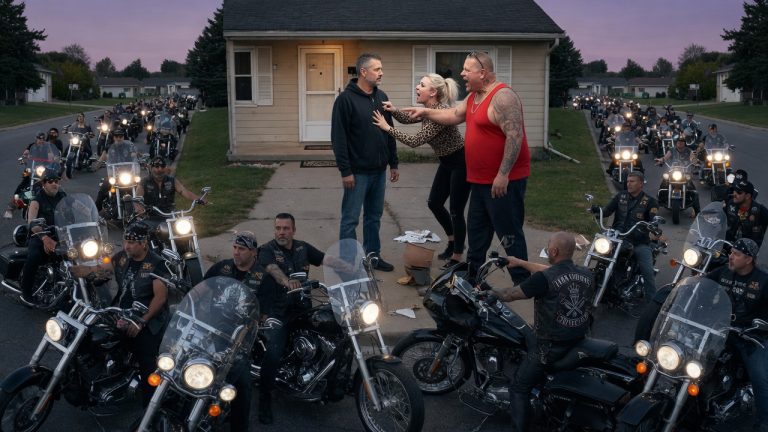
He saw Preacher and four other Black Mountain riders standing there, their arms crossed, their faces grim. The sound of ten more Harleys rumbling into the park filled the air like a localized earthquake.
Cutter’s hand began to shake violently.
“I… I got rights,” Cutter stammered.
“You got a choice,” Bear said. “You can leave the gun on the table and walk out of this county. Or you can stay, and we can find out how deep we can bury a Civic in the desert.”
Cutter dropped the gun. It hit the table with a dull clatter next to the Purple Heart. He turned and bolted, pushing past the bikers who let him go with a series of low, mocking laughs.