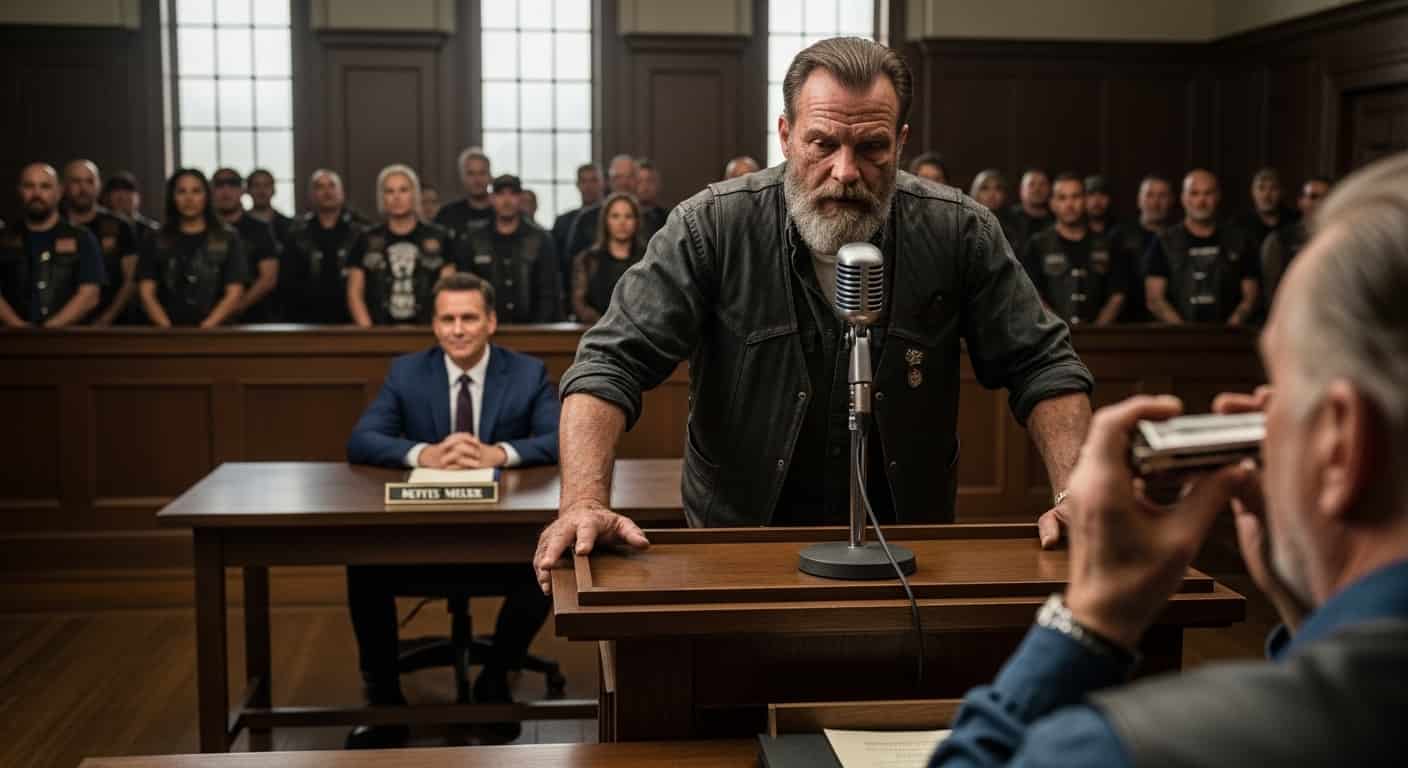
Everyone in Flint knew “Mute” Mike Kovacs. He was the man who fixed your bike in total silence and left bags of groceries on a crippled veteran’s porch under the cover of night. He hadn’t spoken a single word since he came home from the Gulf in ’91.
The corrupt Director of the Bright-Days Nursing Home thought that made Mike the perfect witness. He thought he could steal the Colonel’s pension and kick his service dog into the street because the only man who knew the truth couldn’t speak it.
Miller sat in that courtroom smirking. He told the judge Mike was “mentally incompetent.” He thought he’d won.
Then the Colonel pulled out a dented silver harmonica, and the silence that had lasted two decades finally broke.
When Mike leaned into that microphone, he didn’t just testify. He finished a transmission he’d been holding in his throat for twenty years.
And by the time he was done, the Director wasn’t smirking anymore—he was looking for the nearest exit.
FULL STORY: STEEL SHIELD FOR A BROKEN MAN
Chapter 1: The Groceries on the Porch
The rain in Flint didn’t fall; it surrendered. It draped over the rusted skeletons of old factories and turned the oil-slicked asphalt of the Iron Phalanx garage into a dark mirror. Mike Kovacs stood in the bay door, the smell of 10W-40 and cold dampness clinging to his beard. He didn’t mind the wet. It was better than the heat. Better than the fine, choking dust of the Iraqi desert that lived in the back of his mind, waiting for the lights to go out.
He wiped a rag across his knuckles, the skin scarred and permanently stained with the work of engines. He was a big man, built like an anvil, with shoulders that seemed to carry the weight of the roof. He hadn’t spoken since February 1991. The doctors called it selective mutism, a psychological knot tied so tight no therapy could undo it. To the guys in the club, he was just “Mute.” He was the best mechanic in three counties because he didn’t waste time talking; he listened to the machines.
At 6:00 PM, Mike pulled his denim jacket over his leather cut and swung a leg over his 1998 Fat Boy. The engine turned over with a guttural roar that vibrated in his chest—the only voice he had.
He stopped at Miller’s Grocery on the way. He didn’t use a list. He knew the inventory by heart: two gallons of whole milk, a case of canned beef stew, a bag of high-protein dog kibble, and a pack of peppermint gum. He placed the items on the counter. The cashier, a girl no older than twenty with dyed blue hair, didn’t bother saying hello. She knew the drill. Mike tapped a twenty and two fifties onto the laminate. He didn’t wait for the change.
Ten minutes later, he was idling in a gravel driveway on the edge of town. The house was a sagging rancher with peeling white paint, the kind of place that looked like it was holding its breath. This was the “transition house” for Bright-Days, a low-cost annex for veterans whose benefits didn’t quite cover the main facility’s luxury.
Mike walked up the porch steps, his boots heavy on the wood. He set the bags down. Through the screen door, he could hear it—the thin, mournful wail of a harmonica. It was a blues riff, shaky and breathless, played by a man with lungs full of age and ghosts.
A small, scruffy terrier-mix with a missing ear shoved its nose against the screen, tail thumping a frantic rhythm. Mike knelt, sticking a thick finger through a hole in the mesh to scratch the dog’s snout.
“Scout, settle down,” a voice rasped from the shadows inside.
Colonel Arthur Vance rolled into the light. He was a ghost in a flannel shirt, his legs ending in neatly pinned-over stumps. He looked at the grocery bags, then up at the blurred shape of the man on his porch.
“That you, Kovacs?” Vance asked.
Mike didn’t move. He stood there in the rain, the water dripping off the bill of his cap.
“I know it’s you,” Vance chuckled, a dry, rattling sound. “Nobody else in this godforsaken town buys the good kibble for a three-legged dog. Come in, Mike. The rain’s got teeth tonight.”
Mike stayed on the porch. He never went in. To go in was to face the maps on the wall, the medals in the shadow-box, and the one photo on the mantle—the two of them in the desert, Mike young and wiry with a radio pack on his back, and Vance standing tall on two legs, a commander who looked like he could outrun a tank.
“They’re moving me, Mike,” Vance said, his voice dropping. The harmonica sat in his lap, gleaming under the porch light. “Miller says the annex is closing. Says I’m going to the main ward. He’s already talking about ‘rehoming’ Scout. Says a nursing home is no place for a stray.”
Mike’s grip tightened on the porch railing until the old wood groaned.
“I can’t lose the dog, son. He’s the only one who remembers the sound of my boots.”
Vance looked at Mike, searching for a word, a sign, anything. Mike just looked back, his eyes two dark wells of unsaid things. He turned, walked back to his bike, and kicked it into gear. As he rode away, the sound of the harmonica followed him, a thin silver thread of grief cutting through the thunder of the exhaust.
Chapter 2: The Stolen Song
The Bright-Days Nursing Home looked like a Hilton on the outside and smelled like bleach and slow death on the inside. Mike didn’t like the lobby. It was too bright, too clinical. He felt like a grease stain on a white sheet.
He was there under the guise of “maintenance,” a favor called in by Sarah, a nurse with a tired face and a backbone made of rebar. She met him by the service entrance, her eyes darting toward the security cameras.
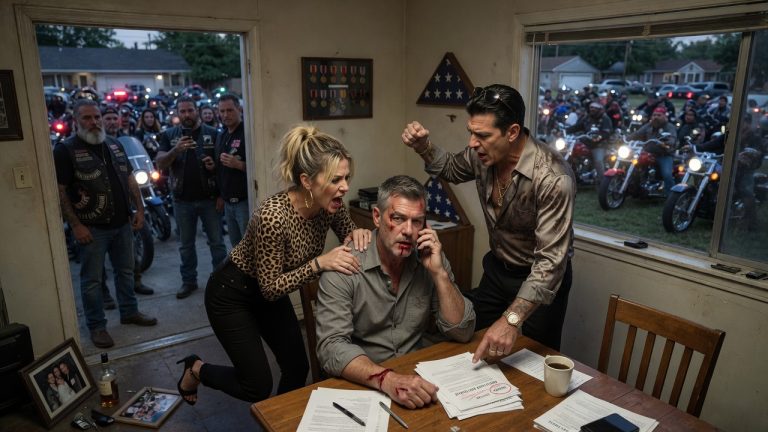
“He took it, Mike,” she whispered, leaning close. “Miller went into Vance’s room this morning. He told the Colonel he was ‘auditing personal property for insurance purposes.’ He took the harmonica. He took the shadow-box. And he served the papers for the dog.”
Mike’s jaw set so hard a muscle jumped in his cheek. He followed Sarah down the hall toward the Director’s office.
Director Miller was a man who smelled of expensive aftershave and cheap ambitions. He was behind a mahogany desk, scrolling through a tablet, when Mike walked in without knocking.
Miller looked up, his expression shifting from annoyance to a practiced, predatory mask of concern. “Ah, Mr. Kovacs. The silent mechanic. I’m afraid I don’t have any vehicles in need of repair today.”
Mike didn’t move. He stood in the center of the plush carpet, a mountain of leather and silent rage.
“If you’re here about Colonel Vance, I suggest you leave,” Miller said, his voice hardening. “The Colonel is experiencing significant cognitive decline. He’s becoming a danger to himself. We’ve taken over his power of attorney to ensure his… assets… are managed correctly. That includes the removal of unsanitary animals from the premises.”
Miller reached into his desk drawer and pulled out a silver harmonica. He turned it over in his hands, the light glinting off the dented chrome. “And items like this? They’re a choking hazard for someone in his condition. I’ll be cataloging it for the estate.”
Mike took a step forward.
Miller didn’t flinch. He knew the law. He knew Mike’s history. “Go ahead, Kovacs. Hit me. Give me a reason to call the cops and have you barred from this county. You think because you wear those colors you’re tough? You’re a man who can’t even say his own name. You’re a broken tool.”
Miller set the harmonica on the desk, right in the center. A trophy.
Mike looked at the instrument. He remembered the night in the cellar outside Basra. The smell of burning rubber and spent shells. Vance had been screaming, his legs shredded by a mortar round, and Mike had been huddled in the corner, the radio handset in his hand. The frequency was open. The evac birds were ten minutes away. All Mike had to do was give the coordinates.
But the fear had been a physical hand across his throat. He had opened his mouth, and nothing had come out. Not a whisper. Not a sob. He had watched his commander bleed out in the dark because he was a coward who lost his voice when the world went loud.
Vance had survived, barely. But Mike’s voice had stayed in that cellar.
Now, Mike reached out. His hand was steady. He didn’t grab Miller. He picked up the harmonica.
“Put that down,” Miller snapped, reaching for the phone. “That’s private property.”
Mike didn’t put it down. He tucked it into the pocket of his vest. He leaned over the desk, his face inches from Miller’s. He didn’t speak. He didn’t have to. The look in his eyes was a promise that a mahogany desk wouldn’t be enough of a shield when the bill finally came due.
He turned and walked out. Behind him, Miller was shouting about theft and police, but the sound was small and distant, like the buzzing of a fly against a window.
Chapter 3: The Young and the Heartless
The Iron Phalanx clubhouse was a converted warehouse where the air was thick with cigarette smoke and the clinking of beer bottles. Jax, a twenty-four-year-old with fresh ink and a mouth that ran faster than his bike, was holding court at the pool table.
“I’m telling you, it’s a waste of time,” Jax said, chalking his cue. He nodded toward Mike, who was sitting at the bar, cleaning the Colonel’s harmonica with a soft cloth. “Old Mute’s got a crush on a guy who can’t even walk. Why are we messing with a nursing home? There’s no money in it. No territory. Just a bunch of old people waiting to kick off.”
The room went quiet. The older bikers, men who had seen the inside of prisons and the underside of life, looked at Mike.
Mike didn’t look up. He kept polishing the chrome.
“The Colonel’s a hero, Jax,” one of the older riders, a man named Preacher, said softly. “He deserves better than a suit stealing his pension.”
“A hero?” Jax laughed, a sharp, ugly sound. “He’s a relic. Just like that harmonica. Look at Mute over there. He’s pathetic. He’s been carrying that guy’s groceries for twenty years like a damn delivery boy. If he had any balls, he’d just blow the doors off the place instead of playing nursemaid.”
Jax walked over to the bar, leaning in close to Mike. “Why don’t you say something for once, Kovacs? Tell us why you’re so obsessed with a cripple. Did you let him down back then? Is that why you’re so quiet? You’re making the club look weak, following around a man who’s half-dead.”
Mike stopped polishing. He placed the harmonica on the bar.
He stood up, and the height difference was immediate. Jax was lean and fast, but Mike was a tectonic plate.
Mike didn’t swing. He didn’t have to. He reached out and grabbed Jax by the front of his vest, lifting him until the kid’s toes were barely touching the concrete. He slammed him against the brick wall of the clubhouse.
The impact rattled the bottles on the shelf. Mike’s hand was a vice around Jax’s throat—not squeezing enough to choke, but enough to show exactly how easy it would be.
Mike stared into Jax’s eyes. He wanted to tell him about the desert. He wanted to tell him that strength wasn’t about who you could beat down, but who you were willing to carry when they couldn’t walk. He wanted to tell him that silence wasn’t weakness; it was a prison.
He let Jax go. The kid slumped to the floor, gasping, the bravado drained out of him.
He’s moving him tomorrow, Mike thought, the words screaming in his head. They’re taking the dog to the pound tomorrow.
Mike looked at Preacher. He tapped the harmonica, then pointed toward the door.
“You want the whole pack?” Preacher asked, standing up.
Mike nodded.
“Alright then,” Preacher said, grabbing his keys. “If we’re going to war for a Colonel, we better dress for it.”
Chapter 4: Gathering the Pack
The rain had turned into a freezing drizzle by the time Sarah met Mike behind the dumpster at Bright-Days. Her hands were shaking as she handed him a thick manila envelope.
“These are the billing records,” she whispered. “Miller’s been charging the VA for physical therapy the Colonel never received. He’s been skimming from the meal budget. And Mike… he’s already called Animal Control. They’re coming for Scout at 8:00 AM.”
Mike took the envelope. He looked at the clinic windows. He could see the silhouettes of the residents—men and women who had built the world, now tucked away in beige rooms, being picked clean by a man in a navy suit.
He spent the night at his workbench. He didn’t sleep. He went through the papers. He wasn’t a lawyer, but he knew how to find the leak in a system. The numbers didn’t add up. Miller was stealing thousands every month, moving the money into a shell company registered to his brother-in-law.
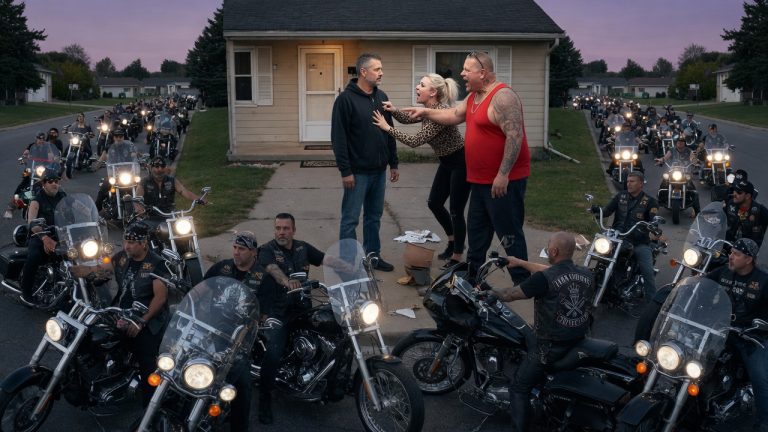
At dawn, the sound of heavy engines began to fill the street outside the garage. One by one, the Iron Phalanx arrived. Then the Highway Kings. Then the Black Jackets.
They weren’t there for a run. They were there because the word had spread through the local vets’ network. A commander was being grounded. A brother was in trouble.
By 7:30 AM, there were fifty bikes idling in the rain. By 7:45, there were a hundred.
Mike led the procession. He didn’t use a siren; he let the collective thunder of the V-twins do the talking. They pulled into the Bright-Days parking lot just as a white van with the words County Animal Control on the side backed into the driveway.
The bikers formed a semi-circle, blocking the van.
A young officer stepped out, looking at the wall of leather and chrome with wide eyes. “Uh, I have a work order for a stray removal.”
Mike stepped off his bike. He walked to the van, placed his hand on the driver’s side door, and gently pushed it closed.
“Hey, I have a job to do,” the officer stammered.
Preacher stepped up beside Mike. “The dog isn’t a stray, son. He belongs to a decorated veteran. And today, the veteran is moving.”
Miller came running out of the front doors, his face purple with rage. “Kovacs! I called the police! This is harassment! This is a private facility!”
Mike didn’t look at him. He looked at the second floor window. Colonel Vance was there, his forehead pressed against the glass, holding Scout in his arms.
Mike pulled the harmonica from his pocket and held it up.
“You think this changes anything?” Miller screamed over the engines. “I have the Power of Attorney! I have the legal right! You’re just a bunch of thugs who can’t even speak for yourselves!”
A black sedan pulled into the lot. A woman in a sharp grey suit stepped out—Eleanor Vance, the Colonel’s daughter, a civil rights attorney Mike had spent the last six hours tracking down and calling via a relay service.
She looked at Miller, then at the bikers, then at her father in the window.
“Mr. Miller,” she said, her voice like a scalpel. “My name is Eleanor Vance. I’ve just spent the last three hours reviewing some very interesting financial documents sent to my office by a concerned citizen. I think you and I should have a conversation. In court. Today.”