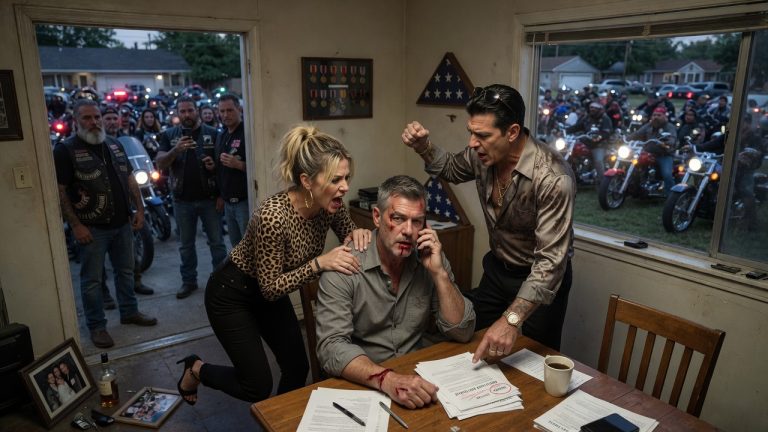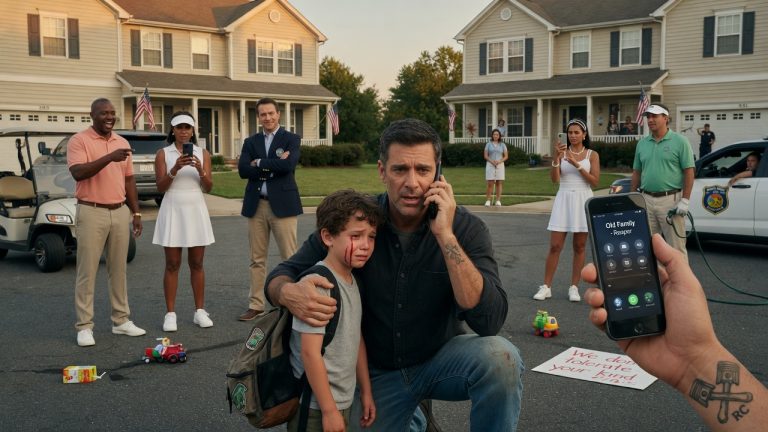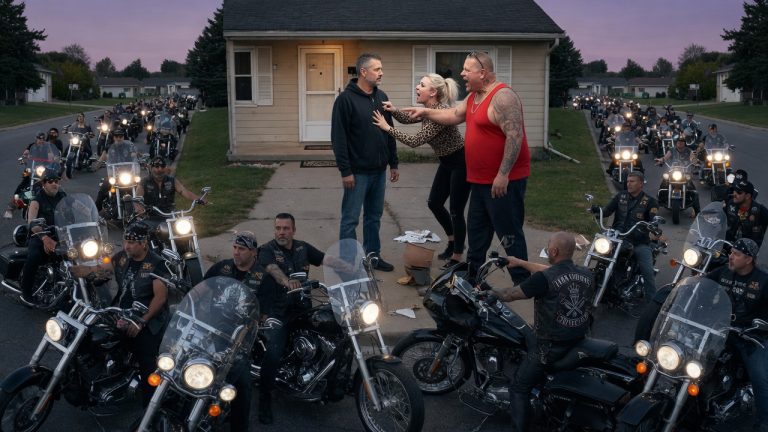
Dutch Van Owen didn’t come back to the Appalachian woods for a homecoming. He came back for a reckoning.
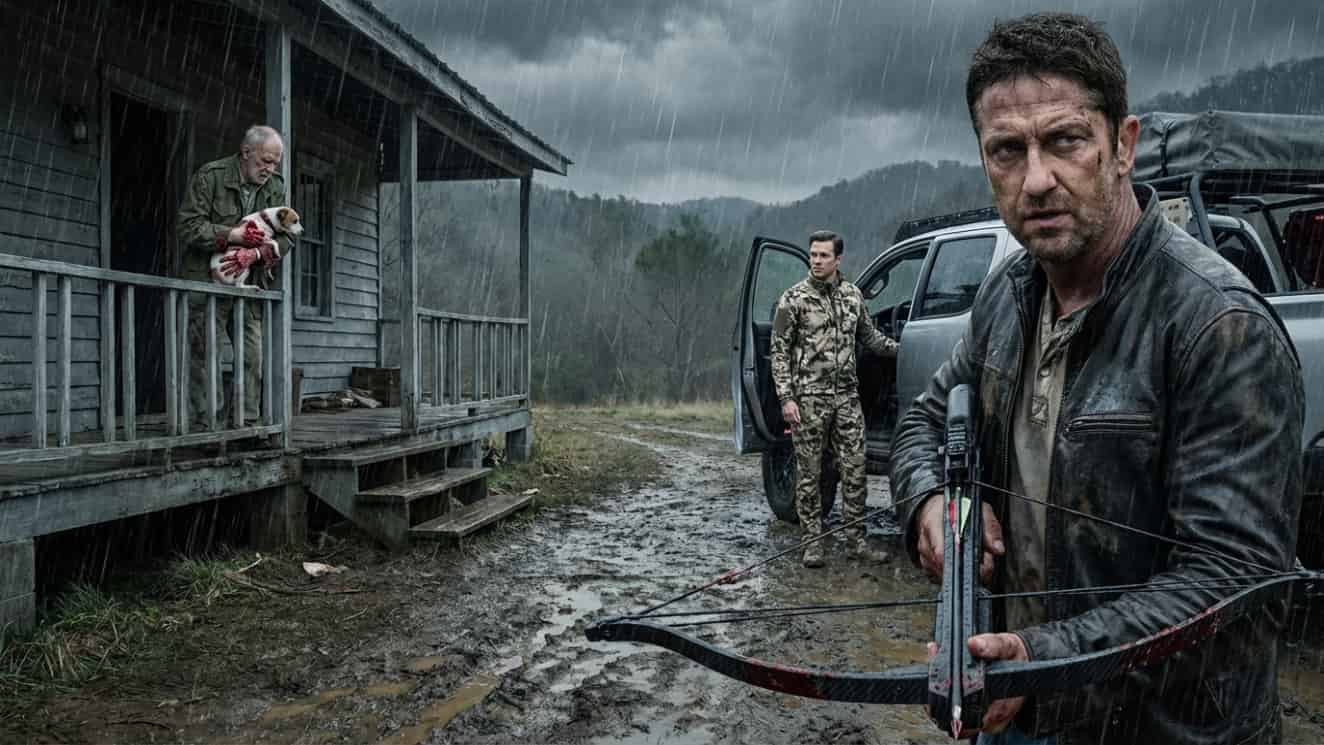
Ten years of his life vanished behind concrete walls because of a lie. He thought he knew who owned the lie, but when Julian Vane put a crossbow bolt through a veteran’s dog, the truth finally stopped running.
The bolt in Dutch’s hand isn’t just evidence of animal cruelty. It’s the signature of the man who framed him. And the old man watching from the porch? He’s been holding a Silver Star and a secret for a decade that’s about to burn the whole county down.
Dutch has a choice: take the blood he’s owed, or save the only thing Eli has left.
The debt is being called in tonight.
FULL STORY: BLOOD, OIL, AND OLD MEDALS
Chapter 1: The Weight of Rain
The rain in the Appalachians didn’t fall; it occupied. It got into the pores of the rusted Chevys and the stitching of Dutch Van Owen’s leather jacket, reminding him that the world was still damp and cold, unlike the recycled, arid air of Leavenworth.
Dutch sat in his ’78 Shovelhead at the mouth of the holler, the engine idling with a wet, rhythmic thumping that felt like a failing heart. He’d been out for seventy-two hours. Ten years of his life had been condensed into a mesh laundry bag and a bus ticket, and now he was staring at the line of pine trees that marked the boundary of the only life he’d ever known.
He wasn’t supposed to be here. His parole officer, a man who smelled like Mentos and desperation, had told him to stay in the city. But the city didn’t have Eli. And the city didn’t have the memory of the night the sirens came for a crime Dutch hadn’t even been present for.
He kicked the bike into gear and rolled up the gravel drive toward the sagging porch of a cabin that looked like it was being reclaimed by the mud. Eli was there, sitting in a rocking chair that didn’t rock anymore. He looked smaller than Dutch remembered. Brittle. Like a piece of driftwood left too long in the sun.
Dutch killed the engine. The silence that followed was heavy.
“You’re late,” Eli said. His voice was a dry rattle.
“Ten years late,” Dutch replied, dismounting. His knees popped. The prison yard had been hard on his joints.
He walked toward the porch, his eyes scanning the perimeter. He saw it before he saw the old man’s face: the dog. A mangy, yellow-furred mutt was curled at Eli’s feet, shivering under a wool blanket. There was a dark, wet stain spreading across the wool.
“What happened to Lucky?” Dutch asked, his voice dropping an octave.
Eli didn’t look up. His hands, gnarled and spotted with age, were buried in the dog’s fur. “Vane’s boy. Or Vane himself. Doesn’t matter. They’re culling the ‘pests’ near the property line again.”
Dutch stepped onto the porch. The wood groaned. He knelt beside the dog and pulled back the blanket. A carbon-fiber bolt was buried deep in the animal’s flank. It was a professional kill-shot that had missed the vitals by an inch of shivering muscle.
“He crawled home,” Eli whispered. “Carrying it like a message.”
Dutch looked at the bolt. It was expensive. Julian Vane didn’t do anything cheap. Vane was the man who owned the local timber mill, the man who owned the sheriff, and the man who—ten years ago—had stood in a courtroom and testified that he’d seen Dutch Van Owen fleeing a burning warehouse with a bag of stolen payroll.
Dutch hadn’t even been in the state that night. He’d been three miles away, fixing Eli’s roof in the middle of a thunderstorm. But Eli hadn’t shown up to court. Eli had vanished.
“Why didn’t you come, Eli?” Dutch asked, his hand hovering over the dog’s head.
The old man finally looked at him. His eyes were milky with cataracts and shame. “I couldn’t, Dutch. I just… I couldn’t.”
“I did ten years because you couldn’t?”
A truck engine roared in the distance, the sound of a high-performance V8 tearing through the quiet of the woods. A pair of LED headlights cut through the rain, blinding them.
“He’s coming for the bolt,” Eli said, his voice rising in panic. “He wants the proof back. Dutch, go. Please.”
Dutch didn’t move. He reached down, gripped the shaft of the bolt, and with a single, practiced motion, pulled it free. Lucky let out a whimpering yelp that tore through the rain. Dutch stood up, the bloody evidence slick in his palm, as a silver overland truck skidded to a halt in the mud.
Chapter 2: The Predator’s Grin
Julian Vane didn’t climb out of his truck; he descended. He was dressed in high-end tactical hunting gear, the kind of camouflage that cost more than Eli’s cabin. He looked healthy—well-fed and protected by the kind of wealth that acted as a second skin.
“Eli,” Vane shouted over the rain, ignoring Dutch entirely at first. “I think one of my bolts went astray. Private property, you know how it is. Just here to collect my trash.”
Vane stopped ten feet from the porch. His eyes finally settled on Dutch. He didn’t look afraid. He looked amused, the way a man might be amused by a stray dog that had somehow learned to stand on two legs.
“Van Owen,” Vane said, clicking his tongue. “I heard the state let you out early for good behavior. I guess they didn’t teach you about trespassing in Leavenworth.”
“You shot the dog, Julian,” Dutch said. He held up the bolt. The blood was dripping onto his boots.
“I shot a coyote,” Vane corrected, his smile widening. “If Eli chooses to keep vermin on his porch, that’s his business. But that bolt is expensive. Hand it over, and we can all go back to pretending you don’t exist.”
Dutch felt the old heat rising in his chest—the “eye for an eye” philosophy that had kept him alive in the yard. It would be so easy to jump the railing. To put the bolt through Vane’s throat before the man could even reach for the sidearm Dutch knew was tucked into his waistband.
But he looked back at Eli. The old man was shaking so hard the rocking chair was clicking against the floorboards.
“The vet is three miles down the road,” Dutch said, his voice terrifyingly calm. “You’re going to pay for the dog. And then you’re going to leave.”
Vane laughed. It was a sharp, jagged sound. “I’m going to pay for a mutt? Dutch, look at yourself. You’re a felon on a porch that’s rotting into the dirt. I own the dirt. I own the air you’re breathing. If you want to play hero, do it on your own time.”
Vane stepped forward, reaching for the bolt. Dutch didn’t hit him. He simply stepped off the porch and stood in Vane’s path. The height difference was negligible, but the density of presence was not. Dutch was a man made of iron and scar tissue; Vane was a man made of paper and arrogance.
“I’m not playing,” Dutch whispered. “I’m counting. Ten years, Julian. Three thousand, six hundred, and fifty days. I spent every one of them thinking about this holler.”
Vane’s smile faltered. He looked at the bloody bolt, then at Dutch’s eyes. He saw something in there that his money couldn’t buy off—a total lack of fear. A man who has lost everything is the only truly dangerous man in the world.
“Fine,” Vane spat, reaching into his pocket. He pulled out a roll of hundreds, peeled off two, and threw them into the mud. “For the vet. Give me the bolt.”
Dutch looked at the money in the mud. He didn’t pick it up. He dropped the bolt. It landed right on top of the bills, staining the faces of the presidents with Lucky’s blood.
“Get out,” Dutch said.
Vane picked up the bolt, wiped it on his sleeve, and retreated to his truck. As he backed out, the tires throwing plumes of grey mud onto Eli’s porch, he leaned out the window.
“Stay off my line, convict. Next time, I won’t miss the vitals.”
Dutch watched the red taillights vanish. He picked up the money, walked back onto the porch, and looked at Eli.
“We’re going to the vet,” Dutch said. “And then you and I are going to have a talk about why a man like Julian Vane thinks he can buy his way out of a shooting.”
Chapter 3: The Silver Star
The vet’s office was a converted garage that smelled of antiseptic and old hay. Dr. Aris, a woman who looked like she hadn’t slept since the nineties, worked on Lucky while Dutch and Eli sat in the waiting room—two plastic chairs and a stack of three-year-old hunting magazines.
“He’ll live,” Aris said, stepping out and wiping her hands. “But he’s old. The shock is the real killer. Who did this?”
“An accident,” Eli muttered, staring at his boots.
Dutch looked at Eli, then back at the vet. “Julian Vane.”
Aris went still. She sighed, a long, tired sound. “I’ll put it on the tab. I don’t want Vane’s money in this building.”
“It’s already paid,” Dutch said, sliding the two blood-stained hundreds across the counter. “Vane paid it himself. He just didn’t know it was a down payment.”
When they got back to the cabin, the rain had turned into a thick, clinging mist. Dutch carried Lucky inside and laid him on a pile of blankets by the woodstove. Eli went to a corner of the room, pulled a loose floorboard, and brought out a small, wooden cigar box.
He sat at the kitchen table and pushed it toward Dutch.
Inside was a Silver Star, the ribbon frayed, the silver tarnished. Next to it was a photograph of a young Eli in Vietnam, standing next to a man Dutch didn’t recognize.
“That’s Julian’s father,” Eli said. “Big Jim Vane. We were in the Highlands together. Jim saved my life. Took a round meant for my chest.”
Dutch picked up the medal. It felt heavy—the weight of a debt. “Is that why you stayed silent? Because of his father?”
“Jim died twenty years ago,” Eli said, his voice breaking. “But Julian… he knew. He came to me the night you were arrested. He told me that if I went to that courthouse, he’d make sure the state looked into how I got this medal. He said he had proof that Big Jim was the one who did the work, and I was just the one who survived to tell the lie.”
Dutch felt a coldness settle in his stomach. “Was it a lie, Eli?”
Eli looked up, tears tracking through the deep lines of his face. “No. I earned it. But I was poor, Dutch. I was a drunk back then, and Julian had the lawyers and the power. He said he’d take my pension. He’d take my house. He’d put me in the street.”
“So you let them take my life instead,” Dutch said. It wasn’t a question.
“I thought you’d get off,” Eli sobbed. “I thought the truth would come out without me. By the time I realized it wouldn’t, you were already gone. And I was just an old man with a medal and a secret.”
Dutch stood up. He walked to the window and looked out at the dark silhouette of the mountains. He had spent ten years hating a ghost. Now the ghost had a face, a name, and a silver truck.
“Vane didn’t just frame me,” Dutch said. “He’s been hunting you, too. Every day for ten years, he’s been holding that over you. Shooting your dog wasn’t an accident. It was a reminder. He wants you to die in fear, Eli.”
“What are you going to do?” Eli asked, his voice trembling.
“I’m going to pay the debt,” Dutch said. “But not with your blood. And not with mine.”
Chapter 4: The Tracking
The next morning, Dutch made a call from a payphone outside the local gas station. An hour later, a man nicknamed Skeeter rolled up on a bike that looked like it was held together by spit and spite. Skeeter was the club’s best tracker—a man who could find a needle in a haystack and then tell you what the needle had for breakfast.
“Dutch,” Skeeter said, grinning to reveal a missing front tooth. “Word is you’re back in the holler. The boys thought you’d be halfway to Mexico by now.”
“I have business,” Dutch said. “I need to know everything about Vane’s timber exports. Especially the stuff that goes through the private rail line in the North Woods.”
Skeeter whistled. “That’s Vane’s heart. He’s been moving ‘special’ hardwoods through there. Old growth that’s protected by the state. He cuts it at night, labels it as scrap, and ships it to overseas collectors. It’s how he bought that fancy truck and that ten-thousand-acre estate.”
“Can you prove it?”
“I can show you where the stumps are,” Skeeter said. “But Vane’s got guards. He’s got sensors. You go up there, you don’t come back.”
“I’ve already been in a cage for ten years, Skeeter. I’m not worried about a fence.”
Dutch spent the next two days in the brush. He used the skills he’d learned before the world went grey—the quiet movement of a man who grew up in these woods. He found the illegal clear-cuts. He saw the way Vane’s men worked under the cover of industrial spotlights, stripping the mountains of their history for profit.
But he also saw Vane. The man would come out in his hunting gear, not to work, but to watch. He treated the destruction like a sport. He would stand on the edge of the ravines, a crossbow over his shoulder, looking out over the valley like a king.
Dutch realized then that taking Vane’s life wouldn’t be enough. Vane didn’t value life—not his own, and certainly not anyone else’s. Vane valued standing. He valued the image of the Great Man.
On the third night, Dutch found what he was really looking for. In the back of a tool shed near the rail line, tucked into a locked metal cabinet, was a ledger. It wasn’t just a record of wood. It was a record of payoffs. Sheriff, county clerk, state inspectors.
And there, on the last page, was a series of entries from ten years ago. Legal Fees: Van Owen Suppression.
It wasn’t a smoking gun. It was a funeral pyre.