“Chapter 5: The Unmasking
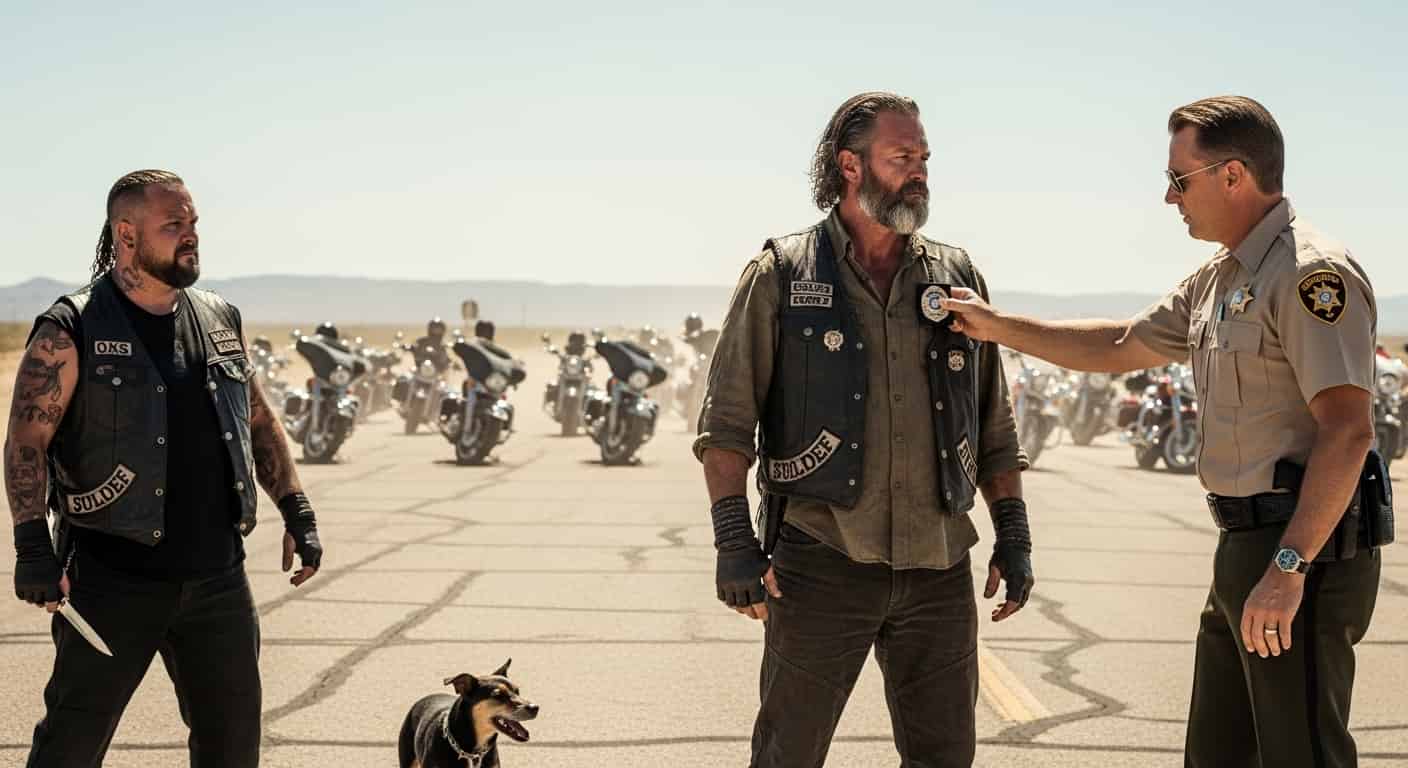
Miller slammed the badge onto the hood of his cruiser with a bone-jarring crack. He pulled out a laminated photograph—old, faded, but unmistakable. It showed a younger, clean-shaven Canyon Reed in a crisp Phoenix PD uniform, smiling next to Miller.
“”This your ‘brother’?”” Miller mocked, holding the photo up for Oaks to see. “”This is Officer Reed. The guy who used to write your tickets and bust your doors down. He didn’t leave the force because he grew a soul. He left because he was a coward who couldn’t protect his own blood, and he thought he could hide among the trash to feel big again.””
The silence that followed was worse than the heat.
Five hundred engines seemed to hum in a lower, more dangerous register. The bikers weren’t looking at Miller anymore. They were looking at Canyon.
Oaks stepped forward. His face was unreadable, which was the most terrifying thing about him. He looked at the badge on the car. He looked at the photo. Then he looked at Canyon’s vest—the patches that said Loyalty, Road Captain, and Original.
“”Canyon,”” Oaks said, his voice a low growl. “”Tell me this is some kind of psychological warfare. Tell me he’s full of it.””
Canyon looked at Oaks. He looked at the men he’d bled with, ridden with, and protected. He thought about the lie. He could keep lying. He could say it was a frame-up.
But he looked at the badge on the hood. His brother’s badge. The brother who died because people were too busy lying to see he was drowning.
“”It’s true,”” Canyon said.
A collective intake of breath hissed through the crowd. Bullet, sensing the shift in the room, tucked his tail and whined.
“”I was a cop,”” Canyon said, his voice steady now, though his world was ending. “”In Phoenix. Fifteen years ago. I worked with Miller. I saw what he was. I saw him take the money. I saw him hurt people. And I did nothing. I was part of the problem.””
“”He’s a rat!”” someone shouted from the back. A bike engine revved—a threat.
“”I left,”” Canyon continued, ignoring the rising heat. “”I took the evidence of what he was doing and I ran because I was scared. I’ve been hiding ever since. But I’m not hiding today. I’m standing here for Sarge. Not as a cop. Not as a biker. Just as a man who’s tired of watching the wrong people win.””
Oaks reached out and grabbed the front of Canyon’s vest. He pulled him close, his eyes burning with a cold, hard rage. “”You lied to us for ten years. You sat at our table. You knew our secrets. You’re a ghost, Canyon. You’re dead to this club.””
“”Maybe,”” Canyon said. “”But the blockade is still here. And the Feds are still coming. You can kill me, Oaks. You probably should. But don’t let him take the house. Don’t let the bully win just because you hate me.””
Oaks looked at Miller, who was smirking. Miller thought he’d won. He thought he’d broken the line by breaking the man.
Oaks let go of Canyon’s vest. He turned to Miller.
“”He might be a liar,”” Oaks spat. “”He might be a blue-blooded rat. But he’s right about one thing.””
Oaks drew a heavy iron pipe from his bike frame.
“”I still don’t like you, Sheriff. And the bikes ain’t moving.””
Chapter 6: The Long Ride Out
The sirens that finally broke the standoff weren’t local. They were the deep, two-tone wails of federal SUVs.
Six black Suburbans screamed across the desert, weaving through the bulldozers and the cruisers. Men in windbreakers with “”FBI”” and “”DOJ”” on the back spilled out.
Miller’s face went from triumph to a sickly, pale grey. He tried to get into his car, but Deputy Vance—the rookie—stood in front of the door. Vance didn’t say a word. He just placed his hand on his holster and shook his head.
The arrest was quick. It wasn’t cinematic. There were no speeches. Miller was cuffed, his aviators knocked into the dirt, and shoved into the back of a black SUV. The ledger had been found. The dead-drop was successful.
As the Feds began processing the scene, the bikers began to mount up. The “”war”” was over. Sarge was safe. The bulldozers were being hauled away.
Canyon stood by his bike, watching them go. No one spoke to him. No one looked at him. They rode past him in a thunderous, cold wave of exhaust and silence.
Oaks was the last one. He stopped his bike next to Canyon.
“”The patch,”” Oaks said.
Canyon didn’t hesitate. He took a knife from his belt and sliced the threads of the “”Original”” and “”Road Captain”” patches from his vest. He handed them to Oaks.
“”You saved the old man,”” Oaks said, tucking the patches into his pocket. “”That’s why you’re walking away from this road instead of being buried under it. But if I ever see you on a bike in this state again, I won’t be talking.””
“”I understand,”” Canyon said.
Oaks kicked his bike into gear and roared away, leaving Canyon alone in the settling dust.
Canyon walked over to the Sheriff’s cruiser, which had been left abandoned in the chaos. The badge was still sitting on the hood. He picked it up, rubbing the dust from the silver.
“”Let’s go, Bullet,”” he said.
He didn’t get on his bike. He couldn’t. He just started walking.
He walked past Sarge’s house. The old man was standing on the porch, holding a glass of water. He raised it in a silent toast. Canyon nodded back, once.
He walked toward the horizon, the dog trotting at his heels. He had no club, no name, and no badge. He was just a man in a dusty Arizona desert, finally holding the only thing that wasn’t a lie.
The sun began to set, turning the sky the color of a bruised heart. Canyon Reed kept walking, a ghost finally finding his way out of the machine.
What do you think Canyon does with the badge he recovered?”