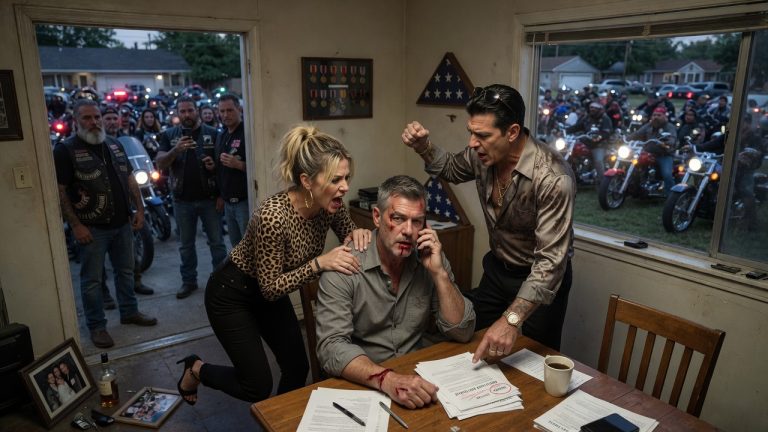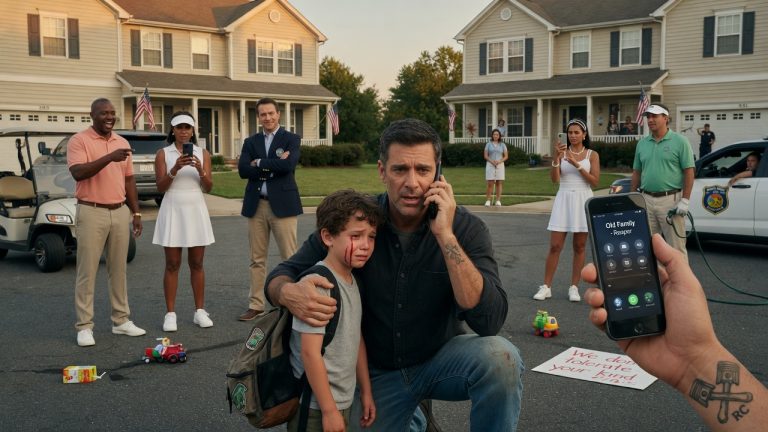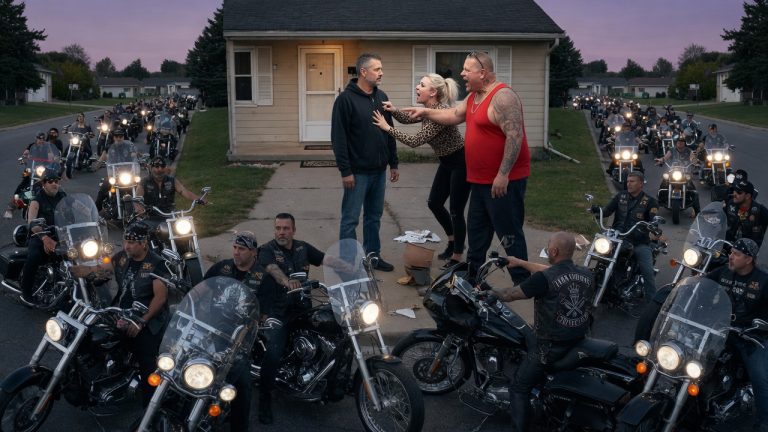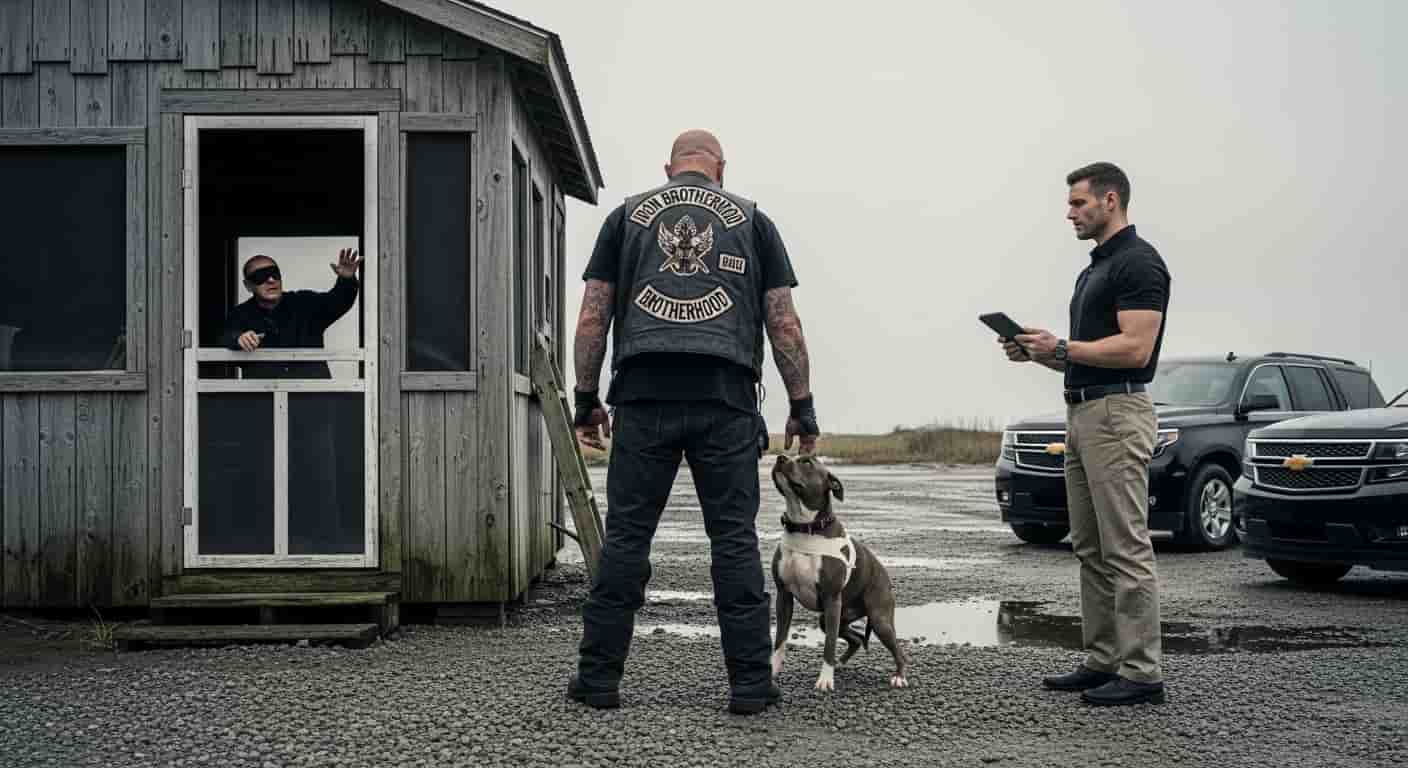
Tank Malloy was a man of his word, and his word belonged to the Iron Brotherhood. When the National Council sent the order to “let the Jersey shore project proceed without interference,” Tank was supposed to turn his back on the only man who ever loved him.
He stood in the mud of the salt marshes, watching a man in a $400 polo shirt look at a blind veteran like he was a rounding error on a spreadsheet.
But then the dog limped out of the shack.
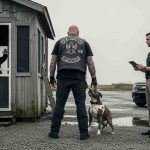
Grace, a Pitbull who didn’t have a mean bone in her body, was whining. When Tank knelt to pick her up, he saw the marks. Fresh, black, circular burns on her flank.
“Who did this?” Tank asked.
The Suit didn’t even look up from his tablet. “The dog was obstructing the surveyors. Consider it a deterrent.”
In that moment, the “order” from the Council didn’t matter. The $20,000 of club money Tank had “borrowed” to pay for Al’s cataract surgery didn’t matter. The only thing that mattered was the line in the mud.
“You’ve got ten seconds to get those engines off this property,” Tank said.
“Or what?” the Suit sneered. “You’re one man, Malloy. Your club already sold this dirt.”
Tank didn’t answer. He just looked toward the road, where 500 sets of headlights were cutting through the Jersey fog.
FULL STORY
Chapter 1: The Salt in the Wound
The New Jersey coastline near Perth Amboy wasn’t the postcard version. There were no boardwalks here, no salt-water taffy, no tanned tourists. There was only the heavy, sulfurous scent of the refineries and the rhythmic, metallic clanging of the shipping cranes.
Tank Malloy sat on the bumper of his 1994 Harley, the chrome pitted by the salt air. He was a man built like a structural pillar—broad, dense, and seemingly immovable. His hands were mapped with scars and old grease that no amount of industrial soap could ever truly lift. He was forty-two years old, and for thirty of those years, he had been waiting for the other shoe to drop.
He looked at the shack. It was a pathetic thing, really. A lean-to of reclaimed timber and corrugated tin, perched precariously over a stretch of marshland that smelled of low tide and diesel.
“Al?” Tank called out.
The screen door creaked open. Al stepped out, his hand trailing along a guide wire Tank had installed two summers ago. Al was seventy, his skin the color of an old leather glove, his eyes clouded over with the thick, milky veil of advanced cataracts. Following him, her tail thumping softly against the wood, was Grace.
“That you, Boy?” Al asked. He always called Tank ‘Boy,’ a holdover from when Tank was sixteen and screaming at the world from behind the chain-link fence of the Middlesex County Juvenile Detention Center.
“It’s me,” Tank said, his voice dropping an octave, losing the serrated edge it held at the clubhouse.
“You sound heavy,” Al said, tilting his head. Blindness had made him a connoisseur of tone. “Something’s coming.”
“Just the rain, Al. Just the rain.”
Tank lied. He lied because he didn’t know how to tell a man who had survived the Tet Offensive that a real estate conglomerate called Vanguard Holdings had bought the marsh. They wanted to build a “luxury logistics hub,” which was a fancy way of saying they wanted Al’s shack gone so they could pave the mud.
Grace trotted over to Tank, shoving her broad, blocky head into his palm. Tank felt the dog’s warmth, but as his hand slid down her side, he felt something else. A crust. A localized heat.
He pulled his hand back. He knelt, his knees popping like small-caliber rounds.
On Grace’s left flank, right near the hip, were three perfectly circular scabs. They weren’t from a fight. They were intentional. Someone had used a cigarette as a cattle prod.
“Al,” Tank said, his voice a low vibration that made Grace whimper. “Has anyone been by today?”
“Some fellas. Said they were surveyors,” Al said, his hand trembling slightly on the guide wire. “Grace didn’t like ’em. She barked. One of ’em… I heard her yelp, Tank. I asked if she was okay, and the man just laughed. Said she needed to learn her place.”
Tank closed his eyes. The foster system had taught him two things: how to take a hit and how to recognize a bully. He remembered the foster father in Rahway who used to “correct” him with a belt buckle because Tank ate too much at dinner. He remembered the feeling of being “broken cargo.”
He stood up. He didn’t look at the marsh. He looked at the black SUVs idling at the edge of the dirt road, three hundred yards away.
“Stay inside, Al,” Tank said.
“Tank? Where are you going?”
“I’m just going to talk to the neighbors.”
Tank climbed onto his bike. The engine roared to life, a violent, mechanical scream that echoed off the refinery walls. He didn’t wear a helmet. He wanted them to see his face. He wanted them to see exactly what kind of problem they had just bought.
Chapter 2: The Price of Loyalty
The Iron Brotherhood clubhouse was a converted machine shop in the shadow of the Pulaski Skyway. It smelled of stale beer, primary drive oil, and the collective sweat of sixty men who valued the patch on their backs more than the laws of the state.
Tank walked past the bar, ignoring the nods from the prospects. He went straight to the back office.
“You’re late,” Spike said. Spike was the club’s tech guy—thin, wiry, with a nervous energy that made him look like he was constantly vibrating. He was staring at three different monitors.
“I was at Al’s,” Tank said.
Spike froze. He slowly turned his chair around. “Tank. The National Council… they sent the word down an hour ago. We’re out. Vanguard Holdings made a contribution to the ‘Veteran’s Relief Fund’ in the National President’s name. Six figures. We don’t touch the Jersey shore project. We don’t even ride past it.”
Tank leaned over Spike’s desk, his shadow swallowing the smaller man. “They burned the dog, Spike.”
“It’s a dog, Tank,” Spike whispered, his eyes darting toward the closed door. “And Al is… he’s a squatter. Technically. The club can’t go to war with a billion-dollar firm over a squatter and a pitbull. Not after the RICO case last year. We’re on thin ice.”
“I used the money,” Tank said.
The silence in the room became heavy, pressurized. Spike looked like he wanted to vanish into his motherboard. “What money?”
“The emergency fund for the North Jersey chapter. The twenty grand we were holding for the legal defense. I took it.”
“Tank, tell me you’re joking.”
“Al needs the surgery. He’s going blind, Spike. He’s the only person who came to see me in juvie. Every Sunday. He took the bus two hours each way just to sit there and tell me I wasn’t trash. He’s the only father I’ve ever had, and I’m not letting him go dark.”
“If the Council finds out you moved club funds for a civilian… they’ll strip your patch. They might do worse.”
“Let them,” Tank said. He felt a strange, cold clarity. He had spent his life looking for a family. He had thought the Brotherhood was it. But a family didn’t sell its soul for a six-figure ‘contribution’ while a veteran got kicked into the mud.
“They’re coming tomorrow morning,” Spike said, his voice trembling. “The clearing crew. They’ve got private security. Ex-military types. Hard asses.”
“Good,” Tank said, turning for the door. “I’m an ex-hard ass myself.”
“Tank!” Spike called out. “If you do this, you’re on your own. Nobody is coming to help you.”
Tank didn’t look back. “I’ve been on my own since I was six, Spike. I’m used to the view.”
Chapter 3: The Geometry of a Fight
The morning was a bruise-colored smear across the horizon. Tank sat on the porch of Al’s shack, a shotgun resting across his knees—not loaded, but visible. It was a prop, for now. He was drinking coffee from a chipped mug that said World’s Greatest Fisherman.
Grace lay at his feet, her flank freshly dressed with clean gauze. Al was inside, sleeping. Tank had given him a heavy dose of his “nerve medicine” to make sure he didn’t wake up until it was over.
At 7:00 AM, the sound arrived. The low-frequency thrum of heavy diesel engines.
Two black SUVs led the way, followed by a flatbed carrying a small yellow bulldozer. They stopped fifty yards out.
A man stepped out of the lead SUV. He was the definition of “corporate tactical.” He wore a black polo shirt that showed off gym-built triceps, expensive sunglasses, and a relaxed, professional smile. He carried a tablet like it was a weapon.
This was the Mirror. The man Tank might have become if he’d had a better zip code and a father who stayed.
The man walked forward alone, stopping just outside the range of a physical swing. He looked at Tank, then at the shack, then at the shotgun.
“Mr. Malloy,” the man said. His voice was mid-western, polished, devoid of any regional grit. “My name is Miller. I’m the head of site security for Vanguard. I believe your leadership has already spoken to you.”
“My leadership isn’t here,” Tank said.
Miller smiled. It was a practiced expression. “They aren’t here because they’ve been paid to be elsewhere. We have the deed. We have the demolition permit. And we have a timeline that doesn’t include a sentimental attachment to a pile of driftwood.”
Tank stood up. He didn’t grab the gun. He just stood there, all six-foot-five of him, a mountain of leather and scarred muscle.
“The old man inside has a name. It’s Al. He’s a Silver Star recipient. He’s lived here for twenty years.”
“He’s lived here illegally for twenty years,” Miller corrected. “And as for the… incident with the dog yesterday. My men were doing their jobs. The animal was aggressive.”
“She wasn’t aggressive,” Tank said, his voice dropping to a whisper. “She was confused. She’s like him. She doesn’t know how to fight back.”
Miller sighed, looking at his watch. “Look, Malloy. I know your type. You think this is a movie where the big guy stands his ground and the bad guys go home. But this is a metric. This shack represents four minutes of delay on a three-year project. I will remove it. With you or through you.”
He tapped his tablet. On the flatbed, the driver started the bulldozer. The blade lowered, scraping against the metal of the trailer with a sound like teeth on a chalkboard.
Chapter 4: The Exposure
“You think I’m the only one who knows about the money?” Miller asked, his voice casual.
Tank paused.
Miller turned the tablet around. It wasn’t a blueprint. it was a bank statement. The Iron Brotherhood’s North Jersey Escrow account.
“We do our homework, Tank. You moved twenty thousand dollars to a medical facility in Cherry Hill forty-eight hours ago. If I call your National President right now and tell him his ‘loyal’ enforcer is stealing from the pot to pay for a hobo’s eye surgery… how long do you think you’ll keep that vest?”
The wind off the marsh picked up, carrying the scent of salt and rot. Tank felt the trap closing. This was the power asymmetry. Miller didn’t need to fight him; he just needed to ruin him.
“You’re a smart guy, Malloy. Walk away. We’ll even throw in five grand for the old man’s ‘relocation.’ You keep your patch. You keep your life. Everybody wins.”
Tank looked down at Grace. She was looking up at him, her tail giving a single, hesitant wag. Then he looked at the screen door. He thought about the Sundays in juvie. The smell of the bus Al had taken. The way Al would put a hand on his shoulder and say, ‘You aren’t the mistakes you’ve made, Boy.’
“The thing about people like you, Miller,” Tank said, stepping off the porch. “Is you think everyone has a price. Because you do.”
Tank reached into his vest. He didn’t pull a weapon. He pulled a folded, yellowing piece of paper.
“This is Al’s service record,” Tank said. “And this is the deed to this specific three-acre plot. It wasn’t in the county database because the county didn’t exist when the state granted this land to Al’s grandfather after the Great War. It’s a sovereign land grant. I spent all night with a shelter volunteer who’s also a paralegal.”
Tank held the paper up. “You don’t have a demolition permit for this land. You have a permit for the marsh next to it. You step one foot on this gravel with that dozer, and I’m not just going to break your jaw. I’m going to sue Vanguard until your grandchildren are working in car washes to pay the legal fees.”
Miller’s smile didn’t just fade. It curdled. He looked at the paper, then back at his tablet.
“That’s a bluff,” Miller said, but his voice had lost its mid-western polish. He looked at his men. They were shifting uncomfortably. They were paid to move squatters, not to spark a constitutional land-rights war with a biker.