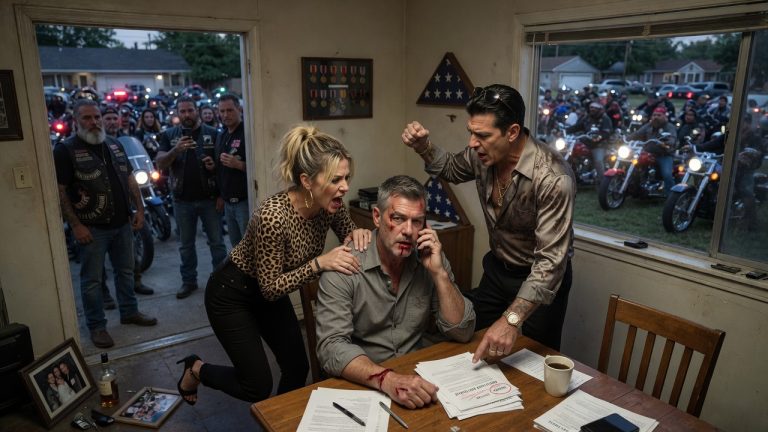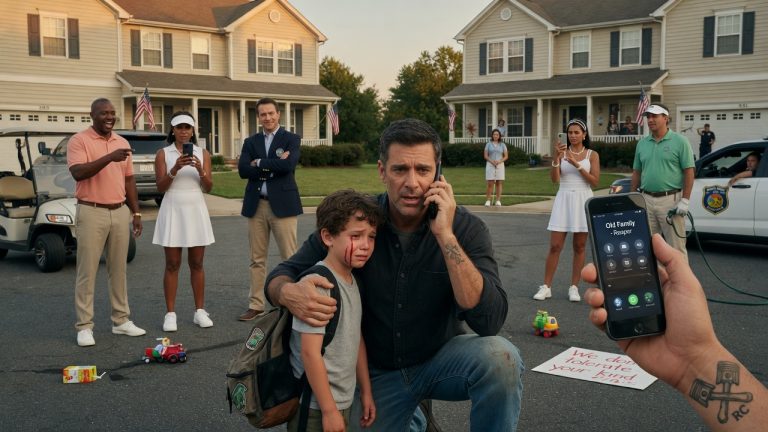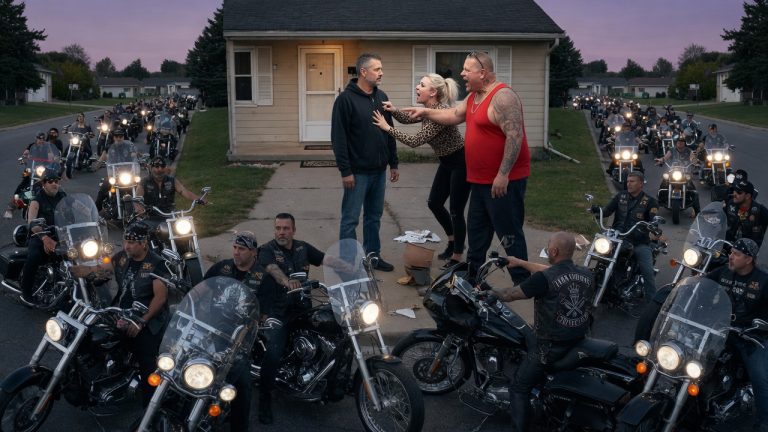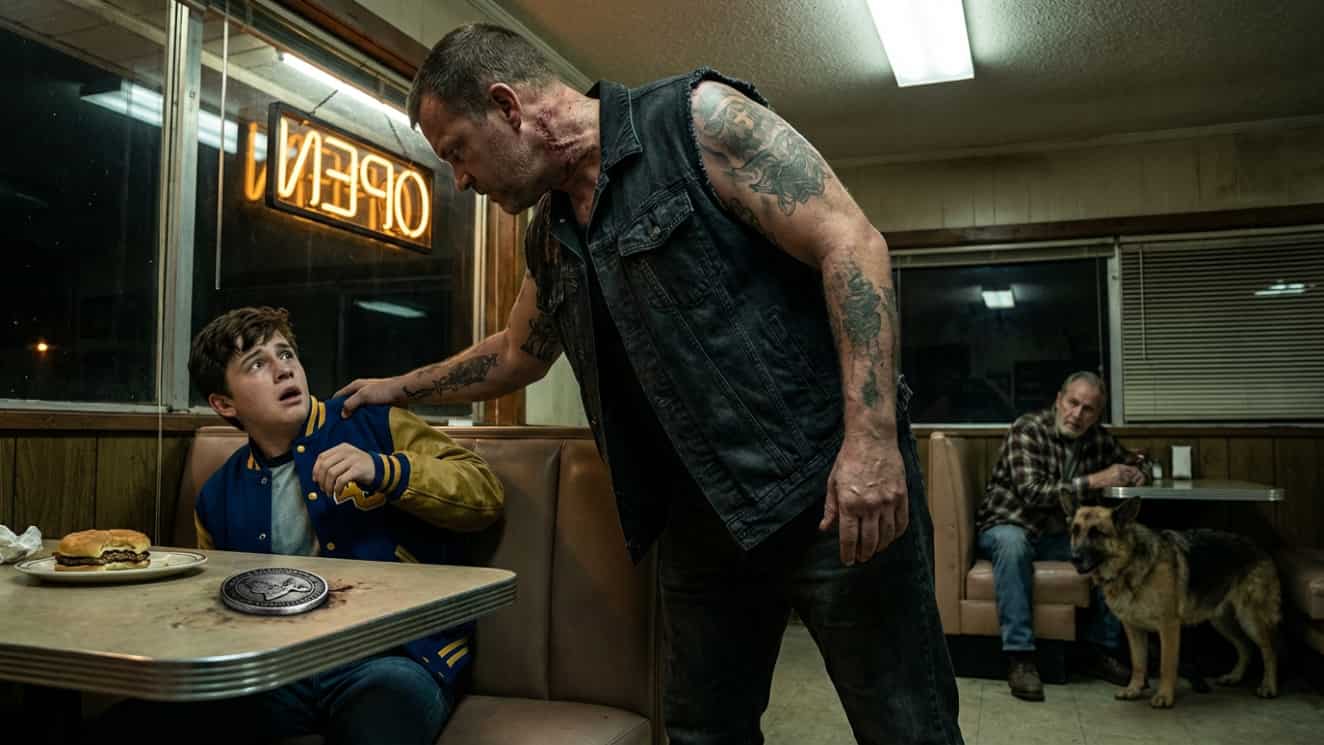
Caleb Miller was the king of Oakhaven, Alabama. State-bound quarterback, son of the mayor, untouchable. He thought the old man with the limp and the three-legged dog in the corner booth was just another “nobody” to kick around for a laugh.
He didn’t notice the man in the back of the diner.
The man covered in tattoos. The man whose skin was melted on one side. The man the town called “Rogue.”
Rogue hadn’t spoken a word in three years. Not since the fire that took his family and half his face. He’d spent a decade in a haze of pain, searching for the voice of the medic who’d crawled through the diesel flames to drag him out.
Then, the old man in the booth spoke.
“Please, son. He’s just a dog.”
The voice hit Rogue like a lightning strike. That was it. The gravel. The calm. The hero he owed his life to was being humiliated by a kid in a varsity jacket.
Caleb thought he was playing a game. He didn’t realize the man he was mocking was the only reason Rogue was still breathing.
And he definitely didn’t know that Rogue wasn’t just a biker—he was sitting on a seven-figure settlement that could buy and sell Caleb’s father ten times over.
The “Golden Boy” was about to find out what happens when you corner a man who has nothing to lose but a debt of honor.
FULL STORY: SCARS AND STRIPES
Chapter 1: The Weight of the Ink
The humidity in Oakhaven didn’t just sit on you; it owned you. It was a thick, wet wool blanket that smelled of pine sap and old diesel. Inside the “Iron Saints” clubhouse, the air was marginally better, stirred by a rattling industrial fan that moved the scent of stale beer and motor oil in a slow, pointless circle.
Jackson—everyone called him Rogue—sat in the tattoo chair, his teeth clamped onto a piece of leather. It wasn’t the pain of the needle; he’d long since gone numb to that. It was the nerve damage. When the needle hit the edge of the scar tissue on his left shoulder, it sent a jolt of phantom heat up his neck, a reminder of the night the world turned orange and stayed that way.
“Almost done, brother,” Stitch said, his voice a low drone over the hum of the machine. Stitch was sixty, his eyes failing, but he knew Rogue’s skin better than anyone. He was currently shading in the final stripe of a tattered American flag that draped over Rogue’s collarbone, partially masking the ropy, white ridges of the burn.
Rogue didn’t answer. He rarely did. For three years, his vocabulary had shrunk to nods, grunts, and the occasional “Yeah” when Mama, the club’s matriarch, forced a plate of cornbread into his hands. Speech felt like a luxury he couldn’t afford, a bridge to a past that had burned to ash in a ditch off Highway 55.
The clubhouse door swung open, letting in a blast of afternoon heat and the sounds of Oakhaven’s pride: the high school marching band practicing three blocks away.
“Look at this,” Preacher said, tossing a local tabloid onto the scarred wooden bar. Preacher was the club’s VP, a man who had actually been a youth pastor before deciding the Lord worked better with a leather vest and a chrome-plated knuckle-duster.
The headline featured a glossy photo of Caleb Miller, the Oakhaven Eagles’ star quarterback, hoisting a trophy. The kid had a smile that looked like it cost ten thousand dollars in dental work.
“Golden Boy does it again,” Preacher scoffed, spitting into a brass bucket. “Mayor’s boy gets a key to the city because he can throw a pigskin. Meanwhile, the VA clinic in the next county over is shutting down because of ‘budget cuts.’ Makes me want to vomit.”
Rogue glanced at the photo. Caleb Miller was the image of everything Oakhaven worshipped. In this town, football wasn’t a game; it was the only currency that mattered. If you could win on Friday night, you could break laws on Saturday morning.
“He’s a punk,” Mama said, walking out of the kitchen with a damp rag. “Saw him and his friends out by the creek yesterday. They were throwing rocks at that old man’s dog. The one with the three legs.”
Rogue’s eyes snapped up. The machine stopped humming.
“Elias?” Stitch asked, wiping the ink from Rogue’s shoulder.
“The very one,” Mama said, her face tightening. “Elias didn’t say a word. Just pulled that poor dog close and walked away. He’s got too much pride for his own good. And that boy Caleb knows it. He knows the cops won’t do a thing to the town’s savior-in-training.”
Rogue felt a familiar tightening in his chest. It wasn’t the scars. It was the debt. He didn’t know Elias. He just knew the man lived in a trailer that looked like it was held together by rust and prayer. He knew the man walked with a limp that suggested a body held together by pins and grit.
“Elias was a medic,” Stitch muttered, cleaning his equipment. “Served three tours. Came back with a chest full of medals and a pocket full of nothing. Now he spends his days at the diner, drinking black coffee and trying to stay out of the sun.”
Rogue stood up, his massive frame casting a shadow over the table. He pulled on a black t-shirt, the fabric dragging against the fresh ink. He reached into his pocket and pulled out a small, charred object. It was a silver coin, the edges melted, the image of a caduceus barely visible.
He’d found it in the pocket of his jacket the morning he woke up in the ICU ten years ago. The nurses said a “Good Samaritan” had pulled him from the wreckage of his truck just before the gas tank went. They said the man had disappeared before the cops arrived, leaving only his medic’s coin in the pocket of the man he’d saved.
Rogue had spent ten years and most of his settlement money trying to find that man. He’d hired private investigators, searched VA records, and combed through every small town in the South. He had two million dollars sitting in a blind trust—the result of a massive legal victory against the trucking company that had fallen asleep at the wheel and killed his wife and daughter.
He hadn’t spent a dime of it. He lived in the clubhouse. He rode a bike he’d built from scrap. To the town, he was just a “scary biker” with a face like a horror movie.
He walked to the bar, grabbed his keys, and headed for the door.
“Where you going, Rogue?” Preacher called out.
Rogue didn’t look back. He just pointed toward the center of town.
Chapter 2: The Sound of Smoke
The Oakhaven Diner was a relic of the fifties, all chrome and cracked red vinyl. It was the kind of place where the waitresses knew your blood type and the coffee was strong enough to peel paint.
Rogue parked his Harley-Davidson “Street Bob” at the far end of the lot. He liked the shadows. He walked in, the bells above the door jingling—a sound that usually caused the conversation to dip. Tonight was no different.
In the center booth sat the “Royalty.” Caleb Miller and three of his teammates, all wearing their blue and gold varsity jackets. They were loud, their laughter cutting through the quiet hum of the evening.
In the corner, sitting alone, was Elias. He was a small man, his skin the color of old parchment, his eyes deep-set and weary. Beside him, tucked under the table, was the dog. Hero. The German Shepherd had lost a leg to an IED in Kandahar, or so the story went. Now, he was just a gray-muzzled shadow that never left Elias’s side.
Rogue sat at the counter, his back to the room. He ordered a black coffee and listened.
“Hey, Pops,” Caleb’s voice rang out, dripping with that particular brand of high-school-hero arrogance. “I think your dog is leaking. You should probably take him outside before he ruins the floor.”
The table of boys erupted in snickers. Elias didn’t look up. He just rested a hand on the dog’s head. “He’s fine, son. Just a little water.”
“I don’t think he’s fine,” Caleb pushed, sliding out of his booth. He walked over to Elias’s table, his chest puffed out. He was a big kid, built for the gridiron, but he looked like a child compared to the men Rogue rode with. “I think he’s a nuisance. Same as you. My dad says the VA is paying for your housing. That’s my dad’s tax money, you know? Buying kibble for a three-legged freak.”
The diner went deathly quiet. Even the waitress, Brenda, froze with a pot of coffee in her hand. She knew better than to cross the Mayor’s son.
Rogue felt the heat rising in his neck. Not the phantom heat of the fire, but a cold, hard anger that tasted like iron.
Elias finally looked up. “I’m just trying to have my coffee, Caleb. Please. Let it be.”
The voice.
Rogue froze. His heart hammered against his ribs like a trapped bird.
“Stay with me, son. Don’t close your eyes. Look at me. Look at the stripes. Focus on my voice. You’re gonna make it. I’ve got you.”
The words from ten years ago rushed back, echoing in his skull. The gravelly tone. The way the “s” sounds hissed slightly through a gap in the front teeth. It was a voice Rogue had replayed in his mind a thousand times while he sat in burn wards and courtrooms.
He turned slowly on his stool.
Caleb had reached down and grabbed the dog’s collar, trying to pull Hero out from under the table. The dog let out a sharp, pained whimper.
“Let go of him,” Elias said, his voice trembling now. “Please. He’s hurt.”
“He’s a waste of space,” Caleb sneered, jerking the collar.
Rogue was across the diner before he realized he’d moved. He didn’t run; he lunged, a sudden, violent shift of mass. He grabbed Caleb’s wrist.
The sound of Caleb’s varsity jacket crinkling under Rogue’s grip was the only sound in the room.
“Whoa, hey!” Caleb shouted, trying to pull away. “Let go! You know who I am?”
Rogue didn’t say a word. He didn’t have to. He squeezed. He felt the small bones in the kid’s wrist shift. Caleb’s face went from arrogance to sheer, unadulterated terror in three seconds.
Rogue leaned in. The light caught the white, jagged scars on his face, the tattoos on his neck pulsing with the rhythm of his jaw.
“I know exactly who you are,” Rogue whispered. The voice was low, rusted from disuse, but it carried to every corner of the room.
He reached into his pocket with his free hand and slammed the charred medic’s coin onto the table.
Elias stared at the coin. His breath hitched. He looked from the silver to Rogue’s face, searching the eyes—the only part of the man that hadn’t changed.
“You,” Elias whispered.
Chapter 3: Tackle Practice
The confrontation at the diner didn’t end in a brawl. It ended with Caleb Miller scurrying out like a kicked cur, his friends trailing behind him in a cloud of embarrassed silence. But in a town like Oakhaven, a “nobody” biker touching the Golden Boy was a declaration of war.
The next morning, the heat was already a physical weight. Rogue stood on the porch of the clubhouse, watching the sunset-colored dust rise from the road.
“You did it now, Rogue,” Preacher said, leaning against the doorframe. “Mayor Miller’s been on the phone with the Sheriff since sunrise. They’re talking assault. They’re talking about revoking the club’s lease on this land.”
Rogue didn’t blink. He was watching a blue Ford Raptor idle at the end of the driveway. Caleb’s truck.
“Let them talk,” Rogue said.
“It ain’t just talk. The town’s riled up. They think you attacked that boy for no reason. They’re calling Elias a ‘magnet for trouble.’ They want him out of that trailer park by the end of the week.”
Rogue felt a cold stone settle in his gut. He’d tried to help, and all he’d done was paint a target on a man who had already lost everything.
He climbed onto his bike and rode. He didn’t go to the diner. He went to the high school.
The football team was in the middle of two-a-days. The sound of whistles and clacking pads drifted over the fence. Rogue parked in the dirt lot and walked toward the practice field. He wasn’t hiding.
He saw them in the far corner of the field, near the equipment shed. Caleb and three other players. They weren’t practicing. They had something trapped against the chain-link fence.
It was Hero.
The dog was limping, trying to find a gap to escape, but the boys were using their practice shields to pin him. Caleb was laughing, holding a football.
“Let’s see if the three-legged wonder can catch a spiral,” Caleb shouted. He fired the ball at point-blank range, hitting the dog in the ribs. Hero let out a yelp that cut through the humid air like a blade.
Rogue didn’t stop to think about the Sheriff. He didn’t think about the lease. He vaulted the fence.
He didn’t hit Caleb. He stepped between the boys and the dog, his presence like a wall of scarred leather and ink.
“Go home, Caleb,” Rogue said, his voice dangerously calm.
“This is school property, freak!” Caleb yelled, though he backed up a step. “My dad owns this town. You touch me again, you’re going to prison. And that dog? He’s going to the pound to be put down as a menace.”
The Coach, a man named Henderson with a whistle buried in his neck fat, came trotting over. “What’s going on here? Jackson? What are you doing on my field?”
“Your boys are torturing a service animal,” Rogue said, pointing to Hero, who had collapsed in the dirt, panting heavily.
Coach Henderson looked at Caleb, then back at Rogue. He knew. Everyone knew. But Caleb was his ticket to a state championship. Caleb was the boy who would get a statue in the town square.
“Caleb says the dog wandered onto the field and was acting aggressive,” Henderson said, his voice flat. “I think you need to leave, Jackson. Now. Before I call the law.”
Rogue looked at the Coach. He looked at the boys, who were smirking behind their helmets. He realized then that Oakhaven wasn’t a town. It was a cult. And the Golden Boy was their god.
He knelt in the dirt, ignoring the stares. He picked up the shivering dog. Hero licked the scar on Rogue’s hand.
“You think you’re untouchable because of a game?” Rogue said, looking up at Caleb.
“I know I am,” Caleb sneered.
Rogue stood up, the dog heavy in his arms. “We’ll see.”
Chapter 4: The Paper Trail
For the next three days, Rogue disappeared. The Iron Saints didn’t see him. The diner was empty.
Caleb Miller took this as a victory. He strutted through the halls of Oakhaven High like a conquering king. His father, Mayor Miller, gave a speech at the Rotary Club about “cleaning up the elements” that threatened their peaceful community.
But while the town celebrated its golden future, Rogue was sitting in a glass-walled office in Birmingham, three hours away.
“Are you sure about this, Mr. Jackson?” the lawyer asked. Her name was Sarah, and she’d been handling his trust for years. She looked at the man in the leather vest with a mixture of pity and awe. “This is a significant portion of the principal. You could live on the interest for the rest of your life.”
“Do it,” Rogue said.
“And the property?”
“Everything. Buy the trailer park. Buy the diner. Buy the lot the high school sits on if the lease is up for renewal.”
“Mr. Jackson, why?”
Rogue touched the charred coin in his pocket. “Because someone once told me to focus on the stripes. I’m just making sure the right people are wearing them.”
He returned to Oakhaven on Friday night. The whole town was at the stadium. It was the season opener against their rivals, the Pine Ridge Panthers. The lights were humming, the air smelled of popcorn and anticipation.
Rogue didn’t go to the bleachers. He went to the clubhouse.
“Rogue, where the hell have you been?” Preacher asked. “The Sheriff was here an hour ago. He had an eviction notice for the club. Miller pulled the trigger.”
Rogue handed Preacher a thick manila envelope. “Read it.”
Preacher pulled out the legal documents. His eyes went wide. He started to laugh, a deep, belly-shaking sound that brought Mama out of the kitchen.
“What is it?” she asked.
“The Iron Saints don’t have a landlord anymore,” Preacher said, grinning. “We have an owner. And his name is Jackson.”
“That’s not all,” Rogue said. He looked at the clock. It was halftime. “Get the bikes. We’re going to the game.”
“Rogue, they’ll arrest us the second we hit the gate,” Mama warned.
“No, they won’t,” Rogue said, pulling his leather vest tight. “I just bought the gate.”