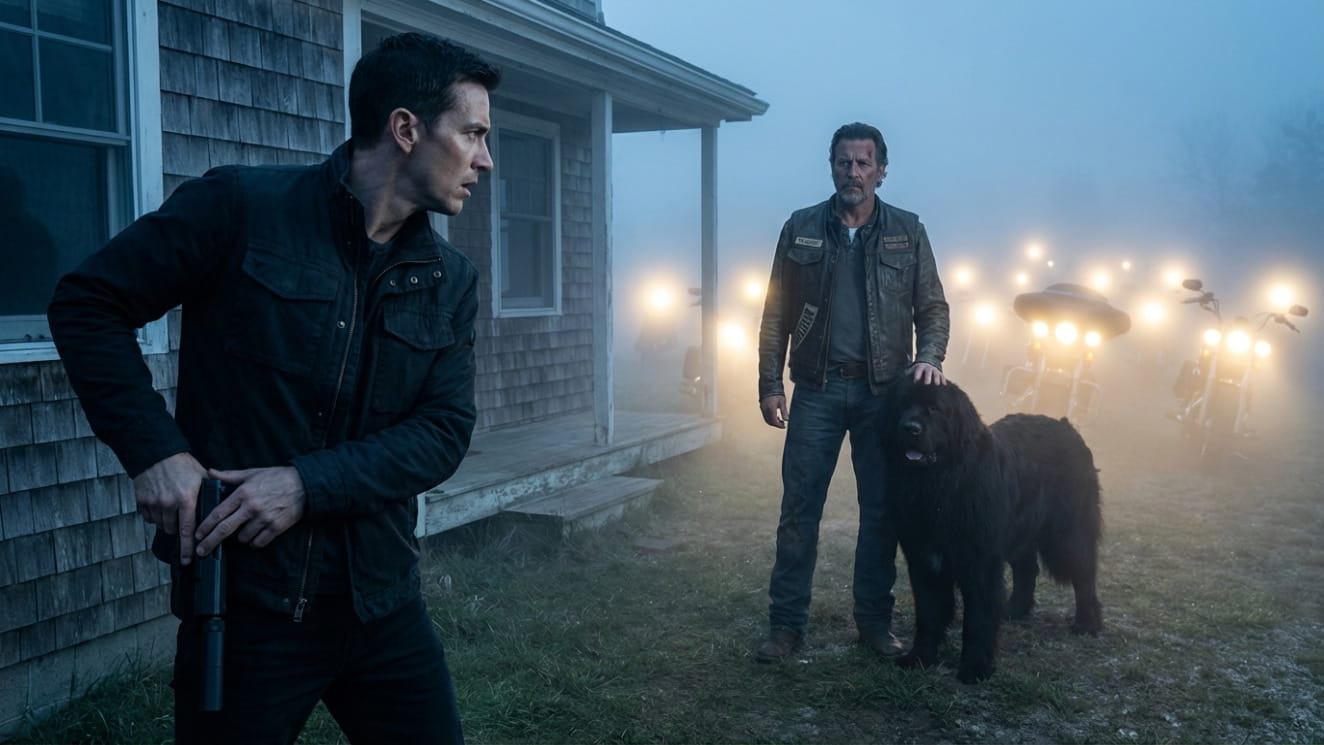
Every night for six months, Solo Thorne rode his bike to a crumbling cottage on the edge of the Maine coast. He wasn’t there for a deal. He wasn’t there for a fight. He was there for a dog—a massive Newfoundland named Bear who was the only thing keeping an aging, dying veteran alive.
Solo kept it a secret. The club didn’t know. The town didn’t know. To the world, Solo was the cold-blooded President of a 500-man army. To Bear, he was just the man who brought the good treats and stayed until the nightmares stopped.
But when a local drug crew decided the veteran’s house was the perfect “stash spot,” they made one fatal mistake. They thought the old man was alone. They thought the dog was just a target.
Tonight, they showed up with guns.
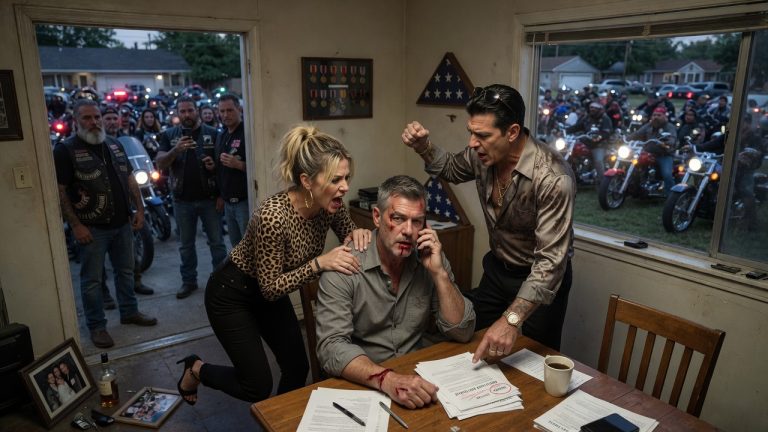
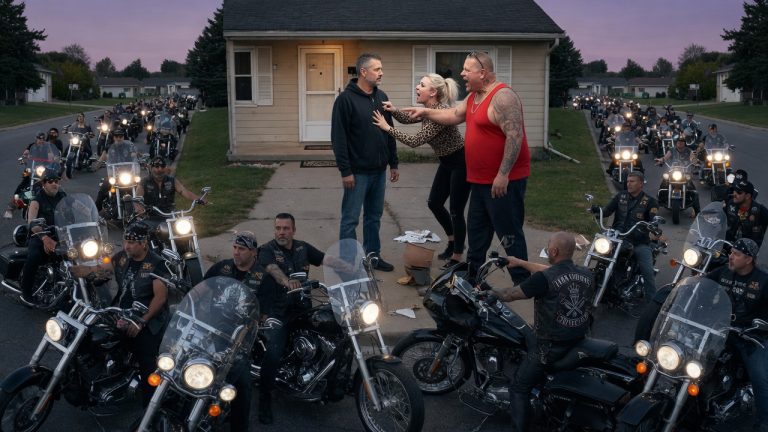
They didn’t expect to find 500 bikes idling in the fog.
FULL STORY: MIDNIGHT AT THE VETERAN’S GATE
CHAPTER 1: THE COLD RITUAL
The wind off the Atlantic didn’t care about leather or pride. It cut through Solo’s jacket like a rusted blade, smelling of salt, rotting kelp, and the deep, pressurized cold of a Maine November. He kept the throttle of the Panhead steady, the engine’s rhythm a low, mechanical heartbeat that felt more real than his own.
He didn’t use his high beams when he turned off the county road. He knew the ruts in the dirt path by memory—the way the bike leaned into the dip by the old oak, the way the gravel crunched under the tires just before the clearing. He killed the engine a quarter-mile out, letting the momentum carry him into the shadows of the pines.
Solo Thorne was a man of noise. As the President of the Reapers’ Gate, his life was defined by the roar of five hundred bikes, the crack of pool cues, and the sharp, sudden violence of a life lived on the fringes. But here, in the dark between the trees, Solo was a ghost.
He dismounted, his boots hitting the damp earth with a soft thud. His knees popped—a gift from a roadside IED in Kunar Province fifteen years ago. He didn’t head for the house immediately. He stood by the bike, letting the silence of the woods settle into his bones.
Then came the sound. A low, rhythmic thumping from the porch of the shingled cottage.
Thump. Thump. Thump.
A massive shape detached itself from the darkness of the wrap-around porch. Bear. The Newfoundland was a hundred and fifty pounds of black fur and stubborn loyalty. He didn’t bark. He didn’t growl. He just trotted down the steps, his paws heavy on the frost-covered grass, and shoved his massive, wet nose into Solo’s palm.
“Yeah, I know,” Solo whispered, his voice gravelly and thin. “I’m late.”
He reached into his pocket and pulled out a strip of dried venison. The dog took it gently, his tail sweeping a wide arc through the tall grass. Solo sat on the bottom step of the porch, and Bear leaned his entire weight against Solo’s shoulder. It was a crushing, honest weight.
In the house, a single lamp flickered. That was Arthur—a man who had survived the Chosin Reservoir only to be defeated by a failing heart and a stack of medical bills he couldn’t read. Arthur didn’t know Solo came here. He didn’t know Solo paid the oil company every month to keep the furnace kicking. He just knew that every morning, his dog seemed a little less restless, and there were fresh tracks in the mud that didn’t belong to any delivery man.
Solo closed his eyes and buried his fingers in Bear’s thick coat. For a moment, the ghost of Jax—his own K9, a Belgian Malinois who had died in a dusty ditch outside Kandahar—felt close enough to touch. Solo had been the one to hold the leash. He’d been the one to give the command. And he’d been the one to carry the empty collar back to a base that felt like a tomb.
He stayed for two hours. He didn’t speak. He just sat there, a violent man in a violent world, letting a dog remind him that he was still made of flesh and blood.
He didn’t see the black SUV parked on the ridge above the house. He didn’t see the glow of a cigarette or the way the moonlight caught the edge of a pair of binoculars. Solo Thorne thought he was alone. It was the kind of mistake that got men killed.
CHAPTER 2: THE CRACK IN THE WALL
The “Grave” was a bar that smelled of stale beer, sawdust, and the lingering ozone of the garage next door. It was the Reapers’ Gate headquarters, a windowless fortress where the air was always thick with the sound of Shadow’s laughter and the clink of glasses.
Shadow was Solo’s Vice President, a man built like a brick oven with a beard that reached his belt. He was the mirror Solo didn’t want to look into—brutal, efficient, and entirely devoted to the club.
“You’re drifting, Solo,” Shadow said, leaning against the bar. He was cleaning a grease-stained fingernail with a folding knife. “Third night this week you vanished after the midnight run. Brothers are talking. They think you got a girl in the city. Or a habit.”
Solo didn’t look up from his whiskey. The amber liquid was cheap and burned all the way down. “Let ’em talk. I’m the President, not their priest.”
“It’s not about confession, man. It’s about optics,” Shadow lowered his voice. “The Coast Crew—those kids out of Portland with the tactical vests and the fentanyl—they’re moving north. They’re looking for a foothold in the county. They see a gap in the fence, they’re gonna crawl through it.”
Solo felt a cold prickle at the back of his neck. “They stay on the highway. That’s the deal.”
“Deals change when people think the man in charge is distracted,” Shadow said. He closed the knife with a sharp clack. “Where do you go, Solo? Seriously. If it’s a woman, just bring her in. If it’s a needle, let us help. But don’t go ghost on us.”
“I’m handling it,” Solo said, standing up. The chair scraped harshly against the floor.
He walked out of the bar, the cool night air hitting him like a splash of water. He needed to get back to the cottage. He felt a sudden, irrational urgency, a tightening in his chest that had nothing to do with the club.
He rode harder than usual, the Panhead screaming at the redline. When he pulled into the woods near Arthur’s place, he didn’t wait for the momentum. He dropped the bike and ran.
He found Martha, the waitress from the local diner, standing by her rusted Subaru in Arthur’s driveway. She was holding a tray of covered dishes, her face pale in the moonlight.
“Solo?” she whispered, her eyes wide. “What are you doing here?”
“I… I check on the dog,” Solo said, the lie feeling heavy and clumsy in his mouth.
Martha looked at the house, then back at him. She was a woman who had seen the worst of the county—the graduations that led to the mills and the mills that led to the morgue. She saw the “President” patch on his chest, then she saw the way his hand was shaking.
“Arthur’s bad tonight, Solo,” she said softly. “The doctor came by. He says it’s days, not weeks. And there were men here today. Not like you. Mean men. In a black SUV. They were asking about the deed. They told Arthur he had ‘unpaid debts’ to some company in Portland.”
Solo felt the world narrow until all he could see was the flickering light in Arthur’s window. “Cutter.”
“They said they’d be back tonight to ‘finalize the paperwork,'” Martha said, her voice trembling. “They told me if I stayed, I’d be part of the deal. I’m scared for him, Solo. And for that poor dog.”
Solo looked at Bear, who was sitting on the porch, his ears pricked toward the ridge. The dog knew.
“Go home, Martha,” Solo said. “Don’t come back tomorrow. Don’t come back until I tell you.”
“Solo, what are you going to do?”
He didn’t answer. He walked toward the porch, and for the first time, he didn’t stop at the bottom step. He walked up, sat down next to Bear, and pulled a heavy, matte-black radio from his vest.
He keyed the mic.
“Shadow,” he said. “Get the brothers. All of them. Tell them to bring the noise. I’m at the Veteran’s Gate. And tell them… tell them we’re not just holding the line. We’re erasing it.”
CHAPTER 3: THE PRICE OF SILENCE
The next four hours were the longest of Solo’s life. He sat on the porch with Bear, the dog’s head resting on his boot. Inside, he could hear Arthur’s ragged, wet coughing. It was the sound of a man drowning on dry land.
Every time Arthur coughed, Bear would whimper, a low, grieving sound that tore through Solo’s chest.
“I know, buddy,” Solo whispered, stroking the dog’s ears. “I’m not letting them touch him. Or you.”
Solo’s mind drifted back to the K9 training facility in North Carolina. He remembered the first time he’d been paired with Jax. The instructor had told him, “The dog is your soul on four legs. If you lose him, you don’t just lose a partner. You lose the part of yourself that’s still human.”
Solo had lost Jax in a hail of gunfire and the smell of burning diesel. He’d spent the last decade trying to build a wall around that hole in his heart, using leather, whiskey, and the club as the stones. But Bear had found the crack. Bear had crawled inside.
Around 2:00 AM, the fog rolled in. It was thick, white, and cold, swallowing the trees and the road. It made the world feel small, like a stage set.
The sound of the SUV came first. A low, expensive hum of a modern engine. It stopped at the edge of the clearing.
Solo didn’t move. He felt Bear’s body go rigid. A low growl started deep in the dog’s chest—a vibration more than a sound.
“Easy,” Solo murmured.
Three figures emerged from the fog. They wore tactical gear—crisp, clean, and arrogant. In the center was Cutter, a man with a face like a hatchet and eyes that held no light. He was carrying a briefcase in one hand and a suppressed Glock in the other.
Cutter stopped at the bottom of the steps. He looked at Solo, then at the dog, then at the “President” patch. He didn’t look impressed. He looked annoyed.
“Thorne,” Cutter said, his voice a smooth, urban drawl. “I heard you were playing nursemaid to a dead man. I didn’t believe it. You’re the President of the Gate. You should be in a bar, not sitting on a porch with a mutt.”
“The ‘mutt’ has a name,” Solo said. “And the ‘dead man’ is a hero. You’re on the wrong property, Cutter.”
“Property is a fluid concept,” Cutter said, stepping closer. “Arthur owes some very bad people in Portland a lot of money. We bought the debt. This house, this land, it’s ours. We need the coastline for… logistics. You know how it is. Business is business.”
Cutter raised the pistol, pointing it at Bear’s chest.
“Move the dog, Solo. Or I bury him right here in the flowerbed. Then I go inside and help the old man sign the papers. It can be easy, or it can be loud.”
Solo felt a strange, cold calm wash over him. It was the same feeling he’d had in the ditch with Jax. The world slowed down. He could see the individual droplets of fog on Cutter’s jacket. He could hear the click of the safety being thumbed off.
“You think you’re the only one who knows about logistics?” Solo asked softly.
Cutter laughed. “What, you got a couple of bikers in the woods with chains and pool cues? My guys are professionals, Thorne. We don’t play dress-up.”
“I’m not talking about dress-up,” Solo said. He stood up slowly, his hand never leaving Bear’s head. “I’m talking about family. You see, Cutter, you made a mistake. You thought this was about a house. You thought this was about a debt.”
Solo leaned forward, his eyes locking onto Cutter’s.
“This is about the only thing I have left that’s real. And you just threatened it.”
CHAPTER 4: THE FOG REVEALS
Cutter sneered, his finger tightening on the trigger. “Last chance, Solo. Move.”
Solo didn’t move. Instead, he reached into his vest and pulled out the radio. He didn’t key the mic. He didn’t need to.
From the fog, a mile away, came a sound. It wasn’t a roar yet. It was a murmur. A low, tectonic vibration that seemed to come from the earth itself. It was the sound of five hundred heavy-displacement V-twin engines idling in unison.
Cutter’s eyes flicked to the tree line. “What is that?”
“That’s the consequence of your business model,” Solo said.
The sound grew. It wasn’t just coming from the road. It was coming from the woods, from the ridge, from the old logging paths. The vibration was so intense that the windows of Arthur’s cottage began to rattle in their frames.
Then, the lights came.
One by one, circular yellow beams pierced the fog. Ten. Twenty. Fifty. A hundred. They formed a wall of light that surrounded the clearing, turning the white mist into a blinding, celestial halo.
The SUV was suddenly illuminated, looking small and fragile against the sheer mass of the bikes. Shadow pulled his Harley to the front, the chrome gleaming like a bared tooth. Behind him were the Reapers—men with scarred faces and grease-stained hands, men who had spent their lives being told they were nothing, now standing as a singular, unstoppable force.
Cutter’s two men stepped back, their hands shaking as they reached for their own weapons.
“Drop them,” Shadow’s voice boomed over the rumble of the engines. He was holding a short-barreled shotgun across his lap. “Unless you want to see what five hundred pounds of steel looks like when it hits you at sixty.”
Cutter looked at Solo, the panic finally breaking through his mask. “You’re crazy. You’re going to start a war over a dog? Over a dying old man?”
“It’s not a war if only one side is standing at the end,” Solo said. He stepped down the stairs, Bear walking at his side, his shoulders bunched and ready.
Solo walked right up to Cutter, until the barrel of the suppressed Glock was inches from his chest. He didn’t flinch.
“Look at the lights, Cutter,” Solo whispered. “Count them. Every one of those men has a reason to hate people like you. Every one of them has something they lost that they can’t get back. You think your ‘professionalism’ matters here? You’re in the middle of a graveyard, and the ghosts just woke up.”
Cutter’s hand trembled. The briefcase hit the mud with a wet slap. He looked at the wall of headlights, then at the shotgun in Shadow’s hand, then back at Solo.
“What do you want?” Cutter hissed, his voice cracking.
“I want the debt cleared,” Solo said. “I want the deed to this house in my hand. And I want you to go back to Portland and tell your friends that this county is closed. No logistics. No scouts. No business. If I see a black SUV north of the bridge again, I won’t call the brothers. I’ll just come find you myself.”
Solo reached out and took the pistol from Cutter’s hand. He did it slowly, as if he were taking a toy from a child. Cutter didn’t resist.
“The papers,” Solo said.
Cutter fumbled with the briefcase, pulling out a folder. Solo grabbed it, tucked it under his arm, and then leaned in close to Cutter’s ear.
“If you ever touch the dog,” Solo whispered, “the last thing you’ll hear isn’t a gun. It’ll be the ocean as I hold you under it.”