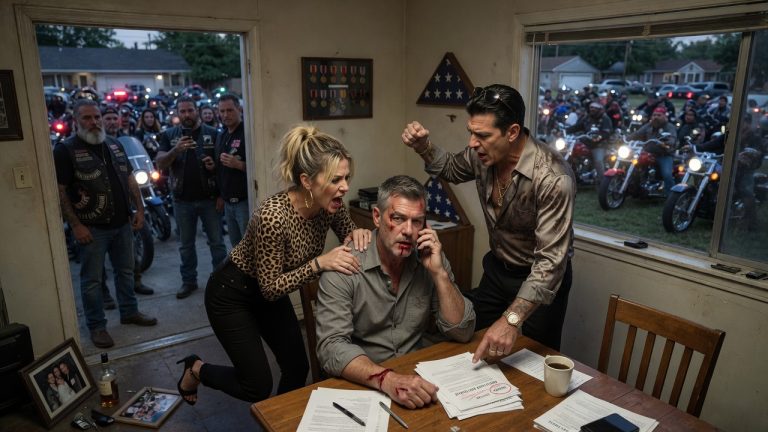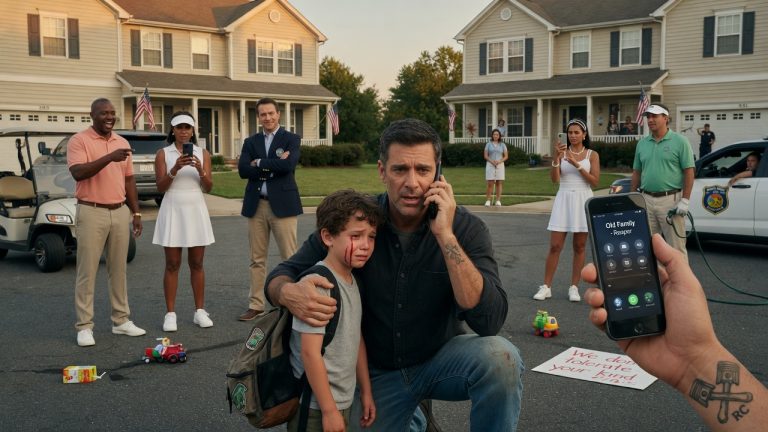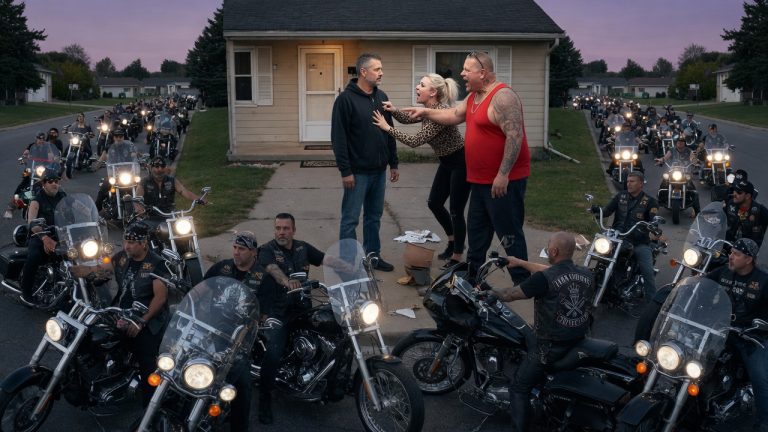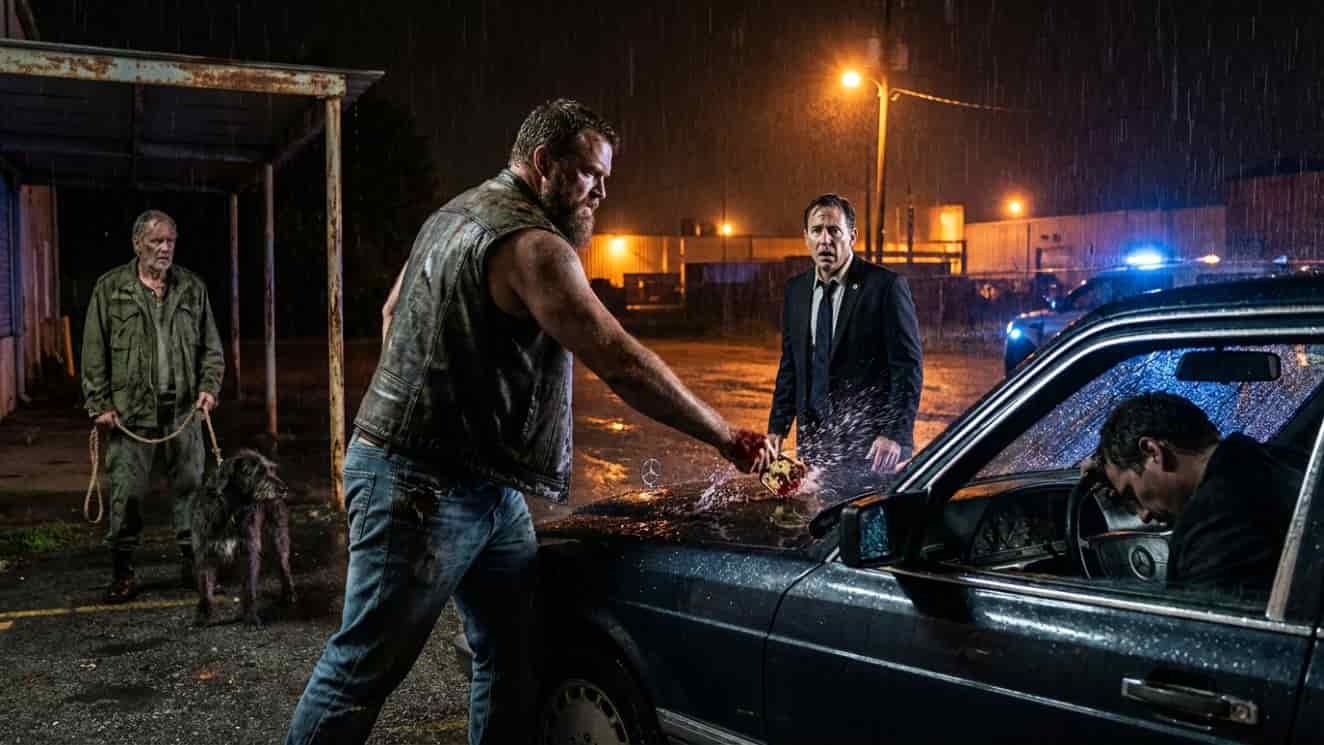
Everett thought he could burn a man out of his home and call it “progress.”
He sent two goons to finish the job. They never came back.
When Grave showed up at the gala, he didn’t bring a lawsuit. He brought the only thing the President’s men left behind in the mud.
“Your boys are in the ground, Everett. The question is, are you joining them?”
The secret Grave found in that veteran’s shoebox changed everything. It wasn’t just about land. It was about a debt from twenty years ago that finally came due.
FULL STORY: FIVE HUNDRED REASONS TO RUN
Chapter 1: The Dirt Specialist
The red clay of North Georgia has a way of holding onto things. It doesn’t wash away like the sandy soil down toward the coast. It stains. It clings to your boots, your tires, and if you spend enough time in the trenches, it clings to your soul.
They called me Grave. It wasn’t because I was morbid or because I had some fascination with the afterlife. It was functional. I was the man the Iron Spires called when something needed to be put where the sun wouldn’t find it. I wasn’t the guy who started the fights; I was the guy who ended the evidence.
I was sitting in the back of The Rusty Link, a dive bar on the edge of Fulton County that smelled of stale beer and ozone from the welding shop next door. My partner, Shovel—a man whose real name had been forgotten three administrations ago—was cleaning his fingernails with a pocketknife.
“You got that look, Grave,” Shovel said without looking up. “The look where you start thinking. Thinking’s bad for the bottom line.”
“Just looking at the news,” I said, nodding toward the grainy TV mounted above the bar.
On the screen, a man in a five-thousand-dollar suit was shaking hands with a developer. Everett Vance, City Council President. He was smiling that smile—the one that said he’d just sold your grandmother’s house and convinced her it was for her own good. He was talking about the “New Atlanta Corridor.” A multi-billion dollar project that required the “reclamation” of a few dozen acres of “blighted” property on the outskirts.
“That’s Elias’s land,” I muttered.
Shovel paused his knife. “The old guy with the dog? The one who lives in the trailer by the creek?”
“Yeah.”
“He’s a ghost, Grave. Let the city have it. They’ll give him a voucher for a motel and a slap on the back. It’s the way of the world.”
I didn’t answer. I reached into the inner pocket of my vest and felt the crinkle of paper. It was a note, yellowed and brittle, tucked inside a plastic sleeve. It had been sent to the clubhouse five years ago. It didn’t ask for money. It didn’t ask for protection. It just said: Thanks for pulling my truck out of the ditch in ’98. I don’t forget a kindness. — Elias.
Most guys in the Spires would have used it for rolling paper. I’d kept it. In my line of work, you don’t get many “thank you” notes. You get screams, you get bribes, and you get “please don’t.” You don’t get gratitude.
“I’m going for a ride,” I said.
“Grave,” Shovel warned, his voice low. “The Prez said we stay out of the city business. We got three bikes to strip and a shipment coming in from Savannah. Don’t go digging a hole you have to climb into.”
I didn’t listen. I never did when the clay started calling.
I rode out toward the creek. The sprawl of Atlanta was creeping closer every year—glass towers and overpriced coffee shops eating up the woods. Elias’s place was an island of rust and pine needles. He lived in a 1974 Airstream that looked like a fallen silver bullet, surrounded by stacks of firewood and old engine parts.
As I pulled up, the smell hit me first. It wasn’t woodsmoke. It was accelerant.
Elias was sitting on a stump, his head in his hands. His old army field jacket was scorched at the hem. Beside him, Cinder—a mutt that was more scar tissue than fur—was whimpering, his side matted with black soot.
The trailer wasn’t gone, but the door had been kicked in, and the windows were shattered. A small fire had been started under the chassis, put out before it could take the whole thing.
“Elias,” I said, kicking the kickstand down.
The old man looked up. His eyes were milky with cataracts, but the fire in them was still burning. “They came back, Grave. In a black SUV. Told me the Eminent Domain papers were signed. Said if I didn’t leave, the next fire wouldn’t be a warning.”
“Who?”
“Suit and tie types. But they had the hands of men who like to hurt things.”
I looked at Cinder. The dog had a fresh burn across his flank. Someone had used a torch on him. Not for the land. Just for the cruelty of it.
“They leave anything?” I asked.
Elias reached into his pocket and pulled out a small, shiny object. “Dropped it when I bit the one who grabbed the dog.”
It was a gold lapel pin. A stylized ‘A’ with the city seal.
I took it from him. The weight of it felt like a lead sinker. I looked at the old man, then at the dog, then at the encroaching lights of the city. My job was to bury things. Usually, I buried people who deserved it. Sometimes, I buried the mistakes of the club.
But looking at that gold pin, I realized there was something else that needed burying. A whole system of men who thought they could torch a man’s life because his zip code wasn’t profitable enough.
“Stay here, Elias,” I said. “And keep the dog inside.”
“What are you gonna do, son?”
I looked at the pin in my hand. “I’m going to return some lost property.”
Chapter 2: The Warning Shot
Shovel was waiting for me back at the shop, leaning against a half-dismantled Harley. He saw the look on my face and sighed. He didn’t ask what happened. He just reached for a heavy iron pipe and tossed it into the sidecar of his rig.
“We aren’t doing this for the club, are we?” Shovel asked.
“No,” I said. “We’re doing it because I’m tired of digging holes for people who aren’t dead yet.”
We spent the next four hours doing what we did best: tracking. In the world of the Iron Spires, information was a currency more stable than the dollar. We knew the mechanics who worked on the city fleet. We knew the guys who provided the “extra-curricular” security for the Council’s high-stakes meetings.
By midnight, we had a name. Miller and Vance Security. A shell company owned by Everett Vance’s brother-in-law. They were the ones doing the dirty work—the late-night visits, the “accidental” fires, the pressure tactics.
They operated out of a warehouse near the rail yards. It was a nondescript brick building that bled the sound of a heavy bass beat and the smell of high-grade diesel.
“Two guards at the gate,” Shovel whispered, peering through binoculars from the shadows of a stack of shipping containers. “Both armed. Both look like they’ve spent more time in a gym than a classroom.”
“I don’t want the guards,” I said. “I want the men who went to Elias’s.”
“How do we find ’em?”
“We wait for the SUV.”
It didn’t take long. A black Suburban with tinted windows rolled up to the gate at 1:00 AM. It was the same one Elias described. It pulled inside the warehouse, the heavy rolling door clattering shut behind it.
I didn’t use a pipe. I used a slim-jim on the back door and slipped inside like a shadow. This was my element. Silence was my first language.
Inside, the warehouse was a playground for the corrupt. Stolen high-end appliances, crates of untaxed cigarettes, and a corner dedicated to “reclaimed” items from cleared properties. I saw a rocking chair that looked like it belonged on a porch, not a warehouse floor.
Two men were standing by the SUV, laughing. One was holding a butane torch, clicking the igniter. Click. Whoosh. Click.
“The old man’s mutt screamed like a woman,” the tall one said. He had a bandage on his hand where Elias had bitten him. “Vance said we gotta go back tomorrow and finish it. Total loss. That’s the order.”
“Vance is a prick,” the other one said, leaning against the hood. “But he pays. And he’s got that big gala tomorrow night. Wants the land cleared before he makes the announcement.”
I didn’t wait for them to finish their conversation.
I came out of the shadows like a ghost. I hit the tall one first, a focused strike to the throat that turned his laugh into a wet wheeze. The second one reached for a holster, but Shovel had come in through the side vent. He didn’t use the pipe—he used a heavy industrial stapler he’d grabbed off a nearby crate.
It was over in thirty seconds. No gunshots. Just the sound of heavy bodies hitting concrete and the frantic, muffled sounds of men realizing they weren’t the biggest predators in the room anymore.
“What now?” Shovel asked, breathing hard.
I looked at the man with the bandaged hand. I knelt on his chest, my knees pinning his arms. I held the gold City Council pin in front of his eyes.
“You dropped this,” I said.
The man tried to spit at me, but his lungs wouldn’t cooperate.
“Everett Vance is having a party tomorrow,” I continued, my voice a low, rhythmic growl. “He thinks he’s celebrating a victory. He thinks he’s building a legacy.”
I leaned in closer, my shadow swallowing him.
“Tell him the Grave Digger is coming for the bill. And tell him I don’t take installments.”
I didn’t kill them. That would have been too easy. I took their IDs. I took their phones. And I took the butane torch.
“Load ’em up,” I told Shovel. “We’re going to the burial ground.”
The burial ground wasn’t a cemetery. It was a forty-acre stretch of swampy woods the Iron Spires had owned since the seventies. It was where the bodies went. It was where the secrets stayed.
We drove the SUV out there, the two goons tied in the back. When we got to the edge of the muck, I pulled them out. They were crying now. The bravado had melted away in the humidity of the Georgia night.
“Look around,” I said, waving the torch toward the dark, stagnant water. “There are a lot of men in there who thought they were untouchable. Men with more money than Vance. Men with more guns than you.”
I dropped the IDs of the two men into the mud and stepped on them, burying them beneath the red clay.
“You’re dead now,” I told them. “If I see your faces in this county again, I’ll finish the job. Go to Florida. Go to hell. I don’t care. But Elias’s land is off-limits.”
I let them run. They ran into the dark, barefoot and terrified.
“They’ll talk to Vance,” Shovel said.
“I count on it,” I replied. “I want him to know exactly who is coming for him.”
Chapter 3: The Social Geometry
The next morning, the air was thick enough to chew. The humidity was a physical weight, the kind that makes people’s tempers short and their skin crawl.
I wasn’t at the shop. I was sitting in a diner across from the City Hall annex, watching the suits come and go. I didn’t look like I belonged there. My leather vest was worn, my knuckles were scarred, and I had a smear of grease on my jaw that no amount of scrubbing seemed to remove.
A woman sat down in the booth across from me. Sarah. She was a lawyer, the kind who worked for pennies defending people the city wanted to forget. She was the one who had tipped me off about the Eminent Domain filings.
“You’re going to get yourself killed, Grave,” she said, not looking at me as she stirred her coffee.
“Everyone gets killed eventually, Sarah. Most people just do it slowly in a cubicle.”
“Everett Vance isn’t just a politician. He’s the spearhead for a group of investors who have put fifty million into this corridor. If Elias doesn’t move, the deal collapses. They won’t just send goons next time. They’ll send the police. They’ll send the sheriff. They’ll use the law like a hammer.”
“Then I’ll need a bigger anvil,” I said.
I pushed a folder across the table. It was the information I’d taken from the goons’ phones. Emails. Text messages. Photos of payoffs in the back of luxury SUVs. Vance wasn’t just clearing land; he was clearing it for his own private development company, hidden under three layers of shell corporations.
Sarah opened the folder. Her eyes widened. “This is custody-level evidence, Grave. This could ruin him.”
“It’s not enough,” I said. “In this city, evidence gets ‘lost.’ Witnesses get scared. I need it to be public. I need him to break in front of people.”
“The gala is tonight,” she whispered. “The Fox Theatre. Black tie. Every donor, every council member, every news camera in the city will be there.”
“I know.”
“You can’t get in there, Grave. You’re a biker with a record long enough to wrap around the building.”
I looked out the window at the gleaming glass of the skyline. “I don’t need to get in. I just need him to come out.”
I left the diner and went back to the shop. Shovel was there, but he wasn’t alone.
Five men were standing in the bay. They were the “Old Guard” of the Iron Spires. Men with grey in their beards and the kind of quiet stillness that only comes from surviving a life of violence.
“The Prez heard you were making moves,” the oldest one, Mack, said. He was leaning against his bike, a massive Road King. “He said if you’re going to start a war over a veteran and a dog, you better not do it alone.”
“It’s not a club matter, Mack,” I said.
“The hell it isn’t,” Mack spat. “That veteran? Elias? He was a Spires associate back in the day. He’s the one who kept the cops off our tail during the ’94 sweep. We don’t forget a debt either.”
I looked at Shovel. He shrugged. “I might have mentioned the ‘Thank You’ note.”
I felt a tightening in my chest. I’d spent my life being the “bad guy.” The one who did the things nobody else wanted to see. I thought I was a solitary creature, a man who worked in the dark.
But looking at these men, I realized I wasn’t just a cleaner. I was part of a brotherhood that didn’t care about Eminent Domain or city corridors. They cared about the dirt. And they cared about who stood on it.
“We need a distraction,” I said.
“Distraction is my middle name,” Mack grinned, showing a gold tooth. “How many bikes you want?”
“All of them,” I said. “I want five hundred reasons for Everett Vance to run.”
Chapter 4: The Sanctuary
We didn’t go to the Fox Theatre first. We went to the burial ground.
The forty acres of swamp and pine weren’t just a place to hide things. They were a fortress. Over the years, we’d built a small cabin back there, a place for brothers to go when the heat got too high or the world got too loud.
Elias was there now. Shovel had moved him and Cinder that morning.
“I don’t want to be a burden, Grave,” Elias said, sitting on the porch of the cabin. The dog was at his feet, his side bandaged with clean gauze.
“You aren’t a burden, Elias. You’re the line in the sand.”
I sat down next to him. The air was quieter here. The sound of the city was a distant hum, easily ignored.
“Why do you do it?” Elias asked. “A man like you. You spend your life in the shadows. Why come out for me?”
I reached into my pocket and pulled out the yellowed note. I handed it to him.
Elias squinted at it, his rough fingers tracing the ink. “I wrote this five years ago.”
“I know.”
“It was just a note, son.”
“No,” I said. “It was the only time someone didn’t look at me and see a tool. You saw a man who did a kindness. I haven’t had much of that.”
Elias looked at me, and for a second, the cataracts didn’t matter. He saw me. Not the Grave Digger. Not the cleaner. Just a man who was tired of the weight of the dirt.
“This land,” Elias said, gesturing to the woods. “It’s peaceful.”
“It’s the burial ground, Elias. People are afraid of it.”
“Good,” Elias grunted. “Fear keeps the neighbors away. Me and Cinder, we don’t mind the ghosts. We’ve lived with enough of our own.”
I stood up. “I have to go to the city. Mack and the others are waiting.”
“Grave,” Elias called out as I walked toward my bike.
I stopped.
“Don’t do it for revenge,” he said. “Do it so they don’t do it to the next man. The world is full of people like Vance who think they can erase people like us. Don’t let ’em.”
I nodded once and kicked the engine to life.
The ride into Atlanta was different this time. I wasn’t slinking. I wasn’t hiding. I was riding at the head of a column of leather and chrome that stretched back for three city blocks.
The sound was a physical force. A low-frequency rumble that rattled the windows of the high-rises and made the tourists on Peachtree Street stop and stare. It wasn’t a parade. It was an army.
We reached the Fox Theatre just as the sun was dipping below the horizon, turning the sky a bruised purple. The red carpet was rolled out. The cameras were flashing. Men in tuxedos and women in gowns that cost more than my bike were stepping out of limousines.
At the center of it all was Everett Vance. He was beaming, his hand on the small of a woman’s back, posing for the local news.
We didn’t stop. We circled.
Five hundred motorcycles began a slow, rhythmic orbit around the theatre. We stayed in the street, our engines idling, creating a wall of sound that drowned out the music, the speeches, and the chatter.
The police were there, of course. They moved in with their lights flashing, but they didn’t know what to do. We weren’t breaking any laws. We were just riding. Five hundred tax-paying citizens on a public road.
I saw Vance’s face change. He looked toward the street, his eyes searching the sea of leather. He saw me.
I wasn’t riding. I was standing by the barricade, my arms crossed.
I held up the gold pin.
Vance’s smile faltered. He whispered something to his security team and began to move toward the side exit, toward the parking lot where his Mercedes was waiting.
He thought he could escape the sound. He was wrong.