Ghost Reed thought he’d finally escaped the blood and the chrome. He traded his kutte for a security guard’s jacket and his name for a lie. He spent a decade building a quiet life in a coastal Maine town, thinking the silence would protect him.
He was wrong.
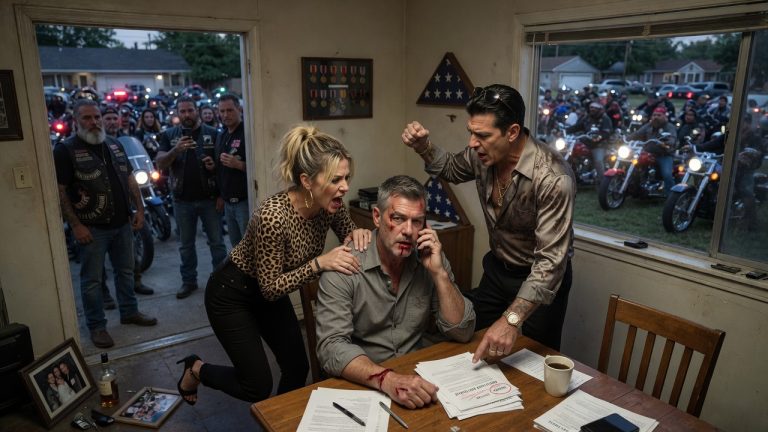
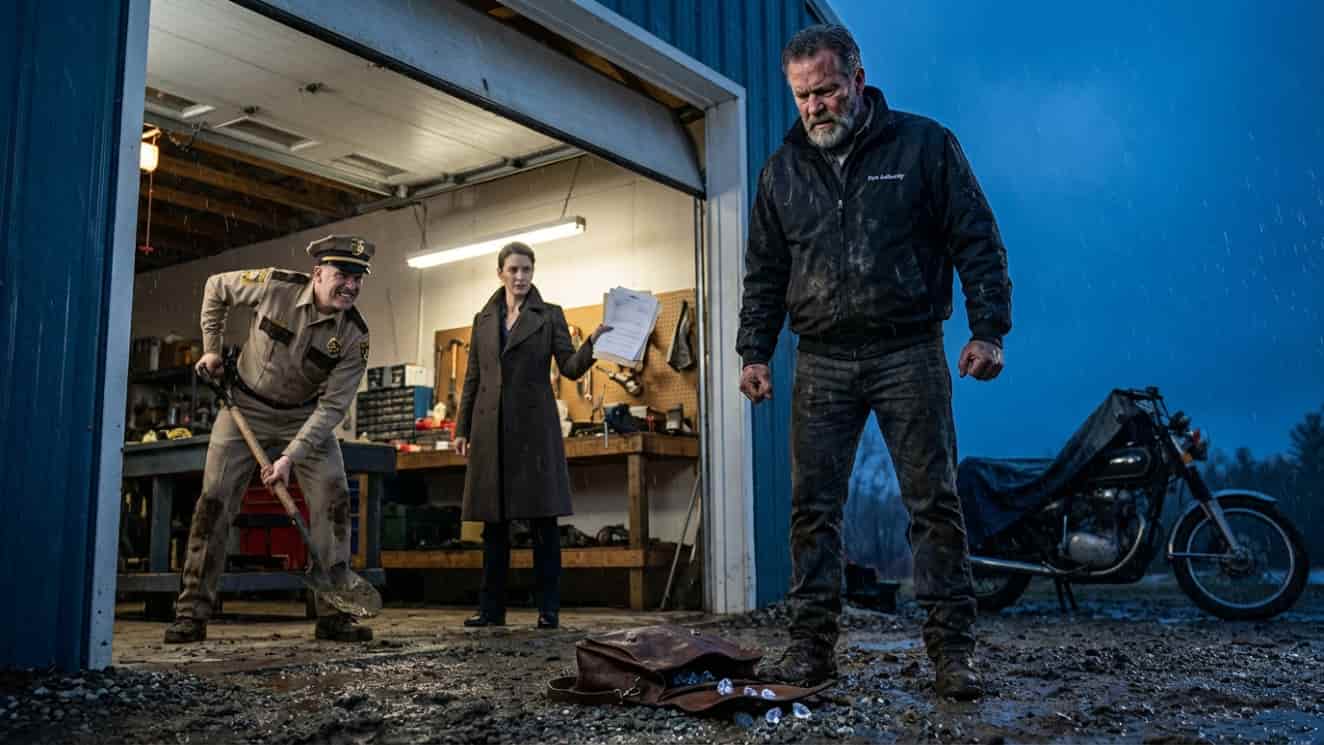
When his wife, Elena, leaned over the kitchen table and asked him to sign “insurance papers,” he trusted her. He didn’t see the way she looked at the Police Chief’s cruiser parked down the street. He didn’t know that by morning, he’d be standing in the freezing sleet, watching the law and the woman he loved dig up his garage floor.
They found the diamonds. They took the deed. They told him a dead man has no rights.
But they forgot why the world thought he was dead in the first place. They forgot that you don’t kick a ghost out of his own house—you just give him a reason to haunt you.
The engines are starting. The Phantoms are coming back to Maine.
FULL STORY: THE SILENCE OF THE CHROME KING
Chapter 1: The Rust of Silence
The Atlantic didn’t care about secrets. It just beat against the jagged Maine coastline, cold and indifferent, much like the life Silas “Ghost” Reed had carved out for himself. For ten years, Silas had been a ghost in more than just name. To the Department of Justice and the Interpol agents who still kept a dusty file on the “Iron Phantoms” motorcycle club, Silas Reed was a pile of charred remains in a burnt-out SUV in the Nevada desert.
In reality, he was a man who smelled of salt air and industrial grease, working the 10 PM to 6 AM shift at the Penobscot Bay shipping terminal. He wore a navy-blue thermal, a canvas jacket with “PORT SECURITY” stitched in fading yellow thread, and a pair of steel-toed boots that had seen better decades.
He liked the night shift. The night was quiet. The night didn’t ask questions about the faded ink visible on his forearms when he rolled up his sleeves—the ghost of a reaper’s scythe that had been mostly covered by a poor cover-up job of a pine tree.
Silas pulled his truck, a 2004 Ford F-150 with a rusted wheel well, into his driveway. The house was a modest saltbox, white paint peeling in strips like dead skin. It sat on a three-acre lot that was mostly overgrown brush and a detached three-car garage that Silas kept padlocked.
He saw the lights on in the kitchen. That was unusual for 6:15 AM. Elena was usually asleep, or at least pretending to be.
He stepped into the mudroom, kicking the slush from his boots. The smell of fresh coffee hit him, but it wasn’t the cheap Folgers he liked. It was something expensive, something with an acidic, floral bite.
“You’re late,” Elena said. She was sitting at the small laminate table, her hair perfectly done, wearing a silk robe that cost more than Silas’s monthly paycheck.
“Shipment of lumber got delayed. Had to sign off on the late manifest,” Silas said, his voice a low gravel. He didn’t look at her. He couldn’t. For the last year, looking at Elena felt like looking at a stranger who had moved into his life.
She wasn’t the girl he’d met in a roadside bar in Tahoe while he was on the run. That girl had liked the danger, the smell of leather, the way Silas moved like he owned the air around him. This Elena liked the status of being the wife of a “retired businessman” with a mysterious past and a steady, if humble, income.
“Chief Miller stopped by last night,” Elena said, her voice casual. Too casual.
Silas paused with his hand on the refrigerator door. Chief Miller was a man who wore his authority like a weapon. He was the kind of cop who knew everyone’s business in a town of three thousand, and he’d spent the last six months sniffing around Silas like a dog at a fresh grave.
“What did he want?”
“Just checking in. Said there were some reports of trespassing near the wharf. He’s worried about us, Silas. About our security.”
Silas turned, his eyes narrowing. “We don’t need his worry, Elena. We need him to stay on the other side of the property line.”
Elena stood up, smoothing her robe. She walked over to him, her eyes soft, a look she hadn’t used in months. She placed a hand on his chest, right over the spot where his heart beat steady and slow.
“He’s helping us, Silas. You know the property taxes are behind. And the house… the deed is still in your old name. The one that doesn’t exist. If the state does an audit, we lose everything.”
“I told you I’m handling it.”
“You’re working security for eighteen dollars an hour,” she snapped, the softness vanishing instantly. “You aren’t handling anything. You’re waiting to die. But I’m not.”
She reached into her pocket and pulled out a folded sheaf of papers. “Miller has a friend in the county clerk’s office. He can fix the deed. Transfer it to my name, legally, so the state can’t touch it. He just needs you to sign these insurance waivers and the transfer affidavit.”
Silas looked at the papers. The text was dense, legalese that made his head swim. He was a man of engines and road maps, not fine print.
“I don’t like Miller,” Silas said.
“I don’t like being poor,” Elena countered. “Sign them, Silas. For us. So we can stop living like ghosts.”
Silas looked at her, searching for the woman he’d protected for a decade. He saw only a cold, sharp hunger. He took the pen she offered. He didn’t see the shadow of a cruiser pass by the end of the driveway. He just wanted to sleep.
He signed.
Chapter 2: The Serpent in the Bed
The sleep didn’t come. Silas lay in the bedroom, listening to the wind rattle the windowpanes. He felt the weight of the house pressing down on him.
He’d spent ten years building this fortress of boredom. He’d meticulously erased Silas “Ghost” Reed, the man who had orchestrated the Great Western Diamond Heist, the man who had led the Iron Phantoms through a three-state war against the Los Muertos cartel. He’d left that man in the desert.
But lately, the desert was calling him back.
He heard the front door open and close. Elena was gone. She’d said she was going to the grocery store, but she hadn’t taken the truck. She’d taken her sedan, the one she’d bought with the “inheritance” Silas had supposedly provided.
He got up and walked to the window. He watched her car disappear down the foggy road. Then, he saw something that made the hair on his neck stand up.
A black SUV pulled into the driveway, five minutes after she left. It didn’t have police markings, but Silas knew the engine sound. It was the heavy, reinforced suspension of a pursuit vehicle.
Chief Miller stepped out. He wasn’t in uniform. He was wearing a leather jacket that looked brand new, the kind of thing a man wears when he’s trying to look like something he’s not. He didn’t knock. He had a key.
Silas pulled back from the window, his breath hitching. He stood in the shadows of the hallway as Miller entered the kitchen.
“Elena?” Miller’s voice boomed.
Silence. Miller chuckled to himself. He walked over to the kitchen table, picked up the coffee pot, and poured himself a mug. He sat in Silas’s chair.
Silas watched from the darkened hall. He saw Miller pull a cell phone from his pocket and dial a number.
“Yeah, it’s done,” Miller said into the phone. “He signed the papers. The house is hers. We can move on the garage tonight. I checked the blueprints—there’s a sub-floor in the northeast corner. That’s where he’s got it. The diamonds. And the hardware.”
There was a pause as the person on the other end spoke.
“I don’t care about Reed,” Miller said, his voice hardening. “He’s a dead man walking anyway. Once we have the pouch, we’ll trigger the Interpol flag. Let them come pick up the trash. Elena’s already got her bags packed. She’s meeting me at the motel after the shift.”
Miller laughed, a wet, arrogant sound. “The idiot thought she loved him. He thought he was safe because he was boring. He forgot that boring men are easy to rob.”
Miller hung up and stood, stretching. He walked toward the mudroom, but paused at the photo on the wall—a picture of Silas and Elena from their first year in Maine. Miller spat on the glass, then walked out.
Silas stayed in the dark for a long time. His hands were shaking, but not with fear. It was a cold, rhythmic vibration, the kind he used to feel through the handlebars of his Shovelhead at eighty miles per hour.
He walked to the mudroom and looked at the photo. He wiped the spit away with his thumb.
“You should’ve stayed in the desert, Silas,” he whispered to the glass.
Then he went to the closet and reached behind the coats. He pulled out a small, locked metal box. Inside wasn’t money or jewelry.
It was a single, battered leather kutte. On the back, the white-and-black embroidery of a grinning skull wearing a crown of thorns. The Iron Phantoms.
And beneath that, a letter. It was yellowed with age, written in a shaky hand.
Dear Mr. Reed, thank you for the money for the clinic. My husband always said you were a man of your word. The town won’t forget what the Phantoms did when the factory closed. God bless you.
Silas folded the letter and put it in his pocket. He didn’t put on the leather. Not yet.
He went to the garage.
Chapter 3: The Cold Snap
The sleet started around 5 PM, turning the world into a grey, treacherous blur. Silas stood in the center of his garage, the smell of oil and old rubber surrounding him.
He’d spent the afternoon working. Not on his truck, but on the floor.
He’d pulled back the heavy rubber mats in the northeast corner. He’d unbolted the false concrete slab he’d poured himself five years ago.
Underneath was a cache that would make a SWAT commander sweat. Three AR-15s, a dozen sidearms, and a crate of flashbangs. And in the center, a small, unassuming leather pouch.
He opened the pouch. The diamonds weren’t cut. They looked like pebbles, dull and unremarkable to the untrained eye. But under a flashlight, they held a fire that had cost twelve lives and a decade of his soul.
He heard the sound of tires on gravel. Two vehicles.
He didn’t hide. He didn’t lock the door. He sat on a stool, the pouch in his hand, and waited.
The garage door was kicked open. The sleet whirled in, bringing the bite of the Atlantic with it.
Chief Miller stepped in first, his service weapon drawn but held at his side. He was back in uniform, the badge on his chest glinting under the fluorescent lights.
Behind him came Elena. She was wearing a trench coat, her eyes darting around the room until they landed on the open hole in the floor.
“Silas,” she said, her voice devoid of the warmth she’d used that morning. “Give it to him.”
Silas didn’t move. “You sign the papers, Elena? You get the house?”
“I got everything, Silas,” she said, stepping forward. “I got the house, the land, and in about ten minutes, I’m going to have the life I was supposed to have before I met a glorified biker on the run.”
Miller stepped closer, the barrel of his Glock rising. “The diamonds, Reed. Put them in the bag.” He tossed a canvas evidence bag onto the floor.
“You’re a cop, Miller,” Silas said. “You really want to go down for a heist that happened ten years ago in Nevada?”
“I’m not going down for anything,” Miller said. “I’m recovering stolen property. The diamonds go into the vault at the station—half of them, anyway. The other half… well, me and Elena are going to have a very long vacation. And you? You’re going to be the ‘Ghost’ that finally got caught. I’ve already called the field office. They’re an hour away.”
Silas looked at Elena. “You really did it. You sold me out for a badge and a paycheck.”
“You were already dead, Silas!” she screamed, the sound echoing off the metal walls. “You just didn’t have the decency to stop breathing. You left me in this freezing, miserable town for ten years while you worked a gate! You had millions under the floorboards and you let me wear clothes from a Sears catalog!”
“I was keeping you safe,” Silas said quietly.
“You were keeping me prisoner!” she spat.
Miller stepped into the light. “Enough. The pouch, Reed. Now.”
Silas stood up. He looked at the pouch, then at Miller. With a flick of his wrist, he tossed the pouch into the mud at Miller’s feet.
The bag spilled. The raw diamonds tumbled into the slush and oil.
Miller laughed. He dropped to one knee, the shovel he’d brought from his truck in his other hand. He started scooping the diamonds into the evidence bag with his fingers, greedy and frantic.
“Look at that,” Miller breathed. “Ten years of hunting, and here it is.”
Elena walked over to Silas. She reached into her pocket and pulled out the deed. She tore it in half, the pieces fluttering into the hole in the floor.
“The locks are being changed tonight,” she said. “Get out. Walk. If I see you on this road in twenty minutes, Miller will shoot you for trespassing. And he’ll be a hero for doing it.”
Silas looked at them—the cop in the mud, the wife with the cold eyes.
“You shouldn’t have opened the floor,” Silas said.
“Why?” Miller sneered, looking up. “What are you going to do? Call the police?”
“No,” Silas said. “I called the family.”
Chapter 4: Under the Floorboards
Miller froze. He looked at the diamonds, then at Silas. “What are you talking about?”
“You think I stayed hidden because I was scared of the law?” Silas asked. He stepped back into the shadows of the garage, toward the tarp-covered shape in the back.
“I stayed hidden because as long as I was ‘dead,’ the Iron Phantoms were at peace. The war ended when I did. But you… you just told the world I’m alive. You just sent a signal to every man who wore that patch that the President is back.”
“You’re delusional,” Elena said, though her voice wavered. “The Phantoms are gone. They broke up years ago.”
“A club doesn’t break up, Elena,” Silas said. “It just goes quiet.”
He reached out and yanked the tarp.
The bike wasn’t a modern cruiser. It was a 1979 Shovelhead, hard-tailed, with high ape-hanger bars and a suicide shifter. It was black and chrome, polished so brightly it seemed to swallow the light.
And leaning against the frame was a heavy, leather vest.
Silas picked it up. He slid his arms into it. The weight felt right. The leather was stiff, smelling of old adventures and burnt gasoline.
“Reed, sit down!” Miller yelled, standing up and leveling his gun. “Put the vest on the floor or I swear to God I’ll put a hole in you.”
Silas didn’t sit. He walked to the workbench and picked up a heavy iron wrench.
“You want to know what was under the other floorboard, Miller?” Silas asked.
He pointed to the far side of the garage.
At that moment, the ground began to vibrate. It wasn’t the wind. It wasn’t the sea.
It was a low, rhythmic thrumming that grew into a roar.
Miller turned toward the open garage door.
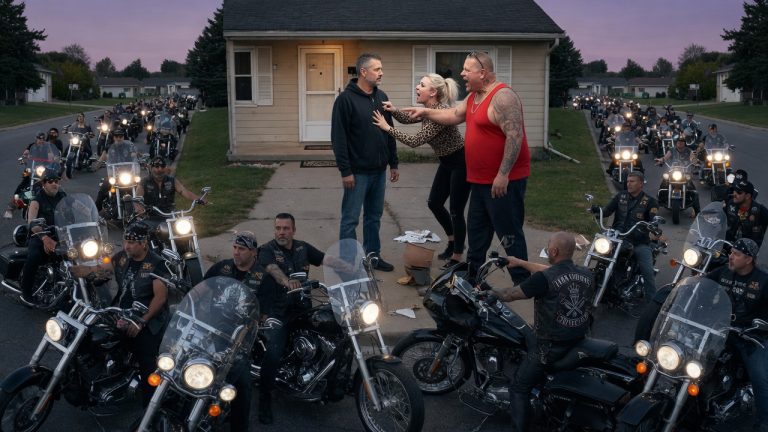
Down the long, winding driveway, through the sleet and the dark, a single headlight appeared. Then two. Then ten. Then a wall of white light that cut through the storm like a blade.
The sound was deafening now—the scream of high-performance engines, the thunder of unbaffled pipes.
Miller stepped out into the mud, his gun shaking. “Stop! Police! Get back!”
The lead bike didn’t stop. It skidded to a halt inches from Miller’s knees, spraying him with freezing slush.
The rider was a giant of a man, his beard white and matted with ice. He wore a matching leather vest. On his chest, a patch read: ROADKILL – VICE PRESIDENT.
Roadkill looked at Miller, then looked past him into the garage at Silas.
“You took your sweet time calling, Ghost,” Roadkill said, his voice like grinding stones.
“I was busy being dead,” Silas said.
Behind Roadkill, forty more bikes roared into the yard, circling the house and the garage, their headlights creating a cage of blinding light. The men on the bikes weren’t young. They were grizzled, scarred, and dressed for a war they’d been waiting ten years to finish.
Elena backed away, her face turning pale. “Silas… Silas, tell them to leave.”
Silas walked out of the garage, the iron wrench still in his hand. He stood between the bikes and his wife.
“The house is yours, Elena. You wanted it. You got it.”
He looked at Miller, who was now surrounded by three bikers, their engines revving in a terrifying symphony.
“And the diamonds are yours, Miller. Take them. But you’re going to have to explain to the field office why the ‘Ghost’ they’re coming to arrest is standing in a yard full of fifty witnesses who say you’ve been extorting us for months.”
“I’ll kill you,” Miller hissed, his finger tightening on the trigger.
Roadkill didn’t even flinch. He just leaned over his handlebars. “Son, there are forty-two cameras rolling on these phones right now. You shoot a man in his own yard with his wife watching? Even in Maine, that’s a hard day in court.”