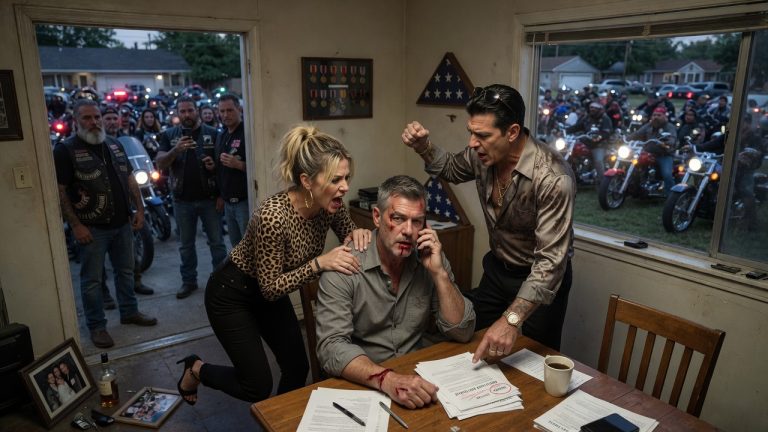
The champagne was $400 a bottle, and the company was even more expensive. I sat there with my burned hands tucked into my pockets, listening to my wife’s new “friends” laugh about the lower class.
Then Julian, the tech genius she’d been seeing behind my back, spilled a drop of mud on his Italian loafers. He looked at me, then at the floor.
“Clean it, Malakai,” he said, his voice loud enough to stop every conversation in the room. “Since you can’t ride anymore, you might as well be useful.”
Sarah didn’t look away. She didn’t defend me. She just sipped her wine and whispered, “Go on, honey. Show them you still know how to take orders.”
They thought they’d stripped me of my crown when they took my bike and my brothers. They thought a man with scars was a man without teeth.
But they forgot one thing about the Outlaw Apostles. We don’t just own the road. We own the secrets that keep people like Julian in the sky.
I got down on one knee. But I wasn’t there to clean his shoes.
I was there to tell him that his bank account just hit zero, and my family was already at the front gate.
FULL STORY: A THRONE OF BROKEN GLASS
CHAPTER 1: The Trophy in the Penthouse
The air in the penthouse smelled like expensive ozone and filtered regret. It was a sterile, high-altitude chill that never quite managed to reach the deep, aching itch in the graft-scarred skin of Malakai’s hands.
Malakai—known only as “Bishop” to men who were either dead or behind bars—stood by the floor-to-ceiling glass. Below, Seattle was a blurred grid of rain and neon. He looked at his reflection. At forty-eight, he looked like a piece of driftwood that had been dragged through a fire and then polished for a museum display. His hair was the color of a guttering charcoal flame, and his eyes were tired in a way sleep couldn’t fix.
“You’re brooding again, Mal,” Sarah said. She didn’t look up from her phone. She was draped across a white Italian leather sofa that cost more than the first three houses Bishop had ever lived in. She was wearing a dress that looked like spun moonlight, a far cry from the oil-stained denim she’d worn when they met at a roadside bar in Yakima fifteen years ago.
“Just looking at the rain,” Bishop said. His voice was a low rumble, the sound of a heavy engine idling.
“Julian says the rain is ‘data points,'” Sarah said with a light, airy laugh that made Bishop’s stomach turn. “He says everything in this city can be predicted if you have the right algorithm.”
Julian. The name was a splinter under Bishop’s skin. Julian Vane, the thirty-two-year-old CEO of Vane-Tech, a man who spoke in “disruption” and “synergy” and looked at Bishop like he was a prehistoric relic that had somehow escaped the tar pits.
“Julian says a lot of things,” Bishop muttered. He rubbed his right palm against the seam of his jeans. The skin there was a roadmap of disaster—thick, ropy keloid scars from the night he’d reached into the engine block of a burning Harley to pull a rival out of the wreck. It was the “Law of the Road.” You don’t let a man burn, even if you’re the one who put him in the ditch.
“He’s coming over tonight,” Sarah said, finally looking up. Her eyes were sharp, scanning him for flaws. “The board of directors is with him. They’re celebrating the merger. Please, Malakai… try to look like you belong here. Don’t wear the vest.”
“The vest is in a box, Sarah. You know that.”
“Good. Keep it there.” She stood up, walking toward him with a grace that felt practiced, artificial. She reached out to touch his cheek, but her eyes landed on his hands, and she flinched—just a fraction of an inch, but he felt it like a physical blow. She redirected her hand to his collar, straightening it. “We’ve worked too hard to get to this floor to let the past drag us down.”
We? Bishop thought. He’d been the one who provided the seed money. He’d been the one who used the Apostles’ “discretionary funds”—the laundered cash from twenty years of cross-border runs—to bail out Sarah’s struggling marketing firm. He’d traded his throne for a cage of glass because she’d told him she was tired of being afraid of the police.
But as he looked at her, he realized she wasn’t afraid anymore. She was hungry. And he was just the meal that had gone cold.
“I’ll be on my best behavior,” Bishop said quietly.
“Thank you.” She kissed his cheek. It felt like a transaction.
He watched her walk toward the kitchen to check on the caterers. He felt the weight of the small, encrypted USB drive in his pocket. It was a cold, hard piece of plastic. It contained the digital “backdoor” to every account Vane-Tech owned. It was a gift from an old friend—a “mirror” of Bishop himself, a man named Twitch who traded his bike for a keyboard but kept the same loyalty.
The Apostles didn’t forget a leader. And they didn’t forget a debt.
CHAPTER 2: The Sound of Silence
The party was a sea of gray suits and sharp smiles. Bishop stood in the corner of the expansive living room, holding a glass of sparkling water he didn’t want. He felt like a bear in a tuxedo. Every time he shifted his weight, he felt the heavy, rhythmic thrum of his own pulse in his scarred hands.
“Malakai! The man of the hour!” Julian’s voice cut through the hum of the crowd. He approached with a group of three men and two women, all of them looking like they’d been manufactured in the same high-end factory.
Julian put a hand on Bishop’s shoulder. It was a dominance move, a way to show the board that he could tame the beast. “I was just telling the team about your… adventurous youth. The ‘Outlaw Apostles,’ right? It sounds like a Netflix series.”
The board members chuckled. A tall woman with glasses peered at Bishop’s hands. “Is it true? About the fire? I heard you did it for a dare.”
Bishop looked her in the eye. The silence stretched. He felt the old pressure building in his chest, the feeling of a winding road and a wide-open throttle. “It wasn’t a dare,” he said. “It was a debt.”
“A debt!” Julian laughed, squeezing Bishop’s shoulder a little too hard. “Everything is a transaction with these guys, isn’t it? Very primitive. Very… visceral. That’s why I love having Malakai around. He reminds us where we came from. Before the ‘smart’ world took over.”
Sarah stepped into the circle, slipping her arm around Julian’s waist. Not Bishop’s. Julian’s.
“He’s my quiet hero,” she said, though the word ‘hero’ sounded like ‘relic.’ “But he’s much better at listening than talking.”
“Well, he’d better be a good listener tonight,” Julian said, his eyes dancing with a cruel light. He turned to one of the caterers. “Excuse me, could we get some more napkins over here? I think someone spilled a bit of their ‘culture’ on the rug.”
He was looking at Bishop’s boots. They were clean, polished, but they were still heavy leather work boots. Out of place on the $20,000 silk rug.
“Actually,” Julian said, his voice dropping to a theatrical whisper that carried across the room. “Malakai, be a pal. I had a bit of a run-in with a puddle in the garage. These loafers are calfskin. If the mud sets, they’re ruined.”
The room went quiet. The only sound was the hum of the air conditioning. Bishop looked at Julian. Then he looked at Sarah. She was looking at Julian’s shoes, then back at Bishop.
“Malakai,” she said, her voice steady and cold. “Help him out. Don’t be difficult.”
It wasn’t about the shoes. It was about the throne. It was about the 50th floor. It was about Julian showing everyone—and Sarah showing herself—that the King of the Outlaw Apostles was now a servant in his own home.
Bishop felt the itch in his hands turn into a burn. He thought about the 1,700 miles he’d ridden in three days to get to Sarah when her father died. He thought about the blood he’d spilled to keep the Apostles’ name clean so she could run her business without the shadow of the patch.
“You want me to clean your shoes, Julian?” Bishop asked.
“I think it would be a great gesture of… synergy,” Julian said. He reached out and pushed Bishop’s shoulder, a light, dismissive shove. “Go on. Get down there.”
CHAPTER 3: The Breaking Point
Bishop didn’t move. The pressure in the room was physical. The board members were leaning in, their faces tight with a mix of discomfort and a voyeuristic thrill. They wanted to see the biker break. They wanted to see the old world kneel to the new.
“Malakai, I’m not going to ask you again,” Sarah said. Her voice had a sharp edge now, the sound of a woman who had already made her choice. “You’re embarrassing me. After everything Julian has done for us… for your ‘retirement’…”
“My retirement?” Bishop said, his voice dropping an octave. “You mean the money I handed you in duffel bags so you could buy this glass cage?”
A gasp went around the room. Julian’s smile didn’t waver, but his eyes hardened. “Careful, Malakai. Libel is a very expensive hobby. Now, the shoe. I’m waiting.”
Bishop looked down. He saw the mud. A tiny, insignificant smear on a piece of overpriced leather. He thought about his mother’s locket. Sarah had thrown it away three weeks ago, saying it “didn’t fit the aesthetic” of the new bedroom. She thought he hadn’t noticed.
He had found it in the trash, the chain broken, the gold scratched.
That was the moment he knew the marriage wasn’t a partnership. It was an occupation.
Bishop slowly sank to one knee.
The socialites let out a collective breath. Julian smirked, tilting his head back to finish his scotch. Sarah looked triumphant, a queen reigning over a conquered territory.
Bishop’s scarred hands reached out. They were trembling, but not from fear.
“Whose name is on the deed to this building, Julian?” Bishop asked quietly, his hands hovering near the shoe.
Julian chuckled. “Vane-Tech Holdings. Which I own 60% of. Why? Thinking of making an offer?”
“And who handles the offshore clearing for Vane-Tech’s ‘disruptive’ logistics in Eastern Europe?”
Julian’s smirk faltered. Just a flicker. “That’s proprietary information.”
Bishop looked up. His eyes were no longer tired. They were the eyes of the man who had led fifty bikers through a police blockade in ’09 without blinking.
“It’s the Apostles, Julian. We’ve been washing your laundry for three years. You thought you were hiring a marketing firm? You were hiring a front. My front.”
Sarah’s face went pale. “Malakai, shut up. You’re drunk.”
“I haven’t had a drink in five years, Sarah. You’d know that if you ever looked at me instead of your reflection.” Bishop reached into his pocket and pulled out the USB drive. He didn’t clean the shoe. He gripped the toe of Julian’s loafer with his scarred hand, squeezing until the leather groaned.
“Hey! Let go!” Julian tried to pull back, but Bishop was a mountain.
“I’m not a ghost, Sarah,” Bishop said, looking at his wife. “I’m the foundation. And I just decided to move.”
CHAPTER 4: The Sound of the Pack
Bishop stood up. He didn’t let go of the USB drive. He walked to the sleek, black media console in the center of the room. Julian was shouting now, calling for security. The board members were backing away, their faces masks of confusion.
“Security won’t be coming, Julian,” Bishop said. He plugged the drive into the main terminal. “The head of your security team is a man named ‘Big Mack.’ He used to be my Sergeant-at-Arms. He’s currently downstairs having a smoke with some old friends.”
On the massive 100-inch screen that dominated the room, lines of code began to scroll. Then, a map of Seattle appeared. Hundreds of small, red dots were converging on the downtown core.
“What is this?” Sarah screamed. “Malakai, stop this right now! You’re ruining everything!”
“No,” Bishop said. “I’m just taking the trash out.”
He hit a key.
Suddenly, the lights in the penthouse flickered and died. The emergency red lights kicked in, bathing the white marble in a bloody glow. Outside, the rain was coming down harder, but through the glass, they could see them.
First, it was a low hum. Like a swarm of bees in the distance.
Then it grew. A deep, rhythmic throb that vibrated in the floorboards, in the glass, in the very bones of the people in the room.
The sound of five hundred heavy-displacement V-twin engines.
The “red dots” on the screen weren’t data. They were headlights.
Julian ran to the window. His face was pressed against the glass. “What… what is this? Is this a protest?”
“It’s a funeral,” Bishop said. He walked over to the bar and poured a glass of Julian’s most expensive scotch, then poured it slowly onto the silk rug. “A funeral for Vane-Tech. I just triggered the ‘Morality Clause’ in your merger agreement. All those offshore accounts? The ones with the Apostles’ signatures? They just went public. The SEC is going to be here in twenty minutes. But my brothers… they’re faster.”