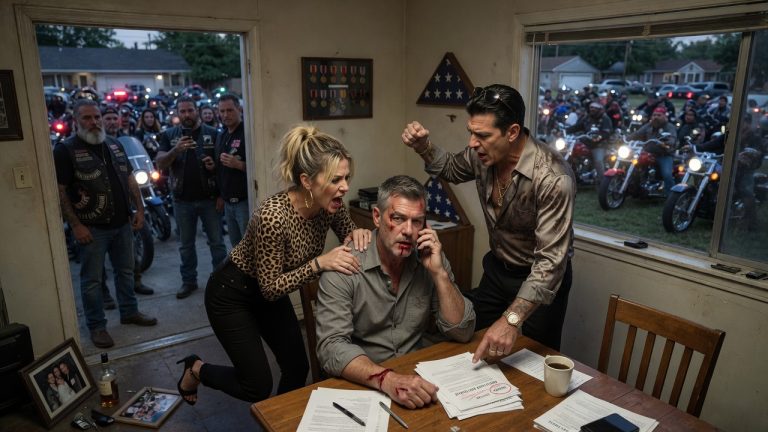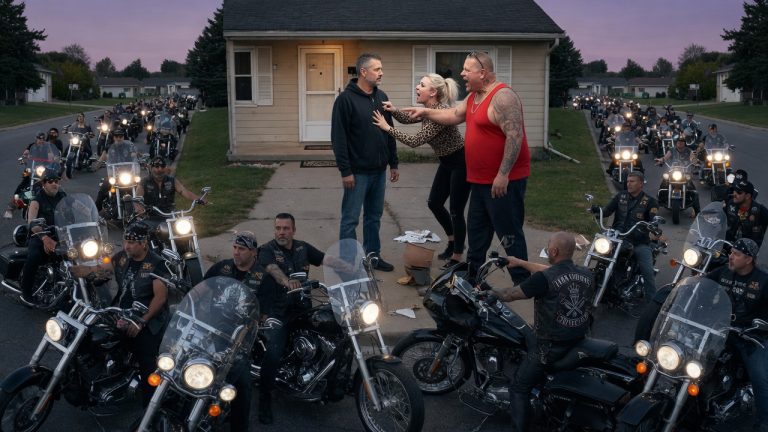
Julian thought “Ripper” Cain was just a washed-up biker with one arm and a shop full of “outdated” history. He and Cain’s wife, Gina, spent months laughing behind his back, planning to tear down “The Ink Grave” to build a boutique studio for the “modern elite.”
They thought they’d finally broken him when they trashed his sketchbooks and served the eviction papers. But they forgot one thing:
Cain didn’t just draw tattoos. He designed the Laws of the Road.
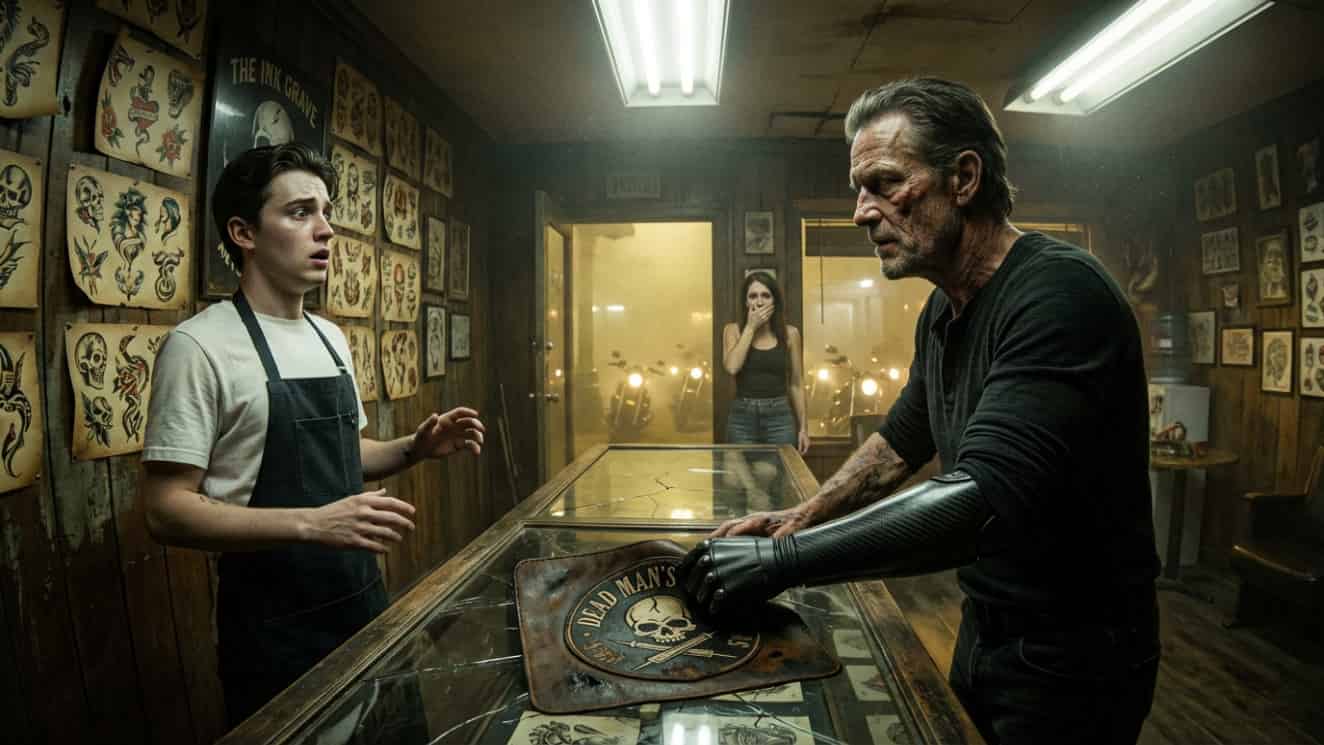
When Cain dropped that single, blood-stained leather patch on the counter, Julian’s “modern art” didn’t matter anymore. Because that patch is a beacon. And right now, there are 500 brothers in the New Orleans fog waiting for Cain to point his finger.
The “old man” isn’t leaving. But Julian might not make it to the curb.
FULL STORY: DEAD MAN’S LEATHER
Chapter 1: The Hum of the Grave
The humidity in New Orleans didn’t just sit on you; it owned you. It seeped into the floorboards of The Ink Grave, making the ancient wood swell until the door to the back room groaned every time it opened.
“Ripper” Cain sat in his heavy iron stool, the only thing in the shop that didn’t feel like it was rotting. He was sixty percent scar tissue and forty percent regret, held together by a denim vest and a prosthetic right arm that cost more than a suburban house. The arm was a masterpiece of carbon fiber and hydraulics, finished in a matte black that swallowed the dim light of the shop.
He was working on a piece of flash—a traditional dagger wrapped in a ribbon. His left hand, his only hand, was steady. He’d learned to tattoo southpaw after the wreck on I-10 ten years ago, the night he lost his throttle arm and his seat at the head of the Iron Apostles.
The bell over the door chimed. It was a light, tinny sound that didn’t belong in a place like this.
Gina walked in, followed by Julian. Gina looked like a woman who had traded her soul for a better zip code. She wore a silk blouse that cost a month’s rent at the shop, her blonde hair pulled back so tight it looked painful. Julian followed her, looking every bit the “visionary” he claimed to be—expensive tattoos peeking out from a crisp white collar, a manicured beard, and eyes that spent too much time looking for a camera.
“Cain,” Gina said. She didn’t look at the walls covered in thirty years of biker history. She looked at the smudge on the glass counter. “We’re here for the keys.”
Cain didn’t look up from his drawing. “Lease isn’t up until midnight.”
“Don’t be difficult,” Julian said, his voice smooth and rehearsed. “We’ve got the contractors coming at six a.m. We’re turning this place into something… relevant. High-end. We’re calling it Primal Ink.”
Cain finally looked up. His eyes were the color of a winter Atlantic, cold and deep. “Relevant. That’s a big word for a kid who uses a stencil for a straight line.”
Julian stiffened. “I have a two-year waitlist, Cain. I’ve tattooed rappers and tech moguls. You tattoo guys who trade catalytic converters for a cover-up. It’s over. The era of the ‘outlaw’ is a museum piece.”
Cain stood up. He was six-foot-four and built like a brick oven. The prosthetic arm whirred—a low, predatory sound. He walked to the counter and leaned on his left elbow.
“You see these drawings on the wall, Julian?” Cain asked, his voice a low gravelly rumble. “These aren’t just pictures. These are maps. They tell you who a man is, who he killed, and who he’d die for. You don’t tattoo people. You decorate them. There’s a difference.”
Gina stepped forward, her heels clicking like a countdown. “Stop it, Cain. The Apostles are gone. You’re just an old man in a dying shop. I’m taking the building. It’s in my name, remember? The one thing you gave me that was actually worth something.”
Cain looked at his wife. The old wound opened up, the one that had nothing to do with the wreck. “I gave you everything, Gina. I kept the blood off your porch for twenty years.”
“And look where it got us,” she spat. “A shop in the slums and a husband who talks to ghosts. Julian is the future. You’re just… leather and dust.”
Cain looked at them both. He felt the weight of the prosthetic. Inside the forearm, tucked into a specialized housing, was a four-inch titanium blade. He’d never used it. Not yet.
“Midnight,” Cain said quietly. “Get out.”
Chapter 2: The Modern Massacre
By ten p.m., the fog had rolled in from the river, thick and yellow, smelling of salt and swamp. Cain sat in the dark of the shop, the only light coming from the glowing red tip of his cigarette.
He wasn’t alone. In the back room, his “Master Ledger” sat on a pedestal. It was a heavy, leather-bound book containing the original designs for every patch the Iron Apostles had ever worn. But it was more than that. Cain had designed the patches for the Black Widows in Oakland, the Screaming Skulls in Vegas, and the Dead Men in London.
He was the Architect. In the world of the one-percenters, Cain’s ink was the only law that traveled across state lines.
The door burst open.
It wasn’t Gina. It was Julian and two guys in construction vests. They weren’t waiting for midnight.
“Change of plans,” Julian said, grinning. He held a sledgehammer like it was a prop in a music video. “We decided to get a head start on the demolition.”
“Julian, don’t,” Cain said, rising from his chair.
“Or what?” Julian laughed. He swung the hammer, smashing a display case full of vintage machines. The glass shattered, raining down on the floor. “You going to hit me with your robot arm? I’ll sue you for every cent you don’t have.”
The construction workers started pulling the flash art off the walls. These were hand-painted originals from the 1970s. One of them ripped a frame down, the glass breaking, and threw it into a pile in the center of the room.
Cain moved, but Julian was faster. He swung the hammer again, this time hitting the pedestal in the back room. The Master Ledger tumbled to the floor.
“No!” Cain lunged, but the weight of the prosthetic slowed him.
Julian stepped on the book, his expensive boot grinding into the hand-tooled leather cover. “This is the garbage I’m talking about. Who cares about some old biker’s diary?”
He looked at the construction workers. “Trash it. All of it. Burn the paper in the alley.”
Cain stood frozen. He watched as thirty years of history were tossed into a heap. He watched Julian pick up a bottle of green soap and pour it over the Master Ledger.
“You don’t know what you’re doing,” Cain whispered. “You have no idea what that book represents.”
“I know what it represents,” Julian said, leaning in. “It represents the end of you. Gina’s outside. She’s watching. She wants to see the moment you realize you’re nothing.”
Cain looked toward the door. Gina was there, standing under the streetlamp, her face cold. She wasn’t just taking the shop. She was erasing him.
The construction workers grabbed the pile of flash and the Ledger and headed for the back door.
“Cain,” Julian said, “stay for the fire. It’ll be the brightest thing you’ve seen in years.”
Chapter 3: The Call of the Iron
The fire in the alley was high and hungry. Cain stood at the back door, watching the orange flames lick the pages of the Master Ledger. The smell of burning leather filled the air—a heavy, cloying scent that smelled like a funeral pyre.
Julian was laughing, taking a selfie with the fire in the background. The construction workers were already back inside, ripping out the floorboards.
Cain looked at his prosthetic arm. He felt the phantom itch of the fingers he no longer had. He reached into his vest pocket. He didn’t pull out a phone. He pulled out a small, encrypted radio—an old-school piece of tech the Apostles used when they didn’t want the feds listening.
He keyed the mic.
“This is the Architect,” Cain said. His voice was steady, devoid of the pain that was currently eating his chest. “Code Black. The Ledger is burning. I’m at the Grave. I need a collection.”
There was silence for five seconds. Then, a single click responded. Then another. And another.
Cain walked back into the shop. Julian was standing in the middle of the room, looking at the bare walls.
“Done already?” Julian asked. “That was fast. You look like you’ve seen a ghost.”
“Not a ghost,” Cain said. “A reckoning.”
Gina walked in, checking her watch. “The fire’s out, Julian. Let’s go. We have a dinner reservation at Shaya.”
“Wait,” Cain said. He walked to the counter, which was now covered in dust and broken glass. He reached into a hidden compartment beneath the register.
He pulled out a single leather patch. It was the “Dead Man’s” patch—the one he’d designed for himself, the one that meant the wearer was a dead man walking unless he was the one holding the needle.
He slammed it onto the glass counter. CRACK.
The sound was like a gunshot. Julian flinched, his bravado slipping for the first time.
“What is that?” Gina asked, her voice trembling slightly.
“This is the debt,” Cain said. He looked at Julian. “You wanted to be relevant, kid? You’re about to be the most famous guy in the city. For about five minutes.”
A low thrum started. It was faint at first, like a distant storm. But it grew. It wasn’t a rumble; it was a vibration that shook the jars of ink on the shelves. It shook the windows. It shook the very bones of the building.
Julian looked toward the front door. “Is that… a parade?”
“No,” Cain said, his prosthetic arm whirring as he flexed the hand. “It’s the family you said I didn’t have.”
Chapter 4: Five Hundred Shadows
The fog outside the shop began to swirl, caught in the wake of something massive.
Gina walked to the window, her hand trembling as she pulled back the grimy curtain. She gasped, her knees nearly giving out.
Through the yellow mist, circular headlights began to appear. Two. Ten. Fifty. They didn’t stop coming. The street was narrow, but the motorcycles were packing in, wheel-to-fender, a sea of chrome and black leather that stretched back three blocks.
The sound was deafening now—the rhythmic, heart-stopping throb of five hundred V-twin engines idling in unison. It was a mechanical growl that silenced the city.
Julian’s face went the color of curdled milk. “Who… who are they?”
“The people who live by the rules in that book you just burned,” Cain said. He walked around the counter, his boots crunching on the glass. He stood directly in front of Julian. “You see, Julian, the Ledger wasn’t just my ‘diary.’ It was the registry. Every man out there owes his colors to the Architect. And they don’t take kindly to people burning their history.”
The front door of the shop creaked open.
A man stepped in. He was older, with a beard that reached his chest and eyes that had seen a thousand miles of bad road. He wore a vest with the Iron Apostles’ colors. He looked at the wreckage of the shop, then at the fire still smoldering in the alley.
“Cain,” the man said.
“Dutch,” Cain replied.
Dutch looked at Julian. It wasn’t a look of anger; it was the look a butcher gives a side of beef. “Is this the one?”
“He burned the Ledger, Dutch. He and the woman. They wanted to build a boutique.”
Dutch nodded slowly. He turned back to the door and raised a hand.
Simultaneously, five hundred engines cut out.
The silence that followed was worse than the noise. It was a heavy, suffocating silence that made Julian’s breathing sound like a scream.
“Cain, please,” Gina said, her voice cracking. “We can fix this. We’ll pay for everything. We didn’t know.”
“You knew,” Cain said, looking at her. “You just didn’t think I mattered anymore.”
Dutch stepped closer to Julian. “You like tattoos, kid? You like the way they look in the light?”
Julian couldn’t speak. He just nodded, his eyes darting toward the back door.
“Good,” Dutch said. “Because we’re going to give you one you’ll never forget. And we’re going to use the ashes of the Ledger to make the ink.”