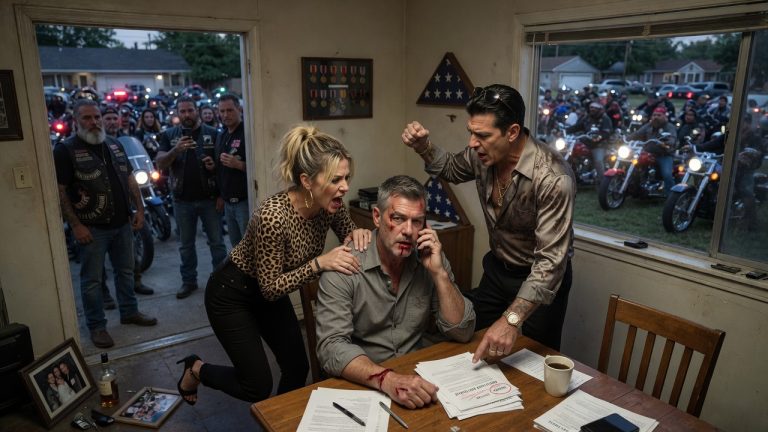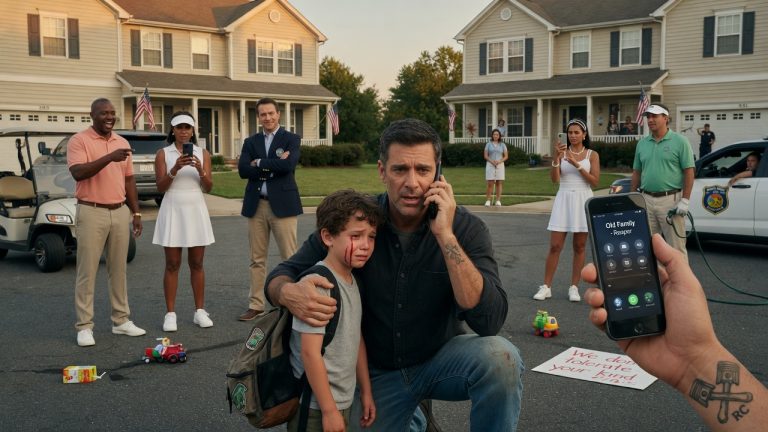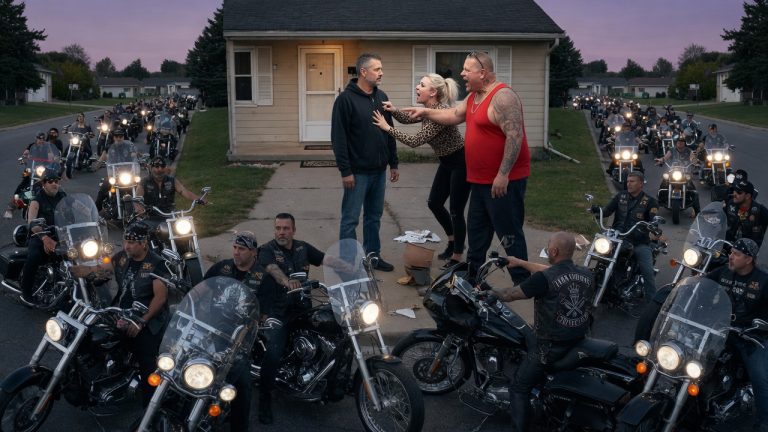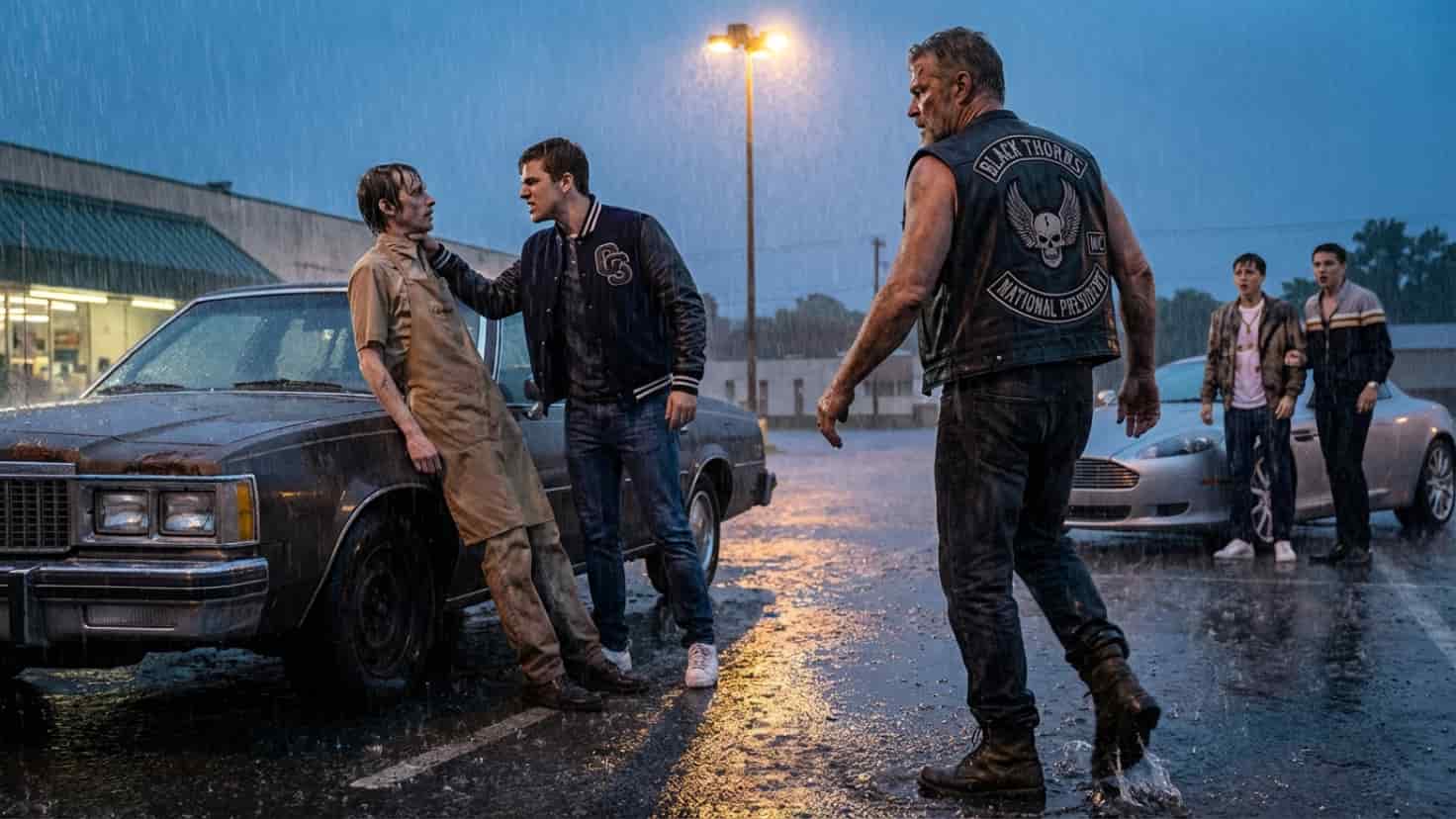
Garrett Sterling thought he owned this town. He thought he could break the quiet kid at the grocery store just because his daddy wears a judge’s robe.
He didn’t know who was watching from the trailer across the street.
He didn’t know that the “old drifter” he mocked had spent twenty years running the most dangerous brotherhood in the Midwest.
When Garrett put his hands on Leo’s throat, he didn’t just pick a fight with a clerk.
He called down a storm he can’t survive.
The silence in Ash Creek just ended. And the roar coming over the hill is the last thing Garrett Sterling will ever hear as a free man.
FULL STORY: THE WRONG MAN’S BLOOD
Chapter 1: The Inventory of a Ghost
The trailer smelled of stale coffee, WD-40, and the damp rot of a rainy Ohio autumn. Silas Vance sat at a laminate table that had been peeling since the Bush administration, staring through a grease-streaked window at the neon sign of “Miller’s Market” across the road.
He’d been in Ash Creek for six months. Six months of being nobody. To the neighbors, he was ‘Si,’ the guy who worked odd jobs at the marina and never said more than a three-word sentence. He wore flannel shirts that didn’t fit right and kept his hair tucked under a salt-stained ball cap. He had buried the man named “Iron” in a shallow grave three hundred miles away, along with the leather vest that carried the weight of a thousand sins.
But every afternoon at 4:00 PM, the ghost came back to life.
That was when Leo walked out of the sliding glass doors of the market to gather the stray shopping carts.
Leo was nineteen. He had a hitch in his stride when he was tired and a habit of pushing his glasses up the bridge of his nose with his pinky finger. He had Sarah’s chin—that stubborn, slightly pointed line—but he had Silas’s eyes. Pale, ice-blue, and perpetually looking for a way out.
Silas watched the boy move. He cataloged every detail like a man counting his remaining breaths. He knew that Leo liked the blue Gatorade, that he took his breaks sitting on a milk crate behind the dumpsters, and that he was currently saving money for a used motorcycle—a detail that made Silas’s chest ache with a physical, tearing heat.
“Don’t do it, kid,” Silas whispered to the empty room. “Buy a Honda Civic. Buy a tractor. Stay off the chrome.”
There was a knock at the trailer door. It wasn’t the polite tap of a neighbor. It was a rhythmic, heavy strike. Three beats. Pause. Two beats.
Silas didn’t reach for the pistol under the table. He knew that knock. It was the rhythm of a life he’d tried to amputate.
He opened the door. Deacon was standing there, looking like a thunderstorm in a denim jacket. Deacon was the Sergeant-at-Arms for the Black Thorns, a man whose knuckles were more scar tissue than bone. He looked out of place in this town of rust and quiet desperation.
“You look like hell, Iron,” Deacon said, stepping inside without being asked.
“I’m not Iron. I’m Si. And you shouldn’t be here.”
Deacon looked around the cramped trailer, his lip curling. “You’re living in a tin can watching a kid who doesn’t even know you’re alive. The club is bleeding, Silas. The feds are sniffing the Chicago chapter, and the Disciples are moving onto our turf in Cleveland. We need the National President.”
“The National President is retired,” Silas said, his voice flat.
“You can’t retire from this. You just hide until someone finds you. And I found you.” Deacon walked to the window, peering out at the grocery store. “That him? The clerk?”
Silas was across the room in a second, his hand clamping onto Deacon’s bicep with the strength of a hydraulic press. “Don’t look at him. Don’t even think about him.”
Deacon didn’t flinch. He looked down at Silas’s hand, then back at his face. “He’s got your eyes. Does Sarah know you’re here?”
“No. And she isn’t going to. I left so the feds wouldn’t use her to get to me. If I go back, I bring the heat with me. If I stay here, they’re safe.”
“Safe?” Deacon laughed, a dry, rasping sound. “Take a look at the parking lot, Silas. Really look.”
Silas turned back to the window. A silver Audi was idling near the cart return. A tall kid in a varsity jacket—Garrett Sterling, the son of the county judge—was leaning out the window, shouting something at Leo. Leo was looking at the ground, his shoulders hunched, trying to push a line of carts toward the store. Garrett threw a half-full milkshake at the boy. It splattered across Leo’s tan apron.
Garrett’s friends in the car erupted in laughter. Leo didn’t swing back. He didn’t even look up. He just reached for a rag in his pocket and started wiping the plastic.
“That’s the safety you bought them?” Deacon asked softly. “Letting your blood get treated like a dog by some rich kid who thinks he’s king of the soot? You’re not protecting him, Silas. You’re just watching him die in slow motion.”
Silas felt the old rage, the “Iron” rage, rattling the cage of his ribs. His knuckles went white against the laminate. “He’s alive. That’s enough.”
“Is it?” Deacon reached into his bag and pulled out a heavy, folded piece of leather. He thudded it onto the table.
It was the vest. The Black Thorns National President colors. The silver “1%” pin caught the dim light of the trailer.
“The club is staying at the motel six miles out,” Deacon said. “Fifty bikes. Waiting for a word. You can stay a ghost, Silas. But ghosts don’t have hands. And that boy is going to need someone with hands before the week is out.”
Deacon left. Silas stood alone in the dark, the smell of the leather vest filling the small space, competing with the scent of coffee and failure.
Chapter 2: The Golden Rot
Ash Creek wasn’t a town; it was a wound that refused to heal. The steel mill had closed in ’08, leaving behind a skeleton of rusted girders and a population that spent its days trading shifts at the hospital or the few surviving retail strips.
But the Sterlings were different. Judge Sterling owned the land the mill sat on, the local bank, and—according to town legend—the souls of at least half the police force. His son, Garrett, was the local god. He was handsome in a sharp, predatory way, with a smile that never reached his eyes.
Leo Vance knew that smile. He saw it three times a week.
“Hey, 7-Eleven,” Garrett shouted, leaning against the hood of his Audi. “I’m talking to you.”
Leo didn’t look up from the produce shelf. He was stacking Honeycrisp apples, his hands slightly shaking. He’d lived in Ash Creek his whole life, and he knew the rules: You don’t look a Sterling in the eye unless you want to spend the night in the county lockup on a made-up “disturbing the peace” charge.
“My car needs a wash,” Garrett said, walking into the store. He was followed by two guys from the football team, bruisers who existed only to provide a chorus for Garrett’s cruelty. “The milkshake left a stain. You’re going to come out and buff it out. Right now.”
“I’m on my shift, Garrett,” Leo said, his voice quiet but steady.
“Did I ask what you were doing?” Garrett stepped closer, his shadow falling over the apples. He reached out and flicked Leo’s ear. Hard. “I told you what you’re doing. You’re coming outside.”
“I can’t.”
Garrett reached out and swept a hand across the shelf. Four dozen apples tumbled to the floor, bruising and rolling into the aisles.
“Oops,” Garrett said. “Looks like you’ve got a mess to clean up. After you wash my car.”
Sarah, Leo’s mother, came around the corner. She was wearing her nurse’s scrubs, her face pale from a double shift at the clinic. She saw the apples, saw Garrett, and her body went rigid.
“Is there a problem here?” she asked, stepping between Leo and the boys.
Garrett’s smile widened. It was a look of pure, concentrated entitlement. “No problem, Mrs. Vance. Just reminding your son about his civic duties. You know, keeping the town clean.”
“Go home, Garrett,” Sarah said. Her voice was iron, but Silas—watching from the front window of the store where he’d followed them—saw the way her hand trembled as she clutched her purse.
“The Judge says the clinic might lose its funding next year, Sarah,” Garrett said, his voice dropping to a conspiratorial whisper. “Be a shame if you lost that job. All because your kid doesn’t know how to be polite.”
Garrett turned and walked out, his friends hooting as they followed.
Leo started picking up the apples. He didn’t look at his mother. Sarah stood there, her eyes closed, breathing in through her nose.
“He’s right,” Leo whispered. “He can do whatever he wants.”
“No, he can’t,” Sarah said, though they both knew it was a lie.
Silas stood by the magazine rack, his heart hammering against his ribs like a trapped bird. He wanted to go to her. He wanted to put his hand on her shoulder and tell her that the world was about to change. But he saw the way she looked at Leo—with a desperate, clawing protection. She had raised this boy to be soft in a hard world because she thought hardness was what killed his father.
She didn’t know that Silas was ten feet away. And she didn’t know that the “softness” she’d cultivated was exactly what was making Leo a target for the wolves.
Silas walked out of the store before they could see him. He walked back to his trailer, his mind racing. He looked at his hands—the hands of a ghost. They were clean. They were empty.
And they were useless.
He sat on his bed and pulled the gym bag from under the frame. He reached inside and pulled out the leather vest. He ran his thumb over the “National President” patch. The leather was cold.
“One more time,” he whispered to the empty room. “For the boy.”
Chapter 3: The First Crack
The rain turned from a drizzle to a downpour by Tuesday. Silas was under the hood of an old Ford F-150 at the marina when Leo walked by on his way home from work. The boy didn’t have an umbrella. He was soaked to the bone, his head down against the wind.
“Hey,” Silas called out.
Leo stopped, startled. He looked at Silas—the ‘Si’ he knew as the quiet guy who lived in the trailer park. “Oh. Hey, Mr. Vance.”
“Truck’s acting up,” Silas said, wiping his hands on a greasy rag. He didn’t know how to talk to his son. He knew how to lead a hundred men into a turf war, but he didn’t know how to ask a nineteen-year-old how his day was. “You want a lift? It’s raining cats and dogs.”
Leo hesitated. “I’m fine. It’s just a mile.”
“Get in the truck, kid. I’m going that way anyway.”
Leo climbed into the passenger seat. The cabin smelled of tobacco and old upholstery. Silas started the engine, the V8 roaring to life with a healthy, aggressive growl.
“Nice truck,” Leo said, looking at the dashboard.
“It’s a workhorse. Like people. Some are built for show, some are built to pull.” Silas pulled out onto the main road. “Saw that kid Garrett at the store yesterday.”
Leo’s body stiffened. He stared out the side window. “He’s just a jerk. It’s fine.”
“It’s not fine,” Silas said. He kept his eyes on the road, but his voice was heavy. “Men like that… they don’t stop until someone makes them stop. They feed on the people who don’t fight back.”
“My mom says fighting just makes things worse. She says if you ignore them, they get bored.”
“Your mom is a good woman,” Silas said, his throat tightening. “But she’s wrong about that. Some people don’t get bored. They just get meaner.”
Leo looked at him then, really looked at him. “You sound like you know.”
“I’ve known a lot of Garretts,” Silas said. “They all think they’re invincible because of a name or a bank account. But they all bleed the same color.”
He pulled the truck up to the small, neat house where Sarah lived. He saw her through the front window, moving in the kitchen. For a second, the years fell away. He wanted to kill the engine, walk up that porch, and take his place at the table. He wanted to tell her he was sorry for the twenty years of silence, for the letters he wrote and never mailed, for the fear that kept him away.
“Thanks for the ride, Mr. Vance,” Leo said, opening the door.
“Leo,” Silas said.
The boy turned back.
“If he corners you… don’t look at the ground. Look him in the eye. Let him see that you aren’t afraid. Even if you are.”
Leo nodded, though he looked more confused than inspired. He ran up the porch steps and disappeared inside.
Silas sat in the idling truck for a long time. He saw Sarah come to the door, saw her hand go to Leo’s head as she ushered him in. She looked out at the truck, squinting through the rain.
Silas pulled away before she could recognize the ghost behind the wheel.
He drove to the motel on the edge of town. The parking lot was filled with Harleys—big, loud, aggressive machines that looked like they belonged in a war zone. Deacon was sitting on a bench outside Room 12, smoking a cigarette.
“The boys are getting restless,” Deacon said as Silas approached. “The local deputy came by and told us to move on. I told him we’d move when the President told us to.”
Silas looked at the row of bikes. These were his men. Men who had bled for him, men who had gone to prison to keep his secrets.
“I need a favor, Deacon,” Silas said.
“Anything.”
“I need to know everything Judge Sterling is hiding. Not the legal stuff. The dirt. The money he’s moving under the table, the people he’s paying off. I want the leverage.”
Deacon grinned, his teeth white against his dark beard. “Now you’re talking like Iron. I’ll have it by morning.”
Chapter 4: The Escalation
The leverage came, but it came with a price. Deacon’s “info” involved leaning on a local bookie who handled the Judge’s off-the-books gambling debts. By Wednesday night, the news had traveled back to the courthouse.
Judge Sterling wasn’t a man who liked being questioned. And Garrett Sterling wasn’t a boy who liked being ignored.
Thursday afternoon, the sky was the color of a bruised plum. Leo was finishing his shift when Garrett’s Audi pulled into the lot, followed by a black SUV. This time, it wasn’t just Garrett’s friends. It was Deputy Miller, a man with a badge and a paycheck signed by the Sterlings.
“Leo Vance!” Miller shouted, stepping out of the car. “Get over here.”
Leo walked toward them, his heart hammering. “Is something wrong, Deputy?”
“We got a report of a theft at the Sterling estate,” Miller said, his hand resting on his holster. “A watch. Very expensive. Someone saw a kid fitting your description near the property this morning.”
“I was at work this morning!” Leo said, his voice rising in panic. “I’ve been here since 8:00 AM. Ask my manager.”
“Manager’s biased,” Garrett said, leaning against the SUV, a cruel smirk on his face. “Maybe you had someone else clock in for you. We’re going to need to search your locker. And your house.”
“You can’t do that,” Leo said. “I didn’t do anything!”
“Resisting, are we?” Miller stepped forward, grabbing Leo’s arm and twisting it behind his back. “That’s another charge.”
“Leave him alone!” Sarah shouted, running out of the store. She had just arrived to pick him up. “Miller, what are you doing? You know this boy didn’t steal anything!”
“Stay back, Sarah,” Miller warned. “This is police business.”
“This is Sterling business!” she screamed.
Garrett stepped toward her, his face inches from hers. “You should watch your tone, Sarah. It’d be a shame if the hospital board heard you were interfering with an arrest. Might make them wonder about your professional judgment.”
He reached out and patted her cheek—a gesture of pure, condescending dominance.
Leo lunged. He didn’t think; he just saw the hand on his mother’s face and exploded. He slammed his shoulder into Garrett’s chest, knocking him back against the car.
Miller didn’t hesitate. He swung his baton, catching Leo across the ribs. The boy crumpled to the asphalt, gasping for air.
“Leo!” Sarah shrieked, throwing herself over him.
“Now he’s assaulted a civilian,” Miller said, looking at Garrett. “That’s a felony, kid. You’re going to the county jail. And since you’re nineteen, you’re going to the adult wing.”
Garrett stood up, brushing off his jacket. He looked down at Leo, who was coughing on the wet ground. “See you in court, grocery boy. My dad’s the judge, in case you forgot. You’re never coming home.”
They hauled Leo up, his face bloody, and tossed him into the back of the cruiser. Sarah was screaming, clawing at the window as they drove away.
Silas saw it all from the trailer. He saw the baton hit his son. He saw the hand on Sarah’s face. He saw the cruiser disappear around the corner.
He didn’t scream. He didn’t move. He just felt a cold, dark tide rising inside him. The “ghost” was gone. There was only Iron.
He walked to the table and picked up the leather vest. He slid his arms into it. He felt the weight of the leather, the history of the patches. He reached into his closet and pulled out a heavy chrome chain and a pair of brass knuckles.
He walked out of the trailer and got onto the Harley-Davidson he’d kept hidden under a tarp in the shed. He kicked the engine over. It didn’t roar; it screamed.
He rode to the motel. Deacon was already on his bike. The other fifty men were standing by their machines, their faces grim.
“They took the boy,” Silas said, his voice echoing in the small parking lot.
“We saw,” Deacon said.
“We aren’t going to the jail,” Silas said. “The jail is a cage. We’re going to the source. We’re going to the Sterling estate. And then we’re going to the town square.”
“What are the orders, President?”
Silas looked at the men—his brothers, his monsters.
“Burn the lie down,” Silas said. “All of it.”