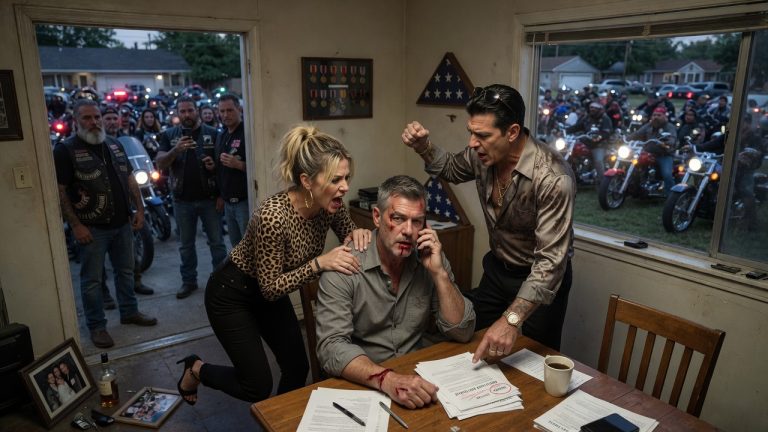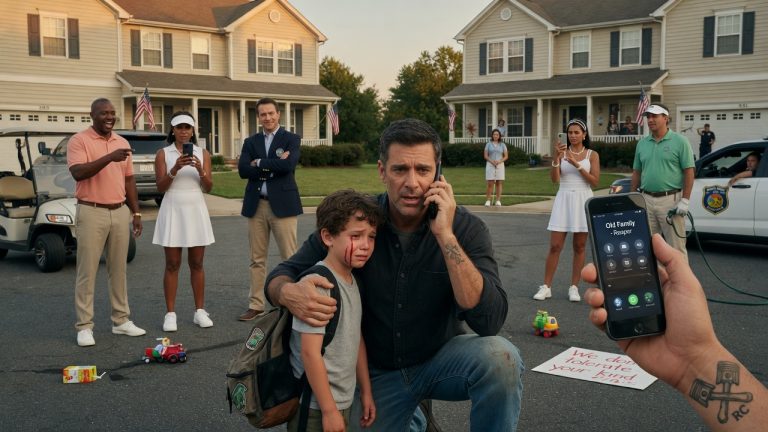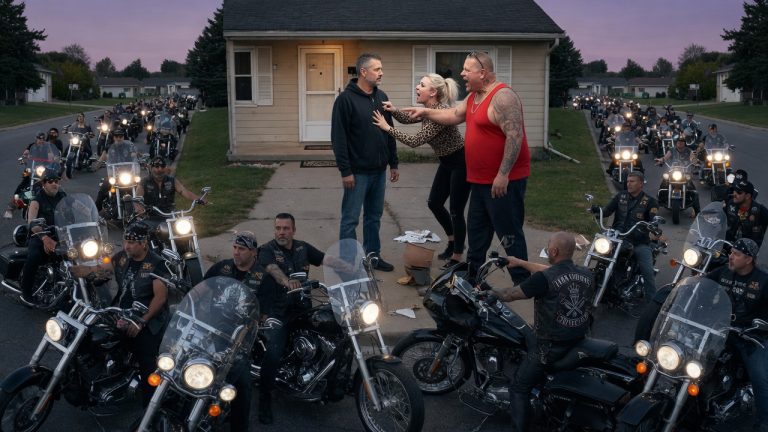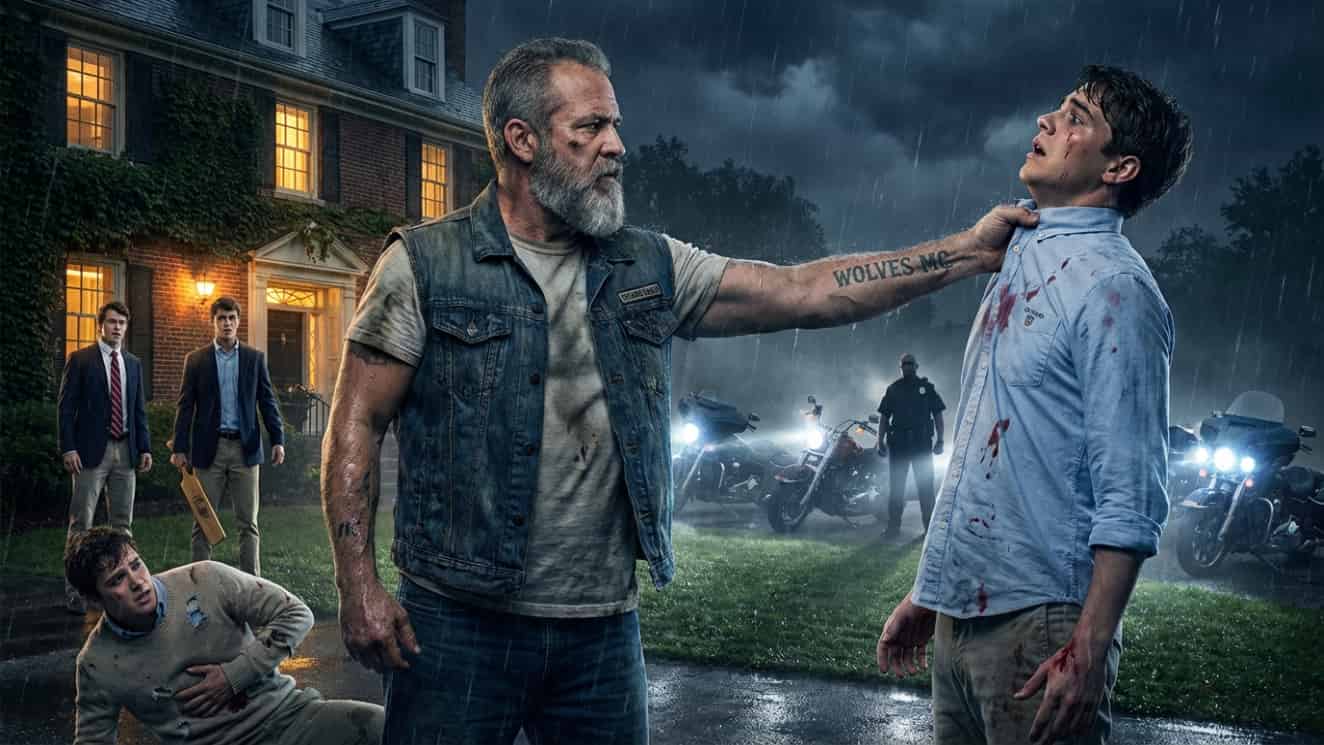
The “Golden Boys” of Alpha Sigma Phi thought they were untouchable. They had the trust funds, the family names, and the law firms on speed-dial. They thought hazing the “scholarship kid” was just a Friday night tradition.
But they didn’t know who was watching from the shadows of the campus gates.
When Reckon Hayes saw the wooden paddle hit the boy’s ribs, fifteen years of parole didn’t matter anymore. The “Wolves” didn’t care about Ivy League rules.
He didn’t just break the “brotherhood.” He dismantled it.
But the real shock wasn’t the violence. It was the moment the bloodied boy on the ground looked up and saw the tattoo on the biker’s arm. The same one he’d seen in a faded Polaroid his mother had hidden for two decades.
Reckon knew that saving the boy meant going back to a concrete cell for the rest of his life.
He did it anyway.
FULL STORY: BLOOD ON THE PAVEMENT
Chapter 1: The Ghost of Richmond
The air in Richmond didn’t smell like the inside of a concrete box, and that was the first thing Reckon Hayes had to get used to. It smelled of humidity, exhaust, and the faint, cloying scent of honeysuckle that drifted off the James River. It was a soft smell. A free smell. And it made him feel like he was walking on glass.
He sat on a rusted bench at the Greyhound station, his duffel bag—containing two pairs of jeans, three shirts, and a photo that had been folded so many times the creases were white—resting against his boots. Fifteen years. Five thousand, four hundred, and seventy-five days of silence, punctuated only by the rhythmic clanging of steel and the low-frequency hum of men losing their minds.
His parole officer, a man named Miller who wore shirts two sizes too small and smelled of peppermint to hide a tobacco habit, had been clear.
“You stay out of the city limits, Hayes. You stay away from the Wolves. You stay away from the girl. You breathe wrong, and I’ll have you back in Augusta before your coffee gets cold. Do you understand?”
“I understand,” Reckon had said. His voice was gravelly, a tool he hadn’t used much in the SHU.
But Miller didn’t know about the letter. The letter that had arrived six months before his release, written on stationery from the University of Virginia. It wasn’t from Sarah. Sarah had died three years into his sentence, a fact that had reached him via a cold, three-sentence note from her sister. No, the letter was from a registrar’s office, a bureaucratic error addressed to “The Estate of Sarah Miller,” confirming a scholarship for one Eli Miller.
Reckon wasn’t an estate. He was a ghost. But he knew the math. He knew the dates. He knew the reason he’d taken the fall for the club’s warehouse fire—to give Sarah the “clean” life she’d begged for. He’d traded his youth so she could raise a child without a “Wolf” for a father.
He stood up, his knees popping—a gift from the prison yard. He wasn’t going to the clubhouse. He wasn’t going to find his old brothers. He was going to a place where he didn’t belong. A place of red brick and white pillars.
He caught a local bus toward the university district. He looked out the window at the changing scenery. The pawn shops and liquor stores gave way to organic grocery stores and boutiques that sold candles for forty dollars. The people changed, too. Their skin looked softer. Their eyes didn’t dart around looking for a threat. They looked through him, or around him, as if he were a piece of urban decay that the city hadn’t gotten around to demolishing yet.
He found the campus by dusk. It was beautiful in a way that felt aggressive. It was so clean it hurt his eyes. He walked the perimeter, a large man in a worn denim vest, his presence a dark smudge on the sunset-lit sidewalks. He reached the library, a massive dome that looked like a temple.
And then he saw him.
It wasn’t hard. The boy had Sarah’s nose. He had the same way of tilting his head when he listened to someone talk. He was carrying a stack of books, walking with a girl in a yellow dress. Eli looked happy. He looked light. He looked like a man who had never seen the inside of a cage.
Reckon stayed in the shadows of an oak tree, his heart hammering against his ribs like a trapped bird. He wanted to scream. He wanted to run across the lawn and grab the boy, to see if he smelled like Sarah, to tell him that every night for fifteen years, he’d whispered the name Eli into a concrete corner.
But he stayed still. He was a Wolf. And Wolves weren’t allowed in the garden.
He watched until the boy entered a dormitory, the heavy oak doors closing with a finality that felt like a cell door. Reckon let out a breath he’d been holding since the bus ride. He had seen him. That was enough. He would find a cheap motel, find a job sweeping floors, and just… watch. He would be the shadow that made sure the light stayed on the boy.
He turned to leave, but a group of young men in matching fleece vests pushed past him, laughing. One of them bumped Reckon’s shoulder—a hard, intentional shove.
“Watch where you’re going, old man,” the leader said. He was handsome, the kind of handsome that came from generations of good food and expensive dentists.
Reckon didn’t look up. He didn’t tighten his fists. He knew the rules. “My mistake,” he muttered.
The boys laughed, moving toward a large brick house with Greek letters over the door. Reckon watched them go. He didn’t like the way they moved. They moved like a pack. But they weren’t Wolves. They were something else. Something that didn’t know what it was like to actually bleed.
Chapter 2: The Weight of the Paddle
Eli Miller hated the smell of the Alpha Sigma Phi basement. It smelled of sour beer, mildew, and the collective anxiety of twenty pledges trying not to vomit.
“Eyes on the floor, Miller!” a voice barked.
Eli stared at the concrete. His knees ached. He’d been in a “wall sit” for forty minutes. His quads were screaming, a burning fire that made his vision blur. Beside him, two other pledges were shaking violently.
“You think you’re special because you’re here on a merit ride?” The voice belonged to Tripp Vanderway III. Tripp was the president of the house, a legacy whose father’s name was on the law school building. “You think you can just study your way into this brotherhood? We’re a family, Miller. And family requires sacrifice.”
“Yes, sir,” Eli gasped.
He didn’t want to be here. He wanted to be in the lab, finishing his chemistry pre-lab. But his mother had died telling him that the only way to survive in this world was to “know the right people.” She’d spent her life cleaning houses for people like Tripp’s parents so Eli could have a shot. Joining this frat wasn’t about parties; it was about the Rolodex. It was about the job offers that happened over cigars in ten years.
“I don’t think you’re listening,” Tripp said. He walked behind Eli. Eli felt the cold splash of a drink being poured over his head. The sticky, sweet smell of ginger ale ran down his neck, soaking into his only good sweater.
The other brothers laughed. It was a cruel, sharp sound.
“You’re a project, Miller,” Tripp whispered in his ear. “A charity case. We’re trying to see if we can scrub the ‘trash’ off you. But I don’t know. Some stains go pretty deep.”
Eli bit his lip until he tasted copper. He thought of his mother. He thought of the way she’d looked in the hospital, her hands worn to the bone, telling him he was meant for better things than this town. He didn’t know who his father was—just a “mistake from the wrong side of the tracks,” his aunt had said. He spent his life trying to outrun a shadow he couldn’t see.
“Stand up,” Tripp ordered.
Eli stood, his legs nearly giving out.
Tripp held up a wooden paddle. It was heavy, dark oak, etched with the Greek letters. “Hell Week starts tomorrow night, Miller. We’re going to see what’s inside you. If there’s a man, or just more trash.”
Eli walked back to his dorm an hour later, the cold Virginia wind biting through his damp sweater. He felt small. He felt diminished. He passed the edge of campus, where the lights were dimmer, and for a second, he felt like he was being watched. He turned, looking toward a darkened park bench.
A man was sitting there. A large man with a beard and a denim vest. The man didn’t move. He just sat there, as still as a statue. There was something about the way he sat—shoulders back, head slightly tilted—that felt familiar. It was a weight. A gravity.
Eli hurried his pace. He didn’t need any more trouble. He had a midterm in the morning and a beating scheduled for tomorrow night. He told himself he could handle it. He told himself it was the price of admission to a better life.
He didn’t see the man on the bench stand up as he passed. He didn’t see the man follow him at a distance of fifty yards, moving with the silent, predatory grace of someone who had spent years navigating the most dangerous hallways in the state.
Reckon Hayes watched the boy go inside. He looked at the fraternity house across the street. He saw the boys on the porch, drinking from red cups, throwing a football. He saw the way they looked at the world—like they owned it.
He reached into his vest and pulled out a small, silver locket. He opened it. Inside was a picture of Sarah, smiling on the back of his old Shovelhead. And beside it, a tiny, blurry ultrasound photo.
“He’s a good kid, Sarah,” Reckon whispered. “He’s got your eyes. But he’s in a bad neighborhood.”
He looked at the Alpha Sigma Phi house. He smelled the beer. He heard the arrogance. He knew that smell. It was the smell of people who thought there were no consequences.
He hadn’t had a drink in fifteen years. He hadn’t pulled a knife in fifteen years. He hadn’t been a Wolf in fifteen years.
But as he watched Tripp Vanderway scream at a delivery driver on the sidewalk, Reckon felt a cold, familiar hum start in the base of his spine. The Wolf wasn’t dead. He was just hungry.
Chapter 3: The Gathering Storm
Reckon found work within forty-eight hours. A garage three miles off-campus, run by an old man named Sal who didn’t ask questions about the “Augusta State Farm” gap in a resume.
“You know bikes?” Sal asked, spitting a stream of tobacco juice into a bucket.
“I know how to make them scream,” Reckon said, his hands already reaching for a wrench.
By Wednesday, he was covered in grease and living in a motel that charged by the week. He spent his days under engines and his nights on the perimeter of the university. He was learning the rhythm of the place. He knew when the library closed. He knew when the campus police did their rounds.
And he knew where the Alpha Sigma Phi house kept its secrets.
He saw Eli every day. The boy looked worse each time. Dark circles under his eyes. A limp in his left leg. A bruise on his jaw that he tried to cover with a scarf. Reckon’s blood simmered. He wanted to walk into that house and tear the tongues out of every boy inside.
But he couldn’t. If he got arrested, Eli would have no one. Miller, the PO, was already sniffing around. He’d shown up at the garage twice, leaning against the doorframe with his peppermint-scented breath.
“You’re staying clean, Hayes? No club business?”
“Just grease and oil, Miller.”
“Good. Because I’d hate to see a man your age go back for another fifteen. You wouldn’t come out next time.”
On Thursday night, the air turned cold. A storm was rolling in off the mountains. Reckon was closing up the garage when a familiar sound vibrated through the floorboards. The low, synchronized thunder of a dozen heavy cruisers.
He stepped out into the rain.
The Wolves were there.
They rolled into the gravel lot, their chrome dulled by the mist. In the lead was “Hog” Jenkins, a man Reckon had shared a cell with twenty years ago. Hog was older now, his leather vest straining against a larger gut, but his eyes were still as sharp as a razor.
“Word gets around, Reckon,” Hog said, kicking his kickstand down. “The brothers heard the Ghost was back.”
“I’m on paper, Hog. You shouldn’t be here.”
“Screw the paper,” Hog said, dismounting. He walked up and pulled Reckon into a crushing hug. “You did fifteen for the patch. You think we forgot? The club owes you a life, brother.”
Reckon looked at the line of bikes. These were his people. The only family he’d ever known besides Sarah. They were violent, lawless, and crude, but they had a code. They didn’t hit people who couldn’t hit back. They didn’t play games with children.
“I need a favor,” Reckon said.
“Name it.”
“I need you to stay close. I’m watching over someone. A kid. He’s in trouble with some rich punks on the hill.”
Hog grinned, showing a missing molar. “Rich punks? Those are our favorite kind of punks. They break so easy.”
“No,” Reckon said, his voice hard. “No one moves until I say. I’m trying to keep this kid clean. But if it goes south… I don’t want him standing alone.”
“We’re the Wolves, Reckon,” Hog said, patting a heavy wrench tucked into his belt. “We never let our own stand alone.”
That night, Reckon followed Eli to the frat house. It was “Hell Night.” He could hear the music from three blocks away—a heavy, pounding bass that felt like a headache. He saw the pledges being marched into the backyard, their shirts off despite the forty-degree weather.
He climbed a maple tree at the edge of the property, his old bones protesting. From the branch, he could see over the fence.
The backyard was lit by floodlights. The brothers were lined up, holding paddles and belts. Eli was at the front of the line of pledges. He was shivering, his ribs visible, his skin pale as a sheet.
Tripp Vanderway stood in front of him, holding a heavy wooden paddle. “Tonight, Miller, we see if you’ve got any ‘Wolf’ in you. Or if you’re just a dog.”
Reckon froze. How did he know?
“We did some digging, Miller,” Tripp said, loud enough for the whole yard to hear. “Found your mom’s old records. Found out who your daddy was. Reckon Hayes. A common criminal. A biker. A murderer.”
Eli looked up, his eyes wide, his face a mask of confusion and shame. “I don’t… I don’t have a father.”
“Oh, you do,” Tripp laughed. “He’s rotting in a cage somewhere. And tonight, we’re going to beat the ‘convict’ out of you.”
Tripp raised the paddle. He swung it with everything he had.
The sound of the wood hitting Eli’s back was like a gunshot. Eli collapsed to his knees, a sharp cry escaping his lips.
Reckon didn’t think. He didn’t consider his parole. He didn’t think about Miller or the fifteen years he’d already lost.
He dropped from the tree like a stone.
Chapter 4: Blood on the Pavement
The fence was six feet of wrought iron. Reckon cleared it in one motion, landing in the mulch with a heavy thud.
The backyard went silent. The music was still thumping, but the brothers froze. A giant of a man had just appeared out of the darkness, covered in grease, his eyes glowing with a flat, terrifying light.
“Who the hell are you?” Tripp barked, still holding the paddle.
Reckon didn’t answer. He walked toward Eli.
“Get out of here, old man!” one of the other brothers shouted, stepping forward. He was a linebacker, two hundred and fifty pounds of muscle. He tried to grab Reckon’s shoulder.
Reckon didn’t even look at him. He caught the boy’s wrist, twisted, and drove his elbow into the boy’s temple. The linebacker went down like he’d been unplugged.
Reckon reached Eli. He knelt in the mud, ignoring the twenty elite college students surrounding him. He put a hand on Eli’s shoulder.
“Can you stand, son?”
Eli looked up. The blood from his nose was dripping onto his chest. He looked at Reckon—really looked at him. He saw the scars on his neck. He saw the silver locket hanging from the chain.
“You,” Eli whispered. “The man from the bench.”
“I’ve got you,” Reckon said.
“This is private property!” Tripp screamed, his voice cracking. “I’m calling the police! My father is—”
Reckon stood up. He turned toward Tripp. The air in the backyard seemed to drop ten degrees.
“Your father isn’t here,” Reckon said. His voice was low, a rumble that felt like an approaching earthquake. “But mine is.”
Reckon reached into his pocket and pulled out a small, black transmitter. He pressed the button.
A second later, the front gates of the fraternity house didn’t just open—they were erased.
Twelve Harleys roared onto the manicured lawn, their tires tearing deep trenches into the grass. The Wolves didn’t stop at the driveway. They rode straight into the backyard, circling the brothers like sharks. The smell of gasoline and burnt rubber filled the air.
Hog Jenkins hopped off his bike, a heavy chain wrapped around his fist. “You called, brother?”
The “Golden Boys” were no longer laughing. Some of them were backing toward the house. Some were literally shaking. Tripp Vanderway stood his ground, but the paddle in his hand looked like a toothpick against the wall of leather and steel.
“You think you’re tough because you have a paddle?” Reckon said, walking toward Tripp.
Tripp swung. He was fast, but he was a boy playing at war. Reckon was a man who had survived four riots and a decade of solitary.
Reckon caught the paddle mid-air. The wood groaned under his grip. He stepped into Tripp’s space, his massive chest hitting the boy’s shoulder. He grabbed Tripp by the throat, lifting him until the boy’s expensive loafers were dangling inches above the mud.
“You’re spilling my blood,” Reckon whispered.
“I… I didn’t…” Tripp wheezed, his face turning a dark shade of purple.
“He’s my son,” Reckon said, loud enough for every witness in the yard to hear. “And if you ever look at him again, if you even think his name, I will burn this house to the ground with you inside it. Do you understand the ‘brotherhood’ now, boy?”
Reckon slammed Tripp against a brick pillar. The boy slumped to the ground, sobbing.
Reckon turned back to Eli. The boy was standing now, leaning against Hog’s bike. He was looking at Reckon with a mixture of terror and awe.
“Is it true?” Eli asked. “Are you…?”
Reckon looked at the boy. He saw the scholarship, the future, the “clean” life he’d sacrificed everything for. And he saw the blood on the boy’s face.
“I’m the man who’s going back to prison tonight,” Reckon said softly. “But yeah. I’m your father.”
The sound of sirens began to wail in the distance. Blue and red lights reflected off the ivy on the walls.