“Chapter 5: The Gathering of the Brotherhood
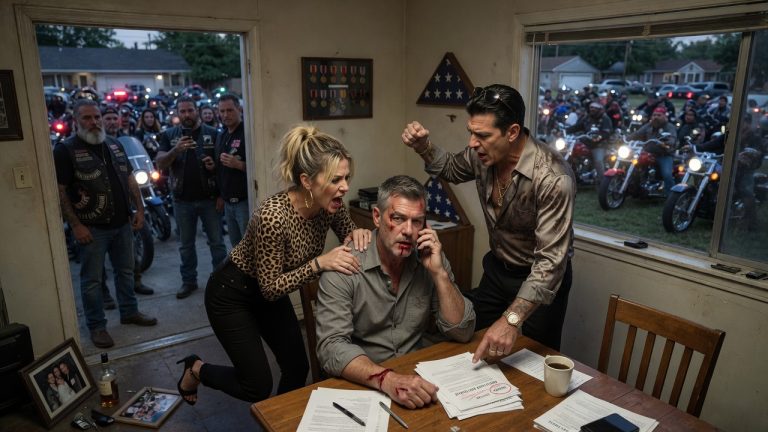
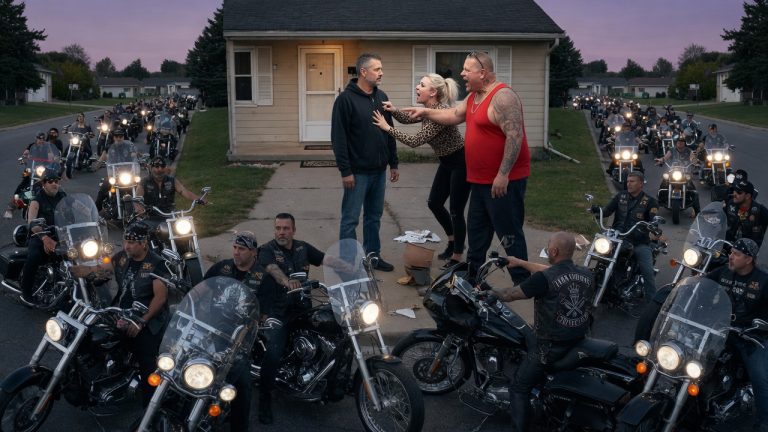
The roar didn’t stop. It grew until it was a physical weight, a wall of sound that made the diner windows vibrate in their frames. One by one, the bikes pulled into the lot, circling the cruiser like a pack of wolves around a wounded deer.
Five hundred men. Men in leather, men with grey beards and scars, men who had been Hammer’s family when he had nothing else. They didn’t shout. They didn’t rev their engines. They just sat there, five hundred engines idling in a low, menacing chorus.
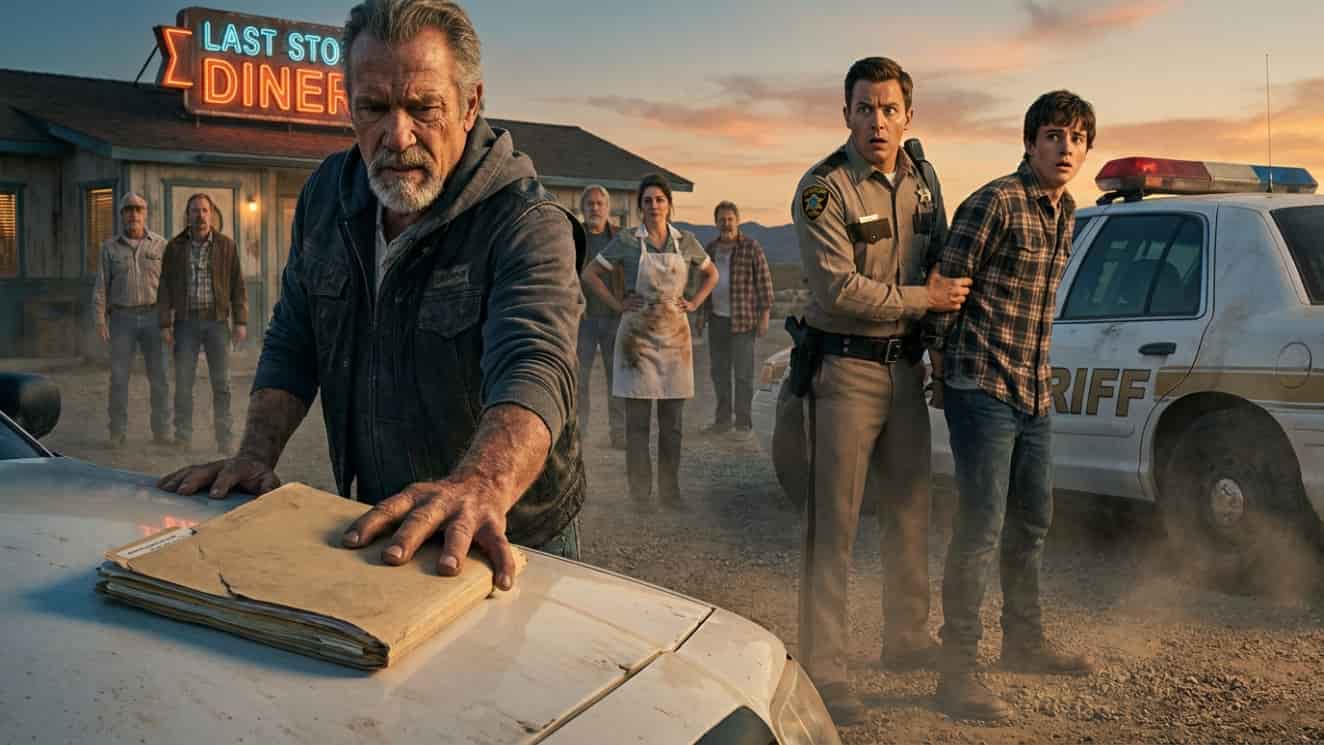
Sheriff Miller Sr. arrived five minutes later. He didn’t come with sirens. He came alone, his face a mask of desperation. He stepped out of his car and saw the sea of denim and leather. He saw his son cowering against the cruiser. And he saw Hammer Thorne holding the ledger.
“”Hammer,”” the Sheriff said, his voice straining to be heard over the engines. “”We can talk about this. We’ve been friends a long time.””
“”We were never friends, Miller,”” Hammer said. He coughed, a violent, hacking sound that forced him to lean against the cruiser. Sam reached out instinctively to steady him, his hand hovering over his father’s leather-clad shoulder.
Hammer pushed himself up. “”You took the money to keep us out of your town, and then you used your boy to hunt my son anyway. You broke the only rule that mattered.””
Hammer tossed the ledger to the Sheriff. It hit him in the chest and fell to the gravel.
“”Keep it,”” Hammer said. “”The copies are already with the state attorney. By morning, there won’t be a Miller left in this county with a job or a badge.””
The Sheriff looked at the book in the dirt. He looked at the five hundred men watching him. He knew it was over. There was no shoot-out. There was no grand stand. There was only the sudden, crushing weight of a legacy collapsing.
“”Take your boy and go,”” Hammer said. “”If I see either of you in this town after sunrise, the Brotherhood won’t be here to watch. They’ll be here to work.””
The Sheriff grabbed Junior by the shoulder and shoved him into his car. They drove away into the dark, the taillights disappearing into the desert haze.
The silence that followed was heavier than the noise had been.
Hammer turned to the men on the bikes. He raised a hand—a simple, tired gesture. One by one, they killed their engines.
“”Go home,”” Hammer said. “”The debt is paid.””
He turned to Sam. The boy was staring at him, his face a map of confusion and grief.
“”Dad?”” Sam whispered. It was the first time he’d used the word in a decade.
Hammer didn’t answer. His legs gave out. He slid down the side of the police cruiser, his breath coming in ragged, shallow gasps.
“”Dad!”” Sam scrambled to the ground, catching him.
“”It’s okay, Sam,”” Hammer wheezed, a ghost of a smile touching his lips. “”I just… I needed to see you stand up to them once. You did good.””
“”You’re sick. We need an ambulance.””
“”No,”” Hammer said, grabbing Sam’s hand. His grip was still strong, the last of his strength channeled into his fingers. “”Look at the bag. In the bike.””
Chapter 6: The Last Will and Testament
They sat in the dirt of the parking lot as the bikers slowly dispersed, leaving only a few of the old guard to stand watch at the edge of the lot. Elena brought out a blanket and a glass of water, her eyes wet as she looked at the two Thorne men.
Sam opened the leather saddlebag on the Shovelhead. Inside wasn’t a gun or more money. It was a stack of letters. Hundreds of them.
He opened the one on top. It was dated four years ago.
Sam, it read. I saw your poem in the University journal. The one about the rain in the desert. I didn’t understand all the words, but I understood the feeling. I’m sorry I’m the reason you had to leave to find it. I’m proud of you. Don’t ever tell me I said so.
Sam read through them, one after another. They were a history of a father watching from the shadows—not a stalker, but a guardian. Hammer had known about Sam’s first job, his first heartbreak, his graduation. He had paid for it all, not to buy Sam’s love, but to pay for the damage he’d done.
“”Why didn’t you just send them?”” Sam asked, his voice thick with tears.
Hammer was leaning back against the tire, his eyes closed. The desert air was cool now, the scent of sagebrush strong.
“”Because as long as I was your enemy, you were safe,”” Hammer whispered. “”If you loved me, you’d have stayed. And if you stayed, you’d have ended up like me. I couldn’t let that happen.””
Sam looked at his father—the man who had dismantled a corrupt government and called an army to his side, all while his lungs were failing him. He realized that Hammer Thorne hadn’t been a ghost. He’d been the foundation.
“”I don’t want the money,”” Sam said.
“”Take it,”” Hammer said. “”Go to Europe. Go to New York. Write your books. Just… remember that a Thorne never bows. Not to a badge, and not to a bully.””
Hammer’s hand went limp in Sam’s. His breathing slowed, becoming a soft, rhythmic whistle that eventually merged with the sound of the wind.
He didn’t die in a hospital bed. He died in the dirt of a town he’d finally made right, with his son’s hand in his and the smell of exhaust in the air.
The next morning, the Sheriff’s office was empty. The ledgers had done their work. The state troopers moved in, and the Miller name became a curse.
Sam Thorne stood in the driveway of the garage. He held the keys to the Shovelhead in his hand. He wasn’t a biker. He was a poet. But as he looked at the open road stretching out toward the mountains, he felt the weight of the name he carried.
He climbed onto the bike. He’d spent his life running from the noise, but today, he wanted to hear it.
He kicked the starter. The engine roared to life—loud, raw, and painfully human.
He rode out of Tonopah, leaving the dust behind. He didn’t look back. He didn’t have to. He knew exactly who was riding with him.”