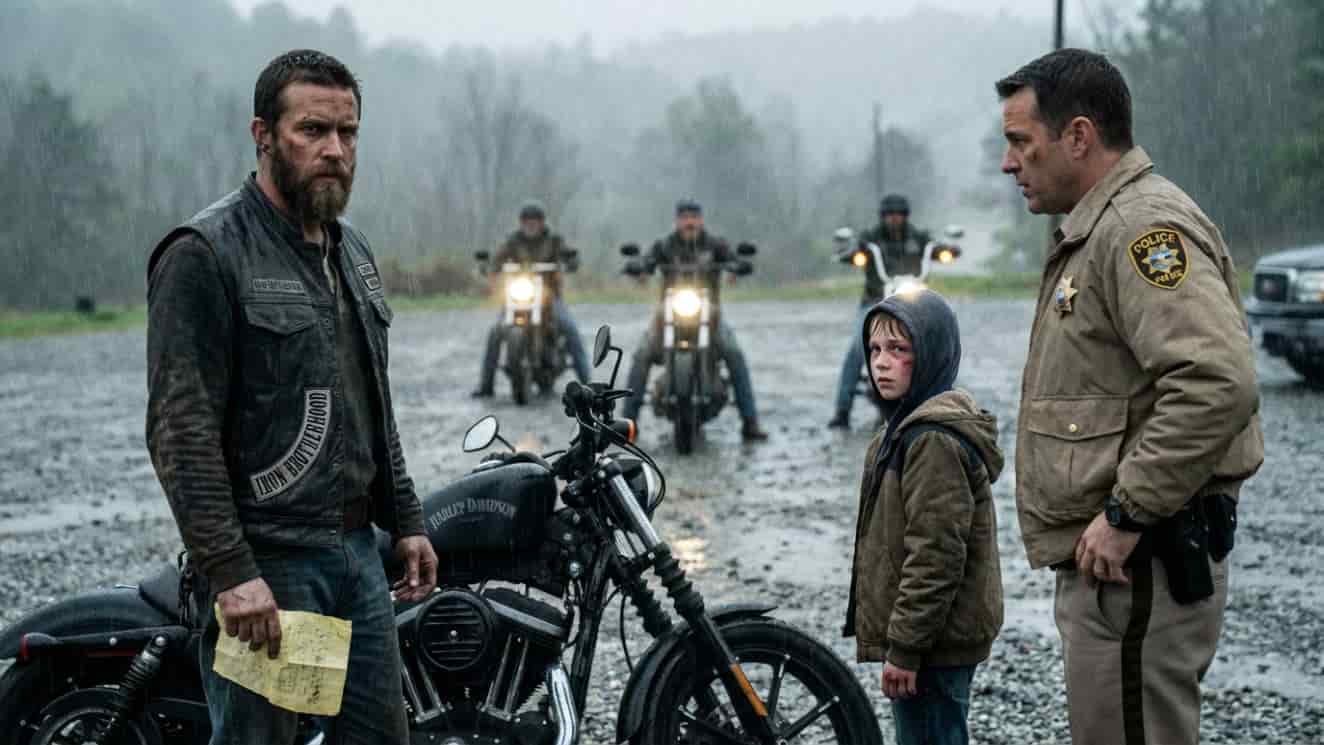
The rain was coming down hard in Blackwood when I saw Officer Miller put his hands on Leo. It wasn’t a “police matter.” It was a bully in a tan shirt picking on a kid who couldn’t fight back—his own son’s favorite target. Miller looked at me like I was roadkill, just another biker trash passing through his mountain town. He didn’t know I’d been watching from the tree line for months. He didn’t know about the letter Leo’s mother wrote me before the cancer took her.
“Step back, Thorne,” Miller spat, his hand twitching toward his gun. “This doesn’t concern you.”
I felt the old heat rising in my chest, the kind of fire that lands a man in state prison. I looked at Leo—my blood, my face, living under a name that wasn’t mine—and I saw the fear in his eyes. But I also saw the moment he realized I wasn’t going to keep riding.
“It concerns me more than you’ll ever know, Miller,” I said. “And by the time the sun goes down, everyone in this valley is going to know exactly whose blood is spilled on that pavement.”
The roar of fifty engines echoed off the ridges, and for the first time in his life, the lawman looked like he was about to break.
Chapter 1
The air in Blackwood didn’t just sit; it clung. It smelled of wet coal dust, pine rot, and the sour metallic tang of the old mine runoff that turned the creek beds the color of rusted knives. I sat on the rusted tailgate of a ’94 Chevy, parked a hundred yards up the ridge from the middle school bus stop. I wasn’t supposed to be there. The court order said fifty yards from the boy, a thousand yards from the mother’s old house, and a lifetime away from the person I used to be.
But the mother was dead, and the boy was bleeding.
I watched Leo through a pair of scratched binoculars. He was twelve, but he carried himself like he was eighty, shoulders hunched, head down, eyes constantly scanning the gravel like he was looking for a place to disappear. He had my nose—straight and slightly too large for his face—and his mother’s nervous habit of picking at the cuticles of his thumbs until they went raw.
He was standing apart from the other kids. A group of three boys, led by a tall, tow-headed kid named Jackson, were circling him. Jackson was the kind of boy who knew exactly how much space he was allowed to take up in a world that favored him. He was the son of Officer Miller, the man who had effectively erased me from the county records while I was doing my seven-to-ten in Mount Olive.
“Look at him,” I muttered to the empty cab of the truck. “Fight back, kid. Just once.”
Jackson said something that made the other boys laugh. He reached out and flicked Leo’s ear. Leo didn’t move. He just tightened his grip on the straps of his backpack. It was a cheap backpack, frayed at the seams, likely something Miller had bought him at the Dollar General just to show he provided the bare minimum.
I felt the itch in my knuckles. It was a phantom sensation, a dull throb that usually preceded a trip to the ER or a jail cell. I’d spent forty-five years being the “Hammer.” I’d led the Iron Brotherhood through three turf wars and two federal investigations. I had a patch on my vest that meant I was the last man standing in a room full of broken glass. And yet, sitting here, I felt like a ghost.
The bus pulled up, a screeching yellow monster that hissed air brakes into the quiet mountain afternoon. The kids scrambled on. Jackson gave Leo one last shove, sending him stumbling into the side of the bus. Leo didn’t look back. He climbed the steps and disappeared into the shadows of the interior.
I started the Chevy. It groaned, the engine laboring against the cold. I didn’t follow the bus. I knew where it went. I drove back toward the garage—Griz’s place. Griz was seventy, with skin like cured ham and hands that stayed permanently stained with 10-weight oil. He was the only one who knew why I was back in Blackwood. The rest of the Brotherhood thought I was scouting new routes for the spring run.
“You look like hell,” Griz said as I pulled into the bay. He didn’t look up from the carburetor he was cleaning. “See him?”
“He’s getting smaller, Griz,” I said, stepping out of the truck. The hinges screamed. “Every day I watch him, he looks like he’s trying to shrink into nothing.”
“He’s a smart kid,” Griz grunted. “Smart kids know when to hide. Especially when they’re living in a house with a man like Miller.”
I walked over to the workbench and picked up a wrench, turning it over in my hand. “Miller’s hitting him. I can see it in the way the boy flinches when anyone moves too fast.”
Griz finally looked up, his eyes milky with cataracts but sharp enough to see through my bullshit. “And what are you gonna do, Silas? Go over there with your colors on? Call in the boys? You do that, and you lose him forever. The state doesn’t give kids to convicted felons with ‘Brotherhood’ tattooed across their throats.”
“I have the letter, Griz. Sarah wrote it three days before she passed. She confessed everything. The dates, the hospital records, the fact that Miller knew the kid wasn’t his but kept him anyway just to spite me.”
“A letter from a dead woman ain’t a ticket to fatherhood,” Griz said, shaking his head. “It’s a suicide note for your freedom. You show that to the wrong person, Miller will have you back in Mount Olive before you can say ‘paternity test.’ He owns the judge, the sheriff, and half the council.”
I didn’t answer. I walked to the back of the shop, where my Harley was parked under a canvas tarp. I pulled the cover back. The chrome caught the dim shop light, reflecting a distorted version of my face—graying, scarred, tired.
The Iron Brotherhood wasn’t just a club. It was a shadow government. We handled the things the law couldn’t, or wouldn’t, touch. But this was different. This wasn’t a dispute over territory or a debt that needed collecting. This was a soul.
I reached into the inner pocket of my vest and pulled out a small, plastic-wrapped bundle. Inside was a single photograph of Sarah, taken a week before I went away. She was smiling, her hair caught in a summer breeze. And behind the photo was the letter. It was written in a shaky hand, the ink smudged in places where her tears had hit the page.
Silas, it read. He’s yours. He’s always been yours. Miller says he’ll take him if I tell. He says he’ll make sure you never see the sun again. Please, if you ever loved me, find a way to save him from becoming like the men in this town.
I tucked the letter back into my vest, right over my heart.
“I’m going to the Blackwood Tavern tonight,” I said.
Griz froze. “That’s a Miller hangout. Don’t be a fool, Silas.”
“I’m not going for Miller,” I said, swinging a leg over the bike. “I’m going to see who’s still loyal to the old ways. If I’m going to take on a cop, I need more than a letter. I need an army.”
I kicked the engine over. The roar filled the garage, vibrating in my teeth, drowning out the sound of the rain and the voice in my head telling me that I was about to ruin everything Sarah had tried to protect.
The road called. The mountains watched. And somewhere in a house that smelled of stale beer and fear, my son was waiting for a man he didn’t know existed to finally come home.
Chapter 2
The Blackwood Tavern was a low-slung building made of cinder blocks and regret. It sat on the edge of the county line, where the asphalt gave way to gravel and the law became a matter of suggestion rather than decree. The neon sign out front flickered with a rhythmic zip-clack, casting a sickly blue light over the row of muddy pick-up trucks and the occasional motorcycle.
I parked my Harley at the far end of the lot, away from the pool of light. I didn’t want to be seen, not yet. I kept my vest buttoned up, hiding the “President” rocker and the Iron Brotherhood patches. In this town, those colors were a declaration of war.
Inside, the air was thick with the smell of fried grease and cheap tobacco. A jukebox in the corner was mourning a lost love through a cracked speaker. I took a stool at the end of the bar, the shadows my only company.
“Draft,” I said to the bartender, a woman with a beehive of bleached hair and eyes that had seen too many Saturday night brawls.
She slid the glass over without a word. I took a sip, the cold beer coating a throat that felt like it had been scrubbed with sandpaper.
Across the room, in a booth by the window, sat Officer Miller. He wasn’t in uniform, but you could tell he was a cop by the way he held his shoulders—arrogant, heavy, as if the weight of his badge gave him the right to displace more air than anyone else. He was with two other men, city council types who laughed too loudly at his jokes.
Miller was holding a glass of bourbon, his face flushed. He was a handsome man in a brutal sort of way—square jaw, clear blue eyes, the kind of face that looked good on a campaign poster but hid a mean streak as wide as the Ohio River.
“So I told the kid,” Miller’s voice boomed over the music, “I said, if you can’t stand up to a few middle schoolers, how are you gonna stand up to the world? He just stared at the floor. Pathological, that one. Just like his mother.”
The men laughed. One of them slapped the table. “He’s a quiet one, for sure, Bill. Doesn’t take after you much.”
Miller’s smile didn’t reach his eyes. It turned into something sharp and jagged. “No. He doesn’t. He’s got that weak streak. I’ve been trying to beat it out of him, but some things are just baked into the bone, I guess.”
I felt the glass in my hand groan. I had to consciously loosen my grip to keep it from shattering. Weak streak. I remembered Leo’s face at the bus stop. It wasn’t weakness. It was endurance. It was the same look I’d seen on men in the hole at Mount Olive—men who knew that every word they spoke was just more ammunition for their captors.
“Hey, buddy,” the bartender said, leaning over the counter. “You okay? You’re turning a bit white around the gills.”
“I’m fine,” I said, my voice sounding like it was coming from a long way off.
I looked back at Miller. He was leaning in now, his voice lower but still carrying in the small bar. “I found him looking at an old photo the other day. One of Sarah and that biker trash she used to run with before I cleaned her up. I took the photo and burned it right in the kitchen sink. Told him that’s what happens to memories that don’t belong in my house.”
I stood up. The stool scraped against the floor, a sharp, violent sound that cut through the conversation. Miller looked up. Our eyes met across the room.
He didn’t recognize me at first. It had been eleven years since the trial. I’d lost weight, grew the beard, and the mountain sun had carved lines into my face that hadn’t been there when I was thirty-four. But then, something shifted in his expression. The arrogance faltered for a fraction of a second. A flicker of recognition, followed by a surge of pure, unadulterated malice.
He stood up slowly, sliding out of the booth. His friends went quiet.
“Well, well,” Miller said, his voice dropping the jovial tone. “I thought I smelled something rotting. Blackwood’s got a strict ordinance against vagrancy, Thorne. Especially the kind that carries a criminal record.”
I didn’t move. I kept my hands at my sides, though every nerve in my body was screaming for me to bridge the distance and put his head through the jukebox. “I’m just a man having a drink, Miller. It’s a free country. Or did you forget that part of the oath?”
Miller walked toward me, his boots clicking on the linoleum. He stopped two feet away. He was taller than me, but I was wider, built of the kind of dense muscle that comes from years of lifting iron and throwing punches in tight spaces.
“It’s a free country for people who contribute,” Miller sneered. “Not for dogs who come back to sniff around a yard they were kicked out of years ago. You’ve got twenty-four hours to get that junk pile of a bike out of my town, Silas. After that, I’ll find a reason to put you in a cage that doesn’t have a door.”
“You haven’t changed,” I said, my voice steady. “Still hiding behind a piece of tin and a gun. Still picking on people who can’t fight back.”
Miller’s face went purple. He leaned in, his breath smelling of bourbon and decay. “I know why you’re here. I saw your truck on the ridge today. You stay away from that boy. He’s mine. I bought him, I paid for him, and I’m the one who decides if he breathes or chokes. You’re nothing but a ghost, Silas. And ghosts don’t have rights.”
He reached out and poked me in the chest, right where the letter was hidden.
I didn’t hit him. Not then. I knew what would happen if I did. But I looked him dead in the eye, and for the first time, I let the “Hammer” show through. I let him see the man who had survived a decade of hell and come out the other side with nothing left to lose.
“The thing about ghosts, Bill,” I whispered, “is that they don’t have anything to fear. You, on the other hand… you’ve got a lot of things that can be taken away.”
Miller flinched. Just an inch. But it was enough.
He backed off, trying to regain his composure. “Twenty-four hours, Thorne. I’m counting.”
He turned and walked back to his booth, but the laughter didn’t start up again. I finished my beer, laid a ten-dollar bill on the bar, and walked out into the cold night.
Griz was wrong. I didn’t need an army to take on Miller. I just needed to show him that the shadow he’d been trying to outrun had finally caught up to him.
But as I rode back to the garage, the wind whipping through my beard, I realized Miller was right about one thing. Leo didn’t know me. To him, I was just a stranger in a leather jacket. If I was going to save him, I had to do more than just threaten a cop. I had to become a father. And I had no idea how to do that without breaking everything in sight.
Chapter 3
The next morning, the fog was so thick you could taste it—a damp, mineral flavor that coated the back of your throat. I didn’t go to the ridge. I went to the school.
I parked the Harley around the corner, hidden behind a row of overgrown privet hedges. I waited near the side entrance, where the kids who didn’t take the bus were dropped off. I saw the black SUV pull up—a late-model Tahoe, the kind of vehicle a man on a civil servant’s salary shouldn’t be able to afford.
Miller was driving. He didn’t get out. He just leaned over and opened the passenger door. Leo hopped out, his movements jerky and uncoordinated. He didn’t say goodbye. He just slammed the door and started walking toward the school, his head tucked into his collar.
Miller sat there for a moment, watching the boy. He tapped a cigarette against the steering wheel, his face a mask of bored contempt. Then he pulled away, the tires spitting gravel.
I waited until the bell rang and the last of the stragglers had vanished inside. I didn’t have a plan, not a good one. I just knew I couldn’t spend another day watching from a distance.
I walked toward the school office. The woman behind the desk was old enough to have been my teacher, but she didn’t recognize me. She looked up from a stack of forms, her glasses perched on the tip of her nose.
“Can I help you, sir?” she asked, her voice wary. Men who looked like me didn’t usually visit the elementary-middle school combination unless they were there to cause trouble.
“I’m looking for Leo,” I said. “Leo Miller.”
She frowned, her fingers hovering over a keyboard. “And you are?”
“A friend of the family,” I said. “His… his mother’s side. I just moved back to town. I have something for him.”
The wariness deepened. “I’m sorry, but without a parent’s permission, I can’t allow any visitors. And Officer Miller is very specific about who is on the approved list.”
“I’m sure he is,” I said. I felt the familiar heat rising. “Look, I’m not here to cause a scene. I just want to give him a book. An old one that belonged to his mom.”
I pulled a small, leather-bound volume of poetry from my pocket. It wasn’t Sarah’s—I’d bought it at a thrift store on the way over—but the lie felt necessary.
The woman softened, just a fraction. “Well, I can take it and give it to him at lunch. But I can’t let you see him.”
“That’s fine,” I said. “Just… tell him it’s from Silas. He won’t know the name, but tell him it’s from a friend.”
I left the book and walked back to the bike. I felt like a coward. I was a man who had led hundreds of bikers into battle, yet I couldn’t even look my own son in the eye.
The day dragged on. I spent it at the garage, helping Griz tear down a transmission. My mind was a whirlwind of calculations. Miller had given me twenty-four hours. That meant by tonight, he’d be looking for a reason to pick me up. I needed to move fast.
I called a number I hadn’t dialed in three years. It was a burner phone, somewhere in a trailer park in West Virginia.
“Yeah?” a gravelly voice answered.
“It’s Hammer,” I said.
There was a long silence on the other end. “I heard you were out. I also heard you went soft and headed back to the hills.”
“I’m in Blackwood, Dutch. And I’m not soft. I’m in a corner.”
“Blackwood?” Dutch laughed, a dry, hacking sound. “That’s Miller’s territory. You trying to get killed, Silas?”
“I need the brothers, Dutch. Not for a run. For a stand. I’ve got a situation here that involves blood. My blood.”
The tone on the other end shifted. Dutch was the Sergeant-at-Arms for the Iron Brotherhood, a man who lived by a code that was older than the Constitution. “You saying the ‘Touch One’ rule applies?”
“I am. Miller’s got my kid. He’s using him as a punching bag, and he’s using the badge to keep me away. I’m going to take the boy back. And I’m going to do it in front of the whole town.”
“How many you need?”
“All of them,” I said. “Everyone within a hundred miles who still remembers what the patch means. I want a wall of leather from the courthouse to the county line.”
“Give us twelve hours,” Dutch said. “We’ll be there before the morning mist lifts.”
I hung up and looked at Griz. He was leaning against the doorframe, his face shadowed.
“You’re starting a fire you can’t put out, Silas,” he said quietly.
“The fire was already burning, Griz,” I said. “I’m just giving it some fuel.”
That afternoon, I went back to the school. I didn’t hide this time. I parked the Harley right at the curb, directly in front of the main entrance. I sat on the bike, arms crossed, my vest open to show the world exactly who I was.
Parents in minivans stared. Some moved their cars to the other side of the lot. The school security guard—a retired deputy who looked like he’d rather be anywhere else—walked toward me, but he stopped ten feet away when I looked at him. He knew the colors. He knew the reputation.
The bell rang. A tide of children poured out of the building. I scanned the crowd until I saw him.
Leo was walking with his head down, but he wasn’t alone. Jackson and his two cronies were following him, chirping at his heels like magpies. As they reached the edge of the sidewalk, Jackson reached out and tripped him.
Leo went down hard, his hands hitting the concrete. His backpack spilled open, notebooks and pencils scattering into the gutter. The other kids laughed.
I didn’t think. I was off the bike before I realized I’d moved.
I was across the grass in three strides. I reached down and grabbed Jackson by the back of his expensive varsity jacket, hoisting him off his feet.
“Hey!” the boy screamed, his face turning pale. “Let me go! My dad’s a cop!”
“I don’t care if your dad is the Pope,” I growled, my face inches from his. “You touch him again, and I’ll make sure you’re eating through a straw for the rest of the semester. Do you understand me?”
I dropped him. He fell in a heap, staring at me with wide, terrified eyes. The other boys scrambled back, disappearing into the crowd.
I turned to Leo. He was still on the ground, looking up at me. His lip was cut, a fresh bead of blood blooming on the skin. But he wasn’t crying. He was just watching me, his eyes searching my face with a desperate, heartbreaking curiosity.
“You okay, kid?” I asked, my voice cracking.
I reached out a hand to help him up. He hesitated, looking at the grease under my fingernails, then at the tattoos on my arms. Slowly, he reached out and took my hand. His skin was cold, his grip frail.
I pulled him to his feet. “You don’t have to take that from them,” I said.
“They say my dad is a loser,” Leo whispered, so low I almost didn’t hear him. “They say he’s a criminal who went away and left me.”
I felt a sharp pain in my chest, worse than any knife wound I’d ever received. “Your dad isn’t a loser, Leo. He’s just a man who made some mistakes. But he never left you. Not in his heart.”
“How do you know?”
Before I could answer, a siren wailed from the end of the block. A cruiser swung around the corner, lights flashing, tires screaming as it pulled up to the curb behind my bike.
Miller stepped out. He didn’t look like the jovial drunk from the bar. He looked like a man who had finally found the excuse he was looking for.
“Get away from the boy, Thorne!” Miller yelled, his hand on his holster. “Hands in the air! Now!”
Leo shrank back, his face clouding with fear. I stood my ground, shielding the boy with my body.
“He fell, Miller,” I said, my voice projecting across the lawn. “I was just helping him up.”
“I saw you assault my son!” Miller shouted, gesturing toward Jackson, who was now playing the victim, huddled near the school door. “You’re under arrest for aggravated assault and violating a restraining order.”
“I don’t have a restraining order against helping a kid who’s being bullied,” I said.
Miller was close now, his face contorted. He didn’t care about the witnesses. He didn’t care about the school. He just wanted me gone. He reached for his handcuffs, but as he did, I leaned in close, so only he could hear.
“The Brotherhood is coming, Bill,” I whispered. “And I have the birth certificate in my pocket. If you touch me, the whole world finds out you’ve been raising another man’s son out of pure, pathetic spite. Is that worth the badge?”
Miller froze. The color drained from his face, leaving it the color of old ash. He looked at me, then at Leo, then at the crowd of parents watching from their cars.
He was trapped. And he knew it.
Chapter 4
The standoff in front of the school felt like a heavy weight pressing down on everyone. The silence was brittle, punctuated only by the distant sound of a lawnmower and the idling engine of Miller’s cruiser.
Miller’s hand stayed on his holster, but it was shaking. I could see the sweat beading on his upper lip despite the cool mountain air. He looked at Leo, who was standing a few feet behind me, clutching the straps of his backpack. The boy looked from me to Miller, his young mind trying to process the sudden shift in reality.
“You’re bluffing,” Miller hissed, his voice barely audible over the hum of the wind. “Sarah wouldn’t have kept anything. She was too scared of what I’d do.”
“She was scared of what you’d do to her,” I said, my voice low and steady. “But she wasn’t scared of what she had to do for him. She loved him more than she feared you. That’s something a man like you can’t understand.”
I reached into my vest and pulled out a folded piece of paper—not the actual birth certificate, but a copy of the letter Sarah had written. I didn’t hand it to him. I just held it up so he could see the handwriting.
Miller’s eyes flickered. He knew that script. He’d seen it on grocery lists and birthday cards for years.
“Thorne, you’re a dead man,” he whispered. “You think a pack of bikers can stop the law in this town? I am the law here.”
“The law is supposed to protect the innocent, Bill. You’ve spent ten years using it to hide a lie. That’s not law. That’s a hostage situation.”
I turned to Leo. “Go get in the truck, kid. Griz is waiting at the end of the block. He’ll take you to the garage.”
Leo hesitated. He looked at Miller, then back at me. “But… he’s my dad.”
The word felt like a hot iron pressed against my ribs. I looked at Miller, who was now regaining some of his bravado.
“That’s right, Leo,” Miller said, his voice dripping with fake paternal concern. “Get away from this man. He’s a dangerous criminal. He’s trying to confuse you.”
“Leo,” I said, kneeling down so I was at eye level with him. I ignored Miller’s hand moving toward his gun. “I’m not going to lie to you. I’ve done bad things. I’ve lived a hard life. But I never stopped thinking about you. Every night I was away, I told myself I’d find a way back. Because you’re not a Miller. You’re a Thorne. And Thornes don’t let people break them.”
Leo’s eyes widened. He looked at the “Thorne” name embroidered in small letters on the inside of my vest, a detail I’d forgotten was even there. Then he looked at Miller’s badge.
“Is it true?” Leo asked Miller.
Miller didn’t answer. He just reached out and tried to grab Leo’s arm. “I said, get in the car, Leo!”
I stepped between them, my shoulder catching Miller in the chest and sending him stumbling back.
“Don’t touch him,” I warned.
Miller snapped. He drew his weapon.
The crowd of parents screamed. Cars began to peel away, tires screeching as people fled the potential crossfire. The school security guard finally moved, drawing his own weapon, but he looked unsure of where to point it.
“Drop it, Thorne!” Miller screamed, his face bright red. “Get on the ground or I’ll open you up right here!”
I didn’t move. I didn’t reach for a weapon, though I had a folding knife in my pocket. I just stood there, my heart hammering against my ribs like a trapped bird. I looked at the barrel of the Glock, then up at Miller’s eyes. He was terrified. A man with a gun who is scared is the most dangerous thing on earth.
“Go ahead, Bill,” I said softly. “Kill me in front of your son. Kill me in front of the whole school. Prove to everyone exactly what kind of ‘hero’ you are. But just know, once you pull that trigger, the truth goes out to every news station in the state. Griz has the originals. You can’t kill a secret once it’s out of the bag.”
Miller’s finger tightened on the trigger. I saw the muscle in his jaw clench. He wanted to do it. He wanted to erase me from the world a second time.
But then, the sound started.
It began as a low vibration in the pavement, a rhythmic thrumming that grew into a bone-shaking roar. It sounded like a thunderstorm rolling down from the ridges, but it was too steady, too mechanical.
Twenty motorcycles crested the hill at the end of the street. They were riding in a tight formation, two by two, a wall of chrome and black leather. At the front was Dutch, his grey beard flying in the wind, his eyes fixed on the scene in front of the school.
They didn’t slow down. They roared past the abandoned minivans and pulled onto the school lawn, circling us like a pack of wolves. The engines stayed running, a deafening, aggressive growl that filled the air with the smell of unburnt fuel.
Miller turned, his gun hand wavering as he saw the sheer number of men surrounding him. These weren’t townies. These were the Iron Brotherhood—men with scars on their faces and “No Mercy” stitched onto their souls.
Dutch killed his engine. The silence that followed was even more terrifying than the noise. He stepped off his bike, his boots crunching on the gravel. He didn’t look at me. He looked at Miller.
“Put the piece away, Officer,” Dutch said, his voice like grinding stones. “You’re making the brothers nervous. And when the brothers get nervous, they start looking for things to break.”
Miller looked around. He was surrounded by twenty men who viewed his badge as a target rather than a shield. He looked back at me, his eyes full of a frantic, cornered light.
“You brought them here,” Miller whispered. “You brought this filth to my town.”
“I brought my family to meet my son,” I said.
I looked at Leo. He was staring at the bikers with awe, his fear momentarily forgotten. He saw the strength in them, the way they stood together, a wall of iron that even the law couldn’t penetrate.
“Leo,” I said. “Go with Griz. He’s the one in the white truck over there. I’ll be there in a minute. I promise.”
This time, Leo didn’t hesitate. He looked at Miller one last time—a look of cold, clear-eyed realization—and then he turned and ran toward Griz’s truck.
Miller tried to follow, but Dutch stepped into his path.
“I wouldn’t,” Dutch said.
Miller lowered his gun, his shoulders slumping. He knew he’d lost. Not because of the bikes, but because the boy had made a choice. The lie was dead.
“This isn’t over, Thorne,” Miller spat, though the words had no weight behind them. “I’ll have the State Police here in twenty minutes.”
“Then you’d better start thinking about what you’re going to tell them when they ask why you’ve been falsifying birth records for a decade,” I said.
I walked back to my Harley. My legs felt like lead, and the adrenaline was starting to fade, leaving me hollow and shaking. I climbed onto the bike and kicked it over.
“We’re going to the garage,” I told Dutch.
“We’re with you, Hammer,” Dutch said, slapping my shoulder. “All the way.”
As we rode away, I looked back in the mirror. Miller was standing alone on the school lawn, a small, pathetic figure in a tan uniform, holding a gun he no longer knew how to use.
But the victory felt hollow. I’d won the battle, but I’d just invited a war into the life of a twelve-year-old boy. I had the son I’d dreamed of for eleven years, but I had no idea if he’d ever forgive me for the man I was.
We rode through the heart of Blackwood, twenty-one bikes strong. The townspeople watched from their porches, their faces full of fear and wonder. The Iron Brotherhood was back. And for the first time in my life, I wasn’t riding for the club. I was riding for a boy who had finally learned his real name.
Chapter 5
The roar of twenty-one engines didn’t just fade when we pulled into Griz’s lot; it settled into the dirt like a physical weight. The gravel pinged against hot chrome, and the smell of ozone and burnt oil hung in the damp air. Griz’s white Chevy was already there, tucked into the shadows of the main bay. I saw Leo through the windshield, his small face a pale moon behind the glass. He didn’t move when I kicked my stand down. He just sat there, watching the wall of leather and denim surround his world.
Dutch hopped off his bike, his joints popping like small-caliber rounds. He surveyed the garage with the practiced eye of a man who spent his life looking for exits and firing lines. “Nice place, Silas. A bit exposed for a siege, but it’s got character.”
“It’s not a siege, Dutch,” I said, though my hands were shaking as I pulled off my gloves. “It’s a mechanic’s shop.”
“In this county, with that cop? It’s whatever he decides it is,” Dutch countered. He turned to the other men—rough-edged brothers from the Morgantown and Charleston chapters. “Set a perimeter. Two on the road, two behind the scrap heap. If a cruiser so much as breathes on that asphalt, I want to know about it before the dust settles.”
I walked toward the truck. My boots felt like they were made of lead. Every step was a reminder of the eleven years I’d missed—the birthdays, the scraped knees, the first time he’d been bullied and had no one to tell him how to hit back. Griz stepped out of the driver’s side, his face looking older than the hills themselves.
“He’s spooked, Silas,” Griz whispered, grabbing my arm. “You brought a goddamn war to his doorstep. He doesn’t know if you’re saving him or kidnapping him.”
“I’m his father, Griz.”
“To you, maybe. To him, you’re the man who just threatened a cop and brought twenty monsters to town.” Griz let go, his eyes full of a weary pity. “Go easy. He’s brittle.”
I opened the passenger door. Leo was huddled against the seat, the cheap poetry book I’d left at the school clutched in his lap. He looked at me, and for a second, I saw Sarah in the set of his jaw—the quiet, stubborn endurance that had kept her alive long enough to write that letter.
“Hey,” I said. The word felt too small for the room.
Leo didn’t speak. He looked out the window at Dutch, who was leaning against a bike, lighting a hand-rolled cigarette. “Are they going to hurt him?” Leo finally asked. His voice was thin, reedy.
“Miller?” I asked.
Leo nodded. “He’s… he’s the only dad I’ve ever had. Even when he’s mean. Even when he drinks.”
I sat on the edge of the seat, leaving the door open so he didn’t feel trapped. “Nobody’s going to hurt anyone if they stay away, Leo. But he lied to you. He took you from where you belonged because he wanted to hurt me. Does that feel like a dad to you?”
Leo looked down at the book. “He said you were dead. He said you died in a car wreck because you were drunk. He told me that’s why I have to be perfect. So I don’t end up like the trash that made me.”
The rage that flared up in my gut was so hot I thought it might actually burn through my vest. Miller hadn’t just stolen my son; he’d poisoned the well. He’d made my existence a cautionary tale to keep the boy compliant.
“I wasn’t in a wreck, Leo. I was in prison. I did something I shouldn’t have done to protect a man I called a brother. I paid for it with ten years of my life. But I never forgot you. And your mom… she wanted you to know the truth.”
“Why didn’t she tell me?”
“Because she was scared,” I said, and the honesty of it tasted like copper. “She was scared of Miller. He’s got power in this town. He’s got the badge. He told her if she ever spoke up, he’d put her in the ground and make sure I never saw a day of freedom again. She was protecting you the only way she knew how.”
Leo finally looked at me. His eyes were red-rimmed, but there was a spark of something—anger, maybe, or just the first crack in a decade-long foundation of lies. “You look like me,” he whispered.
“No,” I said, a small smile breaking through. “You look like me. I’m just the rough draft.”
I reached out, tentatively, and touched his shoulder. He didn’t flinch. It was the first real contact we’d had since he was in diapers, and it felt more significant than any oath I’d ever sworn to the Brotherhood.
Outside, the sun was starting to dip behind the jagged peaks of the Appalachians, casting long, bruised shadows across the valley. The Brotherhood was moving with a quiet, lethal efficiency. They were starting a fire in an old oil drum to keep the chill off. It looked like a camp in a combat zone.
Dutch walked over, his face grim. “Silas. We got a problem.”
I stepped out of the truck, nodding to Leo to stay put. “What is it?”
“A local scout just radioed in. Miller isn’t calling the State Police. Not yet. He’s calling in favors. I got word that three of his cousins and a handful of the ‘good old boys’ from the hunting club are loading up. They’re coming for the kid, Silas. And they aren’t coming with warrants.”
“He’s going to try to take him by force?” I felt the ‘Hammer’ coming back, the cold clarity that happens right before the first punch is thrown. “In front of twenty patched members?”
“He thinks we’re just bikers,” Dutch said, spitting into the dirt. “He thinks he can run us out of town like a bunch of weekend warriors. He doesn’t realize this is a blood claim now.”
Griz walked over, holding a heavy iron pipe. “If this turns into a shootout with the kid here, Silas, you’ve lost before you’ve even started. You know that, right?”
“I know,” I said. I looked at the garage, then at the mountain road. “I’m not going to let him turn this into a massacre. Griz, take Leo into the back office. Lock the door. If things go south, there’s a crawlspace under the floorboards that leads out to the creek. You take him and you don’t stop running until you hit the county line.”
“Silas—”
“Do it, Griz.”
I watched them go. Leo looked back at me one last time before the office door clicked shut. I felt a strange, hollow peace. I’d spent my whole life fighting for things that didn’t matter—territory, respect, a patch of leather. For the first time, I was fighting for something that actually had a future.
“Dutch,” I said, turning to the SAA. “Tell the boys to kill the lights. We don’t want them seeing us until they’re already in the mouth of the trap.”
“You want to talk first, or just hit?”
“I want to give him one last chance to be a man,” I said. “But keep your hand on your piece. Miller doesn’t know how to lose, and a man like that is prone to making mistakes.”
The valley went dark. The only sound was the crackle of the wood in the oil drum and the distant, low-frequency hum of four-wheel-drive engines climbing the ridge. The Iron Brotherhood melted into the shadows of the garage, becoming part of the grease and the rusted metal. I stood in the center of the bay, right under the dim, swinging shop light, waiting for the ghost of my past to show his face.
Chapter 6
The headlights hit the garage like twin spotlights, cutting through the mountain mist. Three trucks—heavy, mud-caked F-150s—screeched to a halt in the gravel lot, their high beams blinding. I didn’t squint. I stood there in the center of the bay, my shadow stretching out behind me like a long, dark road.
Miller stepped out of the lead truck. He wasn’t wearing his tan uniform anymore. He was in a camouflage jacket and jeans, a hunting rifle held loosely in the crook of his arm. Behind him, four other men climbed out. They were the kind of men who ran the local mills and sat in the front pews on Sundays—men who thought their status in a dying town gave them the right to play god.
“Where is he, Thorne?” Miller shouted. His voice was ragged, the sound of a man who had been drinking his way through a panic attack. “Give me the boy and maybe I’ll let you ride out of here with your skin intact.”
“The boy’s where he belongs, Miller,” I said, my voice projecting easily in the quiet night. “With his father. You’re trespassing.”
“I’m his father on every piece of paper that matters!” Miller took a step forward, the rifle coming up slightly. “You’re a ghost. You’re a memory that should have stayed buried in Mount Olive. You think these grease-monkeys are going to protect you?”
One of the men with Miller, a thick-necked guy with a goatee, laughed. “Look at him, Bill. Standing there like he’s in a movie. You want us to clear him out?”
“Stay back, Dave,” Miller muttered. He was looking at the shadows. He wasn’t stupid. He could feel the eyes on him, even if he couldn’t see the bodies. “Thorne, I’m giving you ten seconds. Then we’re coming in.”
“You remember what I told you at the school, Bill? About the letter?” I reached into my vest and pulled out a heavy, manila envelope. “I wasn’t lying. I’ve got the birth certificate. I’ve got the hospital records Sarah hid in the crawlspace of your own house. And I’ve got her confession, witnessed and notarized by a woman you forgot to intimidate.”
Miller froze. The rifle barrel wavered. “You’re lying. She didn’t have the guts.”
“She had enough guts to keep your son alive for ten years,” I said. “I’m going to make you an offer, and it’s the only one you’re getting. You turn those trucks around and you drive home. Tomorrow morning, you go down to the station and you hand in your badge. You cite ‘family reasons’ or ‘health issues,’ I don’t care. But you get out of law enforcement, and you get out of this county.”
“And if I don’t?”
“Then the Brotherhood goes to the District Attorney. Not the one here—the one in the city. We show them the records. We show them the evidence of how you used your position to suppress a legal father’s rights and falsify state documents. You won’t just lose your job, Bill. You’ll be wearing the same orange jumpsuit I wore. And believe me, the boys inside? They have a special way of welcoming former cops.”
The silence that followed was thick enough to choke on. Miller’s friends looked at each other, the bravado starting to leak out of them. They were here for a bit of local intimidation, not a federal fraud case and a prison sentence.
“Bill?” Dave asked, his voice uncertain. “What’s he talking about? You said the kid was yours.”
“Shut up!” Miller screamed. He turned his gaze back to me, and I saw the break. It wasn’t a tactical retreat; it was a total collapse of the ego. “You took everything! I gave that woman a life! I gave that kid a name! And you think you can just walk back in here and take it?”
“I’m not taking it,” I said softly. “I’m claiming what was already mine. You were just holding it for me. And you did a real bad job of it.”
Miller roared—a primal, ugly sound—and leveled the rifle.
He never got the shot off.
A red laser dot appeared on the center of his chest. Then another on his forehead. From the darkness of the scrap heap, Dutch stepped out, holding a tactical carbine. On the roof of the garage, two more brothers appeared, their weapons trained on the trucks.
“Drop it, Miller,” Dutch said. “Unless you want to see what a .223 does to a camo jacket at twenty yards.”
The other men with Miller didn’t hesitate. They dropped their shotguns and put their hands in the air. They were hunters, but they weren’t soldiers. They knew when they were outmatched.
Miller stood there, the rifle trembling in his hands. He looked at the red dots, then at me. For a second, I thought he might do it anyway—suicide by biker. I saw the finger tighten on the trigger.
“Think about your own son, Bill,” I said. “Jackson. If you pull that trigger, he grows up with a father who died a murderer and a liar. Is that the legacy you want to leave him?”
The mention of his son seemed to sap the last of the strength from his legs. The rifle slipped from his hands, clattering onto the gravel. Miller fell to his knees, his face buried in his hands, sobbing with a jagged, ugly sound that echoed off the metal walls of the garage.
Dutch moved in quickly, kicking the rifle away and zip-tying Miller’s hands. The other brothers rounded up the “good old boys” and ushered them toward their trucks.
“Get them out of here,” I told Dutch. “I don’t want the boy seeing this.”
“What about him?” Dutch nodded toward Miller.
“Leave him. He’s finished. He’ll sign the papers tomorrow, or he’ll be in a cell by Monday. He knows the math.”
The Brotherhood cleared the lot with the same terrifying efficiency they’d arrived with. Within ten minutes, the trucks were gone, and the mountain road was quiet once again. Dutch gave me a nod, a silent acknowledgement of a job done, and led the pack back toward the highway. The roar of the bikes faded into the distance, leaving only the sound of the wind in the pines.
I walked to the office door and knocked softly. “It’s over, Griz. Bring him out.”
The door opened. Leo stepped out first. He looked at the empty lot, at the discarded rifle in the dirt, and then at me. He looked older than he had that morning. The innocence was gone, replaced by a hard-won clarity.
“Is he gone?” Leo asked.
“He’s gone,” I said. “He won’t be coming back.”
Griz stayed in the doorway, watching us. I knew what came next wouldn’t be easy. There were lawyers to hire, custody hearings to navigate, and a decade of trauma to unpack. I was a man with a criminal record and a leather vest, trying to raise a boy who had been taught to hate me.
“So,” Leo said, kicking a piece of gravel. “What now?”
I looked at the Harley, then at the old Chevy truck. I looked at the mountains that had held me and hurt me in equal measure.
“Now,” I said, “we go get some dinner. Somewhere that doesn’t serve beer. And then we figure out how to be Thornes.”
Leo looked at me, and for the first time, he didn’t look like a ghost. He reached out and touched the patch on my arm—the one that said Iron Brotherhood.
“Can I learn to ride?” he asked.
I felt a lump in my throat that I couldn’t swallow. I put my arm around his shoulders—carefully, so as not to overwhelm him—and led him toward the truck.
“Maybe in a few years, kid,” I said. “For now, let’s just work on the bicycle. One thing at a time.”
As we pulled out of the lot, the headlights of the Chevy cut through the darkness, illuminating the road ahead. It was a long, winding path through the heart of the Appalachians, full of sharp turns and hidden dangers. But for the first time in eleven years, I wasn’t riding away from something. I was heading home.
The weight of the past was still there, tucked into my vest in the form of a yellowed letter and a blood-stained birth certificate. But as Leo leaned his head against the window and closed his eyes, I realized that some debts are never fully paid—they’re just traded for something better. And I was more than willing to spend the rest of my life making good on the interest.