The wrench in Julian’s hand felt a lot heavier once he saw the patch on my father’s back.
I’ve spent twenty-two years thinking my dad was just a man who fixed lawnmowers and kept his head down. I’d seen him apologize to neighbors for the noise of his shop. I’d seen him sit quietly while my mother’s physical therapist talked down to him. I thought he was soft. I thought he was safe.
But when those guys from the hills dragged me out to the old lot because of a debt I didn’t even owe, my father didn’t call the police. He didn’t come to negotiate. He showed up on a bike I’d never seen, wearing a leather jacket that smelled like thirty years of gasoline and secrets.
“Get up, Ben,” he said. His voice wasn’t the one that tucked me in. It was a growl that stopped the wind.
When the headlights started appearing on the ridge—dozens of them, a wall of chrome and fire—I realized my father wasn’t just a mechanic. He was the reason the ghosts of this valley stayed quiet. And tonight, for me, he was letting them out.
Chapter 1: The Weight of Clean Hands
The smell of Pennzoil and old coffee was the only thing that kept the world steady for Cane Cassidy. It was a thick, honest smell. It didn’t lie to you, and it didn’t ask you for anything it hadn’t earned. He sat on a low rolling stool in the center of Cassidy’s Small Engine Repair, the fluorescent lights overhead humming a low, electric tune that vibrated in his teeth.
Between his knees was a carburetor from a 1994 John Deere. His hands, mapped with scars that looked like pale lightning strikes against his tanned, oil-stained skin, moved with a precision that defied his size. He was a big man, built like a tectonic plate, but when he handled a needle valve, he was as delicate as a watchmaker.
“Dad? You still in here?”
Cane didn’t look up immediately. He finished seating the gasket first. “Back here, Ben. Just closing up the throat on this beast.”
Ben stepped into the pool of light, looking like he’d been imported from a different planet. He was wearing a slim-fit navy suit, his white shirt crisp enough to cut paper, and a leather satchel slung over his shoulder. At twenty-two, Ben had his mother’s sharp jawline and Cane’s deep-set, observant eyes. He looked like a success story. He looked like the dream Cane had been paying for in sweat and transmission fluid for two decades.
“Long day at the firm?” Cane asked, finally wiping his hands on a rag that was more black than red.
“Miller’s got me doing research on a land-use case,” Ben said, leaning against a workbench covered in rusted spark plugs. He looked tired, but it was a clean kind of tired. “It’s a lot of reading, but he says if I keep this pace, I’ll have a junior associate slot waiting the day I pass the bar.”
Cane nodded, a slow, deliberate movement. “That’s the goal. Keep your hands clean, son. There’s enough dirt in this valley for everyone else.”
It was a ritual, this exchange. The mechanic and the future lawyer. The man who lived in the grease and the boy who was meant to rise above it. Cane took a perverse pride in the grease under his own fingernails because it meant Ben didn’t have any.
“How’s Mom?” Ben asked, his voice softening.
Cane’s eyes flicked toward the back door of the shop, which led through a short breezeway to their small, sun-bleached ranch house. “Good. Physical therapy went well today. She’s got more sensation in the left foot. She’s in the kitchen now, trying to convince a pot of chili not to burn.”
Ben smiled, but it was a fleeting thing. He reached out, picking up a heavy silver wrench from the bench. He turned it over in his hands, his thumb tracing the “C.C.” engraved in the steel. “You know, Julian and his friends saw me leaving the office today. They were parked across the street in that neon green McLaren.”
Cane’s movements stopped. It was barely perceptible—a slight tightening of the shoulders—but the air in the shop suddenly felt denser. “Julian Vance?”
“Yeah. He thinks it’s funny. Me, the ‘scholarship kid,’ working for the firm that handles his father’s estate. He told me I should remember who signs the checks in this town.”
“He’s a boy with too much chrome and not enough engine,” Cane said, his voice dropping an octave. “You stay clear of him, Ben. People like that… they don’t understand that things can break. They think everything is replaceable.”
“I know, Dad. I just… sometimes I wish I didn’t have to take it. He’s been leaning on me since high school, and now he’s doing it in front of the partners.”
Cane stood up. He was a head shorter than Ben, but he seemed to occupy three times the space. He walked over and took the wrench from Ben’s hand, placing it back in its shadow on the tool board. “There’s a difference between being a man who takes it and a man who waits. You’re waiting for your life to start. Don’t let a ghost like Julian Vance pull you into the weeds. You’ve got too much to lose.”
Ben nodded, but there was a flicker of something in his eyes—a resentment that Cane recognized too well. It was the look of a man who wanted to strike back but didn’t know how to do it without destroying himself.
They walked into the house together. The kitchen was warm, filled with the spicy, earthy scent of cumin and slow-cooked beef. Sarah was sitting in her wheelchair at the end of the table, her blonde hair pulled back in a practical ponytail. She looked beautiful, even with the lines of chronic pain etched around her mouth.
“The lawyers are home,” she said, her voice a bright chime in the quiet room.
Cane went to her first, leaning down to kiss her forehead. He lingered there for a second, his nose catching the scent of her lavender soap. It was his anchor. Every time he felt the old itch in his knuckles, the old roar of a straight-pipe exhaust in the back of his brain, he smelled her soap and remembered why he’d buried the “King.”
“Ben looks like he’s about to fall over,” Sarah said, reaching out to pat Ben’s hand. “Sit. Eat. Tell me about the big city.”
The dinner was quiet, filled with the small talk of a family that had survived a catastrophe and decided to never speak of the wreckage again. They talked about the law firm, the grocery prices in Bakersfield, and the neighbor’s barking dog. They didn’t talk about the night twenty years ago when the blacktop had screamed. They didn’t talk about the leather jacket locked in a trunk in the crawlspace. They didn’t talk about the fact that Cane Cassidy used to be a name that made state troopers pull over to the side of the road just to let him pass.
After Ben went to his room to study, Cane helped Sarah into bed. It was a slow, practiced dance. He lifted her with an ease that spoke of decades of muscle memory.
“He’s worried, Cane,” Sarah whispered as he tucked the blankets around her legs.
“He’s just tired, Sarah. The law is a heavy bucket to carry.”
“No,” she said, her eyes finding his in the dim light of the bedside lamp. “He’s worried about the Vances. Julian has been bothering him. I saw a bruise on Ben’s ribs when he was changing for the gym yesterday.”
Cane felt a cold drop of lead settle in his stomach. “He didn’t tell me.”
“He wouldn’t. He wants to be like you. He wants to be the man who handles everything without making a sound.” She reached out, her fingers grazing the callouses on his palm. “But you and I both know that silence has a price, Cane. Don’t let him pay it alone.”
Cane didn’t answer. He turned off the light and sat in the dark for a long time, listening to the wind whip through the sagebrush outside. He looked at his hands. They were clean of blood, mostly. Just grease and age. He wanted them to stay that way. He’d promised Sarah, the night she came home from the hospital in a chair, that the “Kings of Dust” were dead.
But as he sat there, he could hear the faint, distant whine of a high-performance engine out on the highway—some rich kid pushing a car he didn’t deserve toward a cliff he couldn’t see. And for the first time in twenty years, Cane Cassidy felt the ghost of a throttle beneath his right hand.
Chapter 2: The High Cost of Chrome
The neon green McLaren was parked in the fire lane in front of the law offices of Miller & Associates. It looked like a radioactive insect, out of place against the grey stone and dignified ivy of the building. Julian Vance was leaning against the hood, a pair of five-hundred-dollar sunglasses perched on his nose, watching the glass doors with the patience of a predator who knew the schedule of the local deer.
When Ben stepped out at 5:30 PM, his satchel heavy with case files, Julian straightened up. He didn’t say anything at first. He just smiled—a thin, rehearsed expression that didn’t reach his eyes.
“Hey, Counselor,” Julian called out.
Ben kept his head down, his pace quickening toward the bus stop. “I’m busy, Julian. I’ve got work.”
Julian moved with a deceptive, athletic grace, cutting Ben off before he reached the curb. Two of Julian’s hangers-on—boys with expensive haircuts and vacant stares—stepped out from behind a nearby SUV, flanking him.
“Work is for people who don’t have options, Ben,” Julian said, his voice smooth and condescending. “My father is wondering why the research on the Valley Project is taking so long. He thinks maybe you’re being a little… thorough. Or maybe you’re just slow, like your old man.”
Ben stopped. He felt the heat rising in his neck, the familiar, stinging shame of being the scholarship kid in a town owned by the Vances. “My father is a better man than anyone in your family, Julian. Leave him out of this.”
Julian laughed, a sharp, barking sound. He stepped closer, leaning into Ben’s space. The smell of expensive cologne and imported tobacco rolled off him. “Your father is a ghost, Ben. He’s a guy who fixes tractors in a shed. My father owns the ground that shed sits on. Remember that.”
Julian reached out, his hand moving fast. He didn’t punch Ben; he just shoved him, a hard, disrespectful jolt to the shoulder that sent Ben stumbling back against a brick wall. The satchel slipped, spilling papers across the damp sidewalk.
“Oops,” Julian said, looking down at the scattered documents. “Looks like you’ve got more work to do, Counselor. Why don’t you pick those up? And while you’re down there, think about that debt we talked about.”
“I don’t owe you anything,” Ben hissed, kneeling to gather the papers. His hands were shaking, not with fear, but with a cold, vibrating rage that felt like it was trying to crack his ribs.
“Your buddy Marcus did,” Julian said, his voice dropping. “He lost big on the street races last month. Ten grand. And since you’re the one who introduced him to the crew, and since you’re the one with the ‘bright future,’ I figured you’d want to make sure Marcus doesn’t lose a couple of fingers. Or a kneecap.”
Ben looked up, his eyes wide. “Marcus? I haven’t seen him in weeks.”
“Exactly. He’s hiding. But we know where you are, Ben. We know where the shop is. We know where the lady in the wheelchair lives.”
The world went silent for Ben. The sound of the city, the buses, the wind—it all vanished, replaced by a high-pitched ringing. He looked at Julian, really looked at him, and saw the utter lack of empathy in the boy’s eyes. Julian didn’t want the money. He wanted the power. He wanted to see the “golden boy” break.
“Don’t you ever mention my mother,” Ben said, his voice trembling.
Julian smirked and tapped the side of his head. “Lot 47. Saturday night. Bring the money, or bring a very good reason why we shouldn’t pay a visit to the shop. I hear those old engines catch fire pretty easy.”
Julian turned and climbed into the McLaren. The engine roared to life, a high, screaming wail that echoed off the office buildings like a taunt. He sped away, leaving Ben alone on the sidewalk, clutching a handful of dirt-streaked legal briefs.
Ben didn’t go home immediately. He sat at the bus stop for an hour, watching the sky turn the color of a fresh bruise. He couldn’t tell his father. He knew what Cane would do—he’d go to the police, or he’d try to talk to Julian’s father, Marcus Vance. But Ben knew the Vances. They owned the police. They owned the judges. They were the law in this part of California.
If he told his dad, he’d see that look of quiet disappointment again. The look that said I worked twenty years so you wouldn’t have to deal with people like this, and you failed.
Ben walked home in the dark. When he entered the kitchen, the house was quiet. His mother was already in bed. His father was out in the shop, the blue glow of a welder flickering through the windows.
Ben went to the bathroom and pulled up his shirt. There was a fresh, purple mark on his ribs where one of Julian’s friends had kneed him while he was picking up the papers. He looked at himself in the mirror—the suit, the tie, the “clean hands.” He looked like a lie.
He went to his desk and opened a drawer, pulling out an old, faded photograph he’d found years ago in the attic. It showed a group of men standing in front of a row of motorcycles. They looked hard, dangerous, and wild. In the center was a younger version of his father. He was wearing a leather jacket with “KING” emblazoned across the back in silver studs. He looked like a man who had never apologized for anything in his life.
Ben had asked about the photo once, when he was ten. Cane had taken it from him, his face turning to stone, and told him it was from a “different life” that didn’t matter anymore.
“The man in that photo is dead, Ben,” his father had said. “Don’t go looking for his ghost.”
But as Ben looked at his own bruised reflection, he realized that the “clean life” his father had built was a glass house, and Julian Vance was holding a bag of rocks. He didn’t need a mechanic. He didn’t need a lawyer. He needed the ghost.
Chapter 3: The Gathering of Shadows
Cane Cassidy knew something was wrong the moment Ben walked into the shop the next morning. It wasn’t the way he moved—Ben was always careful—it was the way he avoided the light. He stayed in the shadows by the parts bin, his movements jerky, eyes darting to the door every time a car passed on the road outside.
“Parts are in for the generator,” Cane said, not looking up from a cylinder head. “I need you to run them over to the Miller farm this afternoon.”
“I can’t, Dad. I’ve got… I’ve got to go into the city. Extra research.”
Cane stopped. He set the torque wrench down with a deliberate clack. He wiped his hands and walked over to his son. He didn’t say a word; he just reached out and hooked a finger under Ben’s chin, lifting his head.
The bruise on Ben’s jaw was small, but to Cane, it looked like a crater.
“Who?” Cane asked.
“It’s nothing, Dad. I tripped.”
“You tripped into someone’s knuckles? That’s a neat trick. Who was it, Ben? Julian?”
Ben pulled away, his face twisting with frustration. “It doesn’t matter! You told me to stay in the lines, right? Stay clean? Well, the lines are rigged, Dad! I’m working my ass off for a future that they can just take away whenever they feel like it.”
“They can’t take what’s inside you,” Cane said, his voice dangerously low.
“They can take you! They can take Mom! Julian told me if I don’t pay Marcus’s debt, he’s coming here. He said the shop might catch fire. He laughed about it, Dad! He laughed like it was a game!”
Cane felt a familiar coldness spreading from his spine to his fingertips. It was a sensation he hadn’t felt since the night the world ended—a crystalline clarity that simplified everything. The world wasn’t a complex place of laws and research papers. It was a place of predators and prey, and the Vances had forgotten which one he was.
“Go inside,” Cane said.
“Dad—”
“Go inside, Ben. Sit with your mother. Don’t tell her about this. Not a word.”
Ben saw something in his father’s eyes that terrified him. It wasn’t anger. It was a total absence of emotion. It was the look of a machine being switched back on after twenty years of rust. Ben backed away, nodding slowly, and retreated into the house.
Cane waited until the screen door clicked shut. He walked to the back of the shop and pulled a heavy tarp off an old, dusty shape in the corner. Beneath it sat a 1978 Ford F-150, its black paint faded to a dull charcoal. He hopped in, the engine turning over with a reluctant, heavy groan before settling into a deep, rhythmic throb.
He drove twenty miles out of town, past the new housing developments and the shopping centers, deep into the industrial scar tissue of the valley. He pulled up in front of a low-slung building made of corrugated steel. A sign above the door read Tank’s Custom Chrome, but the windows were blacked out and a dozen heavy cruisers were parked in a neat, menacing row out front.
Cane stepped out of the truck. His knees popped, and his back ached, but as he walked toward the door, his limp seemed to vanish. He pushed the door open.
The smell of welding slag and stale beer hit him like a physical blow. The music was loud—something heavy and bluesy that felt like it was played on a heartbeat. A dozen men, most of them in their fifties and sixties, were scattered around the shop. They were big men with grey beards and tattoos that had blurred into blue ink over the decades.
The music didn’t stop, but the conversation did. One by one, the men turned.
At the far end of the shop, a man with arms the size of hams and a bandana tied over a bald head looked up from a motorcycle frame. This was Tank. He stared at Cane for a long, silent minute.
“I’ll be damned,” Tank said, his voice a low rumble. “The ghost finally got tired of the graveyard.”
“Tank,” Cane said, nodding.
“You look like a civilian, Cane,” Tank said, walking over, his heavy boots echoing on the concrete. “You look like a man who pays his taxes and goes to bed at nine. What are you doing in a place like this?”
“I need to talk to the Kings,” Cane said.
A man sitting at a small bar in the corner—a lean, wiry man with a scar running through his eyebrow—stood up. “There are no Kings, Cane. You know that. We’re just the ‘Dust Association’ now. We’re a social club. We host toy drives for the kids and barbecues for the veterans. That’s what you wanted, remember? You’re the one who told us to bury the colors.”
“I remember what I said, Vince,” Cane said, looking at the man. Vince had been his second-in-command, the man who had stayed in the life while Cane went quiet. Now, Vince wore a polo shirt with a local politician’s name on it. He looked like he’d traded his soul for a seat at the table. “But the world hasn’t changed as much as I hoped. Someone is leaning on my boy.”
“The Vances?” Tank asked, his eyes narrowing. “We heard Julian and his pack of hyenas have been causing trouble at the races. They think they own the blacktop because they have the fastest cars.”
“They think they own everything,” Cane said. “And they think I’m just a man who fixes lawnmowers. I need to remind them that the dust doesn’t forget.”
Vince stepped forward, his face hardening. “Cane, don’t do this. I work with Marcus Vance now. He’s got the city council in his pocket. If you start a war with his kid, you’ll lose the shop. You’ll lose the house. You might lose Ben.”
Cane walked up to Vince, stopping inches from his face. He was shorter, but Vince flinched. “I already lost my legs, Vince. I lost my wife’s ability to walk. I lost twenty years of my life trying to be ‘clean.’ If they want to take the rest, they’re going to have to bleed for it.”
He turned back to the room. “Saturday night. Lot 47. Who’s still got their leather in the closet?”
The room was silent for a beat. Then, Tank reached behind the counter and pulled out a heavy black vest. He threw it on the workbench. “My closet’s been too full for too long, King.”
One by one, the other men stood up. There was no cheering. There was no cinematic music. Just the sound of heavy men making a heavy decision.
Cane walked out of the shop. He had three days. Three days to prepare. Three days to remember how to be a monster.
Chapter 4: The Debt of Dust
The abandoned parking lot at Lot 47 was a jagged tooth of asphalt surrounded by dead grass and the skeletons of rusted oil derricks. It was the kind of place where the wind always felt like it was whispering secrets you didn’t want to hear.
Julian Vance stood in the center of the lot, the lime-green McLaren idling behind him, its exhaust sounding like a swarm of angry hornets. He was flanked by his crew—six young men who looked like they were dressed for a photoshoot, holding baseball bats and heavy tools as if they were fashion accessories.
Ben stood ten feet away. He looked small. He looked alone. He was still wearing his work slacks, but he’d traded the dress shirt for a simple grey hoodie. His hands were buried in his pockets, and he was staring at the ground.
“You’re late, Counselor,” Julian said, checking a gold watch that cost more than Ben’s education. “And you look empty-handed. Where’s the money?”
“I don’t have it, Julian,” Ben said, his voice surprisingly steady. “And I’m not paying it. Marcus is the one who lost the money. If you want it, go find him.”
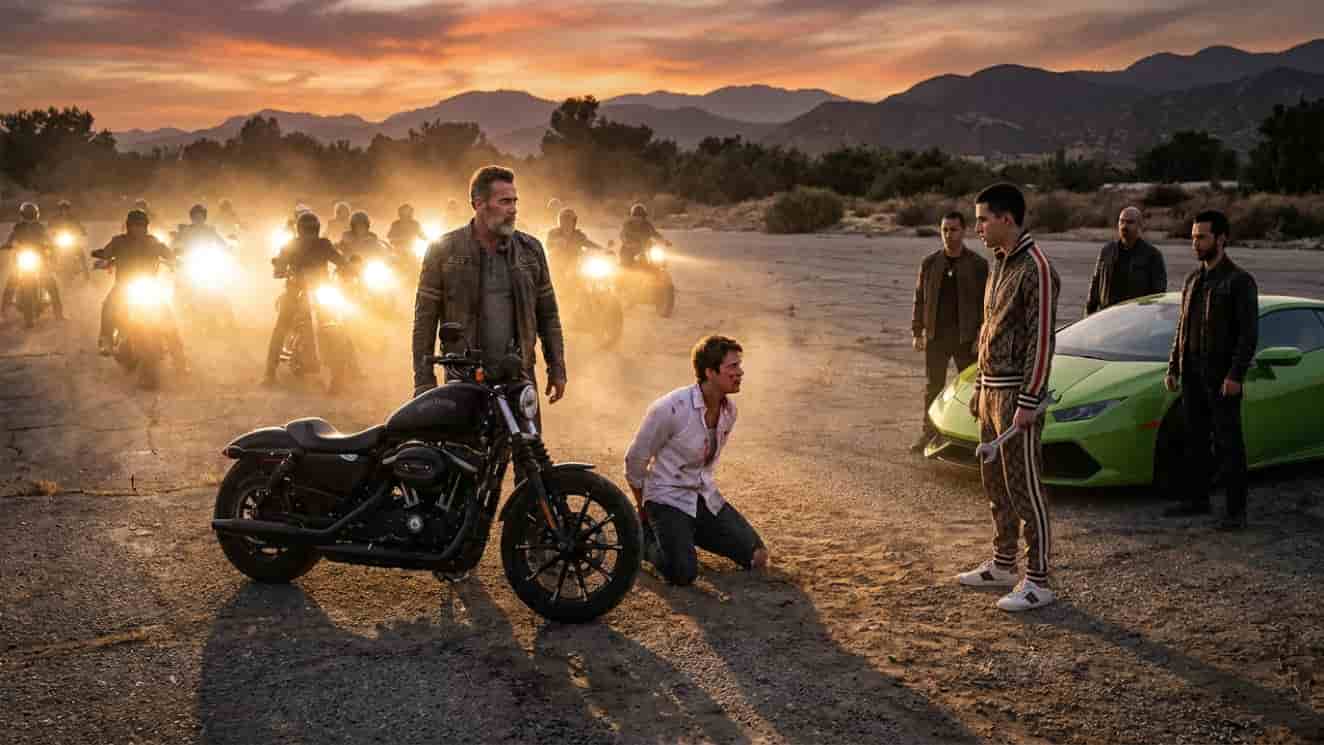
Julian’s smile didn’t just vanish; it curdled. He stepped forward, the heavy wrench in his hand catching the last rays of the setting sun. “You think you’re in a courtroom? You think you can just argue your way out of this? I told you what would happen, Ben. I told you I’d break you, and then I’d go visit your daddy.”
He swung the wrench, a casual, terrifying motion that whistled through the air. “Get him on his knees.”
Two of the boys stepped toward Ben. Ben backed away, his heel catching on a piece of broken asphalt. He stumbled, falling hard onto the gravel.
“Look at you,” Julian sneered, standing over him. “The big hope of the valley. Nothing but a scholarship kid in the dirt.”
Suddenly, a sound cut through the air. It wasn’t the high-pitched scream of a supercar. It was a low, visceral thud—a rhythmic, heavy pounding that felt like it was coming from the earth itself.
Thump. Thump. Thump.
Julian paused, frowning, and looked toward the entrance of the lot.
A single headlight crested the ridge. It was a yellow, flickering beam that cut through the twilight. The bike was old, a matte-black beast that looked like it had been forged in a furnace. It didn’t speed; it rolled in with a slow, majestic arrogance.
The rider stopped twenty feet away. He kicked the stand down and dismounted. He was wearing a leather jacket that looked like it had survived a war—oil-stained, cracked, and heavy. On the shoulder, “BEN” was stitched in faded gold.
Cane Cassidy stepped into the light.
“Dad?” Ben whispered, his voice cracking.
Cane didn’t look at Ben. He looked at Julian. He reached up and slowly zipped the jacket all the way to the throat. The sound of the zipper was the only thing audible in the lot.
“Who the hell are you?” Julian asked, trying to keep the tremor out of his voice. “This is private property, old man. Get that piece of junk out of here before we turn it into scrap.”
Cane didn’t answer. He reached into his pocket and pulled out a heavy silver ring. He slid it onto his middle finger—a ring with a skull and a sprocket.
“My name is Cane Cassidy,” he said, his voice a gravelly rasp that seemed to vibrate the very air. “But in this valley, I’m the King of Dust. And you’re standing in my throne room.”
Julian laughed, but it was a thin, brittle sound. “You’re a mechanic, pops. You’re a nobody. Look at you. You’re shaking.”
“I’m not shaking, boy,” Cane said, taking a step forward. “I’m idling.”
At that moment, the horizon behind Cane exploded into light.
One by one, more headlights appeared. Ten. Twenty. Thirty. The roar of the engines hit the lot like a physical wave, a wall of thunder that made the McLaren’s idle sound like a toy. The “Kings of Dust”—the ghosts of the valley—rolled into the lot, forming a massive, gleaming crescent of chrome and leather behind Cane.
Tank was there. Vince was there, his polo shirt replaced by a vest that looked twenty years too small but twice as dangerous. They didn’t say a word. They just sat on their bikes, the engines growling, their eyes fixed on Julian’s crew.
Julian backed up, his face turning the color of ash. His friends, the boys with the bats, were suddenly very interested in the ground at their feet.
“You… you can’t do this,” Julian stammered. “My father—”
“Your father pays the bills,” Cane said, stopping three feet from Julian. He was a head shorter, but in that moment, he looked like a giant. “But I pay the debts. And you just ran up a bill you can’t afford.”
Cane reached out and grabbed Julian by the front of his expensive tracksuit. He didn’t punch him. He just held him, his grip like a steel vise.
“You touched my son,” Cane whispered, his voice so low only Julian could hear it. “You threatened my wife. You thought because I stayed quiet, I was weak. You forgot that the only reason you’re still breathing is because I chose to be a father instead of a King.”
He shoved Julian back. Julian stumbled, falling against the hood of his McLaren.
“Now,” Cane said, looking around the lot. “We’re going to talk about Marcus’s debt. And then, we’re going to talk about what it’s going to cost you to leave this lot.”
Ben watched from the ground, his heart hammering against his ribs. He looked at the wall of bikers, the “ghosts” his father had told him to never look for. He looked at his father, standing tall in the light of thirty motorcycles, the “King” returned to his throne.
He realized then that the clean hands his father wanted for him weren’t just a gift. They were a sacrifice. And tonight, the sacrifice was over.
Chapter 5: The Echoes of the King
The sound of thirty idling motorcycles wasn’t just noise; it was a physical weight that pressed against the chest, a low-frequency vibration that rattled the marrow in Ben’s bones. In the center of that shimmering heat and chrome, his father stood looking like a man who had finally stopped pretending to be tired.
Julian Vance was still backed against the hood of the McLaren, the lime-green paint a garish contrast to the dusty, oil-streaked leather of the bikers. His “crew”—the boys who had been so bold with baseball bats five minutes ago—had retreated into a tight, shivering knot near their SUVs. They were realized, quite suddenly, that they had brought toys to a war zone.
Cane didn’t move. He didn’t have to. The presence of the “Kings of Dust” was an environmental fact, like a thunderstorm or a landslide.
“Julian,” Cane said, his voice cutting through the mechanical growl. “Call your father.”
Julian blinked, his lower lip trembling. “What?”
“You heard me. Use that phone you’re so proud of. Call Marcus. Tell him the King of Dust is standing in Lot 47 with his son, and that the conversation we started twenty years ago isn’t finished.”
Julian’s hands shook as he fished the iPhone from his pocket. He nearly dropped it twice before he managed to swipe the screen. The bikers watched him with the bored, predatory interest of wolves watching a rabbit struggle in a snare. Tank, sitting atop a custom chopper with handle-bars high enough to reach a man’s throat, spat a glob of tobacco juice onto the gravel near Julian’s designer sneakers.
“He… he’s not picking up,” Julian stammered.
“He’ll pick up for me,” Cane said. He reached out, his hand moving with a speed that made Ben gasp, and plucked the phone from Julian’s grip. He held it to his ear, his eyes never leaving Julian’s.
“Marcus,” Cane said after a moment. There was no greeting, no hesitation. “It’s Cane Cassidy. I’m at the old lot with your boy. He’s been playing a game he doesn’t understand, and he’s using my son as the ball. You have ten minutes to get down here before I decide that the truce we signed in ’06 is officially expired.”
Cane tapped the screen to end the call and tossed the phone back to Julian. It hit the boy in the chest and fell to the asphalt. Julian didn’t reach for it.
“Dad,” Ben said, stepping forward. He felt like he was walking through deep water. “What is this? Who are these people?”
Cane finally looked at his son. For a split second, the “King” mask slipped, and Ben saw the mechanic again—the man who worried about grocery prices and Sarah’s physical therapy. But it was only for a second.
“They’re the people I tried to keep you away from, Ben,” Cane said. “They’re the life I traded so you could wear that suit. But some debts can’t be paid in cash, and some people don’t understand the word ‘no’ until it’s shouted by a thousand CCs of American iron.”
Tank hopped off his bike, the leather of his chaps creaking. He walked over to Ben, looking him up and down with a grim sort of approval. “You look like your mother, kid. Same eyes. But you’ve got the old man’s jaw. You okay?”
“I’m fine,” Ben said, though his voice sounded small to his own ears.
“Good. Stay behind the line,” Tank said, gesturing to the front tires of the bikes. “This is grown-folks business now.”
The ten minutes felt like ten years. The only sound in the lot was the rhythmic thump-thump-thump of the engines and the wind whistling through the rusted derricks. Then, the headlights of a black Cadillac Escalade appeared on the ridge. It didn’t roar like the bikes; it glided, a silent, armored beast that pulled into the lot and stopped ten feet from Cane.
The driver’s door opened, and Marcus Vance stepped out. He was sixty, silver-haired, and dressed in a charcoal suit that probably cost more than Cane’s shop. He looked around the lot, his gaze lingering on Tank, then Vince, and finally settling on Cane.
“Cane,” Marcus said, his voice smooth, professional, and entirely devoid of warmth. “I thought you were dead. Or at least, I hoped you were smart enough to stay buried.”
“I was smart enough to stay quiet, Marcus,” Cane replied. “There’s a difference. Your boy here thinks he can extort my son over a debt he didn’t even accrue. He threatened my shop. He threatened my wife.”
Marcus glanced at Julian, who was trying to disappear into the upholstery of the McLaren. Marcus’s expression didn’t change, but a flicker of disgust crossed his features. “Julian is… enthusiastic. He lacks the refinement of his position. But the debt is real, Cane. Marcus Miller owes my associates ten thousand dollars. In my world, debts are transferable.”
“In my world,” Cane said, taking a step toward the Cadillac, “we don’t touch family. We don’t touch civilians. And we damn sure don’t threaten the woman who lost her legs because of the games we played.”
The bikers shifted. A few of them revved their engines—a sharp, aggressive bark that made Marcus’s security guard, who had just stepped out of the Escalade, put his hand on the holster at his hip.
“Easy, Roy,” Marcus said to the guard, not looking back. “Cane isn’t going to do anything. He has too much to lose. Isn’t that right, Cane? You have a nice little life. A shop. A wife who needs expensive care. A son who wants to be a lawyer. You start a fire here, and everything you’ve spent twenty years building goes up in smoke.”
Cane looked at Ben, then back at Marcus. A slow, cold smile spread across his face. It was the most terrifying thing Ben had ever seen.
“You think I’m afraid of losing the shop, Marcus? I spent twenty years in that garage trying to wash the smell of gasoline and blood off my skin. I did it for them. But if you’re going to take it anyway, then I don’t have to be a mechanic anymore. I can just be the man who knows where the bodies are buried. Literally.”
Marcus’s posture stiffened. The professional mask cracked. “You wouldn’t.”
“Try me. I remember the night in ’04 at the Tulare crossing. I remember who was driving the truck that hit the patrol car. I remember who paid the Kings to make sure the witness never made it to the hearing. I have the ledger, Marcus. The one Vince thought he burned. I didn’t give it to the cops back then because I wanted peace. But I’m starting to think peace is overrated.”
Vince, sitting on his bike nearby, looked away, his jaw tight.
Marcus was silent for a long time. The power dynamic in the lot had shifted. It wasn’t about the number of bikers or the bats anymore. It was about the weight of a past that Marcus Vance had built his empire on—an empire that rested on a foundation of dust and secrets that Cane Cassidy held the keys to.
“What do you want?” Marcus asked, his voice lower now.
“The debt is gone,” Cane said. “Julian stays away from Ben. He stays away from the firm. If I even see that green car drive past my shop, I’m opening the vault. And Marcus… you’re going to pay for Ben’s bar exam fees. Consider it a ‘consultation fee’ for my silence.”
Marcus looked at his son, then at the wall of leather and chrome. He knew he was beaten. In a courtroom, he had all the power. In a board room, he was a god. But here, in the dirt, under the eyes of the men who had done his dirty work for decades, he was just a man with a very expensive secret.
“Fine,” Marcus said. “Get in the car, Julian.”
Julian scrambled into the Escalade without a word. Marcus turned back to Cane. “You’re playing a dangerous game, Cassidy. You can’t keep the King in the box forever once you’ve let him out.”
“Maybe not,” Cane said. “But tonight, he’s the only one who can go home.”
The Escalade sped out of the lot, followed by the SUVs of Julian’s crew. The dust settled slowly. The bikers didn’t move until the taillights disappeared over the ridge.
Cane turned to his son. The adrenaline was fading, and the limp was starting to return to his stride. He looked older, suddenly. Smaller.
“Go home, Ben,” Cane said. “Take the truck. I’ll ride the bike back.”
“Dad, we need to talk,” Ben said, his voice thick with emotion.
“Not here. Not now. Your mother is waiting.”
Ben nodded. He walked to the old Ford F-150, his mind a whirlwind of confusion and a strange, dark pride. He looked in the rearview mirror as he pulled away. He saw his father surrounded by the Kings of Dust, their headlights illuminating him like a fallen star. He realized then that he didn’t know the man who raised him at all. And he realized that the “clean hands” he’d been so proud of had been washed in a tub of someone else’s blood.
Chapter 6: The King’s Final Ride
The house was too quiet when they got back. Sarah was sitting in her wheelchair by the window, the television flickering with some mindless late-night talk show she wasn’t watching. She turned as the front door opened, her eyes immediately finding Cane’s.
He was still wearing the jacket. The smell of it filled the small living room—stale smoke, old leather, and the sharp, metallic scent of the road.
“You went back,” she said. It wasn’t a question. It was a sentence.
Cane sat down on the sofa, his knees clicking. He looked at his hands, which were still vibrating slightly. “I had to, Sarah. They were coming for him.”
Ben stood in the doorway, watching them. He saw the way his mother looked at the “KING” patch on the jacket. There was no surprise in her eyes, only a profound, weary sadness.
“I know why you did it,” Sarah said, her voice trembling. “But you promised me. You promised that the boy would never have to see that man. You promised that the Kings were a ghost story.”
“Sometimes the only way to fight a ghost is to become one,” Cane said. He reached out to take her hand, but she pulled back, her eyes flashing.
“Don’t. Not with those hands. Not while you’re still wearing that skin.”
Cane stood up and slowly unzipped the jacket. He pulled his arms out, the heavy leather thudding onto the floor like a dead weight. He looked at Ben. “Go to bed, son. We’ll talk in the morning.”
“No,” Ben said, his voice firming. “We’re talking now. You said Marcus Vance paid the Kings to silence a witness. You said you have a ledger. Dad, if that’s true, that’s evidence. That’s a felony. Several felonies.”
Cane looked at his son—the future lawyer, the man of rules and statutes. “In the world I lived in, Ben, the law was just another tool Marcus used to build his wall. The ledger isn’t evidence. It’s insurance. If I give it to the DA, Marcus goes to prison, sure. But so do I. And so does Tank. And so does Vince. And the shop gets seized, and your mother loses her healthcare, and your degree becomes a piece of paper from the son of a racketeer.”
Ben felt the weight of the reality settle on him. It was a trap. The “clean life” was subsidized by the very corruption he was being taught to fight.
“So we just… we let him go? We keep the secret?”
“We keep the peace,” Cane said. “That’s the deal. He stays in his world, and we stay in ours. He pays your fees because he owes us a blood debt that twenty years of silence hasn’t cleared.”
The next morning, the shop didn’t open. Cane sat on the back porch, watching the sun rise over the valley. The “Kings” were gone, back to their lives as mechanics, truck drivers, and retirees. The roar had faded, but the silence that replaced it felt different. It felt earned.
Ben came out an hour later, carrying two mugs of coffee. He sat on the steps next to his father. They sat in silence for a long time, watching a hawk circle a distant ridge.
“I found the trunk,” Ben said quietly. “In the crawlspace. I saw the photos. The runs to Nevada. The stuff with the ‘Dust Association’ before it was a social club.”
Cane took a sip of his coffee. “I’m not proud of most of it, Ben. But I’m not ashamed of why I stopped. The night your mother… the night of the accident. It wasn’t a mechanical failure. Marcus’s rivals had cut the lines on my bike. They wanted me dead. I survived. She didn’t walk again. That was the price of being King. I decided that night that I was done paying it.”
“Why didn’t you tell me?”
“Because I wanted you to be better than me,” Cane said, looking at him. “I wanted you to believe that the world was a place where if you worked hard and followed the rules, you’d be safe. I wanted you to have a life that didn’t require a leather jacket and a wall of bikers to protect it.”
“I don’t think I can go back to that,” Ben said. “Knowing what I know now. About the firm. About the Vances.”
“You have to,” Cane said, his voice hard. “You have to go back and be the best damn lawyer this valley has ever seen. You have to use the law to do what I had to use my knuckles for. That’s the only way any of this was worth it.”
A week later, the bill for Ben’s bar prep arrived. It was paid in full by an anonymous trust. A few days after that, Julian Vance was spotted in a local paper, his father having shipped him off to a “leadership academy” in Switzerland. The green McLaren was seen on a flatbed trailer, heading toward a private auction in Los Angeles.
The shop reopened. The smell of Pennzoil and old coffee returned. Cane went back to his rolling stool, his hands moving with the same watchmaker precision, fixing the tractors and lawnmowers of the people who never knew he had once ruled the roads they drove on.
One afternoon, a young man on a loud, poorly-tuned sportbike pulled into the gravel lot of the shop. He was wearing a flashy helmet and a jacket that was all style and no substance. He revved the engine, the high-pitched whine echoing through the trees.
“Hey, old man!” the kid yelled. “Can you make this thing faster? I got a race tonight.”
Cane didn’t look up from the carburetor he was cleaning. He felt the phantom itch in his throttle hand, the memory of the wind at a hundred miles an hour, the feeling of absolute, terrifying freedom. He looked at the “KING” jacket, which was now locked back in the trunk in the crawlspace, the silver studs tarnished by the damp earth.
“I don’t make things go fast anymore, son,” Cane said, his voice a low, steady rumble. “I just make them work.”
The kid laughed, called him a “fossil,” and sped away in a cloud of blue smoke and arrogance.
Cane watched him go. He looked over at the house, where Sarah was sitting on the porch, reading a book in the afternoon sun. He looked at the empty space on the tool board where the silver “C.C.” wrench hung.
He picked up a rag and wiped his hands. They were stained with oil. They were scarred. They were the hands of a man who had done terrible things to protect beautiful ones. He didn’t need the jacket to know who he was. He didn’t need the roar to know his power.
He was Cane Cassidy. He was a mechanic. He was a father. And as he walked toward the house to help his wife inside for dinner, he finally felt the weight of the world lift—not because he had escaped his past, but because he had finally used it to buy his son a future.
The dust had settled. The King was dead. And for the first time in twenty years, the man was finally at peace.