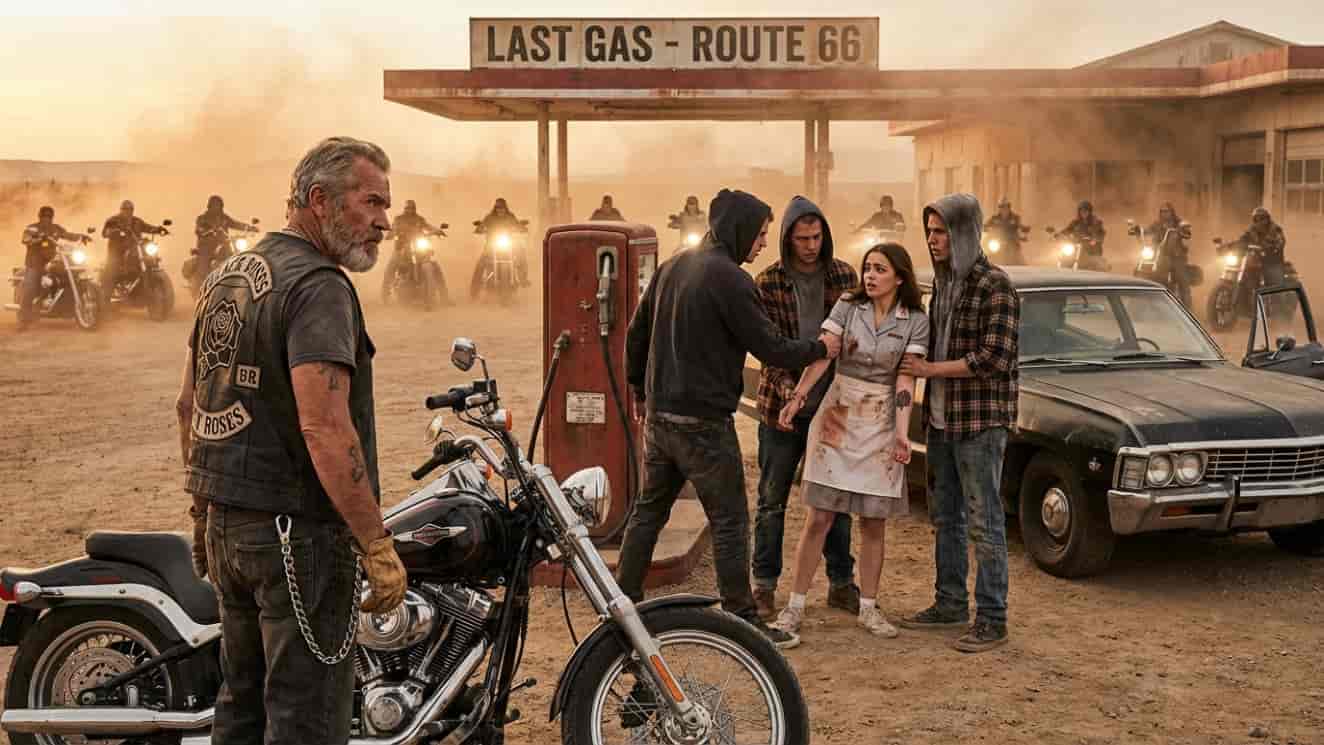
The desert heat was screaming, but Dutch felt cold the second he saw the punk’s hand tighten on the girl’s arm. He’d stopped for gas and a cheap sandwich, just another mile on a fifteen-year road to nowhere. Then he saw it. The small, dark mark on her forearm, shaped exactly like the tattoo he wore over his heart. The air in the Route 66 pit stop turned to static.
“She said she’s busy, kid,” Dutch said, his voice coming from a place deeper than his lungs. He wasn’t just a biker anymore; he was a father who had just found his soul in the middle of a grease-trap parking lot.
The kid with the neck tattoo laughed, looking at Dutch’s weathered vest. “You’re a long way from the retirement home, gramps. Get back on your toy and keep moving before we break something you can’t fix.”
He didn’t know that behind Dutch, twenty sets of headlights were already turning off the highway. He didn’t know that the Black Roses didn’t just ride together—they killed for each other. And he definitely didn’t know that the girl he was terrifying was the only thing keeping Dutch from turning the world into an ash heap.
Dutch didn’t move. He just reached for the chain on his hip. “I’m not going anywhere. But you? You’re about to find out exactly what happens when you touch a Van Horn.”
Chapter 1: The Doll in the Dust
The doll was missing its left eye and smelled like a mixture of stale Marlboros and primary-drive oil. It lived in the left saddlebag of Dutch’s 2004 Road King, nestled between a spare spark plug and a rolled-up flannel shirt. Most guys in the Black Roses MC had charms—gremlin bells, locks of hair, or heavy silver rings taken from men who didn’t need them anymore. Dutch had a six-inch rag doll with a faded yellow dress.
He didn’t touch it often. Usually, he just reached his hand in there before a long haul, feeling the coarse fabric with his calloused fingertips to make sure it hadn’t vibrated out somewhere on the I-40. It was his anchor. As long as the doll was in the bag, Elena was still out there. Somewhere.
“You’re staring again, Boss,” Stitch said, leaning against his own Dyna. Stitch was the club’s primary artist, a man whose skin was more ink than epidermis. He was currently dragging a thumbnail through the grease under his other nails, watching Dutch with that quiet, clinical concern that only old friends can manage.
Dutch snapped the saddlebag shut. The click of the leather strap felt like a period at the end of a sentence he wasn’t ready to finish. “I’m checking the latch. It’s been vibrating since we hit the Arizona line.”
“Right. The latch,” Stitch muttered. He didn’t push it. Nobody pushed Dutch Van Horn, not if they wanted to keep their teeth. Dutch had been the National President of the Black Roses for twelve years, and he’d earned the title through a combination of strategic brilliance and a capacity for violence that made the younger members go quiet when he walked into the room.
The sun was a white-hot hammer, beating down on the cracked asphalt of the staging area outside of Needles. The club was moving east, a column of forty bikes heading toward a regional summit in Albuquerque. It was supposed to be a routine run—business, politics, and enough beer to drown a small town. But Dutch felt the itch. It was a physical sensation, like a grain of sand behind his eyelid that he couldn’t blink away.
“We moving or what?” Miller called out from the back of the pack.
Dutch looked at Miller. Miller was the Vice President, a man who had traded his leather for tailored suits more often lately, flirting with the “legitimate” side of the club’s interests. He’d been with Dutch the night of the fire fifteen years ago. He’d been the one who pulled Dutch out of the collapsing warehouse in San Bernardino while the Rivalry—the “Iron Dogs”—had burned everything to the ground. Including, Dutch had believed for the longest time, his four-year-old daughter.
“We’re moving,” Dutch said, his voice a low rumble that cut through the idling engines. He swung a leg over his bike, the heat of the seat biting through his jeans.
As they pulled onto the highway, the roar of forty V-twins rising in unison, Dutch’s mind did what it always did when the wind started whistling through his helmet. It went back. He saw the orange glow of the warehouse windows. He felt the searing heat against his face as he screamed Elena’s name. He remembered the feeling of Miller’s arms locking around his chest, dragging him back, telling him she was gone, that there was nothing left but ash.
But there had been no body. The cops said the heat was high enough to leave nothing, but Dutch knew fire. He knew what it left behind. He’d spent fifteen years convinced that the Iron Dogs hadn’t killed her—they’d stolen her. A final, cruel piece of leverage that they never used, or perhaps a prize they’d kept and then lost in the chaos of the federal RICO sweeps that followed.
He rode in the “Number One” spot, the wind buffeting his chest. He looked like a king of the road, a man with a brotherhood at his back and a legacy in his hands. But inside the helmet, he was just a father who couldn’t remember the exact shade of his daughter’s eyes anymore. Were they blue like his, or that soft hazel like her mother’s? The memory was fraying at the edges, like the doll in his bag.
By the time they hit the stretch of Route 66 near Kingman, the heat had turned the horizon into a shimmering lake of mercury. The bikes were running hot, and the men were getting irritable. Dutch saw the sign for a place called The Rusty Spoke—a combination gas station, diner, and garage that looked like it had been built out of scrap metal and hope.
“Stopping here!” Dutch signaled, his arm cutting through the air.
He led the pack off the highway, the tires crunching on sun-bleached gravel. The Spoke was a miserable-looking place. A few rusted pumps stood like sentinels in front of a low-slung building with peeling white paint. A hand-painted sign in the window promised “Cold Beer & Hot Coffee,” though Dutch doubted the veracity of both.
As he kicked his kickstand down, he noticed a black sedan parked near the side of the building. It was a late-model Charger, out of place among the rusted pickups and farm equipment. Three guys were standing around it, young, wearing hoodies despite the hundred-degree heat, their eyes hidden behind dark lenses. They were watching a girl who was struggling with a heavy stack of plastic crates near the back entrance of the diner.
Dutch pulled his gloves off, one finger at a time. He didn’t like the way the three guys were standing. He didn’t like the way they were looking at the girl. It was the posture of wolves who had cornered a rabbit.
“Boss,” Stitch said, walking up beside him. “Trouble?”
Dutch didn’t answer. He just watched. The girl couldn’t have been more than nineteen or twenty. She had her hair pulled back in a messy bun, and her apron was covered in grease and old soda syrup. She was trying to ignore the guys, her head down, her shoulders hunched.
“Check the pumps,” Dutch said to Stitch, his eyes never leaving the girl. “Tell the boys to stay sharp. I don’t like the smell of this place.”
It wasn’t just the punks. It was the silence. The desert was usually loud with the sound of wind and insects, but here, everything felt muffled. Like the world was holding its breath, waiting for a match to drop. Dutch walked toward the diner entrance, his boots heavy on the boards, the doll in his saddlebag feeling like a lead weight, pulling at the corner of his mind.
Chapter 2: The Prowlers and the Prey
The interior of The Rusty Spoke smelled of burnt fat and industrial cleaner. A ceiling fan wobbled overhead, doing nothing but moving the warm air in circles. Behind the counter, an older man with a face like a dried-up creek bed looked up from a newspaper, his eyes darting toward the door as Dutch and several other Roses filed in.
“Just coffee,” Dutch said, sliding onto a stool that creaked under his weight. “And whatever’s in the heater.”
The old man nodded nervously. He knew the patches. Everyone in this part of the country knew the Black Roses. They weren’t the kind of bikers who did toy runs for charity; they were the kind who governed the shadows between towns.
“That’ll be five minutes on the coffee, and the sliders are fresh,” the old man said, his voice thin.
Outside, through the smeared window, Dutch watched the three punks. They had moved closer to the girl. One of them, a lanky kid with a jagged scar running through his eyebrow, reached out and plucked a crate from her hands. He didn’t help her; he held it just out of reach, grinning while his friends laughed.
“Prowlers,” Miller said, sitting two stools down from Dutch. He was looking at the black Charger. “Local street crew out of Vegas, probably. They’ve been trying to push their crystal into the smaller towns along the 66. Sloppy kids. No discipline.”
“They’re bothering the girl,” Dutch said.
Miller shrugged, picking at a loose thread on his cuff. “Kids will be kids, Dutch. We’re here for gas and a break. We don’t need a jurisdictional headache over a waitress.”
Dutch looked at Miller. The Vice President’s face was neutral, but there was a coldness there that Dutch had started noticing more and more lately. Miller had become pragmatic to the point of being heartless. He saw everything as a cost-benefit analysis. A waitress being harassed was a zero on the balance sheet.
Dutch stood up. He didn’t say anything to Miller. He walked back out into the heat, the screen door slapping shut behind him with a sharp crack.
The punks hadn’t seen him yet. They were too busy enjoying themselves. The one with the scar had backed the girl up against a rusted-out soda machine.
“I told you, I don’t have it,” the girl was saying. Her voice was shaking, but there was an edge of defiance in it that surprised Dutch. “My shift isn’t over. I don’t have the keys to the back.”
“Don’t lie to me, Elena,” the kid with the scar said.
Dutch stopped dead. The name hit him like a physical blow to the solar plexus. Elena. It was a common enough name. Millions of girls had it. But hearing it here, in this dust-choked hellhole, made the world tilt on its axis.
“I’m not lying, Jax,” the girl said, her voice rising. “Please. Just go. You’re going to get me fired.”
Jax laughed and reached out, grabbing her by the upper arm. He pulled her toward him, his face inches from hers. “You’re already fired, sweetheart. You’re coming with us. We’re gonna have a little talk about what your boyfriend owes us.”
“Let her go,” Dutch said.
The voice didn’t feel like it came from him. It felt like it came from the ground beneath his feet.
The three punks turned. Jax kept his grip on the girl’s arm, his eyes narrowing as he took in Dutch’s height and the heavy leather of his vest. He saw the “National President” rocker and the “Original 13” patch. A smarter man would have let go. Jax was not a smart man.
“Back off, Pops,” Jax sneered. “This is private business. Go play with your tricycle.”
His two friends moved out, flanking him. They were young, fueled by cheap adrenaline and the misplaced confidence of a small-town gang. They didn’t see the forty other bikes parked fifty yards away. They only saw one old man in a vest.
Dutch took a step forward. “I won’t say it again. Take your hand off her.”
The girl was looking at Dutch now. Her eyes were wide, terrified, but there was something else in them. A flicker of something Dutch couldn’t name. She looked exhausted, her face smudged with dirt, a smudge of flour on her cheek.
“Help me,” she whispered.
Jax tightened his grip, his fingers digging into her skin. “She’s with us, old man. You want to die for a waitress?”
Dutch didn’t answer with words. He reached out, his hand moving with a speed that defied his age. He gripped Jax’s wrist—the one holding the girl—and squeezed. Dutch’s hands were built from thirty years of wrenching on iron and brawling in bars. He felt the small bones in the kid’s wrist shift and groan under the pressure.
Jax screamed, his knees buckling. He let go of the girl.
“Run inside,” Dutch told her, never taking his eyes off Jax.
But she didn’t run. She stood there, frozen, her breath coming in ragged gasps.
“You’re dead!” one of the other punks yelled, reaching into his waistband.
Before he could pull whatever he was reaching for, the sound of forty engines roared into life simultaneously. It wasn’t just noise; it was a physical force that vibrated the ground and rattled the windows of the diner. From around the side of the building, the Black Roses began to roll forward, a slow, methodical tide of black leather and chrome.
They didn’t rush. They didn’t need to. They simply formed a circle, thirty feet wide, around Dutch, the girl, and the three punks. The Prowlers looked around, their bravado evaporating like water on a hot tailpipe.
Stitch pulled his bike up right behind Dutch, the engine idling with a deep, rhythmic thrum. He looked down at Jax, who was still whimpering in Dutch’s grip.
“He bothering you, Boss?” Stitch asked, a pleasant, terrifying smile on his face.
Dutch didn’t answer. He was looking at the girl. She had stepped back, her sleeve having slid up during the struggle. And there, on the inside of her forearm, just above the wrist, was the mark.
It was dark, a deep reddish-brown, about the size of a quarter. It was shaped like a rosebud, with a tiny, curved stem.
Dutch’s heart stopped. He forgot how to breathe. He forgot about the punks, the club, and the desert heat. He was back in a small bedroom in San Bernardino, holding a crying infant, tracing that exact same mark with his thumb while his wife slept.
The rose.
He let go of Jax’s wrist like it was a piece of rotten meat. He stepped toward the girl, his hands trembling.
“Elena?” he whispered.
The girl recoiled, her back hitting the soda machine. “How do you know my name?”
Chapter 3: The Ghost in the Flesh
The world narrowed down to the space between Dutch and the girl. The roar of the bikes faded into a dull hum in the back of his skull. He could see the sweat beading on her forehead, the way her pulse was jumping in the hollow of her throat.
“Your name,” Dutch said, his voice cracking. “Who gave it to you?”
The girl looked at him with a mixture of fear and confusion. “My mom. What do you want? Just leave me alone.”
“Your mother,” Dutch repeated. The word felt foreign. “What was her name? Was it Sarah? Sarah Van Horn?”
The girl’s eyes flickered. “No. Her name was Maria. She died six years ago. Look, I don’t know who you think I am, but—”
“The mark,” Dutch interrupted, pointing at her arm. He didn’t care if he sounded like a madman. “The rose. You’ve had that since you were born. On the night of the fire, you were wearing a yellow dress. You had a doll. A rag doll with one eye.”
The girl went completely still. The color drained from her face, leaving her looking sickly in the harsh desert light. She slowly looked down at her own arm, then back at Dutch.
“How… how could you know about the dress?” she whispered. “I have a picture. One picture from when I was little. I’m wearing a yellow dress. Maria told me it was the only thing I had when she found me.”
Behind Dutch, the circle of bikers remained silent. Even the Prowlers had stopped moving, sensing that the air had changed, that they were no longer the center of the drama. They were just spectators at a ghost sighting.
Miller pushed his way through the circle, his face pale. He looked at the girl, then at Dutch. “Dutch, what are you doing? We need to get moving. This is… this is crazy. It’s just a coincidence.”
Dutch didn’t look at him. “A coincidence, Miller? The name? The mark? The dress? You were there. You remember the fire. You told me she was gone.”
“She was gone!” Miller shouted, his voice uncharacteristically high. “The place was a goddamn furnace, Dutch! I saw the roof come down on that corner of the warehouse. There’s no way—”
“Then how is she standing here?” Dutch turned, his eyes burning with a sudden, terrible clarity.
He looked at the girl—Elena—and saw the face of the woman he’d loved hidden in the lines of her jaw and the curve of her brow. She wasn’t a ghost. She was flesh and blood, grease and fear.
“Maria found you?” Dutch asked her, stepping closer. “Where?”
Elena swallowed hard, her eyes darting toward Jax and his friends, who were slowly trying to edge toward their car. “In a parking lot in Barstow. She said a man in a leather jacket left me there. She was working the night shift at a motel. She didn’t have any kids of her own, so she just… she took me. She raised me.”
Dutch felt a wave of nausea. Barstow. It was only thirty miles from the warehouse. Someone had carried her out. Someone had survived the fire with her in their arms and then dumped her like unwanted cargo at a motel.
He looked back at Miller. Miller wouldn’t meet his eyes. The Vice President was staring at his boots, his hands shoved deep into his pockets.
“Miller,” Dutch said, his voice a low, dangerous warning. “Look at me.”
Miller didn’t move.
“Stitch,” Dutch said. “Don’t let those kids leave. And don’t let Miller move an inch.”
The club reacted instantly. Four bikers stepped in front of the black Charger, while Stitch and two others moved to flank Miller. The confusion among the Roses was palpable, but their loyalty to Dutch was absolute. If the President told them to hold their own VP, they held him.
“Dutch, this is insane,” Miller muttered, his voice shaking. “I’m your brother. We’ve bled together for twenty years.”
“Then tell me why my daughter was in a motel parking lot while I was burying an empty casket,” Dutch said. He reached into his saddlebag and pulled out the rag doll.
He held it out toward Elena.
She looked at the doll, and for the first time, the fear in her eyes was replaced by a staggering, heartbreaking recognition. Her hand trembled as she reached out, her fingers brushing the faded yellow fabric.
“Mr. Buttons,” she breathed.
The name hit Dutch like a sledgehammer. He hadn’t told anyone that name. Not the cops, not the club, not even Miller. It was a secret between a father and a four-year-old girl.
“He lost his eye in the dryer,” Dutch said, his voice breaking.
Elena looked up at him, tears finally spilling over her lashes. “You… you’re the man from the smoke.”
“I’m your father,” Dutch said.
Before they could bridge the gap, Jax, sensing the distraction, lunged forward. He didn’t go for Dutch. He went for Elena, grabbing her around the neck and pulling a snub-nosed revolver from his waistband.
“Nobody moves!” Jax screamed, his voice cracking with panic. He pressed the barrel of the gun against Elena’s temple. “I don’t know what kind of weird family reunion this is, but we’re leaving, and she’s coming with us! Get back! All of you!”
The silence that followed was absolute. Forty men, all armed, all dangerous, stood perfectly still. The only sound was the wind whistling through the spokes of the bikes and the ragged breathing of a terrified kid with a gun.
Chapter 4: The Circle of Fire
Dutch didn’t move. He didn’t reach for his chain. He didn’t even blink. He stood exactly six feet from Jax, his eyes locked on the kid’s trembling hand.
“You’re making a mistake, son,” Dutch said. His voice was terrifyingly calm. It was the voice of a man who had already died once and had nothing left to fear. “You have no idea whose world you just stepped into.”
“I don’t care!” Jax yelled, his eyes darting wildly around the circle of bikers. “Tell them to move the bikes! Now! Or I’ll do it! I swear to God!”
Elena was ashen, her eyes locked on Dutch. She wasn’t screaming. She was watching him, waiting, as if she realized that the man standing in front of her was the only thing between her and the end of everything.
“Look at their faces, Jax,” Dutch said, gesturing vaguely toward the Roses. “Do they look like they’re afraid of that little toy in your hand? They’ve spent their lives in prison, in wars, and in morgues. You’re a bug to them. But to me… to me, you’re the thing that’s touching my daughter.”
Dutch took a half-step forward.
“Get back!” Jax shrieked, pressing the gun harder against Elena’s head.
“If you pull that trigger,” Dutch said, his voice dropping to a whisper that somehow carried over the wind, “I won’t kill you. Not at first. I’ll let my brothers have you. Stitch over there? He’s a very patient man. He can make a person last for days. You’ll be begging for a bullet by the time he’s done with your fingernails.”
Jax’s hand shook so violently the gun rattled against Elena’s skull. His two friends had already backed away, their hands raised, completely abandoning him.
“Let her go,” Dutch said. “And maybe you walk away with just a broken arm. Keep holding her, and you never leave this dirt.”
From the back of the pack, a low, rhythmic sound began. It was the sound of heavy boots hitting the gravel in unison. Thump. Thump. Thump. The Roses weren’t moving, but they were closing the psychic space, a wall of black leather and cold eyes that felt like it was shrinking the world around Jax.
“Dutch, let him go,” Miller called out from where he was being held. “Don’t do this here. The heat will be all over us. Think about the club.”
Dutch finally looked at Miller. The betrayal was a cold stone in his gut. He knew now. He knew why Miller had been so eager to get him out of that warehouse. He knew why Miller had insisted she was dead. Miller had been working with the Iron Dogs back then. He’d traded a four-year-old girl for his own life, or for a seat at the table, or for a bag of money that had long since been spent.
“The club is dead to me, Miller,” Dutch said. “Everything is dead to me except her.”
He looked back at Jax. “Last chance, kid.”
Jax looked at the circle of men. He looked at Dutch’s eyes—blue, cold, and utterly devoid of mercy. He saw the inevitability of it. He saw that he was already a dead man; the only question was how much it would hurt.
With a sob of pure terror, Jax shoved Elena toward Dutch and turned the gun on himself.
Before he could pull the trigger, Stitch was on him. Stitch’s heavy boot caught Jax in the ribs, sending him sprawling into the dust. The gun skittered across the gravel, landing under the black Charger.
Elena stumbled, her legs giving out. Dutch caught her.
He pulled her into his chest, his large, scarred hands wrapping around her as if he could shield her from the last fifteen years. She collapsed against him, her face buried in his leather vest, her body shaking with silent, racking sobs.
Dutch held her. He smelled the grease and the cheap perfume and the desert dust, and underneath it all, that same scent of sun and sugar that he remembered from a lifetime ago.
“I got you,” he whispered into her hair. “I got you, Elena. I’m never letting go again.”
The Roses moved in, a silent, grim tide. They picked up Jax and his friends, tossing them into the back of a waiting pickup truck like sacks of trash. No one asked what would happen to them. Everyone knew.
Stitch walked up to Dutch, his face set in hard lines. He looked at Elena, then at the man who had been his leader for a decade. He didn’t say a word. He just placed a heavy hand on Dutch’s shoulder and nodded.
But the moment of peace was short-lived.
Miller was standing by his bike, his eyes darting toward the highway. He knew the clock was ticking. He knew that as soon as Elena could talk, as soon as she could describe the man who had left her in that parking lot, he was finished.
“We need to go, Dutch!” Miller yelled, his voice desperate. “Now! Before the sheriff shows up!”
Dutch looked up from his daughter’s hair. He looked at the man he had called brother. The man who had watched him mourn for fifteen years while the truth was only thirty miles away.
“You’re right, Miller,” Dutch said, his voice as cold as a winter grave. “We should go. But you aren’t going with us.”
He stood up, keeping one arm firmly around Elena. He looked at the forty men of the Black Roses.
“Stitch,” Dutch said.
“Yeah, Boss?”
“Bring the gasoline.”
The circle of bikers began to tighten around Miller, their faces unreadable in the fading light. The “circle of fire” wasn’t just a metaphor. In the Black Roses, it was a sentence.
Dutch looked down at Elena. “Close your eyes, honey. We’re going home.”
Chapter 5: The Weight of the Chain
The gasoline didn’t come in a sleek container. It came in a battered, red plastic jug that Stitch kept strapped to the back of his sissy bar for emergencies. The smell of it—sharp, caustic, and evocative of every bad decision Dutch had ever made—cut through the stagnant desert air. The sun was dipping below the horizon now, bleeding out in streaks of bruised purple and burnt orange, casting long, skeletal shadows across the cracked pavement of the Rusty Spoke.
Dutch didn’t let go of Elena. He kept his left arm looped around her shoulders, feeling the tremors that skipped through her thin frame like a heartbeat he was trying to sync with his own. She was staring at the red jug in Stitch’s hand, her eyes wide and glassy, the pupils blown wide with shock. This wasn’t the world she knew. Her world was grease traps, double shifts, and the low-level thuggery of local punks like Jax. She didn’t know about the high-stakes cruelty of the Black Roses. She didn’t know that for men like Dutch, loyalty wasn’t a choice; it was the only currency that kept them from being animals.
“Dutch, listen to me,” Miller said, his voice cracking. He was backed up against his own bike, his custom-painted tank gleaming in the twilight. “San Bernardino… it was a different time. We were surrounded. The Dogs had us pinned in the warehouse. They didn’t want the girl, Dutch. They wanted the ledger. They wanted the names of the suppliers in Ensenada. They told me if I gave them the girl, they’d let us walk. I thought they’d just leave her somewhere safe. I thought it was the only way to save the club.”
Dutch felt a cold, hard knot tighten in his throat. “To save the club,” he repeated. The words felt like gravel in his mouth. “You traded a four-year-old child to the very people who were trying to burn us out of existence. My child.”
“I told you she was dead so you wouldn’t spend the rest of your life looking for a ghost!” Miller shouted, his face turning a dark, mottled red. “Look at you! You’ve been a shell for fifteen years! You’ve been riding with one hand on a rag doll! I did it for you, Dutch! I did it so you could keep leading! If you knew she was out there, you’d have burned the whole state down to find her, and we would have all gone to prison or the cemetery!”
The silence that followed was heavier than the heat. The forty bikers of the Black Roses stood in a perfect, unmoving ring. They were judge, jury, and executioner, and their silence was the most damning evidence Miller had ever faced. These were men who had lost brothers, wives, and limbs for the patch on their backs. But the line Miller had crossed was one that didn’t exist in their world. You didn’t touch the families. You didn’t trade the blood for the patch.
Dutch stepped forward, drawing Elena with him. He didn’t want her to see this, but he knew he couldn’t hide her from it. She was a Van Horn. She had the rose on her arm, and that meant she had the fire in her blood. She needed to know what her father was, even if it broke her heart.
“Stitch,” Dutch said, his voice barely a whisper.
Stitch didn’t hesitate. He began to walk a slow, deliberate circle around Miller and his bike. He tilted the jug, a steady stream of amber fluid splashing onto the gravel, soaking into the tires of Miller’s Harley, splashing against the chrome pipes. The scent of high-octane fuel became overwhelming, stinging the eyes.
“Dutch, please,” Miller begged. He looked around the circle, searching for a friendly face, but he found only masks of leather and stone. Even the younger members, the ones who had looked up to Miller as the “smart” one, the “legitimate” one, were looking at him with a mixture of disgust and pity. “We’re brothers. We took the oath!”
“The oath was to the blood, Miller,” Stitch said, stopping the pour when the circle was complete. He stood ten feet away, a silver Zippo appearing in his hand as if by magic. “You broke the oath the second you carried that girl out of the smoke and didn’t tell her father.”
Elena clutched at Dutch’s vest, her fingers digging into the worn leather. “Is he… is he going to hurt him?” she asked, her voice small and trembling.
Dutch looked down at her. He saw the terror in her hazel eyes—eyes that were finally, unmistakably, his own. He saw the girl who had been raised by a stranger in a motel, the girl who had survived on the scraps of a life she didn’t remember.
“He hurt you first, Elena,” Dutch said. “He stole fifteen years of your life. He stole your mother’s funeral from you. He stole every birthday, every Christmas, and every night I could have tucked you in. He didn’t just hurt a man. He murdered a family.”
Dutch looked back at Miller. The man who had been his right hand, the man who had pulled him out of the fire, was now the very source of the smoke that had blinded him for a decade and a half.
“Take the patch, Miller,” Dutch said.
Miller looked down at his vest. The “Vice President” rocker was heavy with the weight of his crimes. His hands shook as he reached for the buttons. He unfastened them slowly, his fingers fumbling with the brass. He pulled the vest off and dropped it into the circle of gasoline. The leather hit the wet gravel with a dull thud.
“Now get off the bike,” Dutch ordered.
“Dutch, no,” Miller whispered. “Not the bike. It’s all I have left.”
“You don’t have anything left,” Dutch said. “Not even a name. From this second on, you don’t exist to the Black Roses. If I see your face again, if any of my brothers see your face again, the gasoline won’t be for the bike.”
Miller slowly backed away from his motorcycle, his hands raised in a gesture of total surrender. He looked small without the leather, just a middle-aged man in a sweat-stained t-shirt, standing in the middle of a desert that wanted to swallow him whole.
Stitch looked at Dutch, waiting for the signal. Dutch took a deep breath, the desert wind cooling the sweat on his neck. He felt the doll in his saddlebag, the one-eyed ghost that had finally led him to the truth.
“Do it,” Dutch said.
Stitch flicked the Zippo. The flame was a tiny, insignificant orange spark against the darkening sky. He dropped it.
The gasoline caught with a soft, hollow whump. A wall of blue and orange flame erupted instantly, circling Miller’s bike and his discarded vest. The heat was intense, pushing the circle of bikers back a few feet. The flames licked at the chrome, the tires began to hiss and pop, and the black leather of the VP patch began to curl and blacken in the heat.
Miller stood ten feet away from the fire, watching his identity burn. He didn’t scream. He didn’t cry. He just watched the black smoke rise into the Mojave sky, a funeral pyre for a man who had chosen the wrong side of a fire fifteen years ago.
“The rest of you,” Dutch said, turning his back on the flames and looking at the club. “Take the Prowlers. Drop them at the county line. Tell them if they ever come back to the 66, they won’t get a trial. They’ll just get the dirt.”
Stitch and several other Roses moved toward the pickup truck where Jax and his friends were still huddled in terror. They didn’t use unnecessary violence; they simply moved with the terrifying efficiency of men who had done this a thousand times.
Dutch turned his attention back to Elena. She was staring at the fire, her face illuminated by the dancing orange light. She looked like she was seeing the warehouse fire all over again, the memory finally aligning with the reality of the moment.
“Elena,” Dutch said softly, placing a hand on her cheek.
She flinched at first, then leaned into his palm. Her skin was rough from hard work, but her warmth was the most precious thing Dutch had ever felt.
“I don’t know you,” she whispered, her voice thick with tears. “I remember the smoke. I remember the man who took me out… I thought he was a hero. I thought he saved me. All these years, I thought I was just… abandoned. Like I didn’t matter enough to be kept.”
“You mattered more than anything,” Dutch said, his voice thick with a grief that was finally starting to break. “I never stopped looking. Every mile I rode, I was looking for you. I just didn’t know I was looking for someone who was already so close.”
He reached into his pocket and pulled out a small, silver ring—his wife’s wedding band, which he’d worn on a chain around his neck since the day of the fire. He tucked it into Elena’s hand and closed her fingers over it.
“This was your mother’s,” he said. “She’d want you to have it. And she’d want you to know that she loved you every second of her life.”
Elena looked down at her closed fist, the tears finally flowing freely. She didn’t hug him yet—the gap between them was still too wide, filled with fifteen years of lies and desert dust—but she didn’t pull away when he tucked a loose strand of hair behind her ear.
“Come on,” Dutch said. “We need to get you out of here. This place is finished.”
“What about my things?” she asked, looking back toward the Rusty Spoke. “My pictures… Maria’s things…”
“Stitch will stay,” Dutch said. “He’ll pack everything. It’ll all be waiting for you in Albuquerque. You’re going with me.”
He led her toward his Road King. The bike was a beast of iron and chrome, but to Dutch, it felt like a sanctuary. He helped her onto the back, showing her where to put her feet on the chrome pegs. He could feel her hesitation, her fear of the machine, but she gripped his waist with a strength that told him she wasn’t ready to let go of her only lifeline.
As Dutch kicked the engine over, the roar of the Harley echoed off the rusted walls of the diner. He looked back one last time at the fire. Miller was gone, vanished into the darkness of the desert, a ghost among ghosts. The vest was a charred ruin, and the bike was a skeleton of blackened metal.
The Black Roses began to peel away from the gas station, one by one, their headlights cutting through the night like a string of diamonds. Dutch waited until he was the last one. He reached back and felt Elena’s hands locked around his stomach.
“Hold on tight,” he said.
He twisted the throttle, and they roared out onto Route 66, leaving the fire and the lies behind them in the dust.
Chapter 6: The Road Home
The wind at night in the Mojave is different than the day. It’s not a hammer; it’s a ghost. It carries the scent of sagebrush, cooling asphalt, and the distant promise of rain that never quite falls. Dutch rode at the head of the pack, but he wasn’t looking at the road with the same eyes he’d had that morning. The horizon didn’t feel like a threat anymore. It felt like a beginning.
He kept his speed steady, mindful of the girl behind him. Every time the bike hit a bump or leaned into a curve, he felt Elena’s grip tighten. It was a physical reminder of the responsibility he had reclaimed. He wasn’t just the President of a motorcycle club anymore. He was a father. The weight of that realization was heavier than any chain he’d ever carried.
They rode for three hours in a silence that was only broken by the rhythmic thrum of the engines. When they finally pulled into a small, quiet motel on the outskirts of Kingman, the moon was high and silver, casting a pale glow over the rows of bikes.
The Roses moved with a quiet, respectful gravity. They knew the world had shifted. They didn’t joke or loud-talk as they usually did after a run. They checked their bikes, secured their gear, and disappeared into their rooms. Stitch stayed with Dutch, helping Elena off the back of the bike.
“I’ll be in the room next door,” Stitch said, his voice unusually soft. He looked at Elena with a kind of grim reverence. “If you need anything… anything at all… you just knock on the wall.”
Elena nodded, her face pale and exhausted. “Thank you. For… for the truck. For helping.”
Stitch just nodded and disappeared into the shadows.
Dutch led Elena into the small, cramped motel room. It smelled of lemon wax and old carpet, but it was clean and quiet. He watched as she sat on the edge of the bed, her shoulders slumped, her hands resting in her lap. She looked so small in the oversized diner apron, a relic of a life she had just outgrown in the span of an afternoon.
“You should sleep,” Dutch said, standing awkwardly by the door. He felt out of place in the sterile room, a creature of grease and leather in a space meant for normal people. “We’ll head to Albuquerque in the morning. My house is there. It’s… it’s not much, but it’s safe. It has a yard. You can have your own room.”
Elena looked up at him. The shock was beginning to wear off, replaced by a deep, hollow exhaustion. “Why did you keep the doll?” she asked.
Dutch paused, his hand on the light switch. “Because it was the only thing I had left of you. It was proof that you were real. That I hadn’t just dreamed up the best part of my life.”
He walked over to his saddlebag, which he’d brought inside, and pulled out the tattered rag doll. He held it out to her, the one-eyed face looking up at them both.
Elena took it, her fingers tracing the coarse fabric. “I used to have dreams about this doll,” she said softly. “I thought I made it up. I thought it was just a brain’s way of coping with being alone. I didn’t think it was a real thing. I didn’t think there was a real person holding the other half of the memory.”
She looked at Dutch, her eyes searching his face. “Are you going to go back? To that fire? To the people who did this?”
Dutch felt the old rage flare up in his chest—the desire to find every surviving member of the Iron Dogs and turn the desert into a graveyard. But then he looked at his daughter, at the rose on her arm and the doll in her lap, and he felt the fire begin to die down into embers.
“No,” Dutch said. “I’m done with the war, Elena. I spent fifteen years fighting for a patch that didn’t love me back. I’m going to spend the next fifteen making sure you never have to work a double shift at a place like the Rusty Spoke again.”
“The club…” she started.
“The club will survive,” Dutch said. “Stitch can lead. Miller is gone. The Roses don’t need a king anymore; they need a mechanic. And I think I’ve spent enough time on the road.”
He sat down in the plastic chair by the window, watching the moonlight hit the chrome of his bike through the gap in the curtains. “I’m not a good man, Elena. I’ve done things… things that would make you want to walk out that door and never look back. But I am your father. And if you’ll let me, I’d like to try and be a better one.”
Elena didn’t answer for a long time. She just held the doll against her chest and looked out the window at the endless stretch of the Mojave. The desert was a place of loss, a place where things went to die or be forgotten. But tonight, it had given something back.
“I don’t know if I can call you Dad,” she said, her voice barely audible.
“I know,” Dutch said.
“But I’d like to see the house in Albuquerque,” she whispered.
Dutch felt a lump form in his throat, a pressure he couldn’t swallow away. “I’d like that, too.”
He stood up and turned off the main light, leaving only the small lamp by the bed. “Sleep, Elena. I’ll be right here. I’m not going anywhere.”
He went back to his chair and sat in the dark, his hand resting on the hilt of his knife, his eyes on the door. He was a man of violence, a man of the road, a man who had lived by the code of the Black Roses for longer than he could remember. But as he watched the steady rise and fall of his daughter’s chest as she finally drifted into a fitful sleep, he realized that the hardest ride of his life was over.
The morning would bring more miles. It would bring the cold reality of explaining the truth to the rest of the world. It would bring the legal battles, the social workers, and the slow, painful process of building a relationship out of nothing but dust and shared trauma. But as the first hint of gray light began to touch the horizon, Dutch didn’t feel tired.
He reached out and touched the chrome of his helmet, which sat on the table beside him. He thought about the fire, the smoke, and the man he used to be. He thought about Miller, wandering somewhere out there in the dark, a man without a home.
Then he looked at the doll, tucked under Elena’s arm as she slept.
The road ahead was long, and the desert was unforgiving, but for the first time in fifteen years, Dutch Van Horn knew exactly where he was going. He was going home.
He closed his eyes for just a second, listening to the silence of the desert. It wasn’t a deafening silence anymore. It was just the sound of the world waiting for the sun to rise. And when it did, he’d be there to see it. With his daughter. With the rose. With the only truth that had ever mattered.
He stayed in the chair until the sun hit the handle of his bike, turning the chrome into a blinding, beautiful white light. Then he stood up, stretched his aching back, and went to wake up his daughter for the ride of her life.