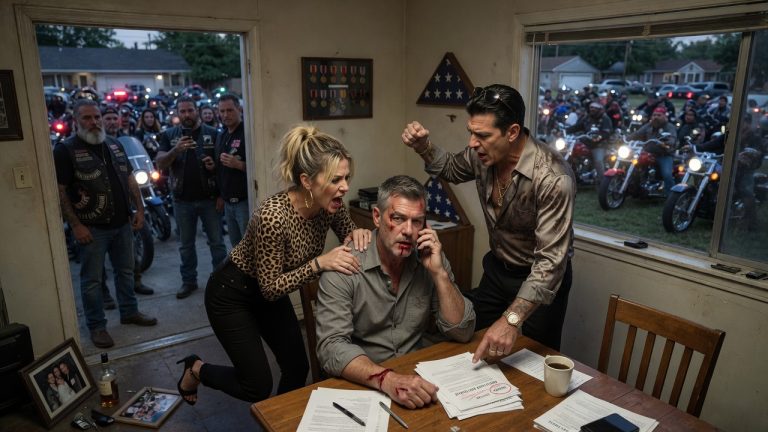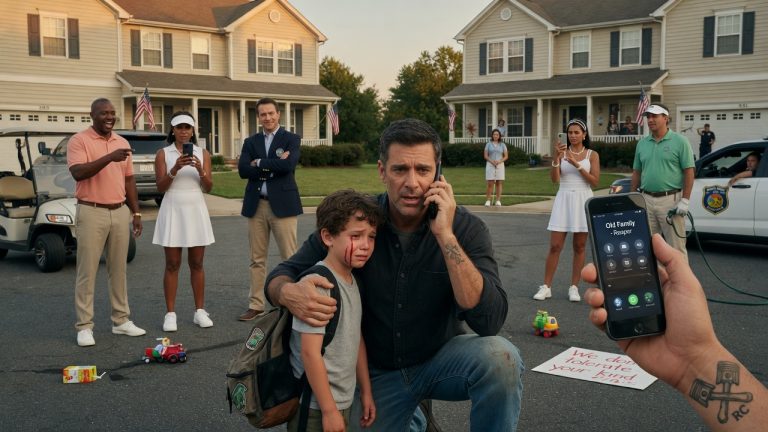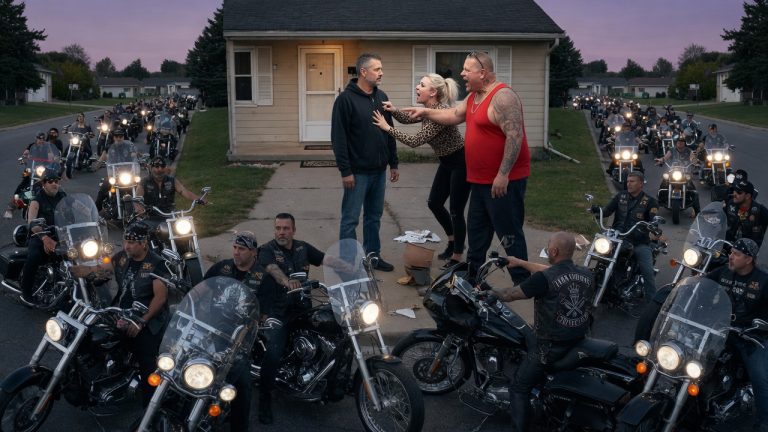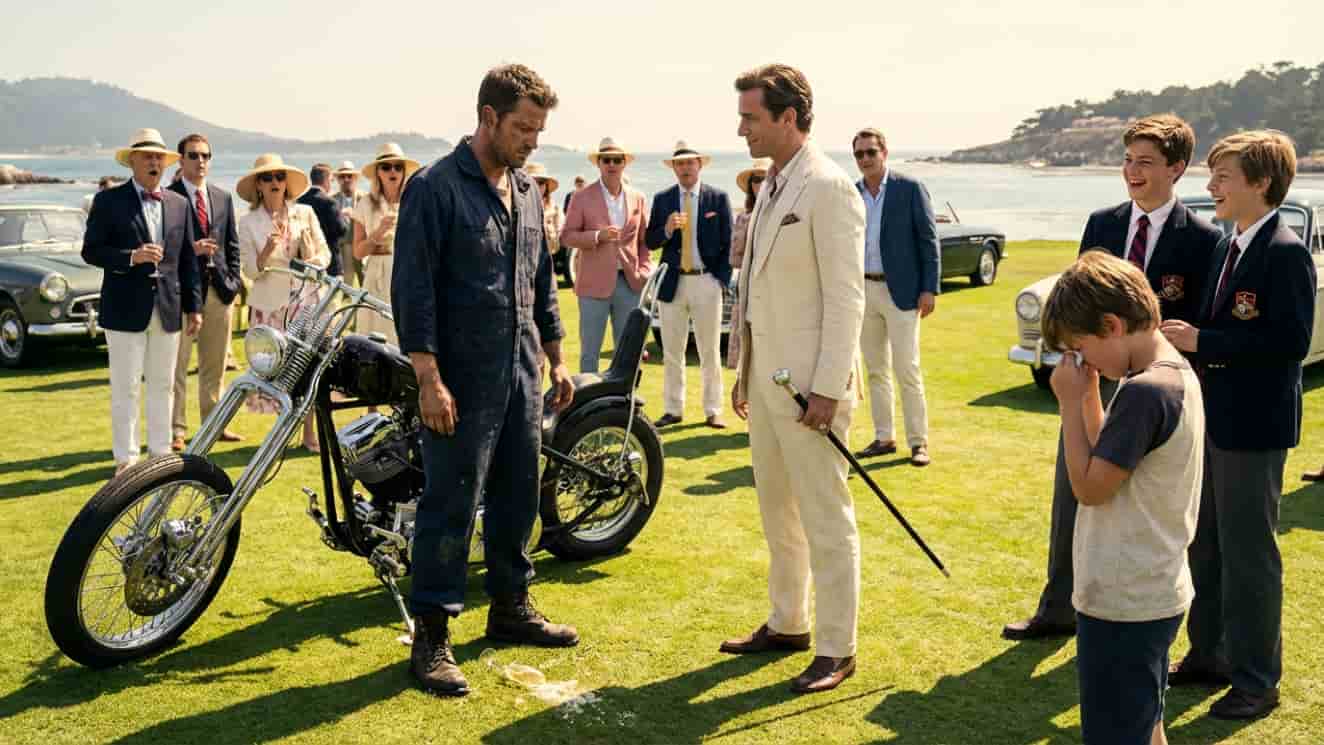
The salt air at Pebble Beach usually smelled like money and expensive wax, but today it just smelled like a trap. I stood there in my oil-slicked coveralls, the “hired help” at a show where the cars cost more than the towns I grew up in. I didn’t care about the sneers from the men in linen suits or the way the women pulled their silk skirts away when I walked by. I was looking for a ghost.
Then I saw him. A ten-year-old boy with my father’s eyes, standing in the shadow of a $200,000 supercar, taking the heat from a group of rich kids while his “guardians” ignored him. They told me he died in the hospital. They told me I wasn’t fit to be a father because I had grease under my fingernails and a patch on my back.
Julian Vane walked up then, leaning on the custom chopper I’d built in a shed ten years ago—the bike he’d “bought” through a crooked estate sale after they ran me out of town. He looked at me like I was a bug he’d forgotten to squash.
“Something wrong, Wyatt? You missed a spot on the chrome,” Julian mocked, flicking ash from his cigar onto the gas tank.
I looked at the bike. I looked at my son, Leo, who was watching us with wide, terrified eyes. Julian didn’t know I’d spent the last year buying up every cent of his predatory debt. He didn’t know that by the time the auction hammer fell this afternoon, I wouldn’t just own this bike—I’d own him.
“The chrome is fine, Julian,” I said, my voice steady as a heartbeat. “But you’re sitting in my seat. And you’re raising my son. That ends today.”
I reached into my pocket and pulled out the one thing Julian feared more than poverty: the truth.
The full story of what happened when the Desert Ghosts rode onto the lawn is in the comments.
Chapter 1: The Invisible Man
The fog rolled off the Pacific in heavy, wet blankets, clinging to the cypress trees and the polished hoods of three-hundred-million dollars’ worth of vintage steel. It was five in the morning at Pebble Beach, the kind of hour where the only people awake were the ones who owned the world and the ones who kept it running for them.
I was the latter.
I knelt on the damp grass of the 18th fairway, a microfiber cloth in one hand and a bottle of high-end detailer in the other. My back ached with a dull, rhythmic throb—a souvenir from a low-side slide on a gravel road in Nevada three years ago. I didn’t mind the pain. It was a grounding thing, a reminder that I was still made of flesh and bone in a place that felt increasingly like it was made of plastic and ego.
“Reed! You’re lagging on the 1938 Delahaye,” a voice barked.
I didn’t look up. I knew the voice. It belonged to Marcus, a man whose only talent was wearing a headset and looking stressed. He was the “Operations Manager” for the Concours d’Elegance, which meant he spent his day yelling at guys like me so he didn’t have to think about the fact that he was just a glorified parking attendant for billionaires.
“I’m finishing the wire wheels on the Talbot-Lago, Marcus,” I said, my voice gravelly from a night spent sleeping in the back of my truck. “You want it done fast, or you want it to win?”
Marcus huffed, his polished loafers clicking away toward the hospitality tents. I went back to the wheel. Every spoke was a chore. Every spoke was a minute closer to the gates opening.
I wasn’t here for the Talbot-Lago. I wasn’t even here for the paycheck, though the two hundred bucks a day in cash was the only thing keeping my “shop”—a lean-to garage in Salinas—from being padlocked by the county. I was here because of a rumor. A whisper that had traveled through the greasy backchannels of the California bike scene, from a fence in Oakland to a bar in Bakersfield, and finally to me.
The rumor said that Julian Vane was coming to the Concours. And he wasn’t coming alone.
I stood up, wiping my hands on a rag that was more black than white. My coveralls had “Wyatt” stitched in faded red thread over the heart. To the people who would be strolling these lawns in three hours, I was part of the landscape. I was a tool, like a jack or a lug wrench. And that was exactly what I needed to be.
I moved toward the staging area near the Lodge. This was where the “Special Interest” vehicles were kept—the oddballs, the prototypes, and the high-end customs that didn’t fit the rigid categories of the main show.
That’s where I saw it.
It sat under a heavy canvas tarp, but I could have identified those lines in a sensory deprivation tank. I’d spent fourteen months of my life shaped by those lines. I’d welded the frame in a fever dream of grief and cheap whiskey. I’d machined the triple trees from a single block of billet aluminum. I’d painted the tank a blue so deep it looked like the ocean at midnight, then let her—Sarah—sign her name in silver leaf on the underside of the fender where nobody would ever see it.
It was the Blue Widow. My bike. The one the Vane family lawyers had seized along with everything else I owned when Sarah died. They’d called it “unsecured asset recovery.” I called it grave robbing.
I reached out, my fingers trembling slightly. I just wanted to touch the leather of the seat. I’d hand-tooled that leather. I knew every grain.
“Don’t even think about it, grease monkey.”
The voice hit me like a bucket of ice water. I pulled my hand back, my heart hammering against my ribs.
A security guard stood ten feet away, his hand hovering near his belt. Behind him, a sleek black SUV had pulled onto the gravel path. The door opened, and a man stepped out. He was wearing a cream-colored linen suit that probably cost more than my first three cars combined. He looked older—the skin around his eyes was papery, and his hair was a disciplined silver—but the arrogance was the same. It was baked into the marrow of his bones.
Julian Vane.
He didn’t see me. Not really. He looked at the tarp-covered bike, then at his watch. He looked like a man waiting for a flight that was slightly delayed.
Then, the rear door of the SUV opened.
A boy climbed out. He looked to be about ten. He was wearing a miniature version of the same linen suit, complete with a tiny silk tie. His hair was slicked back, but a single cowlick defied the gel, standing up at the back of his head. He looked miserable. He looked like a captive.
But it wasn’t the suit or the hair that stopped my breath. It was the way he rubbed his nose with the back of his hand. It was the specific, sharp angle of his chin.
He looked like the photos of my father when he was a kid. He looked like the dream I’d buried in a small, white casket ten years ago.
“Leo, stand up straight,” Julian snapped, not even looking at the boy. “The photographers will be here in twenty minutes. Try not to look like a charity case.”
The boy—Leo—stiffened. He dropped his hand and stared at his polished shoes.
I felt the world tilt. The sounds of the ocean, the distant hum of generators, the chatter of the crew—it all faded into a high, ringing whine in my ears.
Leo.
They told me he died. The Vanes, Sarah’s parents, the whole “Blue Blood” dynasty of the Central Coast. They told me Sarah had died on the table and the baby had followed her ten minutes later. They’d handed me a pile of legal papers and a one-way ticket out of the county while I was still vibrating from the shock of the car accident. They told me I was a “contributing factor” to her death because I was the one who liked to drive fast, even though it was a drunk socialite who had crossed the yellow line and hit us.
I’d believed them. Why wouldn’t I? They had the doctors, the lawyers, and the power. I was just a kid with a leather jacket and a talent for making engines scream.
I stared at the boy. He looked up then, his eyes scanning the fairway. For a split second, his gaze landed on me—the dirty mechanic in the shadows. There was no recognition, only a flicker of curiosity, the way a child looks at a strange animal.
“Wyatt! Get over here!” Marcus was screaming again.
I didn’t move. I couldn’t move.
Julian Vane turned his head slightly, his eyes finally registering my presence. He squinted, his brow furrowed in a brief moment of “do I know this trash?” Then, a slow, ugly realization dawned on his face. The smirk didn’t reach his eyes, but it curled the corner of his mouth.
“Well,” Julian said, his voice loud enough to carry. “I see the Concours has lowered its standards for the maintenance crew. I hope you brought your best rags, Wyatt. My bike is going to need a lot of attention today.”
He knew. He’d known all along. He’d seen me, and he’d brought the boy here on purpose. It wasn’t a coincidence. It was a victory lap.
I looked at the boy, then at the man who had stolen my life and rebranded it as his own. My hands, stained with oil and scarred by a hundred slips of the wrench, curled into fists.
“I’ll be around, Julian,” I said, my voice surprisingly cold. “I’ll be around all day.”
Chapter 2: The Weight of the Chrome
By noon, the sun had burned through the fog, revealing the full, gaudy spectacle of the Concours. The air was thick with the scent of $50 cigars and $500 perfume. I was moving through the crowd like a shark in a swimming pool—unseen, unwanted, and focused.
I’d been called to the “Special Interest” circle three times to wipe down the Blue Widow. Every time I did it, Julian made sure he was there. He’d stand with a glass of champagne, explaining the “heritage” of the bike to a group of bored-looking collectors.
“It’s a bespoke piece,” Julian told a man in a yachting cap. “I commissioned it to capture the raw, American spirit. It’s about the intersection of industrial power and artistic grace.”
You didn’t commission shit, I thought, my rag moving over the primary cover. You stole it from a garage in Santa Cruz while the owner was at a funeral.
The bike was hurting. Julian didn’t know how to maintain a high-compression V-twin. The idle was rough, the timing was slightly off, and he’d let some idiot detailer use a silicone-based polish on the leather seat. It was weeping oil from the base gasket—a small, dark protest from the machine itself.
But my eyes kept drifting to Leo.
The boy was sitting on a folding chair behind the velvet ropes, looking like a decorative plant. He was holding an iPad, his fingers moving listlessly over the screen. Occasionally, a group of other kids—the sons and daughters of the exhibitors—would walk by. They were older, maybe twelve or thirteen, wearing blazers and shorts that made them look like miniature accountants.
“Look at the little Vane kid,” one of them whispered, loud enough for me to hear. “He’s got dirt on his shoes. My dad says his mom was a ‘wild child.’ That means she was a loser.”
The other kids giggled. Leo didn’t look up, but I saw his shoulders hunch. I saw his grip tighten on the tablet.
I moved closer, pretending to inspect the front fork.
“Hey,” I said softly.
Leo looked up, startled. His eyes were wide and guarded. “Am I in the way?”
“No,” I said. “You’re fine. I just noticed your shoes.”
He looked down at the small scuff on his brown leather loafers. “Julian is going to be mad. He says I have to be perfect today.”
“Julian isn’t your dad?” I asked, the words feeling like glass in my throat.
“He’s my guardian,” Leo said, using the word like a title he’d been forced to memorize. “He says my real father was a bad man who went away.”
I felt a surge of heat in my chest that had nothing to do with the sun. I looked at the boy—my son—and saw the loneliness etched into the corners of his mouth. He was surrounded by millions of dollars, by people who claimed to be his family, and he was the most alone person on this entire fairway.
“Maybe he didn’t go away,” I said, my voice barely a whisper. “Maybe he just didn’t know where to look.”
Leo frowned, a small, puzzled crease forming between his eyebrows. Before he could respond, Julian was there, his cane clicking sharply on the pavement.
“Wyatt. I didn’t pay for you to socialize with my ward,” Julian said, his voice dripping with faux-concern. “Shouldn’t you be checking the oil? It seems to be leaking. Quite a disappointment, really. I expected better craftsmanship.”
I stood up, the height difference between us vanished. I was half a head taller than Julian and twice as wide. He stepped back, his smirk faltering for a fraction of a second before he remembered where he was and who he had behind him.
“The bike is fine, Julian,” I said. “It just doesn’t like being owned by someone who doesn’t understand how it works.”
Julian’s eyes narrowed. “Careful, Wyatt. I know you’re struggling. I know about the shop in Salinas. It would be a shame if the county inspectors decided to do a surprise visit tomorrow. I have a lot of friends in the local government.”
“Is that how you do it, Julian?” I asked. “You just threaten people until they give you what you want? Did you threaten the doctors ten years ago, too?”
Julian laughed, a dry, rattling sound. “I didn’t have to threaten anyone. People like us, Wyatt… we don’t have to break the law. We are the law. We decided what was best for the boy. We decided he didn’t need to grow up in a trailer park with a father who smells like gasoline and failure.”
He leaned in closer, his voice dropping so Leo couldn’t hear. “He doesn’t even know your name. To him, you’re just the man who wipes the dust off his life. And that’s all you’ll ever be.”
I looked past Julian at Leo. The boy was watching us, his expression a mix of confusion and fear. He saw the tension, the unspoken violence vibrating between us.
I wanted to grab Julian by the throat. I wanted to howl the truth until the trees shook. But I knew that would only end one way—with me in handcuffs and Leo further away than ever.
“We’ll see,” I said. “The day isn’t over yet.”
Julian snorted and turned away, ushering Leo toward the VIP lounge. “Come, Leo. We have an auction to attend. Some of us actually buy things, rather than just cleaning them.”
I watched them go, my heart a lead weight. Then, I felt a hand on my shoulder.
“Easy, Coyote.”
I turned. It was Sarge. He was wearing a suit that looked like it had been tailored in 1985 and a hat that sat low over his scarred forehead. Sarge was the vice president of the Desert Ghosts, a man who had seen more combat in the jungles of Vietnam than most people see in a lifetime of movies.
“I didn’t think you’d show up,” I said, my voice shaking.
“The brothers are in the parking lot,” Sarge said, his eyes scanning the crowd with a predator’s focus. “Fifty of us. We’re just waiting for the word.”
“It’s not just the bike, Sarge,” I said, looking toward the Lodge. “The kid… he’s alive. Julian’s been hiding him for ten years.”
Sarge went still. The air around him seemed to grow heavy. “You sure?”
“I saw him. I talked to him. He’s mine, Sarge. He’s got Sarah’s eyes and my old man’s chin.”
Sarge looked toward the VIP lounge, his hand drifting toward the pocket of his jacket. “What’s the play?”
“Julian’s got a debt,” I said, a cold smile finally touching my lips. “A big one. He’s been over-leveraging the Vane estate to keep up appearances. He owes three different holding companies nearly ten million dollars.”
“And?”
“And those holding companies? I spent the last eight months buying their paper. I sold the shop. I sold the land my grandfather left me. I took every penny the club had in the ’emergency fund’ and I bet it all on Julian Vane’s arrogance.”
I pulled a small, crumpled envelope from my coveralls. Inside was the final foreclosure notice, signed and stamped by the Monterey County Sheriff’s office.
“I don’t just own the bike, Sarge,” I said. “By four o’clock today, I own the house he lives in, the cars he drives, and the very ground he’s standing on. He thinks I’m the help. He’s about to find out I’m the landlord.”
Chapter 3: The Blueprint of a Life
The heat was becoming oppressive, the kind of California sun that makes the air shimmer and the asphalt soft. I retreated to the small tech-tent near the back of the fairway, away from the prying eyes of the judges and the Vanes.
Sarge followed me, leaning against a stack of tire racks. “You really did it, didn’t you? You went all in.”
“I had to,” I said. I reached into my tool bag and pulled out a worn, grease-stained leather portfolio. I unzipped it carefully, revealing a single sheet of vellum paper.
It was the original blueprint for the Blue Widow. But it wasn’t just a technical drawing. In the margins, there were notes in Sarah’s looping, elegant handwriting. Needs more rake here. Wyatt, don’t forget the seat height—I want to be able to reach the pegs.
And in the bottom right corner, next to my signature, she’d signed her name in silver ink. Sarah Reed. She’d taken my name. Even though her parents had threatened to cut her off, even though they’d called our marriage a “temporary lapse in judgment,” she’d been a Reed. And Leo was a Reed.
“This is the proof of the bike’s lineage,” I said, my thumb tracing her signature. “The auction house is listing it as a ‘Vane Custom.’ They’re claiming Julian designed it. This paper proves he’s a liar. And the debt papers prove he’s a fraud.”
“He’s going to fight you, Wyatt,” Sarge warned. “Men like that don’t just hand over the keys. They’ll call the cops. They’ll call the National Guard if they have to.”
“Let them,” I said. “I’m not a kid anymore. I’m not the scared twenty-year-old they bullied at the hospital. I’m a Desert Ghost. And I’m a father.”
The sound of a gavel echoed from the main stage. The auction was starting. This was the centerpiece of the event—where the high-rollers bid on the most exclusive vehicles in the world. Julian was planning to sell the Blue Widow to cover his first round of debts, never realizing the person buying it would be me.
“Go get the brothers,” I said. “Tell them to move to the north gate. When the gavel drops on that bike, I want the world to hear us coming.”
Sarge nodded, a grim smile on his face. “Give ’em hell, Coyote.”
I walked out of the tent, my heart a drumbeat in my chest. I saw Leo again. He was standing near the entrance to the auction tent, looking lost. A group of men in suits were talking over his head, ignoring him as if he were a piece of luggage.
I moved toward him, my boots crunching on the gravel.
“Leo,” I called out.
He turned, his eyes lighting up with a flicker of recognition. “The mechanic!”
“My name is Wyatt,” I said, kneeling so I was at eye level with him.
“Julian says the auction is very important,” Leo said, his voice small. “He says if the bike doesn’t sell for enough money, we might have to move.”
“Would that be so bad?” I asked.
Leo looked around at the pristine lawns, the cold, beautiful cars, and the people who didn’t look at him. “It’s big,” he said. “But it’s quiet. Everyone is always so quiet.”
I reached out and tucked a stray hair behind his ear. His skin was warm, and for a second, I felt a connection so deep it made my eyes sting. “Where I live, it’s never quiet. There are dogs barking, and the sound of tools, and people laughing around a fire.”
Leo’s eyes widened. “Really?”
“Really,” I said.
“Wyatt!”
Julian was back, his face flushed with anger. He’d seen me talking to the boy again. He marched over, his cane raised as if he were going to strike me.
“I’ve had enough of this! Security!” Julian screamed.
Two large men in blazers appeared instantly, grabbing me by the arms. They weren’t gentle. They twisted my wrists, forcing me to my feet.
“Get this animal off the property!” Julian hissed, his face inches from mine. “I don’t care if you have to throw him into the ocean.”
“Wait!” Leo cried, reaching out for my sleeve. “He didn’t do anything!”
Julian grabbed Leo by the shoulder, pulling him back with a jerk. “Be silent, Leo! Go inside!”
“Don’t touch him like that,” I growled, struggling against the guards.
Julian leaned in, his voice a venomous whisper. “You lost, Wyatt. You lost ten years ago, and you’re losing today. By tonight, I’ll have the money from your bike, and I’ll have your son halfway to a boarding school in Switzerland where you’ll never find him. You’re nothing but road trash. Now, get him out of here!”
The guards dragged me toward the gates. I didn’t fight them. Not yet. I looked back and saw Leo staring at me, his face a mask of heartbreak.
“I’m coming back for you, Leo!” I yelled. “I’m coming back!”
The guards threw me through the ornate iron gates of the Concours. I hit the pavement hard, the air leaving my lungs. I lay there for a moment, the salt air stinging my throat, the sound of the ocean mocking me.
Then, I heard it.
A low, distant rumble. It sounded like thunder, but the sky was clear. It grew louder, a rhythmic, mechanical growl that vibrated in the soles of my boots.
The Desert Ghosts were here.
Chapter 4: The Sound of Thunder
I stood up, wiping the blood from my lip. At the end of the long, winding drive that led to the Concours, a wall of black leather and chrome was appearing through the lingering sea mist.
Fifty bikes. Fifty men who had lived through the worst the world could throw at them and come out the other side with nothing but their honor and their brothers. At the front was Sarge, his gray beard flying in the wind, his hand raised in a fist.
They pulled up to the gates, the sound of fifty engines idling creating a wall of noise that made the security guards at the gate blanch. The “Special Event” security, used to dealing with drunk socialites and lost tourists, looked like they were facing an invading army.
Sarge killed his engine, the silence that followed even more intimidating than the noise.
“You okay, Coyote?” he asked, his eyes taking in my torn coveralls and bloodied lip.
“I’m fine,” I said. I walked to the lead bike—Sarge’s heavy dresser—and pulled a leather vest from the saddlebag. I stripped off the “Wyatt” coveralls, revealing a black T-shirt soaked in sweat. I slid the vest on. On the back was the skull wrapped in a desert scarf, the words DESERT GHOSTS MC arched over it.
I wasn’t a mechanic anymore. I was a King.
“The auction starts in ten minutes,” I said. “The bike is Lot 42. Julian thinks he’s going to sell it and run. He thinks he’s going to take the boy.”
“Not on our watch,” a voice called out. It was Dutch, a massive man with tattooed knuckles and a heart of gold.
“Listen to me,” I said, raising my voice over the murmur of the brothers. “We don’t go in there for trouble. We go in there for justice. We follow the plan. We use the law. But if anyone tries to stop us from taking what’s mine…”
“We’ll flatten ’em,” Dutch finished.
I climbed onto the back of Sarge’s bike. “Let’s go.”
The security guards at the gate didn’t even try to stop us. They simply stepped aside as the gate opened. We rode in a tight, disciplined formation, the sound of our engines echoing off the million-dollar villas and the manicured hedges.
We weren’t supposed to be here. This was a world of hushed whispers and polite applause. We were a scream in a library.
We rode right onto the 18th fairway, the heavy tires of the cruisers leaving deep ruts in the perfect grass. People dived out of the way, champagne glasses shattering on the ground. Women screamed, and men shouted for security, but we didn’t stop until we reached the main auction tent.
I hopped off Sarge’s bike before it had even fully stopped. I pushed through the crowd of stunned bidders, my boots heavy on the red carpet.
On the stage, the Blue Widow sat under the spotlights. Julian Vane was standing next to the auctioneer, a forced smile on his face as he talked up the “provenance” of the machine.
“…and so, we start the bidding for this one-of-a-kind Vane masterpiece at five hundred thousand dollars,” the auctioneer intoned.
“I have a bid for five hundred!” a man in the front row shouted.
“Six hundred!” another called out.
I walked right up the center aisle. Every eye in the room turned toward me. The grease on my face, the leather on my back, the sheer, raw violence of my presence—it was a contagion in this room of sanitized wealth.
“One dollar!” I shouted, my voice cutting through the chatter like a knife.
The auctioneer paused, his gavel mid-air. “Excuse me? This is a professional auction, sir. Security, please remove this—”
“I bid one dollar,” I said, stepping onto the stage. Julian Vane froze, his face turning a sickly shade of gray. “Because you can’t sell something you don’t own.”
“Wyatt, get off this stage!” Julian hissed, his voice cracking. “You’re trespassing! You’re ruined!”
I ignored him and turned to the auctioneer. I pulled the vellum blueprint from my vest and slapped it onto the podium.
“This is the original design for this bike,” I said, my voice projecting to the back of the tent. “It’s signed by my wife, Sarah Reed. It was stolen from my property ten years ago. This man is a thief.”
The room erupted into murmurs. Julian stepped forward, his cane shaking. “That’s a lie! I have the bill of sale! I have the title!”
“You have a title issued by a court you bought,” I said. “But you don’t have the deed to the ground you’re standing on.”
I pulled out the envelope with the foreclosure notices. I didn’t give them to the auctioneer. I gave them to Julian.
“Read it, Julian,” I said. “Read the name of the holding company that bought your debt. Phoenix Recovery LLC. Do you know who owns Phoenix Recovery?”
Julian’s hands were shaking so hard he could barely hold the papers. He scanned the lines, his eyes widening as he reached the bottom.
“You…” he whispered. “How? How did you get this kind of money?”
“I didn’t need money, Julian,” I said. “I needed patience. And I had fifty brothers who were willing to put up everything they owned to see a wrong made right. You’ve been living on credit and arrogance for a decade. Your time is up.”
I turned to the crowd. “This auction is over! Everything in this tent, everything on this lawn, is now the property of the Monterey County Sheriff’s office pending the liquidation of the Vane estate. And as the primary lienholder, I’m taking my bike. And I’m taking my son.”
“Security!” Julian screamed, his voice a high, panicked wail. “Do something!”
The guards moved in, but they stopped when they saw the entrance to the tent. Fifty Desert Ghosts stood there, their arms crossed, their expressions as hard as the steel they rode.
Then, I saw him. Leo was standing at the edge of the stage, his eyes wide. He wasn’t looking at the bikes or the leather. He was looking at me.
“Wyatt?” he whispered.
I walked over to him, ignoring Julian, ignoring the auctioneer, ignoring the millionaires. I knelt in front of him.
“I told you I was coming back,” I said.
“Is it true?” Leo asked, his lip trembling. “Are you my dad?”
I reached into my vest and pulled out a small, silver locket. I opened it to reveal a photo of Sarah holding a tiny, sleeping baby.
“Her name was Sarah,” I said. “She loved you more than anything. And I’ve spent ten years trying to find my way back to you.”
Leo didn’t hesitate. He threw his arms around my neck, sobbing into my shoulder. I held him tight, the grease from my hands staining his expensive linen suit, and for the first time in ten years, the hole in my heart began to close.
Julian Vane slumped into a chair, his cane falling to the floor with a hollow thud. He was a man who had built a kingdom on lies, and the truth had just burned it to the ground.
“Get the bike, Sarge,” I said, standing up with Leo in my arms. “We’re going home.”
Chapter 5: The Toll of the Road
The roar of fifty engines was a physical weight as we cleared the gates of Pebble Beach. Behind us, the manicured paradise was in a state of tectonic collapse. I could feel Leo’s small hands gripping the waist of my leather vest, his face pressed hard against my back. He was trembling, a rhythmic shudder that vibrated through my own spine. Every time Sarge leaned into a curve on the 17-Mile Drive, I felt Leo’s grip tighten, his knuckles digging into my ribs.
I didn’t look back at the luxury SUVs or the security guards frantically talking into their radios. I only looked forward, through the bug-spattered windshield of Sarge’s dresser, at the winding black ribbon of Highway 1. The ocean was a jagged, churning gray to our right, the spray hitting us in cold, salty needles.
We didn’t head for Salinas. Not yet. Julian Vane had too many friends in the Monterey PD, and the paperwork I’d slapped on that auction podium was a legal grenade—it would take hours for the smoke to clear and for the “system” to realize I actually held the pin. We needed a neutral ground, a place where the noise of the club could act as a buffer against the silence of the lawyers.
“We hitting the Nest?” Sarge shouted over the wind, referring to a secluded property the club owned up in the Santa Lucia highlands.
“The Nest,” I yelled back. “Keep the scouts out. I want to know the second a patrol car leaves the station.”
Sarge nodded and signaled the pack. We banked left, turning away from the coast and climbing into the redwoods. The temperature dropped instantly, the air turning damp and smelling of ancient mulch and gasoline.
When we finally pulled into the gravel clearing of the Nest, the silence that followed the engine cuts was deafening. The brothers began to peel off, their boots crunching on the stones, voices low as they set up a perimeter. They knew the stakes. This wasn’t a run for fun; this was a recovery mission.
I dismounted and reached back for Leo. He stayed on the bike for a second, his legs shaky, his eyes wide and unfocused. The expensive linen suit he was wearing was ruined—streaked with oil from my vest and wrinkled from the ride. He looked like a castaway.
“Hey,” I said, my voice dropping to a register I hadn’t used in a decade. “You’re okay. You’re safe.”
Leo looked at the circle of bikers—men with scarred faces, long beards, and patches that screamed of a world he’d been taught to fear. He looked at the dilapidated cabin behind us, its porch sagging under the weight of overgrown vines. Then he looked at me.
“Is Julian coming?” he asked. His voice was a thin, fragile thing.
“No,” I said, crouching down so we were eye-level. “Julian is busy answering questions from people who don’t like being lied to. He can’t touch you here.”
“He said you were dangerous,” Leo whispered. “He said people like you take things that don’t belong to them.”
The irony of that statement nearly made me choke. I reached out, hesitant, and placed a hand on his shoulder. He didn’t flinch, but he didn’t lean in either. “Leo, the only thing I ever ‘took’ was a chance to build something. Julian took the truth. He took ten years of us being together. I’m not dangerous to you. I’m the man who’s been looking for you since the day you were born.”
I led him into the cabin. It was a rough space—wood stove, mismatched chairs, a heavy oak table scarred by a thousand card games. Dutch was already inside, stoking a fire. He’d stopped at a roadside diner on the way and picked up a bag of greasy burgers and fries.
“Kid looks like he’s about to faint,” Dutch said, sliding a cardboard box toward Leo. “Eat. It’s better than that tiny toast they serve at the car shows.”
Leo sat tentatively at the table. He picked up a fry, looking at it as if it were an alien specimen. At the Vane estate, everything was organic, plated by staff, and consumed in a room where the ticking of a grandfather clock was the only soundtrack. Here, there was the crackle of the fire, the distant laughter of the brothers outside, and the heavy scent of woodsmoke.
I sat across from him, watching him eat. Every movement he made hurt me. The way he chewed, the way he pushed his hair back—it was all Sarah. It was like watching a ghost materialize in a dirty kitchen.
“Why did you wait so long?” Leo asked suddenly. He didn’t look up from his burger.
The question hit me harder than any fist ever had. “I didn’t wait, Leo. They told me you died. They showed me papers. They had a funeral with an empty casket. I was twenty years old, and I was broken. I believed them because I couldn’t imagine anyone being cruel enough to lie about a baby.”
Leo finally looked up. His eyes were wet, but he wasn’t crying. He was assessing me with a gravity that no ten-year-old should possess. “Julian says I was a ‘miracle’ he rescued from a bad situation. He said my mother didn’t want me.”
I felt the rage simmer in my gut, but I kept my face still. “Your mother loved you more than her own life, Leo. She was the one who designed that bike outside. She was the one who chose your name. She was the bravest person I ever knew. Julian didn’t rescue you. He stole you so he could use you to keep the Vane money in his pocket.”
“Is that why you bought his debts?” Leo asked. “To get me back?”
“I bought his debts because it was the only way to speak a language he understood,” I said. “Julian doesn’t care about hearts or blood. He cares about balance sheets. I had to become the person who owned his world before he’d ever let me back into yours.”
A knock at the door interrupted us. Sarge stepped in, his expression grim. “Coyote. We’ve got company at the bottom of the hill. Not the cops. It’s a black sedan. One of Julian’s lawyers, I reckon. And he’s got a Sheriff’s deputy with him.”
I stood up, my joints popping. I felt a cold, professional calm settle over me. This was the moment where the “biker” had to become the “landlord.”
“Stay here with Dutch,” I told Leo. “Don’t come outside until I tell you.”
“Are they taking me back?” Leo’s voice went sharp with panic. He stood up, the chair scraping loudly against the floorboards.
I walked over and put both hands on his shoulders. “Nobody is taking you anywhere. I promise you that on my life. I’m going to go talk to them, and then I’m coming back in here, and we’re going to figure out what’s next. You trust me?”
Leo looked at me for a long time. Then, very slowly, he nodded.
I walked out onto the porch. The sun was dipping behind the ridge, casting long, bloody shadows across the clearing. A black Mercedes was idling at the edge of the trees, a Monterey County Sheriff’s cruiser parked right behind it.
A man in a charcoal suit stepped out of the Mercedes. He was holding a briefcase like a shield. Beside him, a deputy I recognized—Miller—stood with his hands on his belt, looking deeply uncomfortable.
“Mr. Reed,” the lawyer called out. He didn’t come closer than the edge of the gravel. “My name is Sterling. I represent the Vane family. We are here to discuss the… unorthodox events of this afternoon.”
“You’re here to trespass on private property,” I said, walking down the porch steps. “This land is owned by the Desert Ghosts. You don’t have a warrant, and you don’t have an invitation.”
“We have a report of a kidnapping,” Sterling said, his voice clipped and superior. “Young Leo Vane was taken from a public event by force.”
“Check your facts, Sterling,” I said, stopping ten feet from him. “Leo wasn’t taken by force. He’s my son. I have his birth certificate—the real one, not the one Julian forged. And as for ‘force,’ I think the fifty witnesses at the auction would say I walked out with my son while his ‘guardian’ sat in a chair and watched because he realized I owned the chair he was sitting in.”
I looked at Deputy Miller. “You know the law, Miller. Julian Vane defaulted on three major loans last month. I bought the notes. I filed the foreclosure papers this morning. I’m the primary lienholder on every asset Julian has, including the house where the boy was staying. Under the emergency custody provisions of the state, given the evidence of fraud and child concealment I’ve already sent to the DA, I have the right to keep him until a hearing is set.”
Sterling’s face reddened. “This is absurd. You are a convicted felon, Mr. Reed. You are a member of a criminal organization. No judge in this state will give you custody.”
“I was convicted of reckless driving when I was nineteen,” I said. “A charge Julian paid to have upgraded so he could run me out of town. As for the club… the Desert Ghosts haven’t had a citation in five years. We’re a registered non-profit that does more for the veterans in this county than the Vanes ever did for anyone but themselves.”
I stepped closer to Sterling, let him smell the woodsmoke and the road on me. “Here’s how this is going to go. You’re going to get back in your car. You’re going to tell Julian that if he so much as breathes in the direction of my son, I will trigger the immediate seizure of the Vane estate. I will have the Sheriff’s department pull him out of his bed by his silk pajamas. I have the receipts, Sterling. I have the blueprints. I have the evidence of the shell companies he used to hide his insolvency from the probate court.”
Sterling looked at Miller. The deputy just shrugged. “The paperwork looks solid on my end, Mr. Sterling. If Mr. Reed is the legal father and he’s got the debt-hold on the Vane properties, it’s a civil matter. I’m just here to make sure nobody gets shot.”
“Nobody’s getting shot,” I said, my eyes locked on Sterling. “Unless they try to touch my kid. Now, get off my mountain.”
Sterling huffed, a sound of pure, impotent frustration. He turned and climbed back into the Mercedes, the door slamming with a muffled thump. Miller gave me a sharp, two-finger salute and followed him down the hill.
I stood there until the sound of the engines faded into the rustle of the trees. My hands were shaking, but not from fear. It was the adrenaline of a man who had finally stopped running and started fighting.
I felt a presence behind me. I turned to see Leo standing in the doorway of the cabin. He’d seen the whole thing.
“You really own his house?” Leo asked.
“Technically, the bank owns it,” I said. “But I own the bank’s interest. It means he can’t keep us apart anymore, Leo. The wall is down.”
Leo walked out onto the porch. He looked out at the bikes, at the brothers who were now drifting back toward the fire, their shadows tall and imposing in the twilight. “What happens tomorrow?”
“Tomorrow,” I said, “we go to the city. We talk to a judge who isn’t on the Vane payroll. We start the real work.”
“Will I have to wear the suit?” he asked, looking down at his ruined clothes.
I smiled, a real one this time. “No. I think we can find you something with a little more grease on it.”
Chapter 6: The King of the Low Road
Six weeks later, the morning sun was hitting the storefronts of Salinas with a flat, unblinking glare. I was standing in front of my shop—no longer a lean-to, but a proper brick-and-mortar garage with a sign that read REED & SON CUSTOMS. The paint was still fresh, the scent of it mixing with the familiar aroma of burnt oil and old rubber.
The legal battle had been a bloodbath, but not the kind Julian expected. When the forensic accountants I’d hired started digging into the Vane estate, they found a decade of systemic embezzlement. Julian hadn’t just stolen my son; he’d been stealing from the family trusts, from charitable foundations, and from the state. By the time the dust settled, Julian Vane wasn’t just broke—he was under indictment.
He was currently awaiting trial in a county facility, his linen suits replaced by orange polyester.
I heard the familiar clack-clack of a skateboard on the sidewalk. Leo came flying around the corner, wearing a black T-shirt and jeans that were permanently stained at the knees. He’d grown an inch, or maybe he was just finally standing up straight.
“Hey, Dad! Sarge is at the light!” Leo shouted, kicking his board up into his hand with practiced ease.
Dad. The word still felt like a miracle every time it landed. It didn’t sound like a title anymore. It sounded like home.
“Get your gear on,” I said. “We’re heading out to the track.”
Leo disappeared into the back of the shop. A moment later, Sarge pulled up on his dresser, followed by a dozen brothers. They weren’t in a formation this time; they were just a group of men heading out for a Saturday ride.
“You ready, Coyote?” Sarge asked, flipping his visor up. “The boy’s been talking about hitting the dirt all week.”
“He’s got the itch,” I said, wiping a smudge off the tank of the Blue Widow. I’d spent the last month restoring it, fixing the damage Julian’s neglect had caused. It was running better than the day I’d finished it ten years ago. It sounded like a heartbeat.
Leo came back out, wearing a small leather jacket the club had commissioned for him. It had a small “Ghost” patch on the shoulder—not a full rocker, but a sign of belonging. He climbed onto the pillion seat of the Blue Widow, his movements confident. He didn’t tremble anymore.
Before we left, a silver Town Car pulled up to the curb. A woman stepped out—Sarah’s mother, Eleanor Vane. She looked older than she had at the auction, the weight of the scandal having etched deep lines into her face. She’d stayed out of the legal fray, claiming ignorance of Julian’s crimes, but the shame was a permanent accessory now.
I felt Leo stiffen behind me. I put my hand on his leg. “It’s okay.”
Eleanor walked up to the edge of the sidewalk. She didn’t look at the bikes or the leather. She looked at Leo.
“I’m leaving for Europe tomorrow, Leo,” she said, her voice thin. “I just wanted to… I wanted to say goodbye.”
Leo looked at her for a long time. There was no anger in his face, just a quiet, distant understanding. “Goodbye, Grandmother.”
She looked at me then. There was no apology in her eyes—women like Eleanor Vane don’t apologize to men like me—but there was a recognition. She saw the way Leo was sitting, the way he looked at me, and she knew she’d lost a war she never should have started.
“He looks like her,” she said softly.
“He looks like himself,” I replied. “But he has her heart.”
She nodded once, a sharp, jerky movement, and then got back into the car. She was a relic of a world that was disappearing in our rearview mirror.
I kicked the Blue Widow into gear. The engine roared, a deep, guttural sound that seemed to shake the very foundations of the street. I felt Leo’s arms wrap around my waist—not in fear, but in a solid, rhythmic embrace.
“You got the blueprint, Dad?” Leo shouted over the engine.
“In the bag,” I said. “Along with the locket.”
We pulled out into the street, the Desert Ghosts falling in line behind us. We didn’t look like the people on the Pebble Beach fairways. We didn’t have the linen suits or the champagne. We had the wind, the grease, and the truth.
As we hit the main highway, I opened the throttle. The Blue Widow surged forward, the chrome gleaming in the midday sun. We weren’t riding away from anything. We were riding toward the life we were always supposed to have.
The road ahead was long, and it wasn’t going to be easy. There would be more lawyers, more growing pains, and more ghosts to face. But as I felt my son’s heart beating against my back, I knew that for the first time in my life, I wasn’t just surviving.
I was the King of the Low Road. And I was finally home.
The pack stretched out behind us, a long, black ribbon of steel and brotherhood, cutting through the California haze. We rode past the gated communities, past the country clubs, and out toward the open hills where the air was free and the only law that mattered was the one you wrote yourself.
Leo let out a whoop of pure, unadulterated joy, the sound lost in the thunder of the engines. I reached down and patted the tank of the bike, Sarah’s silver signature hidden beneath my hand.
“We did it,” I whispered into the wind.
And as the speedometer climbed and the world became a blur of green and gold, I knew she was listening.