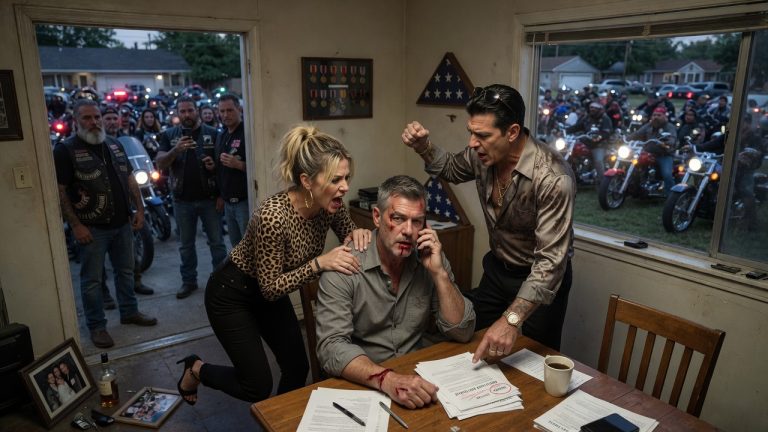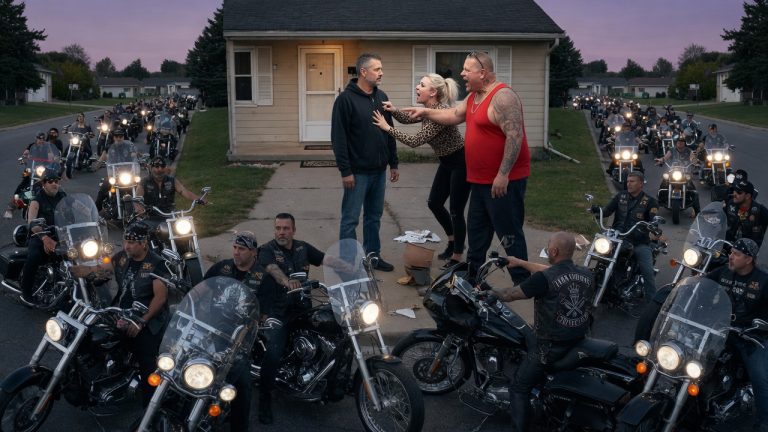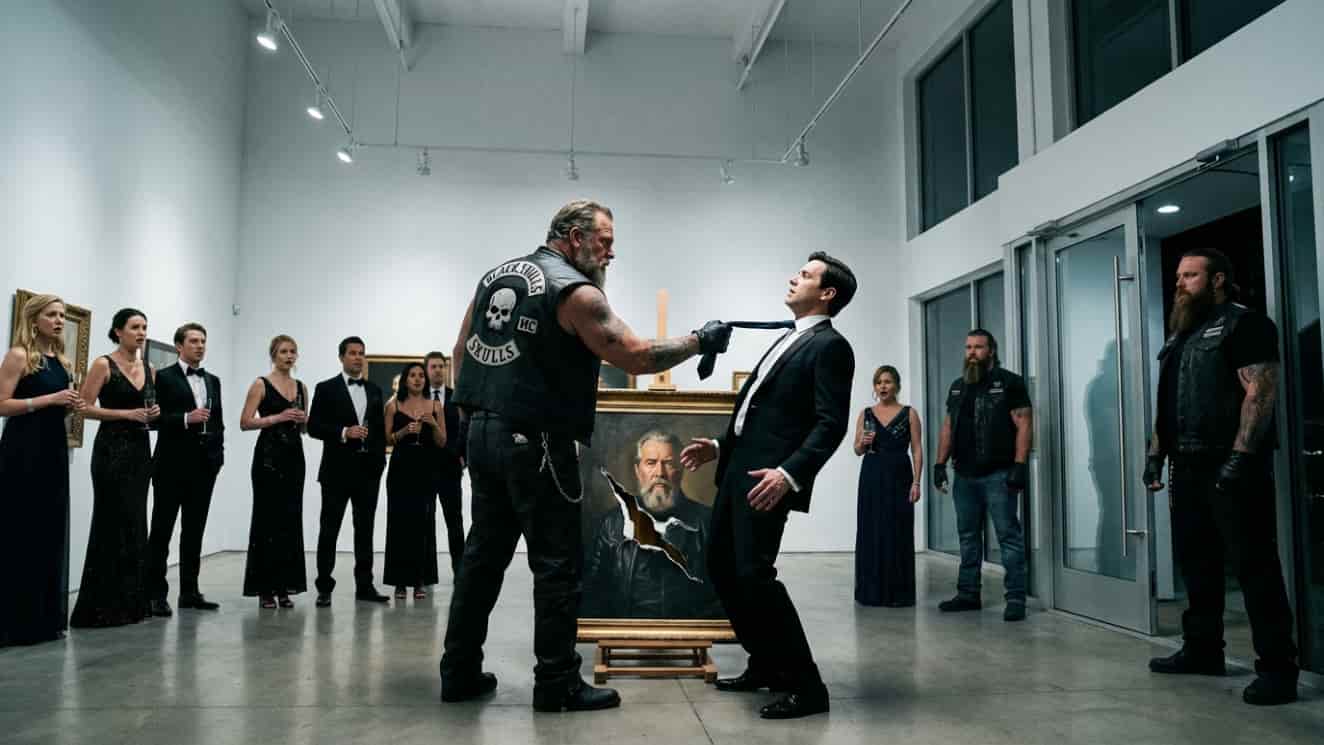
Julian Vane thought he was just bullying a struggling kid with no connections. He thought he could rip Gabe’s soul apart and walk away with a smile and a glass of vintage scotch. He didn’t see the fleet of black Harleys pulling up to the curb. He didn’t know that the “anonymous donor” who bought the gallery’s building was the same man currently holding him by the throat. Gabe spent his whole life trying to hide his father’s tattoos, but tonight, those tattoos are the only thing standing between him and ruin. When the leather meets the velvet, someone is going to pay—and Silas Vance doesn’t take checks.
Chapter 1: The Weight of the Cut
The smell of the Black Skulls clubhouse was a permanent atmospheric layer, a mixture of stale Marlboros, 90-weight gear oil, and the kind of industrial floor cleaner that never quite wins the war against the dirt. Silas “Revolver” Vance sat at the head of the scarred oak table in the “Church” room, his large hands wrapped around a lukewarm cup of black coffee. His knuckles were thick, mapped with white lines of scar tissue from decades of bad decisions and harder fights. At fifty-five, the “Revolver” moniker felt less like a threat and more like a heavy piece of iron he was tired of carrying, but the patch on his back—the grinning skull with the crossed pistons—didn’t allow for retirement.
“Shipment’s late, Silas,” T-Bone said, leaning against the doorframe. T-Bone was six-foot-five of pure, corn-fed muscle, a man whose primary function in life was being an immovable object. But today, even he looked restless. “The guys from the Jersey chapter are getting twitchy. They think we’re losing our grip on the docks.”
Silas didn’t look up. He was staring at a smudge of blue paint on his thumb—a tiny, stubborn remnant from his visit to Gabe’s loft the night before. “Jersey can wait. Tell them if they’re twitchy, they can go for a run. I’m not moving until the manifest is verified.”
“You’ve been distracted,” T-Bone noted, his voice dropping an octave. “You’ve been spending a lot of time in Dumbo. That’s a long ride for a man who hates the city.”
“I don’t hate the city,” Silas grunted, finally meeting T-Bone’s eyes. “I just hate the people who think they own it.”
Silas stood up, his leather vest—his cut—creaking. He was the President of the Black Skulls, a man who had ended lives to ensure the club’s survival. His mother had owned a small, dusty art supply shop in Queens when he was a boy, a place where the air smelled of turpentine and possibility. He had killed his first man in that shop, a debt collector who had pushed his mother a step too far. He had traded the brush for the gun to keep her world safe, and he had spent the rest of his life making sure his own son, Gabe, would never have to make that trade.
He left the clubhouse, the roar of his 1978 Shovelhead drowning out the internal noise. The ride into Brooklyn was a transition between two lives. By the time he crossed the bridge, he wasn’t the Revolver anymore; he was just a big, aging man in a leather jacket that looked a little too rugged for the neighborhood of glass-walled lofts and $15 avocado toast.
He parked three blocks away from Gabe’s building. He didn’t want the neighbors seeing the patches. Gabe was “Gabriel Vance,” a rising star in the contemporary art scene, a kid whose hands were as clean as Silas’s were filthy. Gabe didn’t know that Silas had used club funds, laundered through a dozen shell companies, to buy the very building Gabe lived in. He didn’t know that the “landlord” who gave him such a break on rent was actually a father who watched him through the lens of a security camera every night to make sure he got home safe.
Gabe’s loft was a chaotic sanctuary of stretched canvases and the sharp, medicinal scent of Gamsol. Silas let himself in with his key, finding Gabe slumped over a drafting table, his hair a mess of curls and charcoal dust.
“You look like hell, kid,” Silas said, setting a bag of takeout on the only clean surface in the room.
Gabe looked up, his eyes weary but bright. He had his grandmother’s eyes—wide, observant, and far too kind for the world Silas occupied. “Hey, Pop. Just trying to finish the pieces for the Vane Gallery opening. Julian is… he’s pushing hard.”
Silas felt a familiar tightening in his chest. “Julian Vane. The guy with the silk scarves?”
“He’s a visionary, Pop. He says my work could be the cornerstone of the fall season. But he keeps asking for changes. He wants more ‘edge.’ He says my portraits are too traditional.”
Silas walked over to a canvas covered by a white sheet. He pulled it back. It was a portrait of a man—Silas—but not the man the club saw. In the painting, Silas was sitting on a porch, his face illuminated by a soft, amber light. His hands were resting in his lap, open and vulnerable. There were no tattoos in the painting, no leather, no blood. It was a version of Silas that didn’t exist anywhere but in Gabe’s heart.
“You shouldn’t have painted this,” Silas whispered.
“Why not? It’s the truth,” Gabe said, standing up to join him. “That’s who you are when you’re here.”
“The truth is a dangerous thing to put on a wall, Gabe. Especially in a place like Vane’s gallery. Those people… they don’t look at art. They look for weaknesses.”
“It’s just a painting, Pop. Julian loves it. He says it’s the ‘mystery of the common man.'”
Silas looked at the blue paint on his thumb. He thought about the warehouse in Jersey, the twitchy bikers, and the weight of the revolver in his waistband. He looked at his son, whose only weapon was a piece of charcoal, and felt a cold, creeping dread. He had built a fortress around Gabe, but he had forgotten that the most dangerous enemies don’t use battering rams; they use contracts and smiles.
“Just be careful, Gabe,” Silas said, his voice thick. “If he asks you for something that feels wrong… you tell me. You don’t owe that man anything.”
Gabe laughed, a light, innocent sound that made Silas want to weep. “I’m fine, Pop. It’s just art. What’s the worst that could happen?”
Silas left the loft an hour later, the sun setting behind the Brooklyn skyline. He didn’t head back to the clubhouse. Instead, he rode to a quiet bar on the edge of Red Hook, a place where the bartenders didn’t ask questions and the light didn’t reach the corners. He sat there for a long time, thinking about the look in Gabe’s eyes. He had spent twenty years keeping the darkness away from his son, but as he watched the shadows stretch across the bar, he realized the darkness was already in the room. It was just wearing a tuxedo.
Chapter 2: The Predator’s Smile
The Julian Vane Gallery was a cathedral of curated silence. It sat on a prime corner in Chelsea, all floor-to-ceiling glass and air-conditioned arrogance. Julian Vane himself moved through the space like a shark in a tailored suit, his movements fluid and predatory. He was forty, with silvering temples and a voice that sounded like expensive bourbon poured over ice.
Gabe stood in the center of the main hall, feeling small. He was surrounded by his own work—large-scale oil paintings that looked out of place against the clinical whiteness of the walls. Julian was circling the portrait of Silas, the one Gabe had finished only days before.
“It’s missing something, Gabriel,” Julian said, his back to the boy. “The technique is flawless, yes. The light is… evocative. But it lacks context. Who is this man? Why should my buyers care about a weary laborer in Queens?”
“He’s not a laborer,” Gabe said, his voice catching. “He’s… he’s my father.”
Julian turned, a slow, practiced smile spreading across his face. “Ah. The father. The elusive Mr. Vance. You’ve been very protective of him, haven’t you? Never brings him to the studio when I’m there. No photos. Just this… sanitized version.”
“It’s not sanitized. It’s how I see him.”
Julian stepped closer, his presence suddenly suffocating. He smelled of sandalwood and something metallic. “Gabriel, let’s be honest. The art world is bored of ‘how sons see their fathers.’ They want the grime. They want the scandal. I’ve done some digging, you see. It wasn’t hard. A man like your father… he leaves a very distinct footprint.”
Gabe felt the air leave the room. “I don’t know what you’re talking about.”
“The Black Skulls, Gabriel. A charmingly archaic name for a criminal enterprise, don’t you think? Your father isn’t a ‘common man.’ He’s a thug. A high-ranking one. And that, my dear boy, is the ‘edge’ this painting needs.”
Julian reached out and tapped the canvas with a manicured fingernail. “Imagine the publicity. ‘The Prince of Tides: A Prodigy’s Love Letter to his Outlaw Father.’ We’ll have the bikers here for the opening. We’ll have the press. It’ll be the scandal of the year. You’ll be a star.”
“No,” Gabe said, his voice shaking. “No, he doesn’t want that. I don’t want that. My father is… he’s private. If you involve the club, you’ll ruin him. You’ll ruin me.”
Julian’s smile didn’t falter, but his eyes went cold. He pulled a folder from under his arm and tossed it onto a nearby pedestal. Gabe opened it. Inside were photos of Silas—not the man from the painting, but the Revolver. Silas in his cut, Silas outside a courthouse, Silas with his hand around a man’s throat in an alleyway. And at the bottom, a copy of the deed to Gabe’s building.
“Your father bought this building through a front company called ‘Blue Ink Holdings,'” Julian whispered. “Money laundering is such a tedious crime, but the feds take it so seriously. And you, Gabriel… you’ve been living on that money. You’ve been painting on it. You’re as much a part of the Black Skulls as the man in the leather vest.”
Gabe felt a wave of nausea. He looked at the portrait of his father—the soft light, the open hands. It felt like a lie now. Everything felt like a lie.
“What do you want?” Gabe asked, the words tasting like ash.
“I want the ‘real’ story. I want you to paint a new series. Not this sentimental drivel. I want the violence. I want the blood. I want the truth of your father’s life. And I want you to sign over the exclusive rights to your next five years of work to this gallery. If you do, the folder stays shut. Your father stays out of prison. You stay a rising star.”
“And if I don’t?”
Julian leaned in so close Gabe could see the tiny pores on his nose. “Then I release this to the Times. I call the DA. And I make sure that the next thing your father ‘revolves’ is a prison yard. And you? You’ll be the son of a felon who used dirty money to buy his way into the art world. You’ll never show in this city again.”
Gabe looked around the gallery. The white walls suddenly felt like the interior of a tomb. He thought of his father’s hands—the scars, the grease, the way they had gently held Gabe’s first sketchbook. He realized then that Silas hadn’t been protecting Gabe from the bikers. He had been protecting Gabe from people like Julian Vane.
“I need time,” Gabe said.
“The gala is in three days, Gabriel,” Julian said, straightening his jacket. “The portrait stays. But by opening night, I expect you to have made the right choice. Don’t be a hero. It doesn’t run in your family.”
Gabe stumbled out of the gallery and into the bright, indifferent sun of Chelsea. He walked for hours, his mind a blurred reel of his father’s face and Julian’s threats. He couldn’t tell Silas. If he told Silas, there would be blood. Silas would do what he always did—he would use the gun. And that would only prove Julian right.
He ended up at a pier overlooking the Hudson. He took out his phone and looked at the last text from his father: Eat the pasta I left. It’s better than that rabbit food you buy.
Gabe began to cry, silent, racking sobs that shook his entire body. He was trapped between two worlds of violence, and for the first time in his life, he realized that the armor his father had built for him was actually a cage.
Chapter 3: The Scent of Turpentine and Oil
Silas Vance knew something was wrong the moment he walked into the clubhouse on Thursday night. The air was thick with more than just the usual tension. T-Bone was sitting at the bar, cleaning a knife with a focus that usually preceded trouble.
“Someone’s been asking questions about the building in Dumbo,” T-Bone said without looking up. “A guy in a suit. Not a cop. Private investigator, maybe. He was sniffing around the shell company records.”
Silas felt a cold spike of adrenaline. “Did you find him?”
“We found his car. He’s working for a firm called ‘Vane Associates.’ Rings a bell?”
Silas slammed his hand onto the bar, the sound echoing like a gunshot. “Vane. The gallery guy.”
“What’s an art dealer doing with a P.I.?” T-Bone asked, finally looking at Silas. “Unless he’s looking for leverage. Silas, if the feds get a whiff of that building, it’s not just you. It’s the whole chapter. We used the Jersey money for that down payment.”
“I know what we used,” Silas hissed. “I’ll handle it.”
“Handle it how? You can’t just walk into a Chelsea gallery and start breaking heads. There are cameras everywhere. That neighborhood is crawling with private security.”
“I don’t need a gun to handle a man like Vane,” Silas said, though he knew he was lying. He needed the gun. It was the only language he truly mastered.
He left the clubhouse and rode hard toward the city. The wind whipped at his face, but he didn’t feel it. He was back in his mother’s shop, watching the blood pool on the floorboards as the debt collector gasped for air. He had spent thirty years trying to wash that smell off his hands, but it always came back.
He didn’t go to the gallery. He went to Gabe’s loft. He didn’t knock. When he entered, he found the place in shambles. Canvases were slashed, paint was splattered across the floor, and Gabe was sitting in the middle of it all, his hands covered in black oil paint. He was trying to paint over the portrait of Silas.
“Gabe!” Silas shouted, grabbing the boy’s shoulders. “What the hell are you doing?”
Gabe looked up, his face a mask of grief. “He knows, Pop. He knows about the club. He knows about the building. He told me… he told me I’m just like you.”
Silas felt a part of his soul wither. “Who? Vane?”
“He’s blackmailing me. He wants me to paint… horrible things. He wants to use the club to sell my work. He says if I don’t, he’ll send you to prison. He’ll tell everyone that I’m a fraud.”
Gabe grabbed Silas’s leather vest, his fingers staining the cowhide. “Is it true, Pop? Did you use the club’s money to buy this place? Am I only here because you killed people?”
The silence that followed was the heaviest thing Silas had ever felt. He looked at his son—this beautiful, sensitive creature he had tried to graft onto a better world—and saw the reflection of his own sins.
“I did what I had to do to keep you safe, Gabe,” Silas said, his voice a broken rasp. “I wanted you to have a life where you didn’t have to look over your shoulder. I wanted you to be able to just… see the world. Not survive it.”
“But I’m not safe!” Gabe screamed. “I’m in a different kind of danger! You didn’t protect me, you just traded one monster for another!”
Gabe pushed him away and stood up, pointing at the slashed portrait. “He’s going to show this on Saturday. He’s going to tell everyone who you are. And then he’s going to own me for the rest of my life.”
Silas looked at the painting. The face he had seen as a version of himself was now a jagged ruin of canvas and pigment. He felt a cold, familiar clarity settle over him. The “Revolver” wasn’t just a name; it was a function. When the world tried to crush the things he loved, he became the crushing force.
“He won’t own you, Gabe,” Silas said, his voice deathly quiet.
“What are you going to do?” Gabe asked, fear replacing the anger in his eyes. “Pop, please. Don’t. If you hurt him, it’s over. You’ll prove everything he said about us is true.”
“Go to your room, Gabe,” Silas said, the command of a President. “Pack a bag. Go to the safe house in Montauk. T-Bone will meet you there.”
“Pop—”
“Go!” Silas roared.
After Gabe left, Silas stood alone in the loft. The scent of turpentine was overwhelming, mixed with the smell of his own sweat and the metallic tang of his past. He walked over to the drafting table and found the folder Vane had given Gabe. He looked at the photos of himself. He looked at the deed.
He realized Vane didn’t just want money or fame. He wanted to break the spirit of something he couldn’t understand. He wanted to take the beauty Gabe had created and turn it into a cage for the man who had made it possible.
Silas picked up a brush, dipped it in a jar of deep, blood-red paint, and wrote a single word across the white wall of the loft: SATURDAY.
He walked out, leaving the door unlocked. He had a club to mobilize, a building to leverage, and a man to destroy. But as he kicked his Shovelhead to life, Silas knew that no matter what happened on Saturday, the “common man” in the painting was dead. Only the Revolver remained.
Chapter 4: The Opening Night Massacre
The night of the Vane Gallery gala was a masterclass in pretension. The sidewalk was lined with black Town Cars, and the air was thick with the scent of Chanel No. 5 and desperation. Inside, the elite of New York’s art world drifted through the white-on-white space, sipping champagne and discussing “the Vance phenomenon.”
Julian Vane moved through the crowd like a king, his tuxedo flawlessly pressed. He stopped in front of the center-piece: Gabe’s portrait of Silas. He had had the slashes professionally repaired, but if you looked closely, you could still see the scars beneath the paint.
“It’s about the duality of man,” Julian was telling a wealthy patron. “The hidden violence of the patriarch. We expect the artist, Gabriel, to arrive any moment with the first of his new series. It’s… transformative.”
Julian checked his watch, a flicker of annoyance crossing his face. Gabe hadn’t answered his calls in forty-eight hours. But it didn’t matter. He had the folder. He had the deed. He had the power.
Suddenly, the rhythmic thrum of heavy engines began to vibrate through the floor. It started as a low hum, then grew into a thunderous roar that drowned out the soft jazz playing over the speakers. The guests turned toward the glass front of the gallery, their faces pale with confusion.
A fleet of twenty motorcycles pulled up to the curb, their headlights cutting through the twilight. The riders didn’t dismount immediately. They sat there, revving their engines, a wall of chrome and black leather that looked like an invading army.
Silas Vance dismounted from his Shovelhead. He wasn’t wearing a tuxedo. He was wearing his cut, his heavy boots, and a look of cold, focused intent. Behind him, T-Bone and a dozen other Black Skulls followed, their presence an immediate and violent contrast to the delicate surroundings.
The gallery security tried to block the door, but T-Bone simply walked through them, his sheer mass acting as a human snowplow. Silas entered the gallery, the silence that followed his arrival more deafening than the bikes.
Julian Vane stepped forward, his face a mask of practiced outrage. “Mr. Vance. This is a private event. You and your… associates… are not welcome here.”
Silas didn’t stop until he was inches from Julian’s face. He smelled of exhaust and the road. “I heard there was a show tonight, Julian. I didn’t want to miss the unveiling.”
“Where is Gabriel?” Julian hissed, his voice low enough only for Silas to hear. “If he’s not here with the new work, I’m calling the police. I have the documents, Silas. I’ll ruin you.”
“Call them,” Silas said, stepping back so the entire room could hear him. “In fact, I’ll save you the trouble. T-Bone, show the man the ‘new work.'”
T-Bone stepped forward, holding a thick stack of papers. He didn’t hand them to Julian; he began handing them to the guests.
“What is this?” a woman in a silk gown asked, looking at the first page. “It’s a series of wire transfer records from Vane Associates to an offshore account in the Caymans. And… is this a list of stolen artworks?”
Julian’s face went from pale to gray. “That’s a lie. That’s forged!”
“It’s not forged,” Silas said, his voice vibrating with a terrifying calm. “See, Julian, you’re right. A man like me leaves a footprint. But a man like you? You leave a trail of slime. You’ve been using this gallery to launder money for the Russian syndicate for years. You thought you were the only one who could do some digging?”
Silas walked over to the portrait of himself. He reached out and touched the frame. “You tried to use my son to cover your tracks. You thought you could turn his talent into a shield for your filth. You thought because I wear leather and ride a bike, I wouldn’t know how to look at a ledger.”
Julian lunged for the papers in T-Bone’s hand, but Silas caught him by the tie. He jerked the man forward, his large, grease-stained hand tightening around Julian’s throat.
“I bought this building, Julian,” Silas whispered, his face inches from the terrified dealer’s. “I own the walls you’re standing in. I own the air you’re breathing. And as of ten minutes ago, I’ve sent every record of your ‘business’ to the FBI and the DA.”
The guests were backing away now, some recording the scene on their phones. The “mystery of the common man” was gone. In its place was a scene of raw, primal justice.
“You ripped my son’s painting,” Silas said, his voice cracking with a sudden, sharp grief. “You tried to make him believe he was a monster. But the only monster in this room is you.”
Silas shoved Julian back, sending him crashing into a glass pedestal. A $50,000 sculpture shattered on the floor.
“T-Bone,” Silas said, not looking back. “Clear the room. The show is over.”
The bikers began to usher the stunned socialites toward the door. Some scrambled out in terror, while others looked back, fascinated by the wreckage. Julian lay on the floor, surrounded by broken glass and the evidence of his own ruin.
Silas stood alone in front of the portrait. He looked at the face Gabe had painted—the man on the porch, the man with the open hands. He reached into his pocket and pulled out a small, sharp knife.
He didn’t slash the canvas. He carefully cut the painting out of its frame. He rolled it up with the tenderness of a mother holding a child.
“Let’s go,” Silas said to T-Bone.
As they walked out of the gallery, the sirens were already wailing in the distance. Silas didn’t look back at the glass and the white walls. He climbed onto his bike, the rolled-up canvas tucked safely under his arm.
He had saved his son’s career by destroying his own anonymity. He had protected Gabe’s future by embracing the very darkness he had tried to outrun. He knew that by tomorrow, the world would know exactly who Silas Vance was. The “Prince of Tides” would be the son of a high-ranking biker, a man associated with violence and crime.
But as he rode toward the bridge, the wind hitting his face, Silas didn’t care. He had the painting. He had the truth. And for the first time in twenty years, his hands didn’t feel quite so dirty.
He reached the midpoint of the bridge and slowed down. He looked at the city skyline, then down at the dark, churning water of the East River. He thought of Gabe in Montauk, safe and away from the noise.
The armor was broken. The cage was open. Now, they both had to learn how to live in the wreckage.
Chapter 5: The Salt and the Iron
The ride to Montauk was a three-hour blur of vibrating steel and cold Atlantic air. By the time Silas reached the safe house—a weathered, salt-scoured cottage tucked behind a wall of overgrown sea grass—his back was a map of dull aches and his hands were frozen into claws around the grips. He killed the engine, and the sudden silence of the coast felt heavier than the roar of the Shovelhead. It was three in the morning. The moon was a pale, disinterested sliver hanging over the black churn of the surf.
T-Bone was sitting on the porch in a sagging wicker chair, a shotgun resting across his knees. The glow of his cigarette was the only light for miles. He didn’t stand up when Silas approached, but his eyes tracked the rolled-up canvas tucked under Silas’s arm.
“The kid’s inside,” T-Bone said, his voice gravelly from the damp air. “Hasn’t slept. Spent most of the night staring at the wall. He saw the first news clips on his phone before I could take it away from him.”
Silas leaned against the porch railing, the wood groaning under his weight. “How bad is it?”
“The gallery’s a crime scene. Vane’s lawyers are already screaming ‘extortion’ and ‘assault.’ The feds are looking for you, Silas. Not just for the gallery stunt, but for the ‘Blue Ink’ records you leaked. They want to know how a biker got his hands on offshore banking data. You didn’t just burn Vane; you lit a fire that’s going to take half the city to put out.”
Silas grunted, looking out at the dark water. “Vane was a parasite. He was feeding on Gabe. I just cut the line.”
“Yeah, well, when you cut a line that deep, the blood splashes everyone,” T-Bone said, standing up. He winced as his knees popped. “The Jersey chapter is losing their minds. They think you went rogue. They don’t give a damn about art, Silas. They care about the money we used for that building. They want to know why their retirement fund just became a federal exhibit.”
“Tell Jersey to stay in their holes,” Silas said. “I’ll deal with the club when the sun comes up. Right now, I have to deal with my son.”
He walked into the cottage. The interior smelled of damp wood, old newspapers, and the lingering scent of T-Bone’s cheap coffee. Gabe was sitting at a scarred pine table in the kitchen, a single bare bulb casting harsh shadows across his face. He looked smaller than he had in the gallery. His hands, usually so steady with a brush, were tucked into the sleeves of an oversized hoodie, hiding the black oil stains that still clung to his cuticles.
Silas set the rolled-up painting on the table between them. He didn’t say anything. He went to the sink, ran the water until it was lukewarm, and began washing the road grime from his face. He watched Gabe in the reflection of the window. The boy didn’t move. He didn’t even look at the painting.
“I brought it back,” Silas said, drying his face with a stiff towel.
“Why?” Gabe’s voice was thin, almost translucent. “Everything else is gone. The gallery. The career. The name. Why bother with the canvas?”
Silas sat down across from him. He carefully unrolled the portrait, weighting the corners with a salt shaker and a heavy glass ashtray. The face in the painting—the “soft” Silas—stared back at them, untouched by the chaos of the night.
“Because this is the only thing that was real,” Silas said. “Vane’s contracts were lies. The gallery was a lie. This… this is what you saw. I’m not letting a man like that keep it.”
Gabe finally looked down at the painting. His eyes filled with a sudden, sharp heat. “Do you know what they’re calling me on the news, Pop? ‘The Outlaw’s Apprentice.’ They’re saying my whole life was a front for the Black Skulls. They’re showing pictures of you at the gallery with your hand on Julian’s throat. They’re saying I’m the ‘pretty face’ for a criminal empire.”
He reached out and touched the edge of the canvas, his finger trembling. “You told me you were protecting me. But you just gave them the ammunition to kill me. Nobody is going to look at my work and see ‘light’ or ‘shadow’ ever again. They’re just going to look for the blood.”
“Then let them look,” Silas said, his voice hardening. “People have been looking at me for thirty years, Gabe. They see the patch, they see the scars, and they think they know the whole story. They don’t know a damn thing. You think an artist’s reputation is built on what a bunch of critics say in a magazine? It’s built on whether you can look at a blank wall and tell the truth when the whole world is shouting for you to lie.”
“I can’t paint anymore, Pop,” Gabe whispered. “Every time I pick up a brush, I feel like I’m using your money. Your violence. It’s like the paint is made of… I don’t know.”
“It’s made of oil and pigment, kid. Just like it’s always been.” Silas leaned forward, his massive chest crowding the table. “I didn’t buy that building because I wanted a tax haven. I bought it because I saw you drawing in the margins of your notebooks when you were seven years old. I saw you looking at a sunset like it was a puzzle you had to solve. I knew then that the world was going to try to take that from you. My job wasn’t to make you a ‘success.’ My job was to keep the world’s hands off you long enough for you to find your own strength.”
“And what happens now?” Gabe asked, looking up. “You’re going to jail. The club is going to come for you. And I’m stuck in a safe house in Montauk with a painting of a man who doesn’t exist.”
“He exists,” Silas said, pointing to the portrait. “He’s just been hiding. And as for the rest… I’ve been in a cage my whole life, Gabe. The patch was a cage. The secret was a cage. For the first time tonight, I’m not hiding anything. There’s a freedom in that you haven’t realized yet.”
They sat in silence for a long time, the only sound the rhythmic thumping of the surf against the dunes outside. Silas watched his son. He saw the way Gabe’s eyes kept drifting back to the painting, studying the brushstrokes, the way the light hit the cheekbone. Even in his despair, the artist in him was still working, still observing, still trying to find the order in the chaos.
Outside, the first grey light of dawn began to bleed into the sky. T-Bone tapped on the window, gesturing toward the road. A black SUV was winding its way through the dunes, its headlights cutting through the morning mist.
“Is that the cops?” Gabe asked, his body tensing.
“No,” Silas said, standing up and reaching for his heavy leather vest. “That’s the club. They’re early.”
He walked to the door, then paused. He looked back at Gabe, who was still sitting at the table, framed by the pale morning light.
“Keep the painting, Gabe. And keep the brushes. If you stop now, then Julian Vane won. If you stop now, then every drop of blood I ever spilled was for nothing. You don’t owe me your career. You owe yourself the truth.”
Silas stepped out onto the porch. The air was freezing now, the wind whipping off the ocean with a biting intensity. The SUV pulled to a stop twenty yards away, the doors opening in unison. Three men stepped out. They weren’t wearing masks, and they weren’t carrying guns, but the way they moved suggested they didn’t need them. They were “fixers” from the national chapter, the men who handled internal problems that became public liabilities.
T-Bone stood his ground, his shotgun held loosely but ready. Silas walked down the steps, his boots sinking into the soft sand. He didn’t look like a man who was afraid. He looked like a man who had finally finished a long, exhausting job.
“Silas Vance,” the lead man said, a thin, sharp-featured guy named Miller. “The Board has questions. About the gallery. About the records. About why the Black Skulls are on the front page of the New York Post.”
“I’m sure they do,” Silas said. “But the Board can wait until I’ve had my coffee. And Miller? If you look toward that house, if you even think about the kid inside, I’ll bury you in these dunes before your heart beats twice. We clear?”
Miller looked at Silas—really looked at him—and saw the “Revolver” was back in full force. He nodded slowly. “We’re clear, Silas. But this isn’t going to be a quiet conversation.”
“Good,” Silas said, walking toward the SUV. “I’m tired of being quiet.”
As they drove away, Silas looked back at the small, weathered cottage. He saw a light flick on in the upstairs window. He hoped it was Gabe. He hoped his son was looking at the ocean, seeing the colors of the dawn, and realizing that even in the wreckage, there was something worth painting.
Chapter 6: The Canvas of Aftermath
Six months later, the world had moved on to newer scandals and fresher blood. The “Vane Gallery Incident” was a footnote in the art history books, a cautionary tale about the intersection of high society and low-life crime. Julian Vane was serving four years in a federal penitentiary for money laundering and wire fraud, his reputation dissolved in a sea of litigation.
Silas Vance sat in a visiting room that smelled of industrial floor wax and recycled air. He was wearing a state-issued tan jumpsuit that felt thin and flimsy compared to the leather he had worn for thirty years. His hair had gone almost entirely white, and the lines in his face had deepened into permanent trenches, but his eyes were clear.
On the other side of the plexiglass, Gabe sat with a sketchbook open in his lap. He looked different, too. The soft, boyish uncertainty was gone, replaced by a lean, focused intensity. He wasn’t the “rising star” of Chelsea anymore. He was working out of a small, cramped studio in a warehouse district in Newark, a place where the rent was cheap and the neighbors didn’t care about his last name.
“How’s the hand?” Silas asked, his voice echoing slightly in the sterile room.
“Good,” Gabe said, showing Silas his palm. It was calloused, the skin stained with a deep, permanent green pigment. “I’m working on a new series. No portraits this time. Landscapes. But not the pretty kind. Industrial sites. Scrap yards. The places where things get broken and put back together.”
“Sounds like a lot of grey,” Silas said with a small smile.
“It’s not. There’s a lot of color in rust, Pop. If you look close enough, a decaying crane has more shades of orange and red than a sunset in the Hamptons.”
Gabe flipped the sketchbook around. He had been drawing Silas during the visit. It wasn’t the “soft” father from the Montauk painting, nor was it the “Revolver” from the gallery. It was a man in transition—tired, scarred, but grounded. The lines were bold and unapologetic.
“The club?” Gabe asked, his voice dropping.
“They stripped my patches,” Silas said, leaning back. “Technically, I’m ‘out in bad standing.’ But since I’m in here for the next five-to-ten, they decided to let it lie. T-Bone visits once a month. He says the Jersey guys are still twitchy, but they’ve got a new President who’s more interested in crypto than the docks. Times change.”
“Do you regret it?” Gabe asked. It was the question that had been hanging between them for half a year. “Giving up everything? The club, your freedom… all for a few paintings and a man like Vane?”
Silas looked at his hands, resting on the cold metal table. He thought about the night at the gallery—the sound of the bikes, the look of terror in Julian’s eyes, and the weight of the rolled-up canvas under his arm. He thought about the twenty years he had spent living a double life, always waiting for the moment the two worlds would collide and crush his son.
“I didn’t give up everything, Gabe. I traded a life that was killing me for a life that saved you. That’s a bargain I’d make every morning for the rest of eternity.” Silas met his son’s gaze. “For twenty years, I thought I was your armor. I thought if I just built the walls high enough and thick enough, the world couldn’t touch you. But armor is heavy, kid. It slows you down. It keeps you from feeling the wind. I didn’t realize that by protecting you from the pain, I was also protecting you from the truth.”
Gabe looked down at his sketchbook. “I’m having a show next month. Not in Chelsea. In a community center in Queens. Just a bunch of local artists and people from the neighborhood. No champagne. No Town Cars.”
“You going to show the portrait?” Silas asked.
“No,” Gabe said, a small, knowing smile playing on his lips. “That one’s not for sale. I hung it in my bedroom. It’s the first thing I see when I wake up. It reminds me that even the hardest things have a soft center if you’re brave enough to look for it.”
The guard tapped on the door, signaling the end of the session. Silas stood up, his joints protesting the movement. He looked at Gabe—the son who had found his own way through the wreckage, the artist who was no longer afraid of the grime.
“Write to me about the show,” Silas said. “Tell me about the colors in the rust.”
“I will, Pop. I’ll send you the sketches.”
Gabe watched as his father was led through the heavy steel door. He picked up his charcoal and added one final detail to the drawing in his lap—a small, almost invisible reflection in the window behind Silas. It was the silhouette of a bird in flight, a tiny fragment of freedom captured in a room full of iron.
As Gabe walked out of the prison and into the bright, harsh light of the afternoon, he didn’t look like a victim of a scandal. He looked like a man who finally knew the value of his own hands. He got into his beat-up truck, the engine turning over with a familiar, mechanical growl that reminded him of his father’s Shovelhead.
He drove back toward the city, crossing the bridge he had once crossed in terror. The skyline was a jagged, beautiful mess of steel and glass, a canvas that was never finished. He thought about the “Artist’s Armor.” He realized now that it wasn’t made of leather or secrets or money. It was made of the ability to stand in the middle of a disaster and see the light.
He reached his studio, climbed the three flights of stairs, and stood before a massive, blank canvas. He didn’t hesitate. He picked up a brush, dipped it in a jar of deep, oil-slick black, and began to paint.
The first stroke was thick and heavy, like a tire mark on a wet road. The second was thin and delicate, like the line of a father’s smile. He worked until the sun went down and the city lights began to flicker on outside his window. He worked until his arms ached and his mind was clear.
In the corner of the room, the portrait of Silas watched him. The man on the porch, the man with the open hands. For the first time in his life, Gabe didn’t feel the weight of the “Revolver.” He just felt the presence of a man who had loved him enough to let the world see him bleed.
And as the paint dried, the story of Silas and Gabe Vance finally found its resolution—not in a courtroom or a gallery, but in the quiet, honest work of a man who had learned that the only thing more powerful than violence was the courage to stay soft in a hard world.
The armor was gone. The cage was open. And for Gabriel Vance, the real work had just begun.