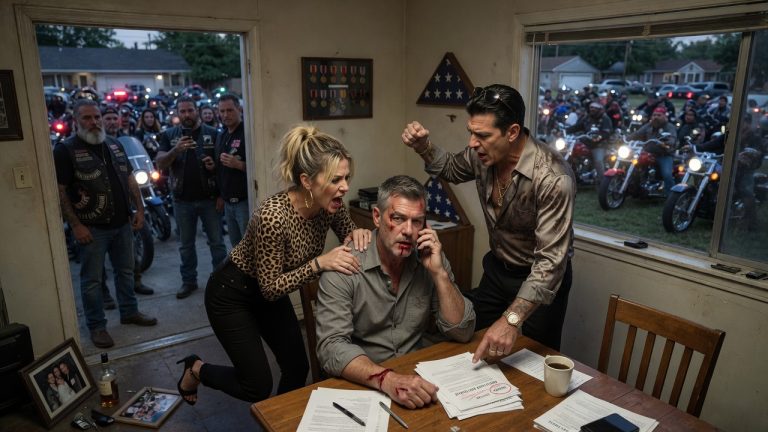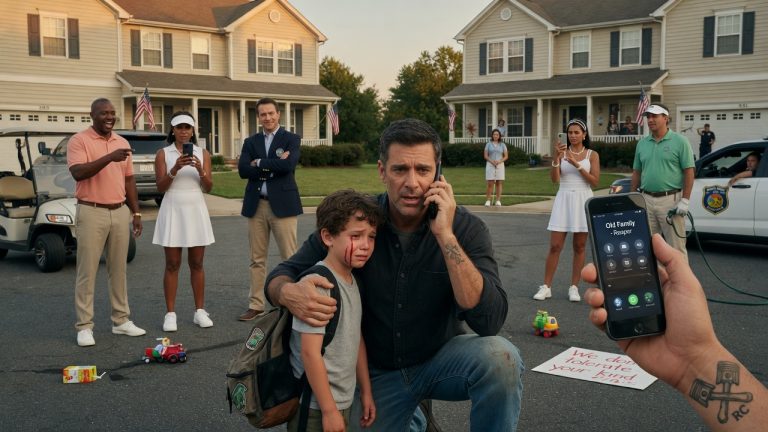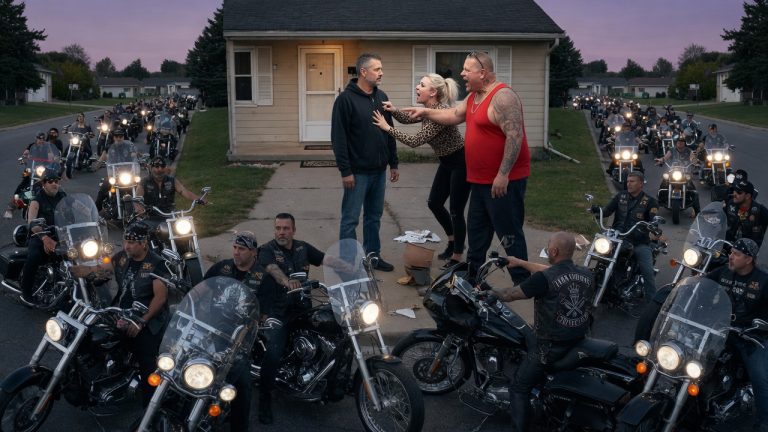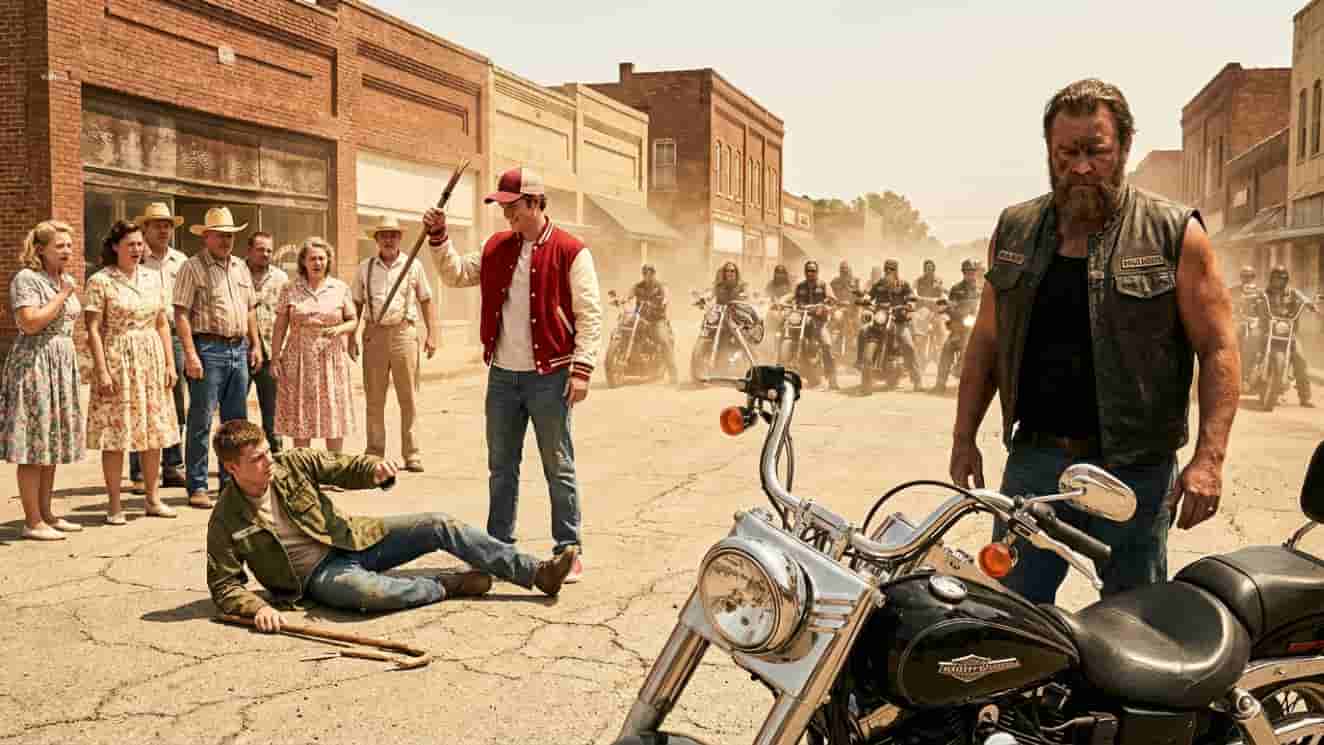
The heat in Oakhaven usually smells like pine and diesel, but today it smelled like a reckoning. My son, Isaac, spent eighteen months in a hospital bed learning how to walk with a piece of oak because he gave his eyes for a country that couldn’t wait to forget him. When Wade Miller pushed him down and broke that stick, he didn’t just break a piece of wood; he broke the only peace I had left. I’ve spent years in the basement of The Vestry gathering the truth about the rot in this town, waiting for the right moment to tear it down. I wanted to do it quiet. I wanted to do it clean. But seeing my boy crawling in the dirt while the Sheriff laughed? That changed everything. The 500 engines roaring behind me aren’t just motorcycles anymore—they’re the sound of a father who’s done playing the saint.
Chapter 1: The Weight of the Oak
The heat in Oakhaven didn’t just sit on you; it owned you. It was a thick, wet blanket that smelled of frying grease from the diner and the sweet, rotting scent of the kudzu vine strangling the pine trees out by the county line. I sat on the porch of The Vestry, my hands wrapped around a lukewarm bottle of Diet Coke, watching the shimmer of the asphalt on Main Street. My leather vest, the one with the “Road Saints” rocker stitched across the back in heavy white thread, felt like a lead weight on my shoulders.
Behind me, inside the bar, the jukebox was low, playing some old Waylon Jennings track that sounded like it was being dragged through gravel. I could hear the clink of glasses and the low rumble of Deacon’s voice. He was my sergeant-at-arms, a man who’d seen enough prison time to know that silence was usually the smartest thing you could carry. But I wasn’t listening to Deacon. I was listening for the tap.
Tap. Slide. Tap.
It came from the hallway that led to the back apartment where Isaac lived. It was a rhythmic, hesitant sound. Isaac had been home for six months, but I still hadn’t gotten used to the noise. In my head, he was still the kid who’d sprinted across the high school football field, the one whose eyes were always moving, always looking for the next play, the next girl, the next horizon. Now, those eyes were still there—a clear, piercing blue—but they didn’t catch the light anymore. They just stared through everything like he was looking at a world that had moved behind a curtain and forgotten to invite him along.
“Dad?” Isaac’s voice was thin, but it had a jagged edge to it. He stepped out onto the porch, his hand trailing along the doorframe. He was wearing his old Army physical-training shirt. It hung loose on him now. He’d lost twenty pounds since the IED took his vision in the Helmand Province, and no matter how much steak and potatoes I shoved in front of him, he didn’t seem interested in putting it back on.
“Right here, son,” I said. I stood up, the joints in my knees popping. I was fifty-four, but in the humid Georgia air, I felt eighty. I reached out, then caught myself. He hated it when I steered him.
He navigated the two steps down to the porch floor with the oak cane I’d carved for him myself. I’d spent forty hours in the garage on that thing, sanding the red oak until it felt like glass, capping the bottom with a heavy rubber tip. It wasn’t one of those flimsy aluminum things the VA gave out. It had weight. It had substance.
“Deacon says the bikes are ready,” Isaac said, turning his head toward the sound of the idling engines out back.
“They’re always ready, Isaac. We’re just doing a run down to the reservoir. Keep the batteries charged.”
Isaac nodded, his chin lifting. “I want to go.”
The air in my lungs felt like it turned to concrete. “Isaac, we’ve talked about this. Sidecars are for dogs and groceries. You’re a Saint. You don’t sit in a tub while someone else steers.”
“Then let me ride pillion behind you,” he snapped, his hand tightening on the oak handle. “I can still feel the lean, Dad. I can still hear the gear shifts. I’m tired of sitting in that back room listening to the ceiling fans. It sounds like a damn clock ticking down to nothing.”
I looked at him—really looked at him. There was a desperation in the set of his jaw that mirrored my own. I was the leader of the Road Saints, the “Preacher” who kept the peace in a town that was half-corrupt and half-dying. People looked to me for strength, for the iron-clad rules of the club. But standing there in front of my son, I felt like a fraud. I was keeping a secret under the floorboards of this bar—files, recordings, and enough unregistered hardware to start a small coup—all aimed at the men who’d sent Isaac into that desert for a lie.
“Not today, son,” I said, my voice lower than I intended. “The Sheriff’s been sniffing around. Miller’s looking for any excuse to pull us over, and the last thing I need is him seeing you on the back of a bike. He’d have Social Services or the VA reps out here in an hour claiming I’m a danger to your safety.”
“Miller’s a coward,” Isaac spat.
“He’s a coward with a badge and a son who’s a bully. That makes him dangerous.”
I watched Isaac’s face fall. The fire went out of him, replaced by that hollow, disciplined mask he’d learned in the infantry. He didn’t argue. He just turned, his cane finding the edge of the doorframe again.
“Isaac,” I called out.
He stopped, but didn’t turn around.
“I’m working on it. I’m working on making it so you don’t have to hide in here.”
“You’ve been working on it since I got back, Dad. All I see is more locks on the basement door.”
He disappeared back into the shadows of The Vestry. I stood there for a long time, the condensation from my soda bottle dripping onto my boots. He wasn’t wrong. The basement was my sanctuary and my sin. Down there, in a room reinforced with cinder blocks and hidden behind a false wall of beer crates, was the map of Oakhaven’s rot.
Sheriff Miller wasn’t just a bad cop; he was the enforcement arm for a land-development scheme that had been bleeding the county dry for a decade. They’d pushed for the new highway, the one that bypassed the local shops and led straight to the new outlet malls owned by the Mayor’s brother-in-law. They’d cut funding for the local clinics to pay for a “beautification project” that was really just a kickback to a construction firm in Atlanta. And they’d done it all while wrapping themselves in the flag and the cross.
I’d been a Saint for thirty years. We started as a group of vets who just wanted to ride and be left alone, but over time, we’d become the only thing that resembled a moral compass in this town. We protected the wives who got hit; we found the kids who ran away; we made sure the old folks had wood for their stoves in the winter. And because of that, Miller hated us. He couldn’t buy us, and he couldn’t break us.
Deacon stepped out onto the porch, wiping his hands on a greasy rag. He was a mountain of a man, his grey beard braided into two neat points. “He still wants to ride, Cain?”
“He wants to live, Deacon. There’s a difference.”
Deacon leaned against the railing, the wood groaning under his weight. “He’s a soldier. You keep a soldier in a cage long enough, he starts looking for a way to break the bars or himself. You need to let him out into the sun.”
“The sun in this town is blinding,” I said, looking toward the Sheriff’s office across the square. “And I’m not ready for him to see what I’m about to do.”
“You mean the basement?” Deacon lowered his voice. “The boys are starting to wonder, Cain. We’re bikers, not private investigators. You got enough dirt down there to bury the whole City Council twice over. Why haven’t you pulled the trigger?”
“Because once I do, there’s no going back,” I said. “Once the first brick falls, the whole wall comes down. And I need to make sure Isaac is standing on solid ground when it happens. If I fail, Miller will take everything. He’ll take the bar, he’ll take the club, and he’ll find a way to put Isaac in a state home where he’ll rot.”
I looked down at my hands. They were scarred, the knuckles enlarged from years of turning wrenches and occasional heads. I wasn’t a saint. I’d done things in the name of the club that would make a preacher weep, which was exactly why they gave me the name. I knew how to navigate the darkness. But Isaac? Isaac was the only clean thing left in my life.
“We’re heading out,” Deacon said, sensing the conversation was over. “We’ll be back by five. You want me to leave a couple of guys behind?”
“No. Take ’em all. Let the town hear the noise. Let ’em know the Saints are still the biggest dog on the block.”
Deacon nodded and hopped off the porch. A minute later, the air exploded with the sound of twenty-four V-twin engines. It was a beautiful, violent symphony that rattled the windows of The Vestry. I watched them pull out, a river of black leather and chrome, heading toward the open road.
When the silence returned, it was heavier than before. I turned and walked into the bar. The room was dim, the air smelling of stale hops and floor wax. I went behind the bar, lifted the hatch, and descended the narrow wooden stairs into the basement.
The air down here was cooler, filtered by an industrial hum. I unlocked the heavy steel door at the end of the hall and stepped into the war room. On the walls were photos, bank statements, and maps pinned with red string. In the center of the room was a long table covered in electronics—scanners, hard drives, and a few items that the ATF would have had a lot of questions about.
I sat down and pulled a file toward me. It was labeled MILLER, WADE – INCIDENT REPORTS.
There were six of them. All of them involved Wade Miller harassing local residents, mostly those who couldn’t fight back. One was a girl at the high school. Another was an elderly man whose dog Wade had shot “by accident.” Every single report had been “resolved internally” or dismissed for lack of evidence.
Wade was twenty-two, a walking ego fueled by his father’s power and a steady diet of cheap beer and arrogance. He was the kind of rot that started at the core and worked its way out. And I knew, deep in my gut, that sooner or later, his path was going to cross Isaac’s.
I looked at the oak cane Isaac had left leaning against the wall in the hallway earlier. I’d carved a small Saint George cross into the head of it. I’d told Isaac it was for luck.
But as I looked at the files on my desk, I knew that in Oakhaven, luck was just another word for survival. And I was running out of both.
Chapter 2: The Sheriff’s Shadow
Tuesday morning hit like a fever. The sky was a pale, sickly blue, and the humidity was already at eighty percent by nine o’clock. I was under the hood of a ’74 Shovelhead in the garage behind The Vestry, my shirt soaked through with sweat, trying to coax a spark out of a stubborn ignition coil.
“Cain! You got company!”
It was Skinner, one of the newer patches, calling from the front of the bar. I wiped my hands on a rag and stepped out into the bright light.
Parked at the curb was a white Ford Explorer with the Oakhaven Sheriff’s Department logo on the door. Sheriff Miller was leaning against the fender, his sunglasses reflecting the dusty street. Beside him, leaning against the passenger door, was his son, Wade. Wade was wearing a mesh-back cap and a grin that made me want to reach for a tire iron.
“Sheriff,” I said, stopping at the edge of the sidewalk. I didn’t move toward him. In this town, territory was everything.
“Cain,” Miller replied. He was a man who’d spent twenty years perfecting a look of bored authority. “Little loud yesterday afternoon, wasn’t it? Had three calls about a ‘motorized gang’ disturbing the peace down by the reservoir.”
“Just a funeral run, Sheriff,” I lied easily. “One of our brothers from the Savannah chapter passed. We were paying our respects.”
“Funny,” Wade piped up, his voice cracking slightly with a forced bravado. “I didn’t see no hearses. Just a bunch of old guys in leather dresses.”
I looked at Wade. I didn’t say a word. I just looked at him until the grin on his face started to flicker. He was soft—soft in the middle, soft in the head. He was the kind of boy who thought a badge was a suit of armor.
“The boy’s got a point, Cain,” Miller said, though he didn’t look at his son. “People are getting tired of the noise. And they’re getting tired of the ‘Road Saints’ acting like they’re the law in this county. I hear you’ve been asking a lot of questions about the new zoning boards.”
“I like to stay informed,” I said. “An informed citizen is a good citizen, right? That’s what they teach in civics class.”
Miller straightened up, his hand resting casually on his belt, near his sidearm. “Stay out of the politics, Cain. You’ve got a good thing going here. You keep your bar, you keep your bikes, and I keep looking the other way when your boys get a little rowdy at the Oasis. But don’t go poking the bear. The bear’s got a long memory.”
“And a lot of debt,” I added quietly.
Miller’s eyes narrowed behind his shades. “What was that?”
“Nothing, Sheriff. Just commenting on the economy.”
Wade moved then, stepping away from the car. He started walking toward the porch of The Vestry. “Hey, I heard your kid’s back. The one who got his eyes blown out. Is he inside? I wanted to thank him for his service.”
The way he said service sounded like a slur.
I stepped into his path. I’m six-foot-three and two-hundred-and-forty pounds of muscle and scar tissue. Wade was five-ten on a good day. He stopped short, his chest nearly hitting my vest.
“Isaac’s resting,” I said. My voice was a low rumble, the kind of sound a dog makes before it bites. “And he’s got enough friends. He doesn’t need any more.”
“Whoa, easy there, Big Mac,” Wade said, holding up his hands in a fake gesture of surrender. “Just being neighborly. I heard he’s gotta use a stick to find the bathroom now. That must be rough. Going from a hero to a blind man in a bar. Kind of a step down, don’t you think?”
“Wade,” Miller said, his voice warning but not angry.
“I’m just saying, Dad. It’s a tragedy. Maybe we should start a collection for him. Get him one of those dogs that wears the little vest. Or maybe a tin cup.”
I felt the heat rising in my neck, a familiar, dangerous burn. I could have ended him right there. I could have put my thumb into the soft hollow of his throat and showed him exactly how much air he didn’t deserve. But I saw Miller’s hand tighten on his belt. He was waiting for it. He wanted me to swing. He wanted a reason to lock me up and tear the bar apart.
“Go home, Wade,” I said.
“Or what? You gonna call your biker buddies to come rev their engines at me?” Wade laughed, a high, nasal sound. He looked back at his father. “See, Dad? They’re just loud. That’s all they are.”
They got back in the car and drove off, Wade throwing a middle finger out the window. I stood there until the dust settled, my heart hammering against my ribs like a trapped bird.
“They’re gonna push until something snaps, Cain.”
I turned. Isaac was standing in the doorway. He’d heard the whole thing. He was holding his oak cane, his knuckles white against the dark wood.
“I heard them,” Isaac said. His voice was flat, devoid of emotion, which was a thousand times worse than if he’d been shouting. “I heard what he said about the tin cup.”
“He’s a punk, Isaac. He’s nothing.”
“He’s the Sheriff’s son,” Isaac corrected. “In this town, that’s everything. And he’s right, isn’t he? I’m the blind man in the bar. I’m the charity case.”
“Don’t you ever say that,” I said, stepping onto the porch. I reached for his shoulder, but he flinched away.
“Don’t, Dad. Just don’t.” Isaac turned his head toward the sound of the retreating police cruiser. “You think because I can’t see the world, I can’t feel the way people look at me? I can hear the pity in their footsteps. I can smell the awkwardness when they walk into the room. And Wade? He’s the only one being honest. He’s the only one saying out loud what everyone else is thinking.”
“Isaac, listen to me—”
“No, you listen. You’re building something downstairs. I’m not stupid. I can hear you moving those crates. I can hear the clicking of those keyboards. You’re planning a war, aren’t you? You’re trying to fix the world so I don’t have to be afraid. But you can’t fix my eyes, Dad. And you can’t fix the fact that this town is rotten to the core.”
He tapped his way back into the bar, the sound of the oak on the floorboards sounding like a gavel.
I spent the rest of the day in a haze of anger. I went down to the basement and stayed there until the sun went down. I pulled up the latest bank records I’d intercepted. Miller had just deposited fifteen thousand dollars into an offshore account. It was the third such deposit in as many months. The money was coming from a shell company called “Palmetto Holdings,” which was the same group trying to buy up the farmlands on the north side of the county.
I had the proof. I had the names. But I knew how the game was played. If I went to the state police, Miller would have the files scrubbed before they even crossed the county line. If I went to the papers, I’d be dead in a week.
I needed a public collapse. I needed Miller to lose his mind in front of witnesses. I needed the town to see the monster behind the badge.
Around 7:00 PM, the “Mirror” showed up.
That’s what I called Pastor Hedges. He was the head of the Oakhaven Baptist Church, a man with a smile as bright as a spotlight and a heart as cold as a well-digger’s ass. He walked into The Vestry like he owned the place, his silk tie perfectly knotted, his hair sprayed into a rigid wave.
“Caleb,” he said, using my given name. He was the only one who did. “I heard there was some unpleasantness with the Sheriff this morning.”
“News travels fast in a small town, Pastor. Usually faster than the truth.”
Hedges sat at the bar, though he didn’t order a drink. He looked around the room with a faint expression of distaste. “This place… it’s a stumbling block, Caleb. You’re a man of influence. You lead these young men. You have a son who has sacrificed so much. Don’t you think it’s time to set aside these worldly grievances? The Sheriff is a God-fearing man. He’s trying to keep order.”
“Order for who, Pastor? For the people who can afford your tithing? Or for the ones like Isaac who get spat on in the street?”
Hedges sighed, a theatrical sound. “We all have our crosses to bear. Isaac’s burden is a heavy one, but perhaps it’s a lesson in humility. Perhaps God is calling him to a life of quiet reflection, rather than the… shall we say, boisterous life of a motorcycle club.”
I leaned over the bar, my face inches from his. “You know what I think, Pastor? I think you’re on the board of Palmetto Holdings. I think you’ve been whispering in the ears of the widows in your congregation, telling them it’s ‘God’s will’ to sell their land for pennies on the dollar.”
Hedges didn’t blink. His smile didn’t even slip. “That’s a very serious accusation, Caleb. A man in your position should be careful about the stones he throws. Especially when he lives in a glass house… or a bar with a very interesting basement.”
My blood went cold.
“I don’t know what you’re talking about,” I said.
“Don’t you? People talk, Caleb. They wonder why the ‘Preacher’ spends so much time underground. They wonder why a man who claims to be a simple biker has the technical capabilities of a federal agency. The Sheriff is a patient man, but even his patience has limits.”
Hedges stood up and smoothed his jacket. “We’re having the Founders’ Day Festival this Saturday in the square. It would be a show of good faith if the Road Saints stayed away. Let the families enjoy the afternoon without the threat of… leather and lawlessness.”
“We’ll be there, Pastor,” I said. “It’s a public square. And I think it’s time my son saw exactly what kind of town he bled for.”
“I hope you reconsider,” Hedges said, his voice dropping an octave. “For Isaac’s sake. A blind man can easily get lost in a crowd, Caleb. Especially if the crowd turns ugly.”
He walked out, leaving the scent of expensive cologne and a lingering threat in the air.
I didn’t go back to the basement that night. I went to Isaac’s room. He was sitting on the edge of his bed, his hands folded over the head of his oak cane. He was staring at the wall, but he turned his head when I walked in.
“Dad?”
“Yeah, Isaac.”
“Is it worth it?”
“Is what worth it?”
“The war. The basement. All of it.”
I sat in the chair across from him. “It’s the only thing I know how to do, son. When someone takes something from you, you don’t just sit there and take it. You fight back.”
“They didn’t take my eyes, Dad,” Isaac said softly. “The war did that. It was just a thing that happened. But what you’re doing… you’re choosing this. You’re choosing to stay angry.”
“I’m choosing to be right,” I said.
“In this town, being right just gets you buried,” Isaac replied. “I don’t want to be a hero, and I don’t want to be a victim. I just want to be able to walk down the street without feeling like a bomb’s about to go off.”
I looked at the oak cane. I’d carved it to be strong. I’d carved it to be a support. But as I sat there in the dark with my son, I realized I’d also carved it as a weapon. And I was the one who had put it in his hand.
Chapter 3: The Basement Apostles
By Wednesday, the air in The Vestry felt charged, like the moments before a lightning strike. The Road Saints were all there—Skinner, Deacon, Biggs, and the rest of the crew. They weren’t drinking much. They were sitting around the pool tables, talking in low voices, their eyes constantly flicking toward the front door.
I called the inner circle down to the basement.
Deacon, Skinner, and a man we called “The Ghost”—a former signals intelligence guy who’d traded his clearance for a patch—crowded into the small room. The heat from the computer towers made the space feel even tighter.
“Alright, listen up,” I said, pointing to the screen. “Saturday is the Founders’ Day Festival. Miller and the Mayor are going to be on the stage at noon to announce the ‘Oakhaven Renaissance’ project. It’s the official launch of the Palmetto Holdings development. Hedges will be there to give the invocation. It’s the whole unholy trinity in one place.”
“What’s the play, Cain?” Deacon asked.
“Ghost has been working on the city’s server,” I said. “He’s got a backdoor into the PA system and the giant LED screen they’ve set up behind the stage. At exactly 12:15, while the Mayor is talking about ‘progress,’ we’re going to dump everything. The bank transfers, the emails between Miller and the developers, the photos of the kickbacks. It’ll be on every speaker and every screen in the square.”
“And then what?” Skinner asked. “Miller’s got twenty deputies. They aren’t just gonna sit there and watch their boss get roasted.”
“That’s where the club comes in,” I said. “We aren’t going there to fight. We’re going there to witness. We’re going to be in the crowd, in full colors. We’re the barrier. If the deputies try to shut down the feed or move on the stage to stop the broadcast, we stand in their way. No weapons. No swings. We just… exist.”
“That’s a hell of a risk, Cain,” Deacon said. “Miller’s been looking for a reason to go ‘tactical’ on us. If we block his men, he’ll call it a riot.”
“Let him,” I said. “The state police are already briefed. I sent a copy of the encrypted drive to a contact in the Governor’s office this morning. They won’t move until they see the public reaction, but once the evidence is out in the open, they’ll have to intervene. We just have to hold the square for ten minutes.”
“What about Isaac?” Ghost asked quietly.
The room went silent.
“Isaac stays here,” I said. “Skinner, you’re staying with him. I don’t care if he begs, threatens, or tries to walk there himself. He does not leave this bar until I call you.”
“He’s not gonna like that, Boss,” Skinner said.
“I don’t care what he likes. This is about his future. If this goes sideways, I’m the one going to jail, not him. He needs to stay clean.”
I dismissed them, but Deacon stayed behind. He waited until the others were back upstairs before he spoke.
“You’re lying to him, Cain.”
“I’m protecting him.”
“There’s a thin line between a shield and a shroud,” Deacon said, his voice heavy. “You’ve spent your whole life being the guy who fixes things with his fists. Now you’re trying to be a mastermind, and you’re leaving your boy in the dark—literally and figuratively. He knows something’s coming. He can feel the vibration of this club just like he feels the vibration of his bike.”
“He’s blind, Deacon! He’s vulnerable!” I snapped, the frustration finally boiling over. “Do you have any idea what it’s like to see him reach for a glass and miss it? To see him trip over a rug I forgot to straighten? I sent him to a war where he was supposed to be the best of us, and he came back needing a piece of wood to find the porch. I won’t let him be a target for Miller’s goons.”
Deacon looked at me for a long time, his eyes sad. “You think you’re the only one who hurts for him. We all do. But Isaac isn’t a piece of glass, Cain. He’s a Road Saint. He’s your son. You treat him like a victim, and eventually, he’ll start believing he is one.”
I didn’t have an answer for that. I just turned back to the screens, the blue light reflecting in my eyes like a cold fire.
The rest of the week was a blur of preparation. We checked the bikes, we rehearsed the blocking, and we watched the Sheriff’s department like hawks. Miller was busy, too. He was bringing in “reserve” deputies from the next county over—men known for being heavy-handed and light on paperwork.
On Friday night, I found Isaac in the garage. He was sitting on a stool next to my bike, his hand running slowly over the chrome of the exhaust pipe.
“It’s cold,” he said without turning around.
“The engine? Yeah. Haven’t started it today.”
“No,” Isaac said. “The air. It feels like the air before a storm. The way it gets real quiet and the birds stop singing.”
I sat down on the workbench. “It’s just the humidity, son.”
“Don’t lie to me, Dad. Please. Not tonight.” Isaac stood up, leaning on his cane. “I heard the Ghost talking to Deacon. I know about the square. I know about the files.”
I felt a surge of anger at Ghost, but I pushed it down. It didn’t matter now.
“It’s almost over, Isaac. After tomorrow, Miller won’t be able to touch us. We’ll be able to breathe again.”
“And then what? You think the people in this town are going to change because you showed them some bank statements? They already know Miller’s dirty. They just don’t care as long as he keeps the ‘troublemakers’ out of their neighborhoods.”
“They’ll care when they see the money he took from the school fund,” I said. “They’ll care when they see the emails where he calls the veterans’ memorial a ‘waste of prime real estate.'”
Isaac flinched. “He said that?”
“He said a lot of things, Isaac. Things I didn’t want you to hear. But tomorrow, everyone’s going to hear them.”
Isaac was silent for a long time. The only sound in the garage was the hum of the refrigerator in the corner and the distant sound of a dog barking down the street.
“Give me your hand,” Isaac said suddenly.
I reached out and took his hand. His skin was rough, his grip still strong. He guided my hand to the head of his oak cane, to the small Saint George cross I’d carved there.
“You told me this was for luck,” Isaac said. “But Saint George didn’t have luck. He had a spear. And he had a dragon.”
“I’m the one with the spear, Isaac. You just hold the light.”
“I can’t hold the light, Dad. I’m in the dark.”
He let go of my hand and walked out of the garage. I stayed there for hours, watching the shadows stretch across the floor. I thought about the basement, the files, and the 500 bikes I’d called in from the surrounding chapters to help hold the square. I thought about the “unholy trinity” and the dragon I was trying to slay.
But mostly, I thought about the look on Isaac’s face. He didn’t look like a man who was being saved. He looked like a man who was being left behind.
I went into the bar and locked the door. I went down to the basement one last time. I checked the scripts, the servers, and the timing. Everything was perfect. 12:15 PM. The moment of truth.
I sat back in my chair and closed my eyes. I could hear the roar of the engines in my head, a sound like the end of the world. I told myself I was doing it for him. I told myself it was for justice.
But as I fell into a restless sleep, I saw Wade Miller snapping that oak cane over and over again. And in the dream, I wasn’t the Preacher. I was just a man watching his son crawl in the dirt, unable to reach him through the crowd.
Chapter 4: The Sound of the Reckoning
Saturday morning arrived with a sky the color of a bruised plum. The heat was already a physical weight, pressing down on the town of Oakhaven. I woke up at dawn, my body aching as if I’d already been in a fight.
The square was already being set up when I looked out the window of The Vestry. Men in work shirts were hauling folding chairs, and a large stage was being erected in front of the courthouse. The giant LED screen I’d planned to hijack stood like a silent sentinel at the back of the platform.
I saw Miller’s cruiser parked near the gazebo. He was out there in his dress uniform, shaking hands and pointing at various security positions. Wade was with him, wearing a bright yellow “Staff” lanyard around his neck, looking like he’d finally been given the keys to the kingdom.
I went to the back room to check on Isaac. He was already awake, sitting at his small table with a cup of coffee. He was dressed in his best jeans and a clean black t-shirt. His oak cane was leaning against his leg.
“Morning, Isaac,” I said.
“Morning.”
“You remember the plan? Skinner’s staying here. The doors are locked. You stay in the back.”
“I remember.” His voice was hollow.
“I’ll be back as soon as it’s done. We’ll have a steak dinner tonight. Just you and me.”
Isaac didn’t answer. He just took a slow sip of his coffee. I wanted to say more—to tell him I loved him, to tell him I was sorry for everything—but the words felt like they’d get stuck in my throat. I turned and walked out.
By 11:00 AM, the square was packed. It was the largest turnout I’d seen in years. Families in sundresses, old men in veteran caps, and kids with sticky faces from cotton candy. It looked like a postcard for small-town America.
And then there were us.
The Road Saints started arriving in small groups, parking their bikes in a designated lot three blocks away and walking in. We weren’t loud. We weren’t revving our engines. We just moved into the crowd, twenty men in leather vests, spreading out around the perimeter of the stage.
I saw Miller’s face change when he spotted us. He stopped mid-sentence with the Mayor and tapped his holster. He whispered something into his radio, and suddenly, ten deputies appeared from behind the courthouse, moving to stand between us and the stage.
I took my position near the fountain, about fifty feet from the podium. Deacon was to my left, Ghost to my right. Ghost had his laptop tucked into a messenger bag, his fingers already hovering over the keys inside the fabric.
“Signal’s strong,” Ghost whispered. “The server’s wide open. We’re green.”
At 12:00 PM, the Mayor took the stage. He was a small man with a loud voice, and he started into a prepared speech about “vision” and “sacrifice.” Pastor Hedges followed him, giving an invocation that sounded more like a political endorsement than a prayer.
I looked around the crowd. People were nodding, clapping, and soaking in the lies. They had no idea that the ground was about to open up beneath them.
And then I saw him.
Across the square, near the corner of Main and Elm, a figure was moving through the crowd. He was wearing a faded Army jacket and carrying a heavy oak cane.
“Isaac,” I breathed.
“What?” Deacon asked, following my gaze. “Oh, hell. Cain, is that him?”
Isaac was alone. He was navigating the crowd with a grim determination, his cane tapping rhythmically against the bricks. He was heading straight toward the center of the square, straight toward the stage.
“Skinner!” I hissed into my radio. “Where the hell are you?”
Static. Then: “Boss, he locked me in the supply closet. I just got out. He’s gone, Cain. He took the back alley.”
“I see him,” I said, my heart dropping into my stomach. “Stay put. Don’t make a scene.”
I started to move toward Isaac, but the crowd was too thick. I was a big man in a biker vest, and people instinctively moved out of my way, but they also created a barrier of friction.
At the same time, I saw Wade Miller notice Isaac. Wade was standing near the edge of the VIP section, and a cruel light sparked in his eyes. He nudged a couple of his friends—local boys who followed him like stray dogs—and pointed toward the blind man.
They moved toward Isaac, cutting him off before I could get close.
“Well, looky here,” Wade’s voice carried over the sound of the Mayor’s speech. “The hero’s come to join the party. You lose your way to the VA, Isaac?”
Isaac stopped. He turned his head toward the voice, his face pale but steady. “I’m just here for the festival, Wade. Like everyone else.”
“The festival’s for people who can actually see the fireworks,” Wade said, stepping into Isaac’s personal space. He reached out and flicked the brim of Isaac’s cap. “You’re just taking up space. Why don’t you head back to the bar and help your old man wash some glasses?”
“Move aside,” Isaac said, his voice low.
“Or what? You gonna hit me with your stick?” Wade laughed, and his friends joined in.
I was twenty feet away, struggling through a wall of people who were watching the confrontation instead of the stage.
“Wade, stop!” I yelled, but the Mayor was shouting into the microphone about “new horizons,” and my voice was lost in the noise.
Wade reached out and grabbed the oak cane. Isaac gripped it tight, but Wade was stronger and had the advantage of sight. He jerked the cane upward, pulling Isaac off balance.
Isaac stumbled, his boots sliding on the slick bricks. He fell hard, his knees hitting the ground with a sickening thud. The crowd gasped, a collective intake of breath that was louder than the Mayor’s speech.
“Oops,” Wade said, holding the cane above his head. “Look at that. The hero’s on his knees.”
“Give it back,” Isaac said, his voice trembling now. He reached out into the air, his fingers searching for the wood.
“You want it? Go get it.”
Wade placed the cane across his knee. He looked directly at the VIP section, where his father was watching. Miller didn’t move. He didn’t stop him. He just watched with a cold, detached expression.
Wade pulled up with his arms. CRACK.
The sound of the oak snapping was like a gunshot. It echoed off the brick buildings, momentarily silencing the Mayor. Wade dropped the two jagged pieces of the cane into the dirt in front of Isaac.
“There you go,” Wade sneered. “Now it’s two sticks. Twice the luck.”
Isaac didn’t move. He sat there in the dust, his hands hovering over the broken pieces of his independence. His unseeing eyes were fixed on nothing, but the humiliation on his face was the most painful thing I’d ever seen.
I stopped moving. I stood there, frozen, as the world slowed down.
“Cain?” Ghost’s voice came through the radio. “It’s 12:15. Do I dump it?”
I looked at my son on the ground. I looked at Wade laughing. I looked at the Sheriff, the Mayor, and the Pastor, all of them standing on that stage like gods overlooking a sacrifice.
“No,” I said, my voice sounding like it came from the bottom of a grave.
“What? Cain, we’re ready. The feed is—”
“I said NO!” I roared into the radio.
I looked at Deacon. He knew. He’d already started moving.
“Deacon,” I said. “Get the bikes.”
“All of them?”
“Every. Single. One.”
I walked toward the center of the square. The crowd parted for me now, not out of respect, but out of fear. I looked like a man who was already dead.
I reached Isaac and knelt beside him. I didn’t say a word. I picked up the two halves of the oak cane. They were jagged and splintered, the Saint George cross I’d carved split right down the middle.
“Dad?” Isaac whispered. He found my arm and gripped it. His hand was shaking.
“I’ve got you, Isaac,” I said.
I stood up, pulling Isaac with me. I handed the broken pieces of the cane to him. He gripped them like they were the only things keeping him on the planet.
I turned to face the stage. The Mayor had stopped talking. The Sheriff was stepping forward, his hand on his gun. The crowd was silent, terrified by the look on my face.
“Caleb!” Hedges shouted from the stage. “Don’t do this. Think about your son!”
“I am thinking about him,” I said.
And then, it started.
From three blocks away, a low rumble began. It was a faint vibration at first, felt in the soles of the feet. Then it grew into a roar. Then a thunder.
Round the corner of Main Street, the first line of motorcycles appeared. Then the second. Then the third.
Five hundred bikes. I’d called every chapter from three states. I’d told them to be ready, but I hadn’t told them why. Now they knew.
They flooded the square, a river of black steel and chrome that drowned out the world. They didn’t stop. They circled the square, a vortex of noise and exhaust that trapped everyone inside—the crowd, the deputies, and the men on the stage.
The sound was absolute. It was the sound of a reckoning.
I looked at Wade. He wasn’t laughing anymore. He was backed up against the stage, his face the color of sour milk. He looked at his father, but the Sheriff was staring at the wall of bikers, his authority evaporating in the face of five hundred angry men.
I stepped toward Wade. The bikes continued to roar, the sound vibrating in my chest, in my teeth, in my soul.
I held up my hand, and the noise stopped. It didn’t fade; it just died, leaving a silence so heavy it felt like it would crush the buildings.
I looked at the broken oak in Isaac’s hands. Then I looked at Wade.
“That wood was the only thing keeping him steady, Wade,” I said, my voice carrying to every corner of the square. “Now I’m gonna need something of yours to replace it.”
I looked at the Sheriff.
“And as for the rest of you,” I said, gesturing toward the stage. “The show is about to begin.”
I looked at Ghost. I didn’t need a radio.
“Dump it,” I said.
The giant LED screen behind the Mayor flickered. For a second, it was white. Then, a document appeared. A bank statement. Then a recording started to play over the massive speakers.
… fifteen thousand for the north side zoning, Sheriff. Just like we agreed.
The crowd gasped. The Mayor turned, his mouth hanging open. Miller reached for his gun, but fifty Road Saints stepped forward in unison, their leather vests a wall of defiance.
I stood in the center of the square, holding my son’s arm, as the truth began to burn the town down.
I looked at the broken cane.
The dragon was here. And I was done being a Saint.
Chapter 5: The Glass House Shivers
The giant LED screen didn’t just show documents; it showed the death of a reputation. The audio, piped through the massive festival speakers Ghost had hijacked, was crystal clear. It wasn’t a grainy, muffled recording from a wire. It was high-definition betrayal. Sheriff Miller’s voice, unmistakable in its slow, Southern drawl, filled the square, talking about “trimming the fat” from the veteran’s memorial fund to pay for the landscaping at his private lake house.
The crowd didn’t erupt in noise immediately. It was the opposite. A heavy, suffocating silence fell over the five hundred townspeople. It was the sound of a thousand illusions shattering at once. These were people who had voted for Miller, who had sat in the pews with Pastor Hedges, who had trusted the Mayor to bring jobs to a town that was slowly starving.
I stood in the center of it all, my hand still gripping Isaac’s shoulder. I could feel him trembling, but it wasn’t fear anymore. It was something sharper, a kinetic energy that seemed to radiate from his bones. He held the two jagged pieces of his oak cane like they were twin daggers.
“Cain! Shut it down! Now!” Miller screamed from the stage. He had reached for his sidearm, but he stopped when he realized he was looking into a literal wall of leather and steel.
The Road Saints had formed a semi-circle at the base of the stage. They weren’t moving. They weren’t shouting. They were just there. Five hundred men, their engines idling in a low, rhythmic thrum that felt like a heartbeat. The deputies stood in the gap between the stage and the bikers, their faces pale, their eyes darting between their boss and the massive crowd that was starting to wake up.
“It’s not me you need to worry about, Miller,” I shouted back. My voice felt raw, like I’d been swallowing glass. “It’s them. Look at them.”
I pointed to the crowd. An old woman in a floral Sunday dress was staring at the screen, her hand over her mouth. Behind her, a man in a “VFW” cap—someone who had probably served with Miller’s father—was shaking his head, his face contorted with a slow-burning rage.
The screen flickered again. Now it was the bank transfers. Palmetto Holdings. Fifteen thousand dollars here. Twenty thousand there. Each transaction was timestamped. Each one was linked to a specific zoning vote. The “Renaissance Project” was exposed for what it was: a colonial-style strip-mining of the town’s remaining assets.
“This is a fabrication!” Mayor Henderson yelled, leaning into the podium, but his voice cracked. He looked small. He looked like a man who had been caught stealing from the church plate. “This is biker propaganda! Domestic terrorism!”
“The numbers don’t lie, Henderson,” Ghost’s voice came through the PA system, distorted and ghost-like. “And neither does your secretary’s email account. You should really learn how to use two-factor authentication.”
On the stage, Pastor Hedges tried to slip away toward the back stairs. He was moving fast for a man of his age, his silk suit shimmering in the sun. But he didn’t get far. Two Saints—Biggs and a brother from the Macon chapter—stepped into his path. They didn’t touch him. They just blocked the exit, their arms crossed over their chests.
“The truth shall set you free, Pastor,” Biggs said, his voice a low growl that carried over the idling bikes. “But I think you’re gonna find the truth has a hell of a prison sentence attached to it.”
I looked back at Wade. He was still backed against the stage, his eyes wide and glazed. He looked at the broken cane in Isaac’s hands, then at me, then at the sea of black leather surrounding him. He realized, perhaps for the first time in his pampered life, that his father’s badge was just a piece of tin, and his father’s power was a ghost.
“You think you’re so tough?” Wade hissed, though his voice was shaking. “You think some pictures on a screen change anything? My dad owns this county.”
“He owns a jail cell, Wade,” Isaac said. He stepped forward, away from me. He moved with a strange, predatory grace, his unseeing eyes fixed on the sound of Wade’s breathing. “And you? You’re just the boy who broke a blind man’s stick because you were too small to be anything else.”
Wade lunged. It was a desperate, stupid move. He swung a wild punch at Isaac’s face, but Isaac didn’t flinch. He didn’t even seem to see it coming—because he didn’t have to. He felt the shift in the air, the heavy scent of Wade’s sweat and cheap cologne. Isaac stepped to the side, a movement he’d practiced a thousand times in the dark of the bar, and brought the heavy, cap-weighted end of the broken cane up in a short, brutal arc.
The sound of wood hitting Wade’s ribs was a dull thump. Wade wheezed, the air leaving his lungs in a sudden rush, and he collapsed onto the bricks.
“Stay down,” Isaac whispered.
Sheriff Miller saw his son go down and finally lost whatever remained of his composure. “That’s it! Arrest them all! Fire! Use your weapons!”
The deputies didn’t move. They looked at each other, then at the crowd, then at the five hundred bikers. They were local boys. They had families in this town. They’d heard the audio. They’d seen the bank statements. They knew that if they pulled their triggers now, they’d be protecting a thief against their own neighbors.
“Drop the belt, Miller,” I said, walking toward the stage. Each step felt like I was shedding a layer of the “Preacher” skin I’d worn for years. “The State Bureau of Investigation is ten minutes out. I sent them the decryption key the second the feed started. You can go out like a man, or you can go out in a heap. It’s your choice.”
Miller looked at me, his face a mask of pure, unadulterated hatred. He looked at his gun, then at the crowd. A man in the front row—a mechanic I’d known for twenty years—threw a half-eaten corn dog at the stage. It hit Miller’s polished boot.
“Thief!” the man yelled.
“Traitor!” someone else screamed.
The dam broke. The crowd began to surge forward, a wave of angry, betrayed people. The bikers didn’t stop them; they just stepped aside, forming a corridor for the townspeople to reach the stage.
I grabbed Isaac and pulled him back. I didn’t want him in the middle of a riot. “Deacon! Get the line! Keep the stage clear until the SBI gets here! We don’t want a lynching, we want a trial!”
Deacon and twenty other Saints moved with military precision. They formed a new perimeter around the stage, holding back the furious townspeople with their bodies. It was the strangest sight Oakhaven had ever seen: a motorcycle club acting as the only thing standing between the law and the people the law had betrayed.
Miller fell back into a chair, his head in his hands. The Mayor was weeping openly, clutching his leather briefcase as if it could save him. Hedges was on his knees, though I couldn’t tell if he was praying or just trying to stay out of the line of sight.
Wade was still on the ground, clutching his ribs, his face pressed into the hot bricks of the square.
The roar of sirens began to bleed into the sound of the motorcycles. Blue and red lights appeared at the edge of the square—not the local cruisers, but the dark, unmarked SUVs of the state police.
I looked at Isaac. He was standing tall, the broken pieces of the cane gripped in his hands. He looked like a statue of a soldier who had finally come home from a war he never wanted to fight.
“Is it over, Dad?” he asked.
“The noise is just starting, Isaac,” I said, looking at the state agents spilling out of their vehicles. “But the lying? Yeah. The lying is over.”
I felt a strange sense of emptiness. I’d spent months, years, gathering the stones for this wall. I’d built the basement, I’d stolen the files, I’d lived in the shadows of my own bar, waiting for the moment to pull the trigger. And now that the wall had fallen, the air felt thin.
The state agents moved through the crowd with practiced efficiency. They didn’t look at the bikers. They looked at the men on the stage. Within minutes, Miller, Henderson, and Hedges were in handcuffs. They were led away through a gauntlet of boos and hissed insults.
As Miller was being pushed into the back of an SUV, he looked over his shoulder at me. There was no anger left in his eyes, only a cold, hollow realization. He had lost everything to a man he thought was just a thug in a leather vest.
I didn’t give him the satisfaction of a middle finger. I didn’t say a word. I just watched him go.
When the square began to clear, leaving only the smell of exhaust and the lingering tension of the afternoon, I turned to the Saints. “Go back to the bar. Keep it quiet. No celebrating. We’ve got a lot of work to do.”
They nodded and began to move toward their bikes. One by one, the engines fired up, a thunderous farewell to the town square.
Isaac and I walked back toward The Vestry. We didn’t take the shortcut through the alley. We walked right down the middle of Main Street. People watched us from the sidewalks. Some of them nodded. Some of them looked away, ashamed of how long they’d let the rot grow.
We reached the porch of the bar. The sun was starting to dip behind the pines, casting long, orange shadows across the wood.
“Dad,” Isaac said as we reached the door.
“Yeah?”
“You kept the cross.”
I looked at the broken piece of the cane in his left hand. The Saint George cross was split, but it was still there.
“I kept it,” I said.
“He didn’t kill the dragon, did he?” Isaac asked, his voice quiet. “He just made it so everyone else could see it.”
“Sometimes that’s the same thing, son.”
We went inside. The bar was empty, the air still smelling of hops and old wood. I went behind the counter and poured two glasses of water. My hands were shaking. I realized then that the adrenaline was gone, leaving only the bone-deep exhaustion of a man who had finally finished a long, ugly job.
I sat down next to Isaac. We didn’t talk for a long time. We just sat there in the dim light of the bar, listening to the world outside start to change.
I knew the next few months would be a nightmare. There would be depositions, trials, and probably more than a few people who would try to blame the Road Saints for the chaos. The town would be broken for a while. The development would stall, the bank would foreclose on the “Renaissance” properties, and Oakhaven would have to figure out how to be a town again without the unholy trinity running the show.
But as I looked at my son—really looked at him—I saw something I hadn’t seen since before he left for the desert.
He wasn’t reaching for a glass. He wasn’t tripping over a rug. He was sitting perfectly still, his head tilted toward the window, listening to the evening birds.
“Dad?”
“Yeah, Isaac.”
“Can you hear that?”
“Hear what?”
“The silence,” he said. “It sounds… clean.”
I closed my eyes and listened. He was right. The heavy, pressurized hum that had sat over this town for years—the sound of secrets being kept and breath being held—was gone.
The basement was empty. The files were gone. The spear had been thrown.
And for the first time in my life, I felt like I could finally put the leather vest in the closet and just be a father.
Chapter 6: The New Oak
Three weeks later, the humidity had finally broken, replaced by the crisp, cool edge of early October. Oakhaven was a different place. The Sheriff’s office was being run by a temporary commander from the State Bureau, and half the City Council had resigned. Pastor Hedges’ church was still open, but the pews were half-empty on Sundays. The town was in the middle of a painful, public reckoning, and the local paper was filled with stories of people who had been cheated by the Palmetto Holdings scheme.
I was in the garage, but I wasn’t working on a bike. I was at the workbench with a piece of seasoned hickory. Oak was strong, but hickory was resilient. It had a flex to it that could survive a blow that would snap oak in half.
I was sanding the handle, the wood dust fine and white on my calloused palms. I’d spent the last four days on this piece. No carvings this time. No Saint George. Just the wood, polished until it felt like skin.
“Cain! You got a visitor!” Deacon called out from the front.
I put down the sandpaper and stepped out. Standing in the driveway was a man I didn’t recognize at first. He was wearing a suit, but he didn’t look like the snakes I’d dealt with before. He looked tired. He was holding a briefcase and leaning against a black sedan.
“Mr. Cain?” the man asked.
“Just Cain.”
“I’m Special Agent Vance. State Bureau. I’m the one who’s been going through your… basement files.”
I wiped my hands on my jeans. “Find what you were looking for?”
“And then some,” Vance said, walking toward me. “I’ve seen a lot of corruption in this state, but what Miller and Henderson were doing… it was a masterpiece of petty greed. We’ve already secured three more indictments this morning. The Mayor’s brother-in-law and two of the developers.”
“Good for the town,” I said. “Bad for the developers.”
“I wanted to talk to you about the club,” Vance said, his eyes scanning the “Road Saints” sign over the door. “Technically, half of what you did to get that evidence was illegal. Wiretapping, hacking, possession of stolen documents. I could have you in a cell right next to Miller.”
“So why aren’t I?”
Vance smiled, a thin, weary thing. “Because the Governor doesn’t want to explain why a motorcycle club had to do the job the state police should have done five years ago. And because your son is a Purple Heart recipient. The optics of arresting the man who saved Oakhaven… well, let’s just say it’s not a priority for the Attorney General’s office right now.”
“So we’re even?”
“We’re ‘resolved,'” Vance corrected. “But I’d suggest you keep the basement for beer and pool from now on, Cain. If I see your name on another encrypted server, I won’t be so neighborly.”
“Consider it a deal,” I said.
Vance nodded, turned, and got back in his car. I watched him drive away, a small part of the weight I’d been carrying finally dissolving into the afternoon air.
I went back into the garage and finished the hickory cane. I capped the bottom with a heavy brass tip and added a leather wrist strap. It was simple. It was honest.
I took it into the bar. Isaac was sitting on the porch, his face turned toward the sun. He was wearing a new pair of sunglasses—not the dark, medicinal ones, but a pair of aviators I’d bought him. He looked like a pilot waiting for a flight.
“I made you something,” I said, handing him the hickory.
He took it, his fingers exploring the wood. He felt the weight, the balance, the smoothness of the finish.
“Hickory?” he asked.
“Hickory. It’s harder to break.”
Isaac stood up and tested it on the floorboards. The sound was a sharp, solid clack. It didn’t ring like the oak; it landed.
“I’m going for a walk, Dad,” he said.
“You want me to come?”
“No,” Isaac said. “I want to go down to the square. I heard they’re tearing down the ‘Renaissance’ billboards today.”
“You sure?”
“I’m sure.”
I watched him walk down the driveway. He didn’t hesitate at the edge of the asphalt. He tapped the hickory against the ground, found his rhythm, and headed toward the center of town. He walked like a man who knew exactly where he was going.
I went back inside The Vestry. Deacon was behind the bar, polishing a glass. The jukebox was playing a slow blues track, something quiet and soulful.
“He’s gonna be okay, Cain,” Deacon said.
“I know.”
“What about you? What are you gonna do now that you aren’t the most dangerous man in Georgia?”
I looked around the bar. I saw the empty space where the “Saint George” cane used to lean. I thought about the basement, now filled with nothing but crates of Miller Lite and extra napkins.
“I think I’m gonna fix that Shovelhead,” I said. “And then I think I’m gonna take a long ride. No destination. Just the road.”
“Sounds like a plan,” Deacon said, sliding a cold beer across the bar. “First one’s on the house. For the man who saved the town.”
“I didn’t save the town, Deacon,” I said, taking a sip. “I just turned the lights on. The town’s gotta save itself.”
That evening, I closed the bar early. I sat on the porch and waited for Isaac to come back. When he appeared at the end of the street, he wasn’t alone. He was walking with a girl—Sarah, the daughter of the mechanic who’d thrown the corn dog at the Sheriff. She was holding his arm, but she wasn’t leading him. They were just walking together, talking and laughing.
Isaac reached the porch and stopped. He turned toward the girl. “Thanks for the walk, Sarah.”
“Anytime, Isaac. See you tomorrow?”
“Tomorrow,” he said.
She smiled at me, waved, and walked away. Isaac stepped up onto the porch, the hickory cane steady in his hand.
“How was the square?” I asked.
“Loud,” Isaac said, sitting down in the chair next to me. “Lots of hammers. Lots of wood falling down. It felt good.”
He leaned back and closed his eyes. The sun was gone now, replaced by a deep, purple twilight. The first few stars were starting to peak through the haze.
“Dad?”
“Yeah, son.”
“You remember when I was a kid? You used to tell me that the Road Saints were like the knights of the round table, but with more grease.”
I laughed. “I might have mentioned that.”
“I used to think that meant you were the ones who did all the fighting. That you were the ones who carried the swords.”
“And now?”
“Now I think the ‘Saints’ part is just about staying in the room when everyone else leaves,” Isaac said. “It’s about being the person who remembers the truth when it’s easier to forget.”
I looked at my hands. They were still scarred. I was still a man who had done things I wasn’t proud of. I wasn’t a knight, and I certainly wasn’t a saint. But I was here.
“I’m not going back to the VA hospital, Dad,” Isaac said suddenly. “Not for the residential program. I’m staying here. I’m gonna help you with the bar. And I’m gonna start training. There’s a program in Atlanta for blind vets who want to open their own businesses. I want to learn how to fix bikes. By touch.”
I felt a lump in my throat that I couldn’t swallow. “That’s a hell of a goal, Isaac. It’s gonna be hard.”
“I’ve done hard, Dad,” he said, tapping the hickory cane on the porch. “Hard is easy. Finding the right rhythm—that’s the part that takes time.”
We sat there for a long time, the two of us, watching the night take over Oakhaven. The smell of pine and diesel was still there, but the rot was gone. The air was cool, the silence was clean, and the road ahead was finally open.
I reached out and put my hand on his shoulder. He didn’t flinch. He leaned into it.
“I’m proud of you, Isaac,” I said.
“I know, Dad,” he replied. “I could hear it in your footsteps three weeks ago. I’ve known ever since.”
The crickets started their nightly song in the kudzu. Somewhere in the distance, a motorcycle roared to life, the sound echoing through the trees like a promise.
I didn’t need the basement anymore. I didn’t need the files. I just needed this moment.
The Road Saints weren’t a gang, and they weren’t heroes. They were just men who rode together because the world was a hard place to walk through alone. And as I sat there with my son, I realized that for the first time in my life, I wasn’t waiting for the next fight.
I was just home.