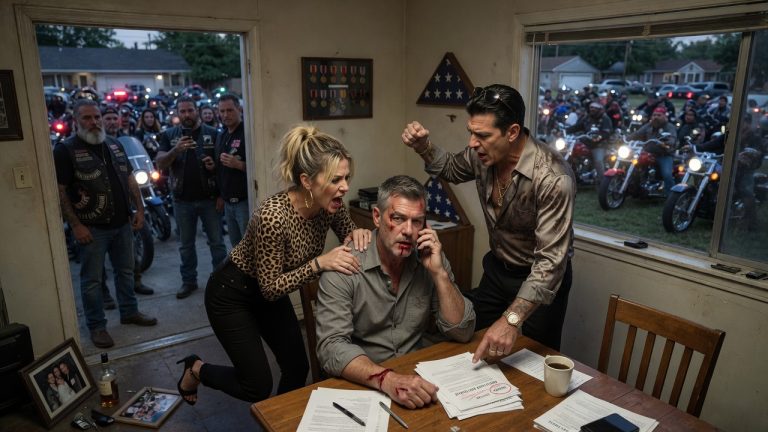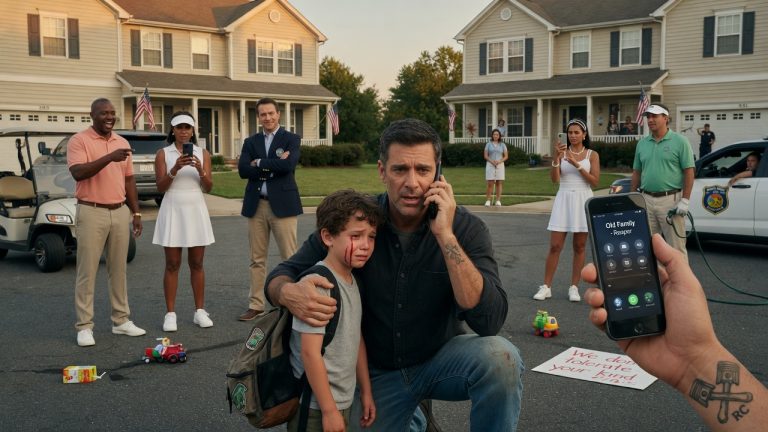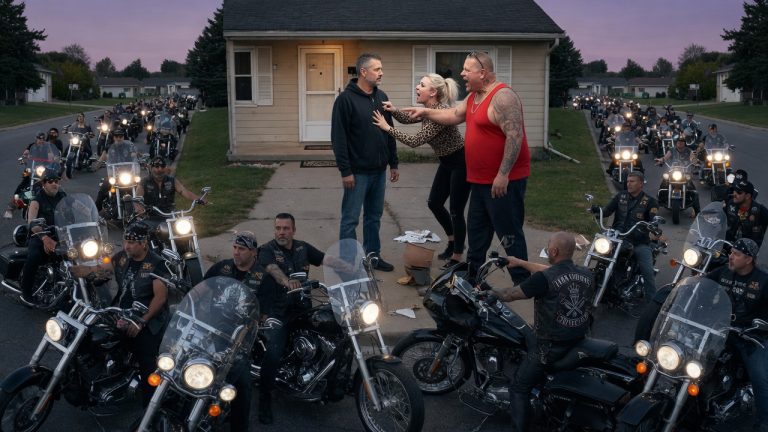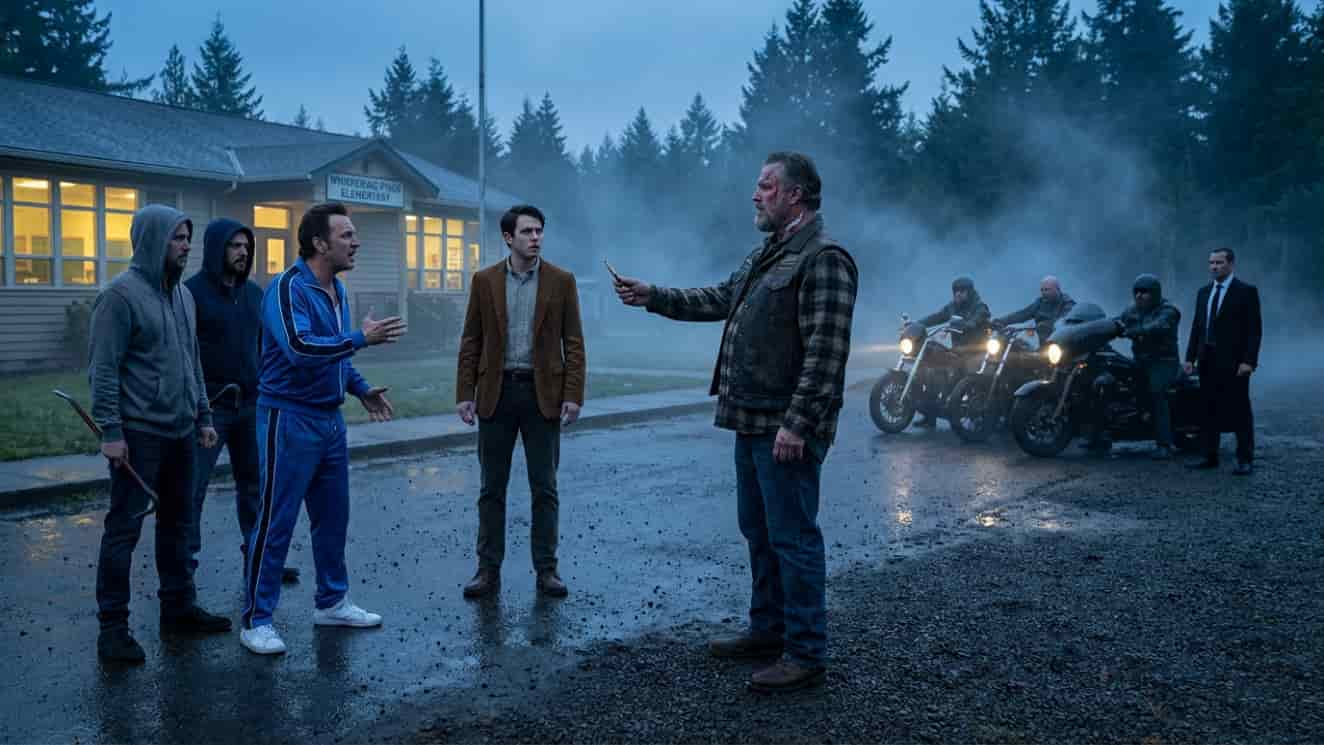
The men Miller sent didn’t care that I was a teacher. They didn’t care about the kids inside the building or the life I’d built away from the shadows. They wanted the school basement for their shipments, and they thought my “helpless” father was the easiest way to break me. I watched them shove him, watched them laugh at the way he just stood there, clutching the gold fountain pen I’d bought him with my first paycheck. I felt the shame of his silence—until I saw the look in his eyes change.
It wasn’t fear. It was the look of a king deciding who lived and who died.
When the first headlight cut through the Oregon mist, Miller stopped laughing. When the second hundred arrived, he started shaking. My father didn’t say a word, but for the first time in twenty-six years, I finally heard him. He wasn’t a victim. He was the man who kept the monsters at bay, and I was the only thing he had left to lose.
If you think the loudest man in the room is the one in charge, you’ve never met a man who has nothing left to say and everything to protect.
Chapter 1: The Weight of Gold
The school smelled of floor wax and the lingering scent of Macintosh apples—the kind of wholesome, institutional aroma that usually acted as a barrier against the rest of the world. For David, it was the smell of safety. He stood at the chalkboard, the white dust of the day’s geometry lesson coating his fingertips, listening to the muffled shouts of fourth-graders heading for the buses. It was a good life. A quiet life.
Then he saw his father sitting on the bench outside the main office.
Bob didn’t belong in a hallway decorated with construction-paper turkeys and “Student of the Month” stars. He was a mountain of a man, even at sixty-five, with shoulders that seemed to push against the very air of the corridor. He wore a faded flannel shirt, sleeves rolled up to reveal forearms mapped with old grease stains and the faint, blurred blue of tattoos that had lost their edges decades ago. He sat perfectly still, his hands resting on his knees.
In his right hand, he held the gold fountain pen.
David felt a familiar tightening in his chest—a mix of affection and a dull, persistent ache. He walked over, the soles of his dress shoes clicking on the linoleum.
“Dad? You’re early. We didn’t have a dinner plan until six.”
Bob looked up. His eyes were the color of the Oregon coast on a stormy day—a hard, flinty grey that missed nothing. He didn’t smile, not with his mouth, but the tension in his forehead eased. He tapped the pen against his palm twice.
Thank you. That was their shorthand. Two taps for gratitude, one for ‘I’m fine,’ a slow closing of the eyes for ‘I’m listening.’
“Is the Shovelhead acting up again?” David asked, leaning against the wall. “I told you I’d come by the shop this weekend to help move those crates.”
Bob shook his head slowly. He reached into his pocket and pulled out a small, crumpled notepad. With the gold pen—the one David had bought him with his first real paycheck from the district, an absurdly expensive thing for a man who spent his days covered in 10W-40—he wrote a single sentence in a precise, architectural script: Someone followed you home last night.
David felt a cold prickle of sweat under his collar. “Followed me? Dad, come on. It’s a small town. Maybe someone was just heading toward the ridge. It was probably just the Henderson boy in that loud truck of his.”
Bob didn’t blink. He stared at David until the younger man looked away. Bob knew the difference between a neighbor and a predator. He had spent his life navigating the space between the two. He tapped the pen again, harder this time, then pointed toward the school’s front entrance.
Outside, a black SUV with tinted windows was idling near the bus loop. It didn’t have a district permit. It didn’t look like a parent’s car. It looked like a bruise on the face of the afternoon.
“I can handle it,” David whispered, though his voice lacked conviction. “I’m the one who deals with the school board, Dad. I’m the one who manages the budget. I’m not a kid anymore.”
Bob stood up. The movement was fluid, devoid of the creaks and groans that usually accompanied a man of his age. He walked to the window, his presence suddenly making the hallway feel narrow. He looked at the SUV, and for a split second, David saw it—the silver-white line of the scar that ran across Bob’s throat. It was a jagged, ugly thing, hidden mostly by the collar of his shirt, but when he turned his head just right, it caught the light like a brand.
David knew the story—or the version Bob had allowed him to know. A workshop accident. A piece of flying metal. A tragedy that had stolen Bob’s voice but left him his life. David had grown up in the silence of that shed, the rhythm of his childhood marked by the clink of wrenches and the soft scratch of Bob’s notepad. He had never questioned why his father had no friends, why he never went to church, or why the local police always gave their small house a wide berth.
The SUV shifted into gear and began to roll slowly toward them.
Bob didn’t move. He didn’t reach for a weapon. He didn’t even tense his muscles. He just watched. There was a terrifying gravity to his stillness, a sense that he was the unmovable object the world was about to break itself against.
“Go back to your room, David,” Bob wrote, his hand steady.
“No,” David said, his voice cracking. “If there’s trouble, we call the sheriff. We don’t do… whatever this is.”
Bob turned. He looked at the gold pen in his hand, then at his son. He reached out and squeezed David’s shoulder. It wasn’t a comforting gesture; it was a grounding one. It said: Stay in your world. Let me deal with mine.
The SUV stopped directly in front of the glass doors. A man stepped out. He was young, dressed in a tracksuit that cost more than David’s monthly mortgage, his hair slicked back with too much product. He looked like he’d been imported from a different reality—one where violence was a currency and mercy was a myth. This was Miller. David had seen him around the edges of town for the last month, a dark spot in the local bars, a name whispered with fear by the older boys in his classes.
Miller looked through the glass, his eyes landing on David, then sliding to Bob. He smirked, a slow, ugly expression that didn’t reach his eyes. He raised a hand, two fingers extended in a mock salute, then got back into the vehicle and sped away, kicking up a cloud of gravel.
Bob watched the dust settle. He looked at the gold pen, then carefully tucked it into his breast pocket, right over his heart. He looked at his son, and for the first time in his life, David felt like he was looking at a stranger.
There was a shadow behind his father’s eyes—a cold, ancient thing that had nothing to do with fixing motorcycles or the quiet of a rural school. It was the shadow of a man who knew exactly what that salute meant. It was the shadow of a man who had been waiting for the storm to break for twenty years.
“Dad,” David said, his voice a ghost. “Who are those people?”
Bob didn’t write an answer. He just started walking toward the exit, his boots heavy on the linoleum, the silence behind him feeling louder than any scream.
Chapter 2: The Iron Lung
The bar was called The Iron Lung, a windowless cinderblock box on the edge of the county line where the asphalt turned to dirt. It didn’t have a sign. It didn’t need one. If you knew where it was, you were either looking for a parts-run or a way to disappear.
Bob walked in at 9:00 PM. The air inside was a thick soup of stale beer, Blue Camel cigarettes, and the metallic tang of hot engines. The conversation didn’t stop when he entered—it evaporated.
Men with grey in their beards and faded “Continental Alliance” patches on their vests looked up from their pitchers. These weren’t the weekend warriors in shiny leather. These were the leftovers—the men who had survived the turf wars of the nineties and the federal sweeps of the early two-thousands. They were hard-bitten, scarred, and tired.
At the end of the bar sat a man who looked like he’d been carved out of a piece of old oak. He wore a tailored black suit that looked absurdly out of place in the grime of the bar, but no one laughed. This was Elias, known to the world as “The Translator.”
Bob pulled up a stool next to him. He didn’t order a drink. He just leaned forward, his elbows on the scarred wood.
Elias didn’t look up from his whiskey. “He’s a bold one, Bob. Miller. Thinks the world started the day he was born. He thinks the Alliance is a ghost story told to keep the young pups in line.”
Bob didn’t move. He waited.
“He’s moving product through the corridor,” Elias continued, his voice a smooth, cultured rasp. “High-grade synthetics. He’s looking for a staging ground. Somewhere quiet. Somewhere with a lot of foot traffic that doesn’t look suspicious. Like a school.”
Bob’s jaw tightened. The scar on his throat flared a dull red.
“I know,” Elias said, finally turning to look at him. “He touched the boy. Not physically, but he leaned into his space. He wanted you to see it. He wants to know if the Emperor is really as dead as the rumors say.”
Bob reached into his pocket and pulled out his notepad. He didn’t use the gold pen this time. He used a cheap, plastic ballpoint he’d found on the bar.
How many?
“Miller’s got twenty, maybe thirty. Young, hungry, no respect for the old codes. They like the noise. They like the flash. They don’t understand that the Alliance didn’t rule through noise. We ruled through the silence that followed the noise.”
Bob wrote again: The boy stays clean.
Elias sighed, swirling the amber liquid in his glass. “David is a good man, Bob. You did that. You carved out a piece of the world where he could be soft. But the world doesn’t like soft things. Miller sees David as a lever. He thinks he can use him to pry you open, to see if there’s any gold left in the vault.”
Bob stood up, the stool screeching against the floor. He looked around the room. The men at the tables were watching him. They weren’t just looking at a mute mechanic. They were looking at the man who had led them through the fire, the man who had sacrificed his own voice to ensure their silence during the Great Purge.
Bob raised his hand. He didn’t point. He didn’t gesture. He simply made a fist, then opened it, palm flat, facing the floor.
Sit. Wait.
The men nodded. It was an old signal, one that hadn’t been used in a decade. It was the command of a general to his sleepers.
“They’ll follow you, Bob,” Elias whispered. “They’ve been waiting. The peace is too quiet for men like them. But if you do this, there’s no going back. David will know. He’ll see the blood on the leather. You can’t fix a motorcycle once you’ve dropped it into a canyon.”
Bob didn’t look back. He walked out into the cool Oregon night. He could smell the rain coming, a heavy, cleansing downpour that would wash the dust off the pines.
He climbed onto his bike—the 1978 Shovelhead he’d rebuilt from a literal pile of scrap. It was a beautiful, terrifying machine, stripped of everything but the essentials. He kicked it over, the engine roaring to life with a visceral, rhythmic thrum that shook the ground.
He didn’t head home. He headed toward the school.
He parked in the shadows of the woods across from the teachers’ parking lot. He watched the light in David’s classroom window. He watched his son, the man who taught children about triangles and history, packing his briefcase.
Bob felt the weight of the gold pen in his pocket. It felt like a mountain. It was the only thing he had that wasn’t stained with grease or blood. It was a symbol of a life he had tried to steal for his son, a life built on a lie of silence.
He saw Miller’s SUV pull into the lot again.
This time, the lights didn’t stay on. The vehicle glided into a dark corner, the engine cutting out. Two figures got out, carrying a heavy duffel bag. They headed toward the side door of the gym—the one with the faulty lock David had been complaining about for weeks.
Bob didn’t move. Not yet.
He reached up and touched the scar on his throat. He remembered the feeling of the blade. He remembered the spray of red on the white snow of a Chicago alley. He remembered the choice he had made: to never speak again, to let the world believe he was broken, so that the enemies of the Alliance would stop looking for the man who knew where the bodies were buried.
He had chosen silence to give David a voice.
Now, he realized, he might have to use his silence to take everything else away.
He kicked the Shovelhead into gear. He didn’t turn on the headlight. He moved like a shadow through the trees, the sound of the engine a low growl that the wind swallowed whole. The hunt had begun, and for the first time in twenty years, the Emperor was no longer just watching.
Chapter 3: The Crack in the Glass
The next morning, the school was different. The air felt thin, charged with a static that David couldn’t explain. He found the side door to the gym propped open with a small, jagged rock. Inside, the equipment room smelled of something chemical—something that didn’t belong with the scent of rubber dodgeballs and sweat.
He reported it to the principal, a harried woman named Sarah who was too busy with a budget crisis to care about a propped door. “Probably just some teenagers, David. Lock it up and get to class.”
But David knew. He saw the black SUV parked across the street from the school all morning. He saw Miller standing on the sidewalk, leaning against a lamp post, watching the playground during recess.
At lunch, David didn’t eat. He went to his car, intending to drive to his father’s shop, but as he reached for his door handle, a hand clamped onto his shoulder.
“Nice car, teacher,” Miller said. He was alone this time, his smile bright and artificial. “A bit sensible for a guy with your pedigree, though.”
David spun around, his heart hammering against his ribs. “What do you want, Miller? Stay away from the school. Stay away from me.”
Miller leaned in closer. He smelled of expensive cologne and something sharper, like gasoline. “I’m a businessman, David. I’m looking for partners. I heard your old man used to be quite the entrepreneur back in the day. Before he lost his… well, his charisma.”
“My father is a mechanic,” David said, his voice trembling. “He doesn’t know people like you.”
Miller laughed, a short, barking sound. “People like me? David, people like me are the only reason your father is still breathing. But the rent is due. I need that basement. Just for a few weeks. A little storage, a little distribution. You keep your head down, you get a nice ‘bonus’ for your classroom supplies, and nobody gets hurt. Especially not a mute old man with a very fragile throat.”
David felt a surge of cold fury. He stepped forward, his chest bumping Miller’s. “If you touch him, I’ll kill you.”
Miller didn’t flinch. He looked at David with genuine amusement. “With what? A red pen? A protractor? You’re soft, kid. You’re the ‘pretty’ version of a man who was once a monster. But even monsters die. And they die faster when they have something to lose.”
Miller reached out and tapped the knot of David’s tie. “Tell Bob the Vipers are done waiting. He knows the code. He knows what happens when the Alliance fails to pay its debts.”
Miller turned and walked away, his gait easy and confident.
David didn’t go to the shop. He went back inside the school, his mind racing. The Vipers. The Alliance. The names sounded like something from a bad movie, but the fear in his gut was real. He went to the library and pulled up the local newspaper archives on an old microfiche machine.
He searched for his father’s name: Robert Thorne.
Nothing.
He searched for Continental Alliance.
The screen filled with headlines from the late nineties.
ALLIANCE LEADER DISAPPEARS AFTER TRIPLE HOMICIDE.
BIKER WAR CLAIMS FOUR IN BEND.
THE SILENT EMPEROR: THE MAN WHO RAN THE NORTHWEST WITHOUT A WORD.
David stared at a grainy, black-and-white photo of a younger man standing over a pile of rubble. The man was huge, his face obscured by shadow, but the stance was unmistakable. It was the way his father stood when he was looking at the Oregon rain.
There was no record of an arrest. No record of a death. Just a sudden, total disappearance of the most powerful criminal organization in the region.
David felt the world tilting. The “accident” in the workshop. The silence. The way the town treated them. It wasn’t pity. It was fear. The people in this town weren’t being kind to a disabled man; they were paying tribute to a sleeping dragon.
He drove to the shop after school, his hands shaking on the steering wheel. The shop was a small, corrugated metal building tucked behind a stand of old-growth firs. The sign simply said THORNE’S CYCLES.
He found Bob inside, bent over the engine of a massive touring bike. The Translator, Elias, was standing by the workbench, cleaning a chrome exhaust pipe with a white cloth.
“Dad,” David said, his voice echoing in the metal shed.
Bob looked up. He saw the look on David’s face and immediately set down his wrench. He wiped his hands on a rag, his eyes narrowing.
“He came to the school again,” David said. “He talked about the Alliance. He talked about… the Vipers. He said you were a monster.”
Elias stopped cleaning the pipe. The silence in the room became heavy, physical.
Bob didn’t reach for his notepad. He walked over to David and placed his hands on his son’s shoulders. He looked deep into David’s eyes, searching for something—maybe the innocence he had tried so hard to protect, or maybe the strength he feared David didn’t have.
“Tell him the truth, Bob,” Elias said quietly. “He’s in the room now. You can’t lock the door anymore.”
Bob’s grip tightened. He looked at Elias, a sharp, warning glance. Then he turned back to David. He reached into his pocket and pulled out the gold pen. He didn’t write. He just held it out, the light catching the polished metal.
I did it for this, his eyes said. I did it for you.
“I saw the papers, Dad,” David whispered. “The Silent Emperor. Is that you? Did you kill those people?”
Bob closed his eyes. He didn’t nod, but he didn’t shake his head either. The silence was his confession.
“They’re using the school,” David said, the words tumbling out. “Miller is putting something in the gym basement. He said if I don’t help, he’ll hurt you. He said you owe him.”
Bob’s eyes snapped open. The grey was gone, replaced by a cold, predatory black. He turned to Elias and made a single, sharp gesture—a horizontal sweep of his hand, followed by a pointed finger toward the door.
Go. Now.
“It’s starting,” Elias said, his voice devoid of emotion. “The Vipers are moving tonight. They think you’re a ghost, Bob. They think they’re walking into an empty house.”
Bob walked to the back of the shop, to a heavy steel locker David had never seen him open. He punched in a code. The door swung wide.
Inside wasn’t a collection of tools. It was a rack of black leather vests, each one bearing the silver insignia of the Continental Alliance—a coiled snake beneath a crown of thorns. Beside them sat a row of heavy, combat-grade communication headsets and a collection of short, weighted batons.
Bob reached in and pulled out a vest. It was worn, the leather cracked with age, but it fit him like a second skin. He zipped it up, the sound of the teeth clicking together like a countdown.
He didn’t look like a mechanic anymore. He looked like a king preparing for a crusade.
“Dad, no,” David pleaded. “We call the police. We don’t do this.”
Bob turned. He looked at David, and for the first time, he used his voice. It wasn’t a word—he couldn’t form words—but it was a sound. A low, guttural growl that started deep in his chest and vibrated through the floorboards. It was the sound of a beast that had been caged for twenty years, finally catching the scent of the hunter.
He handed the gold pen to David.
Keep this, his eyes said. Stay in the light.
Then he walked out to the Shovelhead. He didn’t need to write a command. Elias was already on his phone, his voice cold and precise. “The Emperor is mobile. All units, silent approach. Target is the North Ridge School. Code Black.”
As the engine of the Shovelhead roared to life, David stood in the doorway of the shop, clutching the gold pen so hard the metal bit into his palm. He watched his father disappear into the mist, followed by the rising thrum of a dozen other engines in the distance. The peace was over. The silence was about to be broken.
Chapter 4: The Shadow of the Crown
The school was bathed in the sickly yellow glow of the security lights. It was 11:00 PM. The parking lot was empty, save for Miller’s SUV and a nondescript white van backed up to the gym entrance.
David sat in his car at the edge of the woods, his heart a frantic bird in his chest. He shouldn’t be here. His father had told him to stay away. But how could he stay in a quiet house while the world he knew was being dismantled?
He saw Miller’s men moving boxes. They were laughing, their voices carrying on the damp night air. They looked untouchable, fueled by the arrogance of youth and the belief that they were the apex predators of this small, forgotten town.
“Check the perimeter,” Miller’s voice rang out. He was standing on the loading dock, a cigarette dangling from his lip. “I don’t want any surprises from the local deputies.”
“Deputies are tucked in, boss,” one of the thugs yelled back. “This town is dead.”
“Not dead,” a voice whispered from the darkness behind David’s car.
David jumped, nearly screaming. Elias was standing there, his black suit blending into the shadows. He held a small, tactical tablet in his hand, the screen glowing with a map of the school grounds.
“You should have stayed home, David,” Elias said, his eyes never leaving the screen.
“What is he going to do?” David asked. “There are dozens of them. They have guns.”
“They have noise,” Elias corrected. “Bob has something else.”
Suddenly, the security lights flickered and died. The school was plunged into a thick, suffocating darkness.
“What happened to the power?” Miller shouted from the dock. “Get the lights on!”
The thugs turned on their flashlights, the beams cutting through the mist like frantic fingers.
Then, the sound started.
It wasn’t the roar of an engine. It was a vibration. A low-frequency hum that seemed to come from the ground itself. It was the sound of five hundred motorcycles idling at the lowest possible RPM, their exhausts baffled, their movements synchronized.
Out of the mist, the headlights appeared.
Not all at once. One by one, then in pairs, then in dozens. They formed a perfect circle around the school, a ring of cold, white fire that trapped the SUV and the van in its center.
The Vipers panicked. They pulled handguns from their waistbands, pointing them wildly at the lights.
“Who’s there?” Miller screamed, his bravado evaporating. “Show yourselves!”
The engines cut out simultaneously. The silence that followed was more terrifying than the noise.
A single figure walked into the light of the van’s headlamps.
It was Bob. He was alone, his hands empty, his leather vest reflecting the light. He walked with a slow, deliberate pace, his boots crunching on the gravel. He stopped ten feet from Miller.
“You,” Miller hissed, his voice trembling. “The mute. You think a bunch of old men on bikes can stop us? We’ll kill you where you stand.”
Miller raised his gun, aiming it at Bob’s chest.
Bob didn’t flinch. He didn’t even raise his hands to defend himself. He just stood there, his grey eyes fixed on Miller’s.
Behind Bob, the “Translator” stepped into the light. Elias wasn’t carrying a weapon either. He stood with his hands clasped behind his back, looking like a funeral director.
“Mr. Miller,” Elias said, his voice carrying clearly in the stillness. “You have made a grave tactical error. You mistook a choice for a weakness.”
“Shut up!” Miller yelled. “I’ll blow his head off!”
“You could,” Elias said calmly. “But before your finger finishes its pull, thirty-four snipers with Alliance marks will put a hole in every man you brought tonight. You are not surrounded by bikers, Mr. Miller. You are surrounded by a ghost who has finally decided to return to the living.”
Bob reached into his vest. Miller’s men tensed, their fingers on their triggers.
Bob pulled out a small, silver object. It was an old, weathered biker’s coin—the seal of the Continental Alliance. He tossed it at Miller’s feet. It landed with a dull clink.
“That coin represents a debt,” Elias translated, though Bob hadn’t made a sound. “A debt of blood that was settled twenty years ago. By entering this school, by threatening the Emperor’s blood, you have reopened the books.”
Bob stepped forward, his face inches from Miller’s gun. He reached up and slowly unzipped his vest, revealing the silver-white scar on his throat in its full, jagged glory. He pointed to the scar, then pointed to Miller.
I gave my voice for the peace, his eyes said. I will take your life for the war.
Miller’s hand was shaking so hard the gun was rattling against his palm. He looked around at the circle of lights. He saw the silhouettes of the men on the bikes—massive, unmoving figures who looked like statues of ancient, vengeful gods.
He looked back at Bob, and for the first time, he saw the Emperor. Not a broken old man. Not a mechanic. He saw the man who had ruled the Northwest through the sheer force of his will, a man who didn’t need to speak because his actions left nothing left to be said.
“Take the van,” Miller whispered to his men, his voice breaking. “We’re leaving. Now!”
“You aren’t leaving,” Elias said, his smile cold and thin. “The Emperor has reached a verdict.”
Bob raised his hand, palm up. He slowly closed his fingers into a fist.
From the darkness of the woods, a voice rang out—not a biker’s voice, but a voice of authority. “This is the State Police! Drop your weapons! Hands in the air!”
David watched from his car as the perimeter erupted. But the police weren’t coming for the bikers. They were coming for the van. They were coming for the drugs.
And his father?
Bob stood in the center of the chaos, his eyes never leaving Miller. As the police moved in, the ring of headlights began to fade, the motorcycles slipping back into the mist as silently as they had arrived.
By the time the first deputy reached the loading dock, the Alliance was gone.
Except for Bob.
He stood there as the handcuffs were placed on Miller. He stood there as the drugs were hauled out of the gym. He stood there until David ran across the grass and threw his arms around him.
Bob didn’t hug him back immediately. He looked at the school, at the building where his son taught children about a world that was supposed to be safe. He looked at the gold pen in David’s hand.
Then he leaned down and touched his forehead to David’s.
The silence was back. But it wasn’t the silence of a victim anymore. It was the silence of a guardian. And David knew, as he felt the cold leather of his father’s vest against his cheek, that the man he thought he knew was gone forever, replaced by a truth that was as heavy and as beautiful as gold.
But as the police began to ask questions, and the town began to wake up to the news of the raid, David saw a look of profound sorrow in his father’s eyes. The war had been won, but the lie was dead. And in its place, a new, more dangerous world was waiting for them both.
Chapter 5: The Geography of Shadows
The flashing blue and red lights of the sheriff’s cruisers turned the damp Oregon mist into a rhythmic, pulsing bruise. David stood by the brick pillars of the school entrance, the gold fountain pen still clutched in his hand like a talisman that had lost its magic. He watched the scene with the detached, clinical clarity of a man in shock.
Miller was being shoved into the back of a cruiser, his expensive tracksuit snagged on the doorframe, his face a pale mask of disbelief. The young man who had walked through the school hallways with the swagger of a conquistador was now just a shivering kid in the cold. The heavy duffel bags of synthetics were being cataloged by deputies who moved with a grim, practiced efficiency.
But it was his father David couldn’t stop looking at.
Bob stood by the Shovelhead, his leather vest open to the night air. He wasn’t being questioned. He wasn’t being handcuffed. In fact, Sheriff Miller—no relation to the criminal in the car—was standing three feet away from him, his thumbs hooked into his utility belt, speaking in a low, deferential tone that David had never heard used with a civilian.
“You should’ve called me, Bob,” the Sheriff said. His voice was tired, carrying the weight of twenty years of shared secrets. “We had an arrangement. You stay in the shed, the Alliance stays in the history books, and I keep the peace.”
Bob didn’t look at him. He was staring at the school, at the dark windows of David’s classroom. He reached out and tapped the fuel tank of his bike twice.
Thank you.
“Don’t thank me,” the Sheriff spat, though there was no malice in it. “This is a mess. I’ve got thirty bikers who vanished into the woods the second my sirens hit the ridge. I’ve got a federal-level drug bust on a middle school campus. And I’ve got your boy standing over there looking like he just saw a ghost.”
Elias, the Translator, stepped out of the shadows. He looked as crisp as he had in the bar, his black suit untouched by the chaos. “The Emperor didn’t bring the noise, Sheriff. Miller did. We simply provided the audience.”
“Get him out of here, Elias,” the Sheriff said, gesturing toward Bob. “And tell the rest of them if I see a patch within city limits tomorrow, I’m bringing in the National Guard. I don’t care who owes who a favor from the ninety-eight purge.”
David felt a cold hand on his arm. It was Elias.
“Your car is still by the trees, David. Follow us back to the shop. Don’t stop for gas. Don’t talk to anyone.”
“Why isn’t he in handcuffs?” David asked, his voice sounding thin and alien to his own ears. “Elias, he just… he summoned an army. He’s part of this.”
Elias looked at David with a pity that felt like an insult. “Your father didn’t summon an army, David. He reminded the world that the army never actually left. Now move. The Vipers have friends, and they aren’t as patient as the Sheriff.”
The drive back to the shop was a blur of towering firs and winding county roads. David followed the single red taillight of his father’s Shovelhead, feeling like he was following a stranger into a dark forest. The world he had inhabited—the world of lesson plans, faculty meetings, and quiet dinners—felt like a fragile glass ornament that had finally been crushed.
When they reached the shop, the air was different. The silence wasn’t the peaceful, productive quiet of a mechanic’s workspace anymore. It was the heavy, expectant silence of a war room.
Bob parked the bike and walked into the shop without looking back. He went straight to the workbench, picked up a heavy industrial degreaser, and began scrubbing his hands. He scrubbed until the skin was raw and red, as if he could wash away the smell of the school parking lot, the smell of the life he had tried to bury.
David slammed the shop door behind him. “Talk to me! Use the notepad, use your hands, I don’t care. Just tell me what the hell that was!”
Bob stopped scrubbing. He kept his back to David, his shoulders rising and falling with a ragged, heavy breath.
“He can’t tell you what you already know, David,” Elias said, leaning against the steel locker. “He spent twenty years trying to make sure you never had to ask. That gold pen you bought him? He treats it like a holy relic because it’s the only thing in this shop that doesn’t have blood in its history.”
“I don’t care about the pen!” David shouted, throwing the instrument onto the workbench. It skittered across the wood, clicking against a wrench. “I care about the fact that my father is a criminal. I care about the fact that my school is a crime scene because of some ‘debt’ from twenty years ago. Who is Miller? Who are the Vipers?”
Bob turned around. His face was a map of exhaustion. He reached for the notepad, his hands trembling slightly. He wrote with a jagged, hurried hand: Vipers are the sons.
“The sons of who?” David asked.
Elias stepped forward, his voice dropping into a dark, historical register. “The men your father had to remove to stop the Great Biker War of ninety-eight. The Alliance wasn’t always a peaceful collective, David. It was a slaughterhouse. Your father was the only one with enough weight to stop the bleeding. He cut out the rot, he made a deal with the state, and he took a vow of silence to ensure the survivors wouldn’t come looking for revenge. He became a ghost so you could become a teacher.”
David looked at his father. He saw the scar on the throat—the jagged, silver-white line that he had always been told was a “workshop accident.”
“Who cut you, Dad?” David whispered.
Bob pointed to the locker. To the vest with the silver serpent and the crown of thorns. Then he pointed to himself.
I let them, he wrote. To end it.
The realization hit David like a physical blow. His father hadn’t lost his voice in an accident. He had traded it. He had stood in some dark room, two decades ago, and let a knife open his throat as a blood-price for a peace that would allow his son to grow up without a target on his back.
“Miller’s father was one of them,” Elias added. “He died in prison five years ago. Young Miller didn’t want the peace. He wanted the crown. He thought the Emperor was a myth, a broken old man who couldn’t fight back. He wanted to use you to humiliate the man who broke his father’s world.”
A sudden, sharp crack echoed through the shop.
The front window of the shop shattered, a heavy brick skittering across the floorboards. David dove for the ground, his hands over his head.
Bob didn’t flinch. He didn’t even duck. He watched the brick roll to a stop near his boots. There was a piece of paper taped to it.
Elias moved with a speed that belied his age, reaching for a shotgun hidden beneath the workbench. He checked the perimeter through the broken glass, his eyes cold. “They’re gone. Just a drive-by. A reminder.”
Bob picked up the brick. He peeled the paper off and read it. His face didn’t change, but the muscles in his jaw corded until they looked like they might snap. He handed the paper to David.
The school was just the beginning. The Emperor is dead. Long live the Vipers.
“They aren’t going to stop,” David said, his voice trembling as he looked at the shattered glass. “The police arrested Miller, but his people… they’re still out there. They’re going to burn this place down. They’re going to come for me again.”
Bob looked at the gold pen lying on the workbench. He picked it up, his thick, grease-stained fingers delicate as he gripped the polished barrel. He looked at David, then at the pen, then at the heavy steel locker.
He reached into the locker and pulled out a small, encrypted radio. He keyed the mic three times.
Click. Click. Click.
The response was immediate—a series of static-heavy clicks from dozens of different sources, echoing in the quiet of the shop. The sleepers were still awake. The Alliance was waiting for the final word.
Bob looked at David and wrote one last thing on the notepad before tearing the page off and handing it to him: I can’t protect the teacher anymore. I have to protect my son.
“What does that mean?” David asked.
“It means the peace is over,” Elias said, his voice sounding like a closing coffin lid. “It means tonight, the Emperor doesn’t just watch the shadows. Tonight, he becomes the shadow.”
Bob walked over to the Shovelhead and began checking the chain tension. He didn’t look like a father anymore. He looked like a man who had accepted a death sentence he’d been outrunning for twenty years. David stood in the middle of the broken glass, the gold pen in his hand, realizing that the quiet life he loved was gone, and the man who had given it to him was about to go back into the fire to make sure David survived the funeral.
Chapter 6: The Sound of the End
The North Ridge was a jagged spine of basalt and pine that overlooked the entire valley. It was a place for teenagers to drink beer and for old men to contemplate the distance between themselves and the world. Tonight, it was a graveyard.
The Vipers had chosen the spot for its symbolism. It was where the Alliance had signed the original treaty in 1998, the place where the “Silent Emperor” had first laid down his sword.
Bob rode the Shovelhead up the winding dirt track, the engine a low, rhythmic heartbeat in the dark. He wasn’t wearing a helmet. He wanted the wind to hit his face. He wanted to feel the cold reality of the Oregon night. He was alone—or so it seemed.
At the summit, three black SUVs were parked in a semi-circle, their high beams cutting through the mist to create a makeshift stage. A dozen men stood in the light, most of them in their twenties, wearing leather jackets with “VIPER” scrawled in white spray paint on the back. They were the new generation—loud, undisciplined, and fueled by a sense of inherited grievance they didn’t fully understand.
In the center stood a man older than the rest, a lean, scarred figure named Vance. He had been a lieutenant in the old days, a man who had escaped the purge by hiding in the shadows of the Vipers’ ambition.
Bob kicked the stand down on the Shovelhead and dismounted. He walked into the center of the beam of light, his hands at his sides.
“The ghost finally climbs the hill,” Vance said, his voice a mocking rasp. “Where’s your shadow, Bob? Where’s the fancy man in the suit? Where’s your army of grandfathers?”
Bob didn’t move. He didn’t write. He didn’t gesture. He just stood there, a mountain of leather and scarred skin, his eyes locked on Vance’s.
“You think because you put Miller in a cage, the debt is paid?” Vance stepped forward, a heavy iron pipe in his hand. “My brother died because of your ‘peace.’ My father spent ten years in a box because you decided the Alliance was done. You don’t get to just turn off the machine, Bob. Not when the rest of us are still caught in the gears.”
One of the younger Vipers stepped forward, a jagged knife in his hand. “He can’t even answer you, Vance. Look at him. He’s just an old man with a broken throat. Let’s see if he bleeds in silence, too.”
The boy lunged.
Bob didn’t move until the last possible second. It wasn’t the movement of a brawler; it was the movement of a man who had spent forty years learning the geometry of violence. He caught the boy’s wrist, twisted it until the bone groaned, and drove a thumb into a pressure point on the neck. The boy collapsed like a marionette with its strings cut.
Bob didn’t follow up. He didn’t look at the fallen boy. He looked at Vance.
“Is that it?” Vance laughed, though it sounded forced. “One kid? There are twelve of us, Bob. You’re done.”
Vance raised the iron pipe.
But then, the sound started.
It wasn’t a roar. It was a whistle. A long, low, piercing sound that echoed off the basalt cliffs.
From the trees, the lights began to appear. Not motorcycles this time. Men.
Dozens of them. They didn’t have bikes. They didn’t have flashing lights. They walked out of the darkness with the silence of predators. They were the “grandfathers”—the men from the Iron Lung, the men from the hidden sheds and the quiet suburban homes. They carried heavy wrenches, lengths of chain, and the cold, unblinking eyes of men who had seen the worst the world had to offer and had survived it.
Elias stepped out from behind a tree, a heavy tactical flashlight in his hand.
“The thing about ghosts, Vance,” Elias said, the light catching the silver serpent on his lapel, “is that they don’t like to be disturbed. You thought the Alliance was a club. It wasn’t. It was a vow. And you just broke it.”
The Vipers looked around, their bravado crumbling. They were outnumbered three to one by men who didn’t care about “clout” or “territory.” These men only cared about the man in the center of the circle.
Bob stepped toward Vance. He reached into his vest and pulled out the gold fountain pen. He held it up in the light of the SUVs.
He didn’t use it to write. He used it to point. He pointed at the ground at Vance’s feet.
“He’s giving you a choice, Vance,” Elias translated. “The pen or the sword. You can walk away tonight. You can take your boys, you can leave the valley, and you can forget the name Robert Thorne. If you do, the Alliance stays in the shadows. The peace remains.”
Vance looked at the circle of old men. He looked at the iron pipe in his hand. He was a coward at heart—most bullies are. He saw the cold, mechanical inevitability of his own destruction if he stayed.
“And if I don’t?” Vance hissed.
Bob didn’t wait for Elias to translate. He took the gold pen and, with a sudden, violent motion, snapped it in half. The black ink sprayed across his palms, looking like fresh oil in the harsh light. He dropped the pieces into the dirt.
The message was clear: The only thing I had that was clean is broken. Now there is nothing left but the mess.
Vance backed away. He saw the shift in Bob’s eyes—the transition from a father trying to protect a secret to a king ready to burn his kingdom to the ground.
“We’re leaving,” Vance shouted, his voice cracking. “Get in the cars! We’re done here!”
The Vipers scrambled into the SUVs, the tires spitting gravel as they fled down the ridge. The Alliance didn’t chase them. They didn’t need to. The message had been delivered with the weight of twenty years of repressed fury.
The summit grew quiet. The old men began to fade back into the trees, nodding to Bob as they passed. They didn’t ask for thanks. They didn’t ask for a new order. They had performed their final duty.
David stepped out from behind Elias’s car. He had been watching from the shadows, his face pale, his eyes wide. He walked over to the spot where the gold pen lay in the dirt, its polished barrel stained with ink and dust.
He picked up the pieces.
Bob stood by the Shovelhead, his hands covered in black ink. He looked at David, his face a mask of grief. He had won the war, but he had destroyed the one thing David had given him that represented the “soft” world.
David looked at the broken pen, then at his father. He didn’t see a monster. He didn’t see a criminal. He saw a man who had lived in a prison of silence for two decades just so his son could have a voice.
David walked over and took his father’s ink-stained hand. He didn’t say anything. He didn’t need to. He led Bob back to the bike.
Two days later, the shop was quiet. The window had been boarded up with fresh plywood. The Shovelhead sat in the center of the floor, its chrome gleaming.
David sat at the workbench, a small bottle of jeweler’s glue and a magnifying glass in front of him. He was carefully, painstakingly, piecing the gold fountain pen back together. It would never be perfect. The seam would always be visible, a thin, jagged line of gold and glue. It would never write the same way again.
Bob sat on his stool, watching him. He reached out and tapped the workbench twice.
Thank you.
David looked up and smiled. It was a tired smile, one that reached his eyes but didn’t quite erase the shadows. “It’s okay, Dad. It’s just a pen.”
But they both knew it wasn’t. It was the new contract.
The school had reopened that morning. David had gone back to his classroom. He had taught a lesson on the geometry of circles, his voice steady, his mind focused. But he had kept the broken pen in his pocket. He knew now that the safety of the school, the peace of the town, and the quiet of the shop weren’t accidents of fate. They were the result of a silence that was louder than any roar.
Bob stood up and walked to the door. He looked out at the Oregon rain, the silver-white scar on his throat hidden by the collar of his flannel shirt. He was a mechanic again. He was a father.
But as a lone motorcycle drifted past the end of the driveway, the rider slowing down just enough to nod at the shop before disappearing into the mist, Bob didn’t move. He just watched the road, his hand resting on the doorframe, his presence a silent, unmovable guard at the edge of his son’s world.
The Emperor was back in his shed. And for the first time in twenty years, the silence didn’t feel like a weight. It felt like a promise.