
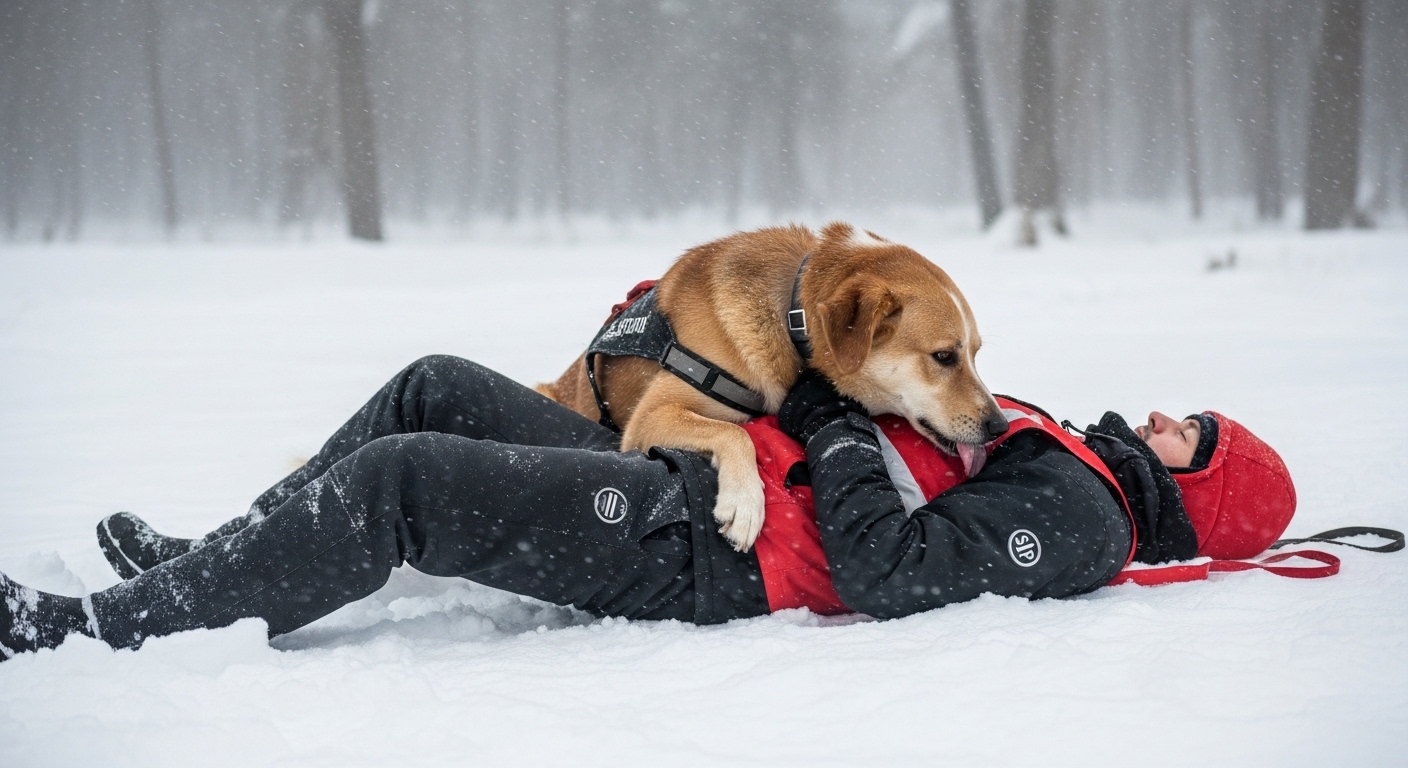
The burglar pointed the gun at my chest, his finger tightening on the trigger as I begged for my life. Suddenly, a golden blur launched from the shadows.
I still smell the gunpowder. It’s a metallic, bitter scent that sticks to the back of your throat and makes you want to heave.
Last night, I wasn’t a man; I was a target. I was cornered in my own living room by someone who didn’t care about my name, my life, or the mother I still needed to call. I saw his eyes behind the mask—they were cold, desperate, and empty.
I begged. I’m not ashamed to say it. I told him he could have the car, the TV, the watch my dad left me. I told him I just wanted to see tomorrow.
He didn’t care. I saw his finger move. I saw the world beginning to end.
Then came the blur.
Three years ago, I found a matted, starving Golden Retriever mix shivering in a dumpster behind a greasy spoon diner in Dayton. He was hours away from giving up. I brought him home, fed him, and named him Rusty.
I thought I was the one who saved him.
But when that bullet left the chamber, Rusty proved me wrong. He didn’t bark. He didn’t hesitate. He did the only thing a soul filled with pure love knows how to do.
Chapter 1: The Sound of the Void
The suburbs are supposed to be quiet. That’s why we buy the overpriced houses with the vinyl siding and the two-car garages. We pay for the illusion of safety, for the right to believe that the world’s ugliness stops at the edge of our manicured lawns. But as I stared down the black, hollow circle of a 9mm barrel, I realized safety is just a story we tell ourselves so we can sleep at night.
“Don’t move! I said don’t move!” the intruder hissed.
He was young—maybe early twenties. His voice was high-pitched, vibrating with a jagged, nervous energy that was more dangerous than a professional’s calm. He was sweating under his mask, the fabric clinging to his forehead. He didn’t want my jewelry; he wanted an out.
I backed into the bookshelf in my living room. The edge of a hardback—ironically, a thriller I’d never finished—dug into my spine. My hands were held high, palms out, a universal sign of surrender that felt pathetic in the face of lead and gunpowder.
“I’m not moving,” I whispered, my voice sounding like it belonged to someone else. “Look, the keys are on the counter. The wallet is right there. Just go.”
“Shut up! Shut up!”
The gun wavered, then steadied. I saw the mechanics of it. The slight pull of the hammer. The tightening of his knuckle. I closed my eyes, a million flashes of a life I wasn’t ready to leave behind strobing through my mind: my mom’s Sunday pot roast, the way the air smells in October, and the weight of a wet nose against my hand.
Rusty.
I’d left him in the kitchen when I went to check the noise. I’d hoped he would stay there. He was an old dog now, his muzzle more white than gold, his joints stiff from a life that hadn’t been kind to him before we met.
The hammer clicked. A sound so small, yet it filled the entire universe.
BANG.
The sound wasn’t like the movies. It was a sharp, physical slap to the air. I felt the heat of it pass my cheek. I waited for the pain, for the coldness of the floor, for the light to go out.
But instead of falling, I saw a golden blur intercept the frame.
Rusty hadn’t growled. He hadn’t given a warning. He had launched himself from the hallway with a speed I didn’t think his old bones possessed. He hit the air between me and the gunman exactly as the muzzle flashed.
I heard a yelp—a sound so full of agony it made my soul shiver—but the golden weight didn’t stop. Rusty slammed into the intruder’s chest, all eighty pounds of him driven by a primal, protective fury.
The man went down hard, his head hitting the hardwood with a sickening thud. The gun skittered across the floor, sliding under the sofa.
Rusty was on top of him in an instant. Even with a red stain spreading across his shoulder, the dog pinned the man’s arm to the floor, his teeth bared in a snarl that sounded like a thunderstorm.
The intruder was screaming now, a high, panicked sound, but he couldn’t move. Rusty’s weight held him like a mountain.
I stood there, paralyzed, my chest heaving. I looked at the floor, at the shell casing glinting in the moonlight, and then at my dog.
“Rusty,” I choked out.
The dog’s ears flicked back at the sound of my voice, but he didn’t let go. He didn’t move. He stood guard over the man who had tried to kill me, even as he began to tremble, the life leaking out of him and onto my living room rug.
I reached for my phone with shaking fingers, dialing 911, my eyes never leaving the golden hero who had just traded his life for mine.
Chapter 2: The Dumpster on 4th Street
To understand why Rusty did what he did, you have to understand where he came from.
Three years ago, my life was a wreck. I’d lost my job at the firm, my girlfriend had moved out of our apartment in the city, and I was staring at the bottom of a bottle more often than I was staring at a computer screen. I was living in a shitty rental on the edge of the industrial district, a place where the streetlights were always broken and the air smelled like burnt rubber.
It was a Tuesday night, raining one of those cold, persistent Midwestern drizzles that soaks into your marrow. I was taking the trash out to the big communal dumpster behind “Louie’s Diner.”
I heard a sound. A scratch. A faint, wet wheeze.
I almost ignored it. In that neighborhood, you learned not to go looking for things in the dark. But the sound was so pathetic, so filled with a singular kind of despair, that I stopped. I lifted the heavy plastic lid.
There, amidst the coffee grounds and the soggy cardboard boxes, was a pile of matted, greyish-yellow fur. He was so thin his ribs looked like a xylophone. He’d been tossed in there like a piece of garbage, his leg bent at an angle that made my stomach flip.
He didn’t bark when the light hit him. He just looked up at me with these cloudy, amber eyes. He didn’t look afraid. He looked… embarrassed. Like he was sorry for being a burden on the world.
“Hey, buddy,” I whispered, the rain dripping off my nose.
I should have called animal control. I should have walked away. I couldn’t afford a vet; I could barely afford my rent. But when I reached down, the dog didn’t cower. He leaned his head—filthy, stinking, and cold—into the palm of my hand.
He chose me.
I spent the next six months and every cent of my savings at Dr. Aris’s clinic. Rusty, as I named him for the color his fur turned once we washed the grease away, had been used as a bait dog. He had scars that told a story of a life lived in fear, a life where humans were things that hurt and dumpsters were things you died in.
But Rusty never held a grudge.
As he healed, he became my shadow. If I was in the kitchen, he was at my feet. If I was in the shower, he was sleeping on the bathmat. He didn’t just love me; he studied me. He knew the sound of my car three blocks away. He knew when I was having a bad day before I even realized it myself.
He taught me how to be a person again. He taught me that you can be broken and still be worth something.
And now, as I sat in the back of an ambulance, watching the paramedics lift his heavy, limp body onto a stretcher, I realized the debt I owed him was one I could never repay.
“Is he… is he going to make it?” I asked the young EMT.
She looked at the dog, then at the blood-soaked towel I was clutching. Her expression was careful—the look of someone who didn’t want to lie but didn’t want to break a man who was already shattered.
“He’s a fighter,” she said. “But he’s lost a lot of blood, Caleb. We’re going to the emergency vet. You need to stay here for the police.”
“No,” I said, my voice cracking. “I’m going with him.”
Chapter 3: The Sterile Vigil
The waiting room of the 24-hour emergency vet clinic in the suburbs is a place where time goes to die. It smells of floor wax and the faint, underlying scent of cedar bedding. It’s a room filled with people clutching leashes and carriers, all of them united by a singular, desperate hope.
I sat in a hard plastic chair, my hands still stained with Rusty’s blood. I hadn’t washed them. I couldn’t. It felt like if I washed the blood away, I’d be letting go of the dog himself.
The sliding glass doors at the front entrance buzzed open, and a woman in a beige coat walked in. It was my mother. She’d driven from two towns over the moment she’d heard.
“Caleb!” she gasped, running toward me.
She hugged me so hard I felt my ribs ache. I didn’t say anything; I just leaned my forehead against her shoulder and let out a sob that had been trapped in my throat since the muzzle flashed.
“The police… they called me,” she whispered, her eyes wet. “They caught the kid. He’s nineteen, Caleb. Just a nineteen-year-old kid who thought he’d find some cash.”
“He had a gun, Mom,” I said, my voice hollow. “He was going to kill me.”
“I know. And thank God for Rusty.”
We sat in the fluorescent light of the waiting room for four hours. The clock on the wall clicked with agonizing slowness. I watched a man come in with a shivering cat, then leave without it, his shoulders hunched. I watched a woman in scrubs walk past the counter, her face unreadable.
Finally, a man in a green scrub top and a stethoscope around his neck came through the swinging doors.
“Family of Caleb and Rusty?” he asked.
I stood up, my legs feeling like they were made of wood. “How is he?”
Dr. Aris had been our vet for three years. He knew Rusty’s history. He knew about the dumpster and the matted fur and the scars. He didn’t look like he’d slept in a week.
“He’s in recovery,” Aris said. “The bullet entered through his shoulder and nicked a major artery. He lost a lot of blood. But the bone stopped the trajectory before it hit his lungs.”
I felt the air leave my chest in a long, shaky exhale. “Is he… is he going to walk again?”
“It’s too early to say,” Aris replied, his voice soft. “He’s an old dog, Caleb. His body has been through a lot even before this. But his heart… his heart is the strongest thing I’ve seen in twenty years of practice. He’s waking up.”
I followed the doctor into the back, my heart hammering against my ribs.
The recovery room was filled with cages and the rhythmic beep-beep of heart monitors. In a large pen at the end of the hall, Rusty lay on a heating pad. He was hooked up to a saline drip, his shoulder wrapped in heavy white gauze.
He looked so small. For eighty pounds of muscle and gold fur, he looked like a pup again.
I knelt by the cage, my hand reaching through the bars. I didn’t say a word. I just touched the tip of his ear, the same way I had three years ago behind the diner.
Rusty’s amber eyes flickered open. They were cloudy from the anesthesia, unfocused and heavy. But when they landed on me, something changed.
He didn’t bark. He didn’t wag his tail. He just let out a long, shuddering sigh and rested his chin on my knuckles.
“I’m here, buddy,” I whispered. “I’m right here.”
Chapter 4: The Shadow in the Mirror
The weeks that followed the shooting were a blur of police statements, insurance adjusters, and the slow, agonizing process of home repair.
I spent most of my time on the floor of the living room, sleeping on a mattress I’d dragged out from my bedroom so I could be near Rusty’s recovery bed. He couldn’t move his left leg, and the vet said he might never again. But the dog didn’t seem to care. He was content to watch me from the corner of the room, his eyes following every move I made.
But I was the one who was struggling.
Every time I closed my eyes, I saw the muzzle flash. Every time I heard a car backfire, I hit the floor. I couldn’t look at the bookshelf without seeing the indentation where the bullet had lodged after passing through my best friend.
The intruder, a nineteen-year-old named Leo, was currently awaiting trial. His mother had been in the local news, crying about how her son was “a good kid who just got desperate.”
Desperate enough to kill me.
One evening, Detective Miller stopped by. He was a man who looked like he’d been carved out of old cedar, his face a map of cases he’d seen and people he’d lost.
“How’s the hero?” Miller asked, nodding toward Rusty.
“He’s okay,” I said, scratching the dog’s ears. “Better than me.”
Miller sat on my sofa, leaning back. “It’s called trauma, Caleb. You’re lucky to be alive. That dog… he’s a once-in-a-lifetime thing. Most people spend their whole lives looking for that kind of loyalty.”
“I don’t deserve him, Detective,” I said, my voice low. “I found him in a dumpster. I gave him a bag of food and a roof. He gave me his life.”
Miller looked at me for a long time. “Maybe he wasn’t paying you back, Caleb. Maybe he was just being who he is. We tend to complicate things with ‘debt’ and ‘contracts.’ Dogs… they just love. It’s the only thing they’re really good at.”
He stood up, his joints popping. “Trial starts in two weeks. You’re going to have to see him. You ready for that?”
I looked at Rusty. The dog was staring at me, his amber eyes filled with a singular, unwavering focus. He wasn’t afraid of the future. He wasn’t worried about the trial or the shooter or the hole in the bookshelf. He was just here. With me.
“I’m ready,” I said.
But as Miller walked out the door, I caught my reflection in the hallway mirror. I didn’t recognize the man staring back. He looked old, his eyes shadowed, his hands shaking as he reached for a glass of water.
I was alive, but I was a ghost in my own house. And the only thing keeping me from drifting away entirely was the sound of a heavy tail thumping against the floor.
Chapter 5: The Weight of Justice
The courthouse in downtown Dayton was a monolith of marble and cold, grey stone. It was a place designed to make you feel small, to remind you that your life was just a line on a docket.
I sat in the hallway, wearing the suit I’d bought for my sister’s wedding four years ago. It was too big for me now.
My mom sat beside me, her hand over mine. “You don’t have to do this, Caleb. You can just give a written statement.”
“I have to,” I said. “I have to look him in the eye.”
The bailiff called my name. I stood up, my heart hammering a frantic rhythm against my ribs.
The courtroom was smaller than I’d expected. It smelled of floor wax and old paper. Leo sat at the defense table, his head bowed. He wasn’t wearing a mask today. He was just a kid in an ill-fitting suit, his hands cuffed to the bar beneath the table.
I walked to the witness stand. I took the oath, my hand trembling as I placed it on the Bible.
“Mr. Hayes,” the prosecutor began. “Can you tell the court what happened on the night of November 14th?”
I started to talk. I talked about the noise in the kitchen. I talked about the gun and the fear and the way the air felt like it was made of lead. I talked about the moment I thought I was dead.
And then I talked about Rusty.
“I saw him launch himself from the hallway,” I said, my voice cracking. “He didn’t hesitate. He took the bullet that was meant for my chest. He pinned the defendant down until the police arrived, even as he was bleeding out.”
I looked at Leo. The kid finally looked up. His eyes weren’t cold anymore. They were filled with a raw, agonizing guilt. He started to cry—not a loud, dramatic sob, but a quiet, rhythmic leaking of tears.
“I’m sorry,” Leo whispered.
The defense attorney stood up. “Objection! The witness is here to testify, not converse with the defendant.”
“Sustained,” the judge said, her voice like a gavel.
I looked at Leo one last time. I’d spent weeks wanting him to rot in a cell. I’d spent weeks wanting him to feel the same fear I’d felt.
But as I stood there, I realized that Rusty hadn’t fought out of hate. He hadn’t launched himself to punish Leo. He’d done it to protect me.
Hate is a human thing. Love is what saves us.
“I have no more questions,” I said, stepping down from the stand.
As I walked out of the courtroom, I felt a weight lift from my shoulders. It wasn’t forgiveness—not yet—but it was the end of the story. I was no longer the man in the living room begging for his life. I was a man going home to his dog.
Chapter 6: The Golden Hour
It’s been six months since the trial.
Leo was sentenced to ten years. His mother still calls me sometimes, leaving messages on my machine that I never return. I wish her well, but I don’t want to hear her voice. I want to hear the sound of the world moving on.
I moved out of the suburbs. I bought a small cottage on the edge of the state park, a place where the trees are thick and the only noise at night is the sound of the wind through the pines.
Rusty is still with me.
He doesn’t run anymore. His left leg is stiff, and he walks with a pronounced limp that makes a rhythmic click-thud on the hardwood floors. He has good days and bad days. Some mornings, he can barely get out of bed, and I have to carry him outside to the grass.
But every evening, as the sun begins to dip below the horizon, we go to the porch.
I sit in the rocking chair, a cup of lukewarm tea in my hand. Rusty lies at my feet, his head resting on my boot. The “Golden Hour,” they call it—that moment when the light turns everything to honey and the world feels like it might actually be okay.
I look at the scar on his shoulder. It’s a jagged, hairless patch of pink skin, a permanent reminder of the night the world tried to break us.
“You did good, buddy,” I whisper.
Rusty doesn’t bark. He doesn’t need to. He just lets out a long, contented sigh and closes his amber eyes. He isn’t worried about the dumpster or the bullet or the kid in the suit. He’s just here. In the light. With the man he saved.
I realized then that I never actually rescued Rusty. I just brought him home so he could rescue me when the time came.
Life doesn’t always give you a second chance, but sometimes, if you’re lucky, it gives you a golden heart to help you find your way back to the light.


