
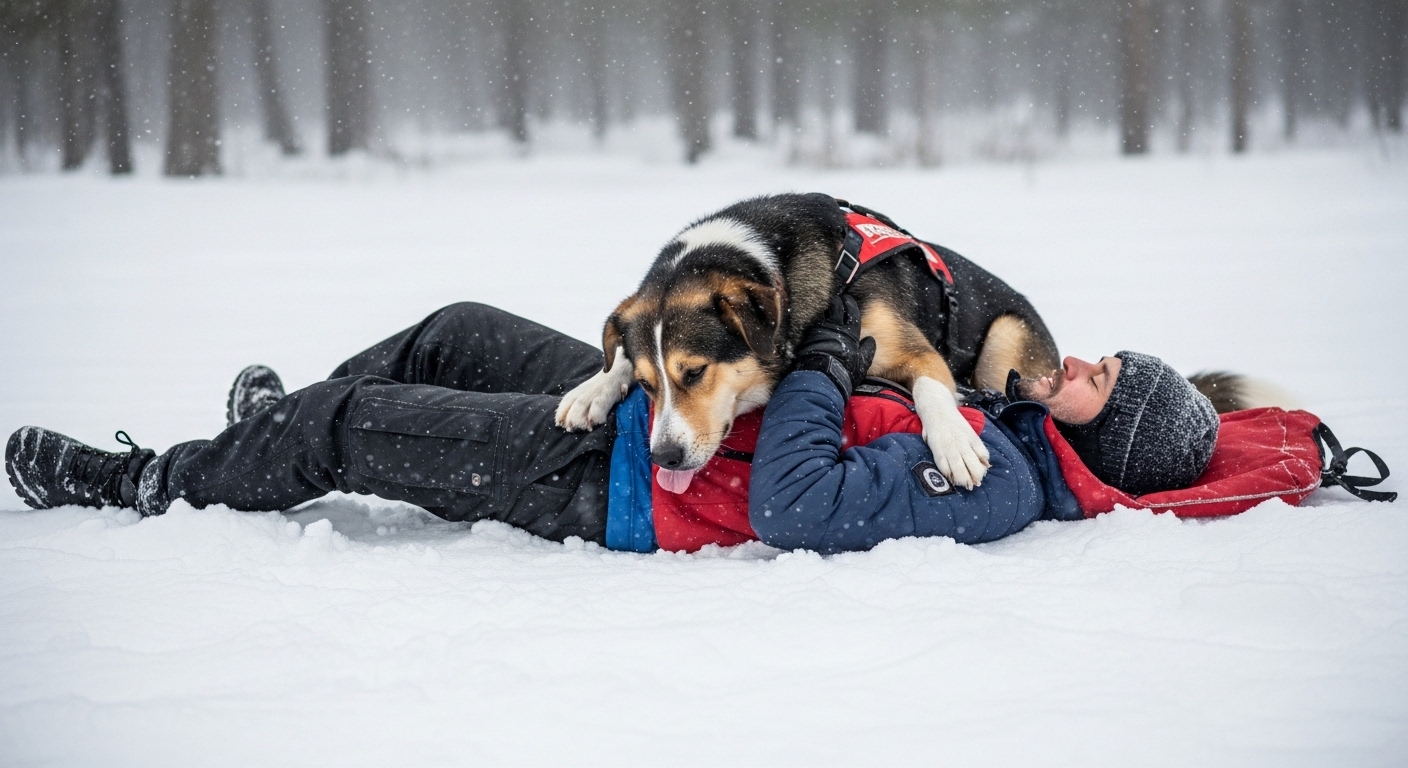
THE GHOST IN THE EMBERS: When the Roof Collapsed and the World Turned to Fire, My Friends Ran for Their Lives. They Didn’t Know the One Who Stayed Behind to Drag My Body From the Grave Was the Only One Who Couldn’t Speak.
Chapter 1
The smoke didn’t come with a warning. It wasn’t like the movies where you hear a crackle and have time to grab your coat. In the high altitudes of Bitterroot, Montana, oxygen is already a luxury. When the fire started in the basement of my cabin, it didn’t just burn; it inhaled the very air I needed to survive.
I was Jackson “Jax” Miller—a man who had spent twelve years in the 10th Mountain Division and another six as a lead smokejumper. I had danced with fire my whole life, but this was different. This felt personal.
I was in the kitchen when the first explosion rocked the floorboards. I remember the smell of accelerant—something sharp and chemical—cutting through the scent of pine needles and old wood. Before I could reach the door, the main support beam, weakened by years of mountain winters and now fueled by high-grade kerosene, gave way.
The sound was like a freight train hitting a brick wall. Six hundred pounds of cedar and slate collapsed directly onto my legs.
The pain wasn’t immediate. There was just a sickening thud and then a numbness that traveled from my waist down to my boots. I was pinned. Above me, the ceiling was a swirling vortex of orange and black.
“Help!” I croaked, but the smoke was like swallowing shards of hot glass.
In the living room, I heard the voices of the men I had called my friends. We had been celebrating the end of the season—Sterling, the deputy mayor; Miller, the contractor; and Hanes, the local sheriff’s deputy. They had been pushing me for months to sign over my acreage for the new “Alpine Vista” resort.
“Jax? Jax, where are you?” Miller’s voice sounded far away, filtered through the roar of the flames.
“He’s under the beam!” Hanes shouted. “The whole roof is coming down! We gotta go, now!”
I clawed at the floorboards, my fingernails tearing against the wood. “I’m here! Under the beam! Help me!”
I saw Sterling’s face through a gap in the smoke. For a split second, our eyes met. I saw the calculation in his gaze. I saw him look at the paperwork on the counter—the papers I had refused to sign—and then back at me, pinned like an insect in a burning jar.
He didn’t move toward me. He moved toward the door.
“It’s too late!” Sterling yelled to the others. “The fuel line is going to blow! If we stay, we all die! Move! Move!”
They ran. I heard the front door slam. I heard their boots crunching on the freezing Montana snow outside. They didn’t call the fire department. They didn’t look back. They left a brother-in-arms to be cremated in his own home because dead men don’t hold onto land titles.
I lay there, the heat blistering the skin on my neck, and accepted that this was how it ended. Not in a canyon in Afghanistan or a forest fire in Oregon, but in a kitchen in Bitterroot, betrayed by the men I’d shared bread with.
Then, I felt it.
A cold nose pressed against my soot-covered cheek. A low, vibrating whine that cut through the thunder of the collapse.
“Boomer,” I wheezed. “Go, boy. Get out.”
But Boomer, my ten-year-old Lab-mix—a dog I’d rescued from a literal battlefield—didn’t move. He didn’t run from the heat. He didn’t run from the smoke.
He gripped the collar of my heavy flannel shirt with his teeth and began to pull.
Chapter 2: The Weight of Silence
The fire was no longer a fire; it was a living entity, a beast that roared and lunged with every gust of wind coming through the shattered windows. The heat was so intense that the glass in the cabinets began to melt, dripping like liquid diamonds onto the charred linoleum.
I was fading. The carbon monoxide was a heavy blanket, pulling me into a sleep I knew I wouldn’t wake up from. My vision was tunneling, the orange flames turning into a soft, distant glow.
Just let go, Jax, a voice in my head whispered. It sounded like my late wife, Sarah. It’s warm here. The pain will stop.
But Boomer wouldn’t let me go.
He was an old dog, his joints stiff with arthritis from years of mountain hiking. He wasn’t a sled dog or a powerhouse. He was a companion. But in that moment, he became something primal. I felt his teeth sink into the thick fabric of my Carhartt jacket. I felt the incredible, agonizing jerk as he threw his entire body weight backward.
Crack.
The beam shifted an inch.
I screamed as the pressure changed, blood rushing back into my crushed legs. It felt like being stabbed with a thousand frozen needles.
Boomer didn’t stop. He let out a muffled growl, his paws slipping on the blood and melted floor wax. He dug his claws into the gaps between the floorboards, his back arching with an effort that should have snapped his spine.
Heave.
Another inch.
I found a spark of survival deep in my gut. I used my elbows to push, dragging my dead weight forward as Boomer pulled. Every foot of progress was a battle. The smoke was so thick I was essentially blind, relying entirely on the feeling of Boomer’s lead.
We reached the threshold of the kitchen. Above us, the second floor groaned, the sound of nails screaming as they were pulled from the joists.
“Go, Boomer! Run!” I tried to shove him away, but my arms were like lead.
The dog didn’t budge. He repositioned his grip, grabbing my sleeve this time, and dragged me toward the mudroom. The air here was slightly thinner, a draft coming from the doggy door he had used a thousand times.
I saw the moonlight through the smoke. It looked like a silver coin at the bottom of a dark well.
We were ten feet from the door when the fuel tank in the basement let out a pre-ignition hiss. My firefighter brain knew exactly what that meant. In five seconds, the pressure would reach critical mass. The cabin would become a bomb.
Boomer felt it too. He didn’t panic. He gave one final, Herculean tug, dragging me over the threshold and out onto the porch.
We tumbled off the steps and into the snow. The transition from 1200 degrees to negative ten was a physical blow. My lungs seized.
Boomer didn’t stop. He kept pulling, dragging me through the deep powder, twenty feet, thirty feet, toward the tree line.
Then, the world turned white.
The explosion wasn’t a sound; it was a pressure wave that flattened the trees and sent a mushroom cloud of embers a hundred feet into the night sky. The heat scorched the back of my head, but we were far enough.
I lay on my back in the freezing snow, watching the remnants of my life rain down in sparks. Boomer collapsed next to me, his chest heaving, his mouth bleeding from where the heavy fabric had torn his gums.
He rested his head on my chest. His fur was singed, smelling of smoke and burnt sugar.
“You stayed,” I whispered, my voice a ghost of itself. “You stayed when they ran.”
I looked up at the stars, the cold Montana air finally clearing my head. I was alive, but as I watched the orange glow reflect in Boomer’s tired eyes, I realized the man who had crawled out of that house wasn’t the same man who had been pinned under the beam.
The Jackson Miller who played nice with local politicians was dead. The man lying in the snow was a soldier again. And I had a war to finish.
Chapter 3: The Gathering Storm
The Bitterroot Valley Memorial Hospital smelled of industrial bleach and bad news. I had been there for three days. My legs were saved, but they were a map of purple bruises and internal stitches. The doctors called it a miracle. I called it Boomer.
Boomer was being held at a local vet clinic under “observation” for smoke inhalation. I had spent every waking hour trying to get the nurses to let him in.
“Mr. Miller, you need to rest,” a voice said from the doorway.
It was Elena. My daughter. She lived in Missoula and hadn’t spoken to me in two years—not since I refused to move closer to her and chose the “lonely mountain life” instead. She looked older, her face etched with the kind of worry that only comes from thinking you’ve lost the last of your family.
“I’m fine, El,” I said, my voice still raspy.
“You’re not fine, Dad. You almost burned to death. The sheriff says it was an electrical fire. Faulty wiring in an old cabin.”
I looked at her. Elena had her mother’s eyes—piercing and honest. “It wasn’t the wiring, Elena. I smelled kerosene. And I wasn’t alone when it started.”
She pulled a chair close to the bed, her brow furrowing. “What are you talking about? Sterling and the others said they tried to get to you. They said the roof came down and they thought you were already gone. Sterling even set up a GoFundMe for your medical bills.”
A cold laugh bubbled up in my throat. “Of course he did. Buying his way out of a conscience.”
I told her everything. I told her about the buyout offers. I told her about the look in Sterling’s eyes before he turned and ran. I told her how Hanes, a man sworn to protect, didn’t even check my pulse.
Elena sat in silence, her hands trembling. “Dad… that’s a heavy accusation. Sterling is going to be the Mayor next year. Hanes is the Sheriff’s golden boy. If you go after them without proof, they’ll ruin you. They’ll say you’re suffering from PTSD, that you’re ‘confused.'”
“I’m a lot of things, Elena, but confused isn’t one of them,” I said. “They left me to die. They didn’t count on Boomer.”
“Where is the proof, then?” she asked, her voice desperate. “The house is a pile of ash. The investigators already cleared the scene.”
I closed my eyes, thinking back to the moments before the collapse. I had been wearing my old search-and-rescue vest. I always wore it when Boomer and I went out on the trails. It had a mounting bracket for a GoPro—the one I used to record our training runs for the volunteer fire department.
I had turned it on that evening to test a new battery.
“Check the mudroom,” I whispered. “Where Boomer dragged me. I was wearing my vest. If that camera survived the heat…”
“I’ll go,” she said, standing up. “But Dad… stay quiet. If Sterling thinks you remember, he’ll finish what he started.”
“Let him try,” I said, looking at the door. “He’s fighting for a resort. I’m fighting for the only thing I have left.”
As Elena left, I felt a familiar presence. The nurse had finally relented. A vet tech walked in, leading a bandaged, slightly limping Boomer.
The dog didn’t bark. He just walked to the side of my bed and rested his chin on the mattress. I reached out, my hand buried in his thick, singed fur.
“We’re not done yet, Boomer,” I whispered. “We’re just getting started.”
Chapter 4: The Predator’s Hubris
Sterling didn’t wait for me to get out of the hospital to visit. He arrived on day five, flanked by Deputy Hanes. They brought a basket of fruit and a stack of papers that looked suspiciously like a “settlement” agreement.
Sterling was a man of manufactured charisma. He had silver hair, a fifty-dollar haircut, and a smile that never reached his eyes. Hanes stood behind him, looking uncomfortable, his hand resting nervously on his utility belt.
“Jackson! My God, look at you,” Sterling said, his voice booming in the small room. “A survivor through and through. The whole town is praying for you.”
“Is that right?” I said, not moving a muscle.
“We’ve been talking to the insurance adjusters,” Sterling continued, ignoring my tone. “Given the… tragic nature of the fire, they’re being a bit difficult. But Alpine Vista is still interested in the land. In fact, we want to offer you a ‘hardship bonus.’ Enough to buy a beautiful condo in Missoula, right near Elena.”
He slid a document onto my tray table.
I looked at Hanes. “You were there, Hanes. You saw me under that beam. How’s the sleep been lately?”
Hanes looked at the floor. “Jax, it was a chaotic situation. We thought the fuel line had already gone. We had to make a command decision.”
“A command decision to leave a man to burn?” I asked.
Sterling stepped between us, his smile faltering. “Now, Jackson, let’s not let trauma cloud the facts. You were unconscious. We did what we could. This offer is more than fair. It’s a way for you to move on. To start over with Boomer.”
He looked down at the dog, who was staring at him with an unnerving, silent intensity. Boomer let out a low, vibrational growl—the kind that signals a hunter has found its mark.
“Keep the fruit, Sterling,” I said, pushing the tray away. “And take your papers. I’m not selling. In fact, I think I’m going to rebuild. Right on the same spot.”
Sterling’s face hardened. The mask slipped, revealing the jagged, ugly greed beneath. “You’re making a mistake, Jackson. A man in your condition… accidents happen. Especially in a construction zone. You should think about your daughter. She’d hate to lose you twice.”
It was a threat. Not even a subtle one.
“Get out,” I said.
“We’re going,” Sterling said, straightening his suit jacket. “But remember—ash doesn’t tell stories. You’re the only witness, and people have very short memories.”
They walked out. I waited until I heard their footsteps disappear down the hall.
My phone buzzed on the nightstand. It was a text from Elena.
I found it. It’s melted, but the SD card was in the fireproof casing. Dad… you won’t believe what’s on here.
I looked at Boomer. He looked back, his tail giving a single, solid thud against the floor.
“Ash doesn’t tell stories,” I muttered, echoing Sterling. “But dogs do.”
Chapter 5: The Reckoning
The “Alpine Vista” groundbreaking ceremony was a gala event. It was held on the edge of my property, under a massive white tent. The town’s elite were there, sipping champagne and looking at architectural models of a future that required my home to be gone.
Sterling was at the podium, his voice echoing through the mountain air. “Today, we don’t just break ground on a resort; we break ground on a new era for Bitterroot!”
I watched from the shadows of the tree line, sitting in my truck. My legs were in braces, and I had a cane, but I was standing. Boomer was in the passenger seat, his head out the window, sniffing the air.
Elena was next to me, her laptop open. She had spent the last forty-eight hours with a digital forensics expert.
“You ready?” she asked.
“Do it,” I said.
The ceremony had a large Jumbotron screen meant to show the 3D walkthrough of the resort. As Sterling began to talk about the “spirit of the community,” the screen flickered.
It didn’t show a resort.
It showed a grainy, fish-eye view of a kitchen. My kitchen.
The audio was muffled but unmistakable. The roar of flames. The sound of a man screaming for help.
The camera angle was low—from Boomer’s perspective on his harness.
The crowd went silent. Sterling turned around, his face pale as he saw the footage.
On the screen, Sterling’s face appeared in the gap of the smoke. The audio picked up his voice, clear and chilling: “Leave him. The papers are in the truck. If he dies, the title goes into probate and we can seize it. Move!”
Then, the footage showed Boomer’s perspective as he dove into the flames. It showed the struggle, the raw, animal desperation as he dragged my unconscious body toward the light.
The video ended with the massive explosion, the camera going black just as Boomer pulled me into the snow.
The silence in the tent was absolute. Even the wind seemed to stop.
Sterling started to stammer. “This… this is a fabrication! AI-generated! Jackson Miller is a disgruntled—”
“I’m right here, Sterling,” I said, stepping out of the truck and onto the grass.
The crowd parted like the Red Sea. I walked toward the stage, Boomer limping proudly beside me. Hanes was there, his hand on his holster, but when he looked at the screen and then at the faces of the townspeople, he let his hand drop. He knew his career ended the moment that file played.
“You said ash doesn’t tell stories,” I said, my voice carrying over the silence. “But you forgot about the one who stayed behind. You forgot about the one you treated like a ‘mutt.'”
I looked at the neighbors, the people who had been Sterling’s friends. “He dragged me through hell while you were planning a party. He stayed when everyone else fled.”
The Sheriff—the real Sheriff, Hanes’s boss—stepped forward. He didn’t look at me. He looked at Sterling.
“Arthur Sterling, you are under arrest for attempted murder, arson, and conspiracy to commit fraud.”
As they led Sterling away in handcuffs, he looked at me one last time. There was no charisma left. Just the hollow, trembling fear of a man who realized he’d been beaten by a dog.
Chapter 6: The New Foundation
Winter in Montana is a long, quiet season.
My cabin was gone, but the community had rallied. Not because of a GoFundMe, but because they were ashamed of what had happened under their noses. A crew of local veterans and neighbors had spent the autumn building a new house on the same ridge.
It wasn’t a “resort.” It was a home.
I sat on the new porch, a thick wool blanket over my legs. The pain was still there, a constant reminder of the night the roof fell, but it was manageable.
Elena was in the kitchen, making coffee. We were talking again. Really talking. She was moving back to Bitterroot to help run a local non-profit we’d started—one that provided service dogs to veterans with PTSD.
Sterling was awaiting trial in the county jail. Hanes had turned state’s evidence to save himself, ensuring that the entire “Alpine Vista” group would spend the next decade behind bars.
I looked down at Boomer. He was curled up at my feet, his grey muzzle resting on his paws. He was slower now, and he slept more than he used to, but his eyes were still bright.
He had saved my life, but he’d done more than that. He’d cleared the smoke from my soul. He’d shown me that even when the world collapses, even when the people you trust run for the hills, there is a loyalty that doesn’t require a signature or a title.
I reached down and scratched him behind the ears. “You did it, boy. We’re home.”
Boomer gave a soft, satisfied groan and closed his eyes.
The mountains were silent, the snow falling softly over the valley, burying the scars of the fire under a clean, white shroud. I realized then that I didn’t need the land to be worth millions. It was worth everything just to be standing on it.
I took a deep breath of the freezing air, and for the first time in years, my lungs didn’t burn.
Because I finally understood that while the flames can take your house, they can never touch the bond between a man and the one who refused to let him go.
Final Sentence:
In the end, it wasn’t the strength of my own will that pulled me from the dark, but the silent, unwavering heart of the friend who chose the fire over the exit.


