FULL STORY
Seawater doesn’t wash off. It isn’t like fresh water. It clings to you, a sticky, corrosive layer that eats at the metal and, eventually, eats at a man’s soul.
I should know. I’ve been on this steel beast, the USS Halsey, for two deployments. I’ve seen men break. I’ve seen them thrive. But I have never seen something so depraved.
Kyle Miller was always a problem. Twenty-four years old, third generation Navy, and he wore that Petty Officer rank like it was a license to dominate. He didn’t lead; he coerced. He didn’t train; he bullied.
And today, his target was Old Man Jenkins.
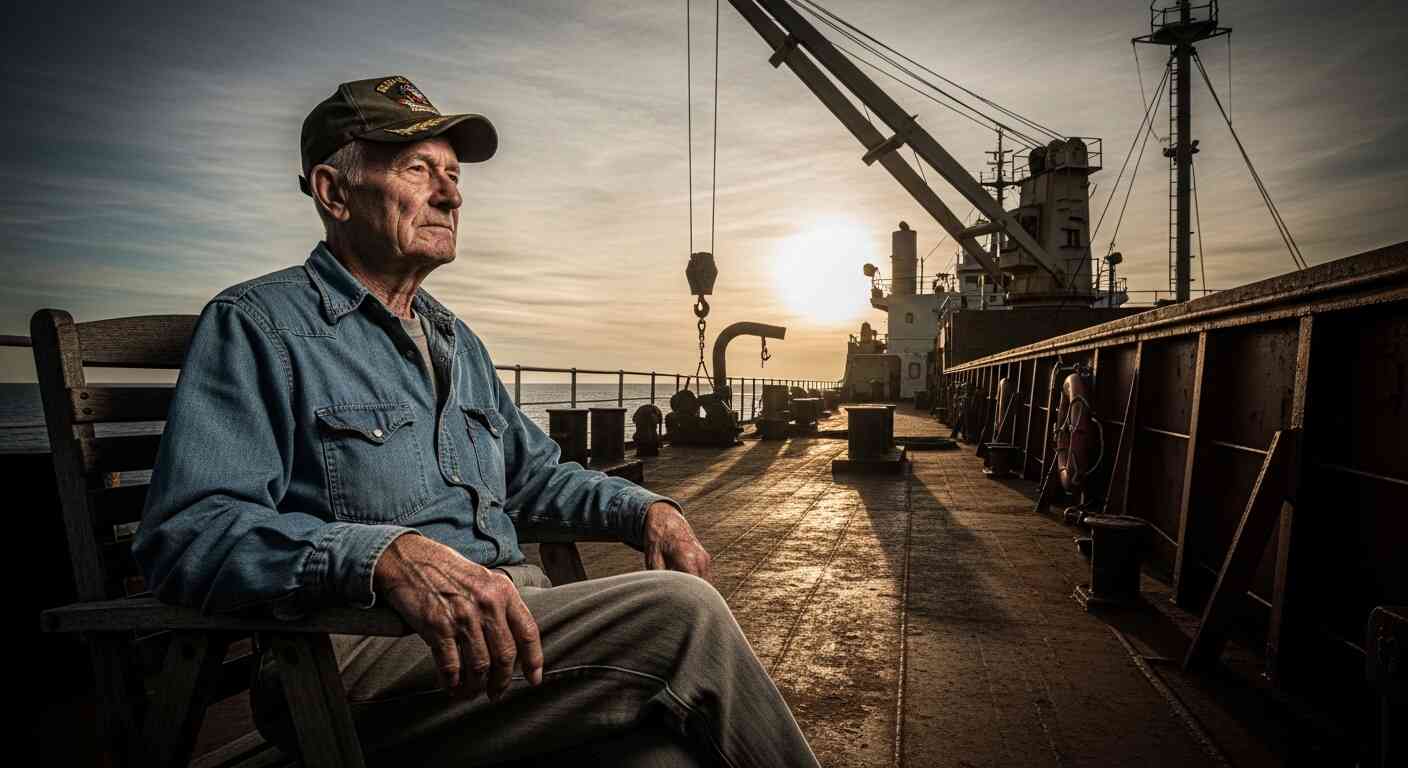
Jenkins arrived a week ago from a support detachment in Seattle. That’s what they said. He was elderly, frail, with a permanent tremor in his left hand and eyes that looked perpetually lost in the memory of some distant catastrophe.
He was assigned to general maintenance. Scrubbing. Painting. The work for the weak.
“Hey, Pops!” Miller’s voice cut through the damp air of the aft deck, raw and demanding.
Jenkins, struggling to lift a twenty-gallon bucket of grey paint, flinched. The tremor in his hand worsened. He turned slowly, his face etched with a patience that only the truly weary possess.
“Yes, Petty Officer Miller?” His voice was raspy, thin, and deferential.
“What is this?” Miller pointed to a microscopic streak of paint on the bulkhead. It was an imperfection no one outside of a white-glove inspection would ever notice.
“I’ll fix it, Petty Officer,” Jenkins said, his hand already reaching for a rag.
“You’ll fix it?” Miller scoffed, his face twisting. “You look like you’re about to fall over. Tell me, old man… why are you still in my Navy? Shouldn’t you be in a home, staring at the walls and waiting to die?”
I saw Seaman Sarah, another sailor, looking down, her knuckles white as she held onto a mop handle. She hated this. We all did. But when Miller was in one of his moods, and when Herc, the Chief, was looking the other way, you stayed quiet.
You survived.
“I have time yet to serve,” Jenkins replied quietly, not looking at Miller. He just wanted to paint.
“You have time yet to be a joke!” Miller shouted, his face reddening. He glanced around, looking for the laughter he felt he deserved. He didn’t get it, but silence, in this Navy, was good enough.
Miller’s eyes went dark. He needed that dominant rush. He saw the large-diameter fire hose coiled nearby.
“You know, Pops, I think you’re still not getting the picture,” Miller said, his voice dropping to a dangerous purr. “The Navy isn’t a museum. We’re about readiness. We’re about toughness. And you… you look a little dusty.”
I felt a pit form in my stomach. No.
Miller walked over to the fire hose station. The other sailors stepped back.
“Petty Officer,” Sarah said, her voice shaking. “Maybe we should just let him finish…”
“Shut up, Seaman,” Miller snapped. He unlocked the safety. He pointed the brass nozzle at Jenkins.
The old man didn’t move. He didn’t fight. He just stared at the nozzle, the bucket still heavy in his trembling left hand.
“How does it feel to be the weakest link?” Miller said. “Let’s see how you handle a little dose of reality.”
He cracked the valve.
FULL STORY
FULL STORY
<Chapter 2>
The water didn’t just pour. At that pressure, it struck like a physical fist. The initial blast hit Old Man Jenkins square in the chest, sending him staggering back into a stack of painted oil drums. The heavy bucket of grey paint flew from his grip, bursting on the metal deck and adding its own sloshing mess to the chaos.
Miller didn’t stop. He turned the valve wider.
Seawater, cold as the breath of the Northern Pacific, drenched the old man instantly. His cheap, issue-clothing offered no protection. The powerful torrent pushed him into a corner of the aft deck, trapping him. He couldn’t stand. He fell to his knees, his face obscured by the spray, his entire body shuddering violently.
Miller was laughing. A loud, forced, chaotic laugh that echoed off the superstructure. “Look at him! Look at the legend! He can’t even stand up to a fire hose!”
Around us, a few sailors watched in stunned, paralyzed silence. I could see the anger in Sarah’s eyes, but she was a Seaman Apprentice; Miller could end her career with a single report. We were trapped by the system Miller abused.
Jenkins was coughing, gasping for air. The pressure was intense, making it hard to even breathe. He was a small man, already frail. This was torture. Plain and simple. This was the kind of hazing that had been outlawed decades ago, yet here it was, happening under the watch of a third-generation Petty Officer who believed he was upholding the “old ways.”
“How does it feel, Pops?” Miller yelled over the roar of the water. “How does it feel to be completely and utterly useless?”
The laughter died down, leaving only the aggressive sound of the water. Miller seemed to be waiting for something. A plea for mercy? A tear? He wanted to break the old man completely.
But Elias Thorne was not Old Man Jenkins.
Through the veil of spray, I saw a change in Jenkins’s posture. The collapse stopped being passive. He was using the metal corner not to hide, but to gain leverage. He dug his soaked shoes into the deck.
The shivering… it stopped. Just like that.
Slowly, fighting the insane force of the water, Jenkins began to stand up. It was impossible. No frail elderly man should have been able to defy that pressure. It was like watching a wounded, aged lion force itself to its feet.
His head lifted. The spray washed the tired, lost look from his face. His eyes, the same gray as the sea around us, locked onto Miller. They weren’t angry. They were just cold. A deeper, more profound kind of cold than the seawater.
Miller saw it. The laughter evaporated instantly. He pushed more water, trying to force him back down.
But the old man kept rising.
<Chapter 3>
He stood fully upright, though his clothes were heavy and clung to him, and water poured from his hair and nose. He looked Miller in the eyes, and for a terrifying second, the power dynamic on that deck completely flipped.
He didn’t scream. He spoke, and somehow, his quiet, raspy voice cut through the sound of the wind and the rushing water.
“Petty Officer Kyle Miller,” Jenkins said. The tremor in his left hand was gone.
Miller didn’t answer. He just held the hose, staring.
Jenkins took one step forward, directly into the strongest part of the flow. He didn’t even flinch.
“You believe your rank is a weapon,” the old man said, his voice gaining a sudden, powerful clarity. It was a voice accustomed to command, not service. “You believe this ship is your kingdom, and toughness is measured in how brutally you can break those you think are weaker than you.”
He took another step. The water was parting around him now.
“The legendary veteran, defeated by a little cold water. How does it feel to be a joke?” Jenkins said, repeating Miller’s own insult back to him, but with a horrifyingly different inflection. It was no longer a taunt. It was a judgment.
Miller, for the first time in his life, looked uncertain. “What… what are you talking about?”
Jenkins stopped, three feet away from the nozzle, looking down at the Petty Officer. “I’ve spent months in frozen trenches; this water is warm compared to the coldness of your soul.”
The silence that followed that statement was profound. The entire aft deck was watching. We were witnessing a man who had seen hell, and who wasn’t intimidated by a Petty Officer and a fire hose.
“You don’t know me,” Miller said, his voice cracking. “You’re a nobody! I could have you up on charges…”
“You are absolutely right, Petty Officer Miller,” the old man said, his gaze unwavering. “You could have Old Man Jenkins up on charges. But you aren’t talking to him anymore.”
The old man reached into his inner shirt pocket, his hand moving with a precision and confidence that did not belong to a frail senior. He pulled out a laminated, waterproof ID. He didn’t just show it; he snapped it open, holding it inches from Miller’s eyes.
Miller stared at the card. I was close enough to see it. It didn’t have a picture of a lost-looking old maintenance worker. It showed a younger, sterner-looking Elias Thorne in full dress white uniform, with an impossible array of stars and ribbons on his chest.
The text across the top was large and clear. It was a standard-issue military ID, but the rank listed on it was something no one on this ship had ever seen in person.
It said: ADMIRAL OF THE FLEET.
“This inspection,” Thorne said, his voice now a quiet thunder, “is officially over.”
<Chapter 4>
The fire hose fell from Miller’s hand. It clattered onto the wet metal deck, the powerful stream of water sending a violent spray across our boots. He didn’t turn the valve off. He just let go.
Miller dropped as if he’d been shot. His knees hit the grey paint he’d forced Jenkins to paint, the slick mixture of water and paint smearing across his uniform. He collapsed against the very oil drums the old man had been pushed into.
He wasn’t laughing now. His face was a mask of utter, complete horror. He looked up at Admiral Elias Thorne, the highest-ranking officer in the entire United States Navy, a man answerable only to the Secretary of Defense and the President. And Miller had just assaulted him with a fire hose.
“A-Admiral…” Miller choked out. His teeth were chattering now. Not from the cold, but from sheer, unadulterated terror. “Sir… I… I didn’t… I didn’t know.”
Thorne didn’t look down at him with anger. He looked at him with an profound, heartbreaking disappointment. He finally reached over, twisted the handle, and shut off the water to the fire hose station. The silence that followed was heavy enough to crush a man.
The Admiral reached up and pulled the false grey hair from his head. It was a simple, realistic wig. He used a corner of his soaked shirt to wipe away some of the latex that had altered his facial structure, revealing a face that looked only slightly less weathered. He was still a man in his late 60s, yes, but no longer the lost soul named Jenkins. He was a warrior.
“Seaman Jenkins,” Thorne said, his eyes still on Miller.
Sarah, her eyes wide as saucers, her mop forgotten, snapped to attention. “Yes, sir!” She looked like she might pass out.
“This man,” he pointed to Miller, “will be taken to the brig immediately. He is to be stripped of all authority pending a formal court-martial for assault on a superior officer, conduct unbecoming, and a dozen other violations I will document shortly.”
Sarah hesitated, looking at her stunned shipmates. We all just stood there. We couldn’t believe what we were seeing. The mythic Admiral Thorne, who we’d only read about in history books, was standing right in front of us.
“Move, sailor!” Thorne commanded, his voice exploding with an authority that left no room for doubt.
Sarah and another sailor, galvanized by the command, scrambled forward. They didn’t even look at Miller, who offered no resistance as they hauled him to his feet and began to lead him off the aft deck.
Just as they reached the hatch, a voice boomed.
“What in the name of God is going on here?”
It was Chief Petty Officer Hernandez—Herc. He had finally decided to see what all the noise was about. He saw the paint mess, the fallen hose, Miller being led away, and the elderly man in the corner.
Herc saw only Old Man Jenkins, though the old man looked… different.
“Miller! Get your ass back here!” Herc shouted, oblivious. He marched toward Jenkins. “And you! What did you do to my deck? I’m going to have you up on…”
“Chief Hernandez,” Thorne said, his voice dropping to that terrifyingly calm level again.
Herc stopped. He looked at the old man, and then he saw the ID card Thorne was still holding, though he was no longer flashing it.
Herc froze. His eyes bulged. He had served for twenty years, and he knew exactly whose face was on that ID. He knew the legends of Elias Thorne.
His entire body locked into the most perfect salute I have ever seen. His voice came out a full octave higher. “Admiral! Sir! I… I didn’t realize… I was unaware of…”
“Unaware of your duty, Chief?” Thorne cut him off, his gaze piercing Herc’s armor of authority. “Unaware that your job is to lead, to discipline, and to protect your crew, not to allow a Petty Officer to run his own personal torture chamber?”
Herc tried to speak, but no words came out. His face was a spectrum of deep purple.
“You are as much a failure as Petty Officer Miller,” Thorne stated matter-of-factly. “He acted from a lack of humanity; you acted from a lack of courage.”
Thorne finally put his ID card back into his pocket. He was still dripping water, but he had never looked more like an Admiral.
“This deployment,” he said to the stunned crew, “is not about power. It’s not about who you can break. It’s about who you can lift. I came here to find the soul of this Navy, and I found it gasping for air in a paint puddle. We have work to do.”
<Chapter 5>
The next forty-eight hours on the USS Halsey were a storm far more chaotic than the ocean we were sailing. Petty Officer Miller was in the brig, delusional, screaming at imaginary guards. His father, the retired captain, couldn’t help him. His grandfather, the retired commander, couldn’t save him. The reality of what he had done—the specific identity of his victim—was too absolute.
Chief Hernandez had been stripped of his leadership and was awaiting an administrative hearing. His twenty-year career was effectively over.
The Captain of the Halsey, a man who had been so obsessed with statistics and metrics that he’d failed to see the rot in his own chain of command, was now on permanent “reassignment” to a desk job in the Pentagon, a dead end for his career. Admiral Thorne had made that call from his secure satellite connection the same day.
We, the crew, were left in a state of stunned disbelief. The frail man who had scrubbed our decks, whose trembling hand we had all ignored, was the Admiral of the Fleet.
Sarah, though shaken, was promoted to Seaman on the spot and appointed as the new commanding officer’s orderly, a massive jump in responsibility and honor. Thorne had seen her attempt to stand up to Miller, and that single act of humanity, however small, had mattered to him.
I was tasked with bringing the Admiral dry clothing and clearing his “maintenance” gear from the locker. I found him in the Officer’s Wardroom, no longer the undercover Elias Jenkins. He was wearing the uniform of his true rank, four stars shining on his collar, looking years younger despite the underlying exhaustion. He was drinking a cup of coffee, staring at a chart of the Pacific.
“You look different, sir,” I managed to say as I set the bag down.
He smiled, a genuine, albeit weary, smile. “The Navy has a way of aging a man, and the ocean has a way of washing away the pretense.”
“Why did you do it, sir?” I had to ask. “Why go undercover like that? Why Jenkins?”
Thorne took a slow sip of his coffee. “Because, sailor, the view from the top is a sanitized lie. As an Admiral, I see polished reports, perfect metrics, and smiling officers. But the real Navy… the real Navy is right here, on this deck, with you and Seaman Jenkins and Petty Officer Miller. I needed to see if the structure still had a pulse, or if it had been replaced by fear.”
“And what did you find, sir?”
His gaze left the chart and locked onto me, those same cold gray eyes, but now tempered with a new, resolute purpose. “I found a system that is breaking. I found a structure that values power over leadership, where silence is the only safety, and where cruelty is mistreated as strength.”
“Will it get better, sir?”
He stood up, walking to the porthole, looking out at the endless horizon. “It must. Not because I am Admiral Thorne, but because if we don’t fix it, we lose the very thing we are fighting to protect. The respect we give each other is the foundation of the respect we get from the world.”
He turned back to me. “Miller thought Old Man Jenkins was a joke. He didn’t understand. Old Man Jenkins was the legend. He just hadn’t needed to use his power yet.”
<Chapter 6>
The conclusion of Elias Thorne’s clandestine morale inspection was swift and absolute. He spent another three days on the Halsey, no longer in hiding. He met with every division, from the engine room to the bridge. He didn’t ask about metrics or budgets. He asked about them. Their lives. Their struggles. Their concerns.
He was the ghost who had become the guardian.
On his final day, the whole crew was assembled on the flight deck. It was a formal colors ceremony, the flag snapping in the sharp wind. The new commanding officer, a man hand-picked by Thorne, was there, but it was Elias Thorne, Admiral of the Fleet, standing at the podium.
“Sailors of the Halsey,” his voice, still that unique, clear thunder, amplified by the ship’s PA system, carried across the deck and out over the water. “I did not come to this ship as an enemy. I came as your commander, to see what you could not tell me in reports.”
He looked out over the sea of faces, his gaze lingering on Sarah, then moving across the crowd.
“We are a fleet. We are a team. And on a team, respect is not a courtesy; it is a critical component of readiness. When we lose our humanity, when we see our brothers and sisters in arms as ‘jokes’ or targets, we become the very weakness our enemies seek to exploit.”
The silence on that deck was heavier than any I had ever known. We knew what he was talking about. We knew who had lost that fight.
“You saw an old man drenched in paint,” Thorne said, his voice dropping slightly. “But you didn’t see the man who survived a frozen trench in Korea before some of your parents were born. You saw a maintenance worker, but you didn’t see the years of dedication and service that put those stars on my collar.”
He paused, letting the words sink in.
“This Navy is not about how many men you can crush beneath your rank. It is about how many men you can pull up with you. That is where our true strength lies. Miller and Hernandez are gone, not because they are evil, but because they are ill-suited to lead in a fleet that values honor.”
He looked back at the flag.
“We are defined not by the storms we cause, but by how we weather them… together.”
The ceremony ended in a profound, dignified silence. We saluted the flag as it was raised, a renewed sense of purpose washing over the entire crew. It felt as if a great weight had been lifted from the ship, replaced by a shared, powerful understanding.
Elias Thorne didn’t stay to be congratulated. He was a busy man, with a whole fleet to fix. But as he boarded the helicopter that would take him back to his carrier group, I saw him say something privately to Sarah. He squeezed her shoulder, a small smile of genuine affection on his face.
The story spread like wildfire across the entire military. “The Admiral in the Rain.” “Old Man Jenkins.” “The Fire Hose Reveal.” It was viral before the word existed. It became a new legend, a cautionary tale for bullies and a source of hope for the disregarded. It forced a conversation that the Navy had been avoiding for years.
Seawater doesn’t wash off. It clings to you. But I realized, as I watched Admiral Thorne’s helicopter lift into the gray sky, that the Admiral was wrong. Seawater isn’t just corrosive. It’s a cleansing force. It’s what you use to wash away the grey paint, to remove the disguise, and to reveal the steel-cold truth of who you really are.
I looked down at the deck where Miller had collapsed, where I had once been silent. The stains were gone, scrubbed clean. But the lesson remained, a sticky, powerful layer that I knew, with a sudden, unwavering clarity, would never wash away.