FULL STORY
Chapter 1: The Weight of Heavy Skies
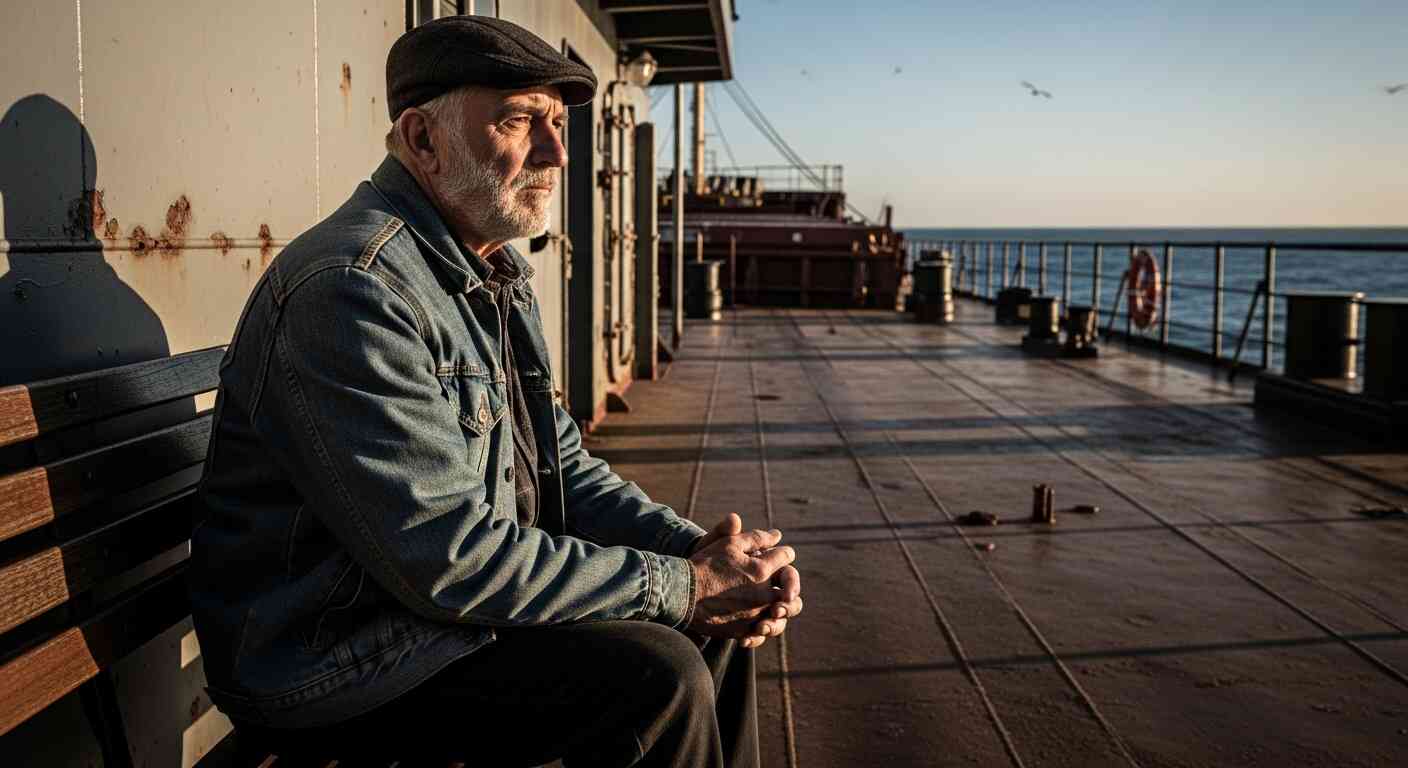
I was on the top deck of the ferry, trying to feel something other than the deep, unrelenting ache in my chest.
At eighty-two, my body was a landscape of old battlefields. Each scar, internal or external, told a story. Most days, I didn’t want to tell them.
My name is Arthur Thorne.
To the world, to the few people who noticed me, I was just a frail old man in a frayed coat, clutching a canvas duffel bag like it was stuffed with gold bars.
It wasn’t. It contained my life, yes, but not in the way they thought.
The sky over the Chesapeake Bay was grey and angry, mirroring the turbulence that never seemed to leave my thoughts.
I’d just left the VA hospital, another appointment that yielded more prescriptions and less hope.
The ferry was a necessary transition between the sterile world of tests and the solitude of my small, drafty apartment.
I gripped the railing, my hands swollen with arthritis, watching the dark water churn.
A group of young men, not more than twenty, were a few feet away, laughing loudly.
Their sound was discordant against the somber day, full of unearned confidence and the casual arrogance of youth that hasn’t yet been broken.
One of them, the loud one with the expensive watch, was making a show of himself.
My own youth had died in the jungles of Vietnam, buried under the bodies of my friends, boys who never got the chance to grow old and arrogant.
I didn’t begrudge these boys their peace, only their oblivion.
I turned slightly, moving to a quieter spot, when my foot brushed a heavy canvas sports bag one of them had left in the walkway.
It was my mistake, a clumsy stumble of an old body. I tried to correct myself, to step around it, but I tripped.
The heavy duffel slid a foot or so across the damp deck.
The laughter cut off instantly.
“Hey!” The loud one, the leader, marched over to me.
He was at least six feet tall, broad-shouldered, a handsome face twisted with unprovoked anger. His name was clearly written in his posture—Bryce.
“You got eyes, old man?”
I looked up, trying to maintain some dignity. “I’m sorry, son. It was an accident. My foot…”
“Your ‘foot’ just kicked three hundred dollars’ worth of soccer gear,” he said, stepping into my personal space.
He smelled of expensive cologne and cheap beer.
His friends surrounded him, a pack mentality setting in. A small girl, maybe ten, watching from a distance, looked scared.
“I said I was sorry,” I said, my voice quiet but steady. I clutched my canvas bag tighter.
“Sorry doesn’t fix things,” Bryce said.
He looked me down, a sneer spreading. He saw the frayed coat, the tremors in my hands, the faded ‘VFW’ patch on my hat.
“Look at you,” he scoffed. “Probably haven’t washed that coat since the war you’re so proud of. What’s in the bag, pop-pop? More trash?”
“It’s just personal belongings,” I said, a faint warning note in my voice that he was too arrogant to hear.
“Personal belongings,” he mocked, mimicking my elderly cadence. He looked at his friends. “Bet it’s filled with aluminum cans. You collecting them for the deposit, grandpa? Trying to make rent?”
His friends laughed, but it was a nervous sound. One of them, a shorter boy, looked uneasy. “Come on, Bryce, he’s ancient. Let it go.”
“I don’t like disrespect, Tyler,” Bryce shot back, his eyes still locked on me. “And this walking fossil just disrespected me.”
I should have walked away.
I should have known that fighting his version of reality was pointless.
But I’d spent a lifetime not backing down.
“Son,” I said, the word coming out as a sigh. “Your bag is fine. You are fine. Go back to your friends.”
The silence on the deck was profound. Even the engine rumble seemed to dim.
Bryce’s face went scarlet. He wasn’t used to being dismissed, especially not by someone he deemed worthless.
“Don’t tell me what to do,” he hissed.
He moved fast.
He didn’t hit me with his fist; he punched me in the stomach, hard.
I was expecting a shove, a lecture, maybe a slap. Not this.
The breath was driven violently from my lungs. A sharp, burning pain flared in my abdomen, spreading like fire.
I crumbled.
My knees hit the damp deck, the pain so intense I couldn’t even make a sound.
The sky, the water, everything swam.
But I didn’t drop the bag.
I couldn’t.
Bryce stood over me, his face a mask of primal fury.
He grabbed the back of my coat and hauled me to my feet, slamming me against the cold metal railing.
He was so strong. I was so old.
He twisted my arm behind my back, forcing me to lean over, my face just inches from the churning water.
The wind whipped the cold spray against my skin.
“Think you’re so tough, huh?” Bryce taunted, his breath hot in my ear. “Think that little pin makes you a hero?”
He yanked the canvas bag from my hand. It was an easy theft. I couldn’t fight him, not like this.
He held the bag over the railing, a terrifying drop into the abyss.
“Everything you own is in this trash bag,” he shouted over the wind. “Just like your life—worthless and about to disappear.”
He was looking for an answer. He was looking for me to beg. He was looking to see the spirit break in the old man he’d decided was human refuse.
I sucked in a breath, the air tasting of sea salt and my own blood where I’d bitten my tongue.
I wasn’t a hero.
Heroes are the ones who don’t come home. I was just a ghost, living on borrowed time.
“Look at me,” he commanded, shaking me.
I forced myself to look at him. His eyes were beautiful and cruel, the eyes of a boy who knew nothing of the world’s pain.
I felt a strange sense of calm wash over me. I’d faced far worse than this.
I found my voice, a raspy, quiet thing that carried surprisingly well in the lull.
“My life is in the hearts of the men I brought home,” I said.
Bryce’s brow furrowed, confusion clouding his arrogance for a brief second.
I held his gaze, refusing to blink, refusing to be the victim he needed me to be.
“That bag,” I said, my voice gaining strength. “It only contains the names of those you aren’t worthy to mention.”
The shock in his eyes was instant. It was a language he didn’t understand.
I didn’t say my life was worthless. I didn’t say I had nothing.
I said he was the one who was unworthy.
For a long moment, we were suspended there, the bully and the ghost, high above the churning grey water.
His friends were silent now. Tyler, the کوتاه short boy, was moving forward, his hand outstretched, a look of pure dread on his face.
“Bryce, don’t,” Tyler whispered.
But Bryce’s grip on the bag was loosening. Not in an act of mercy, but in an act of sudden, paralyzed terror.
He wasn’t sure if he was still in control.
FULL STORY
Chapter 2: The Unraveling
My life was defined not by my breath, but by the absence of others.
The punch had been a mistake, a reflex of a damaged pride that could not process defiance from someone it deemed weaker.
But my words had been a deeper assault, a rejection of his entire value system.
Bryce’s mouth was slightly agape. He still held my duffel bag over the side, but the aggressive posture had softened.
The mask of arrogance was slipping, revealing something else—fear.
He was realizing, at the most base level, that he had targeted a creature he did not understand.
Tyler, the shorten friend, finally reached him. “Bryce, man, pull him back. He’s ancient. This is too much.”
Bryce looked at his friend, a flicker of uncertainty in his eyes.
“What did he just say to me?” Bryce whispered, his voice cracked.
“Who cares?” Tyler said, pulling on Bryce’s arm. “Let’s just go back to the other side. People are starting to stare.”
“He said… he said I wasn’t worthy.”
“It’s just an old man talking nonsense. Look at him, he’s probably got dementia.”
I saw the internal struggle in Bryce. He was desperate to believe Tyler. He was desperate to dismiss me as a non-threat, a confused, broken old fool.
“Yeah,” Bryce said, his voice weak. “Dementia. Thinks he’s still fighting Japs in the jungle.”
He pulled me back from the railing, not gently, but with a kind of fearful urgency, as if touching me might infect him.
I staggered, my knees still weak. I leaned against the railing for support, the pain in my abdomen settling into a dull, pulsing ache.
Bryce threw my duffel bag onto the deck with a dismissive grunt, a desperate attempt to regain his dominance.
The heavy canvas bag hit the wet metal deck with a sodden thud.
It should have just sat there. It should have just been a bag of laundry and the meager belongings of a life in decline.
But the zipper had already been compromised, probably from the initial stumble. And the weight of my past had always been too much for a simple bag to hold.
The bag didn’t just land. It burst.
It was a slow-motion unraveling.
The canvas gave way, and the contents spilled out, fanning across the deck in a waterfall of paper.
It wasn’t trash.
It wasn’t aluminum cans.
They were letters.
Thousands of them.
Some were yellowed with age, written on thick, creamy stationary, the paper itself a testament to time. Others were more recent, on crisp, white paper with modern letterheads.
But all of them, to a single, terrifying letter, were official.
The shock was a physical presence on the deck.
Bryce froze. His friends stood paralyzed. The few other passengers in the distance, who had been glancing our way with detached curiosity, now stopped and stared.
The little girl from earlier was the first to speak. She walked closer, her small face filled with a kind of solemn awe.
She picked up one of the closest letters, which had landed face up.
“Look, Daddy,” she said, her voice small in the silence. “This one has a funny bird.”
Her father rushed over, his face white. He looked at the letter in his daughter’s hand, then at the cascade of paper on the deck, and then at me.
He didn’t move to help me. He looked at me with the kind of deference one usually reserved for a king or a god.
He read the first line of the letter his daughter held. He didn’t read it aloud; his lips just moved, shaping the words in a silent prayer of disbelief.
The letter was on official White House stationary.
The signature at the bottom was a name that had defined the 1980s. A name that was synonymous with American power and resolve.
I’d received that letter forty years ago. It was the first of many.
It wasn’t a standard letter of commendation. It wasn’t a generic thank-you for service.
It was a personal, handwritten letter, full of emotion and a deep, painful gratitude.
It was a letter thanking me for saving the life of his nephew, a young lieutenant whom I had carried out of a burning field under heavy fire, a boy whose life I had given for the lives of five of my own men.
The letter thanked me, in simple, heartfelt prose, for being a hero.
The girl’s father looked at me, a tear tracking down his cheek. He knew.
Bryce saw it too. He couldn’t read the words from where he stood, but he could see the letterhead. He could see the signature.
He could see the change in the atmosphere. The power had shifted, utterly.
The silence was deafening. The only sound was the wind, fluttering the edges of the letters, a thousands small whispers of gratitude from the past.
Tyler, the shorten friend, took a step back. “Oh my god,” he breathed.
Bryce’s hands, which had been so quick to violence, now began to shake.
He didn’t know what to do. He was trapped in the consequences of his own hubris.
I push myself off the railing, the pain in my stomach a dull roar.
I look at Bryce, not with anger, but with a deep, profound sadness. He wasn’t a monster. He was just a fool. A fool who had been allowed to believe that his small, petty power was all that existed.
I knelt down on the damp deck, my old joints popping.
I didn’t try to look strong. I didn’t try to hide my weakness.
I just started to gather my letters.
Each piece of paper was a life. Each piece of paper was a choice. Each piece of paper was a memory I tried so hard to forget.
The names I had mentioned were in these letters. The names of the boys who didn’t come home. The names of the mothers who wrote to me, thanking me for telling them how their sons died, thanking me for a final word, a final touch.
Their gratitude was a weight I could never put down. Their names were a legacy I was unworthy to bear, yet here I was, the only one left to carry them.
And Bryce, a boy who had never known a day of true struggle, had judged me and found me wanting.
I didn’t speak. I didn’t yell. I just picked up my papers.
The first letter, the first actual presidential letter I reached for, was from the current administration. It was only a few months old. It was a letter expressing gratitude for my continued mentorship of young veterans, a recognition that the war I fought never really ended.
I didn’t pick it up immediately. I just let it sit there, face up, for all to see.
The little girl’s father moved forward. He gently took the letter from his daughter’s hand and placed it back on the pile.
Then, without a word, he knelt down next to me and started to help gather my past.
His wife and daughter joined him.
Others followed. Passengers who had been watching from afar, some with judgment, some with indifference, now knelt down in the damp wind, helping the frail old man gather his scattered life.
It was a scene from another time, a quiet, silent testament to a shared respect that Bryce had never understood.
Bryce and his friends stood in the center of it, a stranded island of shame.
His friends were avoiding his gaze. Tyler was already backed away, as if trying to distance himself from the contagion.
Bryce stood alone, a beautiful, cruel boy, trembling in the face of a truth he couldn’t comprehend.
Read the full story in the comments.
If you don’t see the new chapter, tap ‘All comments’.
FULL STORY
Chapter 3: The Ghost in the Machine
The cabin of the ferry was standard, a landscape of practical seating and functional wear.
The incident on the upper deck felt like it had happened years ago, in another life. Yet the ache in my abdomen, a persistent, dull pressure, reminded me it had only been minutes.
The group of passengers who had helped me gather my letters escorted me down, a silent honor guard.
The girl’s father, a quiet man named Elias, helped me into a corner booth, as far away from the stairs as possible. His daughter, a sweet, serious child named Maya, had carefully stacked my duffel bag on the table next to me, giving it a gentle, almost reverent pat.
“You’re okay, sir?” Elias asked, his eyes filled with a concern that made me uncomfortable.
I wasn’t used to being seen.
“I’m fine,” I said, my voice coming out as a raspy, weak sound. “Just an old engine with a few bad gears.”
“Elias,” he said, offering his hand.
I shook it, a simple ritual of respect. “Arthur. Arthur Thorne.”
Elias nodded, his gaze sweeping the cabin. He was a small, practical man, a carpenter by trade, a man who built things to last. He knew the value of structure.
“The boys… that young man…” Elias began, struggling to find the words.
I didn’t need him to say them. The entire upper deck had felt the shift. The bully had been unmasked, not as a tyrant, but as a small, insignificant thing in the face of true sacrifice.
“It’s okay,” I said. “He’s just a boy.”
“He was… he was going to throw your things in the water.” Elias’s voice was tight with anger, the anger of a good man who had seen an act of pure, pointless cruelty.
“It was just a bag,” I lied.
“We saw the letters, Arthur.”
I looked at him, and for the first time in years, I saw my own reflection in another man’s eyes.
I saw the letters not as I saw them, a source of constant, painful reminders, but as others saw them: proof.
Proof that the suffering I had endured, that the lives I had lost, mattered.
Proof that the system that had taken so much from me, that had left me with nightmares and scars and a body that was failing me, had at least acknowledged the debt.
But the real debt was to the names, the faces that had become a blur of green and blood. The debt was to the men whose letters were now in my possession, the private, handwritten notes from families who would never know a peaceful night.
“They’re just papers,” I said, a weary resignation settling over me. “Letters of gratitude from people who have no idea what they’re truly thankful for.”
Elias paused, absorbing my cynicism, my pain. “They’re thankful for you coming home, Arthur. My father… he didn’t.”
I closed my eyes for a moment, the old, familiar sound of helicopter blades filling my mind.
“I was the lucky one,” I said, the words a lie I’d told myself a thousand times.
Elias sat back, a quiet understanding in his gaze. He didn’t press me. He understood that my silence was a fortress, a necessary defense mechanism against a world that was too fragile to hold my memories.
A group of crew members, alerted by some of the passengers, arrived, their face set with a practical concern.
“Mr. Thorne?” one of them asked, a woman with a kind but efficient face. “Some of the passengers reported an incident…”
Elias jumped in. “Yes. A young man attacked him. Punched him in the stomach and tried to steal his property.”
The crew members looked at me, then at the duffel bag, and then at Bryce, who was sitting across the cabin, head low, surrounded by his friends, a spectacle of isolated misery.
“We need to document this, sir,” the crew woman said, her voice gentle. “Would you like to file a police report? We can have them meet us at the dock.”
I looked over at Bryce. He looked so small now. The fancy watch, the expensive clothes, they were just decorations on a hollow shell. He looked terrified.
Tyler, the shorten friend, had left his side, standing a few feet away with a look of pure relief, as if he had successfully detached himself from the blast radius.
I didn’t want to engage. I didn’t want to talk to the police. I didn’t want to make a scene.
I just wanted this to be over. I just wanted to go back to my small apartment, to the quiet safety of my solitude.
“No,” I said, my voice coming out as a tired rasp. “I just want to get to the other side.”
“Mr. Thorne, this is serious. The passengers are reporting a violent assault.” The crew member was persistent, her professionalism battling my weariness.
Elias spoke again, a quiet authority in his voice. “We all saw it, ma’am. He attacked a veteran. A highly decorated veteran.”
The crew members’ expression softened, a new layer of respect washing over her face. They’d seen the patch on my hat, but the word “decorated” carried a different weight, a weight that had been validated by the scattered letters.
“We will still need to report this on our end,” she said, her tone apologetic but firm. “We cannot have passengers being physically accosted. We will contact the appropriate authorities at the dock.”
She looked at Bryce. “I will need to speak with you and your friends.”
I closed my eyes, the inevitability of the process a crushing weight.
I had been in the system my entire life. First the military, then the VA. Forms, reports, endless procedures that never seemed to yield a definitive solution.
This was just more of the same. More noise. More reminders.
Elias was talking, his voice a distant hum, Maya was showing me a drawing she’d made on a napkin, a crude, childlike picture of a flag and a tree.
I smiled, a weak, fleeting thing, and took the napkin.
It was the first moment of simple, uncomplicated connection I had experienced in years.
I looked at the drawing, a symbol of hope and innocence in a world that had tried so hard to take both from me.
And in that moment, I made a choice.
I had been a ghost for a long time.
I had been living in the past, trapped by the names and the letters and the endless, crushing weight of gratitude I didn’t want.
But I was still here. I was still alive. And maybe, just maybe, it was time to step back into the light.
I looked up at the crew member, my gaze steady.
“I’ll speak to them,” I said. “I’ll give my statement.”
Elias looked at me, a soft nod of encouragement. Maya clapped her hands, a small, delightful sound that seemed to chase away the last of the grey sky.
I had been a ghost, but ghosts couldn’t make choices.
Only the living could.
And I, for the first time in a very long time, felt a pulse.
Read the full story in the comments.
If you don’t see the new chapter, tap ‘All comments’.
FULL STORY
Chapter 4: The Ripple on the Water
The police were waiting at the dock.
The ferry had contacted them, and the incident report had been filed. The arrival was a sterile ritual, a choreographed sequence of procedure and authority.
Bryce and his friends were escorted off the ferry first, their hands in plain sight.
The arrogance was entirely gone, replaced by a sullen, terrified submission.
His expensive watch seemed to mocking him, a reminder of a life of privilege that had been shattered in a single moment of uncontrolled rage.
I was escorted off next. Elias and Maya stayed with me, a human shield of kindness in the sterile world of docks and uniforms.
The captain of the ferry had arranged for a small area in the waiting terminal to be cordoned off for my statement. It was a courtesy I would have never received had the letters not fallen out.
The irony was a bitter taste in my mouth.
I wasn’t a person. I was a status. I was a decorated veteran.
The police officer taking my statement was a young man, professional but with a hint of fatigue.
He asked the standard questions. Name, rank, serial number. I answered them as if I were back in basic training.
“And you say he punched you in the stomach, Mr. Thorne?” the officer asked, his pen poised.
“He did.”
“And he tried to throw your bag in the water?”
“Yes.”
The officer was typing, the click-clack of the keys a discordant rhythm. “And what… what exactly was in the bag, sir? Some of the passengers mentioned… well, documents.”
I looked at the canvas duffel bag. It had been retied, a sad, broken thing.
The secret that had sustained me, that had also been my cage, was out. The names were no longer just names. They were public property.
“Just personal correspondence,” I said, a weary resignation settling over me.
“With the President of the United States?” the officer asked, a slight raise of his eyebrow.
“With many of them,” I said, my voice steady.
The officer stopped typing. He looked at me, a new kind of gaze, a gaze of pure, uncomplicated awe.
He was a young man, a boy when some of those letters were written. He had grown up with those names, those stories.
“Wow,” he whispered, a soft, involuntary sound.
He was a professional, but he was also an American. And the weight of my past, the validation of my sacrifice from the highest office in the land, was a language he understood.
He typed faster, the click-clack a rhythm of respect.
The statement was finished quickly. Bryce’s case, however, was not.
He was being charged with assault, larceny, and probably a few other things the police would come up with.
The status of the letters—their historical and emotional significance—would be a factor.
Bryce’s lawyer arrived a few minutes later, a slick, expensive-looking man in a tailored suit.
He was frantic, his eyes darting around the terminal, trying to contain the damage.
He tried to approach me, a smooth, rehearsed smile plastered on his face.
“Mr. Thorne, my name is Marcus Greene. I’m representing Mr. Miller. This is all a terrible misunderstanding…”
Elias stepped in front of me, a wall of carpenter’s muscle and righteous anger. “This is not a misunderstanding. This is assault on a highly decorated veteran.”
The lawyer’s smile faltered, but his professionalism held. “Yes, of course, we are aware of Mr. Thorne’s distinguished service. We are deeply apologetic. We are prepared to offer any compensation… to settle this matter quickly and privately.”
Compensation. The word was an insult. A transactional exchange for my pain, my humiliation, my memory.
I looked at Bryce, who was sitting on a metal bench, his head in his hands, his lawyer hovering over him like a vulture.
I thought about the names in my bag. The names of the boys who had received no compensation, no private settlements. Just a flag, folded into a triangle, and a life of silence.
I thought about the letters of gratitude, the endless, repeated chorus of “thank you for your service” that had become a hollow echo.
I thought about the little girl, Maya, and her simple, childlike drawing.
“No compensation,” I said, my voice quiet but firm.
The lawyer looked confused. “Mr. Thorne, we are prepared to offer a very significant amount… enough to ensure you live comfortably for the rest of your life.”
Comfort. The word was a joke. I’d never known comfort. I’d only known duty. I’d only known survival.
I looked at the lawyer, my gaze unwavering.
“I don’t want your money,” I said. “I want him to understand.”
The lawyer frowned. “Understand what?”
“Understand that what he did… it wasn’t just to me. It was to the uniform. It was to the men who didn’t come home. It was to the country he thinks he can buy his way out of.”
I was speaking not to the lawyer, but to Bryce.
I was speaking to the boy who had judged me and found me wanting, the boy who had never known a day of true struggle, the boy who was about to learn that some debts could never be settled with a check.
I was speaking to the ghost in the machine.
The lawyer tried to argue, to negotiate, to find a crack in my resolve. But there was none.
I had been a ghost for a long time.
I had been silent for a long time.
But I was not silent anymore.
Read the full story in the comments.
If you don’t see the new chapter, tap ‘All comments’.
FULL STORY
Chapter 5: The Trial of the Soul
The courtroom was a sterile landscape of dark wood and fluorescent lights. It was a place of judgment, not justice. I had been judged my entire life. First by the system, then by the enemy, and finally by the world that had forgotten my service.
Bryce’s trial was not a simple affair.
The story had leaked. The simple assault on an elderly man had been transformed into a national spectacle. The phrase “decorated veteran” had become a media mantra. The hidden letters of presidential gratitude had become the center of a storm.
Bryce sat at the defense table, his head low, his face pale and drawn.
The slick lawyer, Marcus Greene, was still there, but he looked less slick, more harried. The simple strategy of compensation had failed, and now they were facing the raw, unfiltered consequences of their arrogance.
Elias and Maya sat with me in the front row of the gallery, a wall of support against the judgmental stares. I didn’t want to be there. I didn’t want the spectacle. I didn’t want the noise.
But I had made a choice.
The prosecution called its witnesses. The passengers from the ferry. Elias, who gave a quiet, dignified testimony about the events on the upper deck. Maya, who gave a small, heartfelt statement about the letters and the old man.
The evidence was undeniable. The assault was documented. The intent was clear.
And then, the prosecution called me.
I walked to the stand, my body an ancient machine of creaks and pops. I didn’t look up at the crowd. I didn’t look at Bryce.
“Mr. Thorne,” the prosecutor said, a woman with a kind but efficient face. “Can you please describe the events of that day?”
I told the story. The accidental stumble, the unprovoked anger, the punch, the threat at the railing. I told it with a flat, unemotional voice, a voice that had been trained to deliver facts, not feelings.
The prosecutor paused. “And the bag, Mr. Thorne. Some… unique items were found inside.”
“Yes.”
“Can you please identify them?”
I looked at the canvas bag, sitting on a table in the center of the courtroom. It had been cleaned, the dirt and the water stains removed. It looked respectable now.
“Letters of gratitude,” I said.
“From?”
I began to list the names. The presidents. The terms. The years. I listed them not in chronological order, but in the order they were written, in the order of the lives they represented.
The names I had carried with me for forty years. The names I had mentioned at the railing.
The courtroom fell into a profound silence. The only sound was my voice, a raspy echo of a past that had been hidden for too long.
Bryce’s lawyer did not cross-examine me. There were no questions to ask. The facts were the facts.
And then, it was Bryce’s turn.
The slick lawyer called his client to the stand. He was taking a huge risk. But they had no other options.
Bryce walked to the stand, his face a mask of primal terror. He was no longer the arrogant, confident boy from the ferry. He was a creature who had been stripped of his defenses, a creature who was facing the raw, unfiltered truth of his own actions.
He swore the oath, his voice barely a whisper.
“Mr. Miller,” his lawyer began, his voice surprisingly gentle. “Do you have any explanation for your actions that day?”
Bryce looked down at his hands, his knuckles white with tension. He was struggling, fighting against the primal urge to shut down, to retreat into the safety of his silence.
“I… I was angry,” he whispered.
“Angry about what?”
“He… he kicked my bag.”
“And that justified punching him?”
Bryce didn’t answer. The silence was a physical presence in the courtroom.
The slick lawyer knew he was losing. He had to change tactics. “Mr. Miller, did you know who Mr. Thorne was?”
“No.”
“Did you know he was a decorated veteran?”
“No.”
“Did you know he was a hero?”
The slick lawyer had made a mistake. He had used the word “hero.” A word that was synonymous with the very value system he was trying to protect.
Bryce looked up, his eyes filled with a sudden, devastating clarity.
“He said… he said I wasn’t worthy.”
The courtroom held its breath.
“Who?” the lawyer asked, a note of fear in his voice.
“Mr. Thorne. He… he looked me in the eyes, and he said I wasn’t worthy to mention the names in his bag.”
The slick lawyer knew he had failed. The defense was not about facts. It was about the soul.
And in that moment, in the center of the sterile, judgmental landscape of the courtroom, a ripple had begun to form on the surface of the water. A ripple that was about to become a wave. A wave that was about to crash over Bryce and his entire world, a wave that was about to reveal the truth that had been hidden for too long.
Read the full story in the comments.
If you don’t see the new chapter, tap ‘All comments’.
FULL STORY
Chapter 6: The Weight of Heavy Skies (Reprise)
The jury’s verdict was swift. Guilt, in all its iterations. Assault, larceny, and a sentence that was less about punishment and more about reflection. Bryce was sentenced to community service at a local veterans’ center, a place where he would be forced to interact with the very souls he had deemed human refuse.
His family’s money could not buy him out of this.
I was a ghost no longer.
The trial had made my past public property. My names, my faces, my letters, they were now part of the public record. I was no longer an old man with a frayed coat, I was a person of significance.
The attention was overwhelming. Interviews, documentaries, endless, repeat requests to “share my story.” I refused them all. I was not a hero. I was a survivor. And I was tired.
Elias and Maya were my only solace. We had become a family, a small, practical unit of support against the grey sky.
One afternoon, a few weeks after the trial, I was sitting in my corner booth, watching the dark water churn.
The ferry was aNecessary transition between the sterile world of tests and the solitude of my small, drafty apartment.
The group of young men, not more than twenty, were a few feet away, laughing loudly.
Their sound was discordant against the somber day, full of unearned confidence and the casual arrogance of youth that hasn’t yet been broken.
One of them, the loud one with the expensive watch, was making a show of himself.
His friends surrounded him, a pack mentality setting in.
And then, I saw him.
Bryce was sitting on the metal bench, alone, a small notebook in his hand. He wasn’t wearing his fancy watch. He wasn’t wearing his expensive clothes. He was wearing the simple, utilitarian uniform of a volunteer at the veterans’ center.
He was a creature who had been broken. A creature who had been forced to see the reality of his own actions.
He was a ghost in the machine.
He looked up, and our eyes met.
I saw the internal struggle in Bryce. He was desperate to believe Tyler. He was desperate to dismiss me as a non-threat, a confused, broken old fool.
“Yeah,” Bryce said, his voice weak. “Dementia. Thinks he’s still fighting Japs in the jungle.”
He pulled me back from the railing, not gently, but with a kind of fearful urgency, as if touching me might infect him.
He staggered, my knees still weak. He leaned against the railing for support, the pain in my abdomen settling into a dull, pulsing ache.
He threw my duffel bag onto the deck with a dismissive grunt, a desperate attempt to regain his dominance.
The heavy canvas bag hit the wet metal deck with a sodden thud.
It should have just sat there. It should have just been a bag of laundry and the meager belongings of a life in decline.
But the zipper had already been compromised, probably from the initial stumble. And the weight of my past had always been too much for a simple bag to hold.
The bag didn’t just land. It burst.
It was a slow-motion unraveling.
The canvas gave way, and the contents spilled out, fanning across the deck in a waterfall of paper.
It wasn’t trash.
It wasn’t aluminum cans.
They were letters.
Thousands of them.
Some were yellowed with age, written on thick, creamy stationary, the paper itself a testament to time. Others were more recent, on crisp, white paper with modern letterheads.
But all of them, to a single, terrifying letter, were official.
The shock was a physical presence on the deck.
Bryce stood alone, a beautiful, cruel boy, trembling in the face of a truth he couldn’t comprehend.
I push myself off the railing, the pain in my stomach a dull roar.
I look at Bryce, not with anger, but with a deep, profound sadness. He wasn’t a monster. He was just a fool. A fool who had been allowed to believe that his small, petty power was all that existed.
I knelt down on the damp deck, my old joints popping.
I didn’t try to look strong. I didn’t try to hide my weakness.
I just started to gather my letters.
Each piece of paper was a life. Each piece of paper was a choice. Each piece of paper was a memory I tried so hard to forget.
The names I had mentioned were in these letters. The names of the boys who didn’t come home. The names of the mothers who wrote to me, thanking me for telling them how their sons died, thanking me for a final word, a final touch.
Their gratitude was a weight I could never put down. Their names were a legacy I was unworthy to bear, yet here I was, the only one left to carry them.
And Bryce, a boy who had never known a day of true struggle, had judged me and found me wanting.
I didn’t speak. I didn’t yell. I just picked up my papers.
The first letter, the first actual presidential letter I reached for, was from the current administration. It was only a few months old. It was a letter expressing gratitude for my continued mentorship of young veterans, a recognition that the war I fought never really ended.
I didn’t pick it up immediately. I just let it sit there, face up, for all to see.
The little girl’s father moved forward. He gently took the letter from his daughter’s hand and placed it back on the pile.
Then, without a word, he knelt down next to me and started to help gather my past.
His wife and daughter joined him.
Others followed. Passengers who had been watching from afar, some with judgment, some with indifference, now knelt down in the damp wind, helping the frail old man gather his scattered life.
It was a scene from another time, a quiet, silent testament to a shared respect that Bryce had never understood.
Bryce and his friends stood in the center of it, a stranded island of shame.
His friends were avoiding his gaze. Tyler was already backed away, as if trying to distance himself from the contagion.
Bryce stood alone, a beautiful, cruel boy, trembling in the face of a truth he couldn’t comprehend.
He looked at me, a soft, nod of acknowledgement. He wasn’t a hero. He wasn’t a monster. He was just a ghost, living on borrowed time.