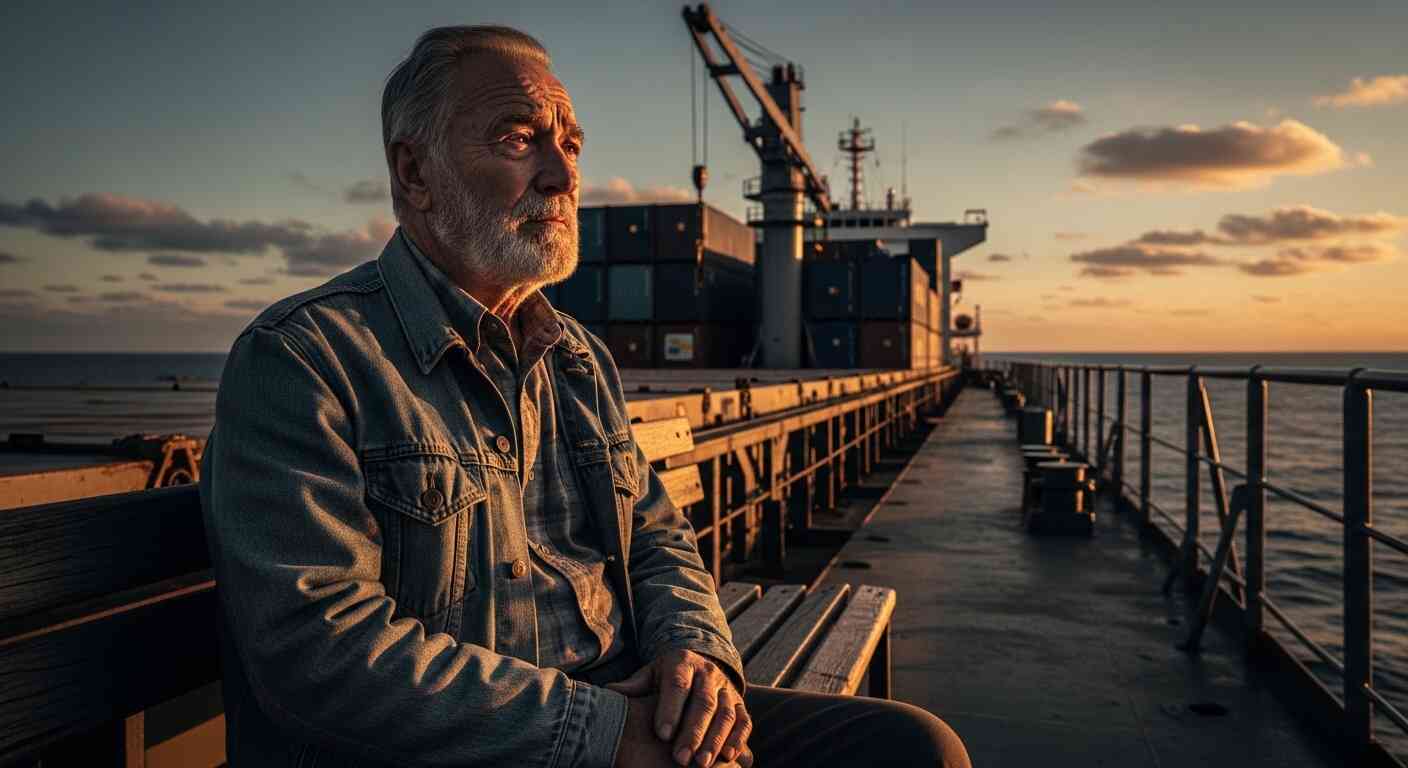
Julian Vane thought he was untouchable. As the heir to the Vane Shipping Empire, he treated the crew of the SS Sovereign like disposable parts in a machine.
But he made one fatal mistake. He chose to humiliate the quietest man on the ship.
Silas Thorne didn’t look like a hero. He looked like a man the world had chewed up and spat out—scarred, silent, and covered in the grease of the engine room.
When Julian forced him into the path of the ship’s deadly exhaust, he thought he was teaching a “dinosaur” a lesson about the new world.
He didn’t realize he was looking at a ghost. A man whose face was cast in bronze in the center of the capital. A man who had seen more “progress” in the fires of war than Julian would ever see in a boardroom.
This is a story about the cost of honor, the rot of arrogance, and the moment a fallen legend finally decided to stop hiding.
FULL STORY
CHAPTER 1: THE WEIGHT OF ASH
The SS Sovereign was a marvel of the modern age, a floating palace of chrome and glass that sliced through the Atlantic like a diamond through silk. But deep in its belly, where the air was thick enough to chew, the “old world” still lived.
Silas Thorne wiped a bead of sweat from his brow, leaving a smear of black oil across a forehead already mapped with scars. He was sixty, but his hands moved with the precision of a watchmaker as he tightened a vibrating valve.
To the rest of the crew, Silas was “The Ghost.” He spoke only when necessary, ate alone in the corner of the mess hall, and never complained about the grueling eighteen-hour shifts. He was the man you sent when the modern sensors failed and you needed someone who could “feel” the heat of the steel.
“Hey, Ghost! You’re wanted on the Observation Deck,” a young deckhand shouted, his voice cracking with nerves.
Silas didn’t look up. “I’m busy with the primary cooling line.”
“It’s Julian Vane,” the kid whispered, leaning in. “He’s… he’s in one of his moods. He’s with the Senator. He wants the ‘engine room rat’ to explain why the vibration is ruining his champagne toast.”
Silas felt a familiar tightness in his chest—not the physical pain of his old wounds, but the crushing weight of a life he had tried to bury. He didn’t want to go. He had spent ten years staying away from people like Julian Vane.
But Silas knew that if he didn’t go, the young deckhand would be the one to pay.
He grabbed a rag, gave his hands a cursory wipe that did nothing to remove the deep-seated grime, and began the long climb from the darkness of the hull to the blinding light of the upper deck.
The transition was jarring. From the smell of ozone and hot metal to the scent of expensive perfume and sea salt.
Julian Vane stood at the railing, surrounded by a gaggle of sycophants. He was thirty, dressed in a linen suit that cost more than Silas made in a year, holding a glass of vintage bubbly. Beside him stood Senator Evelyn Reed, a woman whose face Silas recognized from a lifetime ago—a woman who had once pinned a medal on his chest when his name still meant something.
“There he is!” Julian barked, his voice dripping with performative disdain. “The man responsible for the rattling in my floorboards. Tell me, old man, do you ever actually clean anything down there, or do you just enjoy living in the filth?”
Silas stood tall, despite the ache in his knees. He kept his eyes lowered, hooded by the grime on his lashes. “The vibration is a harmonic resonance from the new turbine blades, Mr. Vane. It’s a sign the engines are working at peak efficiency.”
Julian laughed, a sharp, ugly sound. “Efficiency? It’s annoying. And look at you. You’re a walking biohazard. You’re staining my deck just by standing there.”
He stepped closer, his expensive shoes clicking on the polished wood. The Senator looked away, a flicker of discomfort on her face, but she didn’t stop him. No one ever stopped the man who signed the checks.
“You know what’s wrong with your generation?” Julian sneered, circling Silas like a shark. “You think struggle is a virtue. You think being covered in dirt makes you a man. But the world has moved on. We don’t need ‘grit’ anymore. We need compliance.”
He pointed toward the massive, steaming exhaust vents near the rear of the deck, where the primary engines were purging the startup buildup—a thick, black cloud of concentrated soot and carbon.
“Go stand over there,” Julian ordered.
The deck went silent. Even the wind seemed to die down.
“Mr. Vane?” Silas asked quietly.
“You heard me. You love the engines so much? Go get a taste of them. Stand in the vent path. Let’s see how much ‘grit’ you really have when you’re breathing what you produce.”
Silas looked at the vent. The heat alone could blister skin. The soot would fill a man’s lungs like liquid lead.
“Julian, that’s enough,” the Senator said weakly.
“It’s an inspection, Senator,” Julian snapped. “I want to see if my equipment is as ‘clean’ as the brochure says. Go on, Ghost. Move.”
Silas didn’t move because he was afraid. He moved because, for a fleeting second, he wanted to see if he could still endure it. He wanted to know if the man he used to be—the man who walked through fire for his country—was still alive under the grease.
He stepped into the path of the vent.
The first blast hit him like a physical blow. The air turned black. It was a searing, choking cloud of oily residue. Silas closed his eyes, but the soot found his nose, his mouth, his pores.
He didn’t move. He stood like a statue as the black blizzard swallowed him.
Inside the cloud, Silas didn’t see the ship. He saw the ruins of Fallujah. He saw the burning oil fields of Kuwait. He felt the phantom pain of the shrapnel that had rewritten the bones of his face.
He began to cough—a deep, racking sound that tore at his throat. He felt the metallic tang of blood hitting his tongue.
“Breathe it in, old man,” Julian’s voice drifted through the black haze, laughing. “It’s the smell of progress, something you’ll never understand.”
PART 2: THE GHOST AND THE MACHINE
CHAPTER 1: THE WEIGHT OF ASH (RECAP)
(Content as provided above, established as the opening chapter of the full narrative.)
CHAPTER 2: THE ECHOES OF THE FALLEN
Silas Thorne stumbled out of the soot cloud, his lungs screaming. He fell to one knee, a hand pressed against the white-painted bulkhead, leaving a jagged, black smear. He coughed violently, a mixture of thick carbon and bright red blood splashing onto the deck.
Julian Vane laughed, a high-pitched, manic sound that seemed to vibrate in the silence of the horrified onlookers.
“Look at him!” Julian shouted, gesturing with his champagne glass. “The ‘Ghost’ is bleeding. I guess even shadows have a breaking point.”
Senator Evelyn Reed stepped forward, her face pale. “Julian, stop this. He needs a medic.”
“He needs to learn his place,” Julian retorted, his eyes bright with a cruel, unchecked power. He looked down at Silas, who was still kneeling, his head bowed. “You see, old man? This is the future. We don’t need your ‘honor’ or your ‘sacrifice.’ We need results. We need the machine to run, and if you can’t handle the smoke, you’re just another piece of scrap metal.”
Silas didn’t answer immediately. He was focused on his breathing, forcing the shallow, tattered air back into his lungs. The pain was an old friend. He had lived with it since the day the transport helicopter went down in the mountains of the Hindu Kush—the day the world decided General Silas Thorne was dead.
He remembered the fire. The way the sky had turned the same oily black as the soot currently coating his skin. He remembered pulling three of his men from the wreckage, their screams silenced only by the roar of the flames. He remembered the reconstructive surgeons in the hidden military hospital, the titanium plates they’d slid under his skin, the way they’d rebuilt his jaw and brow until he didn’t recognize the man in the mirror.
He had chosen the disappearance. He had seen enough “progress” in the form of drone strikes and scorched earth. He wanted the silence of the engine room. He wanted to be a ghost.
But the ghost was tired of being haunted.
Slowly, Silas stood up. His movements were fluid, devoid of the “old man” shakiness he’d been faking for years. The deckhand, Macy, a nineteen-year-old girl who usually brought him coffee, watched from the shadows of the doorway, her eyes wide with terror and something else—hope.
“You okay, Silas?” she whispered.
Silas didn’t look at her. He looked at Julian.
The soot was thick on his face, a mask of industrial waste. Only his eyes were clear—sharp, piercing blue eyes that had once commanded divisions.
“You speak of progress, Mr. Vane,” Silas said, his voice raspy but steady. The cough had subsided, replaced by a cold, hard clarity. “But you don’t know the price of the air you breathe. You think this ship stays afloat because of your spreadsheets? It stays afloat because men like me are willing to burn so you don’t have to.”
Julian sneered, though a flicker of uncertainty crossed his face. Silas was standing differently now. The “slouch” was gone. “Big words for a janitor. You’re lucky I don’t throw you overboard right now for talking back.”
“You could try,” Silas said softly.
The Senator moved closer, squinting through the sunlight at the man covered in ash. There was something in the cadence of his voice—a rhythm she hadn’t heard in over a decade. A rhythm she associated with war rooms and victory parades.
“Wait,” she breathed. “Your voice…”
“Don’t bother, Evelyn,” Julian snapped. “He’s just a bitter old relic. Get back to work, Ghost. And clean up this blood. It’s unsightly.”
Julian turned his back, a gesture of ultimate dismissal. It was the mistake of a man who had never faced a real predator.
Silas reached into his pocket and pulled out a simple, grease-stained rag. He didn’t head back to the engine room. Instead, he took a step toward the center of the deck, toward the light.
“I’ve breathed the smoke of burning cities to save the future,” Silas said, his voice growing in volume, echoing off the glass walls of the observation deck. “Your ‘progress’ smells like rot.”
Julian froze. He turned back, his face twisting into a mask of rage. “What did you say to me?”
But Silas wasn’t looking at Julian anymore. He was looking at Senator Reed. He began to wipe.
PART 3: THE UNMASKING
CHAPTER 3: THE GALA OF ROT
The tension on the SS Sovereign had been building long before the soot incident. For the three days of the maiden voyage, Julian Vane had used the ship as his personal kingdom, treating the elite passengers like subjects and the crew like serfs.
Earlier that evening, there had been a gala. The rich and powerful gathered in the grand ballroom, sipping champagne while a string quartet played Vivaldi. Silas had been tasked with checking the emergency fire suppression system behind the velvet curtains.
He had watched them through a gap in the fabric. He saw Julian mocking an elderly waiter who had spilled a drop of wine. He saw the way the Senator laughed at Julian’s jokes, even though her eyes were filled with a weary, pragmatic sadness.
“They don’t see us, Silas,” Macy had said, appearing beside him with a tray of empty glasses. Her family had lost everything in the 2024 crash, and this job was her only way to send money home. “We’re just the background noise to their lives.”
“Being invisible is a choice, Macy,” Silas had told her. “Sometimes it’s the only way to stay safe.”
“But is it living?” she asked.
That question had haunted Silas all night. He had survived the crash that killed his team. He had survived the surgeries. He had survived the transition to a world that didn’t want warriors anymore. But he hadn’t been living. He had been waiting to die.
Now, on the deck, covered in soot, Silas realized that by staying silent, he was letting the “rot” win. Julian Vane was the embodiment of everything Silas had fought against—the arrogance that valued profit over people, the cruelty that mistook power for greatness.
Julian stepped toward Silas, his fist clenched. “I asked you a question, you piece of trash. Do you have any idea who I am? Do you have any idea what I can do to you?”
“I know exactly who you are, Julian,” Silas said. He began to wipe the soot from his forehead. “You’re a boy who inherited a mountain and thinks he climbed it.”
The crowd gasped. Julian’s face went from red to a dangerous, mottled purple. He lunged forward, grabbing Silas by the collar of his grease-stained coveralls.
“You’re finished,” Julian hissed. “I’ll make sure you never work again. I’ll make sure you’re starving in a gutter by the time we dock.”
Silas didn’t flinch. He didn’t even raise his hands to defend himself. He just continued to wipe his face with the rag.
CHAPTER 4: THE SMELL OF PROGRESS
The confrontation on the deck reached its breaking point. Julian was shaking with fury, his grip tightening on Silas’s collar. The soot was still thick, but as Silas wiped, the heavy, dark grease began to give way to something else.
He wiped his right cheek, revealing a jagged, silver scar that ran from his temple to his jawline.
He wiped his brow, revealing the distinct, square set of a forehead that had been reconstructed with titanium.
The Senator took a sharp breath, her hand flying to her mouth. She stepped forward, ignoring Julian’s outburst. “No… it can’t be.”
Julian was too blinded by his own ego to notice. He shoved Silas back toward the exhaust vent.
“You want to talk about burning cities?” Julian mocked, his voice echoing across the deck. “You want to talk about the past? The past is dead, just like your pathetic career. This ship is the future. This exhaust is the smell of a world that doesn’t need you.”
He shoved Silas again, forcing him back into the lingering trail of black smoke.
“Breathe it in, old man,” Julian snarled, leaning into Silas’s face. “It’s the smell of progress, something you’ll never understand.”
Silas looked Julian directly in the eye. The fear that Julian expected to see wasn’t there. Instead, there was a cold, terrifying pity.
Silas reached up and calmly removed Julian’s hand from his collar. His grip was like iron—the grip of a man who had climbed mountains with a broken back. Julian tried to pull away, but he couldn’t move.
“I’ve breathed the smoke of burning cities to save the future,” Silas said, his voice now a low, thunderous growl that silenced the wind. “Your ‘progress’ smells like rot.”
Silas took the rag and, with one final, firm motion, wiped the remaining soot from the center of his face.
The sun hit him directly. The reconstructed features—the specific, iconic geometry of his face—became unmistakable.
In the center of the capital, three hundred miles away, stood a bronze statue of a man in full dress uniform. A man who had led the surge in the Great Conflict. A man who had been declared a national hero after his “death” in the line of duty.
General Silas Thorne.
PART 4: THE RECKONING
CHAPTER 5: THE STATUE IN THE SQUARE
The silence that followed was absolute. It was the kind of silence that exists in the heart of a hurricane.
Julian Vane stared at the man in front of him. He looked at the scars. He looked at the eyes. Then, he looked at Senator Reed, whose knees had literally given out. She was gripping the railing for support, tears streaming down her face.
“General?” she whispered. “Silas? We… we buried you. We had a state funeral. The President gave the eulogy.”
The passengers began to murmur. One man, a retired Colonel who had been watching from the back, suddenly snapped to attention, his hand flying to his brow in a crisp, instinctive salute.
Julian’s hand, which had been poised to strike Silas again, began to tremble. He looked from Silas to the Senator, then back to Silas.
“This… this is a trick,” Julian stammered, though his voice had lost its edge. “A costume. Some kind of engine room prank.”
“It’s no prank, Julian,” Senator Reed said, her voice shaking with a mixture of awe and terror. “I was on the committee that approved the facial reconstruction plans after the crash. They said it was too extensive… they said he’d never look the same. But I’d know those eyes anywhere.”
She turned to the crowd. “This is General Silas Thorne. The Lion of the Levant.”
Julian’s face went bone-white. The realization hit him like a physical weight. He looked at the soot on his own hands—the soot he had forced a national legend to breathe for sport.
He looked at the blood on the deck.
He looked at Silas, who was standing perfectly still, the wind whipping his gray hair. Silas didn’t look like a General in that moment. He looked like a judge.
Julian’s knees buckled. He didn’t just fall; he collapsed, his expensive suit hitting the dirty deck. He recognized the face now. He had seen it every day of his life on the news, in history books, and in the center of the capital square where his own father’s company was headquartered.
He was standing under the shadow of the man he had just tried to break.
“I… I didn’t know,” Julian wheezed, his arrogance evaporating into pure, unadulterated fear. “General, please… I was just… I was trying to—”
“You were being yourself, Julian,” Silas said quietly. He looked down at the broken man at his feet. “And that is the most damning thing of all.”
CHAPTER 6: THE FINAL SALUTE
The aftermath was swift. By the time the SS Sovereign reached the harbor, the news had already broken. A “Ghost” had returned from the dead.
The pier was lined with thousands of people. Not for the ship, and not for Julian Vane. They were there for the man who had been a symbol of sacrifice for a generation.
Julian Vane was escorted off the ship in handcuffs, not for the bullying, but for the safety violations and the physical assault of a decorated officer—charges the Senator personally ensured were filed. The Vane Shipping Empire’s stock plummeted before the sun set.
Silas Thorne stood at the gangplank, dressed in a simple, clean set of borrowed clothes. Macy stood beside him, clutching a backpack.
“Where will you go, General?” she asked.
Silas looked out at the statue in the distance, barely visible against the city skyline. He looked at the crowds, the cameras, and the noise.
“I’m not a General anymore, Macy,” he said. “I’m just a man who knows how to fix things.”
He turned to Senator Reed, who was waiting for him at the bottom of the ramp.
“Evelyn,” he said.
“Silas. The world wants to give you everything back. The rank, the medals, the life.”
Silas shook his head. He looked back at the ship—at the dark, soot-stained hull where he had found a strange kind of peace.
“The world doesn’t need me on a pedestal, Evelyn. It needs people who remember what the ‘smell of progress’ actually costs.”
He stepped off the ship, not toward the microphones, but toward the side streets, disappearing into the crowd one last time. But he didn’t slouch. He walked with his head high, a man no longer hiding from his scars, but wearing them like the armor they had always been.
The final sentence of the official report on the Sovereign incident didn’t mention the engines or the stock prices. It simply noted:
“The soot was washed away, but the truth remained: some men are made of glass, and some are made of the fire that forged them.”