
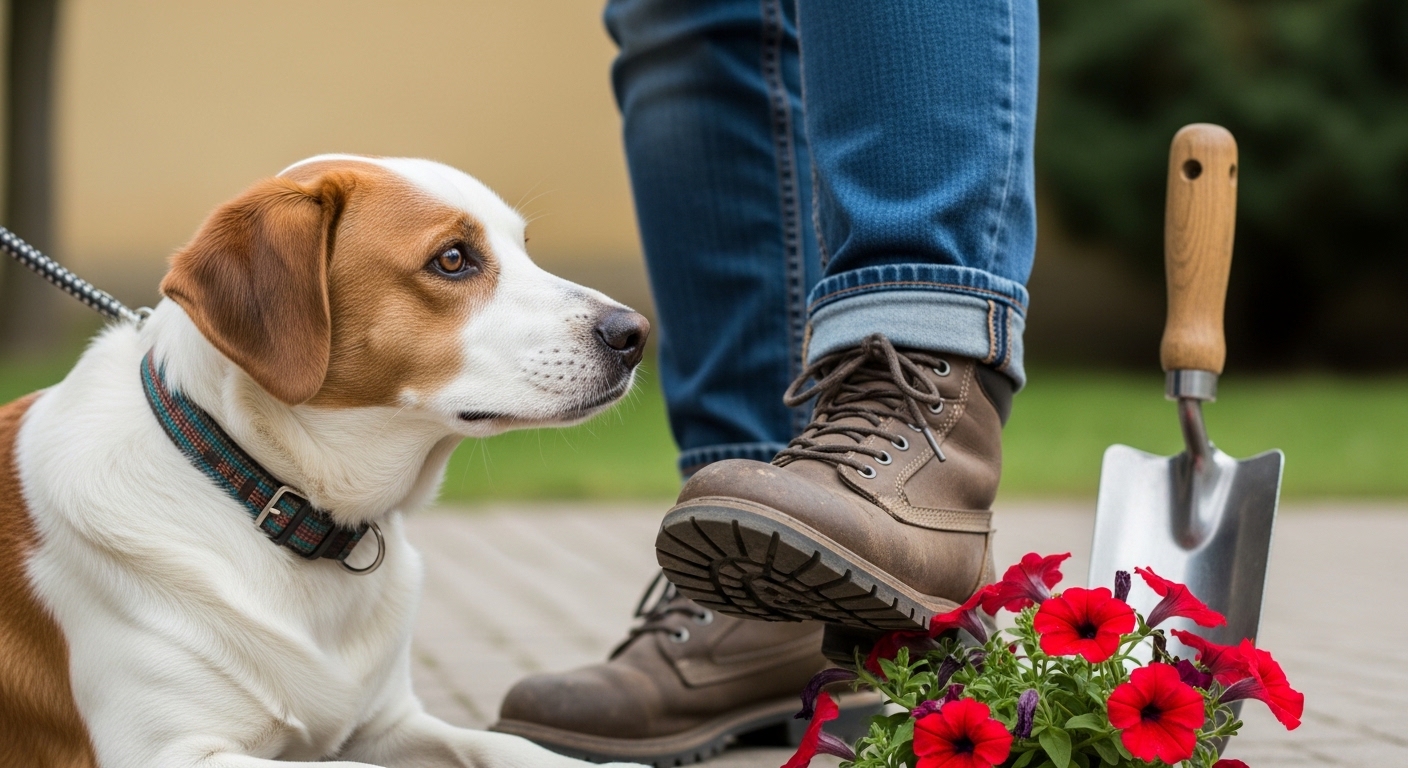
My neighbor tried to end me over a six-inch fence line, but my dog took the hit meant for my chest—and what happened in the aftermath revealed a secret this neighborhood has been hiding for thirty years.
There is a specific sound that a shovel makes when it hits bone. It’s a hollow, wet thwack that stays in your nightmares long after the bruises fade.
I moved to Oak Ridge for the quiet. I wanted the American Dream: a small house, a patch of grass, and a dog who liked to chase tennis balls until the sun went down. I didn’t know that my dream was built on a property line that had been a battlefield since before I was born.
Hank lived next door. He was the kind of man who measured his grass with a ruler and viewed a stray leaf as a personal insult. We’d been arguing about the fence for six months—a six-inch strip of dirt that he claimed was his “sovereign territory.”
I thought it was just the grumbling of a lonely old man. I didn’t think it would turn into a murder attempt.
When Hank raised that shovel, his eyes were gone. He wasn’t my neighbor anymore; he was a cornered animal. He swung with everything he had, aiming right for my head.
I closed my eyes and waited for the dark.
But the hit never came. Jax did.
My 75-pound Golden mix, the dog who usually hides under the bed during thunderstorms, launched himself into the path of that steel blade. He took the blow that was meant for me, his shoulder shattering under the impact.
Even as he fell, even as his bone broke, Jax didn’t run. He stood his ground, his body a broken shield between me and a man who had lost his mind.
This isn’t just a story about a fence. It’s a story about the secret Hank was trying to bury under that dirt—and the dog who refused to let me die for it.
Chapter 1: The Property Line
The suburbs are a lie. We tell ourselves they are safe harbors, places where the biggest threat is a late trash pickup or a stray dandelion. But beneath the emerald lawns of Oak Ridge, there are tectonic plates of resentment that have been shifting for decades.
My name is Caleb. Three years ago, I bought the little blue house on Willow Lane. I was a widower at twenty-nine, looking for a place where the air didn’t smell like the hospital hallway where I’d said goodbye to my wife, Elena. I brought two things with me: a box of her old journals and Jax, a shaggy Golden Retriever mix we’d rescued from a shelter on our second anniversary.
Elena used to say Jax was “too good for this world.” He was the kind of dog who would apologize to a squirrel for scaring it. He was a gentle soul, a fluff-ball of pure, unadulterated empathy.
Then there was Hank.
Hank Miller had lived at the house next door for forty years. He was a man who looked like he’d been carved out of a piece of dry hickory—hard, knotted, and prone to splintering. He was a retired actuary, a man who believed the world could be solved with a spreadsheet and a very sharp line.
The dispute started over six inches.
“You’re over the line, Caleb,” Hank had said the week I moved in, pointing a trembling finger at the edge of my driveway. “The previous owners knew it. I expect you to respect the boundary.”
I tried to be the “good neighbor.” I offered to have a surveyor out. I offered him a beer. I offered to move the flower pots Elena had loved so much. But for Hank, the fence wasn’t about the dirt. It was about control. It was about the fact that the world was changing, his wife was gone, his kids didn’t call, and the only thing he could still dominate was the six inches of sod between our houses.
The tension escalated through the summer. First, it was the “illegal” height of my grass. Then, it was the “nuisance” of Jax’s occasional bark. Hank started filming me when I took the trash out. He’d stand on his porch, a silent, bitter sentry with a Nikon camera, waiting for me to slip up.
The breaking point came on a Tuesday in July. The Georgia heat was a heavy, wet blanket, the kind of weather that makes people’s fuses short.
I was in the backyard, trying to fix a leaning fence post—the very post that sat on the disputed line. I had a hammer and a level. Jax was lying in a patch of shade, his tongue lolling out, watching me with his usual goofy grin.
Hank marched across the lawn. He wasn’t carrying a camera this time. He was carrying a heavy-duty garden shovel, the steel blade glinting in the midday sun. His face was a terrifying shade of plum.
“I told you!” Hank roared, his voice cracking. “I told you not to touch that post! That’s my property! You’re trespassing, you little punk!”
“Hank, take it easy,” I said, holding up my hands. “The post is rotting. It’s going to fall into your yard. I’m just trying to help.”
“You’re trying to steal!” Hank was screaming now, a sound that brought Mrs. Henderson to her window across the street. “You think because you’re young and you’ve got that stupid dog, you can do whatever you want? Not today!”
He raised the shovel.
It happened in slow motion. I saw the muscles in his forearms rope. I saw the determination in his eyes—a man who had finally found a target for forty years of accumulated disappointment. He swung the shovel like a baseball bat, aiming straight for my ribs.
I didn’t have time to dodge. I didn’t have time to think.
But Jax did.
The dog who hid from thunder launched himself from the shade. He was a golden blur of instinct and love. He didn’t growl; he didn’t bark. He simply threw his body into the path of the steel.
The thwack was visceral. It was the sound of metal meeting living tissue and bone.
Jax hit the ground with a sharp, agonizing yelp that I will never forget. The shovel had caught him squarely on the shoulder. He tumbled into the dirt, his front leg splaying at an unnatural angle.
“Jax!” I screamed, dropping to my knees.
Hank stood over us, the shovel still clutched in his hands. He looked down at the dog, his chest heaving. For a second, I thought he was going to swing again. I shielded Jax with my own body, waiting for the impact.
But Jax did something that silenced the entire block.
Despite the shattered bone, despite the agony that must have been radiating through his body, the dog dragged himself back to his feet. He stood on three legs, his weight shifting, his body trembling with the effort. He positioned himself directly between me and Hank. He didn’t bite, but he let out a low, guttural rumble—a warning that came from the very pit of his soul.
You will not touch him again.
Hank looked at the dog. He looked at the blood beginning to stain the golden fur. His hands began to shake. The shovel slipped from his grip, hitting the grass with a dull thud.
“I… I just wanted…” Hank started, but his voice failed him. He looked at his hands as if they belonged to a stranger.
Jax didn’t move. He stood there, a broken, golden sentinel, refusing to let the threat back into our space. It was the bravest thing I’d ever seen. And it was the moment I realized that Hank Miller wasn’t just a mean neighbor. He was a man who had just tried to kill the only thing I had left in this world.
Chapter 2: The Weight of Silence
The emergency vet clinic in Oak Ridge smelled like antiseptic and expensive despair. It was a place where people sat in plastic chairs, clutching leashes and carriers, all of us united by the same frantic, unspoken prayer: Not today. Please, not today.
I sat in the corner, my hands stained with Jax’s blood. The receptionist, a kind-looking woman named Sarah, had given me a cup of lukewarm coffee that I hadn’t touched.
“Mr. Hayes?”
A woman in green scrubs walked into the waiting room. She was Dr. Aris, a vet with eyes that had seen too much but hadn’t lost their light. She looked at me with a mixture of pity and professional detachment.
“How is he?” I asked, my voice cracking.
“He’s in a lot of pain, Caleb,” Dr. Aris said, sitting in the chair next to me. “The shovel shattered the scapula. It’s a clean break, but there’s a lot of splintering. We’re going to have to go in and use pins to stabilize the bone.”
“Will he walk again?”
“He’s a Golden mix. They’re made of heart and stubbornness,” she said with a small, sad smile. “He’ll walk. But he’ll have a limp for the rest of his life. And the emotional trauma… Caleb, what happened out there? The police are asking questions.”
I looked at my hands. “My neighbor snap-shotted. He went for me, and Jax… Jax didn’t let him.”
As if on cue, Officer Miller—a man who had been the town’s primary peacekeeper for twenty years—walked into the clinic. He looked weary, his holster creaking as he sat down across from me.
“Caleb,” Miller said. “I just came from Hank’s house.”
“Is he in jail?” I asked, a surge of cold anger hitting me.
Miller sighed, taking off his hat and rubbing his bald head. “He’s in the hospital. He had a panic attack after he dropped the shovel. He’s sixty-eight, Caleb. His blood pressure went through the roof.”
“I don’t care about his blood pressure,” I snapped. “He tried to kill me. He broke my dog.”
“I know,” Miller said quietly. “But here’s the thing. Hank’s daughter, Elena—not your Elena, but his—called me. She says her dad hasn’t been right since his wife passed last year. She says he’s been obsessed with that property line because it was the only thing his wife ever cared about. She’d planted a row of prize-winning roses right along that strip thirty years ago. When you moved the post, Hank didn’t see a neighbor fixing a fence. He saw a stranger digging up his wife’s ghost.”
The anger in my chest didn’t vanish, but it shifted. It became something heavier. Pity.
“That doesn’t give him the right to swing a shovel,” I said.
“No, it doesn’t,” Miller agreed. “And he’s going to face charges. Aggravated assault. But there’s a problem, Caleb. Hank’s lawyer is already making noise. They’re claiming Jax lunged first. They’re trying to label the dog as a ‘dangerous animal’ to justify Hank’s reaction.”
I stood up, the chair scraping loudly against the tile. “Jax has never bitten a soul in his life! He was protecting me!”
“I believe you,” Miller said. “But in a small town like this, where Hank’s family has roots and you’re the ‘new guy’ from the city… it’s going to be an uphill battle. You need to be careful, Caleb. People are already taking sides.”
I walked to the back of the clinic, where Jax was being kept in a recovery kennel. He was heavily sedated, his shoulder wrapped in a massive white cast. He looked so small under the fluorescent lights.
I sat on the floor next to the bars and reached in, resting my hand on his head. His tail gave a single, weak thump against the metal.
“You did good, boy,” I whispered.
I realized then that the fence wasn’t the problem. The problem was the secrets we bury in the dirt. Hank was trying to bury his grief in a six-inch strip of land, and I was trying to bury mine in a quiet suburb where I didn’t have to be Caleb-the-widow anymore.
But Jax had broken the silence. And now, the whole town was going to find out what was really buried under Willow Lane.
Chapter 3: Old Wounds
The first week of Jax’s recovery was a blur of painkillers and physical therapy. I’d turned my living room into a padded sanctuary, lining the floor with yoga mats so he wouldn’t slip. He walked with a hitch now, his shoulder clicking with every step—a rhythmic reminder of the day the shovel fell.
The neighborhood had changed. It was no longer the friendly, waving suburb I’d moved into. It was a camp divided.
On one side were the “Traditionals”—the people who had known Hank for forty years. They saw him as a grieving old man who had finally snapped under the pressure of a “disrespectful” outsider. I’d find my trash cans overturned in the morning. I’d see Mrs. Henderson turn her back when I walked by.
On the other side were the “Newcomers”—the younger families who were horrified by the violence. They brought over casseroles and bags of high-end dog food. Sarah, the vet tech, became a regular visitor, helping me with Jax’s exercises.
“You can’t let them win, Caleb,” Sarah said one evening, as we watched Jax try to navigate the three steps to the porch. “Hank’s lawyer is pushy. They’ve already filed a petition with the city to have Jax ‘evaluated.’”
“Evaluated? He’s a Golden Retriever, Sarah. His biggest vice is stealing socks.”
“It doesn’t matter,” she said, her eyes dark with concern. “If the city labels him dangerous, they can force you to muzzle him, or worse… they can order him to be removed from the property. And if he’s removed, Hank wins the fence. That’s the goal. They want you gone, Caleb. They want the ‘trouble’ to leave so they can go back to pretending Oak Ridge is perfect.”
That night, I couldn’t sleep. I sat in the dark, Jax’s heavy head resting on my knee. I pulled out Elena’s journals. I’d been avoiding them for months, but I needed to feel her close.
I flipped to an entry from five years ago, back when we were first looking for a house.
“Caleb wants a yard for a dog,” she’d written. “But I want a place with a history. I want a house that has seen people grow and change. I don’t want a new build. I want a house that has a secret garden.”
A secret garden.
I looked out the window at the disputed property line. In the moonlight, I could see the row of dead, grey stubs where Hank’s wife’s roses used to be. Hank had let them die after she passed. He’d let everything die.
I realized then that I had to do something I’d been terrified of. I had to talk to Hank. Not as a victim, and not as an enemy. But as a man who knew what it was like to lose the only thing that made the world make sense.
The next morning, I walked across the lawn. I didn’t take Jax; he was resting inside. I walked right up to Hank’s porch and knocked.
The door opened slowly. Hank looked terrible. He’d lost weight, his skin hanging off his bones like wet parchment. He wasn’t carrying a shovel. He was carrying a small, framed photo of a woman with bright red hair and a laugh that seemed to jump off the paper.
“What do you want?” he rasped.
“I want to talk about the roses, Hank,” I said.
He froze. His eyes narrowed, a flash of the old bitterness returning. “You don’t know anything about those roses.”
“I know they’re why you hit my dog,” I said, my voice steady. “And I know that Elena—my Elena—would have loved them. I think we’ve both been fighting the wrong war, Hank.”
He stared at me for a long time. Then, he stepped back and opened the door. “Come in, Caleb. But don’t expect an apology. I’m too old to change the way I feel about my land.”
The inside of the house was a time capsule of the 1980s. Dust motes danced in the stale air. On the mantle, there were dozens of photos of the red-haired woman.
“Her name was Rose,” Hank said, sitting in a recliner that looked like it had seen a thousand nights of lonely television. “Fitting, right? She spent every waking hour in that dirt. She said that six-inch strip was the best soil in the county. She told me if I ever lost her, to look at the roses, and I’d see her face.”
He looked at his hands. “When you moved that post… I felt like you were digging her up. I felt like I was losing her all over again.”
“Jax saved me, Hank,” I said. “And in a way, he saved you too. If you’d hit me… you wouldn’t be sitting in this chair. You’d be in a cell. Jax took that hit for both of us.”
Hank looked at me, a single, jagged tear tracking through the wrinkles on his cheek. “I never meant to hurt a dog, Caleb. I just… I didn’t know how to stop the world from moving.”
We sat in silence for a long time. The “bully” was gone, replaced by a man who was simply drowning in his own history. But as I prepared to leave, Hank said something that made the hair on the back of my neck stand up.
“The fence, Caleb… the one my father built thirty years ago… it wasn’t just to keep people out. It was to hide what he found when he was digging the foundation. If you want to know why this neighborhood is so quiet, you should look at the survey from 1994. The one they never filed.”
I walked back to my house, the journals clutched to my chest. The secret wasn’t the dirt. It was what was under it. And Jax, the dog who took a shovel for me, was about to lead me to the truth that would either save us both—or burn Oak Ridge to the ground.
Chapter 4: The Legal Maze
The “Dangerous Dog” hearing was set for a Friday in August. The local courthouse was a small, brick building that felt like a pressure cooker.
Hank’s lawyer, a man named Sterling who wore a suit that cost more than my car, was a master of the “victim” narrative. He’d brought photos of Hank in his hospital bed. He’d brought character witnesses who talked about Hank’s “years of service” to the community.
“Your Honor,” Sterling said, pacing in front of the judge. “We are not here to litigate a property dispute. We are here because a young man from the city brought a large, aggressive animal into a quiet neighborhood. My client, an elderly man, felt his life was in danger. He acted in self-defense. The dog intercepted the blow because it was already mid-lunge.”
I felt Jax’s weight against my leg. He was sitting calmly under the table, his cast signed by the neighborhood kids with “Get Well” messages and drawings of bones.
“My dog didn’t lunge,” I said, standing up. My lawyer, a young public defender named Marcus, pulled me back down.
“Evidence, Caleb,” Marcus whispered. “We need evidence.”
I reached into my bag and pulled out the 1994 survey I’d found in the county records office the day before. I also pulled out an old, yellowed newspaper clipping from the same year.
“Your Honor,” Marcus said, stepping forward. “We have reason to believe this entire dispute was orchestrated to prevent Mr. Hayes from discovering a massive environmental violation on the property line.”
The judge, a no-nonsense woman named Gable, leaned forward. “Explain.”
“In 1994,” Marcus continued, “Hank Miller’s father was the head of the local utility board. During the construction of this block, they discovered a major leak in the underground chemical storage tanks from the old dry cleaner that used to sit on this site. Instead of reporting it and losing millions in property value, they buried the tanks—right along the property line between what is now Caleb’s and Hank’s houses.”
A gasp went through the courtroom. Mrs. Henderson, sitting in the front row, turned pale.
“The fence,” Marcus said, “was built specifically to prevent anyone from digging deep enough to find the corroded tanks. Hank wasn’t protecting his wife’s roses, Your Honor. He was protecting a secret that would make every house on Willow Lane worthless if it ever came to light. He swung that shovel because he was terrified Caleb would find the ‘soft’ earth where the tanks are buried.”
Hank, sitting at the defense table, buried his face in his hands. He wasn’t acting anymore. He was a man whose world had finally collapsed.
“The dog,” Marcus said, his voice dropping into a low, resonant tone, “did not lunge. He intervened. He prevented a man from committing a murder to hide a thirty-year-old lie. Jax is not a danger to this community. He is the only thing in it that’s honest.”
The judge looked at the survey, then at the newspaper clipping. She looked at Jax, who let out a long, contented sigh and rested his chin on my foot.
“The petition is dismissed,” Judge Gable said, her gavel hitting the block with a final, satisfying thud. “And I am ordering an immediate environmental inspection of Willow Lane. Mr. Miller, you will remain in custody pending a full investigation into the 1994 concealment.”
As we walked out of the courtroom, the “Traditionals” were silent. They looked at me, then at the dog, and for the first time, they didn’t see an outsider. They saw a man who had just saved their lives from a toxic secret.
But the climax wasn’t over. As we reached the parking lot, I saw Hank’s daughter, Elena. She was standing by her car, her face a mask of grief and shame.
“Caleb,” she said, her voice shaking. “I’m so sorry. About everything.”
“It’s not your fault, Elena,” I said.
“He’s not a bad man,” she whispered. “He was just… he was so scared of being alone. He thought if he lost the house, he’d lose her forever.”
I looked at Jax. He walked over to Elena and nudged her hand with his nose. He didn’t know about lawsuits or chemical tanks. He only knew that she was hurting.
“We’re going to fix the dirt, Elena,” I said. “And then we’re going to plant new roses. For both of them.”
Chapter 5: The Climax
The inspection of Willow Lane turned the neighborhood into a construction zone. Men in hazmat suits crawled over the property line, and the “disputed six inches” was excavated into a gaping, muddy trench.
They found the tanks. They were rusted, leaking a slow, black sludge into the ground—a “silent killer” that had been poisoning the soil for decades.
The neighborhood was in shock. Houses were evacuated, and the “perfect” suburb was revealed to be a precarious facade.
But the real climax happened on a Friday evening, just as the sun was setting behind the oaks.
The construction crew had left for the weekend, leaving the trench open and guarded only by a thin orange fence. Hank had been released on bail, confined to his house under guard.
I was in my backyard, tossing a soft toy for Jax, who was finally out of his cast and walking with a proud, albeit irregular, gait.
Suddenly, I heard a scream. Not a scream of anger, but of pure, unadulterated terror.
It was coming from the trench.
I ran to the edge. Hank’s grandson, a five-year-old named Leo who had been visiting for the afternoon, had crawled under the orange fence and slipped into the muddy pit. He was sinking into the black sludge, his small hands clawing at the crumbling walls of the trench.
“Leo!” I yelled.
I tried to reach him, but the ground at the edge was unstable. If I stepped closer, I’d trigger a landslide that would bury the boy instantly.
Hank was at the edge of his porch, frozen. He couldn’t move, his body failing him in the moment he was needed most.
“Jax, go!” I commanded.
It was a risk. Jax’s shoulder was still tender, the bone still healing. But he didn’t hesitate.
The dog who had taken a shovel for me launched himself into the pit. He didn’t sink; he used his weight to spread himself across the “crust” of the mud. He reached the boy and grabbed the back of his jacket in his teeth.
“Hold on, Jax!” I shouted.
I grabbed a garden hose and tied it to the sturdy oak tree nearby, throwing the other end to the boy. “Leo, grab the hose! Jax, pull!”
It was a grueling, terrifying struggle. Jax’s front leg was trembling, his muscles roping with the effort. I could see the pain in his eyes—the same eyes that had watched the shovel fall. But he didn’t let go.
He hauled the boy through the sludge, inch by inch, until I could reach over the edge and pull Leo to safety.
Jax scrambled out behind him, his golden fur coated in black muck, his breathing a series of ragged, wet gasps.
Hank ran across the lawn, collapsing into the mud and pulling his grandson into his arms. He was sobbing, a raw, broken sound that echoed through the cul-de-sac.
“You saved him,” Hank whispered, looking at Jax. “After everything I did… he saved my boy.”
Jax walked over to Hank. He was limping heavily now, the effort having strained the pins in his shoulder. He didn’t growl. He didn’t bark. He simply sat down and leaned his weight against the old man’s chest.
In that moment, the sixty-year-old actuary and the three-year-old dog were the only thing that mattered. The shovel, the fence, the chemical tanks—they all vanished. There was only the weight of a life saved and the grace of a creature who didn’t know how to hold a grudge.
Chapter 6: Healing
The “Great Oak Ridge Cleanup” took a year. The soil was replaced, the tanks were removed, and the utility company was forced to pay out a settlement that ensured no one on Willow Lane would ever worry about their mortgage again.
Hank didn’t go to jail. Given his age and his cooperation in the investigation, he was sentenced to community service and a permanent restraining order regarding the property line—which he followed religiously.
But he didn’t stay a stranger.
On a warm Saturday in June, exactly a year after the shovel incident, the neighborhood gathered for a “Block Re-Opening.”
The fence was gone. In its place was a communal garden—a wide, blooming stretch of red and white roses that spanned both our yards.
I stood on my porch, a cold beer in my hand. My house wasn’t just a place of grief anymore. It was a place where people came to talk, to laugh, and to watch the dogs play.
Jax was the guest of honor. He walked with a permanent hitch, a “warrior’s limp” that he wore like a badge of honor. He was currently being fed pieces of grilled chicken by Leo, who followed the dog everywhere like a tiny shadow.
Hank walked up the porch steps. He was carrying a small, hand-carved wooden sign.
“I made this for you, Caleb,” he said, his voice steady. “Well, for him.”
He handed me the sign. It was beautiful, the wood polished to a high sheen. Inscribed on it were five words: JAX: THE GUARD OF THE HEART.
“Thank you, Hank,” I said.
We looked out at the garden. The property line was invisible, buried under the flowers and the laughter.
“You were right, Caleb,” Hank said. “The dirt doesn’t matter. It’s what you grow in it that counts.”
I looked at Jax. He was lying in the middle of the roses, his eyes closed, the sun warming his golden fur. He looked like a dog who had finally finished his shift.
I realized then that Elena would have loved this. She wouldn’t have cared about the survey or the legal fees. She would have loved the fact that her husband and her dog had turned a battlefield into a sanctuary.
Life is a series of property disputes—with our pasts, with our neighbors, and with ourselves. We spend so much time building fences to keep the pain out that we forget to leave room for the light to get in.
But sometimes, if we’re lucky, we have a broken, golden shield to show us where the line truly lies.
True strength isn’t found in the weapon you carry, but in the heart that is willing to break so that someone else can remain whole.


