
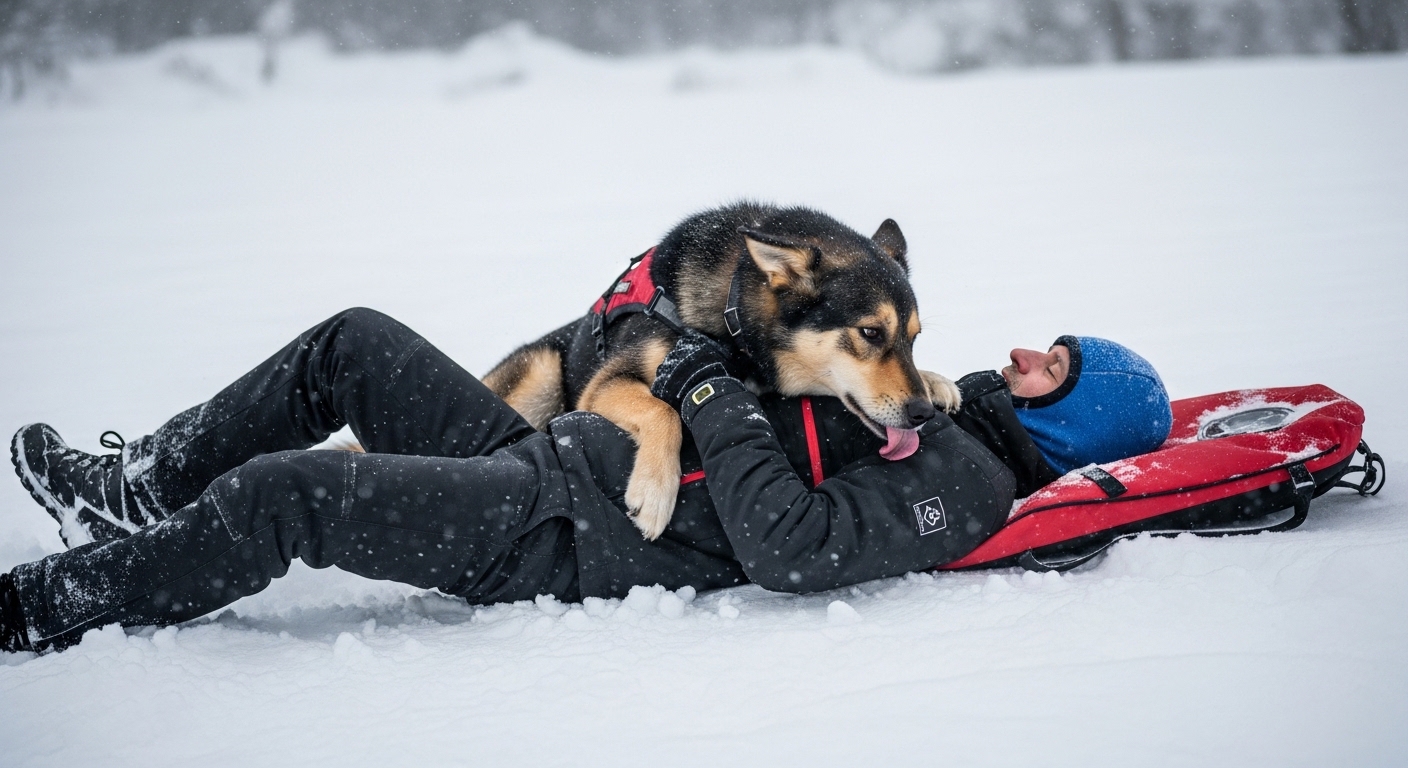
My husband called him a “useless mutt” and was driving him to the pound tomorrow, but when two men put a knife to my throat, that dog became the only thing that could save my life.
The sound of the blade clicking open was the last thing I thought I’d ever hear.
In our house, the silence had become a weapon. My husband, Mark, had spent the last six months complaining about Beau. “He’s too much, Elena,” he’d say, looking at the scuffs on the hardwood. “He’s a liability. He’s a broken dog from a broken home, and I want him out.”
The appointment was made for 8:00 AM. Mark was going to drive Beau to the county shelter—a place where “problem” dogs like him rarely get a second chance. I had spent the evening crying, hugging Beau’s neck while he looked at me with those deep, soulful eyes that seemed to understand every word of the ultimatum.
Then, the world broke.
The front door didn’t just open; it was kicked in. Two men, faces hidden behind masks, smelling of stale cigarettes and desperation. They didn’t want our jewelry. They wanted the safe.
When that cold steel pressed against my skin, and I saw my husband frozen in a corner, unable to even speak my name, I realized that the “order” Mark loved so much was useless.
But then, the glass shattered.
And the “useless mutt” showed us exactly why he was worth saving.
Chapter 1: The Ultimatum
The rain in Connecticut doesn’t just fall; it seeps into the marrow of your bones. It was a Tuesday, the kind of day that feels like a long, slow exhale. I was in the kitchen of our pristine, “Modern Farmhouse” in the suburbs of Greenwich, staring at a bowl of cold pasta.
Across from me, Mark was meticulously cleaning his glasses. Mark is a man of precision. He’s a hedge fund manager who views life as a series of balance sheets. If something doesn’t provide a return on investment, it’s a deficit.
And lately, that deficit was Beau.
“The decision is made, Elena,” Mark said, his voice as flat as the granite countertops. “I’ve called the shelter. They have a spot opening at eight tomorrow morning. It’s for the best. The dog is neurotic. He growls at the neighbors, he’s destroyed the rug in the foyer, and frankly, I don’t feel safe with him in the house.”
I looked over at the mudroom. Beau, a seventy-pound Belgian Malinois and German Shepherd mix, was lying on his bed. He wasn’t sleeping. He was watching us, his ears pricked, his head tilted. He was a rescue from a high-kill facility in Georgia, a dog that had clearly seen the worst of humanity before we found him.
“He’s not neurotic, Mark. He’s traumatized,” I whispered, my heart aching. “He just needs time. He was abused. He’s finally starting to trust me.”
“He trusts you,” Mark countered, sliding his glasses back onto his nose. “But he hates me. He looks at me like I’m the enemy every time I walk into the room. I’m done living in fear in my own home. He’s a useless mutt, and tomorrow, he’s gone.”
I wanted to scream. I wanted to tell Mark that maybe Beau didn’t trust him because Mark didn’t have a grain of empathy in his body. I wanted to tell him that Beau was the only thing in this house that actually looked at me when I spoke. But I stayed silent. In our marriage, silence was the only thing that didn’t start a fight.
Mark stood up, straightened his silk tie, and headed toward his home office. “Pack his things, Elena. I don’t want any delays in the morning.”
I walked over to the mudroom and sat on the floor next to Beau. I buried my face in his coarse, thick fur. He smelled like cedar and rain. He let out a long, shuddering sigh and rested his heavy head on my lap.
“I’m so sorry, Beau,” I sobbed into his neck. “I tried. I really tried.”
He licked my hand—a slow, deliberate gesture. He knew. Dogs always know when the air in a house turns sour. He knew he was being discarded again. He knew that the only person who loved him was too weak to stand up to the man who didn’t.
I fell asleep on the kitchen floor that night, leaning against the dishwasher, with my hand resting on Beau’s flank. I didn’t know it was the last night of the life I knew. I didn’t know that by sunrise, the “useless mutt” would be the only thing standing between me and a shallow grave in the woods.
Chapter 2: The Shadow in the Hallway
The clock on the microwave read 2:14 AM when the world ended.
It started with a sound that wasn’t supposed to be there—the low, rhythmic scrunch of gravel in the driveway. In our neighborhood, the only things moving at 2:00 AM are the deer and the occasional patrol car.
I sat up on the kitchen floor, my joints stiff and aching. Beau was already standing. He wasn’t growling. He was in a state of absolute, vibrating stillness. His hackles were a jagged line down his spine, and his eyes were fixed on the front door.
“Beau? What is it?” I whispered.
The front door didn’t just open; the frame splintered.
Two men burst into the kitchen. They were wearing dark tactical gear, faces obscured by balaclavas. One was tall and wiry, carrying a crowbar. The second was shorter, broader, and he had a serrated hunting knife that glinted in the dim light of the oven clock.
I didn’t even have time to scream.
The tall one grabbed me by the hair, yanking me to my feet. I felt the cold, jagged edge of the knife press into the soft skin beneath my jaw.
“Don’t make a sound, princess,” the short one hissed. He smelled of stale tobacco and something metallic. “Where’s the safe? We know your husband keeps the liquidity in the house. Where is it?”
“I… I don’t know,” I gasped, tears instantly blurring my vision. “Please, just take whatever you want. The cars, the electronics…”
“We want the safe code!” he snarled, pressing the blade harder. I felt a stinging warmth—the first bead of blood trickling down my neck.
Mark appeared at the top of the stairs, wearing his silk pajamas, looking like a man who had walked into the wrong movie. He saw me. He saw the knife. And he did exactly what I expected him to do.
He froze.
He didn’t rush down. He didn’t grab the heavy glass vase on the pedestal. He stood there, his hands trembling, his face a mask of pure, unadulterated cowardice.
“Mark!” I choked out.
“Get down here, suit!” the man with the crowbar yelled, pointing it at Mark. “Get down here and open the box, or we start taking pieces of your wife.”
Mark stumbled down the stairs, his legs looking like they were made of jelly. He reached the bottom and collapsed onto his knees. “Please… don’t hurt her. I’ll give you everything. Just… don’t hurt me.”
I looked at my husband—the man who wanted to get rid of a dog because he was a “liability”—and I realized I was entirely alone.
But then, I heard it.
It wasn’t a growl. It was a roar.
Beau had been pushed into the mudroom when the men burst in. They had kicked him aside, assuming he was just another pampered suburban pet. They were wrong.
Beau didn’t go for the front door. He circled through the dining room and ran toward the sliding glass doors leading to the deck. He hit the glass with the full force of his seventy-pound body.
CRASH.
The sound was like a bomb going off. Tempered glass exploded inward in a thousand diamond-shards.
The man holding the knife turned his head for a fraction of a second—and that was all the “useless mutt” needed.
Chapter 3: The Sound of Breaking Glass
Beau didn’t jump like a normal dog. He launched like a missile.
He hit the man with the knife mid-pivot. The force of the impact sent them both crashing into the kitchen island. The knife skittered across the floor, sliding under the refrigerator.
I fell to the floor, gasping for air, clutching my throat.
The room dissolved into a cacophony of violence. It was a blur of black fur, snarling teeth, and the desperate screams of the intruder. Beau wasn’t nipping; he was tearing. He went for the man’s arm, his jaws locking with a sickening crunch of bone.
The second intruder, the one with the crowbar, let out a roar of rage and lunged at Beau. “Get off him, you beast!”
He swung the heavy iron bar. It connected with Beau’s ribs with a dull, hollow thud.
Beau let out a sharp, visceral yelp, but he didn’t let go. He held on, his eyes wild and fixed on the man who had held the knife to my throat.
“Beau, stop!” Mark screamed from the corner, but he wasn’t trying to help. He was shielding his face, terrified that the violence would spill over onto him.
The man with the crowbar raised it again, aiming for Beau’s head.
“No!” I shrieked.
I scrambled across the floor, grabbing a heavy cast-iron skillet from the drying rack. I didn’t think. I didn’t breathe. I swung with everything I had, catching the second intruder in the side of the knee.
He buckled with a scream, his leg snapping at an impossible angle.
Beau released the first man, who was now clutching a mangled, bloody arm, and turned on the second one. The dog’s face was smeared with blood—the intruder’s blood—and his eyes were glowing with a primal, ancient fury. He stood over me, his body a wall of muscle and scars, his teeth bared in a snarl that silenced the entire room.
The two men were broken. One was clutching his arm, sobbing; the other was pinned by his shattered leg, staring at the dog like he was looking at the devil himself.
“Get out,” I whispered. My voice was raspy, my throat burning. “Get out of my house before he finishes you.”
They didn’t need to be told twice. They scrambled, limping and bleeding, out through the broken front door.
The silence that followed was heavy, thick with the scent of ozone, blood, and the sharp tang of fear.
Beau turned to me. The fury vanished. The “monster” disappeared. He walked over to me, his tail giving a single, tentative wag. He nudged my hand with his nose, checking for the scent of my fear, his body shivering from the adrenaline.
I pulled him into my arms, sobbing, my tears disappearing into his blood-stained fur.
“Good boy,” I whispered. “Good, brave boy.”
Mark finally stood up. He looked at the shattered glass, at the blood on the floor, and at the dog he had planned to discard in five hours.
“Elena… are you okay?” he asked, his voice shaky.
I looked at my husband. I looked at his clean pajamas and his untouched skin. And then I looked at Beau, who was bleeding from his side where the crowbar had hit him.
“Don’t,” I said. “Don’t you dare ask me if I’m okay.”
Chapter 4: The Blood on the Porch
The blue and red lights of the Greenwich Police department turned our driveway into a strobe light of shame.
Officer Miller, a man who looked like he’d seen every dark corner of this town, stood in our kitchen, taking notes. He looked at the shattered glass, the blood on the island, and then at Beau, who was being tended to by Dr. Aris—my vet, who had rushed over the moment I called her personal line.
“You’re lucky, Mrs. Vance,” Miller said, his voice a low gravel. “These guys… we’ve been tracking them for three weeks. They’ve hit four houses in the tri-state area. They don’t just rob people. They leave witnesses in bad shape. If that dog hadn’t come through that glass, I’d be calling the coroner, not the paramedics.”
Mark was sitting at the kitchen table, being treated for “shock” by a young EMT. He hadn’t looked at Beau once.
“The dog is a liability, Officer,” Mark muttered, his voice sounding hollow. “Look at the mess. Look at the damage. He could have turned on us.”
Dr. Aris stopped wrapping Beau’s ribs. She turned to Mark, her eyes flashing with a cold, professional fury.
“He didn’t turn on you, Mark,” she said, her voice dripping with ice. “He saved your wife’s life. He took a crowbar to the ribs and didn’t flinch. He’s got three cracked ribs and a deep laceration on his paw from the glass. And do you know what he’s doing right now? He’s watching Elena to make sure she’s still breathing.”
I sat on the floor next to Beau, holding his paw. He was sedated now, his breathing shallow but steady.
“I’m not taking him to the shelter, Mark,” I said.
The room went silent. The EMTs paused. Officer Miller looked from me to Mark.
“Elena, let’s be rational,” Mark started, his “manager” voice trying to reassert itself. “This was a traumatic event. We need to clear the house of all triggers. The dog is a trigger. We can’t have this… this violence in our lives.”
I stood up. I didn’t feel like the weak wife anymore. I felt like the woman who had swung a cast-iron skillet to save a soul.
“The dog isn’t the trigger, Mark,” I said, my voice echoing in the ruined kitchen. “You are. You stood on those stairs and watched me die. You didn’t move. You didn’t fight. You begged for your own life while they had a knife to mine.”
“I was frozen! It’s a physiological response!” Mark shouted, his face turning a blotchy red.
“Beau had a physiological response too,” I countered. “He chose me. He chose to break his own body to keep me whole. You chose yourself. You’ve always chosen yourself.”
I looked at Officer Miller. “I want to file a protective order. Not against the intruders. Against my husband.”
Miller raised an eyebrow, but he didn’t argue. He’d seen enough “perfect” marriages crumble in the aftermath of a crime to know when a woman was speaking the truth.
“Mark, I think it’s best if you pack a bag and head to a hotel for the night,” Miller said, his hand resting on his belt. “Let’s keep the peace while we process the scene.”
Mark looked at me, then at the dog, and then at the shattered remains of his perfect, orderly life. He didn’t say a word. He grabbed his briefcase and walked out the front door, the silence of the night swallowing him whole.
I sank back down onto the floor next to Beau. I rested my head on his chest, listening to the rhythmic thump-thump of his heart. It was the only sound in the world that mattered.
Chapter 5: The Secrets We Keep
The next three weeks were a blur of construction and healing.
The “Modern Farmhouse” was no longer a show-piece. It was a recovery ward. I had the sliding glass door replaced with reinforced security glass. I had the safe removed—the safe that, as it turned out, contained fifty thousand dollars in cash that Mark had been skimming from his clients’ accounts.
That was why they had come. They hadn’t picked our house at random. They knew Mark.
Officer Miller sat with me on the new deck, watching Beau limp across the grass. The dog was healing well, though he’d always have a slight hitch in his gait—a “warrior’s limp,” Dr. Aris called it.
“Mark’s being investigated for securities fraud, Elena,” Miller said, taking a sip of his coffee. “Those men… they were ‘collecting’ for someone he owed. He didn’t just fail to protect you. He brought the danger to your door.”
I looked at Beau. He was chasing a butterfly, his ears flopping, looking for all the world like a normal, happy dog. He had no idea about safe codes or fraud. He only knew about love.
“He knew, didn’t he?” I asked. “Beau. That’s why he growled at Mark. That’s why he never trusted him.”
“Dogs have a nose for the rot, Elena,” Miller said. “They don’t care about the silk ties or the big houses. They smell the fear and the lies. Your husband was a walking lie.”
I had filed for divorce the day after the break-in. Mark was fighting it, of course, but the fraud investigation had frozen his assets. He was trapped in a web of his own making.
Supporting characters from the neighborhood started to drift in. There was Sarah, the elderly widow from next door who had always been terrified of Beau. She came over with a bag of organic dog treats and a handwritten note.
“I’m sorry I called him a monster, Elena,” she said, her eyes wet. “I didn’t realize that the monster was the one wearing the suit.”
Then there was young Toby, the teenager from across the street who used to tease Beau through the fence. He came over and helped me haul the broken furniture to the curb. He spent an hour sitting on the grass, letting Beau lick his face.
“He’s a legend, Mrs. Vance,” Toby said, his voice full of awe. “The kids at school… they’re calling him ‘The Greenwich Guardian.'”
I realized then that I wasn’t alone. For the first time in ten years, I wasn’t living in the shadow of Mark’s “order.” I was living in a community that had been awakened by the sound of breaking glass.
But the real secret was something I found in the mudroom, tucked behind Beau’s bed.
It was a small, leather-bound journal. Mark’s journal.
I opened it, expecting more financial records. Instead, I found a list. A list of shelters. A list of “aggressive” breeds. And a note dated the week we got Beau: “She loves the dog more than me. If I can’t control the dog, I can’t control her. He has to go. One way or another.”
Mark hadn’t wanted to get rid of Beau because he was a nuisance. He wanted to get rid of him because Beau was the only thing that saw the truth. Beau was the witness that Mark couldn’t silence.
I closed the journal and walked out into the yard. I knelt down and pulled Beau into a hug.
“You saw him, didn’t you?” I whispered into his ear. “You saw him all along.”
Beau let out a soft huff and leaned his weight against me. He didn’t need a journal. He didn’t need a safe. He just needed to know that the air was finally clear.
Chapter 6: The Weight of a Soul
Six months later, the house on the hill finally felt like a home.
The gardens were overgrown—Mark would have hated it. The hardwood floors had a few more scuffs, and there was a permanent basket of dog toys in the foyer. The silence was gone, replaced by the sound of music, the laughter of neighbors, and the steady thump-thump of a wagging tail.
I stood in the kitchen, the same kitchen where I had once prepared for my own death.
The sliding glass door was open, letting in the scent of blooming lilacs. I was packing a bag, but not for a shelter. We were heading to the mountains for the weekend—me, Beau, and Dr. Aris, who had become a dear friend.
Mark was gone. He had taken a plea deal—three years in a federal facility for securities fraud. He had lost the house, the cars, and the “order” he so dearly loved. He was just a number now.
I looked at Beau. He was sitting by the car, his “warrior’s limp” barely noticeable as he jumped into the back seat. He looked at me, his eyes bright and full of life.
I thought about that night. I thought about the knife, the glass, and the roar.
I realized then that we all have “useless” parts of ourselves. The parts that are broken, the parts that are scarred, the parts that the world tells us to discard. We spend our lives trying to be “orderly,” trying to fit into the balance sheets of other people’s expectations.
But sometimes, it’s the broken parts that save us.
It was the dog that had been abused that knew how to fight. It was the wife who had been silenced who knew how to speak. It was the “liability” that became the asset.
I walked out to the car and closed the front door. I didn’t lock it twice. I didn’t check the cameras. I just got into the driver’s seat and looked at my partner in the rearview mirror.
“Ready, Beau?” I asked.
He barked—a loud, joyful sound that echoed through the quiet streets of Greenwich.
As we drove away, leaving the “Modern Farmhouse” behind, I reached back and touched his head.
“You were never a mutt, Beau,” I whispered. “You were a soul.”
The American Dream isn’t a white picket fence or a clean rug. It’s the freedom to be exactly who you are, with the one soul who would break the world to keep you safe.
True loyalty doesn’t come from a pedigree; it comes from the scars we carry for the ones we love.


