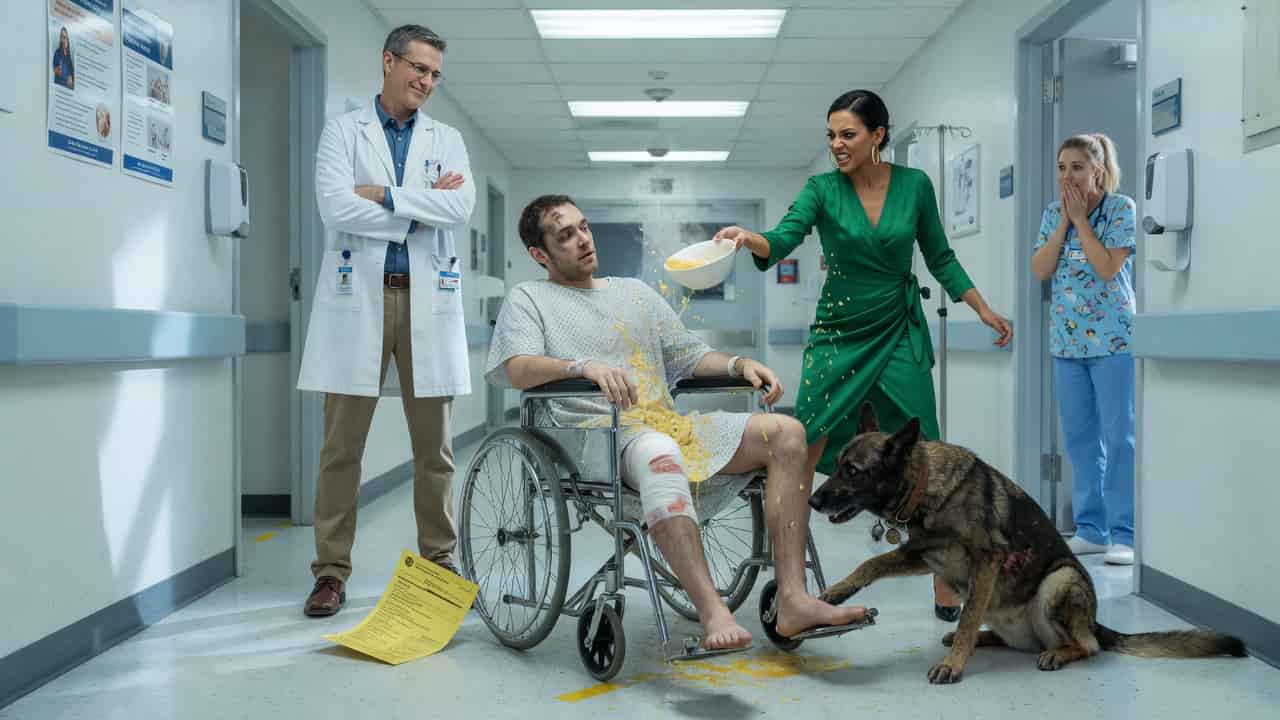
“Pick it up. Crawl for it,” the doctor said, his voice dripping with the kind of casual cruelty you only find in people who think they’re untouchable. He dropped my discharge papers into the mess of porridge my wife had just thrown all over my bandages.
Bella stood there in her new emerald dress—the one she’d probably bought with the money she stole from my safe—and she actually laughed. “Look at him, Marcus. He can’t even remember how to stand up, let alone fight back.”
I sat there in that chrome wheelchair, the smell of hospital bleach and cold oats stinging my nose. They thought the explosion at the border had wiped my mind clean. They thought I was just a broken body with a blank stare. The nurses stood in the hallway, looking away, too scared of the Chief of Surgery to say a word while they watched a man be stripped of his last shred of dignity.
But then, the floor started to vibrate.
It started as a low hum, the kind you feel in your teeth before you hear it in your ears. Then came the roar—the sound of five hundred heavy engines screaming into the hospital parking lot. I looked at the doctor, whose smirk was starting to melt into a mask of pure panic.
“You wanted me to crawl?” I asked, my voice finally finding the gravel it had been missing for weeks. “I think you’re the one who needs to start practicing.”
Chapter 1: The Weight of Antiseptic
The fog didn’t lift all at once. It peeled back in layers, like old wallpaper in a damp house.
For the first week in the St. Jude Private Pavilion, I was nothing but a series of sensations. The bite of the IV needle in the back of my hand. The rhythmic, mechanical huff of the ventilator. The smell—that thick, cloying scent of industrial-grade bleach and lavender-scented floor wax that defines every high-end hospital in Texas. It was the smell of money trying to cover up the scent of dying.
By the second week, the sounds started making sense. The soft squeak of rubber-soled shoes on linoleum. The hushed, urgent whispers of the night-shift nurses. And the sound of Ruger’s tail thumping against the side of my bed.
Ruger. He was the only thing that felt real. I could feel his chin resting on the edge of the mattress, his breath warm against my forearm. Every time I twitched a finger, he’d let out a low whine, a sound of pure, unadulterated loyalty that cut through the haze better than any of the narcotics they were pumping into my line.
“He’s awake, Dr. Miller,” a voice said. It was Sarah, the young nurse with the ponytail who always smelled like peppermint and exhaustion. She was the only one who looked me in the eye when she changed my dressings.
I tried to turn my head, but a sharp, jagged pain flared in my neck, radiating down into my bandaged chest. I groaned, a dry, raspy sound that didn’t feel like it belonged to me.
“Easy, Mr. Vance,” Dr. Miller’s voice arrived before he did. It was a smooth, practiced baritone, the kind of voice that spoke at country clubs and charity galas. He stepped into my line of sight, a tall man with silvering hair and a white coat that was so bright it made my eyes ache. He didn’t look at me; he looked at the tablet in his hand. “The trauma to the occipital lobe was significant. It’s natural for the cognitive functions to be… sluggish.”
Sluggish. That was one word for it. I felt like I was underwater, trying to catch fish with my bare hands. I remembered the border. I remembered the heat of the Rio Grande sun and the sudden, deafening roar of the explosion. I remembered the smell of burning rubber and the way the world had tilted sideways as my bike slid across the gravel. After that, there was only black.
“Can you hear me, Elias?” Miller asked, finally looking down at me through his silver-rimmed glasses. There was no warmth in his gaze, only a clinical curiosity, the way a boy looks at a bug he’s pinned to a board.
I tried to speak, but my throat felt like it had been scrubbed with sandpaper. I settled for a slow, agonizing nod.
“Good. Your wife is outside. She’s been very concerned about your… financial affairs. Given the nature of your recovery, we need to discuss the long-term care plan. This facility isn’t cheap, and the Iron Saints’ insurance policy—if you can call it that—is remarkably thin.”
The Iron Saints. The name hit me like a physical blow. The brotherhood. My family. The men I’d bled with for fifteen years. I wanted to ask where they were. I wanted to ask why none of them were in the room. But I couldn’t find the words, and Miller didn’t stay long enough to listen for them. He turned on his heel and vanished, leaving me alone with the peppermint-scented nurse.
Sarah leaned over me, checking the drip. Her eyes were darting toward the door, then back to me. She leaned in close, her voice a bare whisper.
“They think you don’t remember,” she said. “But I see you. I see the way you look at that dog. Don’t let them know you’re back yet, Elias. Not until you’re ready.”
Before I could process what she meant, the door swung open again, and the scent of expensive French perfume filled the room, clashing violently with the antiseptic air.
Bella.
She walked in with a confidence that didn’t match the occasion. She was wearing a dress I hadn’t seen before—a dark, shimmering thing that looked like it cost more than my first three motorcycles combined. Her hair was perfectly done, and her lips were painted a sharp, aggressive red.
“Oh, Elias,” she said, her voice a theatrical trill of sorrow. She didn’t come to the bed. She stood by the window, silhouetted against the bright Texas sky. “You look terrible. Truly.”
I watched her. I realized then that the fog wasn’t just in my head. It was a shield. And as it slipped away, I saw the woman I’d married for what she really was: a predator who had been waiting for me to bleed out.
Ruger growled, a low vibration in his chest that echoed the one starting to build in mine.
“Hush, you mangy beast,” Bella snapped, glaring at the dog. “I told the doctor to have that animal removed. This is a sterile environment.”
She looked back at me, her eyes cold and calculating. “We need to talk about the safe, honey. The boys are asking questions. Important questions. And since you’re in no condition to lead, I need those codes. For your own protection, of course.”
I closed my eyes, feigning a sudden lapse back into the darkness. I could hear her sigh, the sound of a woman who was losing her patience. But underneath the pain and the weakness, something was hardening.
The memory of the codes wasn’t gone. It was there, etched into my mind like a brand. The access to the Iron Saints’ war chest. The keys to an empire built on grease, chrome, and blood.
And as I lay there, listening to the tap-tap-tap of Bella’s high heels as she paced the room, I realized that I wasn’t just a patient. I was a target. And for the first time since the explosion, I felt a flicker of the man I used to be. The Grim wasn’t dead. He was just waiting for the right moment to bite back.
Chapter 2: The Predator’s Visit
The second week in the pavilion was a masterclass in psychological erosion.
Bella didn’t visit every day, but when she did, she brought a new kind of pressure. She’d sit in the designer chair by the bed, scrolling through her phone, occasionally looking up to remind me how much the room cost per night. She’d talk about the “chaos” at the clubhouse, about how my second-in-command, Dutch, was struggling to keep the younger members in line.
“They think you’re a vegetable, Elias,” she said one afternoon, her voice casual as she applied a fresh layer of lipstick. “They’re already talking about a vote. A change in leadership. It would be so much easier if you just gave me the authorization. I could handle the transition. You could just… rest.”
Rest. She said it like it was a synonym for disappearing.
I watched her through half-lidded eyes, playing the role of the shattered man. It wasn’t hard. My body was a roadmap of agony. The doctors had fixed the broken bones and stitched the shrapnel wounds, but the internal damage—the deep, muscular aches and the persistent ringing in my ears—remained.
“Why is he still here?” Bella asked, gesturing toward Ruger with a flick of her wrist. The dog was lying at the foot of my bed, his head on his paws, watching her with a steady, unblinking gaze.
“Mr. Vance responds well to his presence,” Sarah said, coming in to change my IV bag. She kept her head down, avoiding Bella’s eyes. “It’s therapeutic.”
“It’s disgusting,” Bella countered. “He smells like a wet rug. And he’s dangerous. Look at those scars. He’s a liability to the hospital.”
“He’s a service animal, Mrs. Vance,” Sarah said, her voice gaining a tiny bit of steel. “He has every right to be here.”
Bella laughed—a sharp, brittle sound that set my teeth on edge. “Rights. How quaint. We’ll see what Dr. Miller has to say about his ‘rights’ during the board meeting.”
After Sarah left, Bella leaned in close to my ear. I could smell the wine on her breath—something expensive and oaky.
“I know you can hear me, you stubborn bastard,” she whispered. “I know you’re in there somewhere, clutching onto those numbers like they’re your soul. But look at you. You can’t even hold a spoon. You’re nothing but a drain on everyone’s resources. Give me the codes, and I’ll make sure you’re moved to a nice, quiet facility in the hill country. Somewhere you can have your dog and your silence. Otherwise…”
She didn’t finish the sentence. She didn’t have to. The threat was as clear as the Texas sky.
When she left, the room felt colder. Ruger jumped up, putting his heavy paws on the side of the bed and licking my hand. I gripped his fur, my fingers trembling.
The memory of the explosion was becoming clearer now. It hadn’t been an accident. I remembered the way the lead truck had veered off just seconds before the blast. I remembered the flash of a green silk dress in the rearview mirror of the car trailing us.
Bella hadn’t just been waiting for me to fall. She’d pushed.
That evening, a man I didn’t recognize entered the room. He wasn’t a doctor or a nurse. He was wearing a cheap suit that didn’t fit his broad shoulders, and he had the flat, dead eyes of a man who did things for money that most people couldn’t imagine.
He stood at the foot of the bed, looking at me for a long time. Ruger stood up, a low growl vibrating through the room, his hackles rising into a sharp ridge.
“Easy, boy,” the man said, his voice a low gravel. He looked at me, and for a second, I saw a flash of something like pity. “She’s impatient, Grim. She’s making deals with people who don’t care about the club. People who want the Saints gone for good.”
I stared at him, my heart hammering against my ribs.
“Dutch sent me,” he whispered, leaning over the bed as if checking my vitals. “We know what she’s doing. We know about the doctor. But we can’t get to you. Miller has the whole floor on lockdown. Private security at every entrance. He’s in her pocket, Elias. Deep.”
He slipped something under my pillow—a small, hard object.
“When you’re ready to move, press the button,” he said. “We’re waiting for the signal. But you have to be the one to give it. The Saints don’t follow anyone but the King.”
He left as quickly as he’d arrived. I reached under the pillow and felt the smooth plastic of a GPS transponder. It was a simple device—one press to alert the club of my location and my readiness.
I looked at Ruger. He was still staring at the door, his body tense.
I realized then that the hospital wasn’t a place of healing. It was a cage. And Bella and Miller were the ones holding the keys. They wanted the money, but more than that, they wanted the power that came with it. They wanted to erase the Iron Saints and build something “respectable” on the ruins.
My legs felt like lead, and my chest burned with every breath. I was a long way from being able to ride a bike or hold a gun. But as I clutched that transponder, I felt the first real spark of rage ignite in my gut.
They thought I was a broken ghost. They thought they could humiliate me into submission. They were about to find out that a wounded wolf is the most dangerous thing in the woods.
Chapter 3: The Porridge and the Pride
The third week brought the heat. A Texas heatwave that even the hospital’s high-end HVAC system couldn’t quite beat back. The air in the ward felt heavy, thick with the scent of sweat and simmering tension.
They moved me from the private room to the “observation ward”—a semi-public area with four beds separated by thin, beige curtains. It was a strategic move by Miller. A way to strip away my privacy, to make me feel small in front of an audience.
In the bed next to mine was Arthur, an old cựu chiến binh with skin like weathered leather and a missing left arm. He didn’t say much, but he watched everything. He saw the way the nurses treated me—some with pity, others with a hurried indifference. And he saw the way Ruger never left my side, despite the constant complaints from the administrative staff.
The humiliation happened at lunch.
The ward was full. Families were visiting, the television in the corner was buzzing with a local news report, and the air was filled with the clatter of plastic trays and the smell of lukewarm cafeteria food.
Bella arrived with Dr. Miller. They were walking close together, their shoulders touching in a way that was far from professional. Bella was wearing that emerald dress again, looking like a queen among commoners.
“Still here, I see,” she said, her voice loud enough to carry across the room. She stood over my wheelchair, looking down at me with a mixture of boredom and disgust.
I was trying to eat a bowl of porridge. My hands were shaking—a side effect of the new medication Miller had prescribed. I couldn’t quite get the spoon to my mouth without spilling.
“Here, let me help you, darling,” Bella said, her voice dripping with mock-sweetness. She snatched the spoon from my hand. “We can’t have you making a mess in front of the neighbors.”
She scooped up a large glob of the thick, yellow oats and held it toward my face. I clamped my jaw shut, staring at her with all the defiance I could muster.
“Oh, don’t be difficult, Elias,” she tittered, looking around at the other patients. “He’s like a child, really. Sometimes I wonder if there’s anything left in that head of his at all.”
Dr. Miller stepped forward, his hands in his pockets. “It’s a common regression, Bella. The brain seeks the simplest comforts when it’s been this badly damaged.”
He looked at the old man in the next bed. “Isn’t that right, Arthur? You’ve seen men break before.”
Arthur didn’t answer. He just looked at me, his one good eye full of a cold, quiet fury.
“Come on, Elias. Open up,” Bella urged, her voice sharpening. “Don’t make me embarrassed in front of my friends.”
I didn’t move. I could feel the eyes of the entire ward on us. The silence was heavy, broken only by the hum of the television.
Bella’s face shifted. The mask of the grieving wife slipped, revealing the jagged edge of her frustration. “Fine,” she snapped. “If you won’t eat it, you can wear it.”
With a sudden, violent flick of her wrist, she flung the contents of the bowl at me.
The porridge was hot—not enough to scald, but enough to sting. It splattered across my face, my hospital gown, and the bandages on my chest. A large glob landed on Ruger’s head.
The dog let out a sharp yelp of surprise, scrambling back and hitting the chrome legs of my wheelchair.
Bella laughed. It was a high, shrill sound that echoed off the sterile walls. “Look at him! The Great Grim Vance, leader of the Iron Saints. Covered in mush like a toddler who lost his bottle.”
Dr. Miller chuckled, a low, condescending sound. “Perhaps we should call the orderlies. This is hardly the behavior we expect from our VIP patients.”
I sat there, the wet, sticky weight of the food clinging to my skin. I could feel the heat of the shame rising in my neck, but I didn’t look down. I kept my eyes on Bella.
“You’re just a broken ghost, Elias,” she whispered, leaning down so only I could hear. “A memory of a man who’s already gone. Just give me the codes, and I’ll make sure the dog gets a quick, painless end. Otherwise, I might just forget to tell the pound where he is.”
She straightened up, smoothing her dress. “We’ll be back tomorrow for the discharge papers. I expect you to be in a more… cooperative mood.”
They turned and walked out, their laughter trailing behind them like a foul odor.
The ward remained silent for a long time. Then, I felt a hand on my arm. It was Sarah. She was shaking, her eyes red-rimmed with unshed tears.
“I’m so sorry,” she whispered, picking up a towel and gently wiping the porridge from my face. “I’m so, so sorry.”
From the next bed, Arthur spoke. His voice was a low growl, like an old engine turning over. “Don’t let ‘em see you bleed, son. That’s what they want. They want the show.”
I looked at him. “They’re going to kill my dog.”
“Not if you kill them first,” Arthur said, his gaze fixed on the ceiling. “And I don’t mean with a gun. You use the room, kid. You use the silence.”
I gripped the armrests of my chair, my knuckles white. The rage was no longer a flicker; it was a fire, hot and steady. I looked down at Ruger, who was licking the oats off his paws.
The transponder was still in my pocket. I could feel it through the thin fabric of the gown.
I looked at Sarah. “I need a favor,” I said, my voice finally sounding like the man I used to be. “I need you to make a phone call. Not to the police. To a garage on 4th Street.”
She hesitated, looking at the door where Miller had vanished. Then, she looked at the mess on my chest and the scars on my dog. She nodded once, a sharp, decisive movement.
“What do I tell them?”
“Tell them the King is ready for his crown,” I said. “And tell them to bring the thunder.”
Chapter 4: The Sound of the Storm
The next morning, the air in the hospital felt charged, as if a storm was brewing just beyond the horizon.
Dr. Miller and Bella arrived early, accompanied by two large men in dark suits who didn’t look like medical staff. They were “security consultants,” Miller claimed, though they stood with the practiced boredom of hired muscle.
They wheeled me into a small, windowless consultation room at the end of the hall. It was a room designed for bad news—hard chairs, a cold metal table, and a clock that ticked with agonizing precision.
“Today’s the day, Elias,” Bella said, tossing a yellow folder onto the table. “These are your discharge and transfer papers. They also include a full power of attorney for all club-related assets. All you have to do is sign.”
I sat in my wheelchair, my body aching, my mind sharp. I looked at the papers, then at Dr. Miller.
“And if I don’t?”
Miller stepped forward, his face a mask of professional concern. “Then we have to consider your mental competency, Mr. Vance. If you’re unable to manage your own affairs, the state—and by extension, your next of kin—will have to step in. It’s a long, messy process. One that usually results in the permanent loss of all personal property. Including the animal.”
He gestured toward the door, where one of the suits was holding Ruger’s leash. The dog was muzzled, his eyes wide and panicked.
“Sign the papers, Elias,” Bella said, her voice dropping to a low, dangerous hiss. “Don’t be a hero. You were never very good at it anyway.”
She picked up a pen and shoved it toward my hand. When I didn’t take it, she let out a huff of annoyance and dropped it on the floor.
“Oh, for heaven’s sake,” she spat. “He’s doing the ‘tough guy’ act again. Marcus, help him.”
Miller nodded to the suits. They stepped forward, one of them grabbing my shoulders, the other grabbing my wrist. They forced my hand down toward the floor, where the pen lay.
“Pick it up,” Miller commanded, his voice cold. “Pick it up and sign, or I’ll have that dog in the incinerator before the sun goes down.”
I looked at the pen. I looked at the yellow paper. I could feel the weight of their hands on me, the physical pressure of their contempt.
“I said, pick it up!” Miller barked, giving my arm a sharp twist.
I felt a surge of pain, but I didn’t pull away. I looked Miller in the eye. “You think you’re so smart, Doc. You think you can just erase a man and take what’s his.”
“I’m not erasing you, Elias,” Miller said, leaning in so close I could see the pores on his nose. “I’m just completing the job the border explosion started. You’re a relic. A dinosaur. And I’m the one who gets to inherit the earth.”
He shoved my shoulder, hard. I felt the wheelchair tip slightly, my body sliding toward the floor. I caught myself with one hand, my knees hitting the linoleum.
“Look at him,” Bella laughed, her voice echoing in the small room. “The King of the Saints, on his knees. It’s almost poetic.”
I stayed there for a moment, my head bowed. I could feel the coldness of the floor and the heat of their mockery. But I also felt something else.
A vibration.
It started as a faint tremor in the soles of my feet. Then, a low, rhythmic thrumming that began to rattle the metal legs of the table.
Miller frowned, looking toward the ceiling. “What is that? Maintenance?”
The sound grew louder. A deep, guttural roar that sounded like a thousand lions screaming at once. It wasn’t maintenance. It was the sound of iron and chrome. The sound of freedom.
The door to the consultation room burst open. Sarah stood there, her face pale, her eyes wide.
“Dr. Miller!” she cried, her voice trembling. “You need to see this. You need to see the parking lot.”
Miller let go of my arm, his face flushing with anger. “I’m in the middle of a private consultation, Sarah! Get out!”
“I think you should listen to her, Marcus,” I said, pushing myself up from the floor and back into the wheelchair. My voice was steady, my eyes fixed on the window.
The roar was deafening now. It wasn’t just a sound; it was a force of nature. The windows in the room began to vibrate, a high-pitched rattle that set my teeth on edge.
Miller walked to the window and pulled back the blinds. His face went from red to a sickly, pale gray.
“What… what is this?” he stammered.
Bella joined him at the window, her emerald dress rustling. She let out a soft, choked gasp.
Down below, the hospital parking lot was a sea of black leather and gleaming metal. Five hundred bikers, their machines idling in perfect, menacing unison, had blocked every entrance and exit. They weren’t just protestors; they were an army. And at the front of the line, sitting on a blacked-out Harley with a shotgun strapped to the frame, was Dutch.
He looked up at the window, and even from three stories up, I could see the fire in his eyes.
I reached into my pocket and pulled out the transponder. I looked at Bella, then at Miller.
“You wanted to talk about my financial affairs?” I asked, my voice cutting through the roar of the engines. “Well, the board of directors just arrived. And I don’t think they’re in a very generous mood.”
I pressed the button.
A second later, the sirens started—not the hospital’s, but the ones the club had rigged to their bikes. A piercing, wailing sound that announced the arrival of the storm.
The two suits in the room looked at each other, their bravado evaporating in the face of the overwhelming force outside. They backed away from me, their hands raised in an instinctive gesture of surrender.
Bella turned to me, her face a mask of terror. “Elias… honey… we can talk about this. We can make a deal.”
“The time for deals is over, Bella,” I said, gripping the armrests of my chair and standing up. My legs were shaking, my chest was burning, but I stood. “You thought I was a ghost. Well, you were right about one thing.”
I looked her in the eye, the cold fury of the Iron Saints finally reaching the surface.
“I’m the ghost that’s going to haunt you for the rest of your life.”
Outside, the first of the heavy glass doors at the hospital entrance shattered, and the roar of the brotherhood flooded into the building like a tidal wave.
The King was back. And he wasn’t alone.
Chapter 5: The Breaking of the Ward
The sound of five hundred idling engines is not a noise; it is a physical weight. It is a tectonic shift that rattles the marrow in your bones and makes the air in a sterile hospital room feel thin and insufficient. Through the triple-paned, sound-dampened glass of the St. Jude Private Pavilion, the roar was a low, hungry growl, but I could feel it through the soles of my feet. I could feel the brotherhood before I saw them.
In the small consultation room, the atmosphere curdled. Dr. Miller, the man who had spent weeks treating me like a broken biological specimen, was now just a man with sweat beginning to bead on his upper lip. His expensive silver-rimmed glasses had slipped slightly down the bridge of his nose. He looked at the window, then at the door, then at me. The power dynamic hadn’t just shifted; it had been pulverized.
“Elias,” Bella said, her voice a frantic, high-pitched warble. She reached for my arm, her fingers—manicured, sharp, and cold—clutching at the gray fabric of my hospital gown. “Elias, tell them to stop. This is a hospital. There are sick people here. You’re going to get someone hurt. Think about your reputation.”
I looked down at her hand. It was the same hand that had flung the bowl of porridge at my chest yesterday. The same hand that had probably signed the papers to have me moved to a facility where I’d never be heard from again. I didn’t shake her off. I didn’t have to. I just looked at her until she realized there was no “honey” left in me. She recoiled as if I’d burned her.
“The reputation of the Iron Saints is doing just fine, Bella,” I said. My voice was a rasp, a ghost of the baritone that used to command the road, but it held. “It’s your reputation I’d be worried about.”
The door to the consultation room didn’t just open; it was occupied. One of the hired suits—the “security consultants”—tried to block the entrance, his hand hovering near the holster concealed under his jacket. He was a big man, probably an ex-cop or a discharged MP, but he was standing in the path of a storm he wasn’t equipped to weather.
The door was kicked inward with a flat, metallic bang.
Dutch stepped into the room. He was a mountain of a man, mid-forties, with a beard that looked like it had been braided out of iron wire and eyes that had seen too many miles and too much blood. He was wearing his full colors—the heavy leather vest with the Iron Saints patch, the winged skull that signified we took care of our own. He smelled of high-octane fuel, stale tobacco, and the open Texas highway. To me, it was the finest perfume in the world.
He didn’t look at Miller. He didn’t look at Bella. He looked straight at me.
“Boss,” he said. Just one word. It carried the weight of fifteen years of loyalty.
“Dutch,” I croaked.
He nodded once, then turned his gaze to the suit. The man was reaching for his weapon, a slow-motion mistake born of a paycheck that wasn’t high enough for this kind of work. Dutch didn’t draw a gun. He just stepped into the man’s space, a six-foot-four wall of leather and muscle.
“You want to die in a hospital, son?” Dutch asked. His voice was low, almost conversational, which made it ten times more terrifying. “Because my brothers are currently turning the lobby into a parking lot, and they’re looking for a reason to start a collection.”
The suit looked at Dutch, then at his partner, then at the sheer number of leather jackets now filling the hallway behind him. He let out a shaky breath and stepped aside, raising his hands. His partner followed suit, moving toward the wall like a shadow.
I turned my wheelchair toward the man holding Ruger’s leash. The man was frozen, his face pale, his grip on the leather strap white-knuckled. Ruger was snarling, a deep, rhythmic vibration that matched the engines outside.
“Give me the dog,” I said.
The man didn’t hesitate. He dropped the leash and backed away. Ruger lunged forward, not at the man, but at me. He shoved his large, scarred head into my lap, whimpering, his tail whipping against the chrome of the chair. I buried my fingers in his fur, feeling the heat of him, the living proof that I wasn’t just a number on a chart.
“Get him up,” Dutch commanded.
Two of the younger brothers, Slim and Jax, stepped forward. They moved with a practiced, quiet efficiency. They didn’t treat me like a patient; they treated me like a king being restored to his throne. They hoisted me out of the wheelchair, one on each side, my arms slung over their shoulders.
The pain was a white-hot spike in my chest and a dull, throbbing ache in my leg where the shrapnel had torn through. I felt the stitches pull, felt the cold dampness of new blood against the bandages. I didn’t make a sound. I couldn’t afford to. Not in front of Miller. Not in front of her.
“Wait!” Miller shouted, his voice cracking. He tried to regain his professional footing, stepping forward with a trembling finger pointed at Dutch. “You can’t do this. He is a patient under my care. He hasn’t been medically cleared. If you take him out of this facility, his death is on your heads. I will call the police. I will have this entire club dismantled.”
Dutch paused. He turned his head slowly, looking at Miller like he was an interesting species of cockroach.
“You’ve been billing his insurance for medications he didn’t need to keep him sedated, Doctor,” Dutch said. “You’ve been taking kickbacks from his wife to facilitate a power of attorney transfer. We’ve been sitting in the parking lot for three days with a directional mic pointed at that window. We heard the conversation about the incinerator.”
Miller’s face went from pale to a translucent, sickly green. His hand dropped to his side.
“The police are already on their way, Doctor,” Dutch continued, stepping closer until Miller was backed against the cold metal table. “But they aren’t coming for us. They’re coming for the fraud and the conspiracy to commit murder. And if I were you, I’d pray they get here before my boys decide they want a refund for the ‘care’ you provided.”
I looked at Bella. She was huddled in the corner, her emerald dress crumpled, her eyes darting like a trapped bird. She looked at me, and for a fleeting second, I saw the woman I’d once thought I loved. Then I remembered the porridge on my bandages. I remembered the way she’d laughed when I was on the floor.
“The safe is empty, Bella,” I said. The lie tasted like copper in my mouth, but it was the right move. “The codes you wanted? They don’t open the vault. They open the record of everyone who’s ever tried to steal from the Saints. You’re on the list now.”
Her eyes widened in genuine terror.
“Let’s go,” I told Dutch.
The walk down the hallway was a blur of fluorescent lights and shocked faces. Nurses huddled behind their stations, their eyes wide. Sarah was there, standing by the medicine cart. As I passed, I caught her eye. I gave her a small, imperceptible nod. She had risked her job—maybe more—to make that call. I wouldn’t forget it.
The lobby was a scene of controlled chaos. The high-priced marble floor was scuffed with boot prints. The glass front doors were shattered, the jagged shards catching the Texas sun. Outside, the world was a wall of black leather and chrome.
The brothers parted like the Red Sea as Slim and Jax carried me out. The roar of the engines reached a fever pitch, a deafening salute that rattled my teeth and cleared the last of the hospital fog from my brain. They lowered me into the sidecar of Dutch’s custom trike, Ruger jumping in beside me, his head resting on my knee.
Dutch climbed onto the seat, his hands gripping the handlebars like they were the reins of a warhorse. He looked back at the hospital, at the pale figures of Miller and Bella watching from the third-floor window.
“Where to, Boss?” he asked.
“Home,” I said. “Take me to the garage. We have a lot of history to dig up.”
Dutch kicked the engine into gear. The vibration was a symphony. As we pulled out of the parking lot, the five hundred bikers followed in a formation that looked like a funeral procession for the people we’d left behind.
The wind hit my face, sharp and hot, smelling of sagebrush and asphalt. It hurt to breathe, and I knew the recovery ahead would be long and brutal. I knew the Iron Saints were fractured, and that there were members who might still be loyal to whatever lies Bella had been spinning. I knew the border explosion was a secret that was still bleeding.
But as I looked at the vast Texas horizon, the sun setting in a bruised purple and orange smear across the sky, I felt a weight lift that had nothing to do with the hospital.
The residue of the humiliation was still there—the memory of the cold porridge, the sound of the laughter, the feeling of the floor against my knees. It wouldn’t go away overnight. It would stay with me, a bitter coal in my stomach. But it would be the fuel for what came next.
I wasn’t a patient anymore. I wasn’t a victim. I was the Grim. And the world was about to find out that when you try to bury a King, you’d better make sure he’s actually dead.
Chapter 6: The King’s Court
The Iron Saints’ clubhouse was a converted aircraft hangar on the outskirts of San Antonio, a cathedral of oil-stained concrete and corrugated steel. Inside, the air was thick with the scent of soldering iron, old leather, and the heavy, metallic tang of the Texas dust. It was the only place in the world where I felt like I could actually breathe, even if every breath felt like a knife in my ribs.
They’d set up a cot for me in the back office, a room filled with filing cabinets, old maps of the border, and a desk that had seen more fights than most bars. Ruger was curled up on a pile of old blankets at the foot of the bed, his ears twitching at every sound from the main floor.
Dutch sat across from me, a bottle of cheap bourbon and two glasses on the desk between us. He’d spent the last four hours giving me the real story.
“The border hit wasn’t a cartel job, Elias,” Dutch said, his voice low and heavy. He poured a finger of bourbon and pushed it toward me. “It was internal. A splinter group. They were tired of the ‘old ways.’ Tired of the codes. They wanted in on the synthetic market, and you were the one standing in the way.”
I looked at the glass. I didn’t touch it. My head was still spinning from the move. “And Bella?”
“She was the bridge,” Dutch spat. “She’d been seeing Miller for months. He wasn’t just a doctor; he was a financier for the guys who wanted the Saints moved out of the territory. They wanted your codes to the offshore accounts to fund the expansion. They thought if they kept you sedated and broken, you’d eventually crack.”
I leaned back against the thin pillow. The memory of the explosion came back, not as a blur, but as a sequence. The way the lead bike had braked. The flash of green silk in the car behind us. Bella hadn’t just been a witness; she’d been the signal.
“Where are they?” I asked.
“The boys picked them up as they tried to leave the hospital through the loading dock,” Dutch said. “Miller’s in the basement. Bella’s in the cage. They’re waiting for you.”
I looked at my hands. They were pale, the knuckles scarred and bony. I didn’t feel like a King. I felt like a man who had been hollowed out. But the club was watching. The younger guys, the ones who had been swayed by the promises of easy money and new leadership, were standing in the shadows of the hangar, waiting to see what the Grim would do.
“Help me up,” I said.
It took ten minutes to get me down the stairs to the basement. Every step was a battle. I refused the wheelchair. I refused the stretcher. I leaned on Dutch, my hand clamped onto his shoulder like a vice. We reached the heavy steel door of the holding area, and the two brothers on guard straightened up, their eyes widening.
Inside, the room was lit by a single, buzzing fluorescent tube. Miller was tied to a wooden chair, his white lab coat torn, his face a map of bruises. He wasn’t the Chief of Surgery anymore. He was just a terrified middle-aged man who had realized too late that power in the real world isn’t measured in degrees.
Bella was in the corner, slumped against the wall. She looked up as I entered, her hair matted, her emerald dress ruined. The arrogance was gone, replaced by a raw, jagged desperation.
“Elias,” she whispered, her voice cracking. “Please. It was him. Miller… he forced me. He said they’d kill me if I didn’t help. He promised we’d go away together. He lied to me, Elias.”
I looked at her. I didn’t see a wife. I didn’t even see an enemy. I saw a ghost of a life that had never really existed.
“You laughed, Bella,” I said. My voice was quiet, which made it carry further in the damp room. “When I was on that floor, covered in that mess, you laughed. That wasn’t Miller’s idea. That was yours.”
She started to cry, a messy, ugly sound that didn’t move me. I turned my gaze to Miller. He was shaking, a fine, rhythmic tremor that made the chair rattle against the concrete.
“The codes,” I said. “You wanted them so badly, Marcus. You wanted the keys to the kingdom.”
I reached into the pocket of my gown—I was still wearing the damn thing under my leather jacket—and pulled out a crumpled piece of yellow paper. It was the discharge form he’d dropped on the floor.
I leaned forward, my face inches from his. I could smell his fear—a sharp, acidic scent that was more honest than anything he’d ever said to me.
“I’m going to give you a choice,” I whispered. “I can give the club the signal to finish what the border explosion started. Or I can give you the codes.”
Miller’s eyes lit up with a flicker of hope, a pathetic, grasping thing. “The codes. Give me the codes, Elias. I’ll leave. We’ll both leave. You’ll never see us again.”
I looked at Dutch. He was watching me, his face unreadable. I knew what the club wanted. They wanted blood. They wanted a public execution to set the record straight. They wanted the Grim to be the monster the world expected him to be.
But I looked at the man in the chair, and I realized that killing him was too easy. It was too clean. It wouldn’t remove the residue of the humiliation. It wouldn’t heal the wound.
I leaned in and whispered a string of numbers into Miller’s ear. Twelve digits. The coordinates to a dead-drop in the Big Bend.
“There’s no money there, Marcus,” I said, straightening up. “There are no offshore accounts. There’s a ledger. A list of every cartel deal, every corrupt cop, and every payout the Iron Saints have made in the last decade. Your name is on page four.”
Miller’s face went white.
“I’m turning that ledger over to the Feds in an hour,” I continued. “You have sixty minutes to get as far away from this city as you can. But remember this: the Saints are the only ones who know where that ledger is. And the Feds aren’t the only ones who are going to be looking for you when they realize you’ve been talking.”
I turned to Dutch. “Let them go.”
The room went silent. I could feel the confusion, the simmering resentment from the brothers in the doorway. It wasn’t the ending they wanted. It wasn’t the revenge they’d been promised.
“You heard the Boss,” Dutch growled, his voice a low warning. “Untie him. Throw them out at the edge of the county line. If I see either of them in San Antonio again, the choice is mine.”
We watched as they were dragged out. Bella was screaming, a high, thin sound that faded into the night. Miller was silent, his head bowed, the weight of his own greed finally crushing him.
When the door closed, Dutch looked at me. He didn’t say anything for a long time. Then, he reached out and squeezed my arm.
“You’re a better man than I am, Grim,” he said.
“No,” I said, looking at the scarred concrete floor. “I’m just a man who’s tired of being on his knees.”
The aftermath was long. The recovery took months. My leg would always have a limp, and my chest would always ache when the weather turned cold. The Iron Saints had to be rebuilt, piece by piece, from the ground up. There were more fights, more betrayals, and more nights spent staring at the ceiling, wondering if the codes I’d kept were worth the blood they’d cost.
But a month later, I was back on the road.
I was sitting on my rebuilt Fat Boy, the engine humming between my legs, the Texas sun warming my back. Ruger was in the sidecar, his goggles on, his ears flapping in the wind. We were parked on a ridge overlooking the Rio Grande, the border stretching out like a jagged scar below us.
The amnesia was gone, but the memories of the hospital stayed. The smell of the bleach. The sound of the laughter. The feeling of the porridge on my chest. It wasn’t a weight anymore; it was a map. It reminded me of where I’d been, and where I was never going back to.
I looked at the horizon, at the vast, open space that promised nothing but the road. I wasn’t the man I was before the explosion. I was something else. Someone harder. Someone who knew that dignity isn’t something you’re given; it’s something you take back, one mile at a time.
I kicked the bike into gear and twisted the throttle. The roar was the only answer I needed.
I wasn’t a ghost anymore. I was the storm. And as I headed south into the shimmering heat of the desert, I knew that the King hadn’t just returned. He’d finally found his way home.