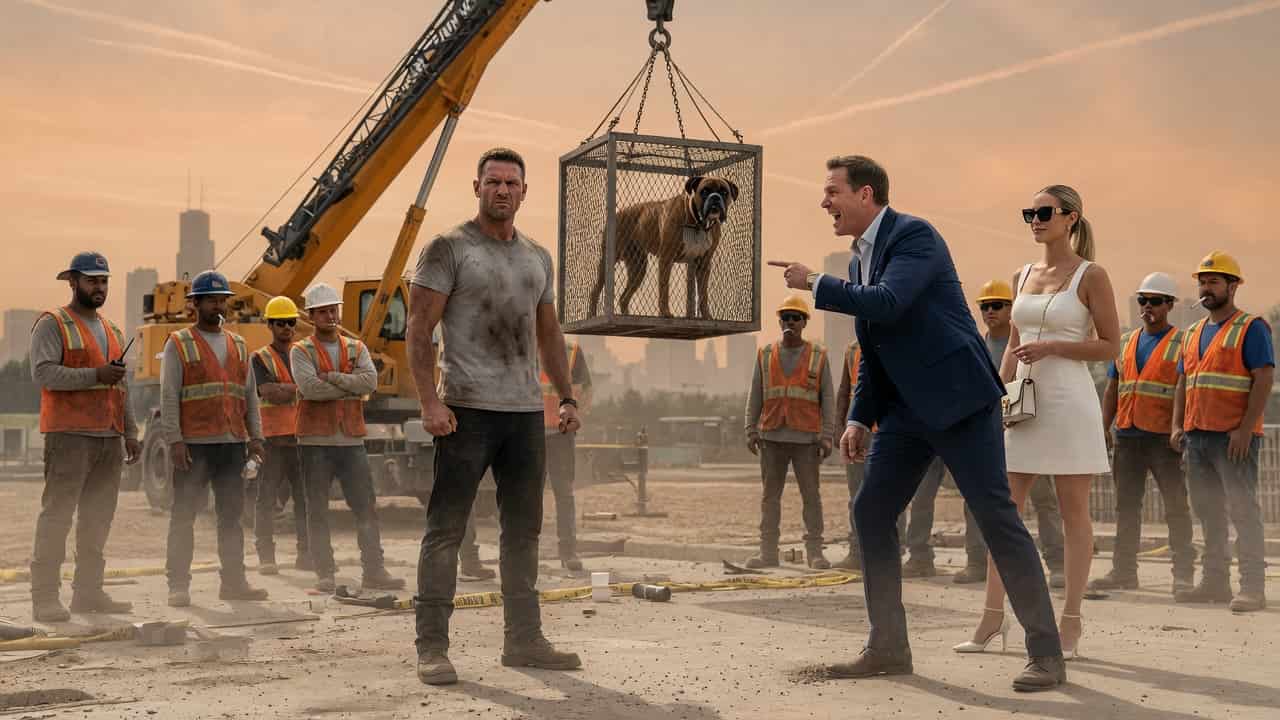
“Kneel, Cole. Get down in the dirt where you belong, and maybe I won’t let that cage drop.”
Garrett stood there in his three-thousand-dollar suit, his boots covered in the very mud he wanted to build his empire on. He had everything—the money, the influence, and the woman who used to be mine. Now, he had Tank, my only friend, dangling fifty feet in the air from a rusted crane.
The construction workers stayed quiet, looking at their feet. They knew it was wrong, but Garrett signed their checks. Tiffany just stood there, checking her reflection in her sunglasses, waiting for me to break. She wanted to see the man she walked away from crawl.
“Let the dog go, Garrett,” I said, my voice steady even as my heart felt like it was being squeezed by a vice. “You’ve got the land. You’ve got the girl. Just let him down.”
Garrett just laughed, a sound as sharp as broken glass. “I don’t just want the land, Cole. I want to see what’s left of the legendary ‘Hammer’ Reed when he’s begging. So, get down. Now.”
He didn’t know I wasn’t just a mechanic with a grease-stained shirt. He didn’t know about the papers in my lawyer’s office or the five hundred brothers currently roaring down the interstate at my signal. He thought he was the one holding the leash.
He was about to find out what happens when you corner a man who has nothing left to lose but his pride.
Chapter 1: The Grit and the Ghost
The smell of 10W-40 and old sweat was the only thing that felt honest anymore. Cole Reed wiped a thick smear of black grease across his forehead, leaving a dark streak against his tanned skin. Underneath the hydraulic lift, the world made sense. Metal met metal, bolts tightened until they didn’t, and if something was broken, you could usually see why. People were different. People broke from the inside out, and you never saw the cracks until the whole engine seized.
His shop, “Reed’s Iron & Oil,” sat on the ragged edge of a town that was trying too hard to forget it was built on blue-collar backs. Outside the open bay doors, the Chicago humidity was a physical weight, thick with the smell of hot asphalt and the distant, rhythmic thud of pile drivers. That thud was the heartbeat of the new development—Garrett’s development—eating up the skyline piece by piece.
“Cole? You in there?”
Cole didn’t move. He knew the voice. It was Miller, a man who had been his mother’s lawyer and was now the only person Cole trusted with a briefcase. Cole slid out from under the 1974 Shovelhead on his creeper, the wheels squeaking against the concrete. He stood up, all six-foot-two of him, and felt the familiar ache in his lower back.
Miller was standing in the sunlight, looking entirely too clean for a garage. He held a manila envelope like it was a ticking bomb.
“You look like hell, Cole,” Miller said, his eyes scanning the cluttered shop.
“I look like a man who works for a living,” Cole replied, grabbing a rag to wipe his hands. The grease didn’t come off; it just smeared thinner. “What’s in the bag, Miller?”
Miller stepped further into the shadows of the shop. “The final title search came through. It’s exactly what you thought. The county records from forty years ago were ‘misplaced’ during the last administration, but the state archives don’t lie. Your mother didn’t just have a life estate. She held the deed in fee simple. That means when she passed, this entire parcel—including the three acres Garrett is currently pouring concrete on—belonged to you.”
Cole looked out the door toward the construction site. A massive yellow crane stood like a predatory bird against the hazy sky. “And the debt? The lien Garrett claims he bought?”
“Manufactured,” Miller said, his voice dropping an octave. “It’s a shell game, Cole. He used a subsidiary to create a fake debt, then used that debt to justify a ‘friendly’ foreclosure while you were… out of town.”
Out of town. That was Miller’s polite way of saying riding with the Reapers across three states trying to outrun the ghost of a dead woman and a brother’s betrayal. Cole threw the rag onto his workbench. “So, he’s building a ten-million-dollar shopping plaza on land he doesn’t own, using a woman he stole to pick out the floor tiles.”
“Essentially, yes,” Miller said. “But Cole, you have to be careful. If you go at him now, he’ll use his connections to bury this. We need to wait for the filing.”
“I’m tired of waiting, Miller.”
A low, guttural woof came from the corner of the shop. Tank, a massive Boxer with a coat the color of burnt sugar, stood up from his burlap bed. He trotted over to Cole and nudged his hand with a wet nose. Cole’s expression softened for a fraction of a second as he scratched the dog behind the ears. Tank had been a pup when Cole’s mother died. He was the only one who had stayed through the silence of the house afterward.
“Just stay quiet for forty-eight hours,” Miller pleaded. “I have the injunction ready. We’ll serve him on the day of the groundbreaking ceremony. In front of the cameras. That’s how you kill a man like Garrett—you take away his audience.”
Cole didn’t answer. He was watching a white Range Rover pull into the gravel lot of the shop. It was a vehicle that didn’t belong here, shining with a pretentious, waxed luster that felt like an insult to the dust.
The door opened, and Tiffany stepped out.
She looked different every time he saw her. Thinner, maybe. Her blonde hair was pulled back so tight it looked painful, and her clothes cost more than Cole made in a month of engine rebuilds. She walked toward the shop with a practiced grace, her designer heels clicking dangerously on the uneven ground.
“Miller,” she said, nodding to the lawyer with a cold smile. Then she turned to Cole. Her eyes skipped over his grease-stained shirt and landed on his face with a mix of pity and irritation. “Cole. You haven’t answered Garrett’s calls.”
“My phone doesn’t like his voice,” Cole said.
“Don’t be difficult. He’s trying to be generous,” Tiffany said, stepping into the shop and immediately wrinkling her nose at the smell. “The offer for the shop stands. Double the market value. You can take the money and go back to… wherever it is you go when you disappear. You could buy a house that isn’t falling apart. You could actually have a life.”
“I have a life, Tiff. You just didn’t like the color of it.”
Tiffany winced, a small fracture in her polished mask. “That’s not fair. I waited, Cole. I waited for two years while you rode around with those people, mourning a woman who wouldn’t have wanted you to waste your life in a garage.”
“Don’t talk about my mother,” Cole said, his voice a low rumble that made Tank growl in sympathy.
“Garrett is building something here,” she continued, ignoring the warning. “Something for the future of this town. You’re just a relic, Cole. A stubborn piece of old iron that’s in the way of progress. If you don’t take the deal today, the eviction notice will be served tomorrow. And there won’t be any ‘generous’ bonuses then.”
“Get out of my shop, Tiffany,” Cole said quietly.
“You’re making a mistake. You think you’re being a hero, protecting some old memory, but you’re just being pathetic.” She looked at Tank. “And that dog… honestly, Cole. He’s as old and ragged as this place. You should let it all go.”
She turned on her heel and walked back to the Range Rover. As she drove away, the dust settled back onto the gravel, coating everything in a fine, grey layer of reality.
“She’s wrong, you know,” Miller said after a long silence.
“About which part?”
“The part where she thinks you’re alone.”
Cole looked at the phone on his workbench. He hadn’t called the Club in a long time. Not since the night he’d walked away from the patches and the brotherhood that had felt like a lie. But standing there, with the weight of the manila envelope in Miller’s hand and the thud of Garrett’s machines in the distance, he realized that the iron wasn’t just in his shop. It was in his blood.
“Go home, Miller,” Cole said. “File the papers. But don’t expect Garrett to play by the rules once he realizes he’s cornered.”
“What are you going to do?”
Cole looked at Tank. The dog was watching him with steady, loyal eyes. “I’m going to finish the Shovelhead. And then I’m going to go for a ride.”
As Miller left, Cole felt the pressure building. It wasn’t just about the land. It was about the way Garrett looked at the world—like everything and everyone had a price tag. He had bought the town council, he had bought the local police, and he had bought the woman Cole had once promised to protect.
But he hadn’t bought Cole Reed. And he certainly hadn’t bought the memory of the woman who had spent forty years tending the garden on the land Garrett was currently choking with gravel.
Cole picked up a wrench. His hands were shaking, just a little. It wasn’t fear. It was the slow-burning fuse of a rage that had been damp for too long. He thought about the day he lost his mother, the way the house had felt so empty that he could hear his own heartbeat in the walls. He remembered the betrayal—his “brother” in the MC, the one who had tipped off the rival crew about the route, leading to the accident that took her. He had spent years blaming the bike, the road, the weather. But it was always people.
Garrett was just the latest version of the same rot.
The sun began to dip lower, casting long, distorted shadows across the garage floor. Cole worked in silence, the rhythmic clink of tools the only soundtrack to his thoughts. He didn’t see the black sedan parked across the street, its tinted windows reflecting the dying light. He didn’t see the man inside pick up a radio.
He only knew that the air felt too still. The kind of still that comes before a storm breaks the sky wide open.
Chapter 2: The Lion’s Den
The construction site for “The Grand At Chicago” was a chaotic sprawl of dirt, rebar, and ego. It sat on the prime real estate that connected the old industrial district to the new suburban sprawl—the very land Cole’s mother had refused to sell for three decades. Now, it was a scar on the earth.
Cole pulled his motorcycle, a customized, matte-black Dyna, through the main gates. He didn’t have an invitation, and the security guard in the little plastic shack started to get up, but something in Cole’s eyes made him sit back down. Cole didn’t look like a visitor. He looked like a debt collector.
He parked the bike near the foreman’s trailer. As he dismounted, he felt the eyes of the workers on him. Most of them were locals. They knew who he was. They knew the “Hammer” and they knew the story of the land. There was a palpable tension in the air, a silence that rippled through the sound of the diesel engines as word spread that Reed was on the property.
Garrett was standing on a raised wooden platform overlooking the foundation pour, surrounded by men in white hard hats and expensive slacks. He was holding a set of blueprints like a scepter. Tiffany was there too, looking out of place in her white dress against the brown dirt, holding a parasol as if the sun itself was an inconvenience.
“Cole!” Garrett shouted, his voice amplified by the acoustics of the site. He didn’t sound angry; he sounded amused. “Come to see the future? Or did you finally come to sign the papers?”
Cole walked toward the platform. He didn’t rush. Every step was deliberate, his boots sinking slightly into the loose soil. Tank walked at his heel, his ears forward, sensing the hostility in the air.
“I came to tell you to stop the pour, Garrett,” Cole said, standing at the base of the platform. “You’re trespassing.”
A ripple of laughter went through the men around Garrett. Garrett himself leaned over the railing, looking down at Cole with a grin that didn’t reach his eyes. “Trespassing? On land I have a deed for? Land your own ex-wife helped me secure?”
“The deed is a forgery, and you know it,” Cole said. “The state archives found the original. This land belongs to my family. It always has.”
Garrett’s grin flickered for a second, then hardened. He stepped down from the platform, his boots clicking on the wooden stairs. He walked right up to Cole, stopping only inches away. He was shorter than Cole, but he carried the weight of a man who believed he was untouchable.
“Listen to me, you grease monkey,” Garrett hissed, his voice low enough that only Cole and Tiffany could hear. “I don’t care what some dusty file in Springfield says. I have the mayor in my pocket. I have the bank in my pocket. And I have the woman you couldn’t keep. You’re nothing. You’re a footnote in a town that’s moving on.”
He looked at the workers, then raised his voice again, projecting to the crowd. “Look at this man! He wants to stop your jobs. He wants to stop your paychecks because he’s clinging to a ghost! He’d rather see this place remain a weed-choked lot than see this town grow.”
The workers shifted. Some looked away, but others, younger men who didn’t know the history, glared at Cole. This was Garrett’s specialty—turning the community against itself.
“You’re a bully, Garrett,” Cole said. “And like every bully, you’re a coward. You hide behind suits and contracts because you can’t stand on your own.”
Garrett’s face flushed a deep, angry red. He looked at Tiffany, who was watching the scene with a look of intense embarrassment.
“Is that right?” Garrett said. He turned and signaled to a man standing near a large yellow crane about fifty yards away. “You think I’m a coward? Let’s see how brave you are.”
The man at the crane engaged the winch. A heavy metal cage, used for transporting materials, began to rise from behind a stack of lumber.
Cole’s heart stopped.
Tank wasn’t at his heel anymore. In the heat of the argument, as Garrett had distracted him, someone had snatched the dog. He looked toward the crane. Tank was inside the cage, his paws scratching at the wire mesh as he was hoisted higher and higher into the air.
“Tank!” Cole roared, stepping forward, but two of Garrett’s private security guards—heavy-set men in black polos—stepped into his path.
“Easy, Hammer,” Garrett said, his voice smooth and cold again. “He’s a little high up, isn’t he? Boxers aren’t known for their flying abilities.”
“Let him down, Garrett,” Cole said, his voice trembling with a different kind of rage now. “This is between us. Leave the dog out of it.”
“Everything is a resource, Cole,” Garrett said, walking back toward the platform. “The land. The woman. The dog. They’re just leverage. And right now, you’re at a serious disadvantage.”
Garrett climbed back onto the platform and looked down at Cole. The workers were all watching now, the machines idling. The only sound was the wind whistling through the rebar and the distant whine of the crane’s motor.
“Here’s the deal,” Garrett shouted, ensuring every man on that site heard him. “You sign the quit-claim deed right now. You walk away from the shop, the land, and this town. You do that, and I’ll have my man bring the cage down nice and slow.”
He paused, a cruel glint in his eye.
“But first,” Garrett continued, “I think you owe us an apology. For the trouble you’ve caused. For the delay in these men’s work. I want you to apologize, Cole. On your knees. Right here in the dirt.”
“Cole, don’t,” Tiffany whispered, though whether it was out of pity or a desire to avoid a scene, Cole didn’t know.
“Shut up, Tiffany,” Garrett snapped, not even looking at her. He kept his eyes locked on Cole. “Well? What’s it going to be, Hammer? Are you the big man everyone says you are? Or are you going to watch your only friend take a fifty-foot dive?”
Cole looked up at the cage. Tank was barking now, a frantic, high-pitched sound that tore through Cole’s chest. He looked at the workers. Some looked ashamed, but no one moved. They were afraid. Garrett’s power was a physical thing on this site, a heavy canopy of fear and greed.
Cole felt the grit of the construction site in his teeth. He felt the weight of his mother’s memory, the weight of the land, and the crushing pressure of the moment. He was being humiliated in front of the world he lived in, stripped of his dignity by a man who didn’t know the meaning of the word.
He reached into his pocket. His fingers brushed against his phone.
“I’m not going to ask you again, Garrett,” Cole said, his voice eerily calm. “Let the dog down.”
“Kneel, Cole,” Garrett sneered. “Kneel and maybe I’ll think about it.”
Cole didn’t kneel. He pulled his phone out and pressed a single button.
“Execute Code Red,” he said into the receiver.
Garrett laughed. “What’s that? Your lawyer? You think a phone call is going to save you now?”
But the laughter didn’t last long.
From the distance, a low vibration began. It wasn’t the rhythmic thud of the pile drivers. It was a roar. A deep, mechanical growl that seemed to come from the earth itself. It grew louder, a thundering crescendo that shook the very foundations Garrett was so proud of.
On the horizon, the dust began to rise. A wall of black and chrome appeared, hundreds of motorcycles cresting the hill and flooding onto the access road. The sun glinted off leather jackets and polished handlebars.
The Reapers had arrived.
Chapter 3: The Weight of the Name
The roar of the engines was a physical assault. It drowned out the construction site, the wind, and Garrett’s protests. Five hundred bikers, riding in a tight, disciplined formation, flooded the gates. They didn’t stop at the entrance. They rode right onto the dirt, circling the construction platform like a swarm of angry hornets.
The workers scrambled out of the way, retreating toward the heavy machinery. The security guards who had been blocking Cole’s path took one look at the incoming tide of denim and leather and stepped back, their hands raised in a universal gesture of I don’t get paid enough for this.
At the head of the pack was a man Cole hadn’t seen in three years. Silas. He was older now, his beard more white than grey, but he still sat on his bike like a king on a throne. He pulled his heavy cruiser to a halt ten feet from Cole, the engine idling with a menacing throb.
Silas killed the engine and kicked down the stand. The silence that followed was even more powerful than the noise had been. Hundreds of men sat on their bikes, their faces unreadable behind dark visors and bandanas, creating a wall of silent, looming judgment.
“You called, Hammer?” Silas asked, his voice gravelly and calm.
“I called,” Cole said.
Garrett was trembling now, his face pale, his grip on the railing of the platform so tight his knuckles were white. Tiffany had shrunk back behind him, her parasol forgotten on the wooden planks.
“What is this?” Garrett screamed, his voice cracking. “This is private property! I’ll have you all arrested! I’ll call the National Guard!”
Silas didn’t even look at him. He looked at the crane. He looked at the cage dangling in the air. “That your dog, Cole?”
“That’s Tank,” Cole said.
Silas nodded. He finally turned his gaze toward Garrett. It was the look a predator gives a particularly noisy insect. “You have sixty seconds to put that cage on the ground. If that dog so much as breaks a nail, we’re going to dismantle this entire site. And we’ll start with you.”
“You can’t threaten me!” Garrett yelled, but his eyes were darting around, looking for an exit that didn’t exist. The bikers had completely boxed him in.
“It’s not a threat, son,” Silas said. “It’s a project management update.”
Garrett looked at his foreman, who was standing near the crane controls. The foreman looked at the five hundred men surrounding him and didn’t wait for Garrett’s signal. He pulled the lever.
The cage began to descend. It felt like an eternity, the whine of the winch the only sound in the tense air. When the cage finally touched the dirt, Cole didn’t wait. He ran to it, ripping the latch open. Tank scrambled out, nearly knocking Cole over as he licked his face, his tail wagging so hard his whole body shook.
Cole buried his face in the dog’s neck for a second, the tension in his chest finally cracking. He stood up, Tank safely at his side, and looked back at the platform.
The power dynamic had shifted so violently it had left a vacuum. Garrett was no longer the master of the universe; he was a small man in an expensive suit trapped in the middle of a wasteland.
“Now,” Cole said, walking back toward the platform. The bikers parted to let him through, their eyes locked on Garrett. “Let’s talk about that land, Garrett.”
Miller, the lawyer, pulled up in his sensible sedan, somehow finding a gap in the line of motorcycles. He stepped out, holding a stack of legal documents. He looked at the sea of bikers, blinked once, and then walked toward Cole.
“I assume this is the ‘audience’ you were talking about?” Miller asked dryly.
“Something like that,” Cole said.
Miller climbed the stairs to the platform. He didn’t look at Garrett; he looked at the other men in suits—the investors and the city officials who had been standing there a moment ago, looking smug.
“Gentlemen,” Miller said, his voice clear and professional. “I am here to serve a temporary restraining order issued by the Cook County Superior Court. All work on this site is to cease immediately. We have filed a suit for quiet title, and given the evidence of fraudulent conveyance we’ve uncovered, the court has frozen all assets associated with ‘The Grand At Chicago’ project.”
Garrett slumped against the railing. “You can’t do this. I’ve put millions into this foundation.”
“Then you should have checked who owned the dirt you were pouring it on,” Cole said.
Tiffany stepped forward, her face a mask of desperation. “Cole, be reasonable. This project is good for the town. It’s good for everyone. We can work something out. A partnership, maybe?”
Cole looked at her. He looked at the woman who had walked away from him when things got hard, the woman who had traded her soul for a white Range Rover and a view of a city that didn’t care about her.
“There is no ‘we’, Tiffany,” Cole said. “There’s just the truth. And the truth is, you’re standing on my mother’s garden. And you’re not invited anymore.”
He turned to the bikers. “Silas. Thank you.”
Silas nodded, a small, grim smile touching his lips. “You’re still a Reaper, Cole. Whether you wear the patch or not. Loyalty doesn’t have an expiration date.”
“I know,” Cole said.
As the bikers began to fire up their engines again, the sound was different. It wasn’t a threat anymore; it was a victory lap. The dust rose again, coating the construction site, the machines, and the broken men on the platform.
Cole walked back to his bike, Tank trotting happily beside him. He felt the weight of the last three years finally beginning to lift. It wasn’t over—there would be court dates, legal battles, and the long process of reclaiming what was his. But the humiliation was gone. The fear was gone.
He looked back one last time. Garrett was sitting on the edge of the platform, his head in his hands. Tiffany was standing a few feet away, looking out at the horizon, realizing that the future she had gambled everything on was nothing but a hole in the ground.
Cole kicked his bike to life. The vibration felt good. It felt real.
He rode out of the gates, the wall of brothers flanking him, leaving the dirt and the greed behind. He was going home. To the shop, to the grease, and to the land that finally, truly, belonged to him.
Chapter 4: Residue
The legal victory felt like a clean break, but the aftermath of a war always left a different kind of mess. Two weeks after the confrontation at the construction site, the silence in Cole’s shop was heavy. The pile drivers had stopped. The dust had settled. But the town felt different.
Cole was working on an old Indian Scout, the light from the afternoon sun streaming through the bay doors. Tank was asleep in his usual spot, his breathing deep and steady.
The door creaked open, and a young man stepped in. He was wearing an orange safety vest, though it was stained with dirt and sweat. It was the young worker Cole had noticed at the site—the one who had looked at him with such anger.
“Mr. Reed?” the boy asked, twisting his hard hat in his hands.
Cole didn’t look up from the carburetor. “Yeah.”
“I… I wanted to apologize. For what happened out there. When Garrett was… when he was doing that to your dog.”
Cole stopped what he was doing and looked at the kid. He couldn’t have been more than twenty. “Why are you telling me this?”
“Because he hasn’t paid us,” the boy said, his voice cracking. “Since the injunction hit, he disappeared. The office is locked. My landlord is threatening to kick me out. I thought… I thought he was the good guy. He talked about progress, about making this place something. But he just left us in the dirt.”
Cole felt a familiar tightening in his chest. It wasn’t the boy’s fault. Garrett had used everyone—the town, the workers, even Tiffany.
“How many of you are there?” Cole asked.
“Thirty. On the main crew. Some of the guys have families, Mr. Reed. They’re hurting.”
Cole wiped his hands on a rag. He walked over to his desk and picked up the phone. He called Miller.
“Miller. The money from the settlement—the preliminary damages the court awarded for the trespass. Is it in the escrow account yet?”
“It arrived this morning, Cole. Why?”
“I need you to write thirty checks,” Cole said, looking at the boy. “Pay the men what they’re owed. Full wages for the month, plus a bridge payment. And tell them if they want to work, I’m going to need a crew to help me restore that land. I want the concrete dug up. I want the trees put back.”
The boy’s eyes widened. “You’re… you’re going to pay us?”
“Garrett owes you,” Cole said. “I’m just making sure the debt gets settled.”
After the boy left, Cole sat on his workbench, the weight of the responsibility settling on him. He had won the land, but he had inherited the town’s pain along with it.
The roar of a single motorcycle approached the shop. It wasn’t the thunder of five hundred; it was a lone, steady beat. Silas pulled in, his bike gleaming even in the dusty shop.
He didn’t get off the bike. He just sat there, looking at Cole.
“Heard you’re playing philanthropist, Hammer,” Silas said.
“Just cleaning up the trash,” Cole replied.
“The Club is heading north tonight. Sturgis is coming up. We could use a man who knows how to keep an engine running.”
Cole looked around his shop. He looked at the Indian Scout, the tools, the dog. He looked at the manila envelope still sitting on his desk, the symbol of the life his mother had fought for.
“I can’t, Silas,” Cole said. “I have roots here now. Literal ones.”
Silas nodded, his expression unreadable behind his sunglasses. “I figured. Just wanted to make sure you knew the door was open. You did good, kid. Your mother would have been proud.”
“Thanks, Silas.”
As Silas rode away, Cole felt the last of the old resentment fade. He had spent so many years running, thinking that the road was the only place he could be free. But freedom wasn’t about the distance you covered; it was about the ground you stood on.
He walked to the back of the shop, where a small door led to the living quarters. On the wall was a framed photograph of his mother, standing in her garden, her hands covered in soil, a wide, triumphant smile on her face.
He touched the frame, the glass cool under his fingertips.
The phone rang. He knew it would be the reporters, or the lawyers, or maybe even Tiffany, trying one last time to find a way back in.
He didn’t answer it.
He picked up a shovel from the corner of the room. He walked out of the shop, past the silent machines of the construction site, and stood in the center of the dirt lot.
The sun was setting, painting the sky in shades of bruised purple and gold. Cole drove the shovel into the earth. It was hard, packed with gravel and the remains of Garrett’s ego. But underneath, the soil was still there. Waiting.
He began to dig.
It wasn’t a shopping mall. It wasn’t a grand development. It was just a hole in the dirt. But as he worked, the rhythm of the shovel felt more honest than any engine he had ever fixed. He was reclaiming the earth, one scoop at a time.
Tank sat nearby, watching him with quiet, loyal eyes. The town was still there, the shadows were still long, and the future was still uncertain. But for the first time in his life, Cole Reed wasn’t looking for a route out.
He was right where he was supposed to be.
The residue of the war was still there—the debts, the broken promises, the lingering anger. But as the moon rose over the Chicago skyline, Cole felt a sense of peace that no motorcycle could ever provide. He was no longer the Hammer, the biker, or the victim.
He was a man standing on his own land. And that was enough.
Chapter 5: The Breaking Ground
The sun didn’t just rise the next morning; it seemed to heave itself over the horizon, casting long, bruised-purple shadows across the scarred landscape of the construction site. Cole stood at the edge of the property, a thermos of black coffee in one hand and a set of keys in the other. He wasn’t looking at the “Grand At Chicago” sign—which had been spray-painted with the word TRESPASSER sometime during the night—but at the soil. It was packed hard, choked by layers of gravel and the chemical stench of curing concrete.
Tank sat beside him, his ears twitching at the sound of approaching engines. It wasn’t the roar of the Reapers this time. It was the stuttering, uneven idle of old pickup trucks and beat-up sedans. One by one, the workers began to arrive. They didn’t park in the paved lot; they pulled onto the shoulder of the county road, stepping out with the hesitant posture of men who didn’t know if they were still welcome on the land they’d spent months tearing apart.
Leo, the young worker who had come to the shop, was the first to approach. He looked tired, his eyes shadowed by the kind of stress that only comes when you don’t know how you’re going to feed your kids. He was wearing the same stained orange vest, but he’d pinned a small, hand-written badge to it that simply said CREW.
“Morning, Mr. Reed,” Leo said, his voice cautious.
“Morning, Leo,” Cole replied. He handed the boy a heavy-duty bolt cutter. “Start with the fence. I want every foot of that chain-link down and coiled by noon. If Garrett’s name is on it, I want it off this property.”
“What about the foundation, sir? That’s six inches of reinforced slab.”
Cole looked at the massive pile driver idling nearby. “We aren’t building today, Leo. We’re un-building. Get the jackhammers ready. We’re going to find the dirt again.”
The work was brutal, slow, and honest. As the sun climbed higher, the rhythmic thud-thud-thud of jackhammers replaced the roar of the construction engines. Cole worked alongside them, his shirt quickly turning dark with sweat, his muscles screaming with a familiar, grounding ache. He wasn’t a boss; he was a man reclaiming a grave. Every chunk of concrete they hauled away felt like a weight lifted from his mother’s memory.
Around mid-morning, a black Mercedes pulled up to the gate. It wasn’t Garrett. It was a man in a charcoal suit—Garrett’s lead architect, a man named Sterling who had once looked at Cole like he was a piece of gum stuck to his shoe. Sterling stepped out, carefully avoiding the puddles of muddy slurry.
“Reed! Stop this immediately!” Sterling shouted, waving a leather-bound folder. “This slab is part of a multi-million dollar structural plan. You’re destroying assets that are currently under judicial review!”
Cole didn’t stop. He finished the line he was cutting with the concrete saw, the spray of grey water coating his boots, before he killed the engine. The silence that followed was heavy.
“The review is over, Sterling,” Cole said, wiping his face with his sleeve. “Miller served the final injunction an hour ago. Garrett’s permits were pulled because the land title was never his to begin with. You’re standing on private property. Move your car before I have one of these boys drive a backhoe over it.”
Sterling looked at the workers. These were men he had commanded for months, men he had treated as disposable parts of a machine. Now, they were standing behind Cole, their jackhammers resting against their thighs, their expressions hard and unforgiving.
“You’re all fools,” Sterling hissed, retreating toward his car. “Garrett will have your licenses for this. You’ll never work in this county again.”
“We aren’t working for the county,” Leo shouted back, his voice surprisingly strong. “We’re working for the owner.”
As the Mercedes sped away, a cheer went up among the men, but Cole didn’t join in. He knew the residue of Garrett’s influence wouldn’t wash away that easily. People like Garrett didn’t just disappear; they curdled.
The pressure shifted again in the late afternoon. The workers had gone for their lunch break, sitting in the shade of the tool shed, when a familiar white Range Rover slowed down on the road. It didn’t enter. It just sat there for a long time. Finally, the door opened, and Tiffany stepped out.
She wasn’t wearing a designer dress today. She was in a pair of jeans and a simple cotton shirt, her hair messy, her face devoid of the expensive makeup that usually served as her armor. She walked toward Cole with a halting, uneven gait.
“He’s gone, Cole,” she said, her voice barely a whisper over the wind.
Cole didn’t stop shoveling the gravel. “Garrett? I figured he’d be halfway to a non-extradition country by now.”
“No. He’s… he’s in the city. But the bank seized the house. They took the cars this morning. He didn’t even tell me. I woke up and the movers were in the living room.” She let out a short, jagged laugh that sounded like a sob. “He told me he bought that house for us. It was a lease-to-own. He hadn’t made a payment in four months.”
Cole finally stopped. He leaned on the shovel, looking at the woman he had once thought he would grow old with. There was no triumph in his heart, only a dull, lingering pity. “Why are you here, Tiffany?”
“I have nowhere else to go,” she said, her eyes filling with tears. “My mother won’t take me back after… after everything I said to her when I left with him. I thought I was choosing the better life, Cole. I thought I was finally getting out of the grease and the dust.”
“You chose the man who signed the checks,” Cole said. “And now the checks are bouncing.”
“I made a mistake. A horrible, stupid mistake.” She stepped closer, reaching out as if to touch his arm, but she stopped herself when she saw the black grease coating his skin. “Please. I just need a place to stay for a few days. Just until I can find a job. I can help in the shop. I remember how to do the books.”
“The books are handled, Tiff. Miller is doing them.”
“Cole, please. I’m scared. Garrett… he wasn’t himself last night. He was drinking. He was talking about how it was all your fault. How you stole his life. He has a gun, Cole.”
The air suddenly felt colder. Cole looked at Tank, who had stood up and was staring toward the shop down the road. “Where is he now?”
“I don’t know. He left in a rental car. He said he was going to ‘balance the ledger’.”
Cole threw the shovel down. “Leo! Get the men. Pack up the tools and go home. Now!”
“What’s wrong, Mr. Reed?”
“Just do it! And call the sheriff. Tell them Garrett is mobile and armed.”
Cole didn’t wait for a response. He hopped on his bike, whistling for Tank. The dog jumped into the sidecar he’d rigged up years ago for long hauls, and Cole twisted the throttle. He didn’t head for the police station. He headed for the shop.
As he rounded the final bend, he saw the smoke. It wasn’t a building on fire—not yet. It was a pile of tires in the middle of the gravel lot, burning with a thick, acrid blackness. Standing in the middle of the smoke, backlit by the setting sun, was Garrett.
He had stripped off his suit jacket. His white shirt was yellowed with sweat, his tie hanging loose around his neck. In his right hand, he held a heavy-duty flare gun. In his left, a half-empty bottle of bourbon.
“There he is!” Garrett screamed, his voice raw and ragged. “The King of the Dirt! Come to claim your throne, Hammer?”
Cole slid the bike to a halt, keeping ten yards of distance. Tank was growling now, a low, vibrating sound that felt like a warning from the deep.
“Put it down, Garrett,” Cole said, his voice low and steady. “It’s over. You lost the land. Don’t lose your life too.”
“I didn’t lose anything!” Garrett roared, staggering toward the shop. “I built this town! I brought the money! And you… you and your band of thugs came in here and took it because of some old lady’s flowers?” He pointed the flare gun at the shop’s wooden doors. “If I can’t build my empire here, then nobody gets anything. I’ll burn every memory of that bitch mother of yours into the ground.”
“You mention my mother again,” Cole said, his voice dropping to a dangerous, icy register, “and I won’t wait for the sheriff.”
“Oh, I’m scared! The big biker is going to hit me?” Garrett laughed, a high, frantic sound. “Go ahead. Do it in front of your girl. She’s watching, isn’t she?”
Tiffany had followed in her Range Rover and was standing at the edge of the lot, her hands over her mouth.
“Garrett, stop it!” she cried. “Please, just come away. We can start over.”
“Start over with what?” Garrett spun on her, his eyes wild. “I have zeroed-out accounts and a warrant for my arrest! There is no starting over! There’s only ending!”
He turned back to the shop and raised the flare gun.
Cole didn’t think. He didn’t have time for a plan. He lunged.
He tackled Garrett just as the trigger clicked. The flare shot upward, a brilliant, screaming streak of red phosphorus that hissed through the air, narrowly missing the roof of the shop and exploding in the trees behind it.
The two men hit the gravel hard. Garrett was surprisingly strong, fueled by a cocktail of alcohol and pure, unadulterated spite. He clawed at Cole’s face, his fingernails digging into the grease-stained skin.
“I’ll kill you!” Garrett hissed. “I’ll kill you and everyone who shares your name!”
Cole pinned Garrett’s arms, his weight pressing the smaller man into the sharp gravel. He looked down at the face of the man who had tried to erase his history. Garrett wasn’t a titan. He wasn’t a mastermind. He was just a pathetic, broken bully who couldn’t handle the word no.
“You’re already dead, Garrett,” Cole said, his voice flat and devoid of emotion. “You died the second you thought people were things you could own. Now, stay down.”
The sound of sirens finally cut through the black smoke. Three sheriff’s cruisers pulled into the lot, their blue and red lights reflecting off the shop’s windows. Deputies swarmed the area, pulling Cole off and pinning Garrett to the ground.
As they dragged Garrett away, his screams of “My land! My land!” echoing through the night, Tiffany walked toward the center of the lot. She looked at the burning tires, then at the shop, then finally at Cole.
He was standing there, bleeding from a cut on his cheek, his hands shaking with the adrenaline. He looked at her, and for the first time in years, he didn’t see the woman he loved. He just saw another part of the wreckage.
“Is it over?” she asked.
Cole looked at the charred earth, then at the sky where the red flare was slowly drifting down like a dying star.
“No,” Cole said. “The fire is out. But we still have to clean up the mess.”
He walked past her, whistled for Tank, and went into his shop. He didn’t look back to see if she was following. He had a garden to plant, and the soil was finally ready.
Chapter 6: The Harvest of Iron
The legal proceedings for Reed v. Garrett Construction & Development didn’t happen in a high-gloss courtroom with mahogany panels. They happened in a cramped, beige-walled deposition room in the basement of the county courthouse, a place that smelled of old paper and industrial floor wax.
Cole sat at the end of the long laminate table, wearing a clean button-down shirt that felt restrictive against his shoulders. Miller sat beside him, surrounded by stacks of ledgers and the original, hand-written deed from 1954. Across from them sat a battery of lawyers representing the bank, the city, and the remnants of Garrett’s estate.
Garrett wasn’t there. He was currently in a psychiatric wing of the state prison, awaiting trial for arson, attempted murder, and a laundry list of white-collar crimes that were coming to light like worms after a heavy rain.
“Mr. Reed,” one of the bank lawyers said, a woman with sharp glasses and a voice like a paper cut. “We acknowledge the validity of the state archive records. However, the bank has already invested four million dollars in the infrastructure of this site. We are prepared to offer a settlement that would allow you to retain the shop and a significant cash payout, provided you allow the development to proceed under our management.”
Cole looked at the woman. He looked at the blueprints she had spread out—the same ones Garrett had used to humiliate him.
“No,” Cole said.
“Mr. Reed, be reasonable. The amount we’re talking about would set you up for life. You could move anywhere. You could build a dozen shops.”
“I don’t want a dozen shops,” Cole said. “I want that land. All of it. From the road to the creek. And I want the concrete gone. Every square inch of it.”
“That’s an environmental and logistical nightmare!” the lawyer argued. “The cost of restoration would exceed the value of the property.”
“Then you shouldn’t have lent money to a thief who was building on a stolen grave,” Miller interjected, sliding a new document across the table. “This is the final audit of the ‘Code Red’ buyout. My client has acquired the primary debt of Garrett’s subsidiary. As the lead creditor, he is not just the owner of the land—he is now the owner of the project’s liabilities. Which means he decides if a single brick stays or goes.”
The room went silent. The lawyers looked at the document, their professional masks slipping for a second. Cole had used the money from his mother’s hidden life insurance and the small fortune he’d made over a decade of high-end custom bike builds to buy Garrett’s debt when it was at its lowest point. He hadn’t just beaten Garrett; he had bought the man’s failure.
“The restoration begins on Monday,” Cole said, standing up. “I’ve already hired the crew.”
The walk out of the courthouse felt different than any walk Cole had ever taken. He didn’t feel the need to look over his shoulder. He didn’t feel the weight of the “Hammer” persona. He was just a man.
The restoration took six months.
It was a slow, painful process of healing the earth. Leo and the other workers became a permanent fixture on the property. They didn’t just haul away concrete; they learned how to test soil, how to grade for natural drainage, and how to plant the native grasses that had once covered this part of Illinois before the factories arrived.
Cole didn’t just watch. He was in the dirt every day. He found that he liked the feel of seeds in his hands as much as he liked the feel of a wrench. The shop stayed open, but the work shifted. He began to specialize in vintage restorations, working on bikes that had been forgotten and left to rust, bringing them back to life with the same patience he was using on the land.
Tiffany had stayed in town. She had moved in with her mother and taken a job at the local library. She didn’t come to the shop, and Cole didn’t go to her. But once a month, she would leave a small box of his mother’s favorite tea on the porch of the shop. No note. Just a quiet acknowledgment of the residue they both still carried.
One Saturday in October, the air crisp and smelling of dry leaves, Silas and a few of the Reapers rode by. They didn’t come as a small army this time. Just four men on a weekend run. They pulled into the lot, which was now surrounded by a low stone wall instead of a chain-link fence.
Silas dismounted and looked around. The massive hole where the foundation had been was now a rolling meadow of green and gold. In the center, where his mother’s house had once stood, Cole had built a small, open-air pavilion.
“You actually did it,” Silas said, shaking his head in disbelief. “You turned ten million dollars of prime real estate into a park.”
“It’s not a park, Silas,” Cole said, wiping his hands on his apron. “It’s a garden. There’s a difference.”
“The guys miss you on the road, Hammer. It’s too quiet without you.”
“I’m done with the quiet, Silas. I like the noise of the bees.”
Silas laughed, a deep, genuine sound. He reached into his vest and pulled out a small, worn leather pouch. He handed it to Cole. “Found this in the back of the clubhouse locker. Thought you might want it back.”
Cole opened the pouch. Inside was his mother’s wedding ring—the one he’d used as collateral years ago to get the shop started, the one he thought had been lost in the shuffle of the MC’s debts.
“I bought it back from the pawnbroker in Joliet,” Silas said. “Consider it a housewarming gift for the land.”
Cole held the ring in his palm, the gold cool and solid. “Thanks, Silas. Truly.”
“Keep the rubber side down, Cole. And if you ever get the itch for the road, you know where we are.”
As the bikers rode away, their tail-lights disappearing into the twilight, Cole walked out to the pavilion. Tank followed him, slower now, his muzzle grey, but his eyes still bright.
Cole sat on the wooden bench and looked out over the property. The shadows were long, but they weren’t Bruised anymore. They were soft, blending into the natural curves of the restored earth. He could see the first green shoots of the lilacs he’d planted near the entrance—his mother’s favorite.
The “Gravel and Grease” of his life had finally balanced out. He had faced the bully, he had reclaimed the wound, and he had turned the shame into something that could grow.
He reached into his pocket and pulled out his phone. For a second, he thought about calling Miller, or Leo, or even Tiffany. But then he put the phone back.
He didn’t need to speak. The silence wasn’t deafening anymore. It was just a space for things to breathe.
He looked down at Tank, who had laid his heavy head on Cole’s boot. Cole reached down and scratched the dog behind the ears, feeling the steady, rhythmic heartbeat of a creature who had seen the worst and stayed for the best.
“We’re okay, Tank,” Cole whispered to the cooling air.
He looked at the ring in his hand, then at the moon rising over the trees he had planted. The residue of the past was still there, a thin layer of dust on everything he owned, but it didn’t feel like a burden anymore. It felt like a foundation.
He wasn’t waiting for the storm to break. He was the one who had survived it.
Cole stood up, whistled for the dog, and walked back toward the shop. Behind him, the wind stirred the long grass of the meadow, a soft, whispering sound that carried the scent of damp earth and late-blooming flowers.
The land was his. The silence was his. And for the first time in his life, the road ahead didn’t matter, because he was already home.
The final light in the shop went out, leaving the property in the quiet, honest dark of a world that had finally found its peace.
[End of Story]