“The stables are out back, Silas. Take that animal and get out of my sight before the guests arrive.”
Victor didn’t even look at me when he said it. He just kept swirling his scotch, standing next to Lydia—my wife. Or at least, she was the woman who’d promised to wait for me before she realized the Thorne family fortune was easier to spend if I wasn’t in the picture.
I stood there in my salt-stained leathers, my dog Duke sitting heavy at my heel, feeling the air conditioning of the manor chill the sweat on my neck. I’d spent fifteen years on the road, building a brotherhood they couldn’t understand, while they stayed here, rotting in silk and pinstripes.
“He stays with me,” I said. My voice sounded like gravel under a tire, out of place in a room that smelled like lemon polish and old money.
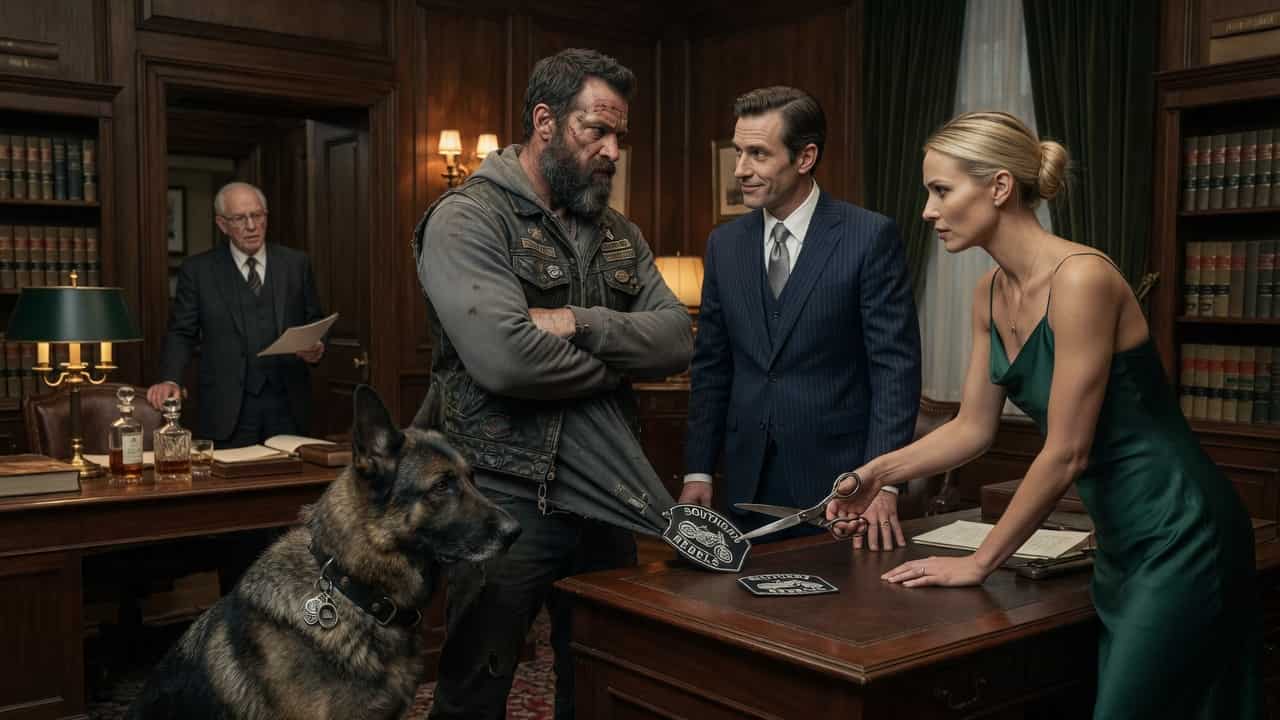
Lydia stepped forward, her emerald dress shimmering. She didn’t look at me with love. She looked at me like I was a stain on the rug. She picked up a pair of heavy silver scissors from the desk and reached for my vest—the only thing I truly owned.
“You’re an embarrassment, Silas,” she whispered, her eyes cold as ice. “You’re not a Thorne. You’re just a ghost in a leather suit.”
They thought they’d stripped me of everything. They thought the old man had forgotten me in his final hours. But they didn’t know what Duke was carrying in his collar, and they didn’t hear the five hundred engines currently cooling at the edge of the property line.
The game was about to change, and I wasn’t the one who was going to be sleeping in the dirt tonight.
Chapter 1: The Prodigal’s Dust
The wrought-iron gates of Thorne Manor didn’t creak. They slid open with a silent, expensive hum that felt like a personal insult. Silas Thorne eased the throttle of his 1998 Shovelhead, the heavy vibration of the engine rattling in his teeth, a stark contrast to the suffocating stillness of the Virginia countryside. Behind him, the road stretched back toward a life of asphalt, oil, and the kind of loyalty that didn’t require a notary. Ahead lay the tomb of his childhood.
He kept the bike in low gear, the rumble echoing off the manicured boxwood hedges that lined the mile-long driveway. Beside him, in the custom sidecar he’d welded himself, Duke sat with his ears forward. The German Shepherd didn’t like the smell of this place. It was too clean. It smelled of fertilizer, money, and the kind of secrets that stayed buried under three generations of topsoil.
Silas pulled the bike to a stop at the base of the grand stone steps. He didn’t turn off the engine immediately. He let it idle, a loud, rhythmic throb that seemed to vibrate the very windows of the Georgian-style mansion. He watched the front door. He knew they were watching him from behind the heavy velvet curtains. He could feel the weight of their judgment, a familiar pressure that had driven him away fifteen years ago.
When he finally killed the ignition, the silence that rushed in was deafening.
“Stay, Duke,” Silas murmured, his voice thick with the dust of the interstate.
The dog didn’t move, but his amber eyes followed Silas as he dismounted. Silas adjusted his leather vest, the “Iron Sentry” patch on his back feeling like a shield he’d earned in a war his family had never acknowledged. He looked down at his boots—scuffed, grease-stained, and out of place on the pristine gravel.
The front door opened. Not by a servant, but by Victor.
Victor Thorne hadn’t aged so much as he had polished himself. At forty, he looked like a campaign ad for a senator who’d never missed a haircut. His navy pinstripe suit was a masterpiece of tailoring, and his smile was the kind of thing you’d find on a shark just before the water turned red.
“Silas,” Victor said, his voice smooth and devoid of any warmth. “You’re late. And you’ve brought… that.”
He gestured vaguely at the bike and the dog.
“The dog’s name is Duke,” Silas said, stepping onto the first stone stair. “And the bike’s a Shovelhead. I figured you’d recognize something with a soul, Victor. My mistake.”
Victor’s smile didn’t falter, but his eyes narrowed. “Grandfather is gone, Silas. The house is in mourning. Your theatrics are hardly appropriate. You look like you just finished a shift at a scrap yard.”
“I did,” Silas replied, closing the distance. He was taller than Victor, broader, his body hardened by years of manual labor and the physical reality of the road. “It’s called living. You should try it sometime without a trust fund to catch you.”
He moved to push past Victor, but his cousin stepped sideways, blocking the door. The air between them crackled with an old, jagged electricity.
“Before you enter this house,” Victor whispered, leaning in so the staff wouldn’t hear, “understand one thing. You were an outcast for a reason. You chose the gutter. Don’t think a few lines in a will are going to change your status in this family. You’re a guest here, Silas. A temporary one.”
“I’m here for the reading, Victor. Nothing else,” Silas said, his voice low and dangerous. “Now get out of my way before I decide to park the bike in the foyer.”
Victor hesitated, the threat of physical violence a language he didn’t speak but clearly understood. He stepped aside, his expression curdling into a sneer.
The foyer was exactly as Silas remembered it: cold marble, the smell of beeswax, and portraits of dead men who all looked like they were disappointed in whoever was looking back at them. And then there was Lydia.
She was standing at the top of the dual staircase, her emerald green dress a sharp blade of color against the white stone. She looked exactly the same as the night Silas had left—beautiful, sharp, and utterly unreachable. When Silas had been twenty, he’d thought they were going to run away together. He’d thought she was his anchor. He’d been wrong. Within six months of his departure, she’d married Victor.
“Silas,” she said, her voice drifting down like a falling leaf. “You actually came.”
“The old man asked for me,” Silas said, looking up at her. His heart didn’t race. It felt heavy, like a stone in his chest. “I didn’t think I had a choice.”
“You always have a choice, Silas,” she said, descending the stairs with a practiced grace. “You chose to leave. You chose to stay away while he was failing. You chose to be a stranger.”
She stopped three steps above him, forcing him to look up at her. She smelled like expensive jasmine and betrayal.
“I stayed away because this house doesn’t breathe,” Silas said. “And because I didn’t want to see what you were turning into.”
Lydia’s hand twitched, her eyes flashing. “And what am I, Silas? Comfortable? Secure? Respected?”
“Owned,” Silas said simply.
The word landed like a slap. Victor, who had followed Silas in, stepped up beside his wife, placing a possessive hand on the small of her back. The gesture was deliberate, a territorial marking that made Silas’s stomach turn.
“Dinner is at seven,” Victor said. “Try to find something in your saddlebags that doesn’t involve grease or roadkill. Though I suspect your standards have plummeted along with your bank account.”
“I’ll be there,” Silas said, turning his back on them. “And so will Duke.”
“The dog sleeps in the stables,” Lydia snapped.
Silas stopped, his hand on the heavy mahogany banister. He turned his head just enough to see her over his shoulder.
“Duke sleeps where I sleep,” Silas said. “He’s the only thing in this county that hasn’t lied to me. If he’s not welcome in the room, I’m not welcome in the house.”
He didn’t wait for an answer. He walked toward the back of the house, toward the small service room he’d been relegated to as a teenager, leaving the two of them standing in the vast, empty foyer. He could feel their eyes on his back—the biker, the outcast, the man they thought they’d broken long ago.
But Silas wasn’t broken. He was just waiting for the clock to start.
Chapter 2: The Table of Scorpions
The dining room of Thorne Manor was designed to make people feel small. The table was a twenty-foot slab of polished mahogany that reflected the flickering light of the sterling silver candelabras like a dark pool of blood. Silas sat at the far end, Duke lying quietly at his feet, his presence a silent rebellion against the formal setting.
Silas had changed into a clean black t-shirt and his vest. He’d scrubbed the grease from under his fingernails, but he couldn’t scrub the history from the room. Across from him sat Victor and Lydia, flanked by a few “family friends”—local power players who looked at Silas as if he were a specimen in a jar.
“So, Silas,” said a man named Sterling, a local developer with teeth too white for his age. “I hear you’ve been involved in… transportation? Logistics?”
“I ride,” Silas said, cutting into a piece of steak that was far too rare for his liking. “And I run a shop. We build things that don’t need a chauffeur to operate.”
Victor chuckled, a dry, condescending sound. “He’s being modest, Sterling. Silas is the president of a motorcycle club. The ‘Iron Sentries.’ It’s a very… dedicated group of individuals. Mostly men with nowhere else to go.”
“A club,” Lydia added, her voice dripping with artificial pity. “It sounds so tribal. Like a little boys’ treehouse, but with more leather and noise.”
Silas didn’t look up from his plate. He felt Duke shift against his boot, the dog’s warmth a grounding force. “It’s about loyalty, Lydia. Something you might find hard to define without checking your prenup first.”
Lydia’s glass hit the table with a sharp clack. The room went silent. The “friends” looked down at their plates, suddenly fascinated by their asparagus.
“You have a lot of nerve, Silas,” Victor said, his voice dropping into a low, controlled hiss. “You show up here, after years of silence, smelling of the highway, and you think you can insult my wife at our own table?”
“Your wife?” Silas raised an eyebrow. “I remember when she was just the girl who used to cry in the garden because she didn’t want to marry into this family. Seems she found a way to dry those tears.”
“Enough,” Victor snapped. He looked toward the head of the table, where the old man’s chair sat empty. “Arthur is gone. He’s not here to protect your insolence anymore. Tomorrow, when that will is read, you’re going to find out exactly how much your ‘independence’ cost you.”
“I didn’t come here for the money, Victor,” Silas said, finally setting his fork down. “I came because the old man sent a messenger to the clubhouse three weeks ago. He said he had something to tell me. Something he couldn’t say over the phone.”
Victor laughed. “A messenger? To a biker bar? My grandfather wouldn’t have known how to find a place like that if his life depended on it. He was bedridden and delirious at the end. He probably thought you were the gardener.”
“He knew who I was,” Silas said. “He knew exactly where I was. Which is more than I can say for you. You were too busy trying to figure out which offshore accounts you could move his assets into before the body was even cold.”
Victor stood up, his face reddening. “Get out. Take your mangy beast and get out of this room.”
“I’m not finished with my steak,” Silas said calmly.
“I said get out!” Victor shouted, his hand slamming into the table.
Duke stood up instantly, a low, guttural growl vibrating in his chest. His teeth were bared, just enough to show white. The guests gasped, pulling back in their chairs.
“Control that animal, Silas, or I’ll have the sheriff here in ten minutes to put it down,” Lydia said, her voice trembling with a mixture of fear and rage.
Silas looked at her. He saw the woman he’d once loved, and he saw the hollow shell she’d become. He saw the way she clung to Victor’s arm, not out of affection, but out of a desperate need for the status he provided.
“He’s controlled,” Silas said, standing up slowly. “Are you?”
He whistled softly, and Duke immediately sat back down, though his eyes never left Victor. Silas reached into his pocket and pulled out a crumpled twenty-dollar bill, tossing it onto the table.
“For the steak,” Silas said. “It was a little tough. Just like the company.”
He walked out of the room, Duke following at his heel. He didn’t head for his room. He headed for the back porch, needing the night air to clear the taste of stagnant wealth from his mouth.
He stood on the porch, looking out over the rolling hills of the estate. The moon was high, casting long, skeletal shadows across the lawn. He felt the weight of the silver signet ring in his pocket—the one he’d taken from Duke’s collar earlier. The old man’s ring. The messenger had given it to him with a single instruction: Don’t let them see it until the end.
Silas didn’t know what it meant yet. He didn’t know why his grandfather, a man who had barely looked at him during his teenage years, had reached out across the void. But as he stood there, he heard a sound in the distance. A faint, low thrum, like the approaching beat of a heart.
It was the sound of engines. His brothers were close.
He looked down at Duke and scratched the dog behind the ears. “Soon, buddy,” he whispered. “Soon they’re going to realize that the ‘trash’ they threw away is the only thing holding this whole empire together.”
He heard footsteps behind him. He didn’t have to turn to know it was Lydia.
“You shouldn’t have come back, Silas,” she said, her voice soft now, stripped of the dinner party performance. “Victor is dangerous when he’s cornered. And he’s been cornered for a long time.”
“Is that why you’re with him?” Silas asked, still looking at the hills. “Because he’s cornered?”
“I’m with him because I had nowhere else to go,” she said. “You left, Silas. You left me in this house with them. You don’t get to judge me for surviving.”
“Is that what you call this?” Silas turned to face her. “Survival?”
She looked at him, and for a second, he saw the girl from the garden. Then she blinked, and the mask was back.
“He’s going to ruin you tomorrow,” she said. “He’s found a way to contest your inheritance. He’s going to make sure you leave here with nothing.”
“He can have the house,” Silas said. “He can have the money. I just want the truth.”
“The truth is a luxury you can’t afford, Silas,” she said, turning back toward the house. “And neither can I.”
As she walked away, Silas felt the residue of her words. She wasn’t warning him. She was mourning him. But as the sound of the distant engines grew slightly louder, Silas knew one thing: he wasn’t the one who should be afraid of the morning.
Chapter 3: The Severed Patch
The morning sun hit the library windows like a judgment. Silas sat in a leather wingback chair that felt like it was designed for a man twice his age and half his size. Duke was a silent weight at his feet. Across the room, Victor was pacing, a glass of water in his hand that he was gripping so hard his knuckles were white. Lydia was by the fireplace, staring into the cold ash.
The air in the room was thick with the scent of old paper and new desperation.
“The lawyer will be here in an hour,” Victor said, his voice tight. “Before he arrives, I want to make one thing clear. This estate—Thorne Logistics, the holding companies, the properties—it’s a delicate machine. It requires a certain… pedigree to manage. A man who understands the nuances of the board, the expectations of the partners.”
“You mean a man who knows how to lie in a silk suit,” Silas said, leaning back. “Get to the point, Victor. I’ve been sitting in this museum for twelve hours. My patience is wearing thin.”
Victor stopped pacing and looked at Silas. “I’m prepared to offer you a settlement. Five hundred thousand dollars. Tax-free. You sign a waiver renouncing any claim to the estate, you take your dog and your bike, and you disappear back into whatever hole you crawled out of. You can buy a lot of leather and whiskey with five hundred grand, Silas. More than you’ll ever see in your life.”
Silas let out a short, dry laugh. “Five hundred thousand? That’s what you think I’m worth? Or is that what you think your peace of mind is worth?”
“It’s a generous offer for a man who hasn’t contributed a single hour of labor to this family in fifteen years,” Victor snapped.
“I’ve contributed more than you know,” Silas said, his voice dropping an octave. “I’ve stayed away. I’ve let you play king of the hill while I lived a life that didn’t require me to look in the mirror and see a coward.”
Victor’s face turned a mottled purple. He set the glass down on a mahogany desk with a violent thud.
“You think you’re so much better than us?” Victor spat. “Look at you. You’re a joke. You’re wearing a uniform of failure. That vest? Those patches? They’re just stickers for boys who never grew up.”
He turned to Lydia. “Give me the scissors.”
Lydia hesitated, her eyes darting between the two men. “Victor, let’s just wait for the lawyer—”
“I said give me the scissors!” Victor roared.
Lydia reached onto the desk and picked up a pair of heavy silver fabric scissors—an heirloom of the house. She didn’t look at Silas as she handed them to Victor.
Victor stepped toward Silas, his eyes gleaming with a frantic, petty malice. “You love this vest so much, Silas? You think it makes you a man?”
Silas didn’t move. He felt Duke tensing, the dog’s muscles rippling under his fur, but Silas kept his hand on the dog’s head, a silent command to stay.
“Don’t do it, Victor,” Silas said quietly. “You’re crossing a line you don’t even see.”
“I’m cleaning up the house,” Victor said. He reached out and grabbed the lapel of Silas’s vest. Silas didn’t fight him. He let the smaller man pull him forward. Victor shoved the blades of the scissors against the leather, right where the “President” patch sat over Silas’s heart.
With a sharp, ripping sound, Victor began to cut. The silver blades chewed through the thick, seasoned leather. Silas watched him, his expression unreadable, even as a piece of his identity was jaggedly severed and fell to the marble floor.
“There,” Victor said, breathing hard, his face inches from Silas’s. “Now you’re just a man in a ripped jacket. You’re nothing.”
Silas looked down at the patch on the floor, then back at Victor. He didn’t look angry. He looked pitying.
“You think the leather is what makes me, Victor?” Silas asked softly. “That’s your problem. You think the suit makes the man. You think the house makes the family. But you’re just a tenant in a place that’s already decided it doesn’t want you.”
Silas reached down and picked up the severed patch. He tucked it into his pocket, right next to the signet ring.
“You just cost yourself everything,” Silas said.
The door to the library opened. The elderly lawyer, Mr. Aristhos, stepped in. He looked at the scene—the ripped vest, the scissors in Victor’s hand, the dog on the verge of a strike—and he sighed. It was the sound of a man who had seen too much of one family’s ugliness.
“Mr. Thorne,” the lawyer said, addressing Silas. “I believe it’s time.”
“It’s certainly time,” Victor said, straightening his suit and trying to regain his composure. “Let’s get this over with so we can escort the guest out.”
Lydia stood by the window, her back to them. Her shoulders were shaking, but Silas couldn’t tell if she was crying or laughing.
As they moved toward the large conference table at the center of the room, Silas felt a strange calm. The humiliation of the vest, the contempt of his family—it was all residue now. It was the old world burning away.
He felt the ring in his pocket, the metal cool against his palm. He thought about the messenger at the clubhouse. He thought about the words his grandfather had written in the letter that came with the ring: The house is built on sand, Silas. You are the only one with the stone.
He sat down at the table. Victor sat opposite him, looking triumphant. Lydia sat beside Victor, her face a mask of emerald silk.
The lawyer opened a heavy leather folder.
“Before we begin the reading of the final testament of Arthur Thorne,” Mr. Aristhos said, looking over his spectacles at Victor, “I have been instructed to verify the presence of the ‘Guardian’s Token.'”
Victor frowned. “The what? What are you talking about?”
“A specific item,” the lawyer said. “Entrusted to a specific person. Without it, the primary clauses of the will cannot be enacted, and the estate will default to a predetermined charitable trust.”
Victor’s face went pale. “A trust? No. That’s impossible. Everything goes to me. I’ve been running this company for years!”
“The token, Mr. Thorne,” the lawyer repeated. “Do you have it?”
“I don’t even know what it is!” Victor shouted.
The lawyer turned his gaze to Silas. “Mr. Silas Thorne. Do you have the token?”
Silas reached into his pocket. He didn’t pull out the patch. He pulled out the heavy silver signet ring and set it on the mahogany table. It hit the wood with a solid, undeniable sound.
Lydia turned from the window, her eyes wide. Victor stared at the ring as if it were a venomous snake.
“That’s…” Victor whispered. “That’s the old man’s ring. He lost that years ago.”
“He didn’t lose it,” Silas said. “He gave it to the only person he knew wouldn’t sell it to the highest bidder.”
The lawyer picked up the ring, examined it, and nodded. “Verification complete. We may proceed.”
Victor looked like he was about to vomit. He looked at Silas, then at the ring, then at the lawyer. The power in the room had shifted so fast it left a vacuum in its wake.
“Now,” the lawyer said, his voice echoing in the sudden silence of the library. “Let’s find out who actually owns Thorne Manor.”
Chapter 4: The Sound of the Reckoning
The lawyer cleared his throat, the sound like a gunshot in the tense silence of the library. He began to read, his voice a steady, rhythmic drone that stripped the emotion from the words, but couldn’t strip the impact.
“I, Arthur Thorne, being of sound mind and tired heart, do hereby declare this my final will and testament. To my grandson, Victor, I leave the sum of one dollar and the mahogany desk in the study. May he use the former to buy a sense of honor and the latter to reflect on his own emptiness.”
Victor surged out of his chair, his face a distorted mask of rage. “This is a joke! A fabrication! The old man was out of his mind! I’ll contest this! I’ll sue every one of you!”
“Sit down, Victor,” the lawyer said, not even looking up from the paper. “The medical evaluations from the final six months of Mr. Thorne’s life were conducted by independent physicians and are attached to this document. He was perfectly lucid.”
Victor sank back into his chair, his chest heaving. Beside him, Lydia looked like she had been turned to stone. Her eyes were fixed on the ring sitting on the table.
“To Lydia Thorne,” the lawyer continued, “I leave the emerald necklace currently stored in the family vault. It is cold, hard, and beautiful. I believe she will find it a fitting companion.”
Lydia didn’t blink. She didn’t move. She just sat there, the weight of her own choices finally catching up to her.
“And finally,” Mr. Aristhos said, his voice softening slightly as he looked at Silas. “To my grandson, Silas. I leave everything else. The manor, the land, the holdings, and—most importantly—the controlling interest in Thorne Logistics. Along with the request that he do what I was too weak to do: clean the house.”
The silence that followed was heavy, suffocating. Silas didn’t feel a rush of triumph. He felt a deep, aching exhaustion. He looked at his cousin and his wife, the people who had spent the last twenty-four hours trying to strip him of his dignity, and he felt nothing but a cold, clinical pity.
“You… you can’t have it,” Victor whispered, his voice cracking. “You’re a biker. You’re a criminal. You don’t know how to run a company like this. The board will never accept you. The partners will pull out.”
“That’s where you’re wrong, Victor,” Silas said, standing up. “You see, while you were busy playing executive, I was building something real. My ‘club’? They’re not just men with nowhere to go. They’re mechanics, drivers, security experts, and analysts. We’ve been the primary security contractors for Thorne Logistics’ regional hubs for the last three years. You just didn’t notice because you never bother to look at the names on the invoices.”
Victor’s mouth hung open. “You… you’ve been inside the company?”
“I’ve been the silent partner keeping your shipments from being hijacked while you were skimming off the top,” Silas said. “And as for the board? They’re already waiting for me.”
Silas walked to the window and pulled back the heavy velvet curtain.
In the distance, at the edge of the estate’s long driveway, a sea of black and chrome was moving. The sound was no longer a faint thrum. It was a roar—a rhythmic, mechanical thunder that shook the foundations of the house. Five hundred bikers, the Iron Sentries and their allied clubs, were riding up the Thorne driveway in a perfect, intimidating formation.
The “Rescue Force” wasn’t coming to save Silas. They were coming to witness the transition of power.
“They’re on my property,” Victor screamed, running to the window. “I’ll call the police! I’ll have them all arrested for trespassing!”
“It’s not your property, Victor,” Silas said, stepping up behind him. “It’s mine. And I’ve already invited them for breakfast.”
Silas looked at Lydia. She was finally looking at him, her eyes filled with a desperate, frantic realization. She saw the man she’d discarded, and she saw the power he now held. She started to move toward him, her hand reaching out.
“Silas… honey, listen. We were both under so much pressure. Victor, he… he forced me into things—”
Silas stepped back, avoiding her touch. “Don’t, Lydia. The emerald necklace is in the vault. Take it and go. You’ve earned it.”
He turned to the lawyer. “Mr. Aristhos, please begin the paperwork for the immediate removal of Victor and Lydia Thorne from the premises. They have one hour to pack. Anything left behind becomes property of the Iron Sentries’ charity auction.”
Victor turned from the window, his eyes wild. He looked at the scissors still lying on the table, then at Silas. For a second, Silas thought he might actually try something—a desperate, pathetic lunge.
But then Victor looked at Duke. The dog was standing, his ears pinned back, his growl a low, terrifying warning.
Victor dropped his head. His shoulders slumped. The arrogant heir was gone, replaced by a broken man in an expensive suit.
“One hour, Victor,” Silas said. “I’d start with the desk. It’s the only thing you have left.”
Silas walked out of the library, Duke at his side. He walked through the cold marble foyer, past the portraits of the dead men, and out onto the front steps.
The roar of the engines was deafening now as the first line of bikers pulled into the circular drive. They didn’t look like criminals. They looked like a brotherhood—rugged, diverse, and loyal to a fault. At the head of the pack was Silas’s vice president, a man named Miller, who killed his engine and looked up at the house.
“Nice place, Silas,” Miller shouted over the dying rumble of the other bikes. “A bit quiet, though.”
“We’re going to fix that, Miller,” Silas said, stepping down the stairs.
He looked back at the house one last time. He felt the weight of the signet ring in his pocket, and the severed patch. He felt the residue of the humiliation, the memory of the scissors cutting through his leather. It still hurt, but it was a clean hurt now. A scar instead of a wound.
He reached down and unclipped Duke’s leash, letting the dog run free on the vast green lawn.
“Welcome home, Duke,” Silas whispered.
The king of the gutter had come home, and the world of silk and pinstripes was never going to be the same. Silas watched the bikers begin to dismount, a wall of black leather forming a new perimeter around the Thorne legacy. He wasn’t just a biker anymore. He was the man who had survived the Thorne family, and he was the only one who knew how to build something that would actually last.
The sun was high now, burning away the last of the Virginia mist. The reckoned had arrived.
Chapter 5: The Weight of the Crown
The grandfather clock in the foyer struck the hour, its chime heavy and slow, echoing through a house that was no longer a tomb but a fortress under new management. Silas stood at the top of the dual staircase, his hands resting on the cold marble railing. Below him, the foyer was a chaotic tableau of shifting worlds. Two of his club brothers, Miller and a grizzly veteran named Hawk, were hauling a crate of vintage bourbon toward the back patio, their heavy boots thudding against the stone. At the same time, three of the estate’s uniformed maids stood huddled near the kitchen entrance, their faces pale, watching the bearded men in leather vests as if they were a Viking raiding party.
Silas didn’t feel like a king. He felt like a man who had survived a shipwreck only to find himself in charge of the island.
“The trucks are at the side gate, Silas,” Miller called up, wiping sweat from his forehead with a grease-stained bandana. “Victor’s packing. Or rather, he’s throwing things into boxes and screaming at the movers. Want me to go in there and quiet him down?”
“No,” Silas said, his voice flat. “Let him scream. Just make sure he doesn’t take anything that isn’t on the list.”
He turned away from the balcony and walked toward the master suite—his grandfather’s room. He hadn’t stepped foot in it since he was sixteen, the day he’d been caught working on a motorcycle engine in the garage and told he was “polluting the lineage.”
The air in the bedroom was stagnant, smelling of lavender water, antiseptic, and the faint, sweet rot of old age. It was a room designed for a man who expected to be served until his final breath. Silas walked to the massive oak wardrobe and opened it. Rows of silk suits, woolen coats, and starched shirts hung in perfect, lifeless order.
He reached into his pocket and pulled out the severed “President” patch Victor had cut from his vest. The edges were jagged, the embroidery frayed where the silver blades had chewed through the thread. It felt like a piece of dead skin in his hand. He looked at the silk suits, then at the patch. The contrast was a physical ache.
A soft knock at the door made him stiffen. He didn’t turn around.
“It’s open,” he said.
It was Lydia. She had changed out of the emerald dress into a simple black wrap, her hair slightly undone. She didn’t look like the ice queen of the library anymore. She looked tired, her eyes rimmed with red. She stayed near the door, as if afraid to cross the threshold into Silas’s new territory.
“Victor is almost finished in the study,” she said softly. “He’s… he’s not taking it well, Silas. He’s talking about lawyers in Richmond. He’s talking about fraud.”
Silas finally turned, the patch still clutched in his hand. “He can talk to whoever he wants. The will is ironclad. Aristhos made sure of that. Victor spent ten years trying to outsmart an old man who had been playing the long game since before Victor was born.”
Lydia looked at the patch in his hand. Her gaze lingered there, a flicker of something that looked like regret crossing her face. “I didn’t want him to do that. To the vest. I knew what it meant to you.”
“Did you?” Silas asked, stepping toward her. “Because you were the one who handed him the scissors, Lydia. You didn’t just watch. You participated.”
“I was scared!” she hissed, her voice cracking. “Do you have any idea what it’s like to live with a man like that? Someone who counts every penny, every calorie, every minute of your day? He didn’t love me, Silas. He owned me. I was just another asset on the Thorne balance sheet.”
“And you were happy to be an asset as long as the dividends were high,” Silas said. He wasn’t trying to be cruel; he was stating a fact. The psychological residue of their shared past was a thick, cloying fog in the room. He remembered the girl who used to dream of the West Coast. He looked at the woman who had settled for a cage with a gold lock.
“I’m leaving,” she said, her chin trembling. “I’m taking the necklace and my personal things. Victor wants me to go with him to his mother’s place in Charleston, but I… I think I’m going to stay at a hotel in the city for a while.”
Silas looked at her, really looked at her, and realized he didn’t hate her anymore. Hate required energy, and all he felt for Lydia was a profound, hollowed-out pity.
“Take the car,” Silas said. “The black Mercedes. It’s in my name now. Consider it a parting gift.”
Lydia’s eyes widened. She opened her mouth to say something—perhaps a thank you, perhaps a plea for something more—but Silas turned back to the wardrobe. He didn’t want her words. He wanted the silence she would leave behind.
“Goodbye, Silas,” she whispered.
He didn’t answer. He waited until the click of her heels faded down the hallway before he sat on the edge of the oversized bed. Duke trotted into the room, his claws clicking on the hardwood, and rested his heavy head on Silas’s knee.
“It’s just us, Duke,” Silas muttered, scratching the dog’s scarred ears. “And five hundred guys who are going to be very disappointed when they realize there’s no beer in the wine cellar.”
He stood up and walked to the small writing desk in the corner. In the top drawer, he found what he was looking for: a small, weathered leather box. Inside was a heavy industrial sewing needle and a spool of high-tensile black thread.
He sat by the window, the afternoon light silvering the Virginia hills, and began to sew. He wasn’t a tailor, and his stitches were thick and uneven, but as he pushed the needle through the leather of his vest, reattaching the “President” patch, he felt a sense of repair that had nothing to do with clothing.
He was stitching his two worlds together. The boy who was told he was nothing and the man who had built everything.
An hour later, a commotion broke out in the driveway. Silas stood up, pulling his vest back on. The leather felt stiff where the new stitches held, a physical reminder of the cost of his return. He walked to the balcony and looked down.
Victor was standing next to a pile of luggage, his face contorted in a scream. He was pointing a trembling finger at Miller, who was leaning against the stone gatepost, picking his teeth with a splinter of wood.
“You’re stealing my heritage!” Victor shrieked. “This house belongs to the Thorne name! Not to a pack of animals on motorcycles!”
“The name on the deed says Silas Thorne, buddy,” Miller said, his voice a low, amused rumble. “And the way I see it, you’re the one trespassing. Now, are you going to get in that taxi, or am I going to have to help you into the trunk?”
Silas stepped out onto the porch, Duke at his side. The bikers fell silent as he appeared. Even Victor stopped screaming, his gaze snapping up to Silas.
“Silas!” Victor yelled, his voice desperate now. “Tell them! Tell them you can’t do this! We’re blood!”
“Blood doesn’t make a family, Victor,” Silas said, his voice carrying clearly over the lawn. “Loyalty does. Sacrifice does. You wouldn’t know the first thing about either.”
He gestured to Hawk, who was standing near the luggage. “Load his things. Make sure he has his desk. I don’t want a single piece of him left in this house by sunset.”
Victor looked around at the wall of black leather, at the chrome of the bikes glinting in the sun, and at the man he had called “trash” only twenty-four hours ago. The reality finally seemed to sink in. He wasn’t the king. He wasn’t even a player. He was just a footnote in a story that had outgrown him.
Without another word, Victor climbed into the waiting taxi. He didn’t look back as the car pulled away, the tires spitting gravel onto the manicured lawn.
Silas watched the car disappear past the iron gates. He felt a strange lightness, a release of tension he’d been carrying since he first saw the “Thorne Estate” sign on the highway. But under the lightness was a new weight.
The estate wasn’t just a house. It was a responsibility. Thousands of employees, miles of logistics routes, a legacy of power that had been used like a hammer for a century.
“What now, boss?” Miller asked, walking up the steps to stand beside him.
Silas looked out at his brothers, then back at the house that had once tried to erase him.
“Now,” Silas said, “we go to work. Call the regional managers. Tell them there’s a meeting tomorrow morning at 0800. In the ballroom.”
Miller grinned. “The ballroom? You want us in there?”
“No,” Silas said, a cold, sharp light entering his eyes. “I want them in there. And I want them to see exactly who’s been protecting their profit margins while they were sleeping in silk sheets.”
He turned and walked back into the house, the “President” patch held firm on his back by black thread and sheer will. The Thorne family was dead. Long live the Iron Sentries.
Chapter 6: The Stone and the Sand
The ballroom of Thorne Manor was a cavern of crystal and gold, a room designed for waltzes and hushed whispers about interest rates. But on this Tuesday morning, it smelled of black coffee, exhaust, and the kind of heavy, industrial tension that preceded a strike.
Thirty men and women in charcoal suits sat on the gold-leafed chairs, looking like they were waiting for an execution. These were the directors of Thorne Logistics, the people who ran the empire Victor had nearly driven into the dirt. They whispered among themselves, their eyes darting to the doors.
When the heavy oak doors finally swung open, the room went dead silent.
Silas walked in first. He wasn’t wearing a suit. He was wearing his scuffed boots, his dark jeans, and his leather vest with the jaggedly repaired patch. Behind him walked Miller and Hawk, their presence a silent, muscular shadow. Duke trotted at Silas’s side, his amber eyes scanning the room with predatory calm.
Silas didn’t go to the podium. He pulled out a chair at the head of the long conference table and sat down, Duke settling at his feet.
“Good morning,” Silas said. His voice wasn’t loud, but it filled the room, a low-frequency hum that made the crystal chandeliers rattle. “I’m Silas Thorne. But most of you already know me as ‘Sector 4 Security’ on your quarterly reports.”
The directors traded confused glances. An older woman near the front, the VP of Operations, cleared her throat. “Mr. Thorne… we were under the impression that Sector 4 was an independent firm contracted through a shell company in Delaware.”
“It was,” Silas said. “I built that shell company fifteen years ago with five thousand dollars and a stolen laptop. I knew my grandfather would never hire his ‘disgraced’ grandson, so I made sure he hired the best security firm on the East Coast instead. For a decade, my club has been the only reason your trucks made it through the Appalachian passes without being stripped to the frames. We knew your routes better than your dispatchers did.”
He leaned forward, his elbows on the table. “Victor thought I was a biker playing in the dirt. He didn’t realize I was the one keeping his empire from collapsing while he was busy spending the dividends.”
The room was so quiet you could hear the ticking of the tall clock in the corner. Silas let the silence hang, let the weight of the realization sink into their polished skulls.
“The board is meeting this afternoon to ratify my position,” Silas continued. “I’m not here to fire you. Not yet. I’m here to tell you that the rules have changed. We’re done with the offshore skimming. We’re done with the cut-rate maintenance on the fleet. From now on, the people who actually move the freight are the ones who get the first seat at the table.”
He looked at Miller. Miller stepped forward and dropped a thick stack of folders onto the table.
“Those are the new safety protocols and the revised wage scales for the drivers,” Silas said. “You’ll have them reviewed and implemented by Friday. If you have a problem with that, my vice president, Mr. Miller, will be happy to discuss your resignation in the parking lot.”
Miller gave a slow, terrifying smile. None of the directors looked like they wanted to discuss anything in the parking lot.
“Meeting adjourned,” Silas said.
He stood up and walked out before they could find their voices. He felt a strange sense of closure. He hadn’t just taken the house; he had taken the machinery that built it. He had proven that the “trash” from the gutter was the only thing with enough grit to keep the wheels turning.
Later that evening, after the suits had fled the property and the house had settled into a more natural, rowdy rhythm of bikers cooking steaks on the back terrace, Silas found Mr. Aristhos in the library. The lawyer was packing his own bag, his work finally done.
“You did well today, Silas,” the old man said, looking up from his briefcase. “Your grandfather would have hated the noise, but he would have loved the results. He always said the Thorne family was built on sand. He spent his life trying to find a stone to anchor it. I think he finally found it in you.”
“I’m not a Thorne, Aristhos,” Silas said, looking at the signet ring on his finger. “Not the kind he wanted, anyway.”
“No,” Aristhos agreed with a small, knowing smile. “You’re something much more dangerous. You’re a man who knows what he’s worth because he had to fight for every inch of it.”
The lawyer walked to the door, then stopped. “By the way, Silas. There was one more thing. A private account. Not part of the estate holdings. Your grandfather set it up the day you left. He called it the ‘Gasoline Fund.’ It’s been collecting interest for fifteen years.”
He handed Silas a small slip of paper with an account number and a balance. Silas looked at the number. It was enough to buy a thousand motorcycles. It was enough to build a new world.
“Why?” Silas asked.
“Because,” Aristhos said, “he knew you’d come back. And he knew you’d need to buy a lot of black thread.”
After the lawyer left, Silas walked out to the front porch. The sun was setting, painting the Virginia sky in bruised purples and deep, bloody oranges. The roar of the bikes was starting to fade as the Iron Sentries prepared to head back to the clubhouse, leaving a permanent security detail behind.
Silas walked down the steps to his Shovelhead. He ran a hand over the cool chrome of the handlebars. He looked up at the massive stone facade of Thorne Manor. It was a house, nothing more. A pile of rocks and history that he now controlled.
He climbed onto the bike and kicked the engine to life. The roar was a beautiful, violent thing in the quiet evening air. Duke hopped into the sidecar, his tail thumping against the metal.
Silas didn’t ride away. He just sat there for a moment, the vibration of the engine a familiar, comforting pulse in his chest. He looked at the jaggedly sewn patch on his vest. It wasn’t perfect. It was messy, thick-stitched, and scarred.
Just like him.
He looked at the iron gates, now standing wide open. He realized he didn’t have to choose between the road and the house. He was the bridge between them. He was the king of the dirt and the master of the stone.
He eased the bike into gear and began a slow, thunderous circle around the driveway, the sound echoing off the hills. He wasn’t leaving. He was marking his territory.
As he pulled back up to the front steps and killed the engine, the silence that followed wasn’t empty. It was full of possibility. It was the silence of a man who had finally stopped running.
Silas Thorne walked back into his house, his dog at his side and his brothers at his back. The empire was theirs. And for the first time in his life, the air in Thorne Manor felt like it was finally easy to breathe.
The residue of the past—the shame, the humiliation, the scissors, and the silk—was gone. All that remained was the road ahead and the man who was strong enough to ride it.
THE END.