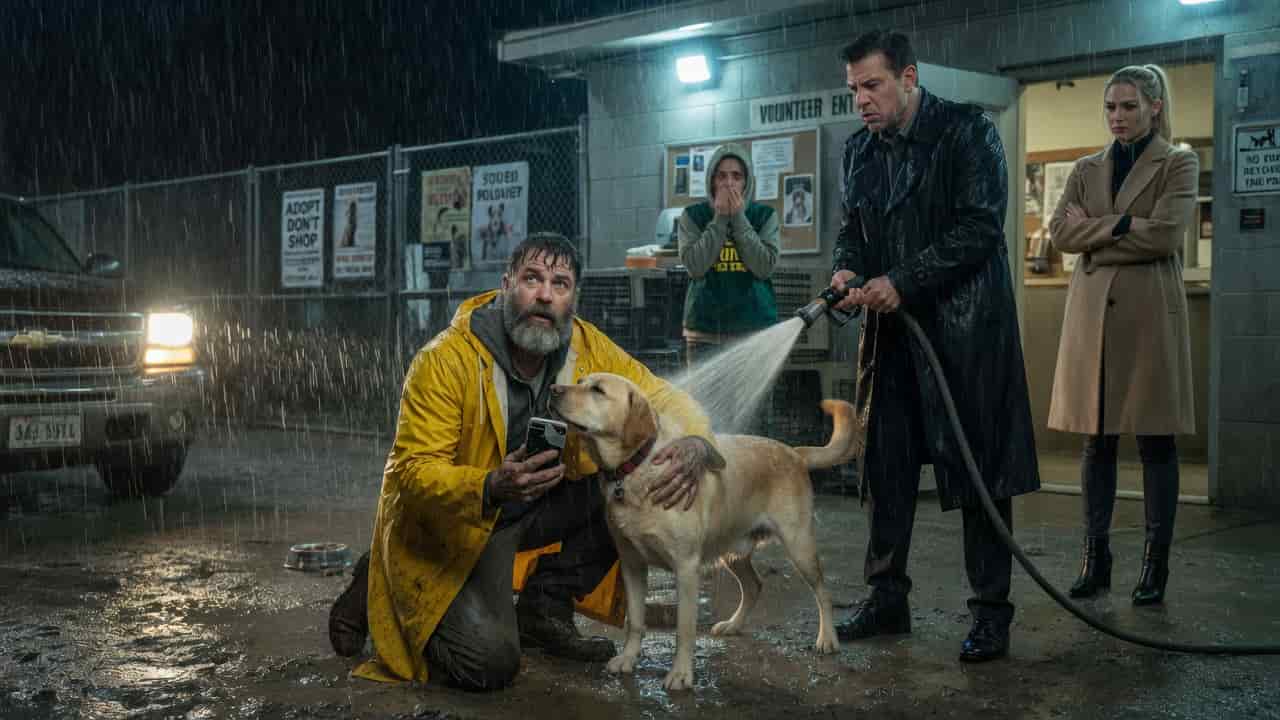
“Eat it, Ben. If you want that old mutt inside where it’s warm, you show me you’re as hungry as he is.”
Garrett dropped a handful of dry kibble into the mud at my feet, his polished shoes staying perfectly dry under the awning. He looked at me like I was something he’d stepped in, and Megan—the woman who used to share my bed—just stood there in her designer coat, watching the rain soak through my cheap hoodie.
They’ve been running this shelter into the ground for months, pocketing the donations while the animals shiver in leaking crates. They thought I was too broken to fight back. They thought because I lost everything in the fire, I had no teeth left.
But I wasn’t just a janitor. I was the one who signed the checks they’d been forging. I was the one who owned the very dirt they were standing on. And I was the one who spent ten years riding with the only family that actually matters when the world turns its back on you.
When Garrett raised that hose to spray my old Labrador, he didn’t see the headlights lining up at the gate. He didn’t hear the roar of five hundred engines drowning out the thunder.
The look on his face when he realizes who actually owns this “trash” is something you have to see to believe.
Chapter 1: The Scent of Wet Concrete
The Pacific Northwest rain didn’t just fall; it inhabited the world. It was a cold, grey presence that seeped into the marrow of your bones and turned the Oregon soil into a hungry, sucking sludge. Ben Hudson shoved the rusted metal spade into the drain grate, prying up a thick mat of sodden fur and waste that had choked the shelter’s outflow again. The smell hit him—a sharp, acidic cocktail of bleach, wet fur, and the underlying rot of a building that had been neglected for too long.
He didn’t flinch. At thirty-eight, Ben’s face was a roadmap of things he’d survived, though the most prominent scars were the ones nobody could see. His salt-and-pepper beard was heavy with moisture, and his yellow raincoat—a cheap thing from a surplus store—was cracked at the elbows. He was the janitor of Second Chance Animal Shelter, a title that came with a sub-minimum wage and the right to be ignored by everyone who walked through the front doors.
“Hudson! You’re lagging!”
The voice cut through the rhythmic drumming of the rain like a dull blade. Ben didn’t look up. He knew the gait of those shoes—expensive leather on concrete. Garrett, the shelter manager, was approaching. Garrett was a man who wore a charcoal wool coat in a kennel and managed to look like he was always smelling something unpleasant, even when he wasn’t looking directly at Ben.
“The south grates are backing up, Garrett,” Ben said, his voice a low, gravelly rumble. He kept his head down, focusing on the mud. “The pump in the basement is struggling. If we don’t clear the main line, the outdoor runs are going to be six inches deep in runoff by midnight.”
Garrett stopped three feet away, just outside the splash zone of Ben’s work. “I don’t pay you for hydraulic analysis, Ben. I pay you to keep the floors looking like someone actually gives a damn about this place. The Board is coming by for a walk-through on Friday. If I see one streak on the lobby glass, you’re back on the street. Understood?”
Ben straightened slowly, his joints popping. He was a large man, built like a brick oven, and even in his tattered rain gear, he dwarfed Garrett. He saw the way Garrett’s eyes flickered, a momentary tremor of fear masked quickly by the arrogance of a man who held a paycheck like a leash.
“Understood,” Ben said quietly.
“Good. And keep that… that creature of yours in the shed. He’s shedding everywhere. It looks unprofessional.”
Garrett gestured vaguely toward the small, leaking lean-to at the edge of the property where Ben was allowed to keep Buster. Buster was a fourteen-year-old yellow Labrador whose muzzle was more white than gold these days. He was Ben’s only family, the only thing he’d managed to pull out of the house ten years ago before the roof collapsed and the world went black.
Ben didn’t respond. He’d learned that words were just targets for men like Garrett. He waited until the manager turned on his heel and disappeared back into the climate-controlled sanctuary of the main office before he dropped the spade and walked toward the shed.
Inside, the air was slightly warmer, though the dampness was inescapable. Buster was lying on a pile of old moving blankets, his tail thumping twice against the wood floor—a slow, rhythmic greeting. The dog’s breath was heavy, a wet rattle in his chest that made Ben’s heart tighten.
“Hey, old man,” Ben whispered, kneeling in the dirt. He reached out with a calloused hand and rubbed the space behind Buster’s ears. The dog leaned into him, a soft whine escaping his throat. “I know. It’s cold. I’ll get the heater running soon as I finish the grates.”
The “heater” was a small electric space heater that tripped the breaker every three hours. It was a pathetic defense against the Oregon winter, but it was all they had. Ben looked at Buster’s eyes—filmy with cataracts but still full of a devastating, simple devotion. This dog had seen Ben at his highest, when he was a man with a thriving construction business and a wife who smiled when he walked through the door. And Buster had stayed when the business burned, the wife left, and the bottle became Ben’s only friend.
Ben pulled a small, dented tin from his pocket—a high-end supplement for joint pain. It cost forty dollars a bottle, nearly two days’ wages for Ben, but he never missed a dose. He tucked the pill into a piece of cheap deli meat and watched Buster swallow it whole.
“Just a little longer, buddy,” Ben said, though he wasn’t sure who he was lying to.
He stood up and looked out the small, grimy window of the shed toward the main building. The Second Chance Animal Shelter was a non-profit, at least on paper. It was supposed to be a haven for the unwanted. But since Garrett had taken over eighteen months ago, the “havens” had become cages, and the “donations” seemed to be funding a lot more than kibble. Ben had seen the invoices. He’d seen the way the high-end dog food was replaced with the cheapest bulk grain available while Garrett’s car got newer and his suits got sharper.
Ben had a secret, one he guarded more fiercely than his own life. He wasn’t just a janitor who’d fallen on hard times. Well, the hard times were real enough, and the manual labor was honest work he needed to keep the ghosts at bay. But Ben Hudson was also the “Anonymous Guardian” who provided nearly ninety percent of the shelter’s operating budget.
Every month, a wire transfer from a blind trust hit the shelter’s accounts. It was the remains of his insurance settlement and the sale of his remaining land—money he couldn’t bring himself to spend on a new life because he felt he didn’t deserve one. He’d stayed close, taking the janitor job under a slightly altered name, just to make sure the money went where it was supposed to go.
He had intended to be a silent protector. But the rot he was seeing now wasn’t just in the pipes. It was in the man running the show.
As the rain intensified, a set of headlights turned into the long, gravel driveway. A white Range Rover, pristine and out of place in the mud. Ben felt a familiar, sharp ache in his chest. He knew that car. He knew the way the driver parked—slightly crooked, impatient.
The door opened, and a woman stepped out. Megan. She was holding a large umbrella, her blonde hair perfectly styled, her beige coat a stark contrast to the grey misery of the shelter. She didn’t look at the cages. She didn’t look at the mud. She walked straight toward the office, her heels clicking on the one patch of dry pavement.
Ten years. It had been ten years since the fire, and six since the divorce papers had been finalized in a cold courtroom. Seeing her now, here, with Garrett, felt like a fresh burn.
Ben gripped the handle of the spade until his knuckles turned white. He had come here to save the animals, to find some shred of redemption in the service of those who couldn’t help themselves. But as he watched his ex-wife disappear into the office with the man who was systematically starving the creatures in Ben’s care, he realized the time for silence was ending.
The grates were still clogged. The pump was still failing. And the storm was only getting started.
Chapter 2: The Ghost in the Hallway
The interior of the shelter lobby smelled of expensive vanilla candles, a thin veil over the persistent scent of ammonia. Ben stood by the mop bucket, his head bowed, slowly working the string mop over the tiles. He kept his movements rhythmic and mindless, the way he’d learned to survive the long hours.
Through the frosted glass of the manager’s office, he could hear voices. Garrett’s laugh—sharp and sycophantic—and Megan’s voice, which still carried the melodic lilt that had once been the soundtrack to Ben’s happiest moments. Now, it just sounded like a haunting.
“The gala is the priority, Garrett,” Megan was saying. Her voice carried through the thin walls. “The donors want to feel like they’re part of something elite. We need to focus on the ‘Success Stories.’ The purebreds, the rescues that look good in a brochure. We can’t have the… less marketable ones… on display.”
“I’ve already moved the older stock to the back runs, Megan,” Garrett replied. Ben heard the clink of glass. They were drinking. “Out of sight, out of mind. I’ve got the janitor working double shifts to make sure the front looks like a goddamn palace.”
Ben squeezed the mop handle. Older stock. That was how they spoke about dogs like Buster. Dogs that had spent their whole lives waiting for a home and were now being hidden away like embarrassing secrets.
The office door opened, and Ben instinctively stepped back into the shadows of the hallway. Megan stepped out first, adjusting her coat. She looked around the lobby with a faint expression of distaste, her eyes sweeping over the “Adopt Me” posters with the clinical detachment of a real estate agent.
Then, her gaze landed on Ben.
He stayed still, the brim of his cap low. For a second, he thought she might pass him by. He was just a shape in a yellow coat, part of the furniture. But Megan had always been perceptive. She slowed her pace, her brow furrowing.
“Ben?” she whispered.
The name sounded foreign coming from her. It belonged to a man who didn’t exist anymore—a man who owned a fleet of trucks and took her to dinner in the city every Friday night.
Ben didn’t look up. “Floor’s wet, ma’am. Watch your step.”
Megan took a step toward him, ignoring Garrett, who had followed her out and was now looking between them with growing confusion. “Ben? Is that really you? What on earth are you doing here? Working as… a janer?”
“It’s honest work, Megan,” Ben said, finally lifting his head.
The shock on her face was visceral. She looked at his beard, the lines around his eyes, the mud on his hands. She looked at him with the kind of pity that felt worse than a punch to the gut. It was the look you gave a car wreck on the side of the highway—relief that it wasn’t you, mixed with a morbid curiosity about the damage.
“You’re the janitor?” Garrett broke in, his voice rising in a mock-surprised pitch. “You two know each other? This is the ‘construction mogul’ you told me about, Megan? The one who lost it all?”
Garrett stepped up beside Megan, sliding a possessive hand onto the small of her back. Ben saw it. He saw the way Megan leaned into the touch, the way she didn’t flinch. It was a calculated move, a public declaration of who had won and who had lost.
“We were married, Garrett,” Megan said, her voice regaining its poise. “A long time ago. Before the… incidents.”
The incidents. That was her word for his collapse. For the months he’d spent in a darkened room, unable to breathe because every time he closed his eyes, he saw the orange glow of the embers. For the way he’d pushed her away because he couldn’t stand the smell of her perfume—the same scent she’d been wearing the night they argued and he’d gone for a drive, leaving the house empty and vulnerable to a faulty wire.
“Small world,” Garrett sneered. He looked Ben up and down, his eyes gleaming with a newfound cruelty. He now had a weapon far more potent than a paycheck. “Well, Ben, if I’d known you were a man of such… pedigree… I would have given you the high-priority tasks sooner. The septic tank in the north field is overflowing. Since you’re so experienced with ‘construction,’ why don’t you go head out there and dig it out? By hand. The backhoe is broken.”
“It’s raining an inch an hour, Garrett,” Ben said. “Digging that out now will just cause a collapse.”
“Did I ask for your professional opinion?” Garrett’s voice turned cold. “Or did I give you an order? Megan and I are going to dinner to discuss the gala. If that tank isn’t cleared by the time I get back, you can take your dog and your blankets and find a new shed to rot in.”
Megan didn’t say a word. She didn’t look at Ben with regret or kindness. She looked at him with the cold, hard eyes of someone who had decided that the past was a weight she no longer cared to carry. She turned and walked toward the door, the bell chiming with a cheerful mockery as they stepped out into the night.
Ben stood in the empty lobby for a long time. The mop bucket was still there, the water dirty and grey. He could feel the residue of the encounter—the shame that sat in the back of his throat like ash. He had allowed himself to be diminished, to be treated like a dog, because he thought it was his penance.
But as he looked at the door, he thought of Buster in the shed. He thought of the forty-dollar pills and the shivering animals in the back runs. He thought of the money he’d funneled into this place, money that was currently being spent on steaks and wine for the people who treated him like garbage.
He walked to the back door and stepped out into the rain. He didn’t go to the septic tank. He went to the shed.
Buster was awake, his head resting on his paws. He let out a low, concerned woof as Ben entered. Ben sat down in the mud, right next to the dog, and let the rain soak through his hoodie. He pulled out his phone—the old, cracked one he only used for emergencies.
He scrolled through his contacts, past the names of people he hadn’t spoken to in years. He stopped at a name he hadn’t touched since the day he’d turned in his colors.
Sully.
His thumb hovered over the call button. Sully was the President of the Iron Disciples, the MC Ben had rode with in his youth, before he’d tried to become a “respectable” man. They were the ones who had helped him clear the rubble after the fire when the insurance company was dragging its feet. They were the ones who didn’t ask questions when he disappeared into the bottle.
Ben looked at Buster. The dog’s breathing was shallow. The shed was leaking in three places now.
He didn’t press call. Not yet. He had to be sure. He had to see just how deep the rot went. If he brought the storm, there would be no going back.
He put the phone away and stood up. He grabbed a shovel from the wall. He would dig the hole Garrett wanted. He would let them think he was broken. He would let the pressure build until the walls couldn’t hold it anymore.
Because Ben Hudson knew one thing about structures: they never fall all at once. They crack first. And he was starting to see the cracks.
Chapter 3: The Donor’s Disdain
The “Second Chance” Gala preparation was a masterclass in superficiality. By Thursday morning, the shelter had been transformed. Potted palms lined the lobby, and the smell of expensive catering—roast beef and truffle oil—replaced the scent of kennel cough and bleach.
Ben was assigned to the “Visibility Team,” which was Garrett’s way of ensuring Ben was in the line of fire for every humiliating task imaginable. He was forced to wear a bright orange vest with “MAINTENANCE” printed in block letters, and he was tasked with hand-polishing the brass railings of the mezzanine while the “Platinum Donors” arrived.
“Don’t speak unless spoken to,” Garrett had hissed at him that morning. “And for God’s sake, stay out of the light. You look like a gargoyle.”
Ben worked the rag over the brass, his movements slow and deliberate. From his vantage point on the mezzanine, he could see the entire room. He saw the local politicians, the wealthy socialites from Portland, and the board members who hadn’t set foot in a kennel in years.
He also saw Sarah. Sarah was a twenty-two-year-old volunteer who actually cared. She spent her lunch breaks reading to the anxious dogs and used her own money to buy toys for the ones that had been there too long. Today, she was dressed in a simple black dress, looking uncomfortable as she handed out brochures.
“Excuse me? Janitor?”
Ben turned. A man in a silk suit was pointing at a spilled glass of red wine on the white carpet near the center of the room. A group of women stood nearby, tittering behind their hands.
“There’s a mess,” the man said, not even looking Ben in the eye. “Clean it up. It’s an eyesore.”
Ben climbed down the stairs, bucket and rags in hand. As he knelt on the carpet to scrub the stain, he could feel the eyes of the room on him. He was a piece of debris, a reminder of the “messy” reality they were all trying to ignore with their thousand-dollar donations.
“Oh, look,” a voice said.
It was Megan. She was walking toward him, accompanied by a woman Ben recognized as the head of the County Animal Control Board.
“Is there a problem, Ben?” Megan asked, her voice dripping with a false, airy concern. “You seem to be having trouble with that stain. Garrett, perhaps we need someone more… capable… for the public areas?”
Garrett appeared from behind a palm tree, a champagne flute in his hand. He looked at the wine stain, then at Ben. A slow, cruel smile spread across his face.
“You’re right, Megan,” Garrett said loudly, ensuring the nearby donors could hear. “Ben has been a bit… slow lately. Maybe it’s the age. Or the company he keeps.” He looked at the crowd. “Ben here refuses to part with a dying dog he keeps in a shed. It’s quite pathetic, really. We offer him a place to work, and he brings his filth with him.”
A ripple of laughter went through the group. Sarah, standing a few feet away, stepped forward, her face flushed. “That’s not fair, Mr. Miller! Buster is a good dog, and Ben works harder than—”
“Quiet, Sarah,” Garrett snapped, his voice sharp as a whip. “Go check the coat room. Now.”
Sarah looked at Ben, her eyes bright with unshed tears. She looked ashamed—not for Ben, but for herself, for being unable to stop the cruelty. She turned and hurried away.
Ben stayed on his knees. He didn’t look up. He kept scrubbing the wine, even though the stain was long gone. The residue of the moment—the collective contempt of the room—settled on him like a shroud.
“Ben,” Megan whispered, leaning down so only he could hear. Her perfume was overwhelming. “You should just leave. For your own dignity. You don’t belong here anymore. You’re just making everyone uncomfortable.”
“I belong wherever I choose to be, Megan,” Ben said, his voice a low vibration that made the water in the bucket ripple.
“Not for much longer,” Garrett intervened. He leaned over Ben, his voice dropping to a hiss. “I found your ‘office’ in the shed, Hudson. I saw the files you were looking at. The invoices. You think you’re some kind of whistleblower? You’re a janitor. Nobody believes a janitor. And tonight, after the gala, I’m calling Animal Control. That dog is a health hazard. He’ll be put down by morning.”
The world went very quiet. The music, the laughter, the clinking of glasses—it all faded into a dull roar in Ben’s ears. The “rot” wasn’t just greed anymore. It was a direct threat to the only heart that still beat for him.
Ben stood up. He didn’t say a word. He didn’t throw a punch, though every muscle in his body screamed for it. He picked up his bucket and walked out of the lobby.
He didn’t go back to the mezzanine. He walked through the kitchen, out the back door, and into the freezing rain.
He walked to the shed. Buster was lying in the corner, his breathing labored. The water was starting to pool on the floor.
Ben pulled out his phone. His hands were shaking, but not from the cold.
He hit the call button. It rang twice.
“Yeah?” A rough, deep voice answered. Sully.
“Sully. It’s Bear.”
There was a long silence on the other end. “Bear? Christ, man. Where the hell have you been? We thought you were—”
“I need a favor, Sully. A big one.”
“Anything. Name it.”
Ben looked at the main building, the warm yellow light spilling out of the windows, the silhouettes of the people who thought they could play God with the lives of the weak.
“I need the brothers. All of them. And I need the trucks. Every ounce of kibble, every blanket, every medical supply you can find in the county.”
“Who we hitting, Bear?” Sully’s voice turned hard, professional.
“The Second Chance Shelter,” Ben said. “And Sully? Tell the boys to bring their loudest pipes. We’re going to bring the storm.”
Ben hung up. He sat down next to Buster and pulled the dog’s head into his lap.
“One more night, buddy,” Ben whispered. “Just one more night.”
Chapter 4: The Breaking Point
By 11:00 PM, the gala was winding down, but the storm was just reaching its crescendo. The rain had turned into a torrential downpour, flooding the gravel parking lot and turning the outdoor kennel runs into a swamp.
Ben stood in the darkness of the shed, watching. He’d seen the Animal Control van pull into the far gate twenty minutes ago. Garrett was meeting the officer now, gesturing toward the shed with a smug, self-assured grin. Megan stood beside him, her beige coat now covered by a black umbrella, looking like a spectator at an execution.
Ben reached into the pocket of his hoodie and pulled out a folded piece of paper. It was the deed to the land and the purchase agreement for the Second Chance Animal Shelter, signed and notarized that morning. He’d spent the last of his “ghost” money to buy the debt from the bank that had been quietly foreclosing on the property.
He wasn’t a janitor anymore. He was the owner. But he wasn’t going to show them the paper yet. Not until the humiliation was complete. Not until they showed the world exactly who they were.
“Hudson! Get out here!”
Garrett’s voice was amplified by a bullhorn. He was standing fifty feet away, flanked by the Animal Control officer and Megan. Sarah was there too, held back by another staff member, her face wet with tears and rain.
Ben stepped out of the shed. He was carrying Buster in his arms. The dog was wrapped in a dry moving blanket, his head resting on Ben’s shoulder.
“Put the dog down, Ben,” Garrett shouted. “Officer Vance here is taking him. He’s a public health risk. And you’re trespassing. Your employment was terminated an hour ago.”
Ben walked slowly toward them, his boots splashing in the deep puddles. He stopped ten feet away. The light from the security beams caught the silver in his beard and the hardness in his eyes.
“The dog stays with me, Garrett,” Ben said.
“It wasn’t a request,” Garrett sneered. He turned to the officer. “Go ahead, Vance. Take the animal.”
The officer stepped forward, but Ben didn’t move. He didn’t even look at the man. He looked at Megan.
“Is this what you wanted, Megan?” Ben asked. “To watch me lose the last thing I have? Does this make the steak taste better?”
Megan looked away, her jaw tight. “You did this to yourself, Ben. You chose this life. You chose to be… this.”
“I chose to stay,” Ben said. “I chose to watch. And I saw what you two did. The missing funds. The expired medicine. The way you let these animals suffer so you could buy a Range Rover.”
“Lies!” Garrett screamed. “You’re a delusional drunk! Vance, take the dog!”
Garrett lunged forward, grabbing Ben’s arm. He tried to pull Buster away, his fingers digging into the old dog’s fur. Buster let out a pained yelp.
That was the spark.
Ben didn’t hit him. He simply dropped his shoulder and drove Garrett back with a force that sent the manager sprawling into the mud. Garrett’s expensive coat was instantly ruined, coated in a thick layer of grey slime.
“You’re dead!” Garrett shrieked, scrambling to his feet. “I’ll have you locked up! I’ll—”
Ben pulled out his phone. He didn’t look at the screen. He just tapped the “send” button on a pre-written message.
Now.
For a second, there was only the sound of the rain. Garrett was huffing, wiping mud from his face, Megan was gasping in shock, and the officer was reaching for his belt.
Then, a low rumble started.
It didn’t sound like thunder. It was too rhythmic, too mechanical. It was a deep, guttural vibration that started in the soles of their feet and rose up through their chests.
The headlights hit first.
From the darkness of the long driveway, a wall of light appeared. Two by two, the motorcycles rounded the bend, their LED bars cutting through the rain like white lasers. The sound was deafening now—a synchronized roar of five hundred heavy-duty engines.
The Iron Disciples.
They didn’t stop at the gate. They rode right onto the lawn, circling the courtyard in a swirling vortex of chrome and leather. The mud flew as the tires tore up the manicured grass.
Sully was in the lead, his massive Harley-Davidson coming to a halt inches from Garrett’s face. He cut the engine, and one by one, the other five hundred riders followed suit. The silence that followed was even louder than the roar.
Sully hopped off his bike, his leather vest displaying the “President” patch. He walked over to Ben and stood beside him, a wall of muscle and tattoos.
“You okay, Bear?” Sully asked.
“I’m fine, Sully,” Ben said, his voice steady.
He looked at Garrett, who was now trembling, his face pale with a terror that went beyond words. Megan was frozen, her umbrella forgotten on the ground.
Ben reached into his pocket and pulled out the folded paper. He held it out to Garrett.
“What… what is this?” Garrett stammered.
“That’s the deed to this property, Garrett,” Ben said. “And a list of every financial discrepancy I’ve documented over the last eighteen months. The police are ten minutes behind my brothers. And they aren’t coming for the dog.”
Ben looked at Sarah, who was staring at him with wide, disbelieving eyes. He looked at the animals in the crates, their heads poking out, sensing the shift in the air.
“The storm is here, Garrett,” Ben said quietly. “And it’s time to clean up the mess.”
Chapter 5: The Weight of the Chain
The roar of five hundred idling engines wasn’t just a sound; it was a physical pressure that vibrated through the marrow of everyone standing in that rain-drenched courtyard. The exhaust fumes mingled with the scent of wet asphalt and cedar, creating a thick, industrial haze that shimmered under the blue-and-red flicker of the security lights. The Iron Disciples didn’t move. They sat like stone gargoyles on their machines, their leather vests slick with rain, their eyes fixed on the man in the mud.
Garrett Miller looked small. For months, he had been the king of this small, miserable hill, ruling with a sharp tongue and a designer shoe on the necks of the vulnerable. But as he sat in the grey sludge of the driveway, his charcoal coat ruined and his pride leaking out into the dirt, he looked like what he truly was: a middle-manager who had mistaken cruelty for power.
“Get up, Garrett,” Ben said. His voice wasn’t loud, but it cut through the low thrum of the motorcycles with the weight of an anvil. He was still holding Buster, the old dog’s heart a frantic, tiny drumbeat against his chest. “The mud suits you, but we have work to do.”
Garrett scrambled to his knees, his hands shaking as he tried to wipe the grime from his face. “This is assault! I’m calling the police! These… these thugs… you can’t just bring a gang onto private property!”
“That’s the thing, Garrett,” Ben said, stepping forward. The bikers shifted in unison, a subtle, predatory movement that made the Animal Control officer, Vance, take three steps back toward his van. “It’s not private property. Not yours, anyway. As of nine-oh-two this morning, the deed for the Second Chance acreage, the physical structures, and all outstanding municipal debts belong to Hudson Holdings.”
Ben pulled a heavy, plastic-sleeved folder from inside his raincoat. He didn’t toss it. He walked right up to Garrett and dropped it into the man’s lap. The weight of the legal documents made Garrett grunt.
“Page twelve,” Ben said, his eyes cold and level. “The forensic audit. It tracks the four hundred thousand dollars in ‘Anonymous Guardian’ donations I’ve funneled into this place over the last two years. It shows exactly where that money went—and it wasn’t to the premium kibble or the roof repairs. It went to a shell company registered to your brother-in-law in Bend. It went to your Range Rover lease. It went to Megan’s ‘consulting’ fees.”
Megan, who had been standing frozen under her umbrella, suddenly found her voice. “Ben, you’re being dramatic. Those were legitimate expenses for the gala, for the rebranding—”
“The rebranding of what, Megan?” Ben turned his gaze toward her. The look wasn’t angry; it was worse. It was indifferent. It was the look of a man who had finally stopped looking for his reflection in her eyes. “The dogs are starving. The north runs are flooding with raw sewage. You’re drinking thirty-year-old scotch in an office while Sarah over there is crying because she can’t afford to buy hay for the rabbits. You didn’t rebrand a shelter. You mined a tragedy for a paycheck.”
Megan flinched as if he’d slapped her. She looked around at the wall of bikers, the chrome reflecting her own pale, terrified expression. For the first time in years, she wasn’t the one in control of the narrative. She was just a witness to her own exposure.
Sully, the President of the Disciples, kicked his kickstand down and stepped off his bike. He walked over to Ben, his heavy boots crunching on the gravel. He didn’t look at the villains; he looked at the dog in Ben’s arms.
“How’s the old man?” Sully asked, his voice a gravelly whisper.
“He’s cold, Sully. He’s tired,” Ben replied.
Sully nodded and looked back at the line of bikes. “Jax! Tiny! Get the ramp down on the lead trailer. We’ve got two tons of high-protein grain and a pallet of medical-grade blankets. And somebody get the heaters out of the back of the dually.”
In an instant, the courtyard transformed from a standoff into a construction site. The bikers didn’t wait for orders. They moved with a practiced, military efficiency born of years of riding together and looking out for their own. The back of a massive black semi-truck—bearing no markings other than a small, subtle disc of a skull and wrenches—swung open.
Men who looked like they lived on a diet of iron and whiskey began unloading bags of high-end dog food with the same care they’d use to handle a vintage engine. Two men carrying a massive industrial space heater jogged toward the main building, pushing past the stunned gala guests who were still huddled under the awning.
“You can’t do this!” Garrett shrieked, finally finding his feet. He lunged toward Sully, a desperate, foolish move. “This is a non-profit! You’re contaminating a sterile environment!”
Sully didn’t even turn his head. He just stuck out a massive, tattooed arm and caught Garrett by the throat, pinning him against the side of the Animal Control van. The metal groaned under the impact. Officer Vance started to reach for his holster, but Jax—a man with a neck thicker than most people’s thighs—stepped into his line of sight and shook his head once. Vance let his hands drop.
“Listen to me, you little worm,” Sully said, his face inches from Garrett’s. “I spent six years in the state pen for things I don’t regret. My brothers and I? We don’t like people who hurt things that can’t fight back. You’ve been starving these animals. You’ve been disrespecting a man who’s worth ten of you. If you say one more word about ‘contamination,’ I’m going to make sure the only thing you’re managing is a liquid diet through a straw.”
Sully let go, and Garrett slumped against the van, gasping for air.
Ben turned toward Sarah, the young volunteer who was still standing by the door, soaked to the bone. “Sarah.”
She looked up, her eyes wide. “Ben? I… I didn’t know.”
“I know you didn’t,” Ben said, his voice softening. “I need you to take charge of the inventory. These men will do whatever you tell them. We need to feed every animal in the back runs first. Start with the seniors. Double rations. And get the medical kits to the vet room. Doc Miller—not this Miller,” he gestured with contempt at Garrett, “is on his way.”
Sarah nodded, a spark of hope finally igniting in her expression. She wiped her eyes and stepped forward, pointing toward the warehouse doors. “This way! We need to clear the pallets in the loading dock first!”
As the chaos of the rescue began, Ben felt a hand on his arm. It was Megan. She had moved closer, her umbrella discarded, her expensive hair now plastered to her face. The designer coat was heavy with water, making her look weighed down, diminished.
“Ben,” she said, her voice trembling. “We can talk about this. I can help you manage the transition. I know the donors, I know the paperwork. Garrett was the one who… he misled me. I didn’t realize how bad it had gotten.”
Ben looked at her. He thought about the fire. He thought about the night she’d left, telling him that she couldn’t stay with a “ghost” of a man, that she needed someone who was actually “alive.” He realized then that she’d never meant someone who was alive in spirit—she’d meant someone who had a functioning bank account.
“You knew exactly how bad it was, Megan,” Ben said. “You just didn’t think the janitor was the one who owned the building. You didn’t think the ‘trash’ you threw away ten years ago could still bite.”
“That’s not fair,” she whispered.
“Fair?” Ben let out a short, dry laugh that had no humor in it. “Fair is you leaving this property right now. Fair is you taking that Range Rover—which, by the way, I’m revoking the corporate lease on by Monday—and driving back to the life you built on the backs of these animals. Don’t come back, Megan. If I see you on this land again, I won’t call my brothers. I’ll call the Sheriff with the wire-transfer records.”
He turned his back on her, a final, irreversible closing of a door. He felt the residue of the encounter—a lingering bitterness, but also a strange, light emptiness. The ghost of the man who had loved her was finally, truly gone.
He walked toward the shed one last time. The bikers were already there, setting up a temporary triage station. A man named “Grease,” a mechanic who could fix a transmission with a paperclip, was gently lifting the old Labrador blankets and replacing them with thick, fleece-lined pads.
“Easy there, old timer,” Grease was saying to Buster. The dog was licking the man’s rough, oil-stained hand.
Ben sat down on a crate, the adrenaline finally starting to ebb, leaving a deep, bone-crushing fatigue in its wake. He looked at his hands—muddy, scarred, and strong. He wasn’t the man he’d been before the fire, and he wasn’t the broken janitor anymore. He was something new. Something forged.
The rain continued to fall, but the sound had changed. It was no longer a drowning weight. It was a washing. The roar of the engines had faded to a low, comforting hum as the brothers settled in for the long night of work.
“Bear,” Sully said, walking over and handing Ben a thermos of steaming black coffee. “The cops are at the gate. Two cruisers. You want me to handle it?”
Ben took a sip of the coffee, the heat spreading through his chest. He looked at the main building, where the lights were bright and the animals were finally being fed. He looked at Garrett, who was being handcuffed by a deputy while Megan stood by her car, looking utterly alone in the dark.
“No,” Ben said, standing up and handing Buster’s leash to Grease for a moment. “I’ll handle it. It’s my house now.”
He walked toward the gate, his boots heavy and certain on the gravel. He had spent ten years hiding in the shadows of his own grief, waiting for the world to finish him off. But as he looked at the brothers standing guard and the young volunteer leading the way into the future, he realized that sometimes, you have to let the house burn down before you can see the stars.
The pressure was still there, the weight of the responsibility he’d just reclaimed. But for the first time since the sparks hit the roof of his old life, Ben Hudson could breathe. The chain was broken. And the man who had been a ghost was finally home.
Chapter 6: The First Light of the Morning
The sun didn’t rise over the Oregon hills so much as it gradually thinned the darkness into a pale, translucent blue. By six in the morning, the rain had finally tapered off to a fine mist, and the Second Chance Animal Shelter was unrecognizable. The gala decorations—the palms, the silk ribbons, the hollow promises—had been stripped away and tossed into a dumpster like the trash they were. In their place was the raw, honest machinery of a working sanctuary.
Ben sat on the tailgate of Sully’s truck, watching the last of the Iron Disciples prepare to head out. They moved quietly now, the bravado of the night replaced by the quiet satisfaction of men who had done something that actually mattered. Jax was helping Sarah organize the new pharmacy supplies, while Tiny was using a power-washer to scrub months of filth from the north kennel runs.
“We’re clear on the logistics, Bear,” Sully said, leaning against the truck bed. He looked tired, but his eyes were bright. “I’ve got three guys staying behind for the week to handle the heavy repairs on the roof and the plumbing. We’ll rotate the guard shifts until the new security team you hired gets here on Monday.”
“Thanks, Sully,” Ben said. “I mean it. I didn’t know who else to call.”
“You don’t have to explain, man,” Sully replied, clapping a hand on Ben’s shoulder. “We’re family. You might have tried to go ‘straight’ for a while, but the blood doesn’t change. You called, and the Disciples answered. That’s the code.”
Sully looked toward the vet room, where the lights were still on. “How’s the dog?”
“Doc says he’s stable,” Ben said, his voice tightening slightly. “The pneumonia was caught just in time. The warmth, the dry blankets… it made the difference. He’s sleeping now. First time in weeks he hasn’t been shivering.”
“Good,” Sully nodded. “He’s a fighter. Just like his owner.”
As the motorcycles roared to life and the brothers began to filter out of the driveway, the silence that followed was different than the one that had preceded the storm. It was a peaceful silence, filled with the soft sounds of dogs eating and the distant chirp of birds in the cedar trees.
Ben walked toward the main office. He had a lot of work to do. There were lawyers to call, a board of directors to dissolve, and a search to begin for a legitimate manager—someone like Sarah, who saw the animals as souls rather than line items.
He found Sarah in the lobby, curled up in one of the donor chairs, fast asleep. She was still wearing the mud-stained black dress, a brochure clutched in her hand. Ben walked over and gently draped his dry hoodie over her shoulders. She didn’t wake up, but she let out a small, contented sigh.
He stepped into the manager’s office—his office now. The smell of vanilla and scotch was gone, replaced by the crisp, cool air of the morning. He sat in the chair Garrett had occupied and looked at the framed photos on the wall. They were all of Garrett—Garrett with local celebrities, Garrett at award ceremonies. Ben took them down, one by one, and placed them face-down in the trash.
Then, he heard the sound of a car. A single vehicle, moving slowly up the drive.
He stood up and walked to the window. It wasn’t the Range Rover. It was a modest silver sedan—Megan’s personal car, the one she’d kept from before the “new life” began.
She parked and sat there for a long minute before stepping out. She wasn’t wearing the beige coat anymore. She was in a simple sweater and jeans, her face pale and scrubbed of the heavy gala makeup. She looked older, more fragile.
Ben met her on the porch. He didn’t step down to meet her. He stayed on the higher ground.
“The police came to my house this morning, Ben,” she said. Her voice was thin, stripped of its melodic armor. “They took my laptop. They took the records from the gala.”
“I told you they would,” Ben said.
“I’m going to lose everything, aren’t I?” she asked, her eyes searching his for a spark of the old Ben, the one who would have sacrificed himself to keep her safe. “The house, the reputation… it’s all tied to the shelter’s accounts.”
“You didn’t lose it, Megan,” Ben said firmly. “You traded it. You traded it for a car and a title and the feeling of being better than everyone else. You knew Garrett was dirty. You just thought you were clean enough to stand next to him and not get stained.”
Megan looked down at her hands. “I was scared, Ben. After the fire… after you went into that hole… I didn’t know how to survive without the things we had. I just wanted to be safe.”
“Safety isn’t something you buy with someone else’s blood, Megan,” Ben said. “And it’s definitely not something you build on the bones of helpless creatures. You were safe with me. You just didn’t like the way ‘safe’ looked when it was covered in soot.”
She looked up, a single tear tracking through the dust on her cheek. “Can you forgive me? Not for the money. Just… for leaving.”
Ben looked at her for a long time. He felt the weight of ten years of resentment, the heavy, suffocating pressure of his own failure. He realized that as long as he held onto the anger, he was still tied to her. He was still the man in the dark room, smelling the smoke.
“I forgive you, Megan,” he said quietly.
Her face lit up with a momentary flash of relief, but he held up a hand.
“But I don’t want you in my life,” he continued. “Forgiveness doesn’t mean restoration. It means I’m done carrying you. Go settle your debts. Tell the truth to the DA. Maybe you can find a way to be someone you actually like again. But you’re going to have to do it on your own.”
Megan stared at him, the reality finally sinking in. The man she had discarded wasn’t just back—he had outgrown her. He was solid in a way she would never understand. She nodded slowly, turned, and walked back to her car. She didn’t look back as she drove away, the silver sedan disappearing into the morning mist.
Ben stood on the porch until the sound of her engine faded. He felt a profound sense of closure, a clicking into place of a gear that had been jammed for a decade. The residue was still there—the sadness of a life that had gone wrong—nhưng it no longer felt like a poison. It felt like history.
He walked back inside and headed straight for the vet room.
Buster was awake. He was lying in a large, heated enclosure, his head resting on a soft blue pillow. Beside him, a bowl of fresh water and a small plate of real chicken sat untouched. When he saw Ben, his tail gave a weak but unmistakable thump against the plastic lining.
“Hey, old man,” Ben whispered, kneeling down.
He didn’t care about the mud on his knees or the fact that he hadn’t slept in thirty-six hours. He reached out and stroked Buster’s head. The dog’s fur was dry and soft, and the rattle in his chest seemed quieter, more manageable.
“We did it,” Ben said. “The shelter is ours. No more sheds. No more cold rain. You’re going to spend the rest of your days on the softest bed in Oregon, eating steak and watching the sun come up.”
Buster licked Ben’s thumb, his dark eyes full of that same, unwavering devotion. For the first time, Ben didn’t feel like he was failing the dog. He didn’t feel like he was a man who only brought ruin.
Sarah walked in, rubbing her eyes and smiling through her exhaustion. “He looks better, doesn’t he?”
“He does,” Ben said, standing up. “Sarah, I want you to start the paperwork for a permanent staff. I want the best people we can find. People who care about the animals first. I’m going to be handling the business side from the city, but this is your house now. You’re the director.”
Sarah’s mouth fell open. “Me? Ben, I’m just a volunteer. I don’t have a degree in—”
“You have a heart,” Ben interrupted. “And you have the courage to stand up when everyone else is looking the other way. That’s the only degree that matters to me. We’ll hire the experts to help you, but you’re the soul of this place.”
He walked to the window and looked out at the courtyard. The sun was fully up now, casting long, golden shadows across the gravel. The bikers were gone, leaving only the memory of their roar and the two tons of food they’d delivered.
Ben Hudson looked at his reflection in the glass. He saw a man who had been through the fire and come out the other side. He wasn’t the mogul he’d been, and he wasn’t the janitor anymore. He was the Guardian.
He reached into his pocket and pulled out his old smartphone. He looked at the call log—the one call to Sully that had changed everything. He deleted the number, not because he didn’t want it, but because he knew he wouldn’t need to call in the storm again. He had learned how to be the sun.
He walked back to Buster’s side and sat on the floor, leaning his back against the enclosure. He closed his eyes, listening to the rhythmic breathing of the dog and the distant, happy barking of the rescues in the back runs.
The fire was out. The rain had stopped. And for Ben Hudson, the long night was finally over. He drifted off to sleep, a man no longer haunted by his past, but finally, truly, inhabiting his present.