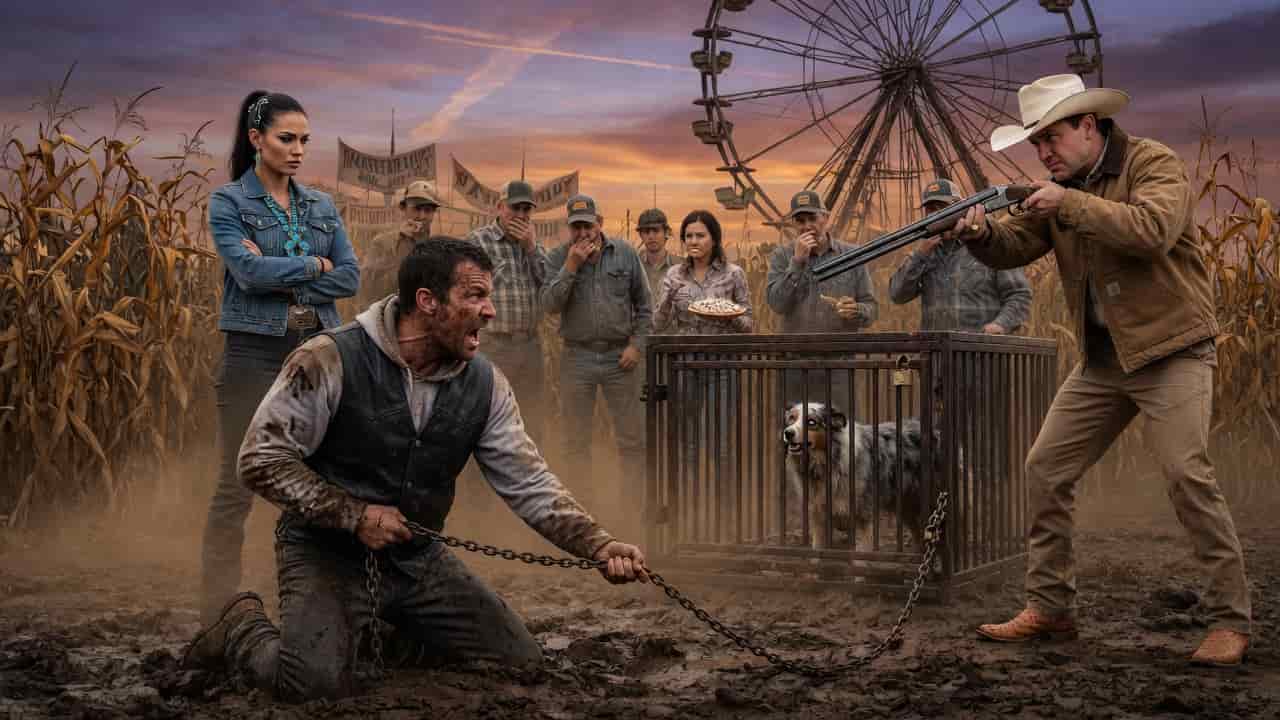
“Bark for me, grease monkey. Tell them all how sorry you are for breathing our air.”
Travis stood there in his three-hundred-dollar boots, the polished leather gleaming even in the Kansas dust. He had the shotgun aimed right at the rusted cage where Scoot was whimpering. My dog. The only thing in this hell-hole county that didn’t have a price tag on its loyalty.
I was on my knees in the mud pit, the thick, black muck of the fairgrounds soaking through my denim. The farmers—men I’d grown up with, men whose tractors I’d fixed for pennies when the crops failed—just stood there. They looked at the ground. They looked at their caps. Nobody looked at me.
“Touch that trigger, Travis, and you’re gone,” I said. My voice was thick with the grit of the road, but I didn’t shake. I couldn’t. Not with Savannah standing right behind him, wearing that designer jacket I’d worked eighteen-hour shifts to buy her, watching me like I was a stray cat he was finally putting down.
“You really think you’re in a position to make threats, Colt?” Travis kicked a spray of mud onto my chest, the wet slap of it echoing in the sudden silence of the crowd. “Look at you. You’re nothing. You’re a grease stain on a family name that actually matters.”
He thought he’d won. He thought the silence meant the town was on his side. He didn’t hear the vibration starting in the soles of his boots. He didn’t see the dust rising over the cornfields—five hundred of my brothers, coming to show him exactly what happens when you try to bury a man who knows where all your secrets are hidden.
Chapter 1
The air at the Flint Hills Agricultural Fair tasted like fried dough, diesel exhaust, and the impending rot of a late-August heatwave. It was the kind of heat that didn’t just sit on you; it pushed. It made people mean. It made the dust from the cattle pens stick to the back of your throat until every word felt like it was being dragged over gravel.
Colt West stood by the entrance of the main exhibition ring, his thumbs hooked into the belt loops of his oil-stained jeans. He was thirty-four, but in this light, under the harsh Kansas sun, the lines around his eyes looked deep enough to hold a week’s worth of regret. He was a big man, built of ropey muscle and a stubbornness that had outlasted three different recessions, but today he felt small. The leather vest of the Dust Devils MC felt heavy, the patch on his back a target he’d carried since he was nineteen.
“Look at this,” a voice drawled, cutting through the low lowing of the prize heifers. “The prodigal grease monkey returns to the scene of the crime.”
Colt didn’t have to turn around. He knew that voice. It was the sound of inherited land, subsidized water rights, and a soul that had never had to work for a damn thing it owned. Travis Miller stepped into Colt’s peripheral vision, flanked by two of his hired hands—thick-necked boys named Miller and Gentry who looked like they’d been bred specifically to take orders and move hay bales.
Travis was dressed for the cameras: a crisp tan jacket, jeans without a single smear of work on them, and a white Stetson that probably cost more than Colt’s first motorcycle. He held a double-barrel shotgun casually over his shoulder, the way a man might carry a golf club.
“I’m just here for the dog, Travis,” Colt said, his voice level. “Give me Scoot, and I’m out of your hair. No trouble.”
“No trouble?” Travis laughed, and the sound prompted a few nearby farmers to stop and look. This was the theater of the small town—the public stripping of a man who didn’t know his place. “You roll into this town on that loud-mouthed scrap heap you call a bike, leaking oil all over the fairgrounds, and you think you can just walk away with property that was found wandering on my land?”
“He wasn’t wandering. He was on the county road,” Colt replied. He could feel the heat rising in his neck, the old familiar itch to swing, but he suppressed it. He knew the stakes.
“My land starts where I say it starts, West. And your dog? He was worrying my sheep. That’s a capital offense in these parts.” Travis gestured with his chin toward the center of the fairground, where a rusted iron cage sat in the middle of a muddy pen used for the pig scramble. Inside, a black-and-white Australian Shepherd huddled in the corner, his tail tucked so tight it was invisible.
“Scoot wouldn’t hurt a fly,” Colt said, stepping forward.
Miller and Gentry immediately stepped into his path, their chests puffed out. They were younger than Colt, faster maybe, but they didn’t have the miles on them. They didn’t have the scars.
“He’s staying in the cage until the board decides what to do with him,” Travis said, his eyes scanning the crowd that was starting to gather. He loved an audience. He thrived on the social weight of his name. “And as for you, you’ve got some explaining to do. My foreman found one of those little electronic boxes of yours tucked under the bridge at the creek. Environmental sensors, the sheriff called ’em. You spying on us, Colt? Trying to find a way to sue the hands that fed your daddy for forty years?”
The crowd murmured. In a town where the water table was the difference between a new combine and a foreclosure, the word ‘environmental’ was a slur. Travis knew exactly which button to press. He wasn’t just bullying a biker; he was defending the tribe against an outsider.
Colt’s hand drifted toward his vest pocket, where a small plastic bottle of cloudy creek water was hidden. He’d spent months tracking the runoff, seeing the way Travis’s new fertilizer processing plant was leaching nitrates into the only clean well in the township. It wasn’t about a lawsuit. It was about the fact that his brothers’ kids were getting rashes, and the old men at the VFW were coughing up gray phlegm.
“The water’s changing, Travis,” Colt said. “You know it. I know it.”
“What I know,” Travis said, his voice dropping to a dangerous, silky edge, “is that you’re standing on my fairgrounds, wearing a gang patch, accusing the man who keeps this county’s heart beating of being a criminal. You want your dog back? You want to leave here without a set of handcuffs on?”
He pointed the shotgun toward the mud pit. The recent rains and the heavy traffic of the livestock had turned the center of the ring into a foul, black slurry of manure and clay.
“Apologize,” Travis said. “Get down there and tell these people you’re sorry for bringing your filth into our town. Tell ’em you’re sorry for trying to sabotage the harvest. Maybe then I’ll think about letting that mutt go.”
Colt looked at the crowd. He saw Old Man Henderson, whose radiator Colt had fixed for free last winter. He saw the Miller twins, who’d gone to school with him. They all looked away. The social gravity of Travis Miller was too high; to stand with Colt was to fall out of orbit, and in this town, nobody survived in the dark.
“I’m not apologizing for the truth,” Colt said.
Travis didn’t hesitate. He swung the shotgun around and aimed it directly at the rusted cage. Scoot let out a sharp, terrified yelp and tried to burrow into the iron bars.
“The choice is yours, grease monkey,” Travis sneered. “The dirt or the dog.”
The residue of the moment settled over Colt like ash. He could see his wife, Savannah, standing on the edge of the VIP tent, a glass of Chardonnay in her hand. She didn’t look worried. She looked bored. She looked like she was waiting for the inevitable conclusion of a story she’d already read.
Colt felt the first drop of sweat roll down his spine. He looked at the mud, then at the dog, and then at the hundreds of eyes waiting for him to break. He realized then that this wasn’t just about a sensor or a dog. It was about the fact that Travis Miller had spent thirty years trying to make Colt West disappear, and he’d finally found the right shovel.
Chapter 2
The internal clock of a man who lives on the road is calibrated to the hum of an engine and the shift of the wind, but as Colt stared into the black muck of the pig pen, time seemed to liquefy. He remembered being seven years old, sitting in the back of his father’s rusted-out pickup, watching Travis’s father hand his dad a wad of cash that wasn’t nearly enough to cover the work he’d done. His father had taken it, tipped his cap, and said, “Thank you, sir.”
Colt had hated that ‘sir’ more than the hunger. He’d spent his whole life trying to outrun that word.
“Tick tock, Colt,” Travis prompted, the shotgun steady in his grip. The metal of the barrel caught the orange light of the sinking sun, gleaming with a predatory sheen. “My trigger finger’s getting a little cramped.”
Colt took a step forward. The mud at the edge of the pit gave way under his boots with a wet, sucking sound. He felt a hand on his shoulder. He turned, expecting one of Travis’s thugs, but it was Savannah.
She’d stepped down from the VIP tent, her designer heels sinking into the soft earth. Her face was a mask of cold, practiced disappointment. This was the woman he’d spent ten years trying to protect, the woman he’d married despite the warnings of his brothers in the MC. They’d called her a ‘climber.’ Colt had called her a ‘survivor.’
“Just do it, Colt,” she whispered, her voice barely audible over the wind. “Don’t be a martyr for a dog. You’re embarrassing me.”
The words hit harder than any fist. Embarrassing me. Not ‘I’m scared for you,’ or ‘let’s get out of here.’ Just the social cost of his humiliation. He looked at her, really looked at her, and saw the truth he’d been minimizing for a decade. She didn’t love the man who fixed bikes and fought for the little guy; she loved the idea of a reformed bad boy she could parade until he became a liability.
“He’s going to kill him, Savannah,” Colt said, nodding toward Scoot.
“Then let him,” she snapped, her eyes flaring with a sudden, sharp cruelty. “It’s just a dog. You want to lose your reputation, your business, and your wife over a stray? Do you have any idea what people are saying about us? About the sensors? Travis told me everything. He told me you’re trying to ruin the Millers because you’re still jealous of a high school football game from fifteen years ago.”
“Jealous?” Colt let out a dry, hacking laugh. “He’s poisoning the wells, Sav. Your sister’s kids are drinking that water.”
“My sister’s kids are fine,” she said, dismissively. “Travis is providing jobs. He’s providing a future. You’re providing… what? Noise and grease?” She leaned closer, her breath smelling of expensive wine. “I married you on a bet, Colt. My friends said I couldn’t tame a West. I won the bet. Don’t make me lose the social standing that came with it.”
The world narrowed to a sharp, painful point. The bet. It wasn’t just a rumor the guys at the clubhouse had whispered. It was the foundation of his home. Every ‘I love you,’ every late-night conversation, every sacrifice—it was all part of a tally sheet in a game he didn’t know he was playing.
Colt felt something inside him go cold. Not the cold of fear, but the cold of a machine that had been pushed past its limit and was now running on pure, frictionless intent.
“Step back, Savannah,” he said. His voice was different now. The gravel was gone, replaced by a terrifying, hollow clarity.
“Colt—”
“Step. Back.”
She recoiled, the look of boredom finally replaced by a flicker of genuine alarm. She’d never heard him speak like that. She retreated toward Travis, instinctively seeking the shelter of the man with the money and the gun.
Colt turned his attention back to Travis. He could see the secret hidden in the way Travis held himself—the slight tremor in his jaw, the way he kept glancing at the crowd. Travis wasn’t just enjoying the power; he was desperate for it. He needed this humiliation to be public because his own foundation was rotting. The sensors Colt had placed weren’t just picking up nitrates; they were picking up the death rattle of an empire built on shortcuts and toxic runoff.
“You want an apology, Travis?” Colt asked. He reached into his vest and pulled out the small plastic bottle of water. He held it up so the crowd could see the murky, yellowish tint of it. “You want me to tell these people that I’m sorry for wanting them to have water that doesn’t kill their cattle? You want me to say I’m sorry for noticing that your ‘harvest’ is built on a pile of bones?”
Travis’s face went from smug to a deep, mottled purple. “I told you to get in the mud, West! I didn’t tell you to give a speech!”
“I’m going into the mud,” Colt said. He dropped the bottle into the muck. “But I’m not going alone.”
He dropped to one knee. The impact sent a spray of black slurry up onto his leather vest, staining the patch he’d spent a lifetime earning. The crowd gasped, a collective intake of breath that sounded like a wind through dry corn. To see Cutter West, the man who’d once stared down a rival gang with nothing but a chain and a grin, brought to his knees by a man in a white hat—it was the end of an era.
But as Colt’s other knee hit the mud, his hand didn’t go down to support himself. It went to the heavy iron chain he’d been carrying in his fist. He didn’t look like a defeated man. He looked like a man who was setting a trap.
“I’m sorry, Travis,” Colt said, his voice echoing across the fairgrounds. “I’m sorry I didn’t come for you sooner.”
The roar of a single motorcycle engine erupted from the north end of the fairgrounds. It was distant, but it was unmistakable—the high-pitched, aggressive scream of a dirt bike stripped for speed. Then another joined it. Then four more.
Travis’s head snapped around, his shotgun wavering. “What is that? Miller! Gentry! What the hell is that?”
Colt just smiled, his teeth white against his mud-streaked face. “That’s the sound of the wind changing, Travis. And in Kansas, you know what happens when the wind picks up.”
Chapter 3
The social hierarchy of a small town is a fragile thing, built on the collective agreement to look the other way. But when five hundred engines begin to scream in unison, it’s hard to keep your eyes on the ground.
The sound was a physical presence now, a low-frequency vibration that rattled the glass in the VIP tents and made the livestock in the pens go wild. The farmers in the crowd began to turn away from the mud pit, their faces shifting from morbid curiosity to genuine fear. They knew that sound. It wasn’t the heavy, rhythmic thrum of the highway cruisers the Dust Devils usually rode. This was something different. This was the frantic, swarming buzz of dirt bikes—hundreds of them, built for the fields, built for the mud, built for the places where there were no roads.
Travis Miller’s confidence was visibly leaking out of him. He stepped back from the edge of the pit, the shotgun trembling in his grip. “Tell them to stop, Colt! Whatever this is, tell them to turn around or I swear to God I’ll end that dog right now!”
Colt didn’t move from his knees. He stayed there in the muck, a silhouette of defiance. “I can’t tell them anything, Travis. They aren’t my men. Not today. Today, they’re just people who are tired of drinking your poison.”
From the high stalks of the cornfields that ringed the fairgrounds, the first riders emerged. They didn’t come through the gates; they tore through the rows, the dry corn husks flying like shrapnel behind them. They were a chaotic, colorful swarm of dirt bikes, riders in mismatched gear—faded jerseys, worn denim, some in MC patches, some in hunting camo.
They didn’t stop. They swirled around the exhibition ring like a cyclone, the dust kicking up into a blinding wall that cut off the sunset. Travis’s hired hands, Miller and Gentry, backed away, their bravado evaporated. They were boys with hunting rifles; they weren’t ready for a mechanical cavalry.
In the center of the chaos, Colt remained still. He felt the residue of the humiliation starting to transform. It wasn’t shame anymore; it was fuel. He looked up at Travis, who was now surrounded by a wall of spinning tires and roaring exhaust.
“You thought you could isolate me,” Colt shouted over the din. “You thought because I wore a patch, I was the only one you had to worry about. But you forgot something, Travis. You’ve been stepping on everyone in this county for twenty years. The mechanics, the field hands, the guys who fix your fences and haul your grain. You thought they were just part of the scenery. But the scenery’s got a voice.”
A lone rider broke from the circle and skidded to a halt at the edge of the pit. He kicked his kickstand down and pulled off his helmet. It was Silas, the oldest member of the Dust Devils, a man who’d been like a second father to Colt. But he wasn’t alone. Behind him, on the back of his bike, was a woman with a camera and a digital recorder—the investigative reporter Colt had been feeding data to for months.
“We’ve got the readings, Colt,” Silas said, his voice projecting through the helmet’s comms system. “The state troopers are ten minutes out with the EPA reps. They found the barrels you marked in the north woods. Travis’s barrels.”
The silence that followed was more deafening than the engines. The crowd of farmers, who had been cowed into silence by Travis’s economic shadow, began to move. They weren’t moving away now; they were moving toward the pit.
Travis looked around, his eyes wild. He saw the faces of the men he’d bullied, the women whose families had been sickened, the workers he’d underpaid. He saw the camera in the reporter’s hand, the red light of the recording indicating that his reign of terror had just been archived.
“This is my land!” Travis screamed, a desperate, pathetic sound. “You’re all trespassing! I’ll have you all in jail by morning!”
He turned the shotgun back toward the cage, his knuckle whitening on the trigger. It was a final, spiteful act of a man who knew he’d lost everything.
“No!” Savannah’s voice cut through the air. She’d been standing near Travis, but now she was backing away, her face pale. She saw the tide turning, and like a true survivor, she was looking for a new shore. “Travis, don’t! You’re making it worse!”
“Shut up!” Travis roared. He wasn’t looking at her. He was looking at Colt. “You did this! You ruined everything!”
“You ruined it yourself, Travis, the day you decided that people were disposable,” Colt said. He stood up slowly, the mud clinging to him, making him look like a creature born from the earth itself. He began to walk toward Travis, his boots squelching in the muck.
“Stay back!” Travis leveled the shotgun at Colt’s chest. “I mean it!”
Colt didn’t stop. He didn’t even slow down. He could feel the weight of the town’s eyes on him, the cumulative pressure of a decade of silence. Every step he took was a rejection of the ‘sir’ his father had been forced to say.
“You’re not going to shoot me, Travis,” Colt said, his voice low and steady. “Because if you do, there are five hundred people here who saw you do it. And there isn’t enough money in the world to buy that many witnesses.”
Colt reached the edge of the pit and stepped onto the solid ground. He was inches from the barrel of the shotgun. He could smell the gun oil, the sweat on Travis’s skin, and the sharp, metallic tang of the man’s fear.
“Give me the gun, Travis,” Colt said.
The standoff lasted for an eternity of seconds. The only sound was the idling of five hundred bikes and the distant, rhythmic yapping of Scoot in his cage.
Chapter 4
The breaking point of a man like Travis Miller doesn’t come with a bang. It comes with a slow, agonizing collapse of the ego. As Colt stood there, the barrel of the shotgun nearly touching his mud-stained hoodie, he saw the exact moment the light went out in Travis’s eyes. It was the realization that his name, his money, and his Stetson were no longer armor. They were just targets.
Travis’s hands began to shake violently. The shotgun, once an extension of his will, was now just a heavy, useless piece of iron. He looked at the circle of riders, then at the farmers who were now shouting, their voices a rising tide of resentment.
“He’s been dumping in the creek!” someone yelled.
“My cows haven’t calved right in two years!” another added.
The social contract was officially shredded.
With a choked sob, Travis let the shotgun slip from his fingers. It thudded into the soft earth at Colt’s feet. Travis slumped, his shoulders rounding, his head bowing. He looked small. He looked like the coward he’d always been under the tan jacket.
Colt didn’t pick up the gun. He didn’t need to. He stepped past Travis as if the man were nothing more than a fence post. He walked straight to the rusted iron cage.
The lock was a simple sliding bolt, stiff with grit. Colt shoved it back, the metal screeching in protest. The door swung open, and for a second, Scoot didn’t move. He just stared at Colt, his amber eyes wide with a mix of terror and hope.
“Come on, buddy,” Colt whispered. “Let’s go home.”
The dog exploded out of the cage, a blur of black and white fur, leaping into Colt’s arms. Colt caught him, burying his face in the dog’s neck, ignoring the mud, the smell of the cage, and the adrenaline still coursing through his veins. For the first time in years, the pressure in his chest eased.
He turned back to the crowd. Silas was there, his hand on Colt’s shoulder, a silent gesture of solidarity that meant more than any speech. The bikers had stopped their circling, forming a semi-circle of steel and leather behind Colt.
“What about her?” Silas asked, nodding toward Savannah.
She was standing ten feet away, clutching her turquoise jewelry, her eyes darting between Colt and the approaching sirens of the state troopers. She took a tentative step toward Colt, her face contorting into a mask of feigned relief.
“Colt… oh, thank God,” she said, her voice trembling with a practiced vulnerability. “I was so scared. I didn’t know how to stop him. I was just trying to keep him calm so he wouldn’t hurt you.”
The lie was so transparent, so beautifully constructed, that it almost made Colt laugh. He looked at her—really looked at the woman he’d built a life for—and felt absolutely nothing. No anger, no resentment. Just a profound sense of residue. The memory of her saying ‘I married you on a bet’ was burned into his mind like a brand, and it had finally cauterized the wound.
“You’re a survivor, Savannah,” Colt said, his voice flat. “I’m sure you’ll find another bet to win. But you’re done with this one.”
He turned to Silas. “Let’s get the bikes out of here before the troopers start looking for reasons to write tickets.”
“You got it, Cutter.”
As the bikers began to mount up, the roar of the engines returning to a triumphant crescendo, Colt walked back to where Travis was still kneeling on the ground. The state trooper cars were pulling into the fairgrounds now, their red and blue lights reflecting off the dusty cornstalks.
Colt reached into his vest and pulled out the small electronic sensor Travis had tried to destroy. He dropped it into Travis’s lap.
“The data’s already in the cloud, Travis,” Colt said. “The bones are coming up. All of them.”
Colt whistled for Scoot, who leaped onto the back of his modified Harley. Colt swung his leg over the seat, the engine turning over with a guttural, earth-shaking growl. He didn’t look back at the mud pit. He didn’t look back at the woman who’d bet against him.
He kicked the bike into gear and headed toward the exit, the five hundred riders falling in behind him like a dark, unstoppable river. Behind them, the Flint Hills Agricultural Fair was in ruins, the lights of the Ferris wheel flickering as the power grid struggled. But as Colt hit the open road, the Kansas wind hitting his face and the weight of the dog against his back, he realized that for the first time in his life, he wasn’t running away from anything.
He was riding toward the harvest. And this time, it was going to be clean.
Chapter 5
The ride back to the Dust Devils’ clubhouse was a blur of highway lights and the rhythmic, cooling rush of the Kansas night. Scoot leaned his weight against Colt’s lower back, a warm, grounding presence that kept the adrenaline from curdling into a crash. Behind them, the swarm of dirt bikes had peeled off into the darkness, disappearing back into the grid of county roads and hidden farm lanes like a fever dream that had broken just in time.
The clubhouse was an old grain storage facility on the edge of town, a corrugated steel cathedral that smelled of stale beer, motor oil, and the kind of history that didn’t make it into the local newspapers. When Colt pulled his bike onto the gravel lot, the silence of the surrounding fields felt heavy. The victory at the fairgrounds hadn’t felt like a celebration. It felt like an extraction.
He killed the engine. The ticking of the cooling metal was the only sound until Silas pulled up beside him. The older man didn’t get off his bike immediately. He just sat there, hands resting on the handlebars, staring at the dark horizon.
“You okay, Cutter?” Silas asked. His voice was rougher than usual, the dust of the day still clinging to his throat.
“I’m alive,” Colt said. He swung his leg over the seat and reached back to lift Scoot down. The dog’s paws hit the gravel with a soft scuffle, and he immediately headed for the water bowl by the door. “That’s about as far as I’ve thought it through.”
“The EPA guys took the samples. The reporter—Vance—she’s already got the story live on the wire. Travis is sitting in a holding cell in Wichita tonight. His lawyers are probably already burning up the phone lines, but there’s too much light on it now. He can’t bury this.” Silas finally climbed off his bike, his knees popping with the effort. He walked over to Colt and looked him in the eye. “You know what happens next, right?”
“The town hates me,” Colt said simply.
“Half of them do,” Silas corrected. “The half that thinks a paycheck is worth a slow death. The other half… they’re just waiting to see if you’re actually going to stay and finish what you started.”
Colt didn’t answer. He looked at the clubhouse door. He thought about Savannah. He thought about the house they shared—a three-bedroom ranch with a mortgage he’d killed himself to pay, filled with furniture that felt like it belonged to a different species. He realized he couldn’t go back there. Not tonight. Maybe not ever.
“Stay here tonight,” Silas said, reading his mind. “There’s a cot in the back office. You need to be here when the sun comes up. The morning is when the bills start coming due.”
Colt nodded and spent the next three hours in a state of mechanical trance. He didn’t sleep. He went to the workbench in the back of the garage and started breaking down a carburetor from an old shovelhead. He needed the repetition. He needed the smell of solvent and the cold feel of steel. It was the only thing that made sense in a world where his marriage had been a wager and his neighbors had been willing to watch him crawl in the dirt.
Around 3:00 AM, the door to the garage creaked open. It wasn’t Silas. It was a man named Elias, a local farmer who’d been one of the loudest voices in the crowd earlier that day. He looked older than he had ten hours ago. His flannel shirt was stained with sweat, and he was twisting his cap in his hands.
“Colt,” Elias said, his voice hesitant.
Colt didn’t look up from the carburetor. “Gate wasn’t locked, Elias. But it’s late for a social call.”
“I just… I wanted to say I’m sorry,” the farmer said. He stepped further into the light of the workbench. “About the mud. About standing there. Travis… he holds the notes on my equipment, Colt. If I’d stepped in, he’d have taken the combine by Monday. My boy’s in his senior year. I couldn’t…”
Colt finally set the needle valve down and looked at him. The man’s face was a map of the American struggle—the quiet, desperate fear of losing the only thing that gave your life meaning. Colt felt the anger in his chest soften into something more painful: pity.
“I know, Elias,” Colt said. “I’m not the one you have to apologize to. It’s the land. It’s your boy.”
“He’s sick, Colt,” Elias whispered. The words seemed to cost him everything. “The youngest one. We thought it was just allergies, but the doctor in Topeka… he said there’s stuff in his blood. Nitrates. Same thing you were talking about. I knew. I think deep down, we all knew.”
The residue of the conversation hung in the air like a heavy mist. This was the cost of the silence. It wasn’t just a loss of dignity; it was the literal poisoning of the future. Colt realized that Travis Miller hadn’t just bullied the town; he’d held it hostage with its own survival.
“What do we do now?” Elias asked.
“We document everything,” Colt said. “We get every well tested. We take the results to the EPA. And when Travis’s lawyers try to settle, we tell them to go to hell. We’re going to make him pay to clean it up, Elias. Every last acre.”
Elias nodded, a small, fragile spark of hope appearing in his eyes. He thanked Colt and slipped back out into the night.
Colt sat back on his stool. The silence of the garage returned, but it was different now. It was no longer the silence of defeat. It was the silence of a man who had finally stopped running and had started to dig in. He looked at Scoot, who was curled up on a pile of shop rags, dreaming of the hunt.
He thought about the ‘Harvest of Bones’ title Travis had joked about. It wasn’t a joke anymore. It was a literal description of what they were living on. Decades of runoff, greed, and the casual cruelty of men who thought they were gods.
He reached into his pocket and pulled out his phone. There were forty-two missed calls from Savannah. He didn’t open the messages. He didn’t need to. He knew what they would say: Come home. We can fix this. Think about our reputation. Travis is willing to talk.
He deleted them all. Then he blocked her number.
The final scene of the night was the hardest. He walked out to the gravel lot and looked at his bike. The mud from the fairgrounds had dried on the fenders, a gray, crusty reminder of the pit. He took a rag and a bucket of water and began to wash it off. He worked slowly, meticulously, cleaning every spoke, every inch of chrome.
As the sun began to peek over the edge of the cornfields, the bike shone under the harsh fluorescent lights of the parking lot. It was just a machine, but it was his. It was the only thing he’d ever owned that didn’t come with a secret or a debt.
Silas came out of the clubhouse with two mugs of coffee. He handed one to Colt and leaned against the brick wall.
“It’s a new day, Cutter,” Silas said.
“Yeah,” Colt replied, taking a sip of the bitter, black brew. “But the mud’s still there. It’s just deeper now.”
They stood there in the quiet of the Kansas morning, two men who had seen the worst of their neighbors and survived it. The road ahead wasn’t going to be easy. There would be trials, lawsuits, threats, and the slow, grinding process of reclaiming a poisoned heritage. But as Colt looked out at the fields, he realized he wasn’t alone. The vibration of those five hundred engines was still echoing in the soil. The town was waking up, and for the first time in a generation, they were waking up to the truth.
Chapter 6
Six months later, the Kansas winter had arrived with a vengeance. The cornfields were nothing but jagged, frozen stubble, and the wind that whipped across the plains felt like a razor against the skin. The fairgrounds were empty, the Ferris wheel a skeletal ghost against the gray sky, but the town of Miller’s Creek—recently renamed back to its original ‘Blackwood’—was more alive than it had been in years.
Colt West stood in the doorway of the new community center, a renovated warehouse that now served as the headquarters for the Land Reclamation Project. He was wearing a heavy, shearling-lined denim jacket, his hands tucked into his pockets. He looked older, more weathered, but the hollow look in his eyes had been replaced by a quiet, focused intensity.
The legal battle had been a bloodbath. Travis Miller’s empire had collapsed under the weight of three hundred separate lawsuits and a federal indictment for environmental racketeering. The ‘Harvest of Bones’ had become the lead story in every national outlet, a cautionary tale of what happens when a community’s silence is weaponized against it. Travis was currently serving a fifteen-year sentence in a federal facility, stripped of his land, his title, and his Stetson.
Savannah was gone, too. She’d fled to Kansas City within a month of the fairground incident, filing for a divorce that Colt hadn’t contested for a single second. The house had been sold, the proceeds split, and Colt had moved into a small apartment above the MC’s garage. He didn’t miss the three-bedroom ranch. He didn’t miss the furniture. He only missed the man he’d been before he’d realized his life was a bet.
“You ready, Colt?” Silas asked, stepping up beside him. He was bundled in a thick parka, his beard rimed with frost.
“Ready as I’ll ever be,” Colt said.
They walked out to the center of the town square, where a new well was being dedicated. It wasn’t just any well; it was the first of the deep-bore filtration systems funded by the Miller settlement. Hundreds of people were gathered there—farmers, bikers, townspeople, and the families who had finally begun to see their children’s health return.
The atmosphere wasn’t the frenetic energy of the fair. It was somber, respectful. People nodded to Colt as he passed. The hatred hadn’t entirely vanished—there were still those who blamed him for the loss of the Miller payroll—but the respect had taken root. He was no longer the ‘trashy biker.’ He was the man who had stayed.
Colt stepped up to the small podium. He didn’t have a prepared speech. He just looked out at the faces he’d known his whole life. He saw Elias, who was holding his youngest son on his shoulders. The boy looked healthy, his skin clear, his eyes bright. That was the only trophy Colt cared about.
“We spent a long time being afraid of the truth,” Colt said, his voice carrying clearly in the crisp, cold air. “We thought that if we ignored the rot, the harvest would still be good. We were wrong. The land doesn’t lie. It keeps the score. But we’ve started to pay the debt. It’s going to take years—maybe decades—before this water is truly clean. But today, we stop pretending.”
He reached down and turned the handle on the new pump. The sound of the machinery was smooth, a precision hum that spoke of engineering and care. After a moment, a stream of clear, crystalline water poured into the basin.
The crowd didn’t cheer. They just watched. One by one, the elders of the town stepped forward, took a cup of the water, and drank. It was a communion of sorts—a shared acknowledgement of what had been lost and what was being reclaimed.
As the ceremony wound down, a familiar figure approached Colt from the edge of the crowd. It was Savannah. She looked different—thinner, her hair shorter, her expensive designer clothes replaced by a sensible winter coat. She looked like someone who had finally realized that social standing was a poor shield against the Kansas wind.
“Colt,” she said, her voice small.
“Savannah.” He didn’t move toward her. He didn’t pull away. He just stood his ground.
“I just… I wanted to see it,” she said, gesturing toward the well. “I wanted to see if you actually did it.”
“It wasn’t just me,” Colt said.
“I know.” She looked down at her boots, then back at him. “I’m sorry, Colt. About everything. The bet… it wasn’t what you think. It started that way, but then…”
“It doesn’t matter, Savannah,” Colt interrupted, his voice gentle but firm. “The bet’s over. The game’s done. I hope you find whatever it is you’re looking for in the city. But you don’t belong here anymore.”
She looked like she wanted to argue, to weave one last narrative that would put her back in the center of the story. But she saw the look in his eyes—the absolute, unshakable lack of interest—and she realized the door was truly locked. She nodded once, turned, and walked toward a car waiting at the curb.
Colt watched her go, and for the first time, he felt the last of the residue wash away. The pain of the betrayal, the shame of the mud, the years of feeling like an outsider—it was all gone. He was just a man standing in his own town, surrounded by people who finally saw him for who he was.
Silas walked over, Scoot trotting at his heels. The dog leaped up on Colt, his tail wagging a frantic rhythm against Colt’s thighs.
“What now, boss?” Silas asked.
Colt looked at the horizon, where the sun was beginning to set, casting long, purple shadows across the frozen plains. He thought about the miles of road ahead, the bikes that needed fixing, and the land that still needed healing.
“Now,” Colt said, scratching Scoot behind the ears. “We get back to work.”
He walked to his bike, the Harley’s chrome gleaming even in the fading light. He swung his leg over the seat, felt the familiar vibration of the engine as it roared to life, and kicked it into gear. He didn’t head for the highway. He headed for the back roads, the ones that wound through the heart of the county, past the farms that were finally breathing again.
As he rode, the Kansas wind howling around him, Colt realized that the harvest wasn’t something you took from the earth. It was something you earned by being brave enough to stand in the sun, even when it burned. The bones were buried deep, but the life was in the water. And for the first time in thirty-four years, Colt West felt like he was exactly where he was supposed to be.
The final sentence of the story wasn’t written in a book or spoken in a speech. It was written in the dust of the road and the clear flow of the well. It was the sound of a man who had finally found his own voice, and a town that had finally found its soul.
Colt rode into the twilight, the dog at his back and the brothers of the MC forming a line behind him, a dark, protective shadow moving across the land they had saved. The harvest was just beginning.