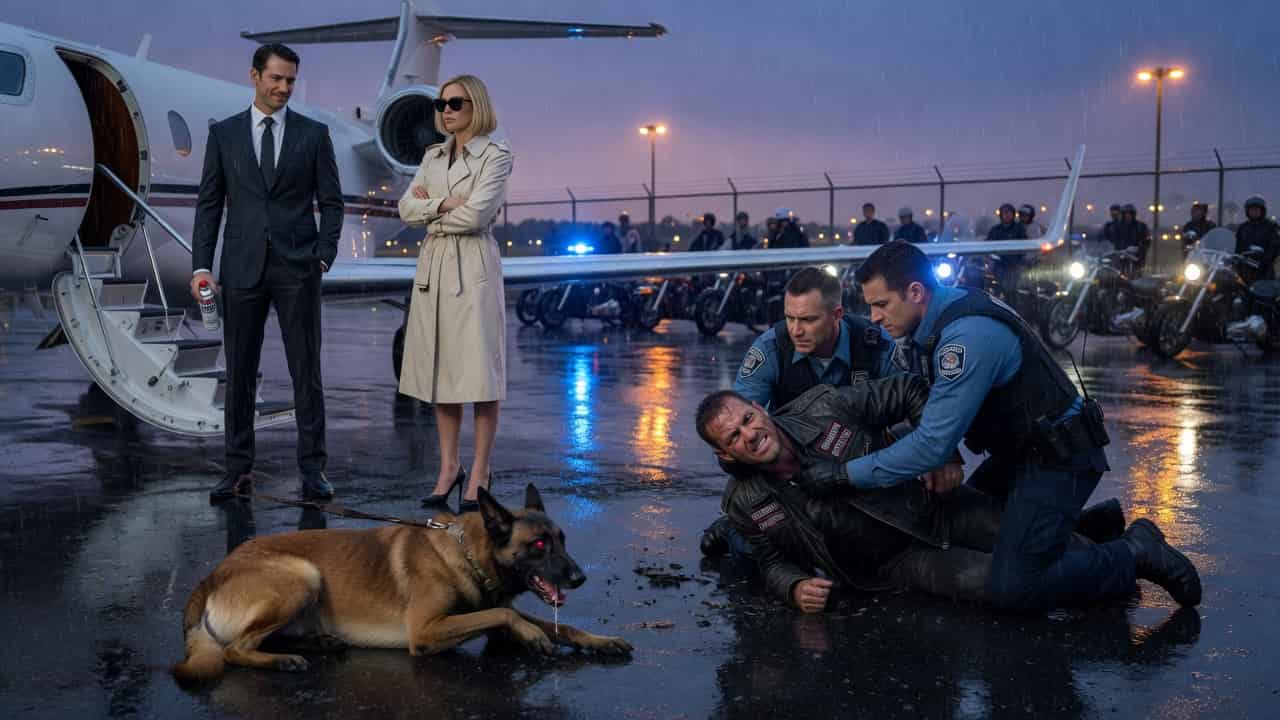
“Bark for me, Ryder. Do it loud enough and maybe I won’t have the guards finish what they started with your dog.”
Christian stood on the stairs of the Gulfstream like he was a god, looking down at me while the security detail ground my face into the oil-stained asphalt of Teterboro. He had the pepper spray canister aimed right at Radar’s eyes—my dog, the only thing I had left from the life Christian had dismantled piece by piece.
Behind him, Ivy didn’t even look at me. She was busy checking the gold watch I’d bought her three years ago, before Christian convinced the FAA I was mentally unfit to fly. She looked at me like I was a stain on the runway, something that needed to be hosed off before their champagne could be corked.
“You’re nothing but a biker in a cheap jacket now, Ryder,” Christian sneered, his voice echoing off the fuselage. “The assets are transferred. The flight plan is filed. You’re just a ghost watching his own life disappear.”
The guards laughed, the sound muffled by the rain. They thought they had me pinned. They thought the fifty men on Harleys waiting at the gate were just a nuisance the local PD would handle.
They didn’t know about the black card in my pocket. They didn’t know that the airline Christian was using to flee didn’t belong to his holding company anymore. It belonged to the ‘Iron Guard’—and I was the one who had just signed the ‘No Fly’ order for every tail number in this zip code.
The engines began to whine, but they weren’t going to take off. Because the thunder wasn’t coming from the sky anymore. It was coming from the perimeter fence.
Chapter 1
The rain at Teterboro didn’t fall so much as it drifted, a fine, kerosene-scented mist that clung to the chrome of my Fat Boy and turned the runway lights into blurry, smeared stars. I didn’t belong here. Not in this leather jacket, not with the “Iron Guard” rocker on my back, and certainly not with a Belgian Malinois sitting in a sidecar that looked like it had been through a war. Which, in a way, we both had.
I pulled up to the Atlantic Aviation terminal, the engine’s idle a low, rhythmic throb that felt like a headache behind my eyes. This was the world of soft hands and hard-numbered accounts. I used to be a part of it. Ten years ago, I was the guy in the cockpit of the birds parked on this tarmac, my wings shiny and my record clean. Now, I was just a “security risk” in a worn-out vest.
“Stay, Radar,” I muttered, hopping off the bike. The dog didn’t move, but his ears tracked the movement of a fuel truck nearby. He was a good boy. Better than the people inside.
I walked toward the sliding glass doors, the heavy thud of my boots echoing in the quiet of the high-end terminal. The smell hit me immediately—expensive coffee, leather upholstery, and the sanitized scent of people who never had to clean up their own messes.
“Can I help you, sir?” The man at the front desk didn’t even look up from his monitor at first. When he did, his face underwent a rapid transformation: boredom, confusion, and then a sharp, pointed disgust. “The service entrance is around the back for deliveries.”
“I’m not a delivery,” I said. I kept my voice low, the way my father taught me when he wanted me to listen. “I’m here for the 6:00 PM departure to Grand Cayman. Tail number N650CS.”
The clerk let out a short, sharp laugh. He leaned back, adjusting his silk tie. “Sir, that’s a private charter. Mr. Sterling’s flight. You’re… you’re definitely not on the manifest.”
“Check again,” I said, leaning over the counter. I could see my reflection in the polished marble—tired eyes, a three-day beard, and a scar running through my left eyebrow from a bar fight in Newark. I looked like the kind of man who broke things for a living. Which was exactly why Christian Sterling had hired me three years ago, before he decided it was easier to just steal my life instead.
“I don’t need to check,” the clerk said, his hand moving toward a button under the desk. “I’m going to have to ask you to leave. Now. Before I call Port Authority.”
“Ryder? Is that you?”
The voice was like a cold needle in my spine. I turned.
Christian was walking across the lounge, his gait easy and practiced. He looked like he’d stepped out of a yachting magazine—charcoal suit, crisp white shirt, no tie. Behind him, draped in a cream silk trench coat that cost more than my first plane, was Ivy. My wife. Or she had been, until six months ago when the divorce papers showed up with Christian’s firm’s letterhead on the envelope.
“Let him in, Marcus,” Christian said to the clerk, his smile not reaching his eyes. “He’s an old friend. A charity case, really.”
Ivy didn’t look at me. She was focused on her phone, her thumb scrolling with a clinical detachment. She used to look at me like I was the only thing in the sky. Now, I was just background noise.
“What are you doing here, Ryder?” Ivy finally asked, her voice flat. She didn’t look up. “We’re busy. We have a schedule.”
“The club’s money, Christian,” I said, ignoring her. The “Iron Guard” wasn’t just a biker club; it was a brotherhood of veterans who’d pooled their pensions into a fund that Christian was supposed to “grow.” Instead, he’d used it as a personal piggy bank to fund his exit strategy. “The three million from the pension fund. It didn’t go into the offshore trust. It went into the fuel tanks of that jet out there.”
Christian laughed, a soft, patronizing sound. He walked closer, stopping just outside my personal space. He smelled like sandalwood and arrogance. “The money is gone, Ryder. It was a bad investment. Market volatility. You wouldn’t understand. You were always better at pushing buttons than reading spreadsheets.”
“You lied to the FAA,” I said, my voice shaking slightly. “You told them I was suicidal so they’d pull my medical. You took my wings so I couldn’t stop you.”
“I took your wings because you were a liability,” Christian hissed, leaning in so only I could hear. “And look at you now. A thug in a costume. You think the Port Authority is going to listen to a biker over a man who donates a hundred grand a year to the PBA?”
He turned to the security guard who had appeared behind me. “Officer, this man is harassing us. He’s armed—I saw a knife on his belt. And he has a dangerous animal outside. Please, remove him.”
“Wait,” I started, but the guard didn’t wait. He was a big guy, twenty-something, looking for a reason to use his training. He grabbed my arm, twisting it behind my back with a practiced jerk.
“Let go,” I grounded out, but then I heard it.
The sound of Radar barking outside. Then, the sharp hiss of an aerosol spray and a pained, high-pitched yelp.
“Radar!” I lunged, but the guard slammed me face-first into the marble counter.
“Stay down!” the guard yelled.
Through the glass doors, I saw a second security officer standing over my bike, a silver canister of pepper spray in his hand. Radar was on the ground, his paws over his face, rolling in agony.
“You son of a bitch!” I roared, but another guard joined in, and they wrestled me to the floor.
Christian walked over, standing right over my head. He looked down at me, his face a mask of cold triumph. “You always were a slow learner, Ryder. This is a private terminal. People like you don’t get to demand things here. You get to leave. Or you get to go to jail.”
He looked at Ivy. “Ready, darling? The pilot says the window is closing.”
Ivy finally looked at me. There was no anger in her eyes. Just a weary, exhausted kind of pity. “Go home, Ryder. There’s nothing left for you here.”
They walked toward the tarmac doors, the guards dragging me toward the exit. The rain was coming down harder now, and as they tossed me out onto the wet sidewalk, I could hear the engines of the G650 beginning to whine. Christian hadn’t just taken my money and my wife. He’d taken the one thing I had left to protect. And as I crawled toward Radar, my eyes stinging from the drift of the spray, I knew I wasn’t just going to stop his plane. I was going to burn his entire world to the ground.
Chapter 2
The sting of the pepper spray was a dull burn compared to the heat in my chest as I knelt over Radar. The dog was whimpering, a sound that cut through the low rumble of the idling jets like a serrated blade. I used my canteen to flush his eyes, my hands shaking. I didn’t care about the guards watching from the glass doors. I didn’t care about the rain soaking through my leather. I just cared about the way Radar’s tail thumped weakly against the pavement when he realized it was me.
“I got you, buddy,” I whispered. “I got you.”
This was the residue of Christian Sterling’s grace. He didn’t just win; he made sure you were humiliated in the process. He’d done it to me in the military, too. Not directly—back then, he was just the high-level consultant for the private contractor we were flying for in the Sandbox. He was the one who signed off on the “unstable flight patterns” report that ended my career after I refused to fly a cargo of “medical supplies” that clinked like ammunition crates.
I had been a Major. I had commanded men. Now, I was a man who smelled like wet dog and failure, sitting in a puddle outside a VIP lounge.
I looked up as the Gulfstream G650 began its slow taxi toward the runway. It was a beautiful machine. $65 million of engineering designed to make the world seem small and insignificant. Christian was in there, probably sipping a Macallan 25 while Ivy looked out the window, pretending I didn’t exist.
I reached into the hidden pocket of my vest, my fingers brushing against the cold plastic of a card I hadn’t used in three years. It wasn’t a credit card. It was a Master ATC Override—a relic from my days as a liaison for the National Guard’s emergency flight response. They never deactivated it. Why would they? Major Ryder Stone was a hero on paper, even if the FAA thought he was a headcase.
I pulled out my phone. It was an old, ruggedized burner, the screen cracked. I dialed a number I had memorized a lifetime ago.
“Teterboro Ground,” a tired voice answered. “State your business.”
“This is Stone,” I said. My voice was different now. The biker was gone. The Major was back. “Verification Code: Alpha-Niner-Seven-Delta-Hotel. I’m declaring a Class 4 Ground Stop. Tail number N650CS. Security threat. Possible asset flight.”
There was a long silence on the other end. I could hear the tapping of keys. “Major Stone? You’re… you’re inactive, sir. This line is for emergency oversight only.”
“The card is active, isn’t it?” I asked. I watched the Gulfstream stop at the edge of the taxiway. “I’m on-site. I have eyes on the target. If that bird wheels up, the liability is on you. Check the ownership of the charter company. It was flagged for a lien ten minutes ago.”
“Hold on, sir.”
I hung up. I didn’t need him to agree. I just needed him to hesitate.
I stood up, wiping the rain from my face. My body ached—the guards hadn’t been gentle—nhưng cái đau đó giống như một tiếng chuông cảnh tỉnh. I looked at the gate. The Port Authority police were already there, their blue lights flashing as they spoke to a group of bikers who had pulled up.
It was Preacher and the boys. Twenty of them, their leather vests dark with rain, their bikes forming a wall of steel against the chain-link fence. They weren’t moving. They weren’t shouting. They were just waiting for the word.
I walked toward the fence, Radar following me with a slight limp. One of the officers, a guy named Miller who I’d played poker with back when I had a house and a mortgage, walked over.
“Ryder, what the hell is this?” Miller asked, gesturing to the club. “You can’t block the gate. This is federal property.”
“I’m not blocking anything, Miller,” I said. I leaned against the cold wire of the fence. “I’m just waiting for my property to come back.”
“Sterling’s jet? Come on, man. We heard the call. You can’t just declare a ground stop because you’re mad about your ex-wife.”
“It’s not about Ivy,” I said. And it wasn’t. Not anymore. It was about the way Christian looked at me. Like I was a bug he could squash. It was about the three million dollars that belonged to guys like Preacher—guys who had lost limbs in wars Christian had profited from. “Check the tail number, Miller. The ‘Iron Guard’ isn’t just a club name. It’s the name of the holding company that bought the debt on that plane this morning.”
Miller’s radio crackled. “Unit 4, be advised. Teterboro Tower is holding N650CS for an FAA compliance check. Do not allow departure.”
Miller looked at me, his eyes widening. “You’re serious. You actually bought his plane?”
“I bought the debt,” I corrected. “And in this state, that gives me the right to inspect the cargo before it leaves the jurisdiction.”
I turned and looked back at the terminal. Christian and Ivy were stepping back out onto the tarmac. The pilot was following them, looking frantic. They weren’t taking off. They were being told to turn around.
I saw Christian’s face even from fifty yards away. The mask of calm was gone. He was shouting at the pilot, his arms flailing. Ivy was standing back, her phone pressed to her ear, probably calling her lawyer.
“He’s going to come for you, Ryder,” Miller said softly. “A guy like that? He doesn’t lose. He just gets meaner.”
“Good,” I said, my hand resting on Radar’s head. “I’ve been waiting for him to get mean. It makes what I’m going to do next feel a lot more like justice.”
I walked back to my bike, the sound of the club’s engines beginning to rise in a collective roar. We weren’t just bikers anymore. We were the wall. And Christian Sterling was about to find out that the sky he loved so much was a very lonely place when you weren’t allowed to touch it.
Chapter 3
The VIP lounge of the Atlantic terminal was silent, save for the rhythmic tick-tick-tick of the high-end clock on the wall and the heavy, wet thud of my boots as I walked back inside. The guards from before were gone, replaced by two Port Authority officers who looked like they didn’t want to be there. Christian was sitting in one of the velvet armchairs, his charcoal suit jacket tossed over a table, his shirt unbuttoned at the collar. He looked like a man who was beginning to realize the floor was made of glass.
Ivy was standing by the window, her back to us. She was looking out at the wall of motorcycles lined up at the perimeter fence. The rain had turned into a downpour, and the headlights of the bikes created a shimmering, flickering barrier of white light.
“You think this is clever?” Christian asked. His voice was thin, brittle. He didn’t look at me. He was staring at a glass of whiskey he hadn’t touched. “You think some legal loophole and a bunch of Neanderthals on Harleys are going to stop me from leaving?”
“It’s not a loophole, Christian,” I said. I pulled out a chair and sat across from him. I smelled like rain and old exhaust. “It’s a lien. You used the club’s money to bridge the lease on this jet. You thought we wouldn’t notice because the paperwork was buried in three different shell companies. But Preacher was a forensic accountant for the IRS before he joined the Guard. He’s better at spreadsheets than you are.”
Christian finally looked up. His eyes were bloodshot. “The money is gone, Ryder. Even if you stop the plane, you won’t see a dime of it. It’s already moved. This jet is the only thing left, and it’s not worth half of what the club is owed.”
“I don’t want the money,” I said. I leaned forward, the leather of my jacket creaking. “I want the ledger. The real one. The one you keep in the encrypted drive in your briefcase. The one that shows exactly where you sent the rest of the pension fund.”
Christian laughed, a harsh, jagged sound. “You’re dreaming. That drive is my insurance. If I give that to you, I’m dead. If I don’t, I just have to wait for my lawyers to clear this mess up. In six hours, that ground stop will be lifted, and I’ll be in international waters.”
He stood up, walking toward me. He was trying to regain his stature, trying to be the man who owned the room. “Look at you. You’re still just a grunt. You think you’ve won because you made me miss a flight? You’re a biker, Ryder. A loser who lost his wife, his job, and his mind. Do you really think anyone is going to take your word over mine when the lawyers show up?”
He looked at the Port Authority officer standing by the door. “Officer, I’m feeling threatened. This man has a history of violence and mental instability. I want him removed.”
The officer didn’t move. He looked at me, then at Christian. “Sir, I have orders from the FAA. No one leaves this terminal until the compliance check is finished.”
Christian’s face twisted. He turned back to me, his voice dropping to a hiss. “You want to play the hero? Fine. But remember what happened last time. I didn’t just get you fired, Ryder. I made sure Ivy watched every second of your meltdown. I made sure she knew exactly how weak you were.”
“Christian, stop,” Ivy said from the window. She didn’t turn around. Her voice sounded small.
“No, let’s talk about it,” Christian said, his eyes locked on mine. He was looking for the fracture, the place where I’d break. “Let’s talk about the night you came home after the FAA hearing. How you sat in the dark for three days, crying like a child because you couldn’t fly a plane anymore. How Ivy had to hold you while you begged for your life back. She didn’t leave you because of me, Ryder. She left you because she couldn’t stand the sight of you.”
The words hit like physical blows. I felt the old shame rising up, the cold, suffocating weight of those three days in the dark. He was right. I had broken. I had let him take everything because I didn’t know how to be a man without a cockpit.
“And now?” Christian sneered. “Now you’re back for more? You want to be humiliated again? Because I can do that. I can make sure the whole world knows what’s on those medical records he’s so proud of.”
He walked over to the table where his briefcase sat. He snapped it open and pulled out a small, silver thumb drive. “You want the ledger? Here it is. But there’s a price.”
He looked at the guards, then at the other passengers in the lounge—a wealthy couple in their sixties who were watching with horrified fascination.
“Bark for me,” Christian said.
The room went dead silent.
“What?” I asked, my voice barely a whisper.
“You heard me,” Christian said, a cruel, predatory light in his eyes. “You’re so fond of that dog out there. Bark for me. Do it loud enough for the whole lounge to hear. Prove to Ivy that you’re exactly the animal you look like. Do that, and I’ll hand you the drive. I’ll give you the money back.”
“Christian, that’s enough!” Ivy turned now, her face pale.
“Stay out of this, Ivy,” Christian snapped. He held the drive up between two fingers. “Well, Ryder? How much is the club’s pension worth to you? Are you a man, or are you just a dog on a leash?”
I looked at the drive. I looked at the couple watching me. I looked at the Port Authority officer, who had his hand on his belt, his face a mask of discomfort.
I could feel the pressure in the room, the collective weight of their eyes. This was what Christian wanted. He didn’t want to win; he wanted to destroy the very idea of me. He wanted to make sure that even if I got the money back, I’d never be able to look Preacher or the boys in the eye again.
I stood up slowly. My heart was hammering against my ribs, a frantic, trapped bird.
“Ryder, don’t,” Ivy whispered.
I looked at her. For the first time in months, I didn’t see the woman who betrayed me. I saw the woman who had watched me break. And I realized that the only way to stop breaking was to stop caring what people like Christian thought of the pieces.
I walked toward him, stopping inches from his face.
“The money isn’t in that drive, Christian,” I said, my voice steady, cold. “The money is already in the club’s account. We didn’t need the ledger to find it. We just needed you to stay in one place long enough for the wire transfer to be reversed by the bank’s fraud department.”
Christian’s face went white. The drive in his hand shook. “What?”
“I didn’t come here for the ledger,” I said. I reached out and took the drive from his hand. He was too stunned to stop me. “I came here to see the look on your face when you realized you weren’t the smartest man in the room. And I came here to tell you that the ‘No Fly’ order isn’t just for today. It’s for as long as I’m the majority shareholder of this terminal.”
I leaned in closer, my voice a low growl. “I don’t need to bark, Christian. I’m the one who just closed the sky.”
I turned and walked away, the sound of my boots heavy and final on the marble floor. Behind me, I heard the sound of Christian’s whiskey glass shattering against the floor. I didn’t look back. I didn’t need to. I had my wings back, even if I never stepped foot in a cockpit again.
Chapter 4
The tarmac was a battlefield of light and shadow. As I walked out of the terminal, the roar of the motorcycles reached a crescendo. The Iron Guard had breached the outer perimeter—not with violence, but with a sheer, overwhelming presence that the local police couldn’t contain. Fifty bikes were now idling in a semi-circle around the Gulfstream, their headlights pinning the white jet in a crossfire of brilliance.
Radar met me at the door, his tail wagging despite the redness still around his eyes. He leaned against my leg, and I rested a hand on his head.
“Almost done, boy,” I murmured.
The pilot of the G650, a young guy in a crisp uniform who looked like he wanted to be anywhere else, was standing by the air-stairs. He looked at me with a mix of fear and recognition. I knew him. He was one of the kids I’d mentored at the flight school before Christian had the school shut down.
“Major Stone?” the pilot asked, his voice cracking. “They told me you were… they said you were dangerous.”
“I am dangerous, Danny,” I said, stopping at the base of the stairs. “But not to you. Get off the plane. Now.”
“I can’t. Mr. Sterling said—”
“Mr. Sterling is currently being detained by the Port Authority for questioning regarding a multi-million dollar fraud case,” I interrupted. It was a lie, but it was a lie that would be true in about twenty minutes. “And this aircraft is under a judicial hold. If you stay on it, you’re an accomplice. Go home to your wife, Danny. Don’t throw your career away for a man who doesn’t even know your last name.”
Danny looked at the bikes, then back at the terminal where Christian was being escorted out by two officers. He didn’t hesitate. He grabbed his flight bag and practically ran down the stairs.
I walked up the air-stairs. The interior of the jet was a palace of cream leather and polished mahogany. Ivy was sitting in one of the swivel chairs, a glass of water in her hand. She didn’t look surprised to see me.
“He’s gone, Ryder,” she said. She sounded tired. “You won. Are you happy now?”
“I didn’t do this to be happy, Ivy,” I said. I stood in the narrow aisle, the luxury of the cabin feeling suffocating. “I did it because it had to be done. The club needed that money. Those men gave everything to this country, and Christian was going to leave them with nothing.”
“And what about me?” she asked, finally looking up. Her eyes were red. “Did you do it to punish me? To show me how wrong I was to leave you when you were broken?”
“I didn’t think about you at all,” I said.
It was the hardest lie I’d ever told. My heart was breaking all over again just looking at her, remembering the way she used to laugh when we’d take my old Cessna up for weekend runs to the shore. But that woman was gone. The woman in front of me was a stranger who had chosen a predator over a partner.
“He never loved you, Ivy,” I said softly. “You were just a trophy. Something else he could take from me to prove he was the better man.”
“I know,” she whispered. She looked down at the floor. “I knew it a month after we moved into the penthouse. But I didn’t have anywhere else to go. You were… you were so far away, Ryder. Even when you were sitting right next to me, you were still in that cockpit, flying away from everything.”
“I’m back now,” I said. “But I’m not the same man.”
I reached into my pocket and pulled out the silver thumb drive. I set it on the table next to her. “This has the ledger. Everything. Give it to the DA. If you do that, maybe you can keep yourself out of the indictment. Christian is going to try to pin everything on you. You know that, right?”
Ivy looked at the drive, then at me. “Why are you helping me?”
“Because I remember who you used to be,” I said.
I turned and walked back to the door. I could see the terminal lights, the rain, and the wall of brothers waiting for me on the tarmac.
“Ryder?”
I stopped, my hand on the doorframe.
“Where are you going to go?” she asked. “The FAA… they’re never going to give you your license back. Not after this.”
I looked out at the bikes, the chrome gleaming in the rain, the “Iron Guard” colors standing out against the dark. I felt a sense of peace I hadn’t known in years.
“I don’t need a license to lead, Ivy,” I said. “And I don’t need the sky to be free.”
I stepped out onto the stairs. The roar of the bikes hit me like a physical wave—a salute from fifty men who had stayed in the rain because I asked them to. I walked down to the tarmac, Radar at my side, and for the first time in three years, I didn’t feel like a ghost. I felt like a king.
I hopped on my bike, kicked the engine to life, and led the Iron Guard away from the terminal. Behind us, the Gulfstream sat dark and motionless on the runway, a $65 million paperweight. Christian was in handcuffs, Ivy was in tears, and the money was home.
But as we hit the open road, the wind cold and wet against my face, I knew this wasn’t the end. Christian had friends. Powerful friends. And a man like him didn’t stay in a cage for long.
I looked at Radar in the sidecar, his eyes clear and bright again.
“Let them come,” I muttered into the wind. “We’re ready.”
Chapter 5
The Iron Guard clubhouse was an old textile warehouse on the edge of Newark that smelled like fifty years of industrial oil and twenty years of stale beer. It was a cathedral of brick and grease, a place where the world outside—the world of credit scores, HOA fees, and silk ties—wasn’t supposed to be able to reach us. But as I sat on a milk crate in the garage bay, watching the rain continue its gray, relentless assault on the corrugated metal roof, I knew the walls were thinner than we liked to pretend.
I had a rag in one hand and a tin of chrome polish in the other, but I hadn’t moved in twenty minutes. Radar was curled up at my feet, his head resting on his paws. His eyes were clear now, the redness gone, but he still flinched whenever a door slammed or a bike backfired. That was the thing about people like Christian Sterling—they didn’t just hurt you; they left a vibration in the air that stayed long after they’d left the room.
“You’re going to rub the finish right off that primary cover, Jet.”
I didn’t turn around. I knew Preacher’s voice by the gravel in it. He walked into the light of the overhead fluorescent, his heavy boots echoing on the concrete. Preacher was sixty, with a beard that looked like steel wool and a missing pinky finger from a roadside repair gone wrong in ’94. He was the club’s President, but more than that, he was the man who had picked me up off the floor of a dive bar three years ago when the FAA took my life away.
“Just thinking,” I said, finally moving the rag in a slow, pointless circle.
“Thinking is for people who don’t have fifty bikers waiting to buy them a drink,” Preacher said. He leaned against the workbench, his shadow long and jagged against the wall. “The transfer cleared, Ryder. The three million is back in the fund. The boys are talking about a run to the coast this weekend. They’re calling you the ‘Giant Slayer.'”
“It doesn’t feel like a win,” I said. I looked up at him. “Christian is out, Preacher. My contact at the Port Authority called an hour ago. His lawyers had a judge on the phone before the ink was dry on the incident report. He’s out on bail, and he’s already filed a motion for a restraining order against the club.”
Preacher took a long pull from a bottle of water, his throat working. He didn’t look surprised. “Men like that don’t go to jail on the first round, son. They have layers. Like an onion, or a tumor. You cut one piece out, and the rest just keeps growing.”
“He’s going to sue us into the ground,” I said. “He’ll claim the lien was fraudulent. He’ll claim the ‘No Fly’ order was an abuse of power. He’ll spend ten million in legal fees just to make sure we don’t keep a dime of that pension money.”
“Let him try,” Preacher said, but his voice lacked its usual iron. He looked around the garage, at the aging bikes and the worn-out tools. We were a brotherhood of veterans, but we were also a collection of broken bodies and thin bank accounts. A protracted legal battle with a man like Sterling wasn’t a fight; it was an execution.
The heavy steel door at the front of the clubhouse groaned open. Usually, that sound was followed by a shout or a laugh, but this time, the silence that followed was heavy. I stood up, Radar instantly coming to attention at my side.
A man walked into the garage bay. He wasn’t a biker. He was wearing a tan windbreaker and khakis, carrying a leather briefcase. He looked like a high school geography teacher, except for the way his eyes moved—scanning the exits, checking the corners, assessing the threat level of every man in the room.
“Can I help you?” I asked, stepping toward him.
“Ryder Stone?” the man asked. His voice was clipped, professional. “My name is Vance. I represent Sterling Holdings.”
The garage went cold. Behind me, I heard the sound of other brothers stepping out from the back room—Big Sal, Deacon, and Mouse. They didn’t say anything, but the air in the room suddenly felt very crowded.
“You’ve got a lot of nerve coming here,” Big Sal growled, his hands curling into fists.
Vance didn’t flinch. He didn’t even look at Sal. He kept his eyes on me. “I’m not here to argue, Mr. Stone. I’m here to deliver a message. Mr. Sterling is prepared to drop all criminal charges and civil litigation regarding the events at Teterboro today.”
I felt a spark of suspicion. “What’s the catch?”
“The catch,” Vance said, opening his briefcase and pulling out a single sheet of paper, “is that you return the ledger. The thumb drive you took from the terminal.”
“I gave it to Ivy,” I said. “It’s out of my hands.”
Vance smiled, a thin, mirthless expression. “Mrs. Sterling… or rather, Ms. Thorne… was intercepted shortly after you left. She was quite cooperative once she realized the legal implications of possessing stolen corporate data. She surrendered the drive. However, our IT team discovered that the drive had been cloned. Multiple times. Within minutes of you taking it.”
I looked at Preacher. He gave a small, almost imperceptible nod. We had been careful.
“The ledger stays where it is,” I said. “It’s the only thing keeping the club safe. As long as we have that data, Christian stays away from our money.”
“Mr. Sterling is less concerned about the money than he is about the… let’s call them ‘historical records’ contained in that data,” Vance said. He stepped closer, his voice dropping. “Records that involve your father, Ryder. Major Thomas Stone.”
My heart skipped a beat. My father had been a legend in the Air Force. He’d died in a training accident when I was twelve, a “mechanical failure” that had never been fully explained.
“What does my father have to do with Christian?” I asked, my voice tight.
“Major Stone didn’t die because of a mechanical failure,” Vance said. He handed me the paper. It was a scanned copy of a flight log from 1996. “He died because he was flying a shipment for a company called ‘Sterling Global Logistics.’ A predecessor to the current firm. He was carrying the same kind of ‘medical supplies’ you refused to fly in Iraq, Ryder. Only your father wasn’t as principled as you. Or perhaps he was just more desperate.”
I stared at the paper. The tail number was familiar. It was the same plane my father had crashed in the Nevada desert.
“The ledger contains the manifest for that flight,” Vance continued. “It also contains the payment records to your mother’s bank account. A hundred thousand dollars, wired the day after the funeral. ‘Grief compensation,’ it was called. But we both know what it was. Silence money.”
The room felt like it was spinning. I looked at Preacher, but he was looking at the floor. He knew. Or he’d suspected.
“He’s lying,” Big Sal said, stepping forward. “Ryder, don’t listen to this suit.”
“Am I?” Vance asked, looking back at his briefcase. “Mr. Sterling doesn’t care about the three million. He can make that back in a week. What he cares about is his reputation. If that ledger goes to the DA, the history of Sterling Global comes out. And your father’s name goes through the dirt along with it. A hero turned smuggler. Is that the legacy you want to leave behind?”
Vance snapped his briefcase shut. “You have twenty-four hours to hand over every copy of that drive. If you don’t, the files will be leaked to the press anyway—but by us. We’ll frame it as a ‘discovery’ during our internal audit. Your father’s memory will be destroyed, and you’ll still be a broke biker with a criminal record.”
He turned and walked toward the door, stopping just before he left. “Think about it, Ryder. Is justice worth the truth about your family?”
The door closed, leaving us in a silence so thick I could taste it. I looked at the paper in my hand, the ink blurred by a drop of rain that had fallen from my jacket. My father had been my North Star. Everything I had done—the Air Force, the flight school, the way I carried myself—was an attempt to live up to the man I thought he was.
“Ryder,” Preacher said, his voice soft. “He’s trying to get inside your head. He’s weaponizing your ghost.”
“What if it’s true?” I asked. I felt like I was twelve years old again, standing on the tarmac at Nellis, waiting for a plane that was never coming back. “What if my whole life was built on a lie Christian paid for?”
“It doesn’t change who you are,” Preacher said. He put a heavy hand on my shoulder. “But it changes who he is. He’s been holding this over you since the day you met him. He didn’t hire you because you were a good pilot. He hired you because he owned you before you even knew it.”
I looked at Radar, who was watching me with those deep, soulful eyes. The humiliation at the airport hadn’t been an outburst; it had been a reminder. Christian thought he owned the sky, the ground, and even the dead.
I crumpled the paper in my fist. The rage that had been simmering since the morning boiled over, but it wasn’t the hot, messy rage of a bar fight. It was cold. It was the kind of rage that helps you hit a target from ten thousand feet.
“He thinks he can trade my father’s name for his freedom,” I said. I looked at Preacher. “He’s wrong. He thinks I’m afraid of the truth. But the truth is the only thing that’s ever going to set us free.”
“What are you going to do?” Preacher asked.
“I’m going to use the ‘No Fly Zone’ one last time,” I said. “Call the boys. We’re not going to wait for the twenty-four hours. We’re going to Christian’s house tonight.”
“Ryder, that’s a fortress,” Big Sal warned. “He’s got private security. He’s got cameras. It’ll be a bloodbath.”
“No,” I said, a grim smile touching my lips. “It’s not going to be a bloodbath. It’s going to be a reckoning. Christian loves his audience. He loves the witnesses. So we’re going to give him the biggest audience he’s ever had.”
I walked over to my bike and kicked the stand up. The residue of the day—the shame, the pain, the betrayal—was still there, but it was being forged into something else. A purpose.
As we rode out of the warehouse, fifty engines screaming into the New Jersey night, I didn’t feel like a victim anymore. I felt like the storm. Christian Sterling thought he could hide in the clouds, but he forgot that eventually, everything has to come down to earth.
Chapter 6
Christian Sterling’s estate in Alpine was a monument to stolen time. It sat behind a wrought-iron gate that looked like it belonged to a palace, perched on a cliff overlooking the Hudson. It was the kind of place where the air felt thinner, more expensive. As the Iron Guard pulled up to the gate, the roar of our engines echoing off the million-dollar stone walls, I could see the security guards scrambling.
“Stay back!” a voice yelled over a megaphone. “You are trespassing on private property!”
I didn’t stop. I rode my Fat Boy right up to the gate, the front tire touching the iron. Behind me, the club formed a semi-circle of idling steel and chrome. We were a wall of leather and light.
“Open the gate!” I shouted. “I have something Christian wants!”
A small side gate clicked open, and Vance, the “messenger” from earlier, stepped out. He looked less composed now. His tan windbreaker was damp, and his eyes were darting toward the fifty bikers who looked ready to tear the gates off their hinges.
“Mr. Sterling is not receiving visitors,” Vance said, his voice trembling slightly. “You were given twenty-four hours.”
“I’m an early bird,” I said. I reached into my vest and pulled out a heavy, manila envelope. “Tell him I have the master drive. And I have the original flight logs from ’96. Tell him I’m ready to talk about my father.”
Vance hesitated, then spoke into a radio. A moment later, the heavy iron gates began to groan open.
“Only you,” Vance said. “The rest stay here.”
“They stay at the gate,” I said. I looked back at Preacher. He gave me a sharp nod. If I didn’t come back out in twenty minutes, they were going through the fence.
I rode up the long, winding driveway alone. The house was a glass-and-steel monstrosity that looked like it was trying to fly off the cliff. Christian was waiting for me on the wide stone terrace, a glass of wine in his hand, looking out at the lights of Manhattan. He looked like he’d already won.
“You’re smarter than I thought, Ryder,” Christian said without turning around. “Most men would have let pride get in the way. But you… you understand the value of a legacy.”
I parked the bike and walked onto the terrace. Radar stayed by the bike, his ears up, watching the two security guards standing by the glass doors.
“My father wasn’t a smuggler, Christian,” I said. I didn’t waste time. “I spent the last three hours on the phone with his old co-pilot. The one you didn’t manage to buy off because he’s dying of cancer in a VA hospital in Phoenix. He told me everything.”
Christian turned around, his smile faltering. “He’s an old man with a failing memory. Nobody will believe him.”
“They won’t have to,” I said. I tossed the manila envelope onto the glass table between us. “My father didn’t take the money to stay silent. He took it because you threatened to kill my mother and me if he didn’t fly that cargo. And when he realized what was in those crates—chemical precursors, not ‘medical supplies’—he didn’t crash because of a mechanical failure. He crashed that plane on purpose, in the middle of nowhere, so the cargo would be destroyed. He sacrificed himself to stop you.”
The silence that followed was heavy, punctuated only by the distant hum of the city. Christian’s face went through a rapid series of changes: denial, anger, and finally, a cold, clinical boredom.
“A heroic narrative,” Christian said, sipping his wine. “Very touching. But the paperwork says otherwise. The wire transfer to your mother? That’s real. The ‘unstable pilot’ report? That’s real. Your father is a ghost, Ryder. And ghosts don’t testify.”
“No,” I said. “But live streams do.”
I pointed to the “Iron Guard” patch on my chest. Tucked into the leather was a small, high-definition body camera, its tiny green light glowing.
“We’ve been live for the last five minutes, Christian,” I said. “To the club’s website, to the local news stations, and to the FAA oversight committee. Everything you just said—the admission about the ‘historical records,’ the dismissal of the co-pilot—it’s all out there. The witnesses aren’t just in a lounge anymore. They’re everywhere.”
Christian’s glass hit the stone floor, shattering into a thousand glittering shards. He lunged toward me, his face contorted in a mask of pure, unadulterated rage. “You ruined it! You ruined everything for a dead man’s pride!”
The security guards moved forward, but I didn’t flinch.
“Don’t,” I said, my voice like ice. “If you touch me, fifty men are coming through that gate. And I don’t think they’re going to be as interested in the legal process as I am.”
The guards stopped. They looked at each other, then at the wall of headlights at the bottom of the hill. They were professionals. They knew when a job was over.
“You think this is over?” Christian screamed, his voice cracking. “I’ll buy the jury! I’ll buy the judge! I’ll be out of this before you even get back to your pathetic warehouse!”
“Maybe,” I said. I walked to the edge of the terrace and looked out at the river. “But you’ll never fly again. I’ve already sent the encrypted files to the NTSB. They’re reopening the investigation into the ’96 crash. They’re going to dig up that desert, Christian. And they’re going to find the evidence my father died to protect.”
I turned back to him. He looked small. In his expensive suit, on his expensive terrace, he looked like a frightened child who had finally been caught in a lie.
“You asked me to bark for you,” I said. “But you’re the one who’s going to be doing the begging now. Begging for a cell that isn’t in general population.”
I walked away, my boots echoing on the stone. I didn’t look at the house. I didn’t look at the luxury. I just looked at Radar, who was waiting for me by the bike.
As I rode down the driveway, the gates swung open for me. The Iron Guard erupted in a roar of cheers, the sound of fifty engines rising up to meet the night. Preacher rode up alongside me, his face illuminated by the flickering light of a flare Big Sal had lit.
“We did it, Ryder,” Preacher said. “The news is already picking it up. It’s a goddamn circus out there.”
“It’s not over,” I said. “But it’s a start.”
We rode away from Alpine, away from the world of glass and steel, and back toward the city. The rain had finally stopped, and the clouds were breaking, revealing a sliver of moon.
An hour later, I was back at the warehouse. The club was in full celebration mode—kegs were tapped, music was blaring, and the “Giant Slayer” was being toasted every five minutes. But I stayed in the garage, sitting on my bike, watching the city lights in the distance.
The door to the garage opened, and Ivy walked in. She was wearing a simple pair of jeans and a sweater, her silk trench coat gone. She looked like the girl I’d met ten years ago, before the money and the lies had changed everything.
“I heard,” she said. She stood by the workbench, her hands in her pockets. “I gave the DA the other drive. The one you didn’t know I’d hidden in my bag. It has the bank codes, Ryder. Everything.”
“Why?” I asked.
“Because you were right,” she said. A single tear tracked through the dust on her cheek. “He didn’t love me. He just wanted to own the only thing you had left. And I let him. I’m so sorry.”
I looked at her, and for the first time in a long time, I didn’t feel the sharp, jagged edge of betrayal. I just felt a dull, heavy sadness. The residue of our life together was still there, but it was like an old scar—it didn’t hurt anymore, it just reminded me of the weather.
“You should go, Ivy,” I said softly. “The police are going to want to talk to you. And the club… it’s not a safe place for you anymore.”
“I know,” she whispered. She turned to leave, then stopped. “What are you going to do now? You have the money. You have your name back.”
“I’m going to stay here,” I said. I looked at Preacher, who was laughing with Big Sal in the back room. “I’m going to help these men. And I’m going to find a way to fly again. Not for a company. Not for a paycheck. Just for the sky.”
She nodded, then walked out into the night. I watched her go, then I reached down and scratched Radar behind the ears.
“We’re okay, boy,” I said.
The “No Fly Zone” was gone. The ground was solid, the sky was open, and for the first time in my life, I wasn’t running from my ghosts. I was riding with them.
The final sentence of the story wasn’t written in a ledger or spoken in a courtroom. It was written in the way the engine felt between my legs as I rode out the next morning, the sun rising over the Newark skyline, the wind cold and clean and full of possibilities. I wasn’t a Major. I wasn’t a hero. I was just a man with a bike, a dog, and a future that finally belonged to me.
I twisted the throttle, the roar of the Fat Boy drowning out the rest of the world, and I headed for the horizon. The sky was waiting.