“Crawl for me, Rex. If you want the dog to keep his ears, you’re going to get on your belly and bark.”
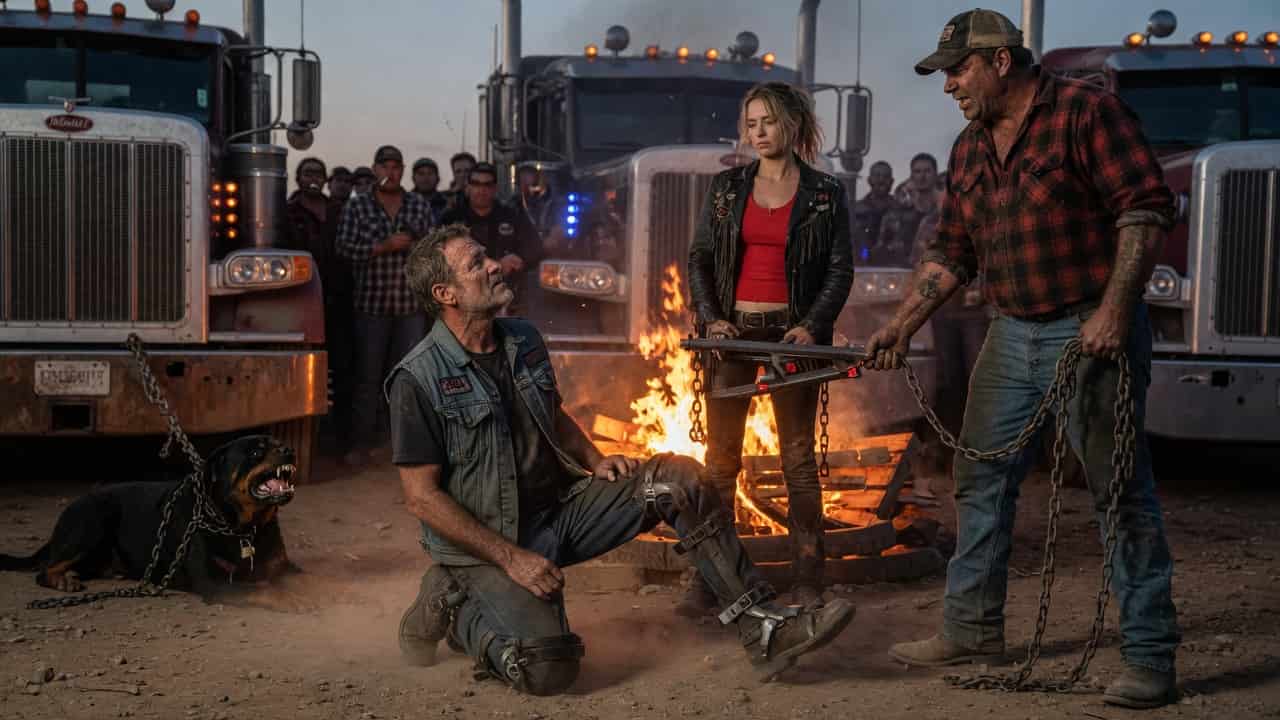
Hank’s voice was thick with the kind of cheap whiskey and unearned confidence that comes from being six-foot-four in a room full of people too tired to fight back. He stood over Rex, swinging a heavy tire chain that caught the flickering orange light of the scrap-wood fire.
Behind him, my wife—well, the woman I’d spent twelve years building a life with—didn’t even look away from the flames. Roxy held my custom steel leg brace over the coals, the heat already bubbling the leather straps I’d spent three months breaking in.
“He’s not a hero anymore, Hank,” Roxy said, her voice colder than the Oklahoma wind. “He’s just a broken biker who doesn’t know when to quit. Drop it in the fire, or I will.”
I was on my knees in the red dirt, the metal nethers of my remaining brace digging into my skin. Diesel was snarling, pinned to a Peterbilt bumper, his eyes fixed on the chain in Hank’s hand. They thought they were breaking a man who had nothing left. They thought the braces meant I was weak.
They didn’t know that the “broken biker” they were humiliating in front of forty laughing drivers was the Chairman of the only Union that matters when the world needs to move.
I looked at the red light blinking on my wrist. In five minutes, five hundred brothers are going to turn this truck stop into a steel cage. And Hank? He’s about to realize that some men don’t need to stand up to be the tallest person in the room.
Chapter 1: The Weight of the Dust
The heat in Oklahoma doesn’t just sit on you; it burrows. It’s a thick, oily pressure that smells of diesel exhaust and sun-baked asphalt. Rex Miller sat on the rusted metal bench outside the “Last Stop” diner, feeling the familiar, rhythmic throb in his calves. It was a dull ache, the kind that reminded him of every mile he’d ever ridden and the one mile he hadn’t finished.
He adjusted the Velcro straps on his left leg, the heavy carbon-fiber and steel brace creaking under his touch. It was a sophisticated piece of engineering, designed to do what his nerves no longer could. To the casual observer, it looked like a cage. To Rex, it was a lifeline.
Beside him, Diesel, a three-year-old Rottweiler with a coat the color of burnt mahogany, let out a soft huff. The dog’s ears were forward, tracking a black Peterbilt 389 pulling into the lot. The truck was polished to a mirror finish, chrome stacks gleaming like silver pillars in the late afternoon sun.
Rex watched the driver climb down. Hank. Even from fifty yards away, the man’s ego preceded him. Hank was built like a refrigerator with a head, his movements broad and unnecessarily aggressive. He slammed the cab door with a force that echoed across the gravel lot, then spat a thick stream of tobacco juice onto the ground.
“Easy, boy,” Rex murmured, his hand dropping to Diesel’s head. The dog didn’t growl, but the hair along his spine shifted. Diesel knew the energy of a predator when he saw one.
Rex stood up, his braces clicking with a metallic finality. He moved with a hitching, deliberate gait—not a limp, exactly, but a slow, mechanical walk that required his entire focus. He needed to get to his bike, an old Harley-Davidson Road King that had been modified with a sidecar for Diesel and a hand-shifter for Rex’s deadened legs. It was parked at the edge of the lot, a relic of a life that felt like it belonged to someone else.
“Well, if it ain’t the Biker King,” a voice boomed.
Rex didn’t turn. He didn’t have to. The scent of stale Marlboros and cheap cologne hit him first. Hank was standing ten feet away, flanked by two other drivers—younger guys, kids really, who looked like they were trying too hard to look tough.
“Moving a little slow today, aren’t you, Roadblock?” Hank stepped closer, his shadow falling over Rex. “I heard they were giving out handicapped tags at the MC clubhouse now. Didn’t know they let you keep the vest if you can’t even kickstand your own pig.”
Rex kept his eyes on his bike. “It’s a long road, Hank. Most people find something to bitch about. You seem to have found me.”
Hank laughed, a dry, rasping sound. He moved into Rex’s path, forcing Rex to stop. The mechanical braces hissed as Rex shifted his weight to maintain his balance. It was a delicate dance; if his center of gravity shifted too far, the braces would lock, or worse, give way.
“I’m talking to you, Miller,” Hank said, his voice dropping an octave. “I don’t like seeing trash cluttering up my stop. Especially trash that thinks it’s still special because it used to lead a pack of weekend warriors.”
“I’m just passing through,” Rex said, his voice level. He could feel the pulse in his neck, the old adrenaline-starved parts of his brain lighting up. “Move aside.”
“Make me move,” Hank challenged. He leaned in, his face inches from Rex’s. “Oh, wait. You can’t. You’re a fucking science project held together by bolts and straps.”
One of the younger drivers chuckled, a nervous, high-pitched sound. Diesel’s lip curled, a flash of white tooth appearing in the shadows of his jowls.
“Diesel, stay,” Rex commanded, though his own hands were beginning to shake. It wasn’t fear. It was the crushing weight of the humiliation, the way the other drivers in the lot were turning their heads, sensing a kill. In this world, weakness was a scent. And Rex, with his clicking legs and his slow walk, smelled like a wounded animal.
“Tell you what,” Hank said, reaching out to flick the heavy metal hinge on Rex’s right brace. “Why don’t you leave the dog here? He’s a good-looking animal. Probably needs a master who can actually walk him. You go on back to your little apartment and your disability checks.”
Rex’s hand clamped onto Hank’s wrist. It was the only part of him that still felt like the old Roadblock Miller—the grip of a man who had spent twenty years wrestling iron. Hank’s eyes widened slightly, the smirk wavering.
“Don’t touch the gear, Hank,” Rex said softly. “And don’t talk about the dog. We’re going to have a real bad day if you keep doing both.”
Hank pulled his arm back, his face turning a dark, mottled red. “You think you’re still the boss? You’re a ghost, Rex. A ghost in a metal suit.”
Hank stepped back, but he didn’t leave. He watched as Rex continued his agonizingly slow trek toward the Harley. Every step was a victory, every click of the braces a reminder of what he’d lost. He could feel the eyes of the entire truck stop on his back. They weren’t looking at a legend. They were looking at a man who was one shove away from the dirt.
Rex reached the bike, his breath coming in short, ragged bursts. He helped Diesel into the sidecar, the dog jumping in with a grace that Rex envied. He settled into the saddle, his hands finding the familiar grip of the handlebars. For a moment, the world felt right.
But as he reached for the starter, he saw a familiar SUV pull into the lot. A white Chevy Tahoe. His heart sank, a cold stone in his chest.
Roxy.
She didn’t get out alone. She climbed out of the passenger side, her eyes finding Rex immediately. She didn’t look away. She didn’t look sorry. She looked bored.
And then the driver’s side door opened.
Hank walked over to the Tahoe, draped an arm around Roxy’s shoulders, and pulled her close. She didn’t resist. She leaned into him, her hand resting on his chest—the same place it used to rest on Rex’s.
“Forget something, honey?” Hank called out, his voice carrying across the lot.
Roxy looked at Rex, her expression unreadable. “I told you not to come here, Rex. You’re embarrassing yourself.”
The silence that followed was louder than any engine. It was the sound of a man’s life being stripped down to the chassis in front of a crowd of strangers. Rex gripped the handlebars until his knuckles turned white. The ache in his legs was nothing compared to the sudden, hollow vacuum in his chest.
He didn’t start the bike. He couldn’t. He just sat there, the “King of the Road,” trapped in a body that wouldn’t fight and a life that had already moved on.
Chapter 2: The Fire and the Betrayal
The sun had dipped below the horizon, leaving a bruised purple sky that felt heavy with the promise of a storm. The “Last Stop” was no longer just a transit point; it had transformed into a theater of cruelty. A scrap-wood fire had been built in a rusted-out tractor rim near the edge of the asphalt, its flames licking at the dark.
Rex was no longer on his bike.
Hank had seen to that. A well-placed kick to the sidecar during Rex’s attempt to leave had sent the bike tipping. In the scramble to keep Diesel from being pinned, Rex’s balance had failed. The braces had locked, and he’d gone down hard in the red Oklahoma dirt.
Now, he was sitting on the ground, his back against the tire of a trailer. Diesel was a few feet away, secured to the chrome bumper of Hank’s truck with a heavy tow chain. The dog was silent now, his head low, his eyes fixed on Rex with a haunting intelligence.
Hank stood by the fire, a beer in one hand and Rex’s right leg brace in the other. He’d ripped it off while Rex was still dazed from the fall. The carbon fiber caught the firelight, looking like the exoskeleton of some strange, futuristic insect.
“You know what I think, Roxy?” Hank asked, turning the brace over in his hands. “I think he’s been using these things as a crutch. Literally. I think he’s got plenty of strength in those legs. He’s just lazy. Wants everyone to feel sorry for him.”
Roxy was sitting on the tailgate of the Tahoe, swinging her legs. She was wearing a red tank top that Rex had bought her for her birthday two years ago. It felt like a lifetime.
“He always liked the drama,” Roxy said, her voice thin and sharp. “The big Biker King. The man everyone looked up to. When the accident happened, he didn’t know how to be a regular person. He just wanted to be a victim.”
Rex looked up at her, his vision slightly blurred. “Is that what you told yourself when you started sleeping with him, Rox? That I was just ‘dramatic’?”
Roxy’s face tightened. She hopped off the tailgate and walked toward him, stopping just outside the circle of firelight. “I told myself I deserved a man who could actually stand up. A man who wasn’t a constant reminder of a mistake. You went down that embankment because you were stubborn, Rex. You lost your legs because you thought you were invincible. I shouldn’t have to lose my life because of it.”
“I didn’t lose my legs,” Rex said, his voice raspy. “I lost my patience for people like you.”
Hank let out a bark of laughter and stepped toward the fire. He held the brace over the flames, the heat shimmering against the metal hinges. “You hear that, boys? He’s still got that spark. Let’s see if we can’t put it out.”
The crowd of truckers had grown. There were maybe twenty of them now, a wall of denim and flannel, their faces illuminated by the flickering orange glow. Some looked uncomfortable, shifting their weight and looking at their boots. But most were smiling—the cruel, hungry smiles of people who were glad it wasn’t them on the ground.
“Give it back, Hank,” Rex said, his voice dropping into a low, dangerous register. “That’s medical equipment. You’re crossing a line you can’t uncross.”
“I’ll give it back,” Hank said, a predatory glint in his eyes. “But you gotta earn it. I want to see you walk for it. Without the help.”
He tossed the brace to Roxy. She caught it with a practiced ease that made Rex’s stomach turn.
“Put it in the fire, Rox,” Hank commanded. “Just the tip. Let’s see how fast he can move when his ‘legs’ start melting.”
Roxy hesitated for a fraction of a second. She looked at the brace, then at Rex. For a moment, Rex thought he saw a flicker of the woman he’d loved—the one who had stayed by his hospital bed for six weeks, holding his hand while he screamed through the phantom pains.
Then, she looked at Hank. She saw the power, the physical dominance, the lack of metal and straps. She chose.
She lowered the brace toward the heart of the fire. The smell of singed leather and heating metal began to rise, a sharp, acrid scent that cut through the smell of woodsmoke.
“Rex, look at me,” Roxy said, her voice trembling slightly. “Just say it. Say you’re nothing without the club. Say you’re just a broken man.”
“I’m not saying a word to you,” Rex spat.
Hank stepped forward and grabbed Rex by the collar of his denim vest, hauling him upward. Without the support of the right brace, Rex’s leg buckled instantly. He collapsed back into the dirt, his left brace screaming as it took the full weight of his descent.
“Look at him,” Hank shouted to the crowd. “The King of the Road! Crawling in the dirt like a dog!”
He looked over at Diesel. “Actually, the dog’s got more dignity. At least he can stand on his own.”
Hank reached into his back pocket and pulled out a heavy iron tire chain. He wrapped it around his fist, the links clinking with a rhythmic, menacing sound. He walked over to Diesel.
“Maybe we should see if the dog can bark for his dinner,” Hank said, raising the chain.
Diesel didn’t cower. He lunged, the heavy tow chain snapping taut, the chrome bumper of the Peterbilt groaning under the strain. Hank stepped back, startled, then his face contorted in a mask of pure, unadulterated rage.
“You think that mutt’s gonna save you?” Hank yelled, turning back to Rex. “He’s next. As soon as I’m done with you, I’m going to chain him to my hitch and see how many miles he can keep up with.”
Rex felt a cold, sharp clarity wash over him. The humiliation, the pain in his legs, the betrayal of his wife—it all funneled into a single point of focus. He looked at his left wrist, at the rugged black tactical watch.
He hadn’t worn his colors today. He hadn’t called the brothers in months. He’d wanted to prove he could do this on his own, that he could live a quiet life as a man who happened to be broken.
He was wrong. He wasn’t a regular man. He was the architecture of the road.
“Hank,” Rex said, his voice eerily calm.
Hank turned, the chain still wrapped around his fist. “What? You ready to bark?”
“I’m going to give you one chance,” Rex said. “Drop the chain. Give me the brace. And walk away from that woman. If you do that, I might let you keep your truck.”
The lot went silent. Even the fire seemed to hush. Then, the laughter started. It began with Hank, a deep, belly-shaking roar, and spread through the crowd of truckers like a virus.
“You’re gonna let me keep my truck?” Hank choked out between gasps. “With what? Your mean looks? You’re a cripple on the ground, Miller!”
Roxy shook her head, a look of profound pity on her face. “You just can’t stop, can you? You always have to be the big man.”
She turned and dropped the leg brace fully into the center of the fire. The flames leaped up, devouring the leather straps, the heat beginning to warp the steel frame.
Rex didn’t look at the fire. He didn’t look at Roxy. He looked at his watch.
He pressed the side button three times. A tiny red LED began to pulse.
Block the road.
Chapter 3: The Silence of the Engines
The humiliation of being on the ground is a specific kind of cold. It’s not just the dirt in your teeth or the way people look down at you; it’s the sudden, agonizing realization of your own limits. Rex Miller lay in the Oklahoma red clay, his left leg throbbing inside its remaining brace, watching his mobility burn.
The fire pit was a pyre for his dignity. The steel of his right brace was glowing cherry-red now, the expensive carbon fiber shell bubbling and blackened. Roxy stood over it like a high priestess of spite, her arms crossed, her eyes fixed on the man she’d once promised to carry when his own legs failed.
“You see that, Rex?” Hank sneered, stepping closer. He used the toe of his heavy work boot to nudge Rex’s shoulder, a casual, insulting gesture. “That’s your future. Scrap metal and smoke.”
Rex didn’t answer. He was counting.
One minute since the signal.
In the distance, beyond the perimeter of the truck stop, the night was still. But Rex knew better. He knew the geography of this state like the back of his hand. He knew where the warehouses were, where the roadside bars tucked into the hills, where the garages hummed with the sound of wrenches and brotherhood.
“What’s the matter, Miller? Watch stopped working?” Hank mocked, noticing Rex’s gaze fixed on his wrist. “You waiting for a miracle? Or maybe you’re waiting for the police? Go ahead, call ‘em. By the time they get here, I’ll be fifty miles down the I-40, and you’ll still be sitting here in the dirt.”
The crowd of truckers had closed in, forming a tight circle. The air was thick with the smell of woodsmoke and the greasy scent of the diner’s vents. They were witnesses now, part of the machine of shame.
“Why don’t you make him crawl, Hank?” one of the younger drivers shouted. “Let’s see if he can make it to the diner door before the fire goes out!”
A chorus of whistles and catcalls followed. The social pressure was a physical weight, pressing Rex further into the dirt.
Hank grinned, a wide, ugly expression. He looked at Roxy, seeking approval. She gave a small, sharp nod.
“That’s a grand idea,” Hank said. He leaned down, his face inches from Rex’s. “You hear that, Roadblock? New rules. You crawl across this lot, all the way to the porch, and I won’t touch the dog. You don’t… well, I think Diesel’s about to have a very short, very fast trip behind my rig.”
Rex looked at Diesel. The dog was strained against the tow chain, his chest heaving, his eyes fixed on Rex with a desperate, pleading intensity. Diesel wasn’t afraid for himself; he was afraid for Rex.
“Don’t do it, Rex,” a voice called out.
The crowd parted slightly. It was Sarah, the waitress from the diner. She was a woman in her late fifties, her hair a permanent cloud of hairspray, her apron stained with coffee and grease. She was holding a heavy cast-iron skillet like a weapon.
“Hank, you’re a coward and a bully,” Sarah said, her voice shaking but firm. “Leave him be. He hasn’t done a damn thing to you.”
Hank turned his head slowly, his eyes narrowing. “Go back inside, Sarah. This don’t concern you. Unless you want to start paying for the repairs on those windows I’m gonna break.”
“He’s a customer,” Sarah insisted, stepping forward.
Hank lunged, a sudden, violent movement. He didn’t hit her, but he slammed his hand against the trailer behind Rex, the boom of the metal echoing like a gunshot. Sarah flinched, stepping back, her face pale.
“I said, get inside!” Hank roared.
The rescue force had been silenced before it could even begin. Rex felt a surge of guilt. Sarah shouldn’t have had to see this. She shouldn’t have had to risk herself for a man who was supposed to be a King.
“It’s okay, Sarah,” Rex said, his voice surprisingly steady. “Go back inside. It’s almost time anyway.”
“Time for what?” Hank sneered, turning back to Rex. “Time for you to start moving? Get on your belly, Miller. Now.”
He raised the tire chain, the links rattling. He didn’t swing it at Rex. He swung it at the chrome bumper inches from Diesel’s head. The clang was deafening. The dog flinched, a low whimper escaping his throat.
Rex’s jaw set. He began to move.
He dragged his body forward, his hands digging into the dry, packed earth. Without the right brace, his leg was a useless weight, a tether to the ground. He moved inches at a time, the dirt staining his denim vest, his breath coming in ragged, humiliated gasps.
The crowd erupted. They laughed, they cheered, they filmed it on their phones. This was the content they craved—the fall of a giant, the public degradation of a man who had once been more than them.
“Faster!” Hank shouted, walking alongside him, swinging the chain in a slow, rhythmic circle. “You’re moving like a turtle, Roadblock! Bark for me! Let’s hear it!”
Roxy watched from the fire, her silhouette framed by the orange glow. She looked down at Rex, and for the first time, he saw something other than boredom in her eyes. He saw a flicker of doubt. Or maybe it was just the reflection of the flames.
Rex reached the halfway point, his palms bleeding from the sharp gravel embedded in the dirt. He stopped, his forehead resting against the ground.
“Keep going!” Hank yelled, kicking a cloud of dust into Rex’s face.
Rex looked up. Not at Hank. At the horizon.
The sound started as a low-frequency hum, something felt in the soles of the feet rather than heard in the ears. It was a vibration that rattled the windows of the diner and made the coffee in the cups inside ripple.
Then came the light.
On the north ridge, a mile away, a single headlight appeared. Then another. Then ten. Then fifty. A wall of white light began to pour over the hill, moving with a synchronized, terrifying precision.
The laughter in the lot died. One by one, the truckers turned their heads toward the road.
“What the hell is that?” someone muttered.
The hum grew into a roar—a tectonic, bone-shaking thunder that drowned out the crackle of the fire and the wind in the plains. It wasn’t the sound of trucks. It was the sound of V-twins. Hundreds of them.
Hank stopped swinging the chain. He looked toward the entrance of the truck stop, his brow furrowed. “Some kind of rally?”
The first line of bikes hit the gravel of the lot at forty miles an hour, sliding into a perfect, coordinated formation that blocked the main exit. They didn’t stop. They kept coming, a flood of chrome and leather, filling the gaps between the parked semi-trucks, surrounding the perimeter, cutting off every possible escape route.
Five hundred men. The Iron Union.
They didn’t look like weekend warriors. They looked like an army. They wore black leather vests with the “Roadblock” rocker on the back—the name Rex hadn’t used in three years.
The engines didn’t shut off. They stayed idling, a synchronized heartbeat of five hundred machines that made the very air vibrate.
The bikers didn’t get off their bikes. They just sat there, their headlights focused on the circle of firelight, their faces hidden behind dark visors or bandanas.
In the center of the entrance, a single bike pushed forward. A massive, blacked-out CVO Road Glide. The rider killed the engine and kicked down the stand. He took off his helmet. It was Silas—Rex’s old lieutenant, a man with a beard like a briar patch and eyes like cold flint.
Silas walked into the circle, his heavy boots crunching on the gravel. He didn’t look at the truckers. He didn’t look at the fire. He looked at Rex, who was still on his belly in the dirt.
Silas stopped three feet from Rex and knelt down. He didn’t offer a hand. He knew Rex wouldn’t want one.
“The road is blocked, Chairman,” Silas said, his voice carrying through the roar of the idling engines. “Every highway within fifty miles is shut down. No one moves until you say so.”
The silence that fell over the truck stop was absolute. The truckers stood frozen, their phones lowered, their faces pale in the glare of five hundred headlights.
Rex Miller began to stand up.
It was a slow, agonizing process. He used the tire of the trailer to pull himself upward, his left brace clicking into place, his right leg trembling under the strain. He stood tall, his chest heaving, the red dirt of Oklahoma caked into his skin.
He looked at Hank.
Hank was no longer a refrigerator with a head. He looked small. He looked fragile. The tire chain in his hand looked like a toy.
Rex turned his gaze to Roxy. She had stepped away from the fire, her face a mask of pure, unadulterated terror. She looked at the army of bikers, then at the man she’d called a “cripple,” and she realized the magnitude of the mistake she’d made.
“Hank,” Rex said, his voice quiet but echoing in the stillness. “You wanted to see me bark.”
Rex stepped forward, his mechanical gait sounding like the heartbeat of a machine.
“Now,” Rex said. “I want to see you crawl.”
Chapter 4: The Price of the Throne
The power dynamic in the lot hadn’t just shifted; it had inverted with such violent force that the air felt thin. Five hundred bikers sat like statues on their idling machines, a wall of chrome and leather that had turned the “Last Stop” into a fortress.
Hank’s face was the color of curdled milk. He still held the tire chain, but his grip was loose, his fingers trembling. He looked at Silas, then at the hundreds of dark visors reflecting the firelight, and he finally understood that he wasn’t in a fight. He was in a sentencing.
“Rex, look,” Hank stammered, his voice cracking. “We were just… we were just blowing off steam. You know how it is on the road. It’s a long haul, people get tense…”
“Shut up, Hank,” Rex said. He moved toward the fire, his gait slow and rhythmic. Click. Thud. Click. Thud.
He stopped in front of the tractor rim. He looked down at the glowing coals. The remains of his right brace were a twisted, blackened skeleton of steel and melted carbon fiber. Thousands of dollars of engineering, months of physical therapy, and a piece of his independence, all reduced to slag because a man with a big truck felt small inside.
Rex reached into the fire with a pair of long-handled metal tongs that had been leaning against the rim. He pulled the glowing brace out and dropped it onto the asphalt. It sizzled, a plume of white smoke rising into the night air.
“This cost me six months of my life,” Rex said, his eyes fixed on the blackened metal. “It cost me the ability to walk into a room without people like you thinking I was an easy target.”
He looked up at Hank. “But the thing about being broken, Hank, is that you learn how to build things that don’t break. Like this Union. Like these men.”
Silas stepped forward, his hand resting on the hilt of a heavy folding knife clipped to his belt. “What do you want to do with him, Rex? The boys are getting restless. They don’t like seeing the Chairman in the dirt.”
The truckers who had been laughing minutes ago were now backing away, trying to blend into the shadows of their own rigs. But there were no shadows. The headlights of the bikes were too bright, too pervasive.
“Please,” Roxy whispered. She had moved toward Rex, her hands clasped in front of her. “Rex, honey, tell them to stop. This has gone too far. We were just angry. I didn’t mean to… I was just hurt.”
Rex looked at her. He didn’t see the woman he’d loved. He saw a stranger wearing his wife’s face. “You dropped it in the fire, Rox. You didn’t just burn a brace. You burned the last reason I had to ever say your name.”
He turned back to Hank.
“You said I was a dog,” Rex said. “You said I should bark for you.”
Rex pointed to the far end of the lot, toward the diner’s porch where Sarah was still standing, her eyes wide with shock.
“The porch is fifty yards away,” Rex said. “You’re going to get on your hands and knees. You’re going to crawl every inch of that dirt. And every time you move, you’re going to apologize to my dog.”
Hank’s jaw dropped. “You can’t be serious. In front of all these people? Rex, come on…”
Silas moved with a speed that defied his bulk. He grabbed Hank by the back of his greasy flannel shirt and shoved him toward the ground. The tire chain clattered onto the asphalt.
“The Chairman didn’t ask,” Silas growled. “He told you.”
Hank looked around desperately. He looked at his fellow truckers. They looked away. He looked at Roxy. She was staring at the ground, her shoulders shaking.
Hank sank to his knees. The red dirt of Oklahoma, the same dirt he’d kicked into Rex’s face, now stained his own jeans.
“Start moving,” Rex commanded.
Hank began to crawl. It was a pathetic sight—a massive man reduced to a shuffling, humiliated wreck.
“I’m sorry, Diesel,” Hank mumbled, his voice barely audible over the hum of the bikes.
“Louder,” Silas barked, punctuating the command with a sharp kick to the dirt near Hank’s hand.
“I’m sorry, Diesel!” Hank yelled, his face turning a deep, shamed purple.
Rex watched him for a moment, then walked over to where Diesel was chained to the Peterbilt. He reached down and unhooked the heavy tow chain. The dog didn’t lung at Hank. He didn’t even growl. He just shook himself, the fur on his neck settling, and walked over to Rex’s side, leaning his heavy weight against Rex’s good leg.
“He’s a better man than you, Hank,” Rex said. “He knows when the fight is over.”
Rex looked at the Peterbilt—Hank’s pride and joy. The chrome was flawless, the paint deep and rich.
“Silas,” Rex said.
“Yeah, Rex?”
“Hank doesn’t need a truck anymore. He’s going to be doing a lot of walking from now on. Take the keys. Strip the GPS. Give the rig to the Union’s relief fund. I think we’ve got a dozen drivers who actually know how to respect the road.”
“No!” Hank screamed, stopping his crawl. “You can’t take my rig! That’s my life! I owe the bank three hundred thousand on that truck!”
“Then I guess you’d better start crawling faster,” Rex said. “Maybe you can find a job as a mascot for a dog food company.”
Rex walked toward his Harley, his one remaining brace clicking with every step. The bikers parted like the Red Sea, their engines roaring in a brief, thunderous salute as he passed.
He reached the bike and helped Diesel into the sidecar. He sat in the saddle, his hands finding the familiar grips. He felt the weight of the lot, the eyes of five hundred men, and the broken remains of his marriage behind him.
He looked at his watch. The red light was still pulsing.
“Silas,” Rex called out.
“Boss?”
“Tell the boys to keep the roads blocked for another hour. I want every driver in this state to remember the night the wheels stopped turning.”
“You got it.”
Rex kicked the starter. The Road King roared to life, a deep, guttural sound that cut through the night. He didn’t look back at Roxy. He didn’t look back at Hank.
He rode out of the lot, the headlights of five hundred bikes illuminating the path ahead. He was a man with one leg, a burnt-out past, and a dog who trusted him. But as he hit the open highway, the wind tearing at his vest, Rex Miller realized something he’d forgotten in the months of physical therapy and quiet shame.
He didn’t need to stand up to lead. He just needed to ride.
But the night wasn’t over. As he reached the top of the ridge, he saw the blue and red lights of a dozen state trooper cruisers heading toward the truck stop.
Rex slowed down, his eyes narrowing. He’d blocked the road. He’d taken a man’s life-blood. And he knew that the law didn’t care about brotherhood or humiliation.
He gripped the handlebars, his heart hammering against his ribs. The real fight was just beginning.
Chapter 5: The Blue and the Gray
The flashing lights of the Oklahoma State Troopers didn’t look like authority to Rex; they looked like a headache he couldn’t outrun. He pulled the Road King onto the shoulder of Highway 66, the gravel crunching under his tires with a sound like grinding teeth. He didn’t wait for them to shout over the loudspeaker. He killed the engine, clicked the side-stand down with his left boot—a move that sent a sharp, familiar spike of lightning up his hip—and raised his hands.
Diesel sat perfectly still in the sidecar. The dog didn’t growl, but he didn’t relax either. He was a mirror to Rex’s internal state: alert, wary, and exhausted.
Four cruisers boxed him in. The doors popped open in a synchronized mechanical ballet, and three troopers took positions behind their doors, hands hovering near their holsters. The fourth man, an older officer with a chest like a barrel and a face carved from granite, stepped into the glare of Rex’s own headlight.
Captain Miller Vance. He was a man who had spent thirty years policing the same stretches of asphalt Rex had spent thirty years riding. They’d shared coffee in diners and insults in roadside ditches. They weren’t friends, but they were familiar.
“Keep ‘em where I can see ‘em, Rex,” Vance called out. His voice was a gravelly baritone that had probably broken more spirits than his baton ever had.
“They aren’t going anywhere, Miller,” Rex replied. “My legs don’t work well enough to run, and my conscience is too tired to lie.”
Vance walked closer, stopping just outside the reach of Diesel’s tether. He looked at the dog, then at Rex’s dusty denim vest, and finally at the single steel brace glinting in the strobe light.
“We got calls from the Last Stop,” Vance said, leaning against the sidecar. “Something about a riot. Something about five hundred bikers and a stolen Peterbilt. You want to tell me your side before I have to start filling out the paperwork that ruins your life?”
“It wasn’t a riot,” Rex said, lowering his hands slowly to the handlebars. “It was a meeting of the Union. Social call. Hank—the guy who owns that Pete—he had some trouble with his cargo. Decided he didn’t want to drive anymore. He gave the rig to the relief fund.”
Vance let out a short, dry laugh. “He ‘gave’ it to you? Rex, I’ve known you since you were eighteen and thought a leather jacket made you bulletproof. You’ve never been a thief, but you’ve always been a shark. You smelled blood at that stop, didn’t you?”
“I smelled smoke,” Rex corrected him. “Hank and my ex-wife decided my medical gear was better used as kindling. They burned my right brace, Vance. In front of forty people. They told me I wasn’t a man because I couldn’t walk without help. They told me I was a dog and I should crawl in the dirt.”
Vance’s expression didn’t change, but his eyes shifted to the empty space where Rex’s right brace should have been. The charred remnants of the trousers Rex was wearing were still visible, a jagged black hole where the heat had been too much.
“Is that right?” Vance asked quietly.
“Ask Sarah at the diner,” Rex said. “Ask the thirty drivers who were filming me on their phones while I was on my belly. I didn’t steal that truck, Vance. I accepted a settlement for damages. Public humiliation, destruction of property, and… well, emotional residue.”
Vance sighed, a long, weary sound that seemed to deflate his chest. He looked back at the cruisers. His men were still tense, watching for any sign of the five hundred bikers Rex had summoned.
“You blocked the state highway, Rex,” Vance said. “You can’t do that. I don’t care if Jesus himself was getting bullied at a truck stop, you don’t shut down the commerce of Oklahoma because your feelings got hurt.”
“It wasn’t my feelings,” Rex snapped, his voice finally cracking with the suppressed rage of the last hour. “It was my dignity. There’s a difference. People like Hank think that because I’m broken, I’m disposable. They think they can treat the road like their own personal playground because they have eighteen wheels and I have a wheelchair in my garage. I reminded them who maintains the pavement.”
“And you did it by becoming the very thing you hate,” Vance said. “A bully with a bigger gang.”
The words hit Rex harder than any of Hank’s kicks. He looked at his hands—the knuckles were still stained with the red dirt of the lot. He’d won. He’d made Hank crawl. He’d seen Roxy’s world collapse. But standing here on the side of a dark highway, surrounded by the law, he didn’t feel like a King. He felt like a man who had used a sledgehammer to kill a fly and was now standing in the wreckage of his own house.
A rumble grew in the distance. The troopers shifted again, their hands tightening on their weapons. But it wasn’t the bikers. It was a single truck—a Union service vehicle, a heavy-duty tow truck with the Iron Union logo on the door. Silas was behind the wheel.
The tow truck pulled up behind the cruisers, its yellow strobes joining the red and blue in a chaotic neon mashup. Silas climbed out, holding a thick manila envelope. He walked toward Vance with the confidence of a man who knew he had the better hand.
“Captain,” Silas said, nodding to Vance. “I believe these are the documents you’re looking for. Bill of sale for the Peterbilt, signed by Hank Thompson. Witnessed by twenty-two members of the Federal Transport Union. Notarized on the spot by our legal counsel who happened to be riding with the pack tonight.”
Vance took the envelope, flipping through the pages with a skeptical eye. “Notarized on a truck stop fire pit?”
“The law doesn’t care about the furniture, Captain,” Silas said, his voice a low rumble. “Only the signatures. Hank was very… motivated to sign. He realized his overhead was getting too high.”
Vance looked at the papers, then at Rex. He knew what had happened. He knew it was a shakedown, a high-speed intervention that would never hold up in a real court if Hank had the balls to fight it. But Hank wouldn’t fight it. Hank was a man who lived by the law of the loudest voice, and Rex had just shouted louder than anyone in the history of the county.
“Get out of here, Rex,” Vance said, handing the envelope back to Silas. “Take your dog, take your circus, and get off my highway. If I see a single biker blocking a lane after midnight, I’m not calling you. I’m calling the National Guard. And I’ll make sure the first person they arrest is the man who can’t run away.”
Rex didn’t say thank you. He couldn’t. He just nodded, the weight of the night pressing down on his skull. He watched as the troopers filed back into their cars, the blue lights fading into the distance.
Silas walked over to Rex, leaning against the handlebars of the Road King. “You okay, boss? You look like hell.”
“I am hell, Silas,” Rex said. “I’m the king of a mountain of dirt.”
“The boys are at the clubhouse,” Silas said, ignoring the melodrama. “They’re celebrating. They think you’re back for good. They think the Chairman is finally home.”
Rex looked at his dead right leg, the muscles twitching in a phantom rhythm. “The Chairman is a guy who needs a ride to the bathroom and a nap every four hours, Silas. Tonight wasn’t a comeback. It was a funeral.”
“Whose funeral?”
“The man I thought I could be,” Rex said. He looked toward the truck stop, where the glow of the fire was still visible against the horizon. “The man who didn’t need the vest to be whole.”
He kicked the bike into gear. The engine roared, a hollow, lonely sound in the vast Oklahoma night. He didn’t head for the clubhouse. He headed back toward the “Last Stop.” There was one more thing he had to do, one more bit of residue he had to scrub off before the sun came up.
“Where are you going?” Silas called out.
“To finish it,” Rex said. “Stay here. I don’t need an army for this.”
He rode back, the wind biting at his face. He felt every vibration of the engine in his teeth. He was heading back to the place where he’d been humiliated, back to the woman who had watched him burn. Not for revenge. He’d already had his fill of that, and it tasted like copper and old grease.
He was going back because he realized that as long as he was running from the memory of that dirt, he was still on his knees. He needed to stand up one last time, even if he had to do it on one leg and a prayer.
As he pulled into the lot of the diner, the bikers were gone. The silence was heavier than the noise had been. The fire in the tractor rim had died down to a bed of glowing orange coals. The Tahoe was still there, parked near the edge of the light.
And Roxy was sitting on the porch, a lone figure in the dark.
Chapter 6: The Residue of Iron
The “Last Stop” felt like a ghost town. The adrenaline that had fueled the night had evaporated, leaving behind a cold, gray reality. The smell of burnt carbon fiber still hung in the air, a persistent reminder of the bridge Rex had crossed.
He parked the Harley ten feet from the porch. Diesel didn’t wait for a command this time; he hopped out of the sidecar and sat by Rex’s left boot, his shoulder a steadying weight. Rex took a deep breath, his hands trembling as he reached for the wooden railing of the porch.
He hauled himself up the three steps, his left brace screaming with every inch of elevation. He didn’t look at Roxy until he was at the top, standing under the buzzing yellow insect-light of the diner’s eaves.
She looked different. Without the crowd, without Hank’s massive presence to lean on, she looked small. Her red tank top was smudged with soot, and her blonde hair was matted with the dust of the lot. She held a cigarette in a hand that wouldn’t stop shaking.
“Hank’s gone,” she said, her voice a flat, hollow rasp. “He walked. He didn’t even take his bag. He just started walking down the service road like a man who’d seen a ghost.”
“He did see a ghost,” Rex said. “He saw the man I used to be. And he realized that man didn’t die in that ditch three years ago.”
Roxy looked up at him, her eyes red-rimmed and glassy. “You think you won, don’t you? You think because you have your little army and you took his truck, you’re the big man again.”
“I don’t think I won anything, Rox,” Rex said, his voice heavy with a fatigue that went deeper than bone. “I think I lost the last person who remembered me before the braces. I think I watched you drop my life into a fire and I realized I didn’t even want to reach in and grab it.”
“I was scared, Rex!” she suddenly screamed, standing up. The cigarette flew from her hand, a tiny spark in the dark. “I was scared of being the woman who had to change the bandages for the rest of her life! I was scared of the way people looked at us! I wanted to be with someone who could dance! Someone who could carry the groceries without having to sit down for ten minutes!”
“So you chose a man who made people crawl,” Rex said. “You chose a man who thought cruelty was a substitute for strength. How’s that working out for you? He’s walking home, and you’re sitting on a porch in the middle of nowhere with a Tahoe you can’t afford and a husband who doesn’t exist anymore.”
Roxy’s face crumpled. She sank back onto the wooden bench, her head in her hands. The silence of the Oklahoma night rushed in to fill the space where her anger had been.
“What am I supposed to do, Rex?” she whispered. “Where am I supposed to go?”
“I don’t care,” Rex said. And he realized, with a startling clarity, that it was the truth. The connection, the years of history, the shared dreams—it was all gone. It hadn’t died when she left; it had died when she stayed silent while Hank mocked his dog.
He reached into his vest and pulled out a small, leather-bound book. His Union ledger. He tore out a blank page and wrote a phone number on it.
“This is a number for a transport company in Tulsa,” Rex said, laying the paper on the bench beside her. “They’re looking for dispatchers. It’s a desk job. You don’t have to dance, and you don’t have to carry anything heavy. It’s a life, Roxy. If you’re smart enough to take it.”
She looked at the paper, then at him. “Why? After everything I did tonight… why are you helping me?”
“Because I’m the Chairman,” Rex said, a ghost of a smile touching his lips. “And the Chairman looks after his own. Even the ones who don’t deserve it. It’s the only way I can stay standing.”
He turned away, the movement awkward and slow. He descended the stairs, his mechanical leg clicking into the quiet. He reached the Harley and settled into the seat.
Sarah, the waitress, stepped out of the diner. She was carrying a small brown paper bag. She walked over to the bike and handed it to Rex.
“For the dog,” she said, her eyes warm. “And for you. There’s a thermos of coffee and some of that jerky you like.”
“Thanks, Sarah,” Rex said. “And thanks for the skillet. You’re the only rescue force that didn’t cost me a piece of my soul tonight.”
Sarah patted his hand. “You’re a good man, Rex Miller. You just got a little dusty. It happens to the best of us on these roads.”
Rex started the engine. The rumble felt different now—less like a war cry, more like a heartbeat. He rode out of the lot, Diesel’s ears flapping in the wind.
He didn’t head for the Union clubhouse. He didn’t head for the celebrations or the stories that would undoubtedly be told about the night “Roadblock” shut down the state. He headed for the small, quiet house on the edge of the county line, the one with the ramp on the porch and the garden he’d been trying to grow.
He pulled into his driveway as the first hint of gray began to bleed into the eastern sky. He spent twenty minutes getting the bike into the garage, his body protesting every movement. By the time he reached his front door, his left leg was numb and his right hip felt like it was being gnawed by a wolf.
He sat on his porch swing, Diesel at his feet. He took off his left brace, the relief of the pressure being released making him lightheaded. He looked at his legs—pale, thin, scarred. They weren’t the legs of a King. They were the legs of a survivor.
He opened Sarah’s bag and pulled out a piece of jerky, sharing it with Diesel. They sat there together, watching the sun come up over the flat, unending horizon.
Rex looked at the tactical watch on his wrist. The red light had stopped pulsing. The Union was quiet. The roads were open. The trucks were moving again, carrying the food and the fuel and the broken dreams of a thousand drivers across the heart of the country.
He realized then that he would never be the man he was before the ditch. He would always have the clicking metal, the slow walk, and the residue of the dirt. But he also realized that he didn’t need to be that man.
He was Rex Miller. He was the man who could stop the world with a button and start it again with a signature. He was the man who knew the price of the road, and the value of the dirt.
He leaned back in the swing, the wood creaking softly. He closed his eyes, the warmth of the rising sun hitting his face. For the first time in three years, the ache in his legs didn’t feel like a cage. It felt like an anchor. And as long as he was anchored, he knew exactly where he stood.
Even if he was sitting down.
The night was over. The road was clear. And for the first time, Rex Miller was finally, truly, home.
[END OF STORY]