
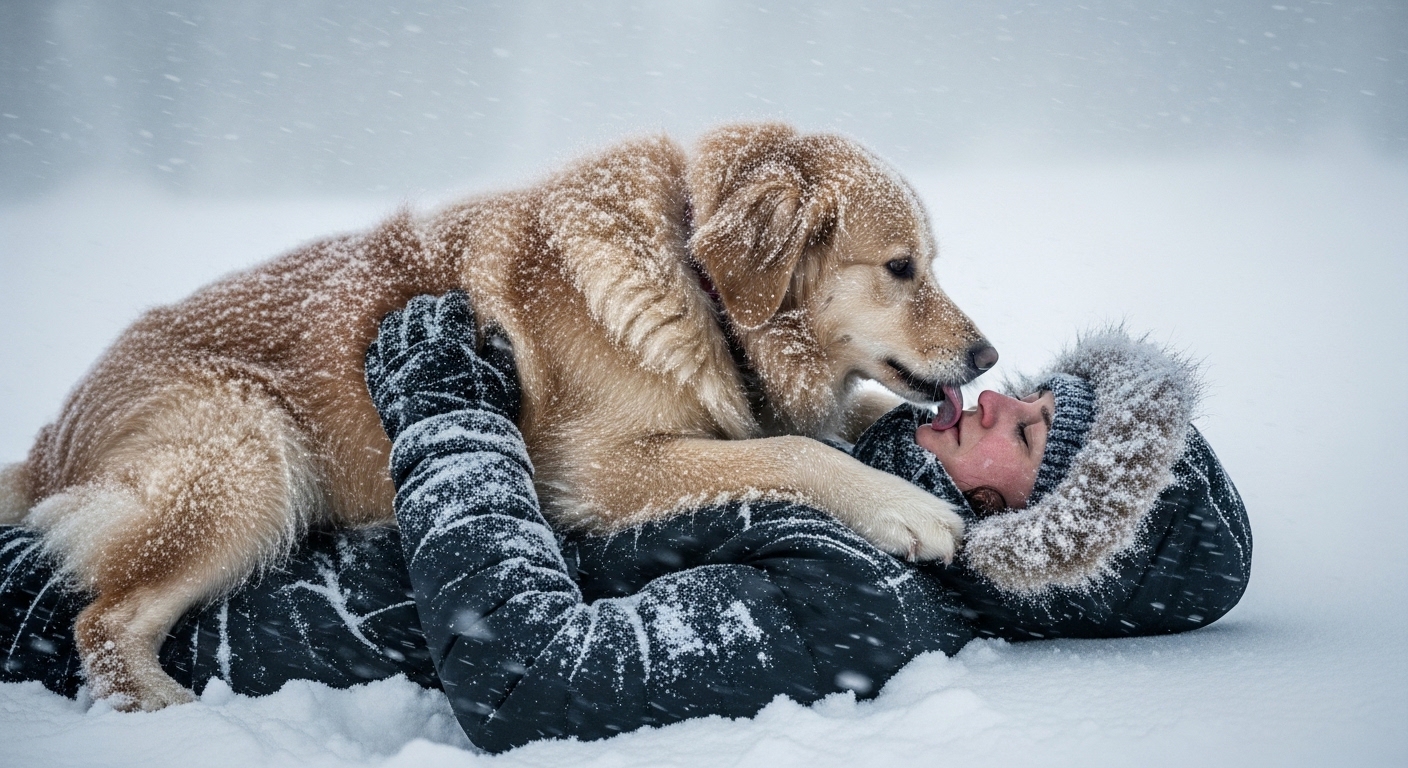
The gas stove was leaking silently while we slept, a deadly trap waiting for a single spark. My dog didn’t just bark; he pulled the heavy blankets off my bed and bit my arm until I woke up, coughing and dizzy. He saved the family that had almost abandoned him.
The appointment was set for 9:00 AM.
I had already packed his leash, his half-empty bag of kibble, and the chewed-up tennis ball he loved so much. My wife, Elena, couldn’t look at him without crying, and I couldn’t look at the scratched doorframes without feeling a surge of resentment. We called him a “problem dog.” We said he was too much for our quiet suburban life. We told ourselves that the local shelter was “no-kill” and he’d find a better home.
The truth? We were giving up on him because he was “inconvenient.”
But at 3:00 AM, the universe decided to test our definitions of inconvenience. While we slept, a faulty valve on our high-end gas stove failed. No smell, no sound—just a slow, invisible flood of methane filling our home, waiting for the furnace to click on and turn our American dream into a pile of ash.
Cooper didn’t have a voice to tell us we were dying. He didn’t have a “smart” sensor. He only had his teeth and a heart that didn’t care that we had signed his surrender papers ten hours earlier.
What happened in that dark bedroom didn’t just save my life; it forced me to realize that the one soul I was ready to throw away was the only one who stayed to fight for me.
Chapter 1: The Surrender Papers
The humidity of a Georgia summer always felt like a physical weight, but inside our air-conditioned colonial in the suburbs of Atlanta, the air was heavy for a different reason.
I sat at the kitchen island, the morning light glinting off the granite, staring at a single sheet of paper. It was the “Animal Relinquishment Form.” It was a cold, clinical document with boxes for things like Breed, Age, and Reason for Surrender.
“What are you going to check?” Elena asked, her voice thin. She was standing by the sink, clutching a mug of coffee that had gone cold.
“I don’t know,” I muttered. “Behavioral issues? Incompatibility?”
“He’s not a ‘behavioral issue,’ David. He’s just… intense,” she said, though her eyes drifted to the corner of the dining room where the wallpaper had been shredded six months ago.
Cooper, a seventy-pound Pitbull and Lab mix with ears that never quite decided which way to flop, was lying on the rug by the back door. He wasn’t sleeping. He was watching us, his head resting on his paws, his amber eyes shifting between me and Elena with a terrifying, human-like perception.
We had rescued Cooper two years ago, right after I got promoted to Senior Analyst. We wanted the dog, the yard, the whole picture-perfect suburban setup. But Cooper hadn’t read the script. He was a high-energy, high-anxiety wreck who barked at butterflies and had a habit of “herding” guests.
Then came the new baby. Little Leo was six months old now, and every time he cried, Cooper would pace and whine, his sheer size becoming a source of constant stress for Elena. We were tired. We were sleep-deprived. And in the logic of a failing marriage and a crying infant, the dog was the variable we could eliminate.
“The appointment is at nine tomorrow,” I said, my heart feeling like a lead weight. “Mark at the shelter said they have a spot. He’ll get adopted fast, Elena. He’s a good-looking dog.”
“He’s our dog,” she whispered, but she didn’t fight me. She was too exhausted to fight anyone.
I looked at Cooper. I had already packed his things into a plastic bin by the garage door. The leash we’d bought him on his first day. The expensive memory-foam bed he’d mostly ignored in favor of the floor.
I felt like a traitor. I felt like a coward. But I also felt a desperate, ugly need for the house to be quiet again.
As the sun set that evening, I took Cooper for one last walk around the block. I didn’t take my phone. I didn’t check the news. I just listened to the rhythmic thump-thump of his paws on the asphalt.
“I’m sorry, boy,” I whispered as we passed the community pool.
Cooper stopped and looked up at me, his tail giving a single, tentative wag. He didn’t know about the papers. He didn’t know about the bin by the door. He just knew that I was his person, and the air was warm, and he was happy to be moving.
We went home, I locked the front door, and I fed him a double portion of his favorite canned beef. A “last meal” for the dog who had done nothing wrong but love us too loudly.
I fell asleep that night thinking about the silence that would greet me tomorrow. I didn’t know that the silence had already started, and it was the deadliest thing in the house.
Chapter 2: The Scent of the Void
The suburbs of America are built on a foundation of “smart” safety. We have Ring cameras that tell us when the mailman arrives, Nest thermostats that learn our sleep cycles, and interconnected smoke detectors that can alert our phones from a thousand miles away.
We believe we are protected. We believe the machines are watching over us.
But at 2:45 AM, the “smart” detector in our kitchen—a high-end unit I’d paid three hundred dollars for—suffered a catastrophic hardware failure. A tiny soldering joint, weakened by a surge during a thunderstorm a week prior, finally snapped. The light remained green, signaling “All Systems Normal,” even as the air began to shimmer with an invisible, odorless poison.
A hairline fracture had opened in the iron pipe behind the stove. It was a slow leak, a rhythmic hiss that was swallowed by the hum of the refrigerator.
Natural gas doesn’t kill you with a bang—at least, not at first. It displaces the oxygen. It lulls you into a deeper, heavier sleep. It turns your dreams into a thick, lavender-scented fog that you never want to wake up from.
In the master bedroom, I was dreaming of being underwater. It was peaceful. The pressure was comforting. I saw Elena and Leo swimming above me, their faces blurred by the ripples.
But then, the water turned into fire.
Cooper, who slept on the floor at the foot of our bed, didn’t have a circuit board. He had an olfactory system with three hundred million receptors. To him, the air didn’t smell like peace. It smelled like the end of the world.
He stood up, his hackles rising. He walked to the bedroom door and sniffed the gap. He let out a low, guttural whine. The air in the hallway was already heavy.
He turned back to the bed. He nudged my hand, which was hanging over the edge of the mattress. I didn’t move. My breathing was already slowing, my heart rate dipping into the danger zone.
Cooper’s anxiety, the very trait I had complained about for two years, saved our lives. He didn’t just “alert.” He went into a combat-rescue mode that he had never been trained for.
He jumped onto the bed, his seventy pounds of muscle landing squarely on my chest. The impact forced the little oxygen I had left out of my lungs in a sharp ungh.
“C… Cooper… off,” I moaned, my head feeling like it was filled with wet wool.
He didn’t get off. He grabbed the corner of the heavy wool duvet in his teeth and backed up, his paws digging into the mattress. With a violent, snapping motion, he yanked the blankets off us. The sudden rush of cooler air against my skin should have woken me, but the methane was too thick.
Cooper looked at my face. He saw my eyes rolling back.
He didn’t have a choice. He leaned down and sank his teeth into my forearm.
The pain was a lightning bolt. It tore through the narcosis, shattering the lavender dream. I bolted upright, a scream of agony and confusion catching in my throat.
“YOU STUPID DOG!” I roared, clutching my bleeding arm.
I looked at Cooper, my vision swimming. He was standing on the bed, his lips curled, his eyes fixed on mine with a terrifying, primal intensity. He barked—a sound so loud and sharp it felt like it cracked the windows.
“Elena! Elena, wake up! The dog just bit me!”
But Elena didn’t move. She was pale, her mouth slightly open, her chest barely rising.
I reached for the bedside lamp and clicked it. It didn’t turn on. The gas had already begun to interfere with the electrical contacts, or maybe I was just too dizzy to find the switch.
I tried to stand, and my legs buckled. I hit the floor with a dull thud.
Cooper was off the bed in a second. He wasn’t biting now. He was nudging me, shoving his broad head under my shoulder, literally trying to hoist my weight up.
“David?” Elena’s voice was a whisper from the bed. “I… I can’t… the air… it’s so heavy.”
“Gas,” I choked out, the realization hitting me with the force of a freight train. “Elena, get Leo! Get the baby!”
I looked at Cooper. The dog I was going to abandon in five hours was currently the only reason I was awake enough to realize I was dying.
Chapter 3: The Extraction
The hallway was a tunnel of grey shadows. Every breath I took felt like I was inhaling liquid lead. My heart was thumping a frantic, irregular rhythm against my ribs—a “knocking” sound that seemed to echo in the house.
“Elena! Go to the window!” I gasped, grabbing the doorframe to keep from falling again.
I heard a muffled cry from the nursery. Leo. The baby was crying, but it was a weak, thin sound—the sound of a kitten in a well.
“I’ve got him!” Elena screamed. She had found a reserve of mother-adrenaline, stumbling toward the nursery with her hands out like a blind woman.
Cooper was the anchor. He stayed between me and Elena, his tail tucked but his body rigid. Every time one of us stumbled, he was there, a solid, warm pressure to lean on. He was barking now—not his usual “squirrel” bark, but a rhythmic, deep-chested alert that I realized later was intended to keep us conscious. The noise was too loud to sleep through.
I reached the kitchen. The smell of the mercaptan—that rotten egg additive—was finally overpowering. I could hear the hiss now. It sounded like a snake in the wall.
“Don’t turn on the lights!” I yelled, remembering a safety video from a decade ago. “Elena! No switches!”
One spark. One flick of a light switch or the furnace cycling on, and the house would become a bomb.
I fumbled for the sliding glass door to the deck. My fingers felt like wooden pegs. I couldn’t find the lock. I felt a wave of nausea so intense I had to drop to my knees.
“Cooper! Help!” I sobbed.
The dog didn’t understand the lock, but he understood the barrier. He threw his entire weight against the glass. Thud. Thud. The lock was sturdy, but the frame was aluminum. On the third hit, the latch snapped. The door slid open an inch, and the Georgia night air rushed in—humid, hot, and beautiful.
I grabbed the handle and shoved it wide.
I tumbled out onto the deck, gasping, my lungs burning as they finally found oxygen. Elena was right behind me, clutching Leo to her chest. We collapsed into the patio furniture, three shivering, terrified humans and one scarred dog.
Behind us, the house was a silent trap.
I pulled my phone out of my pocket—it had been there since I’d checked the time earlier—and dialed 911 with shaking fingers.
“Fire department,” I wheezed. “Gas leak. 114 Maple Drive. Please… hurry.”
As I hung up, I looked at my arm. The bite mark was deep, four puncture wounds oozing blood onto the cedar deck. It hurt like hell.
I looked at Cooper. He was sitting at the edge of the deck, his chest heaving, staring back at the open door. He looked like a soldier who had just finished a tour. He looked exhausted.
Elena reached out and touched the dog’s flank. “He knew, David. He knew before the sensors. He knew before we did.”
“I know,” I said, my voice cracking.
I looked at the garage door, where the plastic bin with his things was waiting. Ten hours from now, I was supposed to drive him to his end. I felt a surge of shame so visceral it made me want to heave.
“We almost killed him, Elena,” I whispered. “And he just saved us all.”
The sirens began to wail in the distance—a low, mournful sound that grew into a scream as the trucks turned onto our street. The neighborhood was waking up. Lights were flickering on in the houses across the street.
Chief Miller, a man who looked like he’d been carved out of old oak, was the first one up the driveway.
“Everyone out?” he roared, his flashlight cutting through the dark.
“Yes,” I said, standing up on shaky legs. “My wife, the baby, and the dog.”
Miller looked at my bleeding arm, then at the massive dog sitting next to me. He didn’t ask about the bite. He walked to the door, held up a gas meter, and swore.
“You guys shouldn’t be alive,” Miller said, looking back at us. “The saturation in there… it’s at the lower explosive limit. If your furnace had kicked on in the next five minutes, this whole block would be a crater.”
He looked at Cooper again. The dog let out a small, tired “woof.”
“Smart dog,” Miller muttered.
“No,” I said, pulling Cooper toward me, not caring about the blood or the grease on his fur. “He’s not smart. He’s the only one in this house with any damn sense.”
Chapter 4: The Aftershock
The morning of the appointment came, but the sun didn’t feel like a beginning. It felt like a witness.
We were staying at a dog-friendly Marriott ten miles away while the utility crews worked on our house. The gas had been shut off, but the lingering smell and the trauma meant we couldn’t go back yet.
I woke up at 8:00 AM. My arm was bandaged, throbbing with a dull, rhythmic heat. I looked at the bedside table. My car keys were there. The relinquishment papers were in the glove box of my SUV, which was still parked in our driveway.
Elena was in the kitchenette, warming a bottle for Leo. She looked at me, her eyes red-rimmed.
“It’s eight o’clock, David,” she said.
“I know.”
I looked at the floor. Cooper was sprawled out on the hotel carpet, his tail thumping against the leg of the desk. He looked perfectly at home. He didn’t know he was supposed to be a “problem.”
“Are you going to do it?” she asked. There was no judgment in her voice, only a profound, hollow exhaustion.
I didn’t answer. I walked to the window and looked out at the parking lot. I thought about the “Golden Hour.” I thought about the way the “smart” detector had failed. I thought about the fact that if I had succeeded in my plan a week earlier, there would be no one in that room to wake me up.
I picked up my phone and dialed the shelter.
“Blue Ridge Animal League, this is Mark,” the voice on the other end said. Mark was a guy I’d talked to three times—a man who sounded like he’d seen too many people give up.
“Mark, this is David Vance. I had an appointment for nine o’clock. For Cooper.”
“Right, David. We’re all set for you. Just bring the papers and the medical records.”
I looked at Cooper. The dog looked back at me, his head tilted.
“Cancel it,” I said.
There was a long silence on the other end. “Excuse me?”
“Cancel the appointment,” I said, my voice finally growing steady. “Cooper isn’t coming in. Not today. Not ever.”
“Is everything okay, Mr. Vance? We were under the impression that the situation was… untenable.”
“The situation changed,” I said. “The dog isn’t the problem. I was. I’ll send a donation for the spot we took up. But keep the cage empty, Mark. My partner is staying home.”
I hung up and felt a weight lift that I didn’t even know I was carrying. It wasn’t the relief of a quiet house; it was the relief of a man who had finally decided to be honorable.
I walked over to the desk, grabbed a pen, and tore the relinquishment form into a dozen pieces.
Elena walked over and put her hand on my shoulder. She didn’t say thank you. she just leaned her head against my back and let out a long, shuddering breath.
“So, what do we do now?” she asked.
“First,” I said, scratching Cooper behind the ears, “we buy this guy the biggest steak in Atlanta. And second, we start learning how to listen to him. Because he’s been trying to tell us something for two years, and we were too busy looking at wallpaper to hear him.”
But the redemption wasn’t a fairy tale. Our house was still a mess. Our marriage was still strained. And Cooper was still a high-strung mess who hated the mailman.
The real conflict was just beginning: the slow, agonizing process of rebuilding a life that had almost been snuffed out by our own neglect.
Chapter 5: The Weight of the Debt
Rebuilding a house is easy. You replace the pipes, you vent the rooms, you paint the walls.
Rebuilding a soul is much harder.
A week later, we moved back into the house. It smelled of fresh paint and ozone. I had replaced every sensor in the building with industrial-grade detectors. I checked the gas stove four times an hour. I was a wreck.
Every time Cooper barked, I jumped. Every time he whimpered, I ran to the kitchen. The trauma of the “Silent Killer” had left me with a hyper-vigilance that bordered on paranoia.
And Cooper knew it.
He didn’t sleep at the foot of the bed anymore. He slept right next to my side of the mattress, his body pressed against the frame. He had become my unofficial shadow.
The neighborhood was different now, too. The story of the “Hero Dog” had spread through the cul-de-sac. People who used to complain about Cooper’s barking now stopped by with bags of expensive treats. Sarah, the neighbor who had once called the HOA about Cooper’s “aggression,” brought over a hand-knit dog blanket.
“I’m sorry, David,” she said, standing on the porch. “I didn’t realize… I just thought he was a nuisance.”
“We all did, Sarah,” I said, looking at Cooper, who was currently sniffing her shoes with suspicious intensity. “We were all looking for something to blame for our own stress. He was just the easiest target.”
But the real test came a month later.
Elena’s mother, Martha, came to visit. Martha was a woman of “Old World” standards—she believed dogs belonged in the yard and babies belonged in sterilized environments. She had been the primary voice whispering in Elena’s ear that Cooper was a danger to Leo.
“I still don’t like it, David,” Martha said, sitting at the kitchen island, the very spot where I’d signed those papers. “He’s too big. He’s too unpredictable. What if he bites the baby next?”
I felt a surge of heat in my chest. “He bit me to save my life, Martha. There’s a difference.”
“He’s an animal! He doesn’t know ‘saving.’ He knows ‘reacting.’ You’re lucky he didn’t tear your throat out.”
I looked at Cooper. He was lying by the stove—the new, reinforced stove. He was looking at Martha with that same steady, amber gaze.
“You’re right, Martha,” I said, standing up. “He is an animal. He’s an animal that stayed in a house filled with poison when he could have jumped out a window. He’s an animal that fought for a family that didn’t even want him anymore. If that’s ‘reacting,’ then I wish more people ‘reacted’ like him.”
Martha didn’t stay long after that.
But as she left, I realized that the “debt” I owed Cooper was something I’d be paying for the rest of his life. And it wasn’t just about steak and walks. It was about being the kind of man who was worth saving.
I went to the garage and found the plastic bin with his old things. I pulled out the chewed-up tennis ball. It was dirty, covered in old slobber and teeth marks.
I walked into the backyard. “Cooper! Ball!”
The dog erupted with energy. He didn’t care about the gas leak. He didn’t care about the HOA. He didn’t care about the surrender papers. He just wanted to play.
As I watched him chase that ball across the grass, I realized that the “inconvenience” of his energy was actually the heartbeat of our home. We had tried to choose silence, not realizing that silence was the sound of a house dying.
I threw the ball again, higher this time.
“Good boy, Cooper,” I whispered. “Good, brave boy.”
Chapter 6: The New Command
Six months later, the Blue Ridge Animal League held their annual “Heroes Gala.”
Mark, the shelter worker, had called us a month earlier. They wanted to honor Cooper with the “Life-Saver Award.”
I didn’t want to go. I didn’t want to stand in a room full of people and be reminded of how close I had come to being a monster. But Elena insisted.
“He earned it, David,” she said, pinning a small bowtie onto Cooper’s new leather collar. “And maybe we need to say it out loud.”
The gala was in a hotel ballroom in downtown Atlanta. It was full of people who loved animals, people who had spent their lives saving the “discarded.”
When our names were called, I walked onto the stage with Cooper at my side. The lights were bright, the applause was deafening. Cooper, true to form, barked at the microphone.
I stood at the podium, my hand resting on his head. I looked at the crowd, then at Elena and Leo in the front row.
“Two hundred days ago,” I began, my voice echoing in the hall, “I sat in my kitchen and decided that this dog was an inconvenience. I decided that my comfort was worth more than his life. I looked at his anxiety and his energy and I saw a problem to be solved.”
The room went quiet.
“That night,” I continued, “a gas leak filled my home. My sensors failed. My ‘smart’ home was a tomb. And the ‘problem’ dog I was going to abandon the next morning was the only thing that refused to let the silence win. He bit me to wake me up. He broke the door to let in the air. He saved a family that had already signed his death warrant.”
I looked down at Cooper. The dog was sitting perfectly, his tail giving a rhythmic thump-thump against the stage floor.
“We like to think we rescue dogs,” I said, a single tear finally breaking through. “We like to feel like the heroes. But the truth is, most of the time, they’re the ones waiting for us to wake up. They’re the ones rescuing us from the versions of ourselves that have forgotten how to be loyal.”
I didn’t take a trophy. I took a deep breath.
When we got home that night, the house was quiet—but it was a good quiet. The “smart” detectors were all green, but I didn’t look at them. I looked at the dog.
I took off Cooper’s bowtie and his fancy collar. I sat on the floor of the living room, and for the first time in a long time, I just existed with him. No training. No “herding.” Just two survivors in a blue-shingled house.
Leo was sleeping in his crib upstairs. Elena was reading on the sofa.
Cooper rested his heavy head on my knee. He let out a long, contented sigh and closed his eyes.
I realized then that life isn’t about the absence of “inconvenience.” It’s about who you want standing by your bed when the air turns heavy. It’s about the scars that remind you that you’re still here.
I reached down and scratched the spot behind his ear—the one he can’t reach himself.
“Mission’s over, boy,” I whispered. “You’re home.”
The sun began to set over the Georgia pines, casting long, golden shadows across the lawn. The house was safe. The air was clear. And the dog?
The dog was exactly where he was meant to be.


