
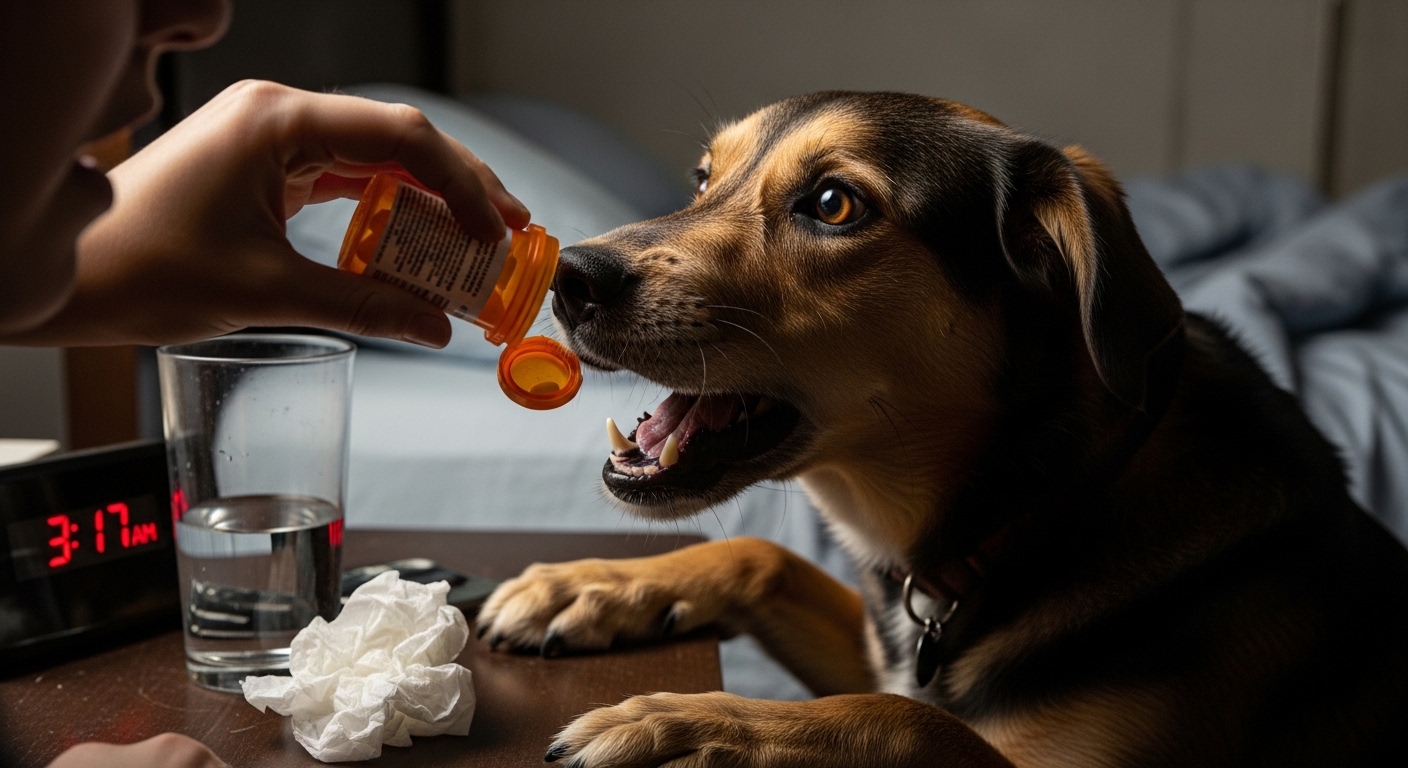
I adopted a “broken” rescue dog on Monday—by Sunday, he was the only thing standing between me and a shadow in an alleyway that wanted me gone.
The shelter worker told me he was “unreliable.”
He had scars on his muzzle and a notch missing from his left ear. They said he’d been found in a shipping container in the Port of Newark, and that he didn’t know how to be a “good boy.” I didn’t care. I felt just as broken as he looked. I brought him home, named him Shadow, and spent the first six days just trying to get him to look me in the eye.
Then came last night.
I was walking home from the late shift, taking the shortcut behind the old Miller’s warehouse. I didn’t see the man in the hoodie until his hand was over my mouth and I was being slammed into the brick.
I fought. I clawed. But I was losing. I saw the flash of a knife and I thought, This is it. This is where my story ends.
I forgot about the dog on the other end of the leash.
Shadow didn’t bark. He didn’t growl. He became a living weapon. What he did in that alleyway—the silent, deadly precision of his attack—wasn’t the work of a “broken” dog. It was the work of a guardian who had finally found someone worth protecting.
Chapter 1: The Port of Broken Souls
The suburbs of Northern New Jersey are a strange mix of manicured lawns and industrial decay. I live right on the edge of that divide, in an apartment that smells like the nearby coffee roasting plant and stale diesel. My name is Maya Thorne. A week ago, my life was a series of empty rooms and the crushing weight of a divorce that had stripped me of my confidence.
I went to the North Jersey Animal League on a rainy Monday, not because I wanted a pet, but because the silence in my kitchen was starting to scream.
“You don’t want that one, honey,” the volunteer had said, pointing to the back corner of the kennel row.
Cage 44 held a black dog that looked like a rough draft of a nightmare. He was massive—a Belgian Malinois and Lab mix, with muscles like knotted rope and a gaze that felt like it was scanning for threats rather than treats. He was still. Unnaturally still.
“That’s Shadow,” the volunteer continued. “Customs found him in a crate from overseas. No paperwork. No history. He’s reactive, silent, and he’s bitten two handlers who tried to corner him. He’s scheduled for ‘evaluation’ on Friday. You know what that means.”
I looked at the dog. He didn’t wag his tail. He didn’t whine. He just looked at me with amber eyes that held a cold, hard intelligence. He looked like a soldier who had seen too much and expected nothing.
“I’ll take him,” I said.
The first week was a cold war. Shadow wouldn’t sleep on the bed. He wouldn’t eat if I was in the room. He spent his hours lying by the front door, staring at the handle. He was a ghost in my house, a 80-pound enigma that made my friends nervous.
“Maya, that dog is going to turn on you,” my brother, Elias, had warned me over the phone. “He’s got ‘tactical’ written all over him. Who knows what he was trained for?”
I ignored him. I liked the company of a fellow survivor.
On Sunday night, I was walking him home from my double shift at the diner. The rain was a fine, cold mist. I decided to take the shortcut behind the Miller’s Creek warehouse—a choice I will regret for the rest of my life.
The streetlights were out. The only sound was the rhythmic click-click of Shadow’s claws on the pavement.
Suddenly, a shadow detached itself from the brick wall.
A hand—gloved and smelling of stale cigarettes—clamped over my mouth. I was hoisted off my feet and slammed into the rough, freezing brick of the alleyway.
“Don’t make a sound, princess,” a voice hissed in my ear. “Give me the purse and keep your mouth shut, or I’ll open you up right here.”
The cold steel of a blade pressed against my neck. I felt my heart hammer against my ribs like a trapped bird. My vision blurred with tears of pure, animalistic terror. I tried to kick, but he pinned me with his weight.
I had forgotten I was holding the leash.
I didn’t hear a growl. I didn’t hear a bark. All I heard was the sound of air being displaced and the sickening thud of muscle hitting bone.
Chapter 2: The Silent Strike
The transition was so fast it didn’t feel real.
One second, the man had his weight on me. The next, he was gone.
Shadow hadn’t lunged like a normal dog. He had launched himself with a terrifying, calculated grace. He didn’t go for the legs. He went for the man’s throat and shoulder. There was no snarling—just a low, guttural vibration that I felt more than heard.
The man let out a high-pitched shriek as he was torn away from me. He hit the wet asphalt hard. Shadow stayed on him, his jaws locked on the man’s jacket sleeve and the meat of his arm, shaking him with a violent, mechanical efficiency.
“Get it off! Kill it! Kill the damn dog!” the mugger screamed, his bravado replaced by a primal, frantic fear.
The man managed to swing his free hand, the knife glinting in the dim light of a distant neon sign. He slashed at Shadow’s side.
I found my voice. “Shadow! No! Get back!”
The dog ignored the blade. He shifted his grip, his teeth snapping inches from the man’s face. The mugger, realizing he was fighting something that didn’t fear pain, scrambled backward, kicking out wildly. He managed to break free, leaving his torn hoodie sleeve in Shadow’s mouth.
He didn’t look back. He ran toward the street, his boots splashing through the puddles, his screams fading into the city’s hum.
The alley went dead silent.
I was slumped against the wall, my chest heaving, my throat raw from the man’s grip. I looked at Shadow.
The dog didn’t chase the man. He didn’t bark into the night. He stood five feet away, his hackles raised, his head low. He looked at me. The amber eyes weren’t cold anymore. They were searching.
“Shadow?” I whispered, my hand reaching out, trembling.
He walked toward me, his “warrior” stance melting away. He nudged my hand with his wet, cold nose. He tasted like rain and copper.
Then I saw the red.
The mugger’s knife had found its mark. A long, jagged cut ran down Shadow’s flank, and blood was beginning to soak into his black fur.
“Oh god, you’re hurt,” I sobbed, pulling him into my arms.
For the first time since I’d met him, the dog did something human. He let out a long, shuddering sigh and rested his heavy head on my shoulder. He had saved me from the dark, and in doing so, he had finally let the light in.
I didn’t call the police first. I called Elias.
“Get your truck,” I told him, my voice finally steady. “I need to get my partner to the vet.”
Chapter 3: The Ghost in the Waiting Room
The 24-hour emergency vet in Oak Creek smelled like industrial floor wax and the quiet, desperate hope of people who love things that can’t speak.
I sat in a hard plastic chair, my trench coat stained with a mix of Shadow’s blood and the alleyway’s grime. Elias sat next to me, a cup of lukewarm coffee in his hand, staring at the floor.
“The vet said it was deep, Maya,” Elias whispered. “But he didn’t hit anything vital. The dog’s built like a tank.”
“He didn’t make a sound, Elias,” I said, my voice shaking. “Even when he got stabbed. He just… handled it. Like he’d done it a thousand times before.”
Elias looked at me, his eyes grave. “That’s what I’m worried about. Where does a dog learn to fight like that? That wasn’t a rescue mutt defending his owner. That was a trained apprehension. Maya, you have a professional-grade weapon in your living room.”
The door to the surgical wing swung open. Dr. Aris, a woman who looked like she’d survived a thousand long nights, walked toward us.
“He’s stitched up,” she said, wiping her hands. “Twelve stitches. He’s sedated, but he’s awake. And Maya? He wouldn’t let the tech near him until I let him see your coat. He smelled you and finally laid down.”
“Can I see him?”
She hesitated. “There’s something else. When I was prepping him for the stitches, I found something under his fur. On the inside of his hind leg.”
She led me into the back. Shadow was lying on a padded mat, his flank wrapped in white gauze. He looked small for the first time—vulnerable. But as soon as I entered the room, his head snapped up. His tail gave a single, heavy thump against the floor.
Dr. Aris pointed to his leg. “Look.”
Parted by a surgical razor, a small, faded tattoo was visible on the skin. It wasn’t a name or a heart. it was a series of numbers and a stylized eagle.
“It’s a military serial number,” Aris said softly. “Probably K9 Unit. He’s not a stray from overseas, Maya. He’s a veteran. And from the look of the scars on his chest… he’s been through a lot more than just a crate.”
I knelt by him, burying my face in the fur of his neck. He smelled like antiseptic now, but the heat of his body was the most grounding thing I’d ever felt.
“They abandoned him,” I whispered. “They used him and they threw him away in a shipping container.”
Shadow licked my ear—a slow, deliberate gesture.
He hadn’t been “unreliable” at the shelter. He had been “off-duty,” waiting for a command that made sense. And in that alleyway, he’d finally found his mission. He wasn’t guarding a port or a perimeter anymore. He was guarding me.
Chapter 4: The Shadow of the Past
The week following the attack was a transformation.
I wasn’t the same woman who had walked into that alleyway. I moved with a new kind of awareness, my shoulders back, my eyes scanning the streets. And Shadow? He was no longer a ghost in my house. He was the heartbeat.
He slept at the foot of my bed now, his head always pointed toward the door. We had a rhythm—morning walks by the docks, long evenings on the couch. He was still silent, but it wasn’t a cold silence. It was the silence of a partner who didn’t need words.
But the “Central Conflict” of our lives wasn’t over. It was just changing shape.
A man named Captain Miller showed up at my door on Thursday. He was tall, wearing a crisp uniform that made me want to hide Shadow in the bedroom.
“Maya Thorne?” he asked, his voice a practiced, military baritone. “I’m with the Department of Defense’s K9 Recovery Program. We received a notification from a vet clinic regarding a registered serial number.”
My heart stopped. “You can’t have him.”
“Mr. Thorne, that dog—designated ‘Asset 704’—is government property. He was lost during a transfer in Eastern Europe eighteen months ago. We’ve been searching for him.”
“You lost him in a crate!” I shouted, the rage bubbling up. “He was starving! He was scheduled to be put down because he was ‘unreliable’! Where were you then?”
Miller’s face didn’t change, but his eyes softened a fraction. “The paperwork was a disaster. But Asset 704 is a highly trained specialist. In the wrong hands, he’s a liability. In the right ones, he’s a hero. We’re here to bring him back to the facility for ‘rehabilitation.'”
Shadow appeared in the hallway. He didn’t growl. He just stood there, looking at Miller.
Miller froze. He recognized the dog’s stance—the tactical readiness. “He looks… different,” the Captain whispered.
“He’s not an asset,” I said, stepping between the man and the dog. “His name is Shadow. And he’s not going back to a kennel. He already served his time. Now, he’s living his life.”
“I have the authority to seize him, Maya.”
“And I have a lawyer,” I lied, though I knew Elias would find me one by sundown. “And I have the local news on speed dial. Do you really want the headline to be: ‘Army Tries to Re-Kidnap Hero Dog Who Saved Woman From Murder’?”
Miller looked at the dog, then at the stitches on his flank, and finally at me. He took a long, slow breath.
“He saved you?”
“He did more than save me,” I said. “He chose me.”
The Captain stood in the doorway for a long time. Then, he reached into his pocket and pulled out a small, brass coin—a challenge coin with the same eagle tattoo that was on Shadow’s leg. He set it on the hallway table.
“Tell the vet to update his records to ‘Retired with Honor,'” Miller said. “And Maya… if he ever stops watching the door, it means he’s finally home. Keep him that way.”
He turned and walked away. I closed the door and leaned against it, my legs feeling like jelly.
Shadow walked over and sat on my feet. He looked at the brass coin, then at me. He gave a single, happy wag of his tail—the first one I’d ever seen.
The war was finally over. The soldier was retired.
Chapter 5: The Final Watch
Six months later, the alleyway behind Miller’s warehouse was just a place I walked past on my way to the park.
The “Old Wound” of my divorce had healed, replaced by a life that was full of purpose. I’d started volunteering at the shelter, helping the “unadoptable” dogs find their rhythms. I used the things Shadow had taught me: patience, silence, and the knowledge that every soul has a story that doesn’t involve a cage.
Shadow was a local celebrity. The kids in the park called him “The Shadow Guard.” He still didn’t bark at squirrels, and he still walked with a slight hitch in his gait where the knife had been, but he was at peace.
On a warm Saturday in October, I took him back to the docks. Not to a shipping container, but to the pier where the sun hit the water in shades of liquid gold.
We sat on a bench, watching the tugboats move through the harbor. I looked at the dog by my side—the “broken” rescue that everyone had laughed at or feared.
“You’re a good boy, Shadow,” I whispered.
He didn’t look at me. He was busy watching a group of seagulls. But he leaned his heavy weight against my leg, a solid, warm anchor.
Suddenly, I saw a man walking toward us. He was wearing a dark hoodie, his hands in his pockets.
For a split second, the old panic flared. My breath hitched. I felt the brick wall against my back again.
Shadow’s ears pricked. He stood up. He didn’t lunge. He didn’t attack. He just moved into the space between me and the man, his eyes locked on the stranger’s movements.
The man walked past us, nodding a polite “Good afternoon.”
Shadow watched him until he was fifty yards away. Then, he turned back to me. He let out a long, contented huff and lay back down, resting his head on my shoes.
I realized then that the fear would always be there, a shadow of its own. But I would never have to face it alone.
I reached down and scratched the spot behind his scarred ear—the one he always leaned into.
“Ready to go home, partner?” I asked.
He barked—a single, clear, joyful sound that echoed over the water. It was the first time I’d ever heard his voice.
It was the most beautiful thing I’d ever heard.
Chapter 6: The Legacy of the Silent
They say that when you adopt a dog, you save a life.
But as the sun set over Northern New Jersey, casting long, golden shadows across the pavement, I knew the truth was much deeper.
I hadn’t saved Shadow. I had just provided the clearing where he could save himself. And in doing so, he had reached into the wreckage of my own heart and pulled me out of the rubble.
We walked home together, the woman and the dog, two survivors who had finally found the one thing the world had tried to take from them: a place where they belonged.
Shadow walked at my heel, no longer watching for threats, but simply enjoying the scent of the evening air. He was a veteran of many wars, some of which I would never know the names of. But tonight, his only duty was to be my best friend.
And as we reached the front door of our apartment, I saw the reflection of us in the glass. I didn’t see a broken woman or a dangerous dog. I saw a pack.
I saw a future.
True loyalty isn’t found in the absence of scars; it’s found in the courage to stay even after you’ve seen the dark.


