CHAPTER 1: THE SOUND OF THE BOOT
The neighborhood of Willow Creek didn’t usually have “problems.” We had blue-ribbon lawns, HOA meetings about mailbox colors, and a silence that we all mistook for peace. But at 114 Sycamore, the silence was a lie.
I’m Clara. I’ve lived on this street for forty years, and I’ve seen the way people treat things they think nobody is looking for. Rick Vance was one of those people. He was twenty-four, lived in his parents’ basement, and had a heart made of cold ash.
For months, he had a dog. He called it “Trash.”
He was a Pit-bull mix, though you could barely tell because he was mostly just skin stretched over a frame of clicking bones. Rick kept him chained to a rusted engine block in the side yard. No doghouse. No bowl that wasn’t tipped over. Just the mud.
Today was the worst. It had rained for three days, and the yard was a swamp. The dog was lying on his side, his ribs pumping like a broken bellows. He was gasping, his tongue blue, his eyes rolled back in his head.
Rick and his two buddies were out there, standing on the only patch of dry grass, laughing.
“Check this out,” Rick said, his voice carrying over my fence. He stepped into the mud and used his heavy steel-toed boot to shove the dog’s hindquarters. “Hey! Wake up, you piece of junk! Don’t die on my clock.”
The dog didn’t even have the strength to whimper. He just slid through the muck, a wet, heavy sound that made my stomach turn into a knot of hot lead.
“He’s barely moving, Rick,” one of the guys said, chuckling. “Maybe he needs a jump-start.”
I stood at my window, my hand on the phone, my heart hammering against my ribs. I’d called Animal Control three times. They said they were “backlogged.” I’d called the police. They said as long as the dog had “access to the outdoors,” their hands were tied.
I was just an old lady. I was invisible.
Rick raised his boot again, aiming for the dog’s ribs. I closed my eyes, waiting for the sound of breaking bone.
But I didn’t hear a thud.
I heard a roar.
It wasn’t a car. It wasn’t the wind. It was a low-frequency vibration that started in my teeth and moved down to my toes. It sounded like the earth itself was opening its mouth to scream.
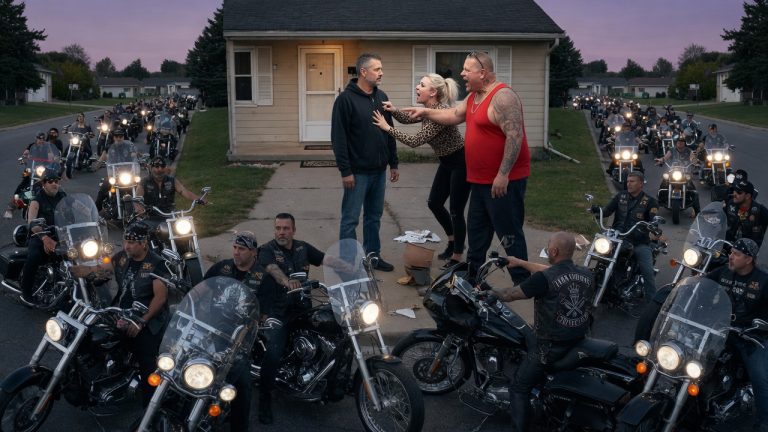
I opened my eyes and looked down the street. A wall of chrome was moving toward us. Twenty motorcycles, black as oil, their headlights cutting through the grey afternoon light like the eyes of vengeful gods.
They didn’t slow down for the stop sign. They didn’t slow down for Rick’s driveway.
They swerved as one, a coordinated wave of steel and leather, and tore right onto Rick’s lawn, their tires churning up the grass he’d spent so much time bragging about.
The laughter in the yard died instantly. Rick stood there, his boot still raised in the air, looking like a statue of a coward caught in the act.
CHAPTER 2: THE SHEPHERDS OF THE SHADOW
The engines didn’t just stop; they snarled one last time before clicking into a heavy, metallic silence. The silence that followed was heavier than the noise. It was the kind of quiet that happens right before a lightning strike.
Rick Vance was no longer the big man on the block. He stood in the mud, his face draining of color until he looked as grey as the overcast sky. His two friends were already backing away, their hands raised in a pathetic, universal gesture of “I’m not with him.”
The lead biker was a man who looked like he had been forged in a furnace. He was easily six-foot-four, his arms covered in intricate tattoos of wolves and weeping angels. On the back of his leather vest was a large, embroidered patch: THE IRON SHEPHERDS – EST. 1994.
His name was Jax. I knew of him—everyone in the county did. They were the guys who showed up when the system failed. They were the guys who didn’t care about HOA rules or property lines when a life was on the line.
Jax didn’t say a word at first. He just looked at the dog.
He saw the mud. He saw the gasping lungs. He saw the boot-print on the dog’s flank.
The air pressure in the neighborhood seemed to drop. Jax stepped off his bike. He didn’t use the kickstand; he just let the massive machine lean against his thigh as he adjusted his gloves.
“Rick, right?” Jax’s voice was a low, gravelly rasp.
“I… I have rights,” Rick stammered, his voice two octaves higher than it had been seconds ago. “This is private property. You’re trespassing. I’ll call the cops!”
“The cops?” Jax took a step forward, his heavy boots squelching in the mud. He didn’t stop until he was six inches from Rick. Jax was so much larger that Rick had to crane his neck back to look him in the eye. “That’s funny. Because we’ve been talking to the cops. And the animal warden. And the DA. They all seem to think you’re a real model citizen, Rick.”
Jax reached out and tapped the “Shepherd” patch on his chest. “But we don’t work for the county. We work for him.” He pointed a finger down at the dog.
The dog, whom Rick called Trash, let out a wet, rattling cough. A small bubble of bloody foam appeared at the corner of his mouth.
“He’s dying, Rick,” Jax said, his voice dropping to a whisper that was more terrifying than a shout. “And you’re laughing. Why are you laughing, Rick? Is it funny? Do you want me to laugh too?”
Jax looked at his twenty brothers. They were all standing by their bikes, a wall of muscle and silent fury.
“Hey, boys!” Jax called out, never taking his eyes off Rick. “Is this funny?”
“Not funny, Jax,” twenty voices rumbled in unison.
Rick’s knees actually buckled. He sank into the mud, the very muck he’d forced that dog to live in. “It’s just a dog! It’s just a stray I found! I was trying to help it!”
“Help it?” Jax reached down and grabbed Rick by the front of his “Varsity” hoodie. He didn’t lift him off the ground, but he made sure Rick felt the strength in his grip. “You were using him for target practice. You were pushing him around because he couldn’t push back.”
Jax let go, and Rick fell backward into the mud.
“Big Mike,” Jax barked.
A man the size of a refrigerator stepped forward, carrying a set of industrial bolt cutters. He didn’t look at Rick. He walked straight to the engine block.
SNAP.
The sound of the chain breaking was like a gunshot. For the first time in three years, the dog was untethered. But he didn’t run. He couldn’t. He just lay there, his eyes searching for the next blow.
“He’s not ‘Trash’ anymore,” Jax said, turning his back on Rick as if the man didn’t even exist. “His name is Lazarus. And he’s going home.”
FULL STORY
CHAPTER 3: THE WEIGHT OF THE PATCH
I watched from my porch, tears streaming down my face. I wasn’t the only one. Old Man Silas from three doors down was standing on his lawn, his cane trembling. Kelly, Rick’s own sister, had come out of the house, her face buried in her hands.
The Iron Shepherds didn’t just take the dog and leave. That wasn’t their way. They understood that a rescue is only half the battle; the other half is making sure the predator knows he’s being watched.
Jax knelt in the mud. He didn’t care about his expensive leathers or the dirt. He reached out and gently slid his hand under the dog—Lazarus—lifting him with a tenderness that seemed impossible for a man of his size.
Lazarus was so light. He looked like a bundle of sticks wrapped in wet velvet.
“Easy, buddy,” Jax whispered. “I got you. You’re done with the mud. I promise.”
As Jax carried the dog toward a specialized sidecar on one of the bikes, the rest of the club began to move. They didn’t leave the yard. Instead, they began to systematically dismantle the “trash” Rick had accumulated.
They picked up the rusted engine block and tossed it into the back of Rick’s own pickup truck with a deafening thud. They gathered the empty beer cans and the rotting scraps of food.
“You like a dirty yard, Rick?” one of the bikers, a man they called ‘Sarge,’ asked. “Because from now on, every time we see a piece of trash on this lawn, we’re going to assume it’s yours. And we’re going to bring it back to you. Inside your house.”
Rick was sobbing now, a pathetic, hiccuping sound. “You can’t do this! I’ll sue!”
“Sue who?” Jax asked, looking back as he secured Lazarus into the sidecar, which was lined with warm, dry blankets. “We aren’t a business, Rick. We’re a family. And we have a lot of cousins.”
Just then, a police cruiser pulled into the cul-de-sac. It was Officer Miller. I knew him; he was the one who had told me his “hands were tied.”
He stepped out of the car, looking at the twenty bikers and the sobbing man in the mud. He looked at the dog in the sidecar.
Officer Miller sighed, adjusted his belt, and looked at Jax.
“Everything alright here, Jax?” Miller asked.
“Just cleaning up the neighborhood, Jim,” Jax said, his voice neutral. “Found some abandoned property. We’re taking it to a specialized facility.”
Miller looked at Rick. “Rick, you want to file a complaint? I see you’re sitting in the mud. Did these men assault you?”
Rick looked at Jax. Then he looked at the twenty other men who were staring at him with eyes that held no mercy. He looked at the bolt cutters in Big Mike’s hand.
“N-no,” Rick whimpered. “I fell. I just… I fell.”
“That’s what I thought,” Miller said. He turned back to his car. “I’d get inside if I were you, Rick. Looks like it’s going to rain harder.”
As the cruiser pulled away, I realized that the “hands were tied” excuse had been a lie. The system hadn’t been unable to help; it had been waiting for someone with enough courage to make the system look the other way while justice was served.
Jax walked over to my fence. He looked at me, and for a second, the hardness in his eyes softened.
“You the one who’s been calling the warden, ma’am?”
“Yes,” I whispered. “For months. I’m so sorry I couldn’t do more.”
“Don’t be sorry,” Jax said. “You were his only friend for a long time. You kept him alive by caring. We just finished what you started.”
He handed me a small business card. It was black with a silver wolf on it. THE IRON SHEPHERDS – WE HEAR THE WHIMPERS.
“If he gives you any trouble,” Jax said, nodding toward Rick, “you call that number. We’ll be back before the second ring.”
FULL STORY
CHAPTER 4: THE SHADOWS OF THE PAST
The weeks following the “Roar” were the quietest Willow Creek had ever been. Rick Vance didn’t come outside. His parents eventually moved him to a relative’s house three states away, unable to deal with the “bikers” who seemed to cruise past their house at exactly 10:00 PM every single night.
But the story of Lazarus was just beginning.
I visited the Iron Shepherds’ clubhouse a month later. It was a converted warehouse on the edge of town, surrounded by a high chain-link fence. But inside, it wasn’t a den of iniquity. It was a sanctuary.
There were four other dogs there, all rescues. And in the center of the room, lying on a massive orthopedic bed, was Lazarus.
He didn’t look like the same animal. His fur was starting to grow back—a beautiful, brindled coat of chocolate and gold. He’d put on twenty pounds. But the most striking change was his eyes. They weren’t rolled back in pain anymore. They were clear, bright, and fixed on Jax.
Jax was sitting on the floor next to him, cleaning a spark plug. Every few seconds, Lazarus would reach out a paw and tap Jax’s leg. Jax would stop what he was doing and scratch the dog behind the ears.
“He’s got a long way to go,” Jax told me, offering me a seat on a stool. “His lungs are scarred from the pneumonia he caught in that mud. He’ll always have a bit of a rattle when he breathes. And his back legs… Rick did some damage there. Nerve endings are shot.”
“Will he ever walk normally?” I asked.
“Maybe not,” Jax said, his face hardening as he mentioned the bully. “But he’ll never have to walk away from a boot again. That’s the trade-off.”
I learned then why Jax cared so much. He told me about his father—a man very much like Rick, only with a badge and a bottle. Jax had spent his childhood in the mud, metaphorically speaking, until he was old enough to ride away.
“People think these dogs are ‘trash’ because they’re broken,” Jax said, his voice thick with emotion. “But they aren’t broken. They’re just waiting for someone to put the pieces back together. Just like us.”
He told me about the club’s mission. They didn’t just rescue animals; they rescued people. They worked with local domestic violence shelters, providing “escorts” for women moving out of dangerous homes. They stood guard at funerals for children who had been bullied to the point of no return.
The Iron Shepherds weren’t a motorcycle club. They were a rebellion against the idea that the weak are meant to be shoved.
As I sat there, Lazarus suddenly stood up. It was a slow, shaky process. His back legs wobbled, and his breath was heavy. But he hobbled over to me and rested his chin on my knee.
He remembered me. He remembered the woman who had watched him through the fence and whispered to him when the boots weren’t around.
I burst into tears, burying my face in his soft fur.
“He knows, Clara,” Jax said softly. “He knows who stayed.”
FULL STORY
CHAPTER 5: THE FINAL CONFRONTATION
Just when we thought the peace would last, the “trash” decided to push back one last time.
Rick Vance’s father, a man with a lot of money and a very small soul, filed a lawsuit against the Iron Shepherds for “theft of property” and “emotional distress.” He claimed the dog was a valuable breeding animal and that the club had “extorted” it from his son.
The day of the hearing, the courthouse was packed. Mr. Vance sat at the plaintiff’s table, looking smug in a three-thousand-dollar suit. He had a lawyer who looked like he’d never stepped in mud in his life.
“The Iron Shepherds are nothing more than a vigilante mob,” the lawyer argued. “They used intimidation and the threat of violence to steal a family pet. This is a nation of laws, not leather.”
I was called to the stand. I was terrified. Mr. Vance stared at me with a look that said I was just as “trash” as the dog.
“Mrs. Clara,” the lawyer said, stepping toward me. “Did you see any of these men strike Rick Vance?”
“No,” I said, my voice trembling.
“Did you see them brandish weapons?”
“I saw bolt cutters,” I said.
“To steal property,” the lawyer sneered. “Now, tell me, was the dog really in ‘danger,’ or was it just a messy yard? Are you an expert in veterinary medicine?”
I looked at Jax, who was sitting in the front row. He wasn’t wearing his vest today. He was wearing a clean black shirt, but his tattoos were still visible. He gave me a tiny, imperceptible nod.
“I’m not an expert in medicine,” I said, my voice growing stronger. “But I’m an expert in Willow Creek. I’ve lived there for forty years. And I know the sound of a living thing giving up. I heard that dog gasping for air. I saw a young man use his boot to shove a dying creature because it gave him a sense of power. If that’s ‘property,’ then your laws are broken.”
The room was silent.
Then, the back doors of the courtroom opened.
Big Mike walked in, leading Lazarus on a leash. The dog was wearing a small vest that said SERVICE ANIMAL IN TRAINING.
The judge, a stern woman who had seen the worst of humanity, leaned over her bench. She watched as Lazarus walked down the aisle. He limped. His breath was audible—that soft, tragic rattle.
But when he got to the front of the room, he stopped. He looked at Rick, who was sitting behind his father.
Lazarus didn’t growl. He didn’t bark. He just stood there and stared at the man who had shoved him into the mud.
Rick turned away. He couldn’t look the dog in the eye.
The judge looked at the photos the club had taken the day of the rescue—the bloody foam, the ribs, the chain. She looked at the vet records showing the permanent lung damage.
She looked at Mr. Vance.
“Mr. Vance,” the judge said, her voice like ice. “You are suing for the return of this ‘property’?”
“It’s the principle of the thing,” Vance blustered.
“The principle,” the judge repeated. “The principle I see here is a total lack of humanity. I am dismissing this case with prejudice. Furthermore, I am forwarding these records to the District Attorney’s office for a full investigation into felony animal cruelty charges against your son. And I suggest you leave my courtroom before I find you in contempt for wasting the state’s time with your arrogance.”
The Iron Shepherds didn’t cheer. They just stood up, as one, and walked out.
Justice wasn’t a roar this time. It was a gavel.
FULL STORY
CHAPTER 6: THE SILENCE WE CHOOSE
A year has passed since the mud was cleared from 114 Sycamore.
The Vance house is for sale. No one wants to buy it. People say the yard feels “heavy,” but I think it feels like a lesson.
I’m sitting on my porch now, watching the sunset. I have a guest today. Lazarus is lying at my feet, his head resting on my shoes.
Jax and the club realized that while they could give him a home at the clubhouse, Lazarus needed a yard. A real yard. One with a fence he could see through, and a neighbor who would never, ever let him go hungry.
He’s mine now. Or rather, I am his.
His breathing is still a bit loud, a rhythmic reminder of the price he paid for our neighborhood’s silence. But he’s happy. He likes to chase the squirrels, even if his back legs don’t always cooperate. He likes the way I cook chicken livers.
Every Friday, the roar of twenty Harleys echoes through Willow Creek. They aren’t here to rescue anyone today. They’re just checking in.
They pull up to my curb, and twenty “tattooed giants” get off their bikes. They come into my yard, and they sit on the grass with Lazarus. They bring him toys, and they bring me stories of the other souls they’ve pulled out of the mud.
Willow Creek is still quiet. But it’s a different kind of quiet now. It’s the quiet of people who know that someone is looking. It’s the quiet of a community that realized we are all responsible for the “trash” the world tries to forget.
I look down at Lazarus, and he looks up at me, his amber eyes full of a peace that was once impossible.
I think about the night the engines roared. I think about the moment the chain snapped.
And I realize that the world is full of Rick Vances. It’s full of people who think that because something is chained, it has no soul.
But as long as there are people willing to ride into the mud, as long as there are people willing to break their silence, the bullies will never truly win.
Lazarus lets out a long, contented sigh and closes his eyes. He’s safe. He’s loved. He’s home.
Because the roar of a thousand engines is nothing compared to the sound of a heart finally learning it doesn’t have to be afraid.